Ezekiel 13:7

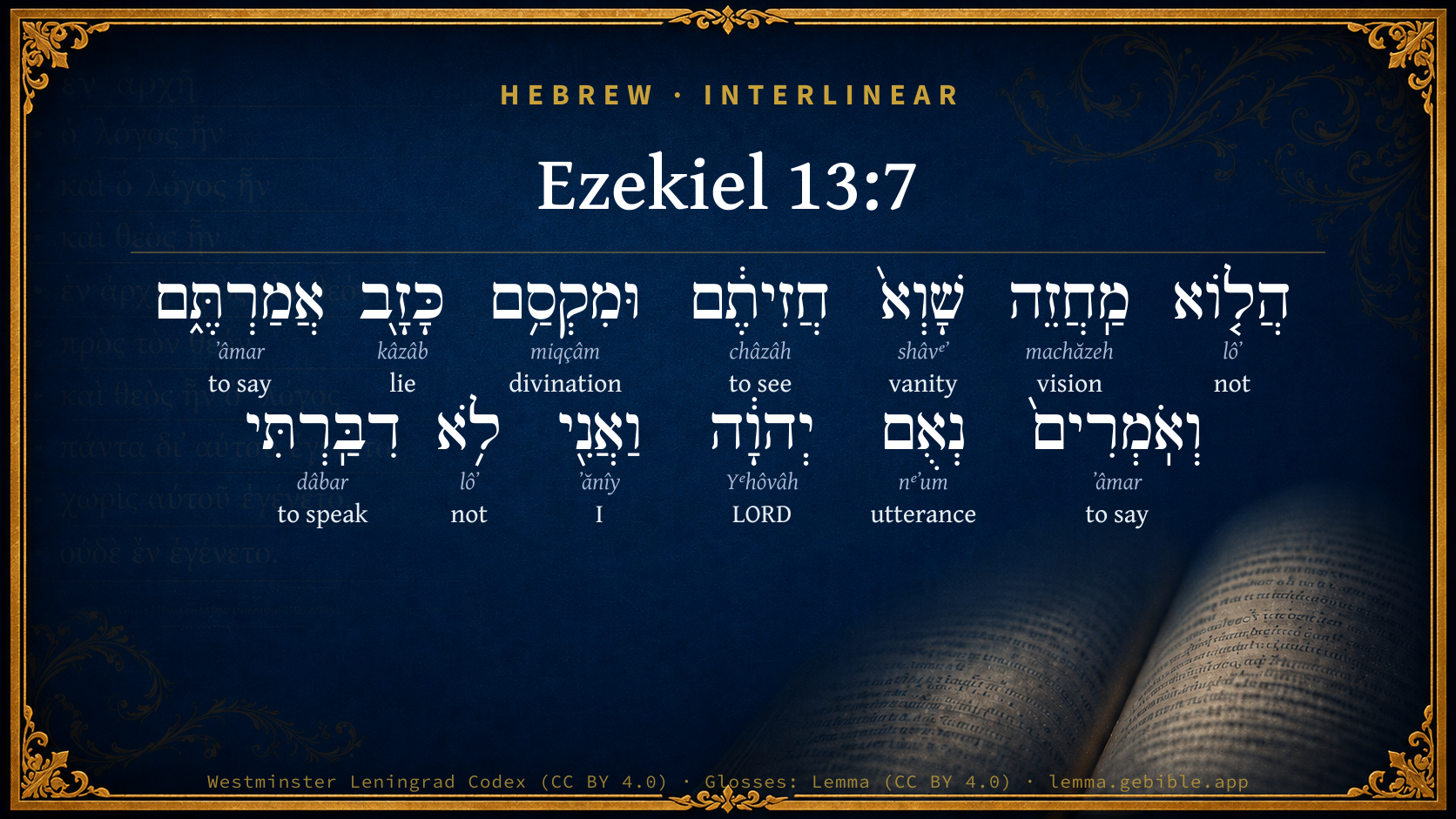
Hebrew (Westminster Leningrad Codex) Ezekiel 13:7 appears in the Hebrew Old Testament. The text above is from the Westminster Leningrad Codex. Each word links to its Strong’s number, a concise gloss, and parsing drawn from the Open Scriptures Hebrew Bible morphology. Click any word for its full Brown-Driver-Briggs (BDB) entry.
Download image
Cite this verse

Ezekiel 13:7 (World English Bible). Public Domain. Lemma interlinear Bible study tool, https://lemma.gebible.app/v/ezekiel/13/7.

Show BibTeX & RIS
BibTeX
RIS
English Translation
Haven't you seen a false vision, and haven't you spoken a lying divination, in that you say, Yahweh says; but I have not spoken?
World English Bible · Public Domain
Download a study sheet

One document with this verse’s original text, its word-by-word gloss line, the meaning frame, cross-references with their text, attributed commentary, and full source and license credits — printable, and it pastes into notes with its structure intact.

This verse Autodidact and up

Study sheet (.html) Plain text (.txt)

A passage Seminary Student

Up to 50 verses in one chapter. A passage sheet keeps up to 6 commentary sources and 12 cross-references per verse, in the order this page ranks them, and says so on the sheet whenever that leaves anything out. Ask for a single verse and you get the Autodidact verse sheet above.

Everything on this page stays free to read, with no account — the sheet is a download of what is already on screen, not access to it.

Want to remove ads? Support Godless Engineer
Compare translations 3

The same verse in 3 English versions, stacked beneath the original-language interlinear above. Click any original word for its lexicon entry.

Each is an independent rendering of the whole verse — the interlinear is not word-aligned to these translations.

Highlighted words mark where these versions differ — a whole-verse word diff, not a word-by-word alignment.

  • World English Bible Public Domain
    Haven't you seen a false vision, and haven't you spoken a lying divination, in that you say, Yahweh says; but I have not spoken?
  • King James Version Public Domain
    Have ye not seen a vain vision, and have ye not spoken a lying divination, whereas ye say, The LORD saith it; albeit I have not spoken?
  • unfoldingWord Literal Text CC BY-SA 4.0
    Have you not had false visions and made false predictions, you who say, “Such and such is Yahweh’s declaration” when I myself have not spoken?’

unfoldingWord Literal Text — © unfoldingWord, licensed CC BY-SA 4.0. Word-aligned USFM3 via Door43 (git.door43.org/unfoldingWord/en_ult).

Versions to compare (up to 4)

3 of 4 selected

Show all 18 translations

Every available English version of this verse, each an independent rendering of the whole verse.

  • World English Bible Public Domain
    Haven't you seen a false vision, and haven't you spoken a lying divination, in that you say, Yahweh says; but I have not spoken?
  • Berean Standard Bible Public Domain
    Haven’t you seen a false vision and spoken a lying divination when you proclaim, ‘Thus declares the LORD,’ even though I have not spoken?
  • Majority Standard Bible Public Domain
    Haven’t you seen a false vision and spoken a lying divination when you proclaim, ‘Thus declares the LORD,’ even though I have not spoken?
  • King James Version Public Domain
    Have ye not seen a vain vision, and have ye not spoken a lying divination, whereas ye say, The LORD saith it; albeit I have not spoken?
  • American Standard Version (1901) Public Domain
    Have ye not seen a false vision, and have ye not spoken a lying divination, in that ye say, Jehovah saith; albeit I have not spoken?
  • Revised Version (1885) Public Domain
    Have ye not seen a vain vision, and have ye not spoken a lying divination, whereas ye say, The LORD saith; albeit I have not spoken?
  • Geneva Bible (1599) Public Domain
    Haue ye not seene a vaine vision? and haue yee not spoken a lying diuination? ye say, The Lord sayth it, albeit I haue not spoken.
  • Douay-Rheims (1899) Public Domain
    Have you not seen a vain vision and spoken a lying divination: and you say: The Lord saith: whereas I have not spoken.
  • Young's Literal Translation Public Domain
    A vain vision have ye not seen, And a lying divination spoken, When ye say: An affirmation of Jehovah, And I have not spoken?
  • Literal Standard Version CC BY-SA 4.0
    Have you not seen a vain vision, || And spoken a lying divination, || When you say, A declaration of YHWH, || And I have not spoken?
  • Unlocked Literal Bible CC BY-SA 4.0
    Have you not had false visions and made false predictions, you who say, “Such and such is Yahweh's declaration” when I myself have not spoken?'
  • unfoldingWord Literal Text CC BY-SA 4.0
    Have you not had false visions and made false predictions, you who say, “Such and such is Yahweh’s declaration” when I myself have not spoken?’
  • Darby Bible Public Domain
    Have ye not seen a vain vision, and spoken a lying divination, when ye say, Jehovah saith; and I have not spoken?
  • World Messianic Bible Public Domain
    Haven’t you seen a false vision, and haven’t you spoken a lying divination, in that you say, ‘The LORD says;’ but I have not spoken?”
  • Webster's Bible Public Domain
    Have ye not seen a vain vision, and have ye not spoken a lying divination, whereas ye say, The LORD saith it, although I have not spoken?
  • Free Bible Version CC BY-SA 4.0
    Isn't it a false vision that you people saw? Isn't it a prophecy of lies when you announce, ‘This is what the Lord says,’ even though I haven't said anything?
  • Bible in Basic English Public Domain
    Have you not seen a vision without substance and have you not falsely made use of secret arts, when you say, The Lord has said; though I have said nothing?
  • JPS Tanakh (1917) Public Domain
    Have ye not seen a vain vision, and have ye not spoken a lying divination, whereas ye say: The LORD saith; albeit I have not spoken?

Literal Standard Version (2020), Covenant Press — licensed CC BY-SA 4.0. Text via the HelloAO Bible API (eBible.org). Unlocked Literal Bible (unfoldingWord) — licensed CC BY-SA 4.0. Text via the HelloAO Bible API (eBible.org). unfoldingWord Literal Text — © unfoldingWord, licensed CC BY-SA 4.0. Word-aligned USFM3 via Door43 (git.door43.org/unfoldingWord/en_ult). Free Bible Version, Dr. Jonathan Gallagher — licensed CC BY-SA 4.0. Text via the HelloAO Bible API (eBible.org).

Word by word

More ways to search: Search by grammar → Find every occurrence → Compare this word →

Practice this passage: Drill this verse → Learn its vocabulary →

וּמִקְסַ֥ם
miqçâm
H4738
“and · divination of”
Conjunction + Noun, Common, Masculine, Singular, Construct
Part of Speech
Conjunction + Noun
Type
Common
Gender
Masculine
Number
Singular
State
Construct
Full BDB Definition

Origin: from H7080

TWOT: 2044b

divination
  1. הֲל֤וֹא lôʼ H3808 “not” Particle, Interrogative + Particle, Negative
  2. מַֽחֲזֵה machăzeh H4236 “vision of” Noun, Common, Masculine, Singular, Construct
  3. שָׁוְא֙ shâvᵉʼ H7723 “vanity” Noun, Common, Masculine, Singular, Absolute
  4. חֲזִיתֶ֔ם châzâh H2372 “to see” Verb, Qal, Perfect, 2nd Person, Masculine, Plural
  5. כָּזָ֖ב kâzâb H3577 “lie” Noun, Common, Masculine, Singular, Absolute
  6. אֲמַרְתֶּ֑ם ʼâmar H559 “to say” Verb, Qal, Perfect, 2nd Person, Masculine, Plural
  7. וְאֹֽמְרִים֙ ʼâmar H559 “and · saying” Conjunction + Verb, Qal, Participle Active, Masculine, Plural, Absolute
  8. נְאֻם nᵉʼum H5002 “utterance of” Noun, Common, Masculine, Singular, Construct
  9. יְהוָ֔ה Yᵉhôvâh H3068 “LORD” Noun, Proper
  10. וַאֲנִ֖י ʼănîy H589 “and · I” Conjunction + Pronoun, Personal, 1st Person, Common, Singular
  11. לֹ֥א lôʼ H3808 “not” Particle, Negative
  12. דִבַּֽרְתִּי dâbar H1696 “to speak” Verb, Piel, Perfect, 1st Person, Common, Singular

About this verse

These counts appear in no published source. They are computed here, from the morphology-tagged text and Lemma’s own curated glosses. What Lemma adds →

13
words
11
distinct lemmas
Prophets
section

Notable vocabulary

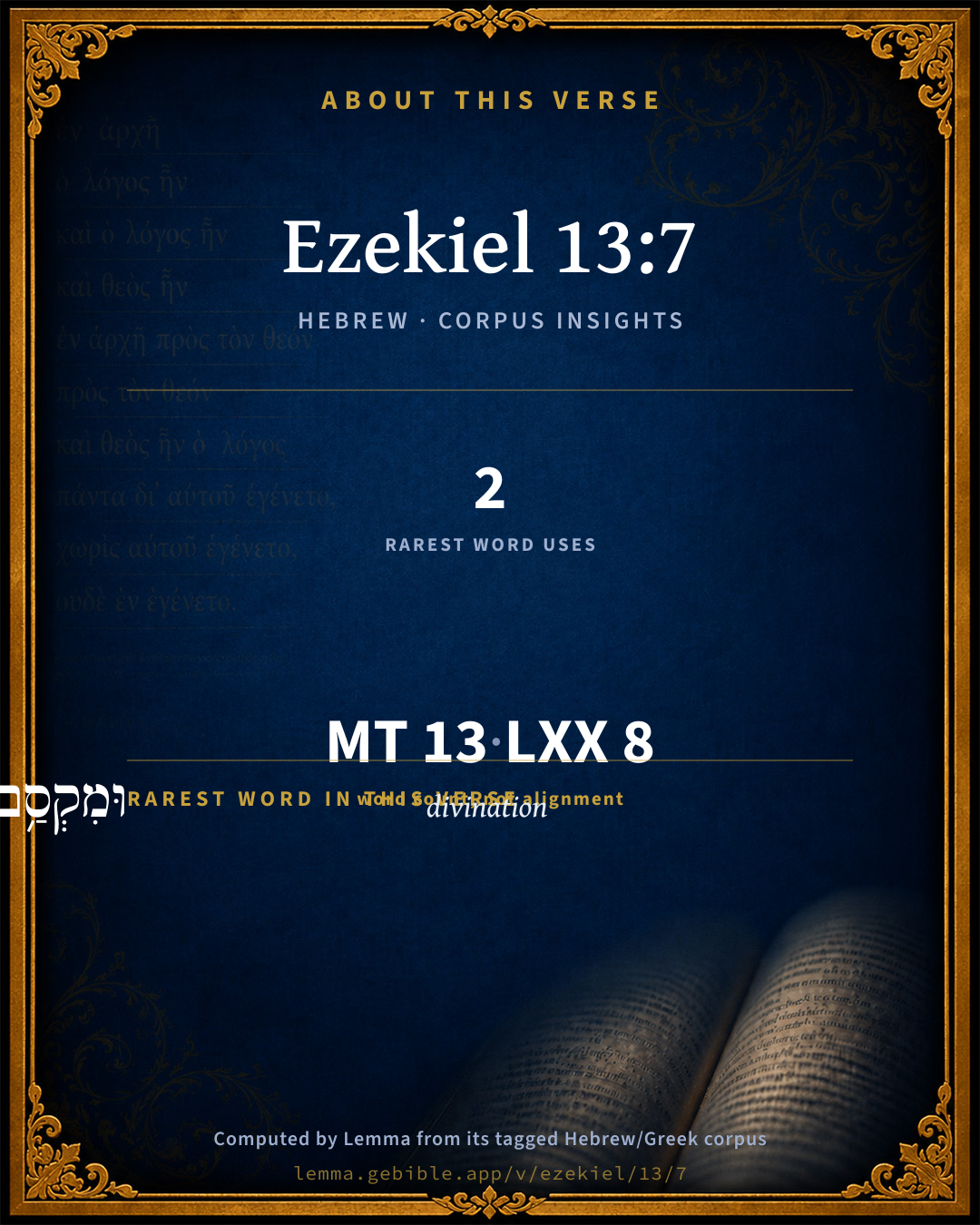
The rarest word here is וּמִקְסַ֥ם divination H4738 — appearing just 2 times in the whole Hebrew Bible.

Shared distinctive vocabulary

וּמִקְסַ֥ם divination H4738 occurs in 2 verses of the Hebrew Bible. Also found in:

Grammatical profile

  • 4 verbs
  • 6 nouns
  • 1 pronoun
  • 2 particles

Verb forms

  • חֲזִיתֶ֔ם Qal · Perfect
  • אֲמַרְתֶּ֑ם Qal · Perfect
  • וְאֹֽמְרִים֙ Qal · Participle Active
  • דִבַּֽרְתִּי Piel · Perfect

Repetition

Words recur within this verse — often emphatic in Hebrew:

  • אֲמַרְתֶּ֑ם to say H559 ×2
  • הֲל֤וֹא not H3808 ×2

Hebrew & Septuagint length

In English translation the verse runs 24 words from the Hebrew and 11 from the Septuagint (LXX English) — the Septuagint runs noticeably shorter here. See the side-by-side →

A rough comparison of the two English renderings, which tokenize alike — not a word-level alignment.

Word counts can differ between the Hebrew and the Greek without any difference in meaning — e.g. the Hebrew direct-object marker אֵת has no separate Greek word, and Greek often adds the article ὁ.

In the original languages it is 13 Hebrew tokens and 8 Greek tokens — but the two are counted differently (Hebrew bundles its prefixes and suffixes into one token; the Greek is in lemma form), so that isn’t a like-for-like length.

Cross-references

3

Topical passages linked to Ezekiel 13:7 in the Treasury of Scripture Knowledge — connected by theme and wording, ordered by reader-vote popularity; previews shown in the World English Bible.

  • Ezekiel 13:2–3 Son of man, prophesy against the prophets of Israel who prophesy, and say you to those who prophesy out of their own heart, Hear you the word of Yahweh:
  • Ezekiel 13:6 They have seen falsehood and lying divination, who say, Yahweh says; but Yahweh has not sent them: and they have made men to hope that the word would be confirmed.
  • Matthew 24:23–24 "Then if any man tells you, 'Behold, here is the Christ,' or, 'There,' don't believe it.

Cross-references courtesy of OpenBible.info (CC BY 4.0).

Hebrew and Greek witnesses Masoretic Hebrew ↔ Greek Septuagint

The same verse in the two great witnesses to the Old Testament, shown verse-for-verse.

Here the Septuagint runs noticeably shorter than the Hebrew — LXX2012 (modern English Septuagint) 11 words vs World English Bible 24. A rough length comparison of the two English translations, not a word-level alignment — read both below.

These are two independent witnesses, not word-aligned to each other, and the Septuagint is shown in lemma (dictionary) form.

Hebrew Ezekiel 13:7 Masoretic · Westminster Leningrad Codex

הֲל֤וֹא מַֽחֲזֵה שָׁוְא֙ חֲזִיתֶ֔ם וּמִקְסַ֥ם כָּזָ֖ב אֲמַרְתֶּ֑ם וְאֹֽמְרִים֙ נְאֻם יְהוָ֔ה וַאֲנִ֖י לֹ֥א דִבַּֽרְתִּי

Haven't you seen a false vision, and haven't you spoken a lying divination, in that you say, Yahweh says; but I have not spoken?

World English Bible · Public Domain

Greek LXX Ezekiel 13:7 Septuagint · lemma form

οὐ ὅρασις ψευδής ὁράω καί μαντεία μάταιος εἶπον

Have you⌃ not seen a false vision? and spoken vain prophecies?

LXX2012 (modern English Septuagint) · Public Domain

Hebrew: Westminster Leningrad Codex (CC BY 4.0). Greek: Septuagint (public domain); English from LXX2012 (modern English Septuagint) (Public Domain). How the Septuagint differs from the Hebrew →

Targum (Aramaic paraphrase)

1

The Targum is the ancient Jewish Aramaic paraphrase of the Hebrew Scriptures — an interpretive translation, not the Hebrew text itself. Onkelos (literal) and Pseudo-Jonathan (expansive) render the Torah, and Jonathan the Prophets. Coverage is partial: where no permissively-licensed English translation exists for a verse, only the Aramaic is shown. This is verse-level text, not a word-by-word alignment to the Hebrew.

  1. Targum Jonathan Prophets (Joshua–Malachi)
    הֲלָא נְבוּאָן דִשְׁקַר אִתְנַבֵּיתוּן וּקְסַם כַּדְבִין אֲמַרְתּוּן וְאָמְרִין אֲמַר יְיָ וּמִן קֳדָם יְיָ לָא אִתְמַלָל:

    (no public-domain English translation for this verse)

    Targum Jonathan — Aramaic: “Mikraot Gedolot” (public domain). English: “Sefaria Community Translation” (CC0 1.0 (public-domain dedication)); “London "Chaldee Paraphrase," 1871” (public domain). Text via Sefaria.

Commentary

Notes on Ezekiel 13:7 from classic Christian and Jewish commentators (each source and its license shown beneath its notes). The classic Christian expositions comment on the surrounding passage and are grouped to its opening verse, so a note may address several verses; the Jewish commentaries on the Tanakh (Rashi and others) are per-verse, so they appear only where the commentator wrote on this verse.

Lemma curates 59 commentaries, every one of them public domain or Creative Commons licensed, each selected and text-cleaned for this edition rather than reprinted as found. About our sources →

Trapp's Complete Commentary

John Trapp

Eze 13:7 Have ye not seen a vain vision, and have ye not spoken a lying divination, whereas ye say, The LORD saith [it]; albeit I have not spoken?

Ver. 7. Have ye not seen a vain vision?] i.e., I appeal to your own consciences, have ye not falsely feigned all? Seducers are extremely impudent, with perverse minds, and cauterised consciences.

John Trapp, A Commentary or Exposition upon All the Books of the Old and New Testament (1647–1656) — public domain. Text from a community e-Sword module.

Geneva Bible (1599)

Geneva Bible translators

Ye promised peace to this people, and now ye see their destruction, so that it is manifest, that ye are false prophets.

Geneva Bible (1599) marginal notes — public domain. Text via Bolls.life.

John Calvin's Commentaries

Here God shows why he had formerly pronounced that they brought forward nothing but vanity and falsehood, namely, because they used his name falsely, and out of light created darkness; for by the feint of speaking in God’s name, they darkened men’s minds. That sacred name is, as it were, a fount of splendor, so as far to surpass the light of the sun; nay, whatever light exists, is made apparent and refulgent by it. But, as I have said, the servants of Satan turn light, into darkness, because they audaciously boast that God has said so. This passage and similar ones show us how diligently we ought to guard against Satan’s fallacies. This is their astounding boldness to bring forward God’s name while they so wantonly trifle with his judgments. For to boast that God has spoken is as if we wished, by impious profanation, purposely to draw him into a dispute. For how can God bear us to turn his truth into lie? But there have been impostors in all ages who have thus thoughtlessly flown in the face of God. We are not surprised at the heathen doing so; but in the chosen people, it was certainly an incredible prodigy and an intolerable disgrace, when they had access to all heavenly doctrine for the guidance of their conduct, and when God was daily calling forth prophets, as he had promised by Moses, to see these impious dogs who barked so, and you pretended so proudly to speak in God’s name. (Deuteronomy 18:15-18.) Admonished, then, by this caution, let us be on our guard when we see Satan’s servants endued with such arrogance. It follows —

John Calvin's Commentaries (1540-1563) — public domain. Text from the Calvin Translation Society English edition (1840s-50s) via the Christian Classics Ethereal Library (ccel.org). Calvin's coverage is partial (roughly two-thirds of the Bible); uncommented books and verses are honest gaps, never fabricated. The 19th-century editor's footnotes and remarks are omitted so the notes are faithfully Calvin's own voice.

John Gill's Exposition

And mine hand shall be upon the prophets that see vanity, and that divine lies,.... Meaning, by his hand, not the true spirit of prophecy, attended with a divine power and energy, as in Eze 1:3; but the wrath and power of God seizing on them and punishing them. So the Targum,

"and the stroke of my power shall be upon the false prophets, &c.''

The sense is, that they should feel the weight of his hand, and the lighting down of his arm with the indignation of his wrath, by inflicting punishment upon them:

they shall not be in the assembly of my people; shall have no place in the church of God, nor fellowship with the saints; they shall not join with them in religious worship here; but either shall be left by the righteous judgment of God to separate themselves from them, or shall be excluded their communion; and much less shall they stand in the congregation of the righteous hereafter: or, "they shall not be in the secret", or "council of my people" (g); shall not be consulted by them on any account, civil or religious; or not be let into the secret counsels of the Lord, as the Lord's people be, who are his favourites and his friends; see Psa 25:14. The Targum is,

"in the good secret which is hidden for my people they shall not be:''

neither shall they be written in the writing of the house of Israel; their names shall not be in the roll or register of those that return from captivity, as in Ezra it but shall die in their exile; they shall not be in the list and catalogue of the citizens of any city in the land of Israel, particularly of Jerusalem, the chief city; see Isa 4:3; and it should appear that their names were never written in the Lamb's book of life; or that they ever were among the number of God's elect, the true and spiritual Israel of God. So the Targum,

"and in the writing of eternal life, which is written for the righteous of the house of Israel, they shall not be written;''

see Psa 69:28;

neither shall they enter into the land of Israel; should not return to the land of Israel, when the captives should at the end of the captivity; nor enter into the land of Canaan, the heavenly rest, which remains for the people of God; for into the New Jerusalem state shall nothing enter that makes an abomination, or a lie, as these prophets had done; see Rev 21:27;

and ye shall know that I am the Lord God; omniscient, omnipotent, true and faithful, holy, just, and good.

(g) "in secreto populi mei non erunt", Montanus; "in arcano", Munster; "in comilio", Junius & Tremellius, Calvin, Polanus; "in concilio", Vatablus.

John Gill's Exposition of the Whole Bible (1746–1763) — public domain (CC PDM 1.0). Text via the HelloAO Bible API.

Matthew Poole's English Annotations

Consider with your own consciences; do they not tell you that all is vain pretence which you make? Can you think Jerusalem can escape, or the first captives be returned, and all this so soon? Is not this vain to be imagined, and they vainer that imagine and believe it? If it should come to pass, which it never shall, yet herein you are convicted liars; you say the Lord saith, whereas he hath said no such thing, nay, the contrary hath God spoken to what you speak, and the event shall be as contrary to your expectation, which is of good; but behold evil cometh out of the north, and great destruction.

Matthew Poole's English Annotations on the Holy Bible (1683–1685) — public domain. Text from a community e-Sword/MySword module.

Whedon's Commentary on the Bible

Daniel D. Whedon

7. Ye say, The Lord saith it — They boldly lay claim for themselves to the only true source of prophetic inspiration; but the Lord himself repudiates them as liars and deceivers of the people.

Daniel D. Whedon (gen. ed.), Commentary on the Old and New Testaments (1874–1909) — public domain. Text from a community e-Sword module.

Lesson kit

Teaching starters — assembled from the data on this page, not authored interpretation. Every prompt links to the verse data it draws on. Edit before teaching.

Ezekiel, in the Prophets, opens this verse with 13 words (11 distinct Hebrew lemmas). Its most distinctive word is miqçâm (“divination”). The Greek Septuagint runs shorter here. A historical commentator’s framing appears above. Read the whole chapter for the surrounding context.

Discussion questions

  1. What does “divination” (miqçâm) contribute to the verse as a whole?
  2. Ezekiel 12:24 shares the word «divination» with this verse. How do the two illuminate each other?
  3. “to say” occurs 2× in this one verse. What is the effect of the repetition?
  4. Compared with the Hebrew, the Septuagint runs shorter here. What questions does that raise?
  5. These translations render this verse differently. What is at stake in choosing one wording over another?
  6. The verb «חֲזִיתֶ֔ם» is Qal Perfect. How does its form color the action?
  7. Reading how Trapp's Complete Commentary and Geneva Bible (1599) read this verse, where do the two commentators agree and where do they part?

Things to notice

Reading settings

Reading text

Shown beneath each verse's original-language words.

Old Testament
Old Testament edition

Read the OT as the Masoretic Hebrew (MT) or the Greek Septuagint (LXX).

English shown for the Greek Septuagint (in the Hebrew ↔ Greek comparison).

Comparing translations? Open the Compare panel on any verse page to stack up to four side by side.