
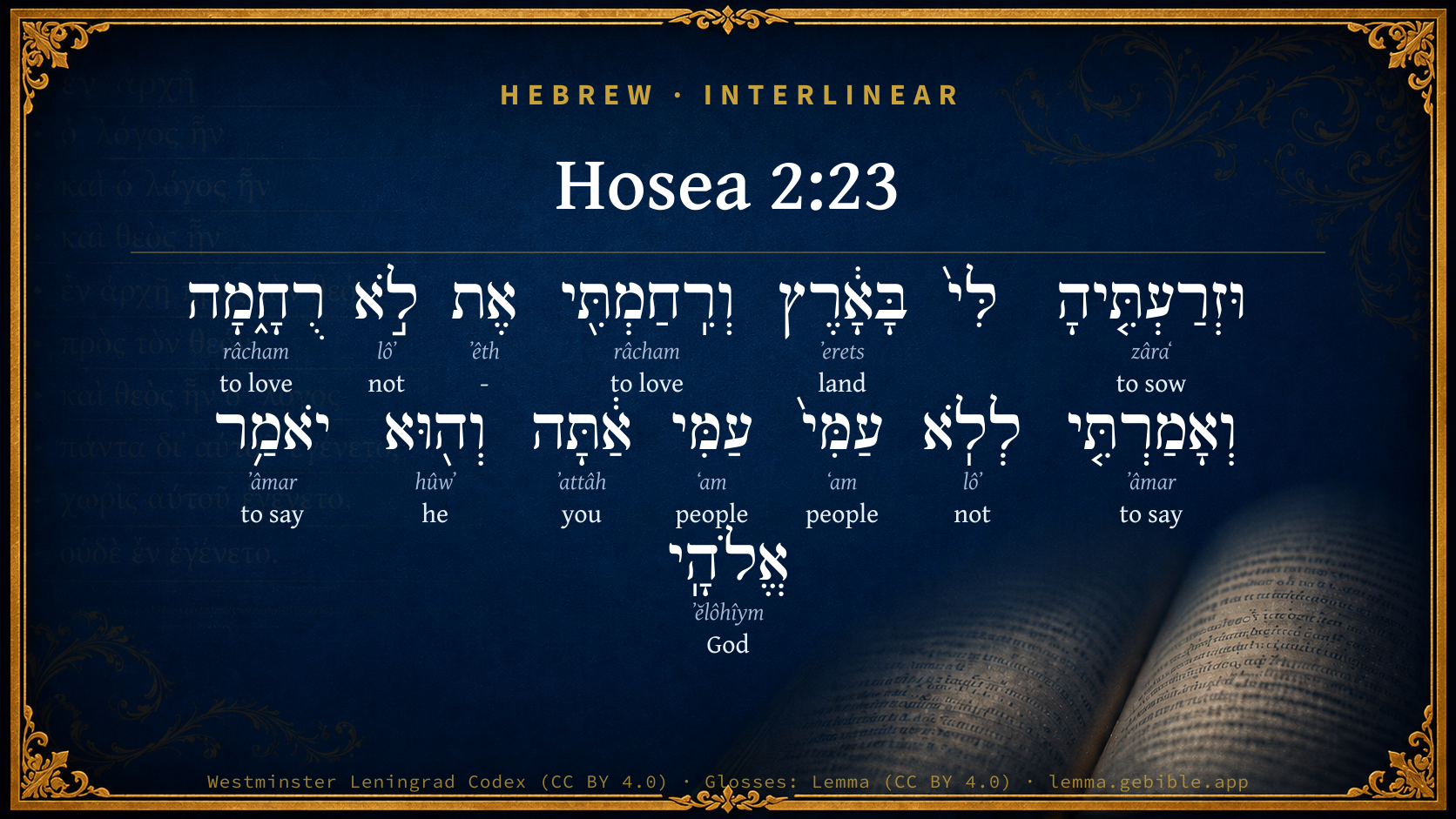
Hosea 2:23

Hebrew (Westminster Leningrad Codex) Hosea 2:23 appears in the Hebrew Old Testament. The text above is from the Westminster Leningrad Codex. Each word links to its Strong’s number, a concise gloss, and parsing drawn from the Open Scriptures Hebrew Bible morphology. Click any word for its full Brown-Driver-Briggs (BDB) entry.
Download image
Cite this verse

Hosea 2:23 (World English Bible). Public Domain. Lemma interlinear Bible study tool, https://lemma.gebible.app/v/hosea/2/23.

Show BibTeX & RIS
BibTeX
RIS
English Translation
I will sow her to me in the earth; And I will have mercy on her who had not obtained mercy; And I will tell those who were not my people, 'You are my people;' And they will say, 'My God!'"
World English Bible · Public Domain
Download a study sheet

One document with this verse’s original text, its word-by-word gloss line, the meaning frame, cross-references with their text, attributed commentary, and full source and license credits — printable, and it pastes into notes with its structure intact.

This verse Autodidact and up

Study sheet (.html) Plain text (.txt)

A passage Seminary Student

Up to 50 verses in one chapter. A passage sheet keeps up to 6 commentary sources and 12 cross-references per verse, in the order this page ranks them, and says so on the sheet whenever that leaves anything out. Ask for a single verse and you get the Autodidact verse sheet above.

Everything on this page stays free to read, with no account — the sheet is a download of what is already on screen, not access to it.

Want to remove ads? Support Godless Engineer
Compare translations 3

The same verse in 3 English versions, stacked beneath the original-language interlinear above. Click any original word for its lexicon entry.

Each is an independent rendering of the whole verse — the interlinear is not word-aligned to these translations.

Highlighted words mark where these versions differ — a whole-verse word diff, not a word-by-word alignment.

  • World English Bible Public Domain
    I will sow her to me in the earth; And I will have mercy on her who had not obtained mercy; And I will tell those who were not my people, 'You are my people;' And they will say, 'My God!'"
  • King James Version Public Domain
    And I will sow her unto me in the earth; and I will have mercy upon her that had not obtained mercy; and I will say to them which were not my people, Thou art my people; and they shall say, Thou art my God.
  • unfoldingWord Literal Text CC BY-SA 4.0
    And I will sow her for myself on the earth, and I will have compassion on Lo Ruhamah, and I will say to Lo Ammi, “You my people,” and he, he will say, “My God.”

unfoldingWord Literal Text — © unfoldingWord, licensed CC BY-SA 4.0. Word-aligned USFM3 via Door43 (git.door43.org/unfoldingWord/en_ult).

Versions to compare (up to 4)

3 of 4 selected

Show all 18 translations

Every available English version of this verse, each an independent rendering of the whole verse.

  • World English Bible Public Domain
    I will sow her to me in the earth; And I will have mercy on her who had not obtained mercy; And I will tell those who were not my people, 'You are my people;' And they will say, 'My God!'"
  • Berean Standard Bible Public Domain
    And I will sow her as My own in the land, and I will have compassion on ‘No Compassion.’ I will say to those called ‘Not My People,’ ‘You are My people,’ and they will say, ‘You are my God.’”
  • Majority Standard Bible Public Domain
    And I will sow her as My own in the land, and I will have compassion on ‘No Compassion.’ I will say to those called ‘Not My People,’ ‘You are My people,’ and they will say, ‘You are my God.’”
  • King James Version Public Domain
    And I will sow her unto me in the earth; and I will have mercy upon her that had not obtained mercy; and I will say to them which were not my people, Thou art my people; and they shall say, Thou art my God.
  • American Standard Version (1901) Public Domain
    And I will sow her unto me in the earth; and I will have mercy upon her that had not obtained mercy; and I will say to them that were not my people, Thou art my people; and they shall say, `Thou art' my God.
  • Revised Version (1885) Public Domain
    And I wilt sow her unto me in the earth; and I will have mercy upon her that had not obtained mercy; and I will say to them which were not my people, Thou art my people; and they shall say, Thou art my God.
  • Geneva Bible (1599) Public Domain
    And I will sowe her vnto me in the earth, and I will haue mercie vpon her, that was not pitied, and I will say to them which were not my people, Thou art my people. And they shall say, Thou art my God.
  • Douay-Rheims (1899) Public Domain
    And I will sow her unto me in the earth, and I will have mercy on her that was without mercy.
  • Young's Literal Translation Public Domain
    And I have sowed her to Me in the land, And I have pitied Lo-Ruhamah, And I have said to Lo-Ammi, My people thou `art', and it saith, My God!'
  • Literal Standard Version CC BY-SA 4.0
    And I have sowed her to Me in the land, || And I have pitied Lo-Ruhamah, || And I have said to Lo-Ammi, You [are] My people, || And he says, My God!”
  • Unlocked Literal Bible CC BY-SA 4.0
    I will plant her for myself in the land, and I will have mercy on Lo-Ruhamah. I will say to Lo-Ammi, 'You are Ammi Attah,' and they will say to me, 'You are my God.'”
  • unfoldingWord Literal Text CC BY-SA 4.0
    And I will sow her for myself on the earth, and I will have compassion on Lo Ruhamah, and I will say to Lo Ammi, “You my people,” and he, he will say, “My God.”
  • Darby Bible Public Domain
    And I will sow her unto me in the land; and I will have mercy upon Lo-ruhamah; and I will say to Lo-ammi, Thou art my people; and they shall say, My God.
  • World Messianic Bible Public Domain
    I will sow her to me in the earth; and I will have mercy on her who had not obtained mercy; and I will tell those who were not my people, ‘You are my people;’ and they will say, ‘You are My God!’”
  • Webster's Bible Public Domain
    And I will sow her to me in the earth; and I will have mercy upon her that had not obtained mercy; and I will say to them who were not my people, Thou art my people; and they shall say, Thou art my God.
  • Free Bible Version CC BY-SA 4.0
    I will ‘sow’ her for myself in the earth. I will love Lo-ruhamah (unloved) and I will say ‘You are my people’ to Lo-ammi (not my people), and they will say, ‘You are my God.’”
  • Bible in Basic English Public Domain
    And I will put her as seed in the earth, and I will have mercy on her to whom no mercy was given; and I will say to those who were not my people, You are my people, and they will say, My God.
  • JPS Tanakh (1917) Public Domain
    (2-25) And I will sow her unto Me in the land; and I will have compassion upon her that had not obtained compassion; and I will say to them that were not My people: 'Thou art My people'; and they shall say: 'Thou art my God.'

Literal Standard Version (2020), Covenant Press — licensed CC BY-SA 4.0. Text via the HelloAO Bible API (eBible.org). Unlocked Literal Bible (unfoldingWord) — licensed CC BY-SA 4.0. Text via the HelloAO Bible API (eBible.org). unfoldingWord Literal Text — © unfoldingWord, licensed CC BY-SA 4.0. Word-aligned USFM3 via Door43 (git.door43.org/unfoldingWord/en_ult). Free Bible Version, Dr. Jonathan Gallagher — licensed CC BY-SA 4.0. Text via the HelloAO Bible API (eBible.org).

Word by word

More ways to search: Search by grammar → Find every occurrence → Compare this word →

Practice this passage: Drill this verse → Learn its vocabulary →

וְרִֽחַמְתִּ֖י
râcham
H7355
“and · to love”
Conjunction + Verb, Piel, Sequential Perfect, 1st Person, Common, Singular
Part of Speech
Conjunction + Verb
Stem
Piel
Form
Sequential Perfect
Person
1st Person
Gender
Common
Number
Singular
Full BDB Definition

Origin: a primitive root

TWOT: 2146

to love, love deeply, have mercy, be compassionate, have tender affection, have compassion - (Qal) to love - (Piel) - to have compassion, be compassionate - of God, man - (Pual) to be shown compassion, be compassionate
  1. וּזְרַעְתִּ֤יהָ zâraʻ H2232 “and · to sow · her” Conjunction + Verb, Qal, Sequential Perfect, 1st Person, Common, Singular + Suffix, Personal, 3rd Person, Feminine, Singular
  2. בָּאָ֔רֶץ ʼerets H776 “in/at the · land” Preposition, Determined + Noun, Common, Both, Singular, Absolute
  3. אֶת ʼêth H853 “-” Particle, Direct Object
  4. לֹ֣א lôʼ H3808 “not” Particle, Negative
  5. רֻחָ֑מָה râcham H7355 “to love” Noun, Proper
  6. וְאָמַרְתִּ֤י ʼâmar H559 “and · to say” Conjunction + Verb, Qal, Sequential Perfect, 1st Person, Common, Singular
  7. לְלֹֽא lôʼ H3808 “to/for · not” Preposition + Noun, Proper
  8. עַמִּי֙ ʻam H5971 “people” Noun, Proper
  9. עַמִּי ʻam H5971 “people · my” Noun, Common, Masculine, Singular, Construct + Suffix, Personal, 1st Person, Common, Singular
  10. אַ֔תָּה ʼattâh H859 “you” Pronoun, Personal, 2nd Person, Masculine, Singular
  11. וְה֖וּא hûwʼ H1931 “and · he” Conjunction + Pronoun, Personal, 3rd Person, Masculine, Singular
  12. יֹאמַ֥ר ʼâmar H559 “to say” Verb, Qal, Imperfect, 3rd Person, Masculine, Singular
  13. אֱלֹהָֽי ʼĕlôhîym H430 “God(s) · my” Noun, Common, Masculine, Plural, Construct + Suffix, Personal, 1st Person, Common, Singular

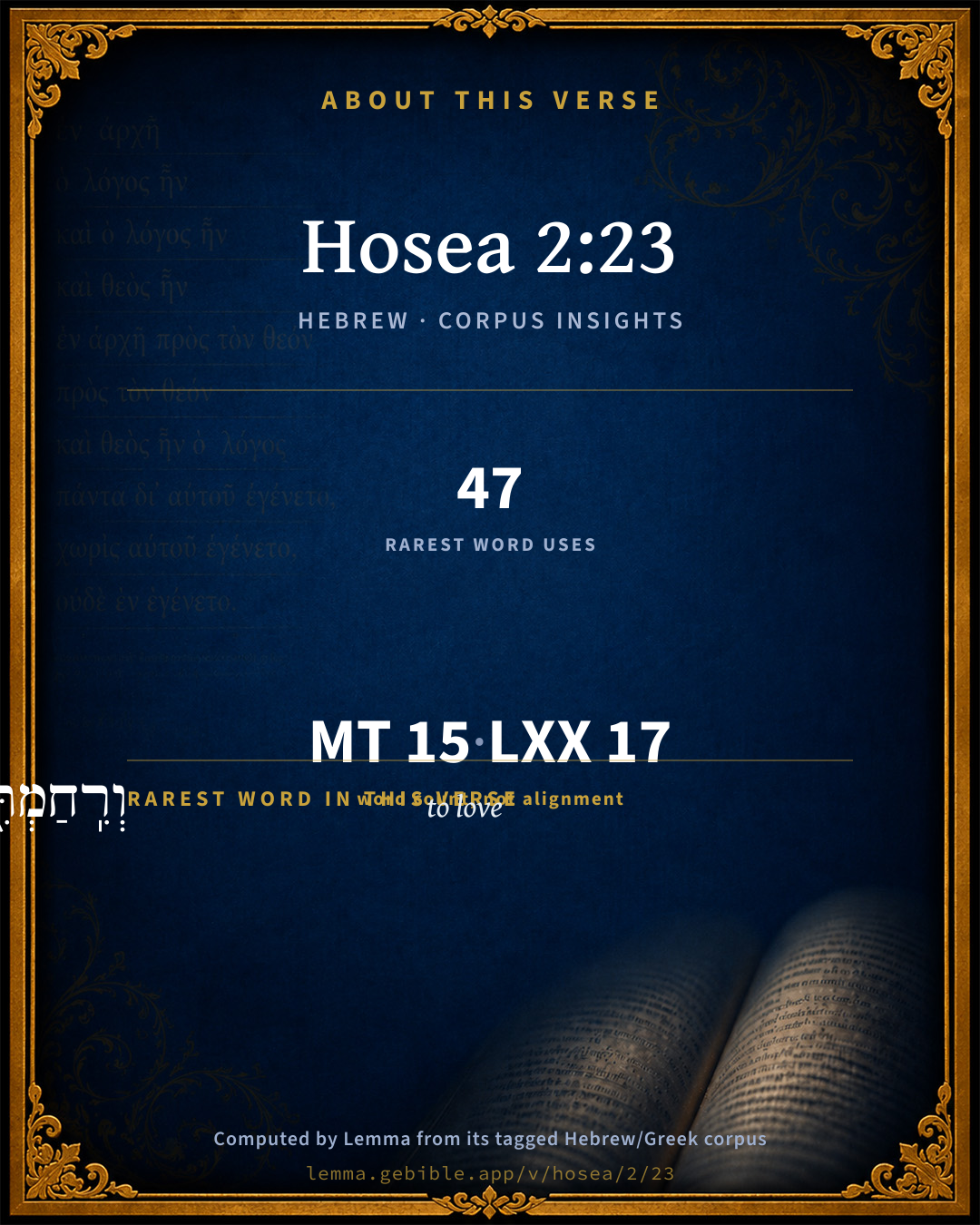
About this verse

These counts appear in no published source. They are computed here, from the morphology-tagged text and Lemma’s own curated glosses. What Lemma adds →

15
words
10
distinct lemmas
Prophets
section

Shared distinctive vocabulary

וְרִֽחַמְתִּ֖י to love H7355 occurs in 43 verses of the Hebrew Bible. Also found in:

Grammatical profile

  • 4 verbs
  • 6 nouns
  • 2 pronouns
  • 1 preposition
  • 2 particles

Verb forms

  • וּזְרַעְתִּ֤יהָ Qal · Sequential Perfect
  • וְרִֽחַמְתִּ֖י Piel · Sequential Perfect
  • וְאָמַרְתִּ֤י Qal · Sequential Perfect
  • יֹאמַ֥ר Qal · Imperfect

Repetition

Words recur within this verse — often emphatic in Hebrew:

  • וְרִֽחַמְתִּ֖י to love H7355 ×2
  • וְאָמַרְתִּ֤י to say H559 ×2
  • עַמִּי֙ people H5971 ×2
  • לֹ֣א not H3808 ×2

Hebrew & Septuagint length

In English translation the verse runs 41 words from the Hebrew and 42 from the Septuagint (LXX English) — closely comparable.

A rough comparison of the two English renderings, which tokenize alike — not a word-level alignment.

Word counts can differ between the Hebrew and the Greek without any difference in meaning — e.g. the Hebrew direct-object marker אֵת has no separate Greek word, and Greek often adds the article ὁ.

In the original languages it is 15 Hebrew tokens and 17 Greek tokens — but the two are counted differently (Hebrew bundles its prefixes and suffixes into one token; the Greek is in lemma form), so that isn’t a like-for-like length.

Cross-references

30

Topical passages linked to Hosea 2:23 in the Treasury of Scripture Knowledge — connected by theme and wording, ordered by reader-vote popularity; previews shown in the World English Bible.

  • Romans 9:25–26 As he says also in Hosea, "I will call them 'my people,' which were not my people; And her 'beloved,' who was not beloved."
  • 1 Peter 2:9–10 But you are a chosen race, a royal priesthood, a holy nation, a people for God's own possession, that you may show forth the excellencies of him who called you out of darkness into his marvelous light:
  • Zechariah 13:9 I will bring the third part into the fire, And will refine them as silver is refined, And will test them like gold is tested. They will call on my name, and I will hear them. I will say, 'It is my people;' And they will say, 'Yahweh is my God.'"
  • Hosea 1:9–10 He said, "Call his name Lo-Ammi; for you are not my people, and I will not be yours.
  • Romans 3:29 Or is God the God of Jews only? Isn't he the God of Gentiles also? Yes, of Gentiles also,
  • Zechariah 2:11 Many nations shall join themselves to Yahweh in that day, and shall be my people; and I will dwell in the midst of you, and you shall know that Yahweh of Hosts has sent me to you.
  • Revelation 21:3–4 I heard a loud voice out of heaven saying, "Behold, God's dwelling is with people, and he will dwell with them, and they will be his people, and God himself will be with them as their God.
  • Deuteronomy 26:17–19 You have declared Yahweh this day to be your God, and that you would walk in his ways, and keep his statutes, and his commandments, and his ordinances, and listen to his voice:
  • Zechariah 8:22–23 Yes, many peoples and strong nations will come to seek Yahweh of Hosts in Jerusalem, and to entreat the favor of Yahweh."
  • Psalms 22:27 All the ends of the earth shall remember and turn to Yahweh. All the relatives of the nations shall worship before you.
  • Hosea 1:6 She conceived again, and bore a daughter. Then he said to him, "Call her name Lo-Ruhamah; for I will no longer have mercy on the house of Israel, that I should in any way pardon them.
  • Jeremiah 32:38 and they shall be my people, and I will be their God:
  • Jeremiah 31:27 Behold, the days come, says Yahweh, that I will sow the house of Israel and the house of Judah with the seed of man, and with the seed of animal.
  • Malachi 1:11 For from the rising of the sun even to the going down of the same, my name is great among the nations, and in every place incense will be offered to my name, and a pure offering: for my name is great among the nations," says Yahweh of Hosts.
  • Romans 11:30–32 For as you in time past were disobedient to God, but now have obtained mercy by their disobedience,
  • Psalms 68:31 Princes shall come out of Egypt. Ethiopia shall hurry to stretch out her hands to God.
  • Jeremiah 16:19 Yahweh, my strength, and my stronghold, and my refuge in the day of affliction, to you shall the nations come from the ends of the earth, and shall say, Our fathers have inherited nothing but lies, [even] vanity and things in which there is no profit.
  • Psalms 118:28 You are my God, and I will give thanks to you. You are my God, I will exalt you.
  • Song of Solomon 2:16 My beloved is mine, and I am his. He browses among the lilies.
  • Psalms 72:16 There shall be abundance of grain throughout the land. Its fruit sways like Lebanon. Let it flourish, thriving like the grass of the field.
  • Hosea 8:2 They cry to me, 'My God, we Israel acknowledge you!'
  • Zechariah 14:9 Yahweh will be King over all the earth. In that day Yahweh will be one, and his name one.
  • Zechariah 14:16 It will happen that everyone who is left of all the nations that came against Jerusalem will go up from year to year to worship the King, Yahweh of Hosts, and to keep the feast of tents.
  • Romans 15:9–11 and that the Gentiles might glorify God for his mercy. As it is written, "Therefore will I give praise to you among the Gentiles, And sing to your name."
  • Zechariah 10:9 I will sow them among the peoples; And they will remember me in far countries; And they will live with their children, and will return.
  • 1 Thessalonians 1:9–10 For they themselves report concerning us what kind of a reception we had from you; and how you turned to God from idols, to serve a living and true God,
  • Isaiah 44:5 One shall say, I am Yahweh's; and another shall call [himself] by the name of Jacob; and another shall subscribe with his hand to Yahweh, and surname [himself] by the name of Israel.
  • James 1:1 James, a servant of God and of the Lord Jesus Christ, to the twelve tribes which are in the Dispersion: Greetings.
  • Acts 8:1–4 Saul was consenting to his death. A great persecution arose against the assembly which was in Jerusalem in that day. They were all scattered abroad throughout the regions of Judea and Samaria, except for the apostles.
  • 1 Peter 1:1–2 Peter, an apostle of Jesus Christ, to the chosen ones who are living as strangers in the Dispersion in Pontus, Galatia, Cappadocia, Asia, and Bithynia,

Cross-references courtesy of OpenBible.info (CC BY 4.0).

Hebrew and Greek witnesses Masoretic Hebrew ↔ Greek Septuagint

The same verse in the two great witnesses to the Old Testament, shown verse-for-verse.

These are two independent witnesses, not word-aligned to each other, and the Septuagint is shown in lemma (dictionary) form.

Hebrew Hosea 2:23 Masoretic · Westminster Leningrad Codex

וּזְרַעְתִּ֤יהָ לִּי֙ בָּאָ֔רֶץ וְרִֽחַמְתִּ֖י אֶת לֹ֣א רֻחָ֑מָה וְאָמַרְתִּ֤י לְלֹֽא עַמִּי֙ עַמִּי אַ֔תָּה וְה֖וּא יֹאמַ֥ר אֱלֹהָֽי

I will sow her to me in the earth; And I will have mercy on her who had not obtained mercy; And I will tell those who were not my people, 'You are my people;' And they will say, 'My God!'"

World English Bible · Public Domain

Greek LXX Hosea 2:23 Septuagint · lemma form

καί εἰμί ἐν ἐκεῖνος ὁ ἡμέρα λέγω κύριος ἐπιἀκούω ὁ οὐρανός καί ὁ οὐρανός ἐπιἀκούω ὁ γῆ

And I will sow her to me on the earth; and will love her that was not loved, and will say to that which was not my people, You are my people; and they shall say, You are the Lord my God.

LXX2012 (modern English Septuagint) · Public Domain

On this verse, The Cambridge Bible for Schools and Colleges discusses the Septuagint’s reading. Read the note in Commentary ↓

Hebrew: Westminster Leningrad Codex (CC BY 4.0). Greek: Septuagint (public domain); English from LXX2012 (modern English Septuagint) (Public Domain). How the Septuagint differs from the Hebrew →

Targum (Aramaic paraphrase)

1

The Targum is the ancient Jewish Aramaic paraphrase of the Hebrew Scriptures — an interpretive translation, not the Hebrew text itself. Onkelos (literal) and Pseudo-Jonathan (expansive) render the Torah, and Jonathan the Prophets. Coverage is partial: where no permissively-licensed English translation exists for a verse, only the Aramaic is shown. This is verse-level text, not a word-by-word alignment to the Hebrew.

  1. Targum Jonathan Prophets (Joshua–Malachi)
    וִיהֵי בְעִדָנָא הַהִיא אֲקַבֵּיל צְלוֹתְכוֹן אֲמַר יְיָ אַפְקִיד יַת שְׁמַיָא וְאִינוּן יַחְתוּן מִטְרָא עַל אַרְעָא:

    (no public-domain English translation for this verse)

    Targum Jonathan — Aramaic: “Mikraot Gedolot” (public domain). English: “Sefaria Community Translation” (CC0 1.0 (public-domain dedication)); “London "Chaldee Paraphrase," 1871” (public domain). Text via Sefaria.

Commentary

Notes on Hosea 2:23 from classic Christian and Jewish commentators (each source and its license shown beneath its notes). The classic Christian expositions comment on the surrounding passage and are grouped to its opening verse, so a note may address several verses; the Jewish commentaries on the Tanakh (Rashi and others) are per-verse, so they appear only where the commentator wrote on this verse.

Lemma curates 59 commentaries, every one of them public domain or Creative Commons licensed, each selected and text-cleaned for this edition rather than reprinted as found. About our sources →

Trapp's Complete Commentary

John Trapp

Hos 2:23 And I will sow her unto me in the earth; and I will have mercy upon her that had not obtained mercy; and I will say to [them which were] not my people, Thou [art] my people; and they shall say, [Thou art] my God.

Ver. 23. And I will sow her unto me in the earth] Not in the air, as once, when they were scattered into the four winds of heaven; but in the earth which the heavens should hear, Hos 2:21, the inhabitants whereof should be multiplied, and become as the sand of the sea, which cannot be measured nor numbered, Hos 1:10, {See Trapp on "Hos 1:10"} and Jer 31:27 Eze 36:37. The preaching of the gospel is a kind of sowing of seed, 1Pe 1:23, and this seeding is in the earth, that they may be gathered into heaven, where the mower shall fill his hand, and he that bindeth sheaves his bosom, Psa 129:7. And although God’s elect lie here for a time under the clods, yet at length they shall fructify, and many spring from them by whom the name of Christ shall be so propagated. "He shall see his seed, he shall prolong his days, and the pleasure of the Lord shall prosper in his hand," Isa 53:10.

And I will have mercy upon her] Her unhappy name, Lorubamah, shall be done away, and the contrary come in place. Lo! this is as it were the epilogue of the sermon, and it is very comfortable. The Sun of righteousness loves not to set in a cloud. "Gracious is the Lord, and righteous, yea, our God is merciful." Be it that he is once righteous, yet he is both gracious and merciful for it, Psa 116:5. The Jews, for their seventy years’ captivity in Babylon, had seven seventies of years (set forth by Daniel’s weeks) granted for the enjoying of their own country. God’s mercies bear the same proportion to his punishments (when he hath to deal with his elect people) which seven, a complete number, hath to a unity. This promise here made the apostle testifieth, Rom 9:25, to be begun to be fulfilled in his time by the conversion of some Jews, and calling of some Gentiles. The full accomplishment thereof we daily expect and pray for.

And I will say to them] That is, I will make them so, as when he said to Lazarus, Come forth of the grave, he brought him forth; together with his word there went forth a power.

And they shall say] Dicere nostra est fides et obedientia nostra, saith Pareus here; we say thus when we believe and obey. There shall be, restored, therefore, between God and his people a most sweet harmony, and an intimate conjunction, such as he had before described to be between himself and all the second causes, for his Church’s sake; and truly it is never well with us, indeed, till the heavens answer the earth till Christ, the Sun of righteousness, so shine into our hearts, that we melt and comply as here, and as Zec 13:9. {See Trapp on "Zec 13:9"}

John Trapp, A Commentary or Exposition upon All the Books of the Old and New Testament (1647–1656) — public domain. Text from a community e-Sword module.

The Biblical Illustrator

Joseph S. Exell

Hos_2:23

And I will sow her unto Me in the earth.

Gods sowing

I. These words refute pantheism. God is not nature, nor is nature God. Pantheism teaches that there is no real and practical distinction between God and the universe. This form of infidelity ignores evil as evil, and all moral responsibility, for it declares that the soul is only a mode of the thought of God.

II. These words declare the Divine personality. Only on belief in a personal God can any sound superstructure of religion be raised.

III. These words show the abiding connection between God and His works. The Bible invariably attributes the operations of nature to the energy of God.

IV. These words show that the universe is the friend of the praying soul, One part of the universe is here represented as related to and acting upon another on behalf of Jezreel. All the forces of nature are arrayed against the disturber of the harmony of Gods kingdom.

V. These words teach that God will really answer prayer. The answers are, I will sow her unto Me. I will have mercy upon her. Thou art My people. The infinite God gives Himself to the soul, and becomes its present and eternal portion. (Christian Age.)

Gods people as seeds

1. Gods people are the seed of the earth.

2. Every godly man should so live as, either in life or in death, to be as a seed from whence many should spring.

3. The saints are sown unto Christ, they are seed for Christ, therefore all their fruit must be consecrated to Christ. (Jeremiah Burroughs.)

Hope for the forsaken

All the brighter side of the prophetic message is summed up in the most wonderful way in this verse, and there are few verses even in the Bible itself, so crowded with significance. Hosea sums up all that he himself had said, all that he had been teaching for some seven years. It is God whom he represents as speaking these weighty and matterful words:--And I will sow (an allusion, of course, to the meaning of Jezreel--Gods sowing) her (the impersonated people of Israel) unto Me (sow, and no longer scatter); and I will have pity upon, not pitied; and I will say unto Not My people, Thou art My people; and she shall say to Me, My God. Obviously, as soon as we can read the verse aright, we find in it the names of all Hoseas children, and the whole significance of this prophetic message. On the one hand, we are reminded of the time in which Israel was scattered for their guilt among the heathen, the time in which God refused to pity them, or to acknowledge them as His own; and on the other hand, we are reminded of the better time in which, instead of being God-scattered, unpitied, and not My people, they were called God-sown, pitied, and sons of the living God; when the heavens smiled upon them, and the earth gave them her increase, and all the forces of nature, once so hostile, were at peace with them. (S. Cox, D. D.)

I will say to them who were not My people, Thou art My people; and they shall say, Thou art my God.

Sinners owning a covenant God

Read in the light of the context, these words seem to refer to the nation of Israel only. But in the ninth chapter of the Epistle to the Romans, Paul quotes them as having a more comprehensive reference. He there applies them to the vessels of mercy, who are called in the Gospel day, not of the Jews only, but also of the Gentiles. These words foretell the formation of a gracious relation between God and sinners, and the mutual acknowledgment of that relation. On His side He shall own the outcasts as His people. On their side they shall own Him as their God. What is implied in sinners saying to Jehovah, Thou art my God?

I. The gracious relation thus acknowledged.

1. And first of all, it is a new covenant relation. Naturally, as is here intimated, we are not the people of God. When the covenant which He made with us in Adam, our representative, was broken, we ceased to be His people and He ceased to be our God. We, by wilful apostasy, have cast Him off; and He, in holy and righteous displeasure, has cast us off. Our carnal minds are enmity against Him, and His law has only condemnation and death for us. We are miserable outcasts from our Maker. We are without God in the world. But He has made a covenant with His Chosen: and in that new and better covenant He has made provision that the gracious relation so fearfully ruptured shall be more than restored. He has covenanted with His only begotten Son, as the Head of an innumerable multitude of our outcast race, that on condition of His assuming their nature and doing all His will in their redemption He will, in a very special and gracious sense, be a God to Him, and in the same special and gracious sense be a God to them.

2. In this new covenant relation, as willing to be our God in Christ, God offers Himself to us unconditionally and individually in the Gospel. It was such an offer of Himself He made to the Israelites when, from the summit of the flaming mount, He proclaimed--I am the Lord thy God, who have brought thee out of the land of Egypt, out of the house of bondage. It was God in the person of Christ, as we learn from Stephen (Act_7:38), who there announced His willingness to be the God of Abrahams seed. And to these sinners, deeply infected as they were soon to show, with the idolatry and moral corruption or Egypt, that was a most free offer; and it is expressed in absolute and unconditional terms, clogged with no condition of any sort whatever. It was also an individual offer, made to every Israelite in the camp without exception, so that, every soul in all that host, the vilest and most abject was warranted as much as Moses and Aaron, to close with it, and on the ground of it to take Jehovah as his own personal God. Now we are most earnest you should realise this day that God is making to each one of you, through Christ, the same absolutely free and gracious offer to be your God. Only with this great difference, that He is making it not from the mount that might be touched and that burned with fire, and from blackness and darkness and tempest--not from among that dark obscurity of type, and rigor of ordinance and law tending to bondage and fear, which beset the revelation of covenant mercy and love under the old economy, but in the clear sweet light of the risen Sun of Righteousness, and through the lips of ambassadors whom He has sent to beseech you in Christs stead to be reconciled to Him. Incline your ear, and come unto Me: hear, and your soul shall live; and I will make an everlasting covenant with you, even the sure mercies of David (Isa_4:3).

3. For, be it remarked further, that while God offers Himself in this relation to all, He actually gives Himself in this relation to those who are made willing by His Spirit to close with the offer by faith. This highest and holiest of covenant unions, like every other covenant union, is formed by mutual consent. Thus the sons of the stranger are said to join themselves to the Lord, in the way of taking hold of His covenant: in doing which they first take hold of Christ the Surety of the Covenant with the grasp of a living and entire faith when brought near them in the Gospel; and then, in and through Christ, they take hold of the God of the covenant, and enter into all the fulness of His covenanted love and grace (Rom_3:29-30). And mark how faith avails to bring the guiltiest and vilest into all the good and blessedness of this endearing relation to Jehovah. Faith, laying hold of Christ, unites us to Him. It makes us so vitally one with Him that we participate in all the boundless merit of His righteousness. And, having Christs righteousness as our own, there is no more any legal obstacle to keep us outcasts from God.

4. For observe yet again, that in this relation God gives Himself to believing sinners in all He is and all He has. He is not ashamed to be called their God (Heb_11:16). And why not ashamed to be called their God? It is because He acts toward them with a Divine munificence worthy of Himself, glorifying the exceeding riches of His grace in giving them not this or that kind and measure of good, but in giving them Himself, the Fountain and Centre of all good. Think of the ineffable dignity and privilege of being able to say of Him whom angels count it their supreme happiness to adore, He is my God; mine in all His essential perfections: His wisdom mine, to enlighten and guide me; His power mine, to uphold and protect me; His holiness mine, to raise me to walk in the light as He is in the light; His justice mine, to guard me as one of Christs ransomed ones, and to guarantee to me all the inheritance He has purchased with His blood; His truth mine, to fulfil to me every word He has spoken and every expectation and longing His Spirit has wakened within me; His love mine, to delight in me and rejoice over me to do me good; His infinitude mine, to be the measure of the good and the blessedness which I have in Him; and His eternity mine, to be the duration through which it shall all be enjoyed. All things are yours; whether Paul, or Apollos, or Cephas, or the world, or life, or death, or things present, or things to come; all are yours, and ye are Christs and Christ is Gods (1Co_3:22-23). Can you contemplate this, the inheritance of the saints in light, without exclaiming, Happy is the people whose God is the Lord?

II. What is implied in the acknowledgment of this relation which our text foretells? It is, as we have hinted, a divinely wrought acknowledgment. Neither reason, nor conscience, nor moral suasion, though that were put forth with the tongue of an angel, will persuade the soul in its natural hatred and fear and distrust of God to make it. It is the response of the newborn nature to the call of the Spirit of God within.

I. It implies, first of all, the believing personal acceptance of the offer which God makes of Himself to sinners indefinitely and individually in the Gospel. Proud unbelief, putting on the deceitful guise of humility, may tell you that it is presumption for such as you to claim Jehovah as your God. You virtually say by that refusal that all His professed love and goodwill toward you is insincere, that His word is not faithful and worthy of all acceptation.

2. This acknowledgment implies, further, the taking of God as our only and all-sufficing portion. Naturally, our carnal hearts will not have God for their portion. They that are after the flesh do mind the things of the flesh. But these earthly things can no more satisfy the nature and cravings of the spiritual essence within us than the husks that the swine did eat could satisfy the prodigal. Deeply and unfeignedly that sinner grieves that, in following lying vanities, he should so long have forsaken his own mercies. But in proportion to the shame and sorrow of his penitence is his satisfaction that in Christ, and God in Him, he has found at last the good, the rest, the home of his heart.

3. Again, this acknowledgment implies the surrender of ourselves to God as our Lawgiver and King and the great End of our being. If we naturally dislike God as our portion, we still more dislike the thought of entire subjection to Him as our King. Many, indeed, would wish to enjoy His favour and His benefits, provided that, free from His holy authority and control, they could get following their carnal inclinations and living aa they list. But this will not do. It is an eternal moral impossibility. God must change His nature and reverse all the laws of His moral government ere He can make you happy while you are unwilling to be holy, and ere you can enjoy Him as your portion while you will not know, obey, and submit to His will, in all things, as your Lawgiver and King. And most certainly on these terms you can never enter the bond of His covenant (Heb_8:10). The true-hearted covenanter is well pleased with Gods covenant in all respects. He delights in the law of the Lord after the inward man (Psa_119:140). He feels that God has infinite claims upon the love and loyalty of his heart and the perfect obedience of his life. As He who made him, and made him a rational and immortal being responsible to Himself; as He who has made goodness and mercy to follow him through all his sinful (lays when he would have been honoured in shutting him up in hell; as He who has redeemed his life from destruction with the blood of His Own Son, and hid his life with Christ in Himself forever--he feels that He has claims upon him which the love and never-ceasing service of eternity shall fail to discharge, but which shall rather ever grow in a still accumulating debt.

4. In a word, this acknowledgment implies the explicit and formal devotement of ourselves to God. They shall say, Thou art my God. Not merely think it or feel it, but say it. Say it explicitly, formally, solemnly. With the heart he believeth, unto righteousness, and with the mouth he makes confession unto salvation. Such an avowed devotement of ourselves to God is really made in all spiritual worship. In all true prayer there is an owning of God s sovereignty and of our dependence which says, Thou art my God. In all true praise there is an owning of Gods goodness and of our obligations which says, Thou art my God. But the honour of God, the promptings of the new nature, and the necessity of binding our wayward hearts by the firmest and closest of bonds, demand that this avouching of the Lord to be our God should be made in the most explicit and public manner possible to man (Isa_44:3-6). (Original Secession Magazine.)

.

The Biblical Illustrator, edited by Joseph S. Exell (c. 1880s–1900s) — public domain. Text from a community e-Sword module.

Joseph Benson's Commentary

Hos 2:23. And I will sow — Or plant, her unto me in the earth, &c. — The original word, rendered sow, or plant, alludes to and explains the word Jezreel, or seed of God, as used Hos 1:4; Hos 1:11, and here in the foregoing verse. The prophet foretels a plentiful increase of true believers, like to that of corn sown in the earth; and represents the converted Jews as being the seed from which an abundant harvest of Gentile converts should arise. “The myriads of the natural Israel,” says Bishop Horsley, “converted by the preaching of the apostles, were the first seed of the universal church. And there is reason to believe, that the restoration of the converted Jews will be the occasion and means of a prodigious influx of new converts from the Gentiles in the latter ages, Rom 11:12; Rom 11:15. Thus the Jezreel of the natural Israel, from the first have been, and to the last will prove, a seed sown of God for himself in the earth.” I will have mercy upon her that had not obtained mercy — I will have mercy both on the Jews and Gentiles, who shall obey the gospel call, and become true converts to the Christian faith. This was in part fulfilled at the first preaching of the gospel, whether in Judea or in other countries: see Rom 9:24-26. But it shall receive a more perfect completion at the restoration of the Jews, and the coming in of the fulness of the Gentiles: compare Hos 1:10-11.

Joseph Benson's Commentary on the Old and New Testaments (1811–1818) — public domain. Text from a community e-Sword module.

Tyndale Open Study Notes

Tyndale Open Resources

2:23 As God has promised (2:1), on the coming day of the Lord he will reverse the names of Gomer’s children. He will show love to ‘Not loved.’ To ‘Not my people,’ he will say, ‘Now you are my people.’ The only fitting response from God’s people is “You are our God!”

Tyndale Open Study Notes — © Tyndale Open Resources, licensed CC BY-SA 4.0. Text via the HelloAO Bible API.

Jamieson, Fausset & Brown

Robert Jamieson, A. R. Fausset & David Brown

I will sow her--referring to the meaning of Jezreel (Hos 2:22).

Next: Hosea Chapter 3

Jamieson, Fausset & Brown — Commentary Critical and Explanatory on the Whole Bible (1871) — public domain (CC PDM 1.0). Text via the HelloAO Bible API.

Adam Clarke's Commentary

Verse 23. I will sow her] Alluding to the import of the name Jezreel, the seed of God. Then shall it appear that God has shown mercy to them that had not obtained mercy. Then the covenant of God will be renewed; for he will call them his people who were not his people; and they shall call Jehovah their God, who before had him not for the object of their worship. It does not appear that these promises have had their fulfilment among the Jews. They must either be understood of the blessings experienced by the Gentiles on their conversion to God by the preaching of the Gospel, or are yet to be fulfilled to the Jews on their embracing the Gospel, and being brought back to their own land.

The sentences in the latter part of this verse are very abrupt, but exceedingly expressive; leaving out those words supplied by the translators, and which unnerve the passage, it stands thus: I will say to NOT MY PEOPLE, THOU MY PEOPLE; and they shall say, MY GOD.

Adam Clarke's Commentary on the Bible (1810–1826) — public domain. Text from a community e-Sword/MySword module.

John Calvin's Commentaries

The Prophet here takes the occasion to speak of the increase of the people. He had promised a fruitful and large increase of corn, and wine, and oil; but for what end would this be, except the land had numerous inhabitants? It was hence needful to make this addition. Besides, the Prophet had said before, ‘Though ye be immense in number, yet a remnant only shall be preserved.’ He now sets God’s new favor in opposition to his vengeance, and says, that God will again sow the people.

From this sentence we learn that the allusion in the word, Jezreel, has not been improperly noticed by some, that is, that they, who had been before a degenerate people and not true Israelites shall then be the seed of God: yet the words admit of two senses; for זרע saro, applies to the earth as well as to seed. The Hebrews say, ‘The earth is sown,’ and also, ‘The wheat is sown,’ or any other grain. If then the Prophet compares the people to the earth, the sense will be, I will sow the people as I do the earth; that is, I will make them fruitful as the earth when it is productive. It must then be thus rendered, I will sow her for me as the earth, that is, as though she were my earth. Or it may be rendered thus, I will sow her for myself in the earth, and for this end, that the earth, which was for a time waste and desolate, might have many inhabitants, as we know was the case. But the relative pronoun in the feminine gender ought not to embarrass us, for the Prophet ever speaks as of a woman: the people, we know, have been as yet described to us under the person of a woman.

And he afterwards adds, לא-רוחמה, La-ruchamae. He speaks here either of La-ruchamae, an adulterous daughter, or an adulterous woman, whom a husband takes to himself. As to the matter itself, it is easy to learn what the Prophet means, which is, that God would diffuse an offspring far and wide, when the people had been brought not only to a small number, but almost to nothing: for how little short of entire ruin was the desolation of the people when scattered into banishment? They were then, as it has been stated, like a body torn asunder: the land in the meantime enjoyed its Sabbaths; God had disburdened it of its inhabitants.

We then understand the meaning of the Prophet to be, that God would multiply the people, that the small remnant would increase to a great and almost innumerable offspring. I will then sow her in the earth, that is, throughout the whole land; and I will have mercy on La-ruchamae, that is, I will in mercy embrace her, who had not obtained mercy; and I will say to the no-people, Ye are now my people We see that the Prophet insists on this, — That the people would not only seek the outward advantages of the present life, but would make a beginning at the very fountain, by regaining the favor of God, and knowing him as their propitious Father: for this is the meaning of the Prophet, of which something more will be said to-morrow.

John Calvin's Commentaries (1540-1563) — public domain. Text from the Calvin Translation Society English edition (1840s-50s) via the Christian Classics Ethereal Library (ccel.org). Calvin's coverage is partial (roughly two-thirds of the Bible); uncommented books and verses are honest gaps, never fabricated. The 19th-century editor's footnotes and remarks are omitted so the notes are faithfully Calvin's own voice.

Ellicott's Commentary for English Readers

(23) St. Paul considers this great prediction to be truly fulfilled when, by the acceptance of the Divine hope of Israel, both Jews and Gentiles shall be called the children of the living God (Rom_9:25-26).

A Bible Commentary for English Readers, edited by Charles John Ellicott (1878–1897) — public domain. Text from a community e-Sword module.

The Cambridge Bible for Schools and Colleges

gen. ed. J. J. S. Perowne

23. And I will sow her unto me in the earth] Rather, in the land. Jehovah declares that Jezreel shall verify her name (her name, for Jezreel means restored Israel) by being sown anew in the promised land. (Similarly Jeremiah, see Jer_31:27-28). Thus one of the symbolic names of chap. 1 is not indeed changed, but transformed by interpretation. The other names are absolutely reversed. ‘Unto me’, because while they were outside ‘Jehovah’s land’, the relations of Jehovah to Israel seemed interrupted.

I will have mercy upon.…] Rather, I will compassionate Uncompassionated [Lo-ruhamah], and to Not-my-people [Lo-ammi] I will say, Thou art My-people [Ammi]; and he (viz. Not-my-people) shall say, My God! St Paul’s quotation in Rom_9:25 (in a form which differs both from the Hebrew and from the Septuagint) has been already referred to in illustration of a critical hypothesis (see on Hos_1:10-11). A post-exile prophecy also contains an unmistakable allusion to this passage (Zec_13:9, end). Applications like these shew how great was the posthumous influence of the prophets.

The Cambridge Bible for Schools and Colleges (gen. ed. J. J. S. Perowne; Cambridge University Press, 1878–1918) — public domain. Text from a community e-Sword module.

Albert Barnes' Notes on the Bible

And I will sow her unto Me in the earth - She whom God sows, is the Church, of whom God speaks as her, because she is the Mother of the faithful. After the example of her Lord, and by virtue of His Death, every suffering is to increase her. “The blood of Christians was their harvest-seed” . “The Church was not diminished by persecutions, but increased and the field of the Lord was even clothed with the richer harvest, in that the seeds, which fell singly, arose multiplied” .

In the earth - “o He does not say “in their own land,” i. e., Judea, but “the earth.” The whole earth was to be the seed-plot of the Church, where God would sow her to Himself, plant, establish, cause her to increase, and multiply her mightily.” As he said, “Ask of Me, and I will give Thee the pagan for Thine inheritance, and the utmost parts of the earth for Thy possession” Psa 2:8. Of this sowing, Jews were the instruments. Of them according to the flesh, Christ came; of them were the Apostles and Evangelists and all writers of Holy Scripture; of them was the Church first formed, into which the Gentiles were received, being, with them; knit into one in Christ.

I will ... have mercy upon her that had not obtained mercy - This which was true of Israel in its dispersion, was much more true of the Gentiles. These too, the descendants of righteous Noah, God had cast off for the time, that they should be no more His people, when he chose Israel out of them, to make known to them His Being, and His will, and His laws, and, (although in shadow and in mystery,) Christ who was to come. So God’s mercies again overflow His threatenings. He had threatened to Israel, that he should be “unpitied,” and no more His people; in reversing His sentence, He embraces in the arms of His mercy all who were not His people, and says of them all, that they should be “My people and beloved.” At one and the same time, was Israel to be thus multiplied, and “pity” was to be shown to those not pitied, and those who were “not God’s people,” were to become “His people.” At one and the same time were those promises fulfilled in Christ; the one through the other; Israel was not multiplied by itself; but through the bringing in of the Gentiles. Nor was Israel alone, or chiefly, brought into a new relation with God. The same words promised the same mercy to both, Jew and Gentile, that all should be “one in Christ,” all one Jezreel, one Spouse to Himself, one Israel of God, one Beloved; and that all, with one voice of jubilee. should cry unto Him, “my Lord and my God.”

And they shall say, Thou art my God, - (or rather, shall say, my God) There seems to be more affectionateness in the brief answer, which sums up the whole relation of the creature to the Creator in that one word, “Elohai, my God.” The prophet declares, as before, that, when God thus anew called them His people, they by His grace would obey His call, and surrender themselves wholly to Him. For to say, “my God,” is to own an exelusive relation to God alone. It is to say, my beginning and my end, my hope and my salvation, my whole and only good, in whom Alone I will hope, whom alone I will fear, love, worship, trust in, obey and serve, with all my heart, mind, soul and strength; my God and my all.

Albert Barnes' Notes on the Bible (1834–1885) — public domain. Text from a community e-Sword/MySword module.

Matthew Poole's English Annotations

Their sins, the enemies’ sword, and God’s just displeasure, had wasted and lessened their numbers; but now the Lord will bless them with wonderful increase of people, expressed with allusion to a seed sown in the earth, which multiplieth exceedingly: so the Jews multiplied after the Babylonish captivity, but much more are the numbers increased since the preaching of the gospel, and the gathering in the dispersed elect of God.

The earth; either the land of Canaan, if you refer this to the Jews after the captivity; or the whole earth, all places and nations, if you do, as you should, refer it to gospel days; and so we have seen this promise fulfilled.

I will have mercy upon her that had not obtained mercy: see Hos 1:6,10.

I will say to them which were not my people, Thou art my people; so great is the change grace hath made, that a rejected people are once more taken to be a peculiar people; a remnant among them is saved. Not in word only, but with hearty consent, joy, affection. and thankfulness they shall be my people, as well as call themselves so.

They shall say, Thou art my God: this people of whom the prophet here speaketh shall openly confess the Lord is their God, Sovereign to command and rule, and Saviour to deliver and save them. Their God to give them law and life, to direct their obedience, and to be their exceeding great reward for it; their God to sanctify, justify, and glorify.

Matthew Poole's English Annotations on the Holy Bible (1683–1685) — public domain. Text from a community e-Sword/MySword module.

The Pulpit Commentary

(See homily above, on the curse reversed, Hos_1:10, Hos_1:11, and Hos_2:1) C.J.

Purposes of pity and of possession.

The name Jezreel had been applied by the Divine command to one of Hosea"s sons, and thence to Israel, by way of marking God"s displeasure with the rebellious people, whose capital has been marked by deeds of disobedience and of bloodshed. But the name itself was good, moaning "God will sow." And in this verse it is declared that God will indeed sow Israel unto himself, in mercy and for life and blessing. It is thus figuratively asserted that days of favor and of prosperity shall be accorded to repenting Israel.

I MERCY COMES TO THOSE WHO BY REBELLION HAD PUT THEMSELVES BEYOND MERCY. In this respect the northern tribes are representative, not of the Hebrew people only, but of the human race. God has ever pitied those who have had no pity upon themselves. Had there been no sin, there would have been no room for mercy. This Divine attribute is manifested pre-eminently in the gospel of Jesus Christ, who is incarnate compassion.

II GOD CLAIMS AS HIS OWN PEOPLE THOSE WHO HAD THROWN OFF HIS AUTHORITY AND THEIR ALLEGIANCE. Israel was bound to Jehovah, both by the common ties of human creatureship and by the special ties of the covenant he had made with the fathers of the nation. It was especially discreditable in those who owed so much to God, to forsake his worship, to despise his ordinances, to break his laws, to defy his authority. Yet, even for those who had so sinned, there was, when they repented, reconciliation and restoration. His of right and his by covenant, Israel now became his by actual possession. The language of mutual appropriation here employed is very beautiful. "Thou art my people," says Jehovah. And Israel responds, "Thou art my God." When such language is sincere, the convictions it expresses may be regarded as the foundation of all good. Such a relationship involves unfailing favor from God and unfailing faithfulness from man.

APPLICATION.

1. Consider the light this passage casts upon the Divine disposition towards mankind.

2. Consider the urgency of our condition, and the consequent desirableness of taking advantage of this Divine disposition. T.

The Pulpit Commentary (1880–1919), ed. H.D.M. Spence-Jones & Joseph S. Exell — public domain. Text from a community e-Sword module.

John Wesley's Explanatory Notes

I will sow - I will bless them with a wonderful increase of people, exprest with allusion to seed sown in the earth. So the Jews multiplied after the Babylonish captivity, but much more are the numbers increased since the preaching of the gospel.

John Wesley, Explanatory Notes Upon the Whole Bible (1754–1765) — public domain. Text via the GEBible commentary corpus.

unfoldingWord translationNotes

Door43 World Missions Community

General Information:

Yahweh is speaking to Hosea about what he will do for Israel.

I will plant her for myself in the land

When God makes his people safe and prosperous in their land again, they are spoken of if they were agricultural crops. AT: "I will take care of the Israelite people as a farmer plants his crops and takes care of them" (See: Metaphor)

Lo-Ruhamah

This name means "no mercy." The translator may choose to represent this meaning as the name. See how you translated this in Hosea 1:6. AT: "No Mercy" (See: How to Translate Names)

Lo-Ammi

This name means "not my people." The translator may choose to represent this meaning as the name. See how you translated this in Hosea 1:9. AT: "Not My People" (See: How to Translate Names)

Ammi Attah

This name means "you are my people." The translator may choose to represent this meaning as the name. AT: "You Are My People" (See: How to Translate Names)

translationWords

mercy

God

unfoldingWord translationNotes — © Distant Shores Media and the Door43 World Missions Community, licensed CC BY-SA 4.0. Source: git.door43.org/Door43/en_tn.

Rashi

Rabbi Shlomo Yitzchaki (Rashi)

I will answer the heavens to pour upon the clouds from the rivulet of good that depends on My word. They will, in turn, answer to pour water upon the earth.

Rashi on the Tanakh — English translations: “The Judaica Press complete Tanach with Rashi, translated by A. J. Rosenberg” (CC BY 4.0); “Pentateuch with Rashi's commentary by M. Rosenbaum and A.M. Silbermann, 1929-1934” (public domain); “The Metsudah Tanach series, Lakewood, N.J” (CC BY 4.0); and “The Book of Joshua, Metsudah Publications, 1997” (CC BY 4.0). Text via Sefaria.

Lesson kit

Teaching starters — assembled from the data on this page, not authored interpretation. Every prompt links to the verse data it draws on. Edit before teaching.

Hosea, in the Prophets, opens this verse with 15 words (10 distinct Hebrew lemmas). Its most distinctive word is râcham (“to love”). A historical commentator’s framing appears above. Read the whole chapter for the surrounding context.

Discussion questions

  1. The word râcham carries the sense “to love.” How does it shape the verse?
  2. How does Exodus 33:19, which shares the word «to love», read alongside this verse?
  3. What does the repetition of “to love” (2× in this one verse) do in this verse?
  4. The translations on this page render this verse differently — a whole-verse word diff, not a word-by-word alignment. What might account for the different wordings?
  5. «וּזְרַעְתִּ֤יהָ» is a Qal Sequential Perfect verb. How does that grammatical form shape the action described?
  6. Compare how Trapp's Complete Commentary and The Biblical Illustrator read this verse. Where do they agree or differ?

Things to notice

Reading settings

Reading text

Shown beneath each verse's original-language words.

Old Testament
Old Testament edition

Read the OT as the Masoretic Hebrew (MT) or the Greek Septuagint (LXX).

English shown for the Greek Septuagint (in the Hebrew ↔ Greek comparison).

Comparing translations? Open the Compare panel on any verse page to stack up to four side by side.