
Ezekiel 24:25

Hebrew (Westminster Leningrad Codex) Ezekiel 24:25 appears in the Hebrew Old Testament. The text above is from the Westminster Leningrad Codex. Each word links to its Strong’s number, a concise gloss, and parsing drawn from the Open Scriptures Hebrew Bible morphology. Click any word for its full Brown-Driver-Briggs (BDB) entry.
Download image
Cite this verse

Ezekiel 24:25 (World English Bible). Public Domain. Lemma interlinear Bible study tool, https://lemma.gebible.app/v/ezekiel/24/25.

Show BibTeX & RIS
BibTeX
RIS
English Translation
You, son of man, shall it not be in the day when I take from them their strength, the joy of their glory, the desire of their eyes, and that whereupon they set their heart, their sons and their daughters,
World English Bible · Public Domain
Download a study sheet

One document with this verse’s original text, its word-by-word gloss line, the meaning frame, cross-references with their text, attributed commentary, and full source and license credits — printable, and it pastes into notes with its structure intact.

This verse Autodidact and up

Study sheet (.html) Plain text (.txt)

A passage Seminary Student

Up to 50 verses in one chapter. A passage sheet keeps up to 6 commentary sources and 12 cross-references per verse, in the order this page ranks them, and says so on the sheet whenever that leaves anything out. Ask for a single verse and you get the Autodidact verse sheet above.

Everything on this page stays free to read, with no account — the sheet is a download of what is already on screen, not access to it.

Want to remove ads? Support Godless Engineer
Compare translations 3

The same verse in 3 English versions, stacked beneath the original-language interlinear above. Click any original word for its lexicon entry.

Each is an independent rendering of the whole verse — the interlinear is not word-aligned to these translations.

Highlighted words mark where these versions differ — a whole-verse word diff, not a word-by-word alignment.

  • World English Bible Public Domain
    You, son of man, shall it not be in the day when I take from them their strength, the joy of their glory, the desire of their eyes, and that whereupon they set their heart, their sons and their daughters,
  • King James Version Public Domain
    Also, thou son of man, shall it not be in the day when I take from them their strength, the joy of their glory, the desire of their eyes, and that whereupon they set their minds, their sons and their daughters,
  • unfoldingWord Literal Text CC BY-SA 4.0
    “But you, son of man, on the day that I capture their temple, which is their joy, their pride, and what they see and desire—and when I take away their sons and daughters—

unfoldingWord Literal Text — © unfoldingWord, licensed CC BY-SA 4.0. Word-aligned USFM3 via Door43 (git.door43.org/unfoldingWord/en_ult).

Versions to compare (up to 4)

3 of 4 selected

Show all 18 translations

Every available English version of this verse, each an independent rendering of the whole verse.

  • World English Bible Public Domain
    You, son of man, shall it not be in the day when I take from them their strength, the joy of their glory, the desire of their eyes, and that whereupon they set their heart, their sons and their daughters,
  • Berean Standard Bible Public Domain
    And you, son of man, know that on the day I take away their stronghold, their pride and joy—the desire of their eyes which uplifted their souls—and their sons and daughters as well,
  • Majority Standard Bible Public Domain
    And you, son of man, know that on the day I take away their stronghold, their pride and joy—the desire of their eyes which uplifted their souls—and their sons and daughters as well,
  • King James Version Public Domain
    Also, thou son of man, shall it not be in the day when I take from them their strength, the joy of their glory, the desire of their eyes, and that whereupon they set their minds, their sons and their daughters,
  • American Standard Version (1901) Public Domain
    And thou, son of man, shall it not be in the day when I take from them their strength, the joy of their glory, the desire of their eyes, and that whereupon they set their heart, their sons and their daughters,
  • Revised Version (1885) Public Domain
    And thou, son of man, shall it not be in the day when I take from them their strength, the joy of their glory, the desire of their eyes, and that whereupon they set their heart, their sons and their daughters,
  • Geneva Bible (1599) Public Domain
    Also, thou sonne of man, shall it not be in the day when I take from them their power, ye ioy of their honor, ye pleasure of their eyes, and the desire of their heart, their sonnes and their daughters?
  • Douay-Rheims (1899) Public Domain
    And thou, O son of man, behold in the day wherein I will take away from them their strength, and the joy of their glory, and the desire of their eyes, upon which their souls rest, their sons and their daughters.
  • Young's Literal Translation Public Domain
    And thou, son of man, Is it not in the day of My taking from them their strength, The joy of their beauty, the desire of their eyes, And the song of their soul, Their sons and their daughters?
  • Literal Standard Version CC BY-SA 4.0
    “And you, son of man, is it not in the day of My taking from them their strength, the joy of their beauty, the desire of their eyes, and the song of their soul—their sons and their daughters?
  • Unlocked Literal Bible CC BY-SA 4.0
    “But you, son of man, on the day that I capture their temple, which is their joy, their pride, and what they see and desire—and when I take away their sons and daughters—
  • unfoldingWord Literal Text CC BY-SA 4.0
    “But you, son of man, on the day that I capture their temple, which is their joy, their pride, and what they see and desire—and when I take away their sons and daughters—
  • Darby Bible Public Domain
    And thou, son of man, shall it not be in the day when I take from them their strength, the joy of their glory, the desire of their eyes, and that whereunto they lift up their soul, their sons and their daughters,
  • World Messianic Bible Public Domain
    “You, son of man, shouldn’t it be in the day when I take from them their strength, the joy of their glory, the desire of their eyes, and that whereupon they set their heart—their sons and their daughters—
  • Webster's Bible Public Domain
    Also, thou son of man, shall it not be in the day when I take from them their strength, the joy of their glory, the desire of their eyes, and that on which they set their minds, their sons and their daughters,
  • Free Bible Version CC BY-SA 4.0
    You, son of man, should know that when I destroy their fortress that is their pride and joy, the place they looked to for comfort and happiness —and their sons and daughters too—
  • Bible in Basic English Public Domain
    And as for you, son of man, your mouth will be shut in the day when I take from them their strength, the joy of their glory, the desire of their eyes, and that on which their hearts are fixed, and their sons and daughters.
  • JPS Tanakh (1917) Public Domain
    And thou, son of man, shall it not be in the day when I take from them their stronghold, the joy of their glory, the desire of their eyes, and the yearning of their soul, their sons and their daughters,

Literal Standard Version (2020), Covenant Press — licensed CC BY-SA 4.0. Text via the HelloAO Bible API (eBible.org). Unlocked Literal Bible (unfoldingWord) — licensed CC BY-SA 4.0. Text via the HelloAO Bible API (eBible.org). unfoldingWord Literal Text — © unfoldingWord, licensed CC BY-SA 4.0. Word-aligned USFM3 via Door43 (git.door43.org/unfoldingWord/en_ult). Free Bible Version, Dr. Jonathan Gallagher — licensed CC BY-SA 4.0. Text via the HelloAO Bible API (eBible.org).

Word by word

More ways to search: Search by grammar → Find every occurrence → Compare this word →

Practice this passage: Drill this verse → Learn its vocabulary →

מַחְמַ֤ד
machmâd
H4261
“desire of”
Noun, Common, Masculine, Singular, Construct
Part of Speech
Noun
Type
Common
Gender
Masculine
Number
Singular
State
Construct
Full BDB Definition

Origin: from H2530

TWOT: 673d , 673e

desire, desirable thing, pleasant thing
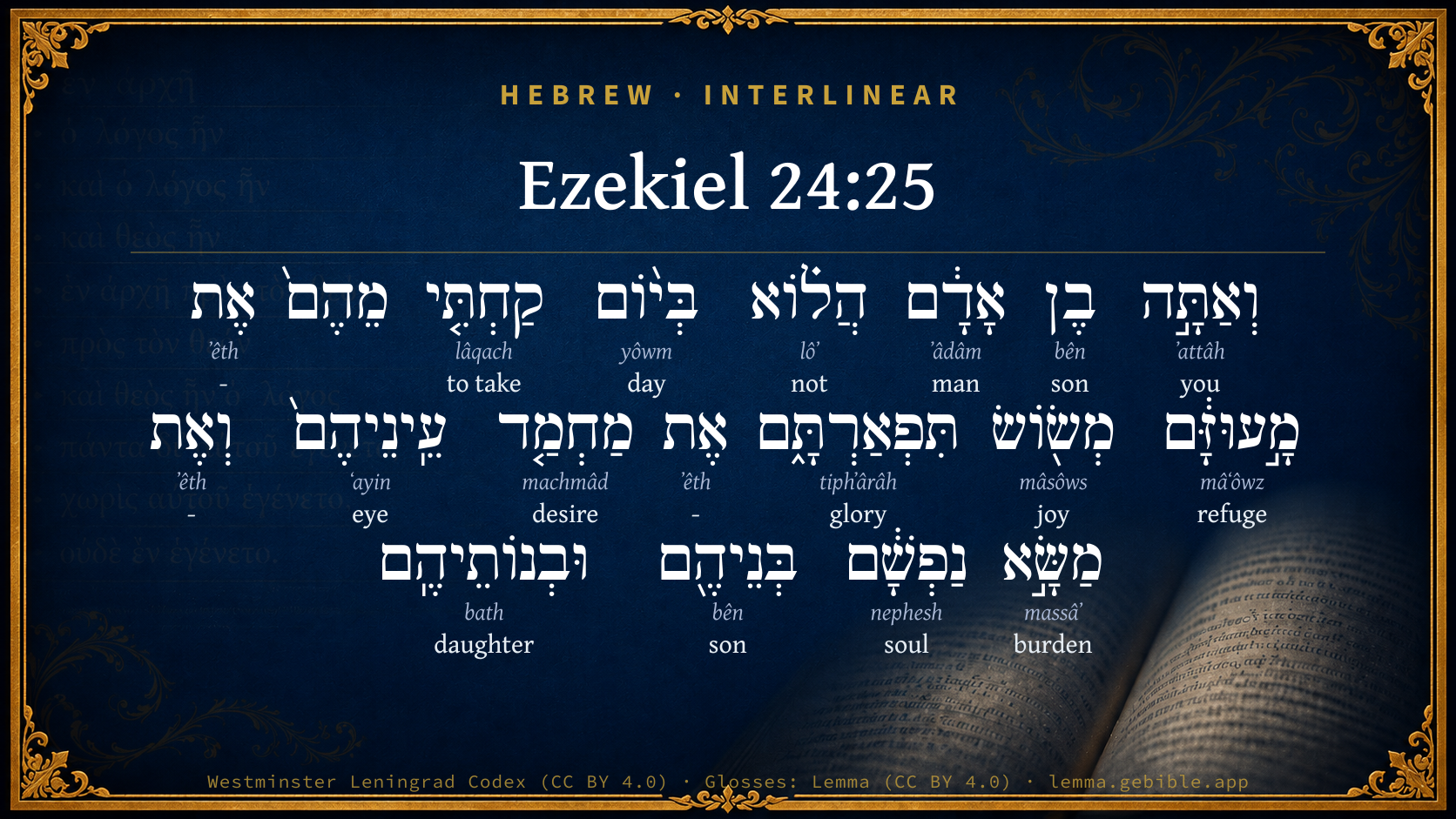
  1. וְאַתָּ֣ה ʼattâh H859 “and · you” Conjunction + Pronoun, Personal, 2nd Person, Masculine, Singular
  2. בֶן bên H1121 “son of” Noun, Common, Masculine, Singular, Construct
  3. אָדָ֔ם ʼâdâm H120 “man” Noun, Common, Masculine, Singular, Absolute
  4. הֲל֗וֹא lôʼ H3808 “not” Particle, Interrogative + Particle, Negative
  5. בְּי֨וֹם yôwm H3117 “in/at · day of” Preposition + Noun, Common, Masculine, Singular, Construct
  6. קַחְתִּ֤י lâqach H3947 “to take · me” Verb, Qal, Infinitive Construct + Suffix, Personal, 1st Person, Common, Singular
  7. אֶת ʼêth H853 “-” Particle, Direct Object
  8. מָ֣עוּזָּ֔ם mâʻôwz H4581 “refuge · their” Noun, Common, Masculine, Singular, Construct + Suffix, Personal, 3rd Person, Masculine, Plural
  9. מְשׂ֖וֹשׂ mâsôws H4885 “joy of” Noun, Common, Masculine, Singular, Construct
  10. תִּפְאַרְתָּ֑ם tiphʼârâh H8597 “glory · their” Noun, Common, Feminine, Singular, Construct + Suffix, Personal, 3rd Person, Masculine, Plural
  11. אֶת ʼêth H853 “-” Particle, Direct Object
  12. עֵֽינֵיהֶם֙ ʻayin H5869 “eyes · their” Noun, Common, Both, Dual, Construct + Suffix, Personal, 3rd Person, Masculine, Plural
  13. וְאֶת ʼêth H853 “and · -” Conjunction + Particle, Direct Object
  14. מַשָּׂ֣א massâʼ H4853 “burden of” Noun, Common, Masculine, Singular, Construct
  15. נַפְשָׁ֔ם nephesh H5315 “soul · their” Noun, Common, Both, Singular, Construct + Suffix, Personal, 3rd Person, Masculine, Plural
  16. בְּנֵיהֶ֖ם bên H1121 “sons · their” Noun, Common, Masculine, Plural, Construct + Suffix, Personal, 3rd Person, Masculine, Plural
  17. וּבְנוֹתֵיהֶֽם bath H1323 “and · daughters · their” Conjunction + Noun, Common, Feminine, Plural, Construct + Suffix, Personal, 3rd Person, Masculine, Plural

About this verse

These counts appear in no published source. They are computed here, from the morphology-tagged text and Lemma’s own curated glosses. What Lemma adds →

19
words
15
distinct lemmas
Prophets
section

Notable vocabulary

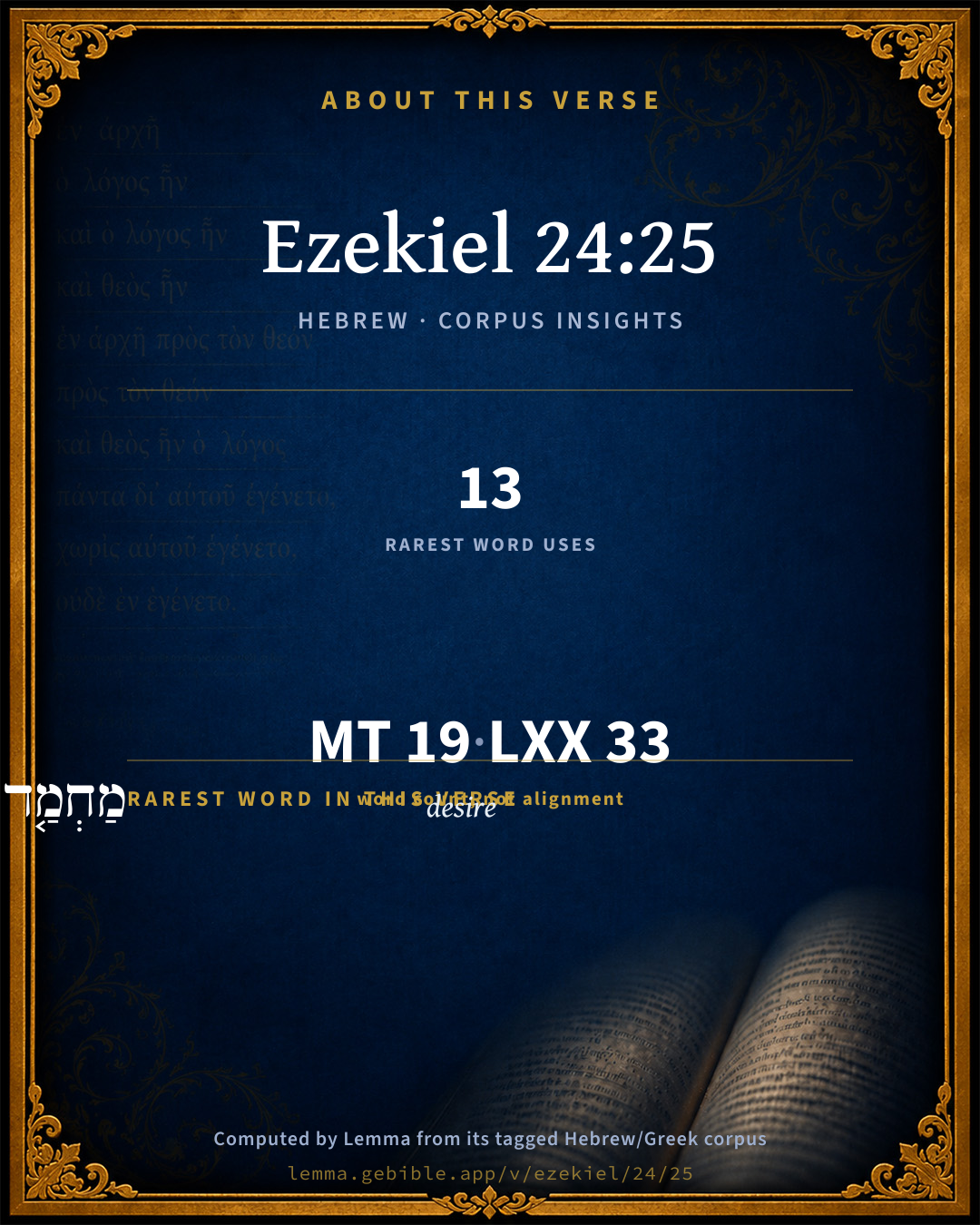
The rarest word here is מַחְמַ֤ד desire H4261 — appearing just 13 times in the whole Hebrew Bible.

Shared distinctive vocabulary

מַחְמַ֤ד desire H4261 occurs in 13 verses of the Hebrew Bible. Also found in:

Grammatical profile

  • 1 verb
  • 12 nouns
  • 1 pronoun
  • 1 preposition
  • 4 particles

Verb forms

  • קַחְתִּ֤י Qal · Infinitive Construct

Repetition

A word recurs within this verse — often emphatic in Hebrew:

Hebrew & Septuagint length

In English translation the verse runs 40 words from the Hebrew and 40 from the Septuagint (LXX English) — the same length.

A rough comparison of the two English renderings, which tokenize alike — not a word-level alignment.

Word counts can differ between the Hebrew and the Greek without any difference in meaning — e.g. the Hebrew direct-object marker אֵת has no separate Greek word, and Greek often adds the article ὁ.

In the original languages it is 19 Hebrew tokens and 33 Greek tokens — but the two are counted differently (Hebrew bundles its prefixes and suffixes into one token; the Greek is in lemma form), so that isn’t a like-for-like length.

Cross-references

8

Topical passages linked to Ezekiel 24:25 in the Treasury of Scripture Knowledge — connected by theme and wording, ordered by reader-vote popularity; previews shown in the World English Bible.

  • Ezekiel 24:21 Speak to the house of Israel, Thus says the Lord Yahweh: Behold, I will profane my sanctuary, the pride of your power, the desire of your eyes, and that which your soul pities; and your sons and your daughters whom you have left behind shall fall by the sword.
  • Psalms 48:2 Beautiful in elevation, the joy of the whole earth, Is Mount Zion, on the north sides, The city of the great King.
  • Psalms 50:2 Out of Zion, the perfection of beauty, God shines forth.
  • Jeremiah 11:22 therefore thus says Yahweh of hosts, Behold, I will punish them: the young men shall die by the sword; their sons and their daughters shall die by famine;
  • Deuteronomy 28:32 Your sons and your daughters shall be given to another people; and your eyes shall look, and fail with longing for them all the day: and there shall be nothing in the power of your hand.
  • Psalms 122:1–9 I was glad when they said to me, "Let's go to Yahweh's house!"
  • Jeremiah 7:4 Don't you trust in lying words, saying, The temple of Yahweh, the temple of Yahweh, the temple of Yahweh, are these.
  • Jeremiah 52:10 The king of Babylon killed the sons of Zedekiah before his eyes: he killed also all the princes of Judah in Riblah.

Cross-references courtesy of OpenBible.info (CC BY 4.0).

Hebrew and Greek witnesses Masoretic Hebrew ↔ Greek Septuagint

The same verse in the two great witnesses to the Old Testament, shown verse-for-verse.

These are two independent witnesses, not word-aligned to each other, and the Septuagint is shown in lemma (dictionary) form.

Hebrew Ezekiel 24:25 Masoretic · Westminster Leningrad Codex

וְאַתָּ֣ה בֶן אָדָ֔ם הֲל֗וֹא בְּי֨וֹם קַחְתִּ֤י מֵהֶם֙ אֶת מָ֣עוּזָּ֔ם מְשׂ֖וֹשׂ תִּפְאַרְתָּ֑ם אֶת מַחְמַ֤ד עֵֽינֵיהֶם֙ וְאֶת מַשָּׂ֣א נַפְשָׁ֔ם בְּנֵיהֶ֖ם וּבְנוֹתֵיהֶֽם

You, son of man, shall it not be in the day when I take from them their strength, the joy of their glory, the desire of their eyes, and that whereupon they set their heart, their sons and their daughters,

World English Bible · Public Domain

Greek LXX Ezekiel 24:25 Septuagint · lemma form

καί σύ υἱός ἄνθρωπος οὐ ἐν ὁ ἡμέρα ὅταν λαμβάνω ὁ ἰσχύς παρά αὐτός ὁ ἔπαρσις ὁ καύχησις αὐτός ὁ ἐπιθύμημα ὀφθαλμός αὐτός καί ὁ ἔπαρσις ψυχή αὐτός υἱός αὐτός καί θυγάτηρ αὐτός

And you, son of man, shall it not be in the day when I take their strength from them, the pride of their boasting, the desires of their eyes, and the pride of their soul, their sons and their daughters,

LXX2012 (modern English Septuagint) · Public Domain

Hebrew: Westminster Leningrad Codex (CC BY 4.0). Greek: Septuagint (public domain); English from LXX2012 (modern English Septuagint) (Public Domain). How the Septuagint differs from the Hebrew →

Targum (Aramaic paraphrase)

1

The Targum is the ancient Jewish Aramaic paraphrase of the Hebrew Scriptures — an interpretive translation, not the Hebrew text itself. Onkelos (literal) and Pseudo-Jonathan (expansive) render the Torah, and Jonathan the Prophets. Coverage is partial: where no permissively-licensed English translation exists for a verse, only the Aramaic is shown. This is verse-level text, not a word-by-word alignment to the Hebrew.

  1. Targum Jonathan Prophets (Joshua–Malachi)
    וְאַתְּ בַּר אָדָם הֲלָא בְּיוֹמָא דְאַעֲדִי מִנְהוֹן יַת בֵּית מִקְדָשֵׁיהוֹן יְקַר תּוּקְפֵהוֹן חֶדְוַת תּוּשְׁבַּחְתְּהוֹן יִתְנְסִיב מִנְהוֹן רִגְגָא דְעֵינֵיהוֹן וְחַבּוּב נַפְשְׁהוֹן דְטַב לְהוֹן מִבְּנֵיהוֹן וּמִבְנָתֵיהוֹן:

    (no public-domain English translation for this verse)

    Targum Jonathan — Aramaic: “Mikraot Gedolot” (public domain). English: “Sefaria Community Translation” (CC0 1.0 (public-domain dedication)); “London "Chaldee Paraphrase," 1871” (public domain). Text via Sefaria.

Commentary

Notes on Ezekiel 24:25 from classic Christian and Jewish commentators (each source and its license shown beneath its notes). The classic Christian expositions comment on the surrounding passage and are grouped to its opening verse, so a note may address several verses; the Jewish commentaries on the Tanakh (Rashi and others) are per-verse, so they appear only where the commentator wrote on this verse.

Lemma curates 59 commentaries, every one of them public domain or Creative Commons licensed, each selected and text-cleaned for this edition rather than reprinted as found. About our sources →

Trapp's Complete Commentary

John Trapp

Eze 24:25 Also, thou son of man, [shall it] not [be] in the day when I take from them their strength, the joy of their glory, the desire of their eyes, and that whereupon they set their minds, their sons and their daughters,

Ver. 25. When I take from them their strength.] Their kingdom, temple, all.

And that whereupon they set their minds.] Heb., The lifting up of the soul, or the burden of their souls, that whereof they are most solicitous.

John Trapp, A Commentary or Exposition upon All the Books of the Old and New Testament (1647–1656) — public domain. Text from a community e-Sword module.

Joseph Benson's Commentary

Eze 24:25-27. Also thou son of man, shall it not be, &c. — This question is to be resolved affirmatively; it shall be: in the day when I take from them their strength — Their walls, fortifications, and defences, with all that is dear and valuable to them; the joy of their glory, the desire of their eyes — Their kingdom, city, and temple, the emblem of my special presence among them, and protection over them, whose beauty and magnificence were their peculiar glory, and the most grateful object of their sight; together with their sons and daughters, whereon they placed their affections; he that escapeth in that day — Namely, when the city shall be taken, and both it and the temple burned; shall come unto thee, to cause thee to hear it, &c. — To acquaint thee, that what thou didst prophesy is come to pass. See the fulfilling of this recorded Eze 33:21-22. In that day shall thy mouth be opened to him that is escaped — This implied, that the prophet was to prophesy no more about the affairs of Jerusalem and Judah till after the destruction of the city and temple; when the fulfilling of this part of his predictions, so contrary to the expectations of those who despised his prophecies, would give him more credit with them, and make them pay a higher regard to what other things he should prophesy of. According to this we find, that the spirit of prophecy, in regard to the affairs of Judea, did not come on him again till the news of the taking of Jerusalem was brought to him. See Eze 3:21-23.

Joseph Benson's Commentary on the Old and New Testaments (1811–1818) — public domain. Text from a community e-Sword module.

Keil & Delitzsch

C. F. Keil & F. Delitzsch

Sequel of the Destruction of Jerusalem to the Prophet Himself

Eze 24:25. And thou, son of man, behold, in the day when I take from them their might, their glorious joy, the delight of their eyes and the desire of their soul, their sons and their daughters, Eze 24:26. In that day will a fugitive come to thee, to tell it to thine ears. Eze 24:27. In that day will thy mouth be opened with the fugitive, and thou wilt speak, and no longer be mute; and thus shalt thou be a sign to them that they may know that I am Jehovah. - As the destruction of Jerusalem would exert a powerful influence upon the future history of the exiles on the Chaboras, and be followed by most important results, so was it also to be a turning-point for the prophet himself in the execution of his calling. Hvernick has thus correctly explained the connection between these closing verses and what precedes, as indicated by ואתּה in Eze 24:25. As Ezekiel up to this time was to speak to the people only when the Lord gave him a word for them, and at other times was to remain silent and dumb (Eze 3:26 and Eze 3:27); from the day on which a messenger should come to bring him the tidings of the destruction of Jerusalem and the temple, he was to open his mouth, and not continue dumb any longer. The execution of this word of God is related in Eze 33:21-22. The words, "when I take from them their strength," etc., are to be understood in accordance with Eze 24:21. Consequently מעזּם is the sanctuary, which was taken from the Israelites through the destruction of Jerusalem. The predicates which follow down to משּׂא refer to the temple (cf. Eze 24:21). משּׂא נפשׁ, an object toward which the soul lifts itself up (נשׂא), i.e., for which it cherishes a desire or longing; hence synonymous with מחמל נפשׁ htiw suomynon in Eze 24:21. The sons and daughters are attached ἀσυνδετῶς. בּיּום (in that day), in Eze 24:26, which resumes the words 'בּיום ק (in the day when I take, etc.) in Eze 24:25, is not the day of the destruction of the temple, but generally the time of this event, or more precisely, the day on which the tidings would reach the prophet. הפּליט, with the generic article, a fugitive (vid., Gen 14:13). להשׁמעוּת אזנים, to cause the ears to hear (it), i.e., to relate it, namely to the bodily ears of the prophet, whereas he had already heard it in spirit from God. השׁמעוּת, a verbal noun, used instead of the infinitive Hiphil. את־הפּליט, with the escaped one, i.e., at the same time "with the mouth of the fugitive" (Hitzig). את expresses association, or so far as the fact is concerned, simultaneousness. The words,"then wilt thou speak, and no longer be dumb," do not imply that it was only from that time forward that Ezekiel was to keep silence, but point back to Eze 3:26 and Eze 3:27, where silence is imposed upon him, with the exceptions mentioned there, from the very commencement of his ministry; and in comparison with that passage, simply involve implicite the thought that the silence imposed upon him then was to be observed in the strictest manner from the present time until the reception of the intelligence of the fall of Jerusalem, when his mouth would be opened once more. Through the "words of God" that were given to His prophet (Ezekiel 4-24), the Lord had now said to the people of Israel all that He had to say concerning the approaching catastrophe for them to consider and lay to heart, that they might be brought to acknowledge their sin, and turn with sorrow and repentance to their God. Therefore was Ezekiel from this time forward to keep perfect silence toward Israel, and to let God the Lord speak by His acts and the execution of His threatening words. It was not till after the judgment had commenced that his mouth was to be opened again for still further announcements (vid., Eze 33:22). - Ezekiel was thereby to become a sign to the Israelites. These words have a somewhat different meaning in Eze 24:27 from that which they have in Eze 24:24. There, Ezekiel, by the way in which he behaved at the death of his wife, was to be a sign to the people of the manner in which they were to act when the judgment should fall upon Jerusalem; whereas here (Eze 24:27), למופת refers to the whole of the ministry of the prophet, his silence hitherto, and that which he was still to observe, as well as his future words. Through both of these he was to exhibit himself to his countrymen as a man whose silence, speech, and action were alike marvellous and full of meaning to them, and all designed to lead them to the knowledge of the Lord, the God of their salvation.

Keil & Delitzsch — Biblical Commentary on the Old Testament (1861–1891) — public domain (CC PDM 1.0). Text via the HelloAO Bible API. (Old Testament only.)

Tyndale Open Study Notes

Tyndale Open Resources

24:25-27 In the midst of this deep gloom and woe, on the very day when a survivor would arrive to confirm the fall of Jerusalem, there would also be a sign of hope for the people. On that day, Ezekiel’s voice would suddenly return (see 3:26), and he would once again be able to pray to God for the people and intercede on their behalf. The final destruction of Jerusalem would complete the full outpouring of God’s wrath and fury. On that day, Ezekiel would finally be able to speak words of hope to the shattered remnant of the exiles, so that they might know the Lord.

Tyndale Open Study Notes — © Tyndale Open Resources, licensed CC BY-SA 4.0. Text via the HelloAO Bible API.

Geneva Bible (1599)

Geneva Bible translators

Hebrew, lifting up of their souls.

Geneva Bible (1599) marginal notes — public domain. Text via Bolls.life.

Jamieson, Fausset & Brown

Robert Jamieson, A. R. Fausset & David Brown

"The day" referred to in these verses is the day of the overthrow of the temple, when the fugitive "escapes." But "that day," in Eze 24:27, is the day on which the fugitive brings the sad news to Ezekiel, at the Chebar. In the interval the prophet suspended his prophecies as to the Jews, as was foretold. Afterwards his mouth was "opened," and no more "dumb" (Eze 3:26-27; compare Eze 24:27; Eze 33:21-22).

If Israel was not spared, much less the heathen utterly corrupt, and having no mixture of truth, such as Israel in its worst state possessed (Pe1 4:17-18). Their ruin was to be utter: Israel's but temporary (Jer 46:28). The nations denounced are seven, the perfect number; implying that God's judgments would visit, not merely these, but the whole round of the heathen foes of God. Babylon is excepted, because she is now for the present viewed as the rod of God's retributive justice, a view too much then lost sight of by those who fretted against her universal supremacy.

Next: Ezekiel Chapter 25

Jamieson, Fausset & Brown — Commentary Critical and Explanatory on the Whole Bible (1871) — public domain (CC PDM 1.0). Text via the HelloAO Bible API.

The Cambridge Bible for Schools and Colleges

gen. ed. J. J. S. Perowne

25. their strength] i.e. stronghold; the thing in which they placed confidence.

joy of their glory] the glorious (or beautiful) thing in which they delighted. Both expressions allude to the temple, &c.

set their minds] their hearts,—that which is the object of their desire, Psa_24:4.

25–27. When tidings come of the city’s fall, verifying the prophet’s predictions and giving confirmation to all the principles which he had long declared, his mouth will be opened, he will have confidence to speak and more willing listeners before him.

The Cambridge Bible for Schools and Colleges (gen. ed. J. J. S. Perowne; Cambridge University Press, 1878–1918) — public domain. Text from a community e-Sword module.

John Gill's Exposition

That he that escapeth in that day shall come unto thee,.... That is, that one that should escape the hands of the Chaldeans, when the city should be taken, should directly make the best of his way to the prophet:

to cause thee to hear it with thine ears; all the particulars of the destruction of the city and temple, as it had been represented to him in vision; when he would see the exact agreement between prophecy and facts; see Eze 33:21.

John Gill's Exposition of the Whole Bible (1746–1763) — public domain (CC PDM 1.0). Text via the HelloAO Bible API.

Matthew Poole's English Annotations

Shall it not be? the question is to be resolved affirmatively, it shall be.

In the day; in the day of the taking the city of Jerusalem.

When I take from them; though Nebuchadnezzar was the means or instrument, God did act by him, who did God’s work more than his own.

Their strength, & c.; the kingdom dissolved, the king taken, city sacked, the temple burnt, which is by the following characters described, as the only thing they valued; though those particulars may be applied to soils and daughters in the close of the verse: however, it amounts to this, In that day, wherein all their public and private joys and hopes shall be destroyed in the destruction of the kingdom and their children, one that escapeth shall bring the news to the prophet.

Matthew Poole's English Annotations on the Holy Bible (1683–1685) — public domain. Text from a community e-Sword/MySword module.

Whedon's Commentary on the Bible

Daniel D. Whedon

25. That whereupon they set their minds — Hebrews, the lifting up of their soul.

Daniel D. Whedon (gen. ed.), Commentary on the Old and New Testaments (1874–1909) — public domain. Text from a community e-Sword module.

John Wesley's Explanatory Notes

Their strength - Their walls and fortifications. The joy - All their public and private joys and hopes shall be destroyed in the destruction of the kingdom, and their children.

John Wesley, Explanatory Notes Upon the Whole Bible (1754–1765) — public domain. Text via the GEBible commentary corpus.

unfoldingWord translationNotes

Door43 World Missions Community

that I capture their temple

Here Yahweh speaks of destroying the temple as if it were someone that he was capturing. AT: "that I destroy their temple"

which is their joy, their pride

The abstract nouns "joy" and "pride" can be translated as noun phrases. AT: "which is what they are joyful about and what they are proud of" (See: Metaphor)

refugee

someone who has been forced to leave their country because of war or another disaster

your mouth will be opened up

This can be stated in active form. Ezekiel being given understanding and the ability to speak is represented by his mouth being opened. AT: "I will open your mouth" or "you will know what to say" or "I will cause you to know what to say" (See: Active or Passive and Synecdoche)

you will speak—you will no longer be silent

Both of these phrases mean that Ezekiel will speak. In the second phrase it is stated in negative form to emphasize that he will speak. (See: Litotes)

You will be a sign for them

Here the word "sign" refers to something that communicates a special warning to those who see it. Yahweh speaks of Ezekiel and his actions as being this warning. See how you translated this metaphor in Ezekiel 12:6. AT: "You will be a warning for them" (See: Metaphor)

know that I am Yahweh

When Yahweh says that people will know that he is Yahweh, he is implying that they will know that he is the one true God who has supreme authority and power. See how you translated this in Ezekiel 6:7. AT: "understand that I am Yahweh, the one true God" or "realize that I, Yahweh, have supreme power and authority" (See: Assumed Knowledge and Implicit Information)

translationWords

joy

unfoldingWord translationNotes — © Distant Shores Media and the Door43 World Missions Community, licensed CC BY-SA 4.0. Source: git.door43.org/Door43/en_tn.

Rashi

Rabbi Shlomo Yitzchaki (Rashi)

the pride of their soul [Heb. מַשָׂא נַפְשָׂם.] Their soul is uplifted through them.

Rashi on the Tanakh — English translations: “The Judaica Press complete Tanach with Rashi, translated by A. J. Rosenberg” (CC BY 4.0); “Pentateuch with Rashi's commentary by M. Rosenbaum and A.M. Silbermann, 1929-1934” (public domain); “The Metsudah Tanach series, Lakewood, N.J” (CC BY 4.0); and “The Book of Joshua, Metsudah Publications, 1997” (CC BY 4.0). Text via Sefaria.

Lesson kit

Teaching starters — assembled from the data on this page, not authored interpretation. Every prompt links to the verse data it draws on. Edit before teaching.

Ezekiel, in the Prophets, opens this verse with 19 words (15 distinct Hebrew lemmas). Its most distinctive word is machmâd (“desire”). A historical commentator’s framing appears above. Read the whole chapter for the surrounding context.

Discussion questions

  1. What does “desire” (machmâd) contribute to the verse as a whole?
  2. 1 Kings 20:6 shares the word «desire» with this verse. How do the two illuminate each other?
  3. “son” occurs 2× in this one verse. What is the effect of the repetition?
  4. These translations render this verse differently; the difference is in the English rendering, not the original. What questions does that raise?
  5. The verb «קַחְתִּ֤י» is Qal Infinitive Construct. How does its form color the action?
  6. Reading how Trapp's Complete Commentary and Joseph Benson's Commentary read this verse, where do the two commentators agree and where do they part?

Things to notice

Reading settings

Reading text

Shown beneath each verse's original-language words.

Old Testament
Old Testament edition

Read the OT as the Masoretic Hebrew (MT) or the Greek Septuagint (LXX).

English shown for the Greek Septuagint (in the Hebrew ↔ Greek comparison).

Comparing translations? Open the Compare panel on any verse page to stack up to four side by side.