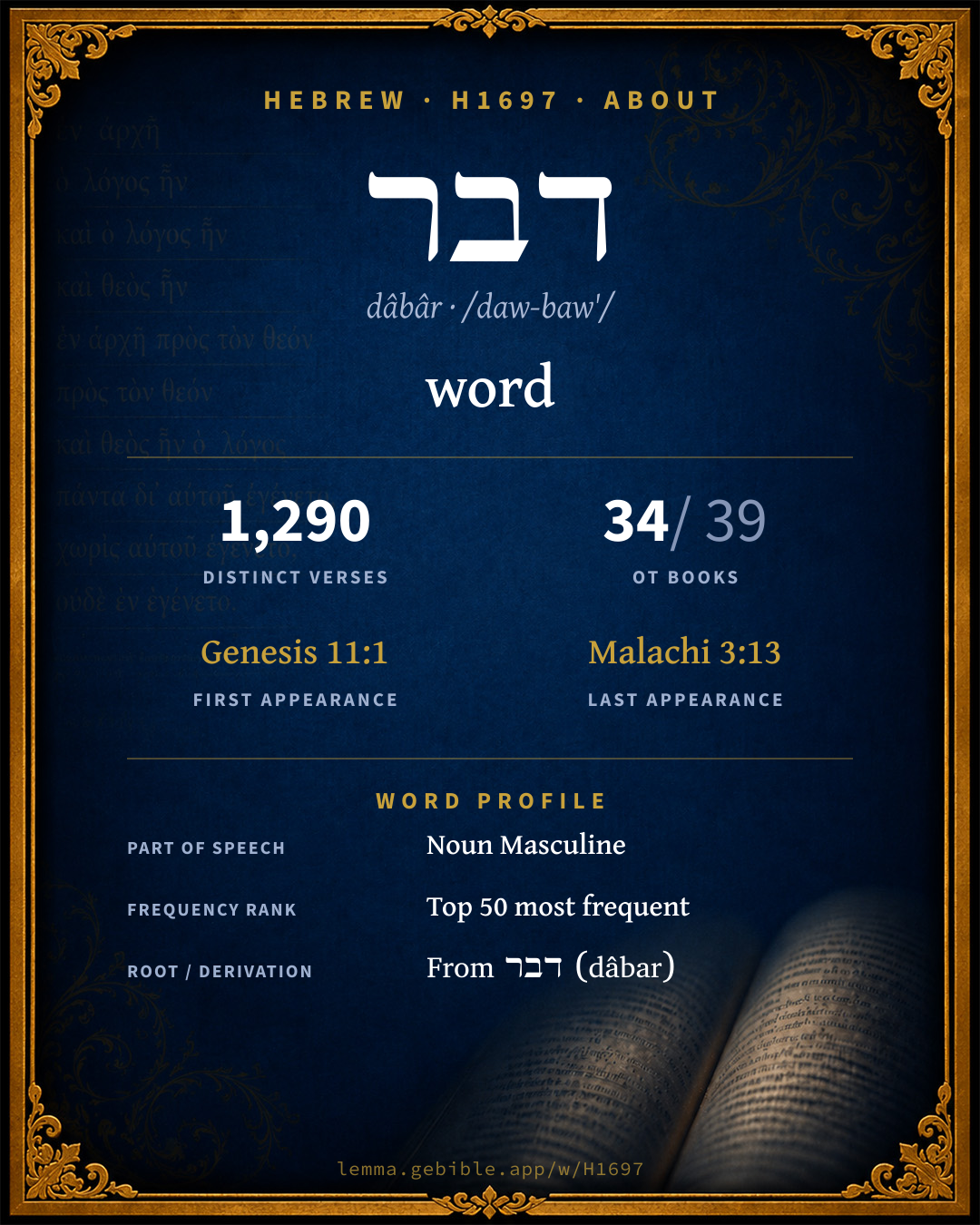
דָּבָר
word
also: speech, speaking, thing fuller range ↓
Full lexicon entry — Brown-Driver-Briggs (BDB)
From Brown-Driver-Briggs (BDB)
Where this word appears
See every Construct-state word in the Hebrew Bible →
Grammar key — what these labels mean
Part of speech
- Noun
- A naming word — a person, place, thing, or idea.
Noun type
- Common
- A common noun — a general class of person, place, or thing (“king,” “city,” “water”), not a specific name.
- Proper
- A name of a specific person, place, or people (e.g. Abraham, Zion, Israel).
Stem
- Qal
- The basic, simple active stem — the plain form of the verb (“he wrote”).
Form
- Sequential Imperfect
- An imperfect with prefixed waw — the standard past-narrative form (waw-consecutive imperfect).
State
- Construct
- A noun bound to a following noun in a possessive / “of” relationship (the construct chain).
- Absolute
- The independent form of a noun, not bound to a following word.
Person
- 3rd Person
- The one spoken about (“he / she / it / they”).
- 2nd Person
- The one addressed (“you”).
Gender
- Masculine
- Grammatically masculine.
Number
- Singular
- One.
- Plural
- More than one (in Hebrew, generally three or more).
38 verses where H1697 appears in the Absolute state in the Book of 1 Kings. Filtered view — show all forms. Click any verse to open its interlinear word-by-word view. Verse text shown in the World English Bible for context — . Each verse’s Hebrew form is shown with its reference; the English is not keyword-highlighted, since the data carries no word-level English alignment. Use “Compare translations” on any verse to read it across multiple English versions. This concordance covers the Hebrew Bible; Septuagint (Greek Old Testament) occurrences are not indexed here.
1 Kings
- 1 Kings 1:27 הַ/דָּבָ֣ר ptcl def.art + n c ms Is this thing done by my lord the king, and you haven't shown to your servants who should sit on the throne of my lord the king after him?
- 1 Kings 2:14 דָּבָ֥ר n c ms He said moreover, I have somewhat to tell you. She said, Say on.
- 1 Kings 2:23 הַ/דָּבָ֖ר ptcl def.art + n c ms Then king Solomon swore by Yahweh, saying, God do so to me, and more also, if Adonijah has not spoken this word against his own life.
- 1 Kings 2:30 דָּבָ֣ר n c ms Benaiah came to the Tent of Yahweh, and said to him, Thus says the king, Come forth. He said, No; but I will die here. Benaiah brought the king word again, saying, Thus said Joab, and thus he answered me.
- 1 Kings 2:38 הַ/דָּבָ֔ר ptcl def.art + n c ms Shimei said to the king, The saying is good: as my lord the king has said, so will your servant do. Shimei lived in Jerusalem many days.
- 1 Kings 2:42 הַ/דָּבָ֖ר ptcl def.art + n c ms The king sent and called for Shimei, and said to him, Didn't I adjure you by Yahweh, and protest to you, saying, Know for certain, that on the day you go out, and walk abroad any where, you shall surely die? and you said to me, The saying that I have heard is good.
- 1 Kings 3:10 הַ/דָּבָ֖ר הַ/דָּבָ֖ר ptcl def.art + n c ms ptcl def.art + n c ms The speech pleased the Lord, that Solomon had asked this thing.
- 1 Kings 3:11 הַ/דָּבָ֣ר ptcl def.art + n c ms God said to him, Because you have asked this thing, and have not asked for yourself long life, neither have asked riches for yourself, nor have asked the life of your enemies, but have asked for yourself understanding to discern justice;
- 1 Kings 4:27 דָּבָֽר n c ms Those officers provided food for king Solomon, and for all who came to king Solomon's table, every man in his month; they let nothing be lacking.
- 1 Kings 8:56 דָּבָ֣ר דְּבָר֣/וֹ n c ms n c ms cs + sfx pers 3ms Blessed be Yahweh, who has given rest to his people Israel, according to all that he promised: there has not failed one word of all his good promise, which he promised by Moses his servant.
- 1 Kings 10:3 דְּבָרֶ֑י/הָ דָּבָר֙ n c mp cs + sfx pers 3fs n c ms Solomon told her all her questions: there was not anything hidden from the king which he didn't tell her.
- 1 Kings 10:6 הַ/דָּבָ֔ר דְּבָרֶ֖י/ךָ ptcl def.art + n c ms n c mp cs + sfx pers 2ms She said to the king, It was a true report that I heard in my own land of your acts, and of your wisdom.
- 1 Kings 10:7 לַ/דְּבָרִ֗ים prep det + n c mp However I didn't believe the words, until I came, and my eyes had seen it: and, behold, the half was not told me; your wisdom and prosperity exceed the fame which I heard.
- 1 Kings 11:10 הַ/דָּבָ֣ר ptcl def.art + n c ms and had commanded him concerning this thing, that he should not go after other gods: but he didn't keep that which Yahweh commanded.
- 1 Kings 11:27 הַ/דָּבָ֔ר ptcl def.art + n c ms This was the reason why he lifted up his hand against the king: Solomon built Millo, and repaired the breach of the city of David his father.
- 1 Kings 12:6 דָּבָֽר n c ms King Rehoboam took counsel with the old men, who had stood before Solomon his father while he yet lived, saying, What counsel give you me to return answer to this people?
- 1 Kings 12:7 דְּבָרִ֣ים n c mp They spoke to him, saying, If you will be a servant to this people this day, and will serve them, and answer them, and speak good words to them, then they will be your servants forever.
- 1 Kings 12:9 דָּבָ֖ר n c ms He said to them, What counsel do you give, that we may return answer to this people, who have spoken to me, saying, Make the yoke that your father did put on us lighter?
- 1 Kings 12:16 דָּבָ֣ר n c ms When all Israel saw that the king didn't listen to them, the people answered the king, saying, What portion have we in David? neither have we inheritance in the son of Jesse: to your tents, Israel: now see to your own house, David. So Israel departed to their tents.
- 1 Kings 12:24 הַ/דָּבָ֣ר דְּבַ֣ר כִּ/דְבַ֥ר ptcl def.art + n c ms n c ms cs prep + n c ms cs Thus says Yahweh, You shall not go up, nor fight against your brothers the children of Israel: return every man to his house; for this thing is of me. So they listened to the word of Yahweh, and returned and went their way, according to the word of Yahweh.
- 1 Kings 12:30 הַ/דָּבָ֥ר ptcl def.art + n c ms This thing became a sin; for the people went [to worship] before the one, even to Dan.
- 1 Kings 13:11 הַ/דְּבָרִים֙ ptcl def.art + n c mp Now there lived an old prophet in Bethel; and one of his sons came and told him all the works that the man of God had done that day in Bethel: the words which he had spoken to the king, them also they told to their father.
- 1 Kings 13:17 דָבָ֤ר בִּ/דְבַ֣ר n c ms prep + n c ms cs for it was said to me by the word of Yahweh, You shall eat no bread nor drink water there, nor turn again to go by the way that you came.
- 1 Kings 13:32 הַ/דָּבָ֗ר בִּ/דְבַ֣ר ptcl def.art + n c ms prep + n c ms cs For the saying which he cried by the word of Yahweh against the altar in Bethel, and against all the houses of the high places which are in the cities of Samaria, shall surely happen.
- 1 Kings 13:33 הַ/דָּבָ֣ר ptcl def.art + n c ms After this thing Jeroboam didn't return from his evil way, but made again from among all the people priests of the high places: whoever would, he consecrated him, that there might be priests of the high places.
- 1 Kings 13:34 בַּ/דָּבָ֣ר prep det + n c ms This thing became sin to the house of Jeroboam, even to cut it off, and to destroy it from off the surface of the earth.
- 1 Kings 14:5 דָּבָ֨ר n c ms Yahweh said to Ahijah, Behold, the wife of Jeroboam comes to inquire of you concerning her son; for he is sick: thus and thus shall you tell her; for it will be, when she comes in, that she will feign herself to be another woman.
- 1 Kings 14:13 דָּבָ֣ר n c ms All Israel shall mourn for him, and bury him; for he only of Jeroboam shall come to the grave, because in him there is found some good thing toward Yahweh, the God of Israel, in the house of Jeroboam.
- 1 Kings 17:17 הַ/דְּבָרִ֣ים ptcl def.art + n c mp It happened after these things, that the son of the woman, the mistress of the house, fell sick; and his sickness was so sore, that there was no breath left in him.
- 1 Kings 18:21 דָּבָֽר n c ms Elijah came near to all the people, and said, "How long will you waver between the two sides? If Yahweh is God, follow him; but if Baal, then follow him." The people answered him not a word.
- 1 Kings 18:24 הַ/דָּבָֽר ptcl def.art + n c ms You call on the name of your god, and I will call on the name of Yahweh; and the God who answers by fire, let him be God." All the people answered, "It is well said."
- 1 Kings 18:36 ו/ב/דברי/ך וּ/בִ/דְבָרְ/ךָ֣ הַ/דְּבָרִ֖ים conj + prep + n c mp cs + sfx pers 2ms conj + prep + n c ms cs + sfx pers 2ms ptcl def.art + n c mp It happened at the time of the offering of the [evening] offering, that Elijah the prophet came near, and said, Yahweh, the God of Abraham, of Isaac, and of Israel, let it be known this day that you are God in Israel, and that I am your servant, and that I have done all these things at your word.
- 1 Kings 20:9 וְ/הַ/דָּבָ֣ר דָּבָֽר conj + ptcl def.art + n c ms n c ms Therefore he said to the messengers of Ben Hadad, Tell my lord the king, All that you did send for to your servant at the first I will do; but this thing I may not do. The messengers departed, and brought him word again.
- 1 Kings 20:12 הַ/דָּבָ֣ר ptcl def.art + n c ms It happened, when [Ben Hadad] heard this message, as he was drinking, he and the kings, in the pavilions, that he said to his servants, Set [yourselves in array]. They set [themselves in array] against the city.
- 1 Kings 20:24 הַ/דָּבָ֥ר ptcl def.art + n c ms Do this thing: take the kings away, every man out of his place, and put captains in their room;
- 1 Kings 21:1 הַ/דְּבָרִ֣ים ptcl def.art + n c mp It happened after these things, that Naboth the Jezreelite had a vineyard, which was in Jezreel, hard by the palace of Ahab king of Samaria.
- 1 Kings 21:4 הַ/דָּבָר֙ ptcl def.art + n c ms Ahab came into his house sullen and angry because of the word which Naboth the Jezreelite had spoken to him; for he had said, I will not give you the inheritance of my fathers. He laid him down on his bed, and turned away his face, and would eat no bread.
- 1 Kings 21:27 הַ/דְּבָרִ֤ים ptcl def.art + n c mp It happened, when Ahab heard those words, that he tore his clothes, and put sackcloth on his flesh, and fasted, and lay in sackcloth, and went softly.
About this entry
At a glance — auto-summarized from this page’s data, not written by a person. Every figure links to its source below. This summary describes the numbers; it doesn’t interpret them.
At its core, דבר (dâbâr) means “word.” Alongside “word” the lexicon also lists “speech”, “speaking”, and “thing” — part of its full sense range. With 1,290 verses in 34 books, it is one of the most common word in the Hebrew Bible. Debuting at Genesis 11:1, it then recurs through the corpus. Sharing its root, it stands alongside דבר, דבורה and דביר. Dig into 1,290-verse concordance and the renderings breakdown below.
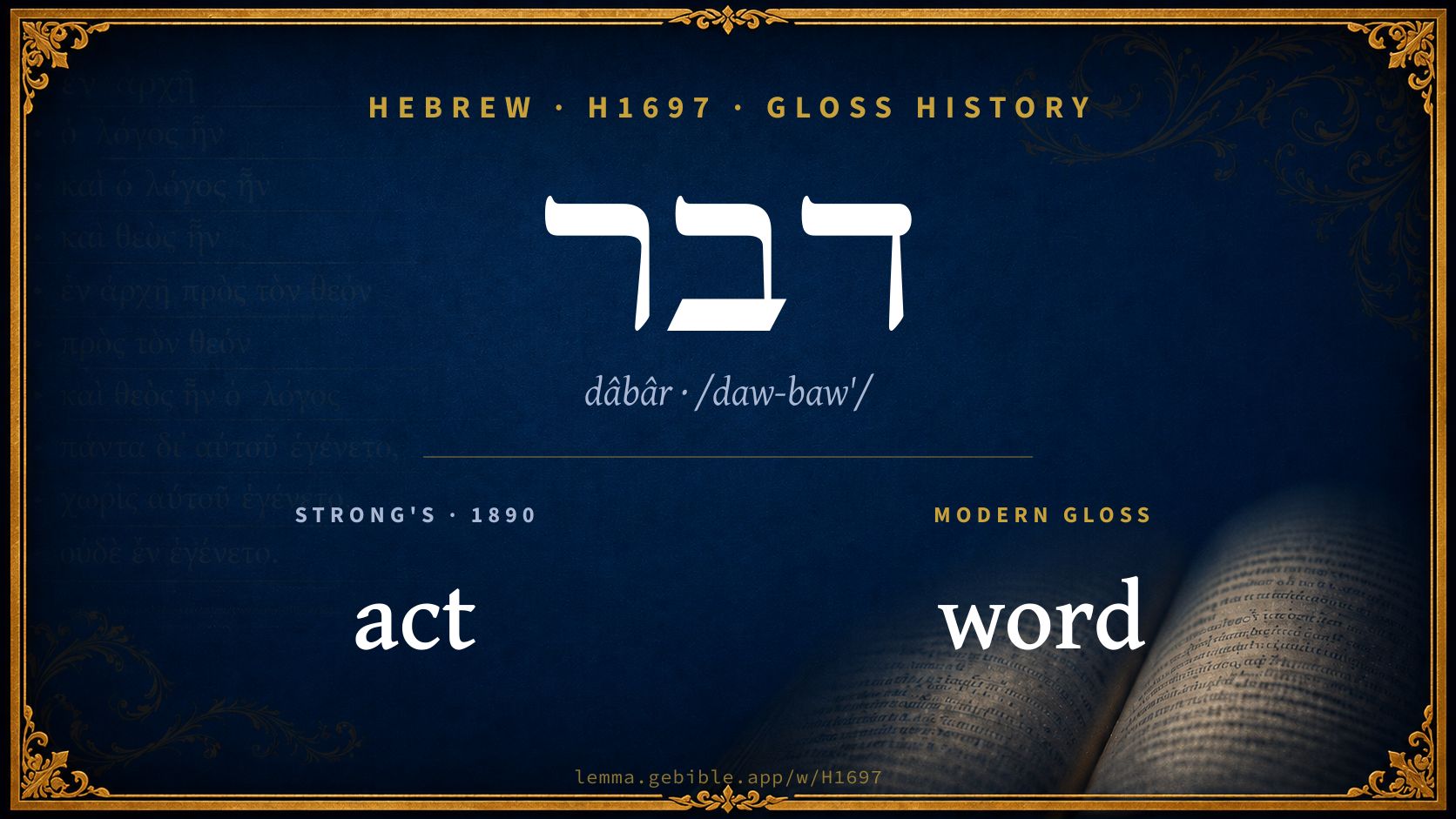
Gloss history
Strong's 1890 vs modern scholarship
About this word
Strong's H1697 catalogs a Hebrew word from the Hebrew Old Testament.
These counts are not copied from any lexicon or concordance. They are computed here, from the morphology-tagged Hebrew Old Testament. What Lemma adds →
- 1,290
- distinct verses
- The word appears in 1,290 distinct verses.
- 34 / 39
- OT books
- The word appears in 34 of 39 Old Testament books.
- #26
- by frequency
- Top 50 most frequent Hebrew words (rank 26 of 8,640 Hebrew words by occurrence).
View all 1,290 occurrences in the concordance →
Most concentrated in
- Jeremiah 183 verses 14%
- 1 Kings 100 verses 8%
- Deuteronomy 89 verses 7%
By section of the Old Testament
By traditional corpus
Conventional, traditional groupings — biblical authorship is debated, so this is a traditional corpus grouping, not an authorship claim. Each share is this word’s portion of its verses in that division of the Hebrew canon. Each figure is a share of the word’s 1,290 distinct verses.
- Prophets (Nevi'im) 725 verses · 56%
- Writings (Ketuvim) 328 verses · 25%
- Torah (Pentateuch) 237 verses · 18%
How translations render this word
Counts come from each version’s own published word-to-Strong’s tagging or interlinear alignment — an approximate guide to how each version renders this word, not a word-level alignment the data otherwise carries. Because each total is that version’s own tagged count, the per-version totals vary from one another and need not match the appearance or distinct-verse counts above. These counts may also differ from a printed concordance because Lemma counts each distinctly tagged rendering and does not collapse phrase taggings into a single head-word total. This is a fixed set of word-tagged versions (KJV, ASV, BSB, ULT) and does not change with the reading translation you choose elsewhere. Each version’s license is shown beside its name below (and on Sources).
- King James Version: Word 281×, Words 253×, Thing 120×
- American Standard Version: Word 270×, Words 231×, Thing 96×
- Berean Standard Bible: Word 296×, Words 287×, Acts 48×
- unfoldingWord Literal Text: Word 301×, Words 207×, Word of 154×
King James Version Public Domain
Renders H1697 across 1,427 tagged occurrences — most commonly:
Plus other, less common renderings. Plus 220 renderings that appear only once — usually multi-word phrases or single function words the recovered tagging swept in, not distinct renderings. Not rendered by a distinct English word in 12 further occurrences.
American Standard Version Public Domain
Renders H1697 across 1,424 tagged occurrences — most commonly:
Plus other, less common renderings. Plus 312 renderings that appear only once — usually multi-word phrases or single function words the recovered tagging swept in, not distinct renderings.
Berean Standard Bible Public Domain
Renders H1697 across 1,239 tagged occurrences — most commonly:
Plus other, less common renderings. Plus 185 renderings that appear only once — usually multi-word phrases or single function words the recovered tagging swept in, not distinct renderings. Not rendered by a distinct English word in 198 further occurrences.
unfoldingWord Literal Text CC BY-SA 4.0
Renders H1697 across 1,436 tagged occurrences — most commonly:
Plus other, less common renderings. Plus 86 renderings that appear only once — usually multi-word phrases or single function words the recovered tagging swept in, not distinct renderings.
31 senses and sub-senses in the full BDB
What do BDB’s symbols mean?
BDB uses these scholarly abbreviations:
| Symbol | Meaning |
|---|---|
| 𝔊 | the Septuagint (the ancient Greek translation, LXX) |
| 𝔙 | the Vulgate (the Latin translation) |
| 𝔖 | the Syriac version (the Peshitta) |
| 𝔗 | the Targum (the Aramaic translation) |
| ψ | the Psalms |
| √ | root (the underlying root or stem) |
| ‖ | parallel passage (a synonymous or contrasted parallel) |
| † | the dagger: every passage where the word occurs is cited |
The 31 senses and sub-senses the full Brown-Driver-Briggs lexicon distinguishes for this word, in lexicon order (not ranked by frequency), with BDB’s own verbatim wording and sub-sense lettering. Shown in Hebrew script with BDB’s own scholarly abbreviations. The condensed entry is in the Lexicon Entry tab. See also the Forms in the corpus table below.
- I. sg. speech, discourse, saying, word, as the sum of that which is spoken:
- 1. of men,
- a. נְבוֹן דָּבָר discreet in speech 1 S 16:18; ד׳ שְׂפָתַיִם speech of lips ψ 59:13, mere talk Is 36:5 (= 2 K 18:20) Pr 14:23 (cf. ψ 17:4 speech of God’s lips); דָּבָר מָר bitter speech ψ 64:4; ד׳ כָּזָב lying speech Pr 30:8; טוֹב דְּבָֽרְךָ thy saying is good 1 S 9:10; וּדְבַר אַבְנֵר הָיָה עִם and the speech of Abner had been with the elders of Israel 2 S 3:17 (cf. 1 K 1:7); †אמר הדבר הזה say this saying Je 23:38; 31:23 cf. 13:12; 14:17 (of God), 1 S 8:10 (דִּבְרֵי י׳). e.g. 1 Samuel 16:18
- b. word of command, ד׳ (הַ)מֶּלֶךְ 1 Ch 21:4, 6 Est 1:12 + 6 times Est, Ec 8:4 cf. 2 Ch 30:5; 31:5 Dn 9:23, 25; †ד׳ מַלְכוּת royal edict Est 1:19; עשׂה כדבר do according to the command of Gn 44:2; 47:30 Ex 8:9, 27; 12:35; 32:28 (J) Lv 10:7 (P) Ju 11:10 Ezr 10:5 Ne 5:12, 13; cf. 2 S 17:6 (word of counsel), 1 K 3:12 (request), 1 K 17:13 (proposal; on these meanings v. infr.) e.g. 1 Chronicles 21:4
- c. message, report, tidings, וַיִּשְׁמַע הָעָם אֶת־הַדָּבָר הָרָע הַזֶּה and the people heard this evil report Ex 33:4 (JE) cf. 1 K 20:12; אמת (היה) הדבר the report was true 1 K 10:6 = 2 Ch 9:5; עַד בּוֹא דָבָר מֵעִמָּכֶם until word come from you 2 S 15:28; ויגע הדבר אל מלך נינוה Jon 3:6; †הֵשִׁיב דָּבָר return or bring word, report Gn 37:14 Nu 13:26; 22:8 (J) Dt 1:22, 25 Jos 14:7; 22:32 (D) 1 K 2:30; 20:9 2 K 22:9, 20 (= 2 Ch 34:16, 28), but answer 1 S 17:30 2 S 3:11; 24:13 (= 1 Ch 21:12), 1 K 12:6, 9 (= 2 Ch 10:6, 9), 12:16 Ne 2:20 Pr 18:13; 27:11 Is 41:28 Ez 9:11 (DrSm p. 190 explains the phrase as turn back with a word); cf. ענה (לא) דבר answer something or nothing 1 K 18:21 2 K 18:36 ψ 119:42 Is 36:21 Je 44:20 vid. IV. 6; השׁיב דברים return words Ex 19:8 (E) Pr 24:26 vid. III. 1. e.g. Exodus 33:4
- d. advice, counsel, בדבר בלעם by advice of Balaam Nu 31:16 (P), cf. Ju 20:7 2 S 19:44 Est 5:5. e.g. Numbers 31:16
- e. request, אמתו of his maid, עבדו of his servant 2 S 14:15, 22. e.g. 2 Samuel 14:15
- f. promise, לא יחל דברו he shall not break his word Nu 30:3 (P), cf. הקים דבר perform a promise Ne 5:13, vid. also 2 b. e.g. Numbers 30:3
- g. charge, complaint, אם אמת היה הדבר הזה if this charge be true Dt 22:20 cf. 13:15; 17:4, שׂים דבר בְּ 1 S 22:15, שׂים עלילות דברים לְ Dt 22:14, 17. e.g. Deuteronomy 22:20
- h. decision, sentence, דְּבַר דַמִּשְׁפָּט the sentence of judgment Dt 17:9 cf. v 10, 11. e.g. Deuteronomy 17:9
- i. theme, story, רָחַשׁ לִבִּי דָּבָר טוֹב my heart swells with a good theme ψ 45:2; דְּבַר גְּבוּרוֹת the story of his great might Jb 41:4. e.g. Psalms 45:2
- 2. word of God, as a divine communication in the form of commandments, prophecy, and words of help to his people, used 394 times. This word is communicated in several ways:
- a. ויהי דבר י׳ אל then the word of Yahweh came unto 1 S 15:10 2 S 7:4 (cf. אלהים 1 Ch 17:3), 1 K 6:11; 13:20; 16:1; 17:2, 8; 21:17, 28 2 Ch 11:2 (cf. האלהים 1 K 12:22); cf.1 Ch 22:8 (על by confusion), Is 38:4 Je 1:4 + 20 times Je, Ez 3:16 + 41 times Ez, Jon 1:1; 3:1 Hg 2:20 Zc 4:8; 6:9; 7:4, 8; 8:1 (without אל) v 18; †היה ד׳ י׳ אל Gn 15:1 2 Ch 12:7 Je 25:3 + 4 times Je, Ez 1:3 + 7 times Ez, Dn 9:2 Zc 1:1, 7; 7:1; †הנה ד׳ י׳ אל Gn 15:4 1 K 19:9; †ד׳ י׳ היה אל 2 S 24:11 1 K 16:7; 18:1 2 K 20:4 Ez 24:20; †היה ד׳ י׳ ביד Hg 1:1; 2:1, 10; †ויהי ד׳ י׳ ביד Hg 1:3; †ד׳ י׳ אשׁר היה אל Ho 1:1 Jo 1:1 Mi 1:1 Zp 1:1; †אשׁר היה ד׳ י׳ אליו 1 K 18:31 Je 1:2; †אשׁר היה ד׳ י׳ אל יר׳ Je 14:1; 46:1; 47:1; 49:34 (vid. אשׁר 6 a; הדבר אשׁר היה אל Je 7:1 + 11 times Je; †את ד׳ י׳ 2 K 3:12 Je 23:28; 27:18; cf. אֵלַי דָּבָר יְגֻנָּב unto me a word was brought by stealth Jb 4:12, cf. וְטֶרֶם יִגָּלֶה אֵלָיו דְּבַר י׳ and the word of Yahweh was not yet revealed unto him 1 S 3:7. Yahweh also sends his word שׁלח ψ 107:20; 147:18 Is 9:7 Je 42:5 (cf. pl. Zc 7:12) and makes it an object of vision ראה Je 2:31; 38:21 (cf. pl. Ez 11:25), חזה Is 2:1; it is also commanded צוה Ex 16:16, 32; 35:4 Lv 8:5; 9:6; 17:2 Nu 30:2; 36:6 (P) Dt 4:2; 13:1; 15:15 Jos 1:13; 4:10 (D) 1 Ch 16:15 (= ψ 105:8) Ne 1:8 Je 7:23, cf. הדברים אשׁר צוה Ex 35:1 Lv 8:36 (P) Ex 19:7 (E) Dt 6:6. e.g. 1 Samuel 15:10
- b. Yahweh confirms his word of promise Dt 9:5 1 S 1:23 (where read דְּבָרֵךְ thy word according to 𝔊 𝔖 & Dr), 1 K 2:4; 6:12; 8:20 Je 29:10; 33:14, and his word of warning 1 K 12:15 Dn 9:12; his word stands for ever Is 40:8; it is settled for ever in heaven ψ 119:89; he remembers his holy word דבר קדשׁו ψ 105:42 (cf. דִּבְרֵי קָדְשׁוֹ Je 23:9); he himself Jo 2:11, the angels ψ 103:20, and forces of nature ψ 148:8 עשׂה דברו do his word of command; by his word the heavens were made ψ 33:6; it is near his people, in their mouth and heart Dt 30:14; a lamp to their feet ψ 119:105. e.g. Deuteronomy 9:5
- 1. of men,
- II. saying, utterance, sentence, as a section of a discourse:—
- a. דָּבָר בְּעִתּוֹ a word in due season Pr 15:23 cf. Jb 4:2 Pr 12:25; commonly in plural, †דִּבְרֵי (הַ)שִּׁירָ(ה) words of the song (i.e. its lines of poetry) Dt 31:30; 32:44 ψ 18·1 (= 2 S 22:1) 137:3; הלל בדברי דויד to sing praises with the words of David (his psalms) 2 Ch 29:30; דִּבְרֵי חֲכָמִים sentences of the wise Pr 1:6; 22:17 Ec 9:17; 12:11; these sayings are commonly written, cf. דברי האגרת words of the letter Est 9:26; הדברים עתיקים the records are ancient 1 Ch 4:22; דִּבְרֵי (ה)סֵפֶר Is 29:11, 18 Je 29:1. e.g. Proverbs 15:23
- b. title of writings: דִּבְרֵי קֹהֶלֶת Ec 1:1, ד׳ אגור Pr 30:1, ד׳ למואל Pr 31:1, ד׳ ירמיהו Je 1:1, so Am 1:1 Ne 1:1; cf. in appended phrase or clause, Je 51:64, ד׳ איוב Jb 31:40. e.g. Ecclesiastes 1:1
- c. in Ch name of a work: ד׳ החזים 2 Ch 33:18, 19, בד׳ שׁמעיה 2 Ch 12:15, בד׳ יהוא 2 Ch 20:34, על ד׳ שׁמואל 1 Ch 29:29; על ד׳ נתן 1 Ch 29:29 2 Ch 9:29, על ד׳ גד 1 Ch 29:29. (It is not certain whether writings of prophets or histories about them are referred to; in the latter case they are acts, IV. 2, vid. DrIntr. 497.) e.g. 2 Chronicles 33:18
- 2. of God: עֲשֶׂרֶת הַדְּבָרִים the ten words (sentences in the tables) Ex 34:28 (JE) Dt 4:13; 10:4, referred to as הדברים Ex 34:1 (JE) Dt 4:10, 36; 5:19; 9:10; 10:2; of commands of covenant code Ex 24:3, 4, 8 cf. 34:27 (JE); of Deuteronomic code Dt 17:19 (+ 16 times D) 2 K 22:11; 23:3–24 (cf. 2 Ch 34:19–31) Je 11:2–8; 34:18; the lawbook of joshua Jos 24:26 (E); of the code of Ezra Ezr 7:11; 9:4 Ne 8:9, 13; the words of Yahweh written by Jeremiah Je 25:13; 36:4–32; 51:61; the words of the book of Daniel Dn 12:4; 9 commands in general 1 S 15:11 ψ 50:17; 119:57, 130, 139; promises 2 S 7:28 Ne 9:8, cf. 1 Ch 25:5 2 Ch 36:16. e.g. Exodus 34:28
- III. a word, words:—
- 1. of men: שָׂפָה אֶחָ֑ת וּדְבָרִים אֲחָדִים one lip, and one and the same words Gn 11:1 (J); אֵין אֹמֶר וְאֵין דְּבָרִים no speech and no words ψ 19:4; אִישׁ דְּבָרִים man of words, ready in speech, Ex 4:10 (J); רב דברים multitude of words Jb 11:2 Pr 10:19 Ec 5:2; קְחוּ עִמָּכֶם דְּבָרִים take with you words Ho 14:3; דבר(י) (ה)שׁקר lying word(s) Ex 5:9; 23:7 (E) Pr 13:5; 29:12 Is 59:13 Je 7:4, 8; דִּבְרֵי רוּחַ words of wind, vain words Jb 16:3; וּמַה־שֶּׁמֶץ דָּבָר נִשְׁמַע־בּוֹ and what a whisper of a word we hear of him! Jb 26:14. e.g. Genesis 11:1
- 2. of God. It is difficult to determine how many of the following should come under II. 2. The pl. for words of God is relatively seldom: Gn 20:8 Ex 19:6 Nu 12:6 Jos 3:9 (E) Ex 4:28, 30 Nu 11:24 (J) Dt 18:19 Jos 23:14 (D) 1 S 3:18; 8:10; 15:1 2 Ch 11:4 Jb 42:7 Pr 30:6 Is 31:2 Dn 10:11 Am 8:11 Mi 2:7, apart from Je 3:12 + 30 times Je, Ez 2:7 + 4 times Ez, Zc 1:6 + 4 times Zc. e.g. Genesis 20:8
- IV. matter, affair, thing about which one speaks:—
- 1. business, occupation: דְּבַר הַמֶּלֶךְ king’s business 1 S 21:9; לְכָל־דְּבַר for every matter of 1 Ch 26:32; 27:1 2 Ch 19:11; לְכָל־דְּבָרֶיךָ for all thine affairs 1 Ch 28:21; דבר המזבח Nu 18:7; דָּבָר אֵין־לָהֶם עִם they had no dealings with Ju 18:7, 28; †דְּבַר־יוֹם בְּיוֹמוֹ the task or portion of a day in its day, daily duty or due Ex 5:13, 19 (E) 16:4 (J) Lv 23:37 (P) 1 K 8:59 2 K 25:30 1 Ch 16:37 2 Ch 8:13 (ביום) v 14 31:16 Ezr 3:4 Ne 11:23; 12:47 Je 52:34 Dn 1:5; †דבר שׁנה בשׁנה 1 K 10:25 2 Ch 9:24. e.g. 1 Samuel 21:9
- 2. pl. acts cstr. דִּבְרֵי 1 K 11:41(×2) 1 Ch 29:29 2 Ch 12:15; 16:11; †דְּבָרָיו his acts 2 Ch 13:22; 35:27; especially in phrases, וְיֶתֶר דִּבְרֵי … עַל־סֵפֶר דִּבְרֵי הַיָּמִים and the rest of the acts of … in the book of the chronicles (daily record of events) of 1 K 14:29 + 32: times K.; וְיֶתֶר דִּבְרֵי 2 Ch 13:22 + 8 times Ch, וְיֶתֶר דְּבָרָיו 2 Ch 28:26, שְׁאָר דִּבְרֵי 2 Ch 9:29 are referred to various sources; cf. also במספר דברי הימים 1 Ch 27:24, בדברי דויד 1 Ch 23:27, על־דברי מלכי ישׂראל 2 Ch 33:18: דברים טובים good deeds 2 Ch 12:12; 19:3; דִּבְרֵי עֲוֹנֹת acts of iniquity ψ 65:4 (De, Fälle von Missethaten); דִּבְרֵי־רָע evil deeds Je 5:28. It is used of God, only in כל דבריו לא יענה Jb 33:13, ד׳ אֹתוֹתָיו ψ 105:27, ד׳ נִפְלְאֹתֶיךָ ψ 145:5. e.g. 1 Kings 11:41
- 3. matter, affair: דבר אוריה affair of Uriah 1 K 15:5; שׁרשׁ דבר root of the matter Jb 19:28; מה היה הדבר how went the matter? 1 S 4:16 2 S 1:4 cf. Ru 3:18; סבב את פני הדבר change the face of the matter 2 S 14:20; דִּבְרֵי הָאֲתֹנוֹת the matter of the asses 1 S 10:2; זה דבר הרצח this is the case of the slayer Dt 19:4; לְכָל־דְּבָרָיו 1 K 6:38 as to all its particulars; Pr 13:13; 16:20. e.g. 1 Kings 15:5
- 4. events, things: †אחר הדברים האלה after these things (events in time) Gn 15:1; 22:1; 40:1 (E) 39:7 (J) 1 K 17:17; 21:1 Ezr 7:1 Est 2:1; 3:1; †אחרי הדברים האלה Gn 48:1 Jos 24:29 (E) Gn 22:20 (J) 2 Ch 32:1. e.g. Genesis 15:1
- 5. cause, case for judicial investigation: כִּי־יִהְיֶה לָהֶם דָּבָר if they have a case Ex 18:16 cf. 18:22; 22:8; בעל דברים one having a case Ex 24:14, cf. בדבר משׁפט 2 Ch 19:6; דְּבָרֶיךָ טוֹבִים וּנְכֹחִים pleas, good and right 2 S 15:3 cf. Jos 20:4. e.g. Exodus 18:16
- 6. something, anything (indefinite): עשׂה דבר do a thing Gn 22:16 + (frequent); עשׂה דברים Is 42:16 + (less frequent); היפלא מי׳ דבר Gn 18:14 cf. Je 32:17, 27; לא … דבר nothing 1 K 5:7; 10:3 Is 39:2 Je 42:4 + (frequent), אין דבר Ex 5:11 (E) Nu 20:19 1 S 20:21; לא דבר מ׳ nothing of Ex 9:4 (J) Jos 8:35; 11:15; 21:45; 23:14 (D); כל דבר anything Nu 31:23 Dt 23:20 +; דבר רע ψ 141:4 +; ד׳ טוב 1 K 14:13 +; דְּבַר־מָה whatsoever Nu 23:3 (E); עֶרְוַת דבר Dt 23:15 nakedness of a thing, i.e. unclean or unseemly thing (indecency in camp); so of a wife 24:1. e.g. Genesis 22:16
- 7. way, manner: זֶה דְּבַר הַשְּׁמִטָּה this is the manner of the release Dt 15:2 (cf. SI1); כֵּן דְּבַר הַמֶּלֶךְ so was the way of the king Est 1:13; כדבר הזה after this manner, thus †Gn 18:25; 32:20; 44:7 (JE) 2 S 15:6 Ezr 10:5 Ne 5:12, 13 with (עשׂה), 1 S 9:21 2 S 14:3; 17:6 (דבר), 1 S 17:27, 30 Is 8:20 (אמר), Ne 6:4, 5 (שׁלח), Ne 6:4 (השׁיב) cf. 1 S 17:30, 2 K 7:19 (היה); (peculiar to D, כדבר הרע הזה such a wicked deed as this Dt 13:12; 19:20, כדבר הגדול הזה Dt 4:32); כדברים האלה עשׂה thus and thus did he Gn 39:19 (J) 1 S 2:23 (but usually the pl. = these words). e.g. Deuteronomy 15:2
- 8. reason, cause: זֶה דְבַר־הַמַּס 1 K 9:15; זה הדבר אשׁר this is the reason why Jos 5:4 (D) 1 K 11:27; so 1 S 17:29 AV RV, was it not but a word? Th Ke RVm VB Dr; … עַל דְּבַר, עַל־דִּבְרֵי for the sake of, in reference to, v. KöExpositor, Aug. 1902, 142–148; and add for עַל־דְּבַר Nu 25:18(×3); 31:16 2 S 18:5, and for עַל־דִּבְרֵי Je 7:22 2 K 22:13 = 2 Ch 34:21a, and perhaps ψ 7:1. because of, for the sake of Gn 20:11, 18 (E) 12:17; 43:18 Ex 8:8 (J) Nu 17:14 (P) ψ 45:5; 79:9, עַל דִּבְרֵי Je 14:1; עַל־דִּבְרֵיכֶם for your sakes Dt 4:21, עַל דְּבַר אשׁר Dt 22:24(×2); 23:5 2 S 13:22.. Oldest tradition (Jerome) seems to waver between דָּג fish and דָּגָן grain, as explan. of דָּגוֹן, v. בית ד׳. e.g. 1 Kings 9:15
Senses from the full Brown-Driver-Briggs lexicon (Brown, Driver, Briggs; Oxford 1906 — public domain), digitized via Sefaria, supplemented by the OpenScriptures HebrewLexicon (CC BY 4.0). Full attribution on Sources.
Word origin
n.m. speech, word—Gn 18:14 + 446 times; cstr. דְּבַר Gn 12:17 + 361 times; sf. דְּבָרִי Nu 11:23 + (sfs. 66 times); sg. in all 875 times; pl. דְּבָרִים Ex 4:10 + 182 times; cstr. דִּבְרֵי Gn 24:30 + 253 times; sf. דְּבָרָיו Gn 37:8 (sfs. 127 times); pl. in all 564 times;—
— Brown-Driver-Briggs (Oxford 1906, public domain), digitized via Sefaria, supplemented by the OpenScriptures HebrewLexicon (CC BY 4.0). See Sources.
Derived from דבר (dâbar) (H1696) — to speak.
Jastrow Dictionary
A second Hebrew/Aramaic lexicon for comparison, covering Aramaic and post-biblical (Talmudic, Targumic, Midrashic) usage that the biblical-Hebrew BDB does not. Matched by lemma rather than by Strong’s number, so a lemma may carry more than one Jastrow headword (shown separately below), and the entries cover usage well beyond the Bible.
דָּבַר
- (b. h.) to join, arrange, lead (the flock); v. next w.
- (b. h.) to converse, speak. Ber. 31ᵇ, a. fr. דִּבְּרָה תורה כלשון ב"א the Torah speaks according to the language of men, i.e. uses metaphors and phrases adapted to human understanding. Sot. 12ᵇ שעתיד לְדַבֵּר וכ׳ destined to speak to Divinity. Ter. I, 2 חרש שדִּבְּרוּ … מְדַבֵּר wherever the scholars use the word ḥērēsh, they mean one who neither hears nor talks. Mekh. Bo 7, end, a. fr. או אינו מְדַבֵּר אלא ב־ or does perhaps the text speak only of—? [מְדַבֵּר as a noun, v. s. v.].
- to hold communion, converse. Mekh. Bo, introd. לא נ׳ עמו וכ׳ the Lord did not hold communion with him outside the capital of Egypt. Ib. fr.
- , same, esp. part. f. מִדַּבֶּרֶת being on terms of intimacy with a man. Keth. I, 8 ראוה מד׳ עם אחד (omit בשוק); expl. ib. 13ᵃ. Ib. VII, 6 מד׳ עם כל אדם she is intimate with everybody. Ib. לכשהיא מד׳ בתוך ביתה וכ׳ when her neighbors can hear her voice in moments of intimacy with her husband.
- to make submissive, persuade, v. דִּיבּוּר. Macc. 11ᵃ דִבֵּר לחוד יַדְבֵּר לחוד the Piel dibber has one meaning (speaking harshly), and the Hif. yadber another.
דְּבַר
- 1. to seize, take, lead, drive. Targ. Gen. XIX, 15; a. fr. (h. לקח).—Ib. XXXI, 18; a. fr. (h. נהג).
- 2. to conduct one’s self (cmp. נָהַג). Erub. 14ᵇ, a. e. פוק חזי מאי עמא ד׳ go out and see how the people conduct themselves (what the religious usage is). Koh. R. to IX, 10, v. כְּלוּם.
- 1. to lead, drive. Targ. O. Ex. III, 1 ed. Berl. (ed. דְּבַר). Ib. XIV, 21 (ed. דְּבַר, h. text ויולך). Targ. Ez. XVI, 12; a. e.—Keth. 62ᵇ sq. עד כמה קא מְדַבְּרַת אלמנות חיים how long yet wilt thou lead a life of living widowhood (separation from a living husband)?
- 2. to carry off. Targ. Ezek. XXXIII, 6; a. e.
- to take, lead. Targ. Is. XIV, 2; a. fr.—Bets. 21ᵇ אַדְבְּרֵיה וכ׳ took him out on a walk; ib. 29ᵃ. Y. Yeb. XIII, 13ᶜ bot. מַדְבְּרוּן לה גבר they introduce to her a suitor.
- 1. to be seized, taken away. Targ. Prov. XXIV, 11. Targ. Ez. XXXIII, 6. Targ. II Kings II, 9 sq.; a. e.
- 2. to conduct one’s self. Targ. Gen. XXXIII, 14 אֵידַבַּר ed. Berl. (h. text אתנהלה).
דָּבָר
- preced.)
- 1. word, utterance, command (cmp. דִּיבּוּר). B. Bath. 56ᵇ (ref. to Deut. XIX, 15) ד׳ ולא חצי ד׳ a statement (testimony) but not a partial statement. Mekh. Bo, introd. היה הד׳ לאהרן (Tanḥ. ib. 5 דבור) the word of the Lord came to &c.; a. fr.—דְּבַר תורה according to the Biblical law. Erub. 81; a. fr.—Pl. דְּבָרִים, constr. דִּבְרֵי. ד׳ תורה Biblical laws; ד׳ סופרים Rabbinical laws. Ib. Yeb. IX, 3; a. fr.—ד׳ קבלה prophetic exhortations or incidental utterances in other Biblical books than the Pentateuch. Ḥag. 10ᵇ; Nidd. 23ᵃ; a. e.—B. Mets. 49ᵃ; Bekh. 13ᵇ ד׳ יש בהם משום מחוסרי אמנה to word of mouth the rules concerning the faithless are applied, i.e. a verbal agreement is morally binding. B. Mets. 48ᵃ הנושא ונותן בד׳ וכ׳ he who contracts verbally has no legal claim. Ib. ד׳ ואיכא … קאי באבל he who retracts a verbal transaction with which a payment of money was connected, comes under the category of those against whom the words ‘but the scholars declared’ (ib. IV, 2) has been pronounced.—דִּבְרֵי הַיָּמִים the Book of Chronicles. Lev. R. s. 1. B. Bath. 14ᵇ.—דָּבָר אַחֵר (abbrev. ד"א) another interpretation (is this). Gen. R. s. 1, beg.; a. fr.—2) thing, affair, object, occurrence &c. Sot. 28ᵇ ד׳ שיש בו דעת לישאל an object which has sense to ask, i.e. a rational being, opp. ד׳ שאין וכ׳ dumb creatures &c.—Num. R. s. 11 ד׳ שבינך לבינו that which concerns only thy relation to God; v. בֵּין.—ד׳ שבממון a monetary affair. B. Mets. 94ᵃ; a. fr.—ד׳ הלמד מענינו a thing (law) derived from the context on the very subject. Sifra, introd.; a. fr.—ד׳ אחר (abbr. ד"א) something not to be named, a) idolatry. Men. XIII, 10 ואין צריך לומר לד"א much less priests who have been offering to idols; a. fr.—b) swine. Ber. 43ᵇ (prov.) תלה ליה קורא לד"א וכ׳ hang a palm shoot around the swine and it will follow its habits (of wallowing in the mud). Sabb. 129ᵃ sq.; a. e.—c) leprosy Ib. אי פגע בד"א קשה לד"א if he meets a swine (after blood letting), he is in danger of becoming a leper.—d) unchaste conduct, sexual intercourse, sodomy &c. Ib. 17ᵇ על בנותיהן משום ד"א ועל ד"א משום ד"א they forbade connection with their daughters on account of idolatry, and decreed something else (that a gentile child should be unclean as though afflicted with gonorrhœa) on account of sodomy. Ber. 8ᵇ צנועין בד"א chaste in marital life; a. fr.—Pl. as above.—בעל ד׳ the person to deal with, opponent, party. B. Mets. 14ᵃ לאו ב"ד דידי את I have nothing to do with thee; a. fr.—לא היו ד׳ מעולם there were no such things, I deny it outright. Shebu. 41ᵇ; a. fr.—ד׳ בגב, ד׳ בגו, v. גַּב, גֵּו. e.g. Deuteronomy 19:15
דֶּבֶר
- , esp. Targ. Ez. XXXIII, 6) death, pestilence. Ab. V, 8. Sabb. 33ᵃ; a. fr.—Esp. the plague of pestilence in Egypt. Ex. R. s. 12. Tanḥ. Vaëra 14; a. fr.
דַּבָּר
- (דבר) leader.—Pl. דַּבָּרִין. Snh. 8ᵃ ד׳ אחד וכ׳ a generation must have one leader, but not two.
A Dictionary of the Targumim, the Talmud Babli and Yerushalmi, and the Midrashic Literature (Marcus Jastrow; London, Luzac, 1903) — Public Domain. Digitized via Sefaria. Digitized via Sefaria. Full attribution on Sources.
Forms in the corpus
The 308 distinct written forms H1697 takes in the Hebrew Bible, most frequent first — each parse links to that state’s occurrences in the concordance. Hebrew forms include their vowel points and cantillation, so a single lemma takes many written forms.
The 60 most common forms are shown; 248 rarer forms follow in the full concordance.
Same root — word family
Other BDB entries built from the same root as H1697, grouped by Strong’s listed origin. These share a root / origin per the lexicon — not necessarily a shared meaning. Each links to that word’s own entry.
Derives from
Shares the same root
- דבורה dᵉbôwrâh H1682 bee
- דביר dᵉbîyr H1687 holy of holies
- דבר deber H1698 pestilence
- דבר dôber H1699 pasture
- דברה dôbᵉrâh H1702 raft
- דברה dabbârâh H1703 word
- מדבר midbâr H4057 wilderness
Derived from this word
Proper names from this root
People and places named from this root — a name, not an additional meaning of the word.
Compare all same-root words → Showing 4 of 12 — not the complete family. 2 of the same-root words are proper names (people or places). They share a root, not necessarily a meaning.
Septuagint verse parallels
This word appears in 1,180 verses that also exist in the Greek Old Testament (Septuagint), out of the 1,290 Hebrew verses it occurs in. You can read those verses in Greek by switching the Old Testament edition to the Septuagint.
Read these verses in the Septuagint
- Genesis 11:1
- Exodus 1:18
- Leviticus 4:13
- Numbers 11:23
- Deuteronomy 1:1
- Joshua 1:13
- Judges 2:4
- Ruth 3:18
- 1 Samuel 1:23
- 2 Samuel 1:4
- 1 Kings 1:7
- 2 Kings 1:7
This is a verse-level parallel only — the same verses exist in both the Hebrew and Greek Old Testaments. No word-level Hebrew↔Greek correspondence is claimed: the data carries no such alignment, so no Greek word is shown as this Hebrew word’s translation. Coverage is not total — the Septuagint omits the deuterocanon and renumbers the Psalms, so some Hebrew verses have no direct Greek parallel.