Deuteronomy 23:19

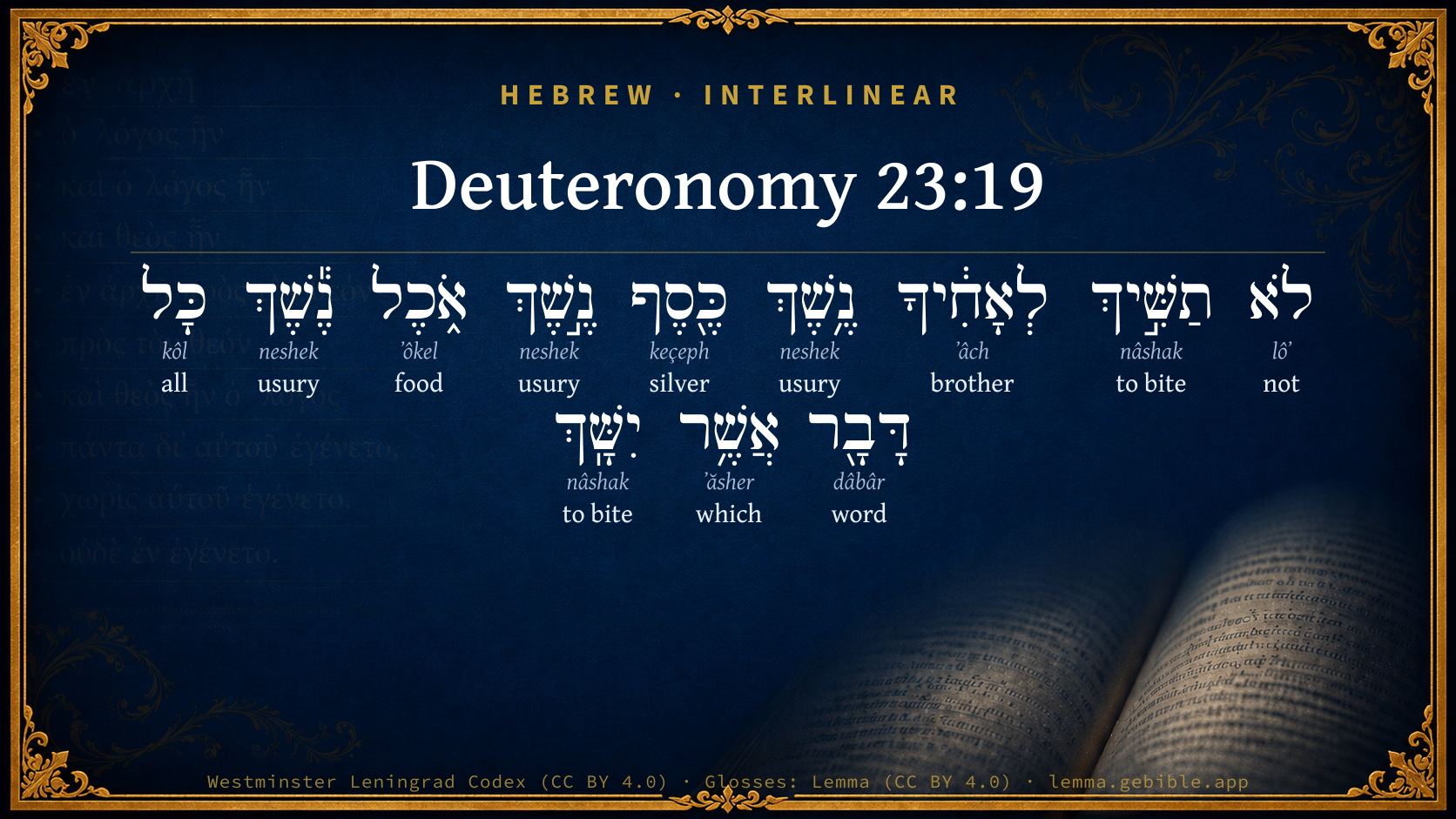
Hebrew (Westminster Leningrad Codex) Deuteronomy 23:19 appears in the Hebrew Old Testament. The text above is from the Westminster Leningrad Codex. Each word links to its Strong’s number, a concise gloss, and parsing drawn from the Open Scriptures Hebrew Bible morphology. Click any word for its full Brown-Driver-Briggs (BDB) entry.
Download image
Cite this verse

Deuteronomy 23:19 (World English Bible). Public Domain. Lemma interlinear Bible study tool, https://lemma.gebible.app/v/deuteronomy/23/19.

Show BibTeX & RIS
BibTeX
RIS
English Translation
You shall not lend on interest to your brother; interest of money, interest of food, interest of anything that is lent on interest:
World English Bible · Public Domain
Download a study sheet

One document with this verse’s original text, its word-by-word gloss line, the meaning frame, cross-references with their text, attributed commentary, and full source and license credits — printable, and it pastes into notes with its structure intact.

This verse Autodidact and up

Study sheet (.html) Plain text (.txt)

A passage Seminary Student

Up to 50 verses in one chapter. A passage sheet keeps up to 6 commentary sources and 12 cross-references per verse, in the order this page ranks them, and says so on the sheet whenever that leaves anything out. Ask for a single verse and you get the Autodidact verse sheet above.

Everything on this page stays free to read, with no account — the sheet is a download of what is already on screen, not access to it.

Want to remove ads? Support Godless Engineer
Compare translations 3

The same verse in 3 English versions, stacked beneath the original-language interlinear above. Click any original word for its lexicon entry.

Each is an independent rendering of the whole verse — the interlinear is not word-aligned to these translations.

Highlighted words mark where these versions differ — a whole-verse word diff, not a word-by-word alignment.

  • World English Bible Public Domain
    You shall not lend on interest to your brother; interest of money, interest of food, interest of anything that is lent on interest:
  • King James Version Public Domain
    Thou shalt not lend upon usury to thy brother; usury of money, usury of victuals, usury of any thing that is lent upon usury:
  • unfoldingWord Literal Text CC BY-SA 4.0
    You shall not charge interest to your brother—interest of money, interest of food, interest of each thing that is charged interest.

unfoldingWord Literal Text — © unfoldingWord, licensed CC BY-SA 4.0. Word-aligned USFM3 via Door43 (git.door43.org/unfoldingWord/en_ult).

Versions to compare (up to 4)

3 of 4 selected

Show all 18 translations

Every available English version of this verse, each an independent rendering of the whole verse.

  • World English Bible Public Domain
    You shall not lend on interest to your brother; interest of money, interest of food, interest of anything that is lent on interest:
  • Berean Standard Bible Public Domain
    Do not charge your brother interest on money, food, or any other type of loan.
  • Majority Standard Bible Public Domain
    Do not charge your brother interest on money, food, or any other type of loan.
  • King James Version Public Domain
    Thou shalt not lend upon usury to thy brother; usury of money, usury of victuals, usury of any thing that is lent upon usury:
  • American Standard Version (1901) Public Domain
    Thou shalt not lend upon interest to thy brother; interest of money, interest of victuals, interest of anything that is lent upon interest:
  • Revised Version (1885) Public Domain
    Thou shalt not lend upon usury to thy brother; usury of money, usury of victuals, usury of any thing that is lent upon usury:
  • Geneva Bible (1599) Public Domain
    Thou shalt not giue to vsurie to thy brother: as vsurie of money, vsurie of meate, vsurie of any thing that is put to vsurie.
  • Douay-Rheims (1899) Public Domain
    Thou shalt not lend to thy brother money to usury, nor corn, nor any other thing:
  • Young's Literal Translation Public Domain
    `Thou dost not lend in usury to thy brother; usury of money, usury of food, usury of anything which is lent on usury.
  • Literal Standard Version CC BY-SA 4.0
    You do not lend in usury to your brother—usury of money, usury of food, usury of anything which is lent on usury.
  • Unlocked Literal Bible CC BY-SA 4.0
    You must not lend on interest to your fellow Israelite—interest of money, interest of food, or the interest of anything that is lent on interest.
  • unfoldingWord Literal Text CC BY-SA 4.0
    You shall not charge interest to your brother—interest of money, interest of food, interest of each thing that is charged interest.
  • Darby Bible Public Domain
    Thou shalt take no interest of thy brother, interest of money, interest of victuals, interest of anything that can be lent upon interest:
  • World Messianic Bible Public Domain
    You shall not lend on interest to your brother: interest of money, interest of food, interest of anything that is lent on interest.
  • Webster's Bible Public Domain
    Thou shalt not lend upon interest to thy brother; interest of money, interest of victuals, interest of any thing that is lent upon interest:
  • Free Bible Version CC BY-SA 4.0
    Don't charge a fellow Israelite interest on money, food, or any other kind of loan.
  • Bible in Basic English Public Domain
    Do not take interest from an Israelite on anything, money or food or any other goods, which you let him have:
  • JPS Tanakh (1917) Public Domain
    (23-20) Thou shalt not lend upon interest to thy brother: interest of money, interest of victuals, interest of any thing that is lent upon interest.

Literal Standard Version (2020), Covenant Press — licensed CC BY-SA 4.0. Text via the HelloAO Bible API (eBible.org). Unlocked Literal Bible (unfoldingWord) — licensed CC BY-SA 4.0. Text via the HelloAO Bible API (eBible.org). unfoldingWord Literal Text — © unfoldingWord, licensed CC BY-SA 4.0. Word-aligned USFM3 via Door43 (git.door43.org/unfoldingWord/en_ult). Free Bible Version, Dr. Jonathan Gallagher — licensed CC BY-SA 4.0. Text via the HelloAO Bible API (eBible.org).

Word by word

More ways to search: Search by grammar → Find every occurrence → Compare this word →

Practice this passage: Drill this verse → Learn its vocabulary →

נֶ֥שֶׁךְ
neshek
H5392
“usury of”
Noun, Common, Masculine, Singular, Construct
Part of Speech
Noun
Type
Common
Gender
Masculine
Number
Singular
State
Construct
Full BDB Definition

Origin: from H5391

TWOT: 1430a

interest, usury
  1. לֹא lôʼ H3808 “not” Particle, Negative
  2. תַשִּׁ֣יךְ nâshak H5391 “to bite” Verb, Hiphil, Imperfect, 2nd Person, Masculine, Singular
  3. לְאָחִ֔יךָ ʼâch H251 “to/for · brother · your” Preposition + Noun, Common, Masculine, Singular, Construct + Suffix, Personal, 2nd Person, Masculine, Singular
  4. כֶּ֖סֶף keçeph H3701 “silver” Noun, Common, Masculine, Singular, Absolute
  5. נֶ֣שֶׁךְ neshek H5392 “usury of” Noun, Common, Masculine, Singular, Construct
  6. אֹ֑כֶל ʼôkel H400 “food” Noun, Common, Masculine, Singular, Absolute
  7. נֶ֕שֶׁךְ neshek H5392 “usury of” Noun, Common, Masculine, Singular, Construct
  8. כָּל kôl H3605 “all of” Noun, Common, Masculine, Singular, Construct
  9. דָּבָ֖ר dâbâr H1697 “word” Noun, Common, Masculine, Singular, Absolute
  10. אֲשֶׁ֥ר ʼăsher H834 “which” Particle, Relative
  11. יִשָּֽׁךְ nâshak H5391 “to bite” Verb, Qal, Imperfect, 3rd Person, Masculine, Singular

About this verse

These counts appear in no published source. They are computed here, from the morphology-tagged text and Lemma’s own curated glosses. What Lemma adds →

12
words
9
distinct lemmas
Pentateuch
section

Notable vocabulary

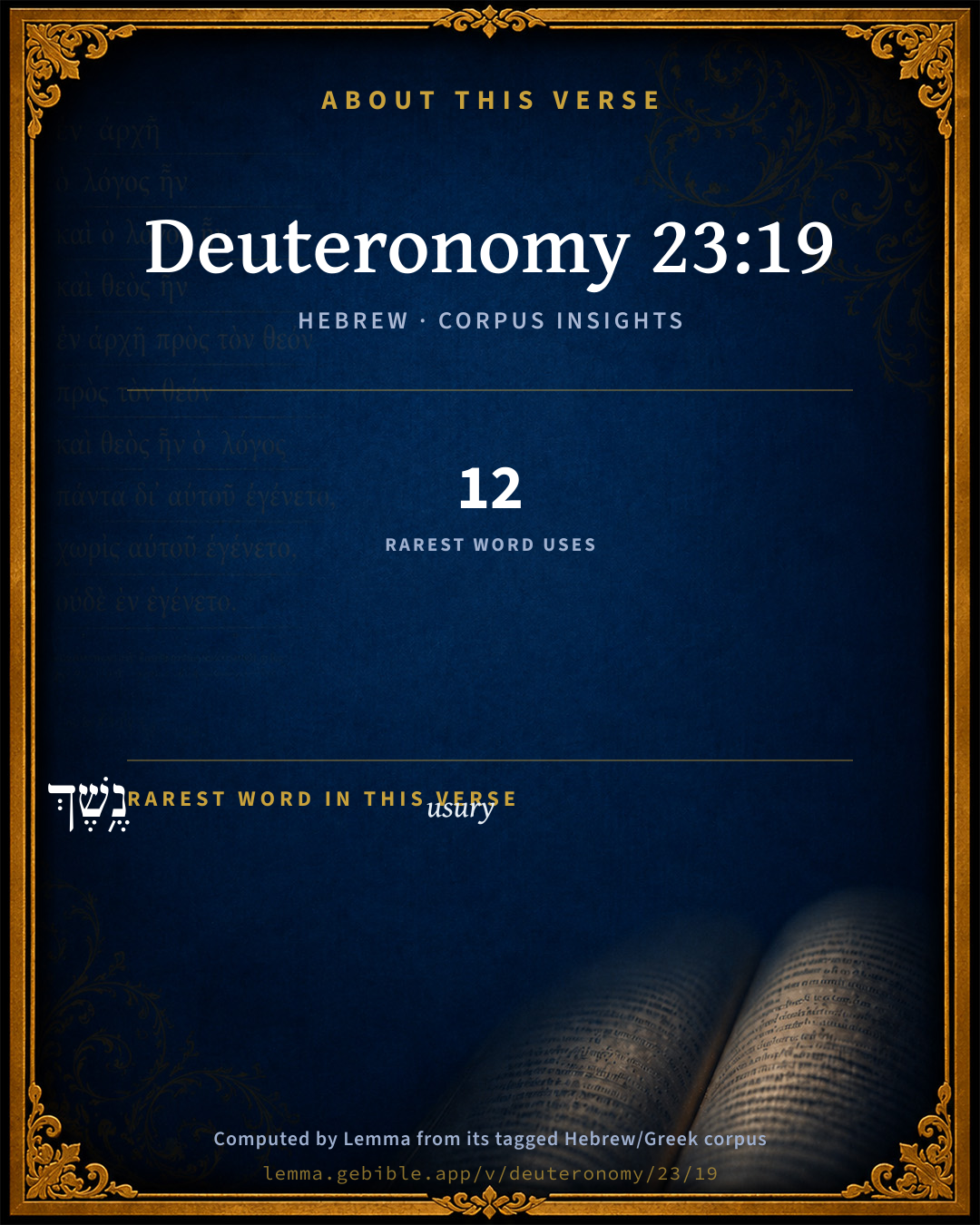
The rarest word here is נֶ֥שֶׁךְ usury H5392 — appearing just 12 times in the whole Hebrew Bible.

Shared distinctive vocabulary

נֶ֥שֶׁךְ usury H5392 occurs in 10 verses of the Hebrew Bible. Also found in:

Grammatical profile

  • 2 verbs
  • 8 nouns
  • 2 particles

Verb forms

  • תַשִּׁ֣יךְ Hiphil · Imperfect
  • יִשָּֽׁךְ Qal · Imperfect

Repetition

Words recur within this verse — often emphatic in Hebrew:

  • נֶ֥שֶׁךְ usury H5392 ×3
  • תַשִּׁ֣יךְ to bite H5391 ×2

Hebrew & Septuagint length

In English translation the verse runs 23 words from the Hebrew and 25 from the Septuagint (LXX English) — closely comparable.

A rough comparison of the two English renderings, which tokenize alike — not a word-level alignment.

Word counts can differ between the Hebrew and the Greek without any difference in meaning — e.g. the Hebrew direct-object marker אֵת has no separate Greek word, and Greek often adds the article ὁ.

Cross-references

8

Topical passages linked to Deuteronomy 23:19 in the Treasury of Scripture Knowledge — connected by theme and wording, ordered by reader-vote popularity; previews shown in the World English Bible.

  • Exodus 22:25 "If you lend money to any of my people with you who is poor, you shall not be to him as a creditor; neither shall you charge him interest.
  • Leviticus 25:35–37 "'If your brother has become poor, and his hand can't support him among you; then you shall uphold him. As a stranger and a sojourner he shall live with you.
  • Psalms 15:5 He who doesn't lend out his money for usury, Nor take a bribe against the innocent. He who does these things shall never be shaken.
  • Ezekiel 18:7–8 and has not wronged any, but has restored to the debtor his pledge, has taken nothing by robbery, has given his bread to the hungry, and has covered the naked with a garment;
  • Ezekiel 18:13 has given forth on interest, and has taken increase; shall he then live? he shall not live: he has done all these abominations; he shall surely die; his blood shall be on him.
  • Ezekiel 18:16–18 neither has wronged any, has not taken anything to pledge, neither has taken by robbery, but has given his bread to the hungry, and has covered the naked with a garment;
  • Ezekiel 22:12 In you have they taken bribes to shed blood; you have taken interest and increase, and you have greedily gained of your neighbors by oppression, and have forgotten me, says the Lord Yahweh.
  • Luke 6:34–35 If you lend to those from whom you hope to receive, what credit is that to you? Even sinners lend to sinners, to receive back as much.

Cross-references courtesy of OpenBible.info (CC BY 4.0).

Hebrew and Greek witnesses Masoretic Hebrew ↔ Greek Septuagint

The same verse in the two great witnesses to the Old Testament, shown verse-for-verse.

These are two independent witnesses, not word-aligned to each other, and the Septuagint is shown in lemma (dictionary) form.

Hebrew Deuteronomy 23:19 Masoretic · Westminster Leningrad Codex

לֹא תַשִּׁ֣יךְ לְאָחִ֔יךָ נֶ֥שֶׁךְ כֶּ֖סֶף נֶ֣שֶׁךְ אֹ֑כֶל נֶ֕שֶׁךְ כָּל דָּבָ֖ר אֲשֶׁ֥ר יִשָּֽׁךְ

You shall not lend on interest to your brother; interest of money, interest of food, interest of anything that is lent on interest:

World English Bible · Public Domain

Greek LXX Deuteronomy 23:19 Septuagint · lemma form

οὐ προςφέρω μίσθωμα πόρνη οὐδέ ἄλλαγμα κύων εἰς ὁ οἶκος κύριος ὁ θεός σύ πρός πᾶς εὐχή ὅτι βδέλυγμα κύριος ὁ θεός σύ εἰμί καί ἀμφότεροι

You shall not lend to your brother on usury of silver, or usury of meat, or usury of any thing which you may lend out.

LXX2012 (modern English Septuagint) · Public Domain

Hebrew: Westminster Leningrad Codex (CC BY 4.0). Greek: Septuagint (public domain); English from LXX2012 (modern English Septuagint) (Public Domain). How the Septuagint differs from the Hebrew →

Targum (Aramaic paraphrase)

2

The Targum is the ancient Jewish Aramaic paraphrase of the Hebrew Scriptures — an interpretive translation, not the Hebrew text itself. Onkelos (literal) and Pseudo-Jonathan (expansive) render the Torah, and Jonathan the Prophets. Coverage is partial: where no permissively-licensed English translation exists for a verse, only the Aramaic is shown. This is verse-level text, not a word-by-word alignment to the Hebrew.

  1. Targum Onkelos Torah (Genesis–Deuteronomy)
    לָא תָעֵל אֲגַר זַנִיתָא וְחוּלְפַן כַּלְבָא לְבֵית מַקְדְשָׁא דַיְיָ אֱלָהָךְ לְכָל נִדְרָא אֲרֵי מְרָחָק קֳדָם יְיָ אֱלָהָךְ אַף תַּרְוֵיהוֹן

    (no public-domain English translation for this verse)

    Targum Onkelos — Aramaic: “Onkelos Genesis” (public domain); “Onkelos Exodus” (public domain); “Onkelos Leviticus” (public domain); “Onkelos Numbers” (public domain); “Onkelos Deuteronomy” (public domain). English: “Sefaria Community Translation” (CC0 1.0 (public-domain dedication)); “J.W. Etheridge. The Targums of Onkelos and Jonathan Ben Uzziel on the Pentateuch. London: Longmans, Green, 1862” (public domain). Text via Sefaria.

  2. Targum Pseudo-Jonathan Torah (Genesis–Deuteronomy)
    לָא תַעֲלוּן אֲגַר מוֹהֲבוֹת מַטְעִיתָא וּפֵירוּג דְּכֶלֶב לְקַרְבָא בְּבֵי מוּקְדְּשָׁא דַיְיָ אֱלָהָכוֹן לְכָל נִדְרָא כָּל דְּכֵן לִשְׁאַר קוּרְבָּנַיָא אֲרוּם מְרַחֵק קֳדָם יְיָ אֱלָהָכוֹן אוּף תַּרְוֵיהוֹן

    You shall not bring a gift of the hire of an harlot, nor the price of a dog to offer it in the sanctuary of the Lord your God for any vow, much less as any of the oblations; for they are abominable, both of them, before the Lord your God.

    Targum Pseudo-Jonathan — Aramaic: “Targum Jonathan on Genesis” (public domain); “Targum Jonathan on Exodus” (public domain); “Targum Jonathan on Leviticus” (public domain); “Targum Jonathan on Numbers” (public domain); “Targum Jonathan on Deuteronomy” (public domain). English: “The Targum of Jonathan ben Uzziel, trans. J. W. Etheridge, London, 1862” (public domain). Text via Sefaria.

Commentary

Notes on Deuteronomy 23:19 from classic Christian and Jewish commentators (each source and its license shown beneath its notes). The classic Christian expositions comment on the surrounding passage and are grouped to its opening verse, so a note may address several verses; the Jewish commentaries on the Tanakh (Rashi and others) are per-verse, so they appear only where the commentator wrote on this verse.

Lemma curates 59 commentaries, every one of them public domain or Creative Commons licensed, each selected and text-cleaned for this edition rather than reprinted as found. About our sources →

Trapp's Complete Commentary

John Trapp

Deu 23:19 Thou shalt not lend upon usury to thy brother; usury of money, usury of victuals, usury of any thing that is lent upon usury:

Ver. 19. Thou shalt not lend upon usury.] Heb., Upon biting usury. It must needs bite at length that licks so clean. Amalek, the licking people, I mean the nation of usurers and their factors, as cormorants, fall upon the poor borrower, and with open mouth devour him.

“Eστι τοκος προ τοκοιο, τοκος γε μεν εστι και αλλος.”

Faenus a multiplici foetu, ut τοκος α τοκτω. In the year 1235, there were spread through England certain Roman usurers, called Caursini, quasi capientes Ursi; { a} devouring bears, saith Matthew Paris. These bite to purpose. Others are more cunning and close in their conveyance; like serpents, they can sting without hissing; like dog fish, suck your blood only with licking, and in the end kill you, and cut your throats without biting. "For as much as all usury, being forbidden by the law of God, is a sin, and detestable," &c., saith the statute, 13 Eliz., cap. 8. And "Verily so many as increase themselves by usury, &c., they have their goods of the devil’s gift" (Homil. of the Church of England, vol. ii. hom. 17, p. 2). Aristotle, {b} by the dim light of nature, saw the evil of it, condemning in one page the usurer and the dicer. And Agis, General of the Athenians, so hated usury, that he made a bonfire of all the usurer’s bills and bonds in the market place, and then said that he never saw a finer fire than that in all his life. {c}

{a} Speed.

{b} Arist., Eth., lib. iv. cap. 1.

{c} Plut., in Solone.

John Trapp, A Commentary or Exposition upon All the Books of the Old and New Testament (1647–1656) — public domain. Text from a community e-Sword module.

Joseph Benson's Commentary

Deu 23:19. Thou shalt not lend upon usury to thy brother — To an Israelite. They held their estates immediately from God, who, while he distinguished them from all other people, might have ordered, had he pleased, that they should have all things in common. But instead of that, and in token of their joint interest in the good land he had given them, he only appointed them, as there was occasion, to lend to one another without interest. This, among them, would be little or no loss to the lender, because their land was so divided, their estates so settled, and there was so little merchandise among them, that it was seldom or never they had occasion to borrow any great sums, but only for the subsistence of their families, or some uncommon emergence. But they might lend to a stranger upon usury who was supposed to live by trade, and therefore got by what he borrowed: in which case it is just the lender should share in the gain. This usury, therefore, is not oppressive; for they might not oppress a stranger.

Joseph Benson's Commentary on the Old and New Testaments (1811–1818) — public domain. Text from a community e-Sword module.

Keil & Delitzsch

C. F. Keil & F. Delitzsch

Different Theocratic Rights of Citizenship. - Deu 23:19, Deu 23:20. Of his brother (i.e., his countryman), the Israelite was not to take interest for money, food, or anything else that he lent to him; but only of strangers (non-Israelites: cf. Exo 22:24 and Lev 25:36-37).

Keil & Delitzsch — Biblical Commentary on the Old Testament (1861–1891) — public domain (CC PDM 1.0). Text via the HelloAO Bible API. (Old Testament only.)

Tyndale Open Study Notes

Tyndale Open Resources

23:19-20 The word translated interest is related to a noun meaning “bite.” Charging interest was to “put the bite” on the debtor. See also Exod 22:25; Lev 25:36-37; Neh 5:1-13; Ps 15:5.

Tyndale Open Study Notes — © Tyndale Open Resources, licensed CC BY-SA 4.0. Text via the HelloAO Bible API.

Jamieson, Fausset & Brown

Robert Jamieson, A. R. Fausset & David Brown

Thou shalt not lend upon usury to thy brother . . . Unto a stranger thou mayest lend upon usury--The Israelites lived in a simple state of society, and hence they were encouraged to lend to each other in a friendly way without any hope of gain. But the case was different with foreigners, who, engaged in trade and commerce, borrowed to enlarge their capital, and might reasonably be expected to pay interest on their loans. Besides, the distinction was admirably conducive to keeping the Israelites separate from the rest of the world.

Jamieson, Fausset & Brown — Commentary Critical and Explanatory on the Whole Bible (1871) — public domain (CC PDM 1.0). Text via the HelloAO Bible API.

Adam Clarke's Commentary

Verse 19. Usury] See Clarke on Le 25:36.

Adam Clarke's Commentary on the Bible (1810–1826) — public domain. Text from a community e-Sword/MySword module.

Ellicott's Commentary for English Readers

(19, 20) Usury.—See Exo_22:25; Lev_25:35-36. Some recent writers on this law have thought that it forbids the putting out of money to interest. But it is noticeable that in both the previous passages referred to (in Exod. and Lev.) the loan is supposed to be made to a “poor man” in “real distress.” Usury in such cases means oppression; and so it is proved to be by the examples given in Neh_5:2-5; Neh_5:10-12. The connection between this exaction and modern investments is not obvious, except in a very few cases. The Mosaic law against usury does not belong to commerce with other nations; it is part of the poor law of the land of Israel.

A Bible Commentary for English Readers, edited by Charles John Ellicott (1878–1897) — public domain. Text from a community e-Sword module.

John Gill's Exposition

Thou shalt not lend upon usury to thy brother,.... One of the same nation and religion, and who is in poor and necessitous circumstances, and wants either food for himself and family, or money to carry on his husbandry, till such times as the fruits of his ground will bring him in a sufficiency for his support, and the payment of what he borrows, and which is to be lent him without any interest: as the Jews were chiefly employed in husbandry, and not merchandise, they had but little occasion to borrow, and when they did could not afford to pay interest, as persons concerned in merchandise, whose gains are great, are able to do; and it is but reasonable that such persons should; but that the Israelites, when poor and in distress, might not be bowed down under their burdens, this law is made for their relief:

usury of money, usury of victuals, usury of anything that is lent upon usury; this takes in all sorts of usury, whether what is lent be money or food, or anything else, no interest was to be taken for it; See Gill on Lev 25:36; See Gill on Lev 25:37.

John Gill's Exposition of the Whole Bible (1746–1763) — public domain (CC PDM 1.0). Text via the HelloAO Bible API.

Matthew Poole's English Annotations

i.e. So as to receive thy principal money or thing left with such increase or improvement of it, as was usual and allowed among the Gentiles. But whether all usury be unlawful to Christians is too great a question to be determined in a work of this nature. See Exo 22:25; Deu 15:3; Psa 15:5; Neh 5:2; Luk 6:34.

Matthew Poole's English Annotations on the Holy Bible (1683–1685) — public domain. Text from a community e-Sword/MySword module.

Whedon's Commentary on the Bible

Daniel D. Whedon

19, 20. Not lend upon usury — Not to a brother Israelite. Compare Exo_22:25, and Lev_25:36-37. The Israelite was to exact nothing for the use of money, food, or any thing, provided it was loaned to his own countryman; but from non-Israelites he might.

Daniel D. Whedon (gen. ed.), Commentary on the Old and New Testaments (1874–1909) — public domain. Text from a community e-Sword module.

The Pulpit Commentary

Vers. 19-25. Certain civil rights and duties are here prescribed.

Vers. 19, 20. An Israelite might lend on interest money, or victuals, or other property, to a foreigner, but of one of his own people he was not to take interest for a loan (cf. Exo_22:24; Lev_25:36, Lev_25:37)

Vers. 19, 20. The opposite working of like principles.

The difference here permitted between lending to brethren and to strangers resembles that allowed in Deu_15:1-6. (see Homily thereon)

Vers. 19, 20. Usury lawful and unlawful.

From all conduct the element of selfishness is to be eliminated. All forms of honorable commerce are permitted, because, while the end is gain, it is not solely gain; seller and buyer both obtain advantage.

I OUR CONDUCT IS TO BE REGULATED BY RELATIONSHIP. Kindly feeling is due unto all men. We should honor man as man. Yet the conduct which is commendable to a stranger is not commendable to a father. According to the degree of propinquity should be the degree of affection. A brother has claims upon us which a stranger has not. Our stock of affection is limited; we are to bestow it on most suitable objects. Our capacity for doing good is measurable; we must expend it with care,

II MONEY GAIN IS NOT THE BUSINESS OF LIFE. There are occupations nobler than money-getting. Contentment is better than gold. The culture of the mind is better. The discipline of the moral powers is better. Brotherly kindness is better. The diffusion of knowledge is better. Earthly prosperity is to be hailed especially as a condition for doing good. To have, and yet to refuse to help, is a sin. That man"s gold is a curse.

III YET MONEY GAIN, WITHIN PROPER LIMITS, IS WISE AND HONORABLE. Properly viewed, moderate usury is but a species of commerce. If with my loan of a thousand pounds a shrewd merchant makes a gain of a hundred pounds in addition, it is just that I should receive a part thereof, as the earning of my loan. If one has money capital and another has skill and a third has time, it is simply equitable that the temporal earnings of the partnership should be divided, in some proportion, among all. If I obtain fair usury for the use of my money from honest traders, have power to help impoverished brethren to an extent I could not otherwise. God had not intended that the Hebrews should be a commercial nation, Their business was to be witness-bearers to the world of heavenly truth. D.

The Pulpit Commentary (1880–1919), ed. H.D.M. Spence-Jones & Joseph S. Exell — public domain. Text from a community e-Sword module.

John Wesley's Explanatory Notes

Thou shalt not lend upon usury to thy brother - To an Israelite. They held their estates immediately from God, who while he distinguished them from all other people, might have ordered, had he pleased, that they should have all things in common. But instead of that, and in token of their joint interest in the good land he had given them, he only appointed them, as there was occasion, to lend to one another without interest. This among them would be little or no loss to the lender, because their land was so divided, their estates so settled, and there was so little a merchandise among them, that it was seldom or never they had occasion to borrow any great sums, but only for the subsistence of their family, or some uncommon emergence. But they might lend to a stranger upon usury, who was supposed to live by trade, and therefore got by what he borrowed: in which case 'tis just, the lender should share in the gain. This usury therefore is not oppressive: for they might not oppress a stranger.

John Wesley, Explanatory Notes Upon the Whole Bible (1754–1765) — public domain. Text via the GEBible commentary corpus.

unfoldingWord translationNotes

Door43 World Missions Community

General Information:

Moses speaks to the Israelites as if they were one man, so the words "you" and "your" here are singular. (See: Forms of You)

You must not lend on interest to your fellow Israelite

"If you lend something to your fellow Israelite, you must not make him pay you back more than he borrowed"

lend on interest

to lend to somebody and force that person to pay back more than was lent

interest of money ... anything that is lent on interest

"you must not charge interest when you lend somebody money, food, or anything else"

all that you put your hand to

This is an idiom. AT: "all that you do" (See: Idiom)

translationWords

Israel

alien

bless

possess

unfoldingWord translationNotes — © Distant Shores Media and the Door43 World Missions Community, licensed CC BY-SA 4.0. Source: git.door43.org/Door43/en_tn.

Rashi

Rabbi Shlomo Yitzchaki (Rashi)

אתנן זונה [THOU SHALT NOT BRING] THE PROSTITUTION HIRE OF A WHORE [… INTO THE HOUSE OF THE LORD, THY GOD FOR ANY VOW] — This means, if he (the paramour) gave her a lamb as the hire of her prostitution it is unfitted for sacrifice (Sifrei Devarim 261:1; Temurah 29a).

ומחיר כלב [THOU SHALT NOT BRING …] THE PRICE OF A DOG [INTO THE HOUSE OF THE LORD …], if one has exchanged a lamb for a dog (Sifrei Devarim 261:2; Temurah 30a).

גם שניהם FOR EVEN BOTH THESE ARE [ABOMINATION UNTO THE LORD, THY GOD] — The words גם שניהם taken as גם שנוייהם are intended to include in the prohibition the things into which they (whatever is given as hire) are changed, as, e.g., if he gave the woman wheat and she made it into flour (Temurah 30b).

Rashi on the Tanakh — English translations: “The Judaica Press complete Tanach with Rashi, translated by A. J. Rosenberg” (CC BY 4.0); “Pentateuch with Rashi's commentary by M. Rosenbaum and A.M. Silbermann, 1929-1934” (public domain); “The Metsudah Tanach series, Lakewood, N.J” (CC BY 4.0); and “The Book of Joshua, Metsudah Publications, 1997” (CC BY 4.0). Text via Sefaria.

Ramban (Nachmanides)

Rabbi Moshe ben Nachman (Ramban / Nachmanides)

THOU SHALT NOT BRING THE HIRE OF A HARLOT, [OR THE PRICE OF A DOG, INTO THE HOUSE OF THE ETERNAL THY G-D FOR ANY VOW]. Harlots are wont to do good deeds with their hire, thinking thereby to atone for their sins, as our Rabbis mentioned in their proverb, “She commits illicit sexual intercourse for apples and she divides them among the sick.” Therefore the Torah prohibited a harlot’s gift to be brought for any vow, for now they sin more and more. Similarly the matter of the price of the dog is that hunters using dogs and watchmen of walls raise brazen dogs that harm the public, and the owners vow [to contribute] their value [to a cause which they consider sacred], as an atonement for their soul. Such is still the custom among men who ride to the hunts that they place the waxen image of their dogs before an idol that they may be successful with them. And the commentators [as mentioned by Ibn Ezra] have said [that the reason for the prohibition is] because they [i.e., these payments] came about in a contemptible manner.

GAM SHNEIHEM’ (‘EVEN THEY BOTH’) [ARE AN ABOMINATION TO THE ETERNAL THY G-D]. “Even they both — this includes the products into which they have been processed, such as wheat which she made into flour.” This is Rashi’s language. But in the Gemara the Rabbis have said that the School of Shammai forbid it and the School of Hillel permit it. Instead, the verse [in accordance with the teaching of the School of Hillel] is to be interpreted as follows: “They [are forbidden] but not their young; they [are forbidden] but not the products into which they have been processed.” And the purport of the expression gam shneihem is that since one of them is indeed a great abomination — namely, the hire of a harlot, since the harlotry was committed for it — [while the price of a dog might be considered less of an abomination] the verse states that “even both of these” [including the price of a dog] G-d will reject. Similarly, He that justifieth the wicked, and he that condemneth the righteous, ‘even they both’ are an abomination to the Eternal; the verse attaches the smaller offense [i.e., he that justifies the wicked] to the bigger one [he that condemns the righteous]. So also, then they shall both of them die, as I have explained [there, that the man is the greater sinner of the two, and therefore the verse states that even she is also to die].Or it may be that the purport [of the expression gam shneihem] is that since he had already warned against the disqualifications of the offering through blemishes, and stated concerning them, Thou shalt not sacrifice unto the Eternal thy G-d an ox, or a sheep, wherein is a blemish, even any evil thing; for that is an abomination unto the Eternal thy G-d, he supplemented here saying that the hire of the harlot and the price of the dog — although in themselves perfect — that they too are the abomination of the Eternal like those [blemished offerings]. This is the correct interpretation. So also, The hearing ear, and the seeing eye, the Eternal hath made even both of them, the verse alludes to man in general and states that G-d created man and also made these characteristics in him. Similarly, Diverse weights, and diverse measures, both of them alike are an abomination to the Eternal, Verse 10. the verse intimates to whoever robs, extorts, and exploits in any manner which are greater abominations than these [false weights and measures], although it does not mention them, [and declares that even diverse weights and diverse measures are an abomination to G-d].

Ramban (Nachmanides) on the Tanakh — English translation: “Commentary on the Torah by Ramban (Nachmanides). Translated and annotated by Charles B. Chavel. New York, Shilo Pub. House, 1971-1976” (CC BY 4.0). Text via Sefaria.

Lesson kit

Teaching starters — assembled from the data on this page, not authored interpretation. Every prompt links to the verse data it draws on. Edit before teaching.

Deuteronomy, in the Pentateuch, opens this verse with 12 words (9 distinct Hebrew lemmas). Its most distinctive word is neshek (“usury”). A historical commentator’s framing appears above. Read the whole chapter for the surrounding context.

Discussion questions

  1. What does “usury” (neshek) contribute to the verse as a whole?
  2. Exodus 22:25 shares the word «usury» with this verse. How do the two illuminate each other?
  3. “usury” occurs 3× in this one verse. What is the effect of the repetition?
  4. These translations render this verse differently; the difference is in the English rendering, not the original. What questions does that raise?
  5. The verb «תַשִּׁ֣יךְ» is Hiphil Imperfect. How does its form color the action?
  6. Reading how Trapp's Complete Commentary and Joseph Benson's Commentary read this verse, where do the two commentators agree and where do they part?

Things to notice

Reading settings

Reading text

Shown beneath each verse's original-language words.

Old Testament
Old Testament edition

Read the OT as the Masoretic Hebrew (MT) or the Greek Septuagint (LXX).

English shown for the Greek Septuagint (in the Hebrew ↔ Greek comparison).

Comparing translations? Open the Compare panel on any verse page to stack up to four side by side.