
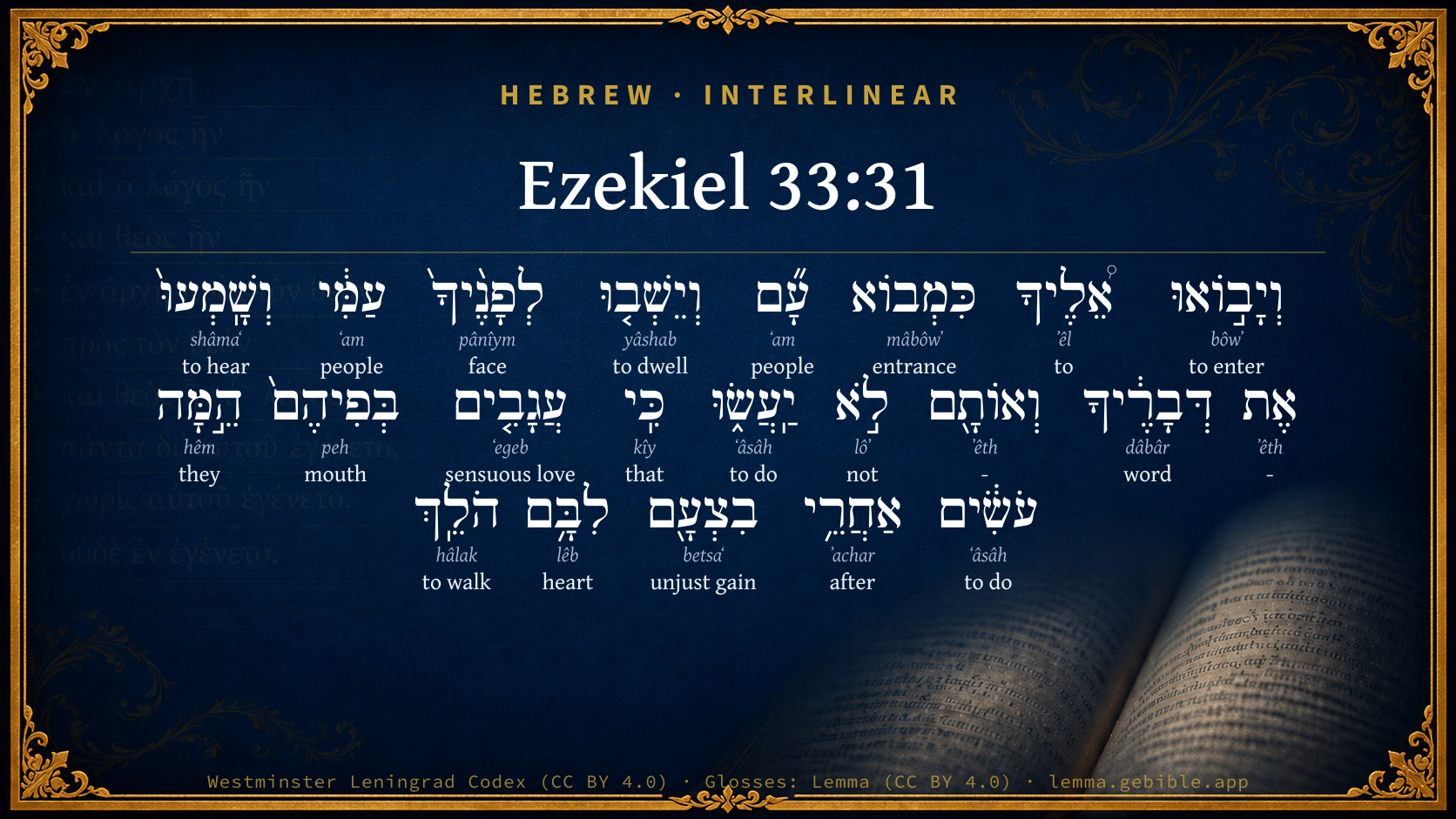
Ezekiel 33:31

Hebrew (Westminster Leningrad Codex) Ezekiel 33:31 appears in the Hebrew Old Testament. The text above is from the Westminster Leningrad Codex. Each word links to its Strong’s number, a concise gloss, and parsing drawn from the Open Scriptures Hebrew Bible morphology. Click any word for its full Brown-Driver-Briggs (BDB) entry.
Download image
Cite this verse

Ezekiel 33:31 (World English Bible). Public Domain. Lemma interlinear Bible study tool, https://lemma.gebible.app/v/ezekiel/33/31.

Show BibTeX & RIS
BibTeX
RIS
English Translation
They come to you as the people comes, and they sit before you as my people, and they hear your words, but don't do them; for with their mouth they show much love, but their heart goes after their gain.
World English Bible · Public Domain
Highlights
  • 1 first appearance in the Hebrew Bible
Full analysis ↓
Download a study sheet

One document with this verse’s original text, its word-by-word gloss line, the meaning frame, cross-references with their text, attributed commentary, and full source and license credits — printable, and it pastes into notes with its structure intact.

This verse Autodidact and up

Study sheet (.html) Plain text (.txt)

A passage Seminary Student

Up to 50 verses in one chapter. A passage sheet keeps up to 6 commentary sources and 12 cross-references per verse, in the order this page ranks them, and says so on the sheet whenever that leaves anything out. Ask for a single verse and you get the Autodidact verse sheet above.

Everything on this page stays free to read, with no account — the sheet is a download of what is already on screen, not access to it.

Want to remove ads? Support Godless Engineer
Compare translations 3

The same verse in 3 English versions, stacked beneath the original-language interlinear above. Click any original word for its lexicon entry.

Each is an independent rendering of the whole verse — the interlinear is not word-aligned to these translations.

Highlighted words mark where these versions differ — a whole-verse word diff, not a word-by-word alignment.

  • World English Bible Public Domain
    They come to you as the people comes, and they sit before you as my people, and they hear your words, but don't do them; for with their mouth they show much love, but their heart goes after their gain.
  • King James Version Public Domain
    And they come unto thee as the people cometh, and they sit before thee as my people, and they hear thy words, but they will not do them: for with their mouth they shew much love, but their heart goeth after their covetousness.
  • unfoldingWord Literal Text CC BY-SA 4.0
    So my people will come to you, as they often do, and will sit in front of you and listen to your words, but they will not obey them. Right words are in their mouths, but their hearts are going after unjust profit.

unfoldingWord Literal Text — © unfoldingWord, licensed CC BY-SA 4.0. Word-aligned USFM3 via Door43 (git.door43.org/unfoldingWord/en_ult).

Versions to compare (up to 4)

3 of 4 selected

Show all 18 translations

Every available English version of this verse, each an independent rendering of the whole verse.

  • World English Bible Public Domain
    They come to you as the people comes, and they sit before you as my people, and they hear your words, but don't do them; for with their mouth they show much love, but their heart goes after their gain.
  • Berean Standard Bible Public Domain
    So My people come to you as usual, sit before you, and hear your words; but they do not put them into practice. Although they express love with their mouths, their hearts pursue dishonest gain.
  • Majority Standard Bible Public Domain
    So My people come to you as usual, sit before you, and hear your words; but they do not put them into practice. Although they express love with their mouths, their hearts pursue dishonest gain.
  • King James Version Public Domain
    And they come unto thee as the people cometh, and they sit before thee as my people, and they hear thy words, but they will not do them: for with their mouth they shew much love, but their heart goeth after their covetousness.
  • American Standard Version (1901) Public Domain
    And they come unto thee as the people cometh, and they sit before thee as my people, and they hear thy words, but do them not; for with their mouth they show much love, but their heart goeth after their gain.
  • Revised Version (1885) Public Domain
    And they come unto thee as the people cometh, and they sit before thee as my people, and they hear thy words, but do them not: for with their mouth they shew much love, but their heart goeth after their gain.
  • Geneva Bible (1599) Public Domain
    For they come vnto thee, as the people vseth to come: and my people sit before thee, and heare thy wordes, but they will not doe them: for with their mouthes they make iestes, and their heart goeth after their couetousnesse.
  • Douay-Rheims (1899) Public Domain
    And they come to thee, as if a people were coming in, and my people sit before thee: and hear thy words, and do them not: for they turn them into a song of their mouth, and their heart goeth after their covetousness.
  • Young's Literal Translation Public Domain
    And they come in unto thee as the coming in of a people, And they sit before thee -- My people, And have heard thy words, and they do them not, For doting loves with their mouth they are making, After their dishonest gain their heart is going.
  • Literal Standard Version CC BY-SA 4.0
    And they come in to you as the coming in of a people, || And they sit before you—My people, || And have heard your words, and they do not do them, || For they are making unhealthy loves with their mouth, || Their heart is going after their dishonest gain.
  • Unlocked Literal Bible CC BY-SA 4.0
    So my people will come to you, as they often do, and will sit in front of you and listen to your words, but they will not obey them. Right words are in their mouths, but their hearts are going after unjust profit.
  • unfoldingWord Literal Text CC BY-SA 4.0
    So my people will come to you, as they often do, and will sit in front of you and listen to your words, but they will not obey them. Right words are in their mouths, but their hearts are going after unjust profit.
  • Darby Bible Public Domain
    And they come unto thee as a people cometh, and they sit before thee [as] my people, and they hear thy words, but they do them not; for with their mouth they shew much love, [but] their heart goeth after their dishonest gain.
  • World Messianic Bible Public Domain
    They come to you as the people come, and they sit before you as my people, and they hear your words, but don’t do them; for with their mouth they show much love, but their heart goes after their gain.
  • Webster's Bible Public Domain
    And they come to thee as the people come, and they sit before thee as my people, and they hear thy words, but they will not do them: for with their mouth they show much love, but their heart goeth after their covetousness.
  • Free Bible Version CC BY-SA 4.0
    So my people come and visit you like they usually do. They sit and listen to the message you share, but they don't do anything about it. Even though they talk about love, all they're thinking about is how to cheat others.
  • Bible in Basic English Public Domain
    And they come to you as my people come, and are seated before you as my people, hearing your words but doing them not: for deceit is in their mouth and their heart goes after profit for themselves.
  • JPS Tanakh (1917) Public Domain
    and come unto thee as the people cometh, and sit before thee as My people, and hear thy words, but do them not — for with their mouth they show much love, but their heart goeth after their covetousness;

Literal Standard Version (2020), Covenant Press — licensed CC BY-SA 4.0. Text via the HelloAO Bible API (eBible.org). Unlocked Literal Bible (unfoldingWord) — licensed CC BY-SA 4.0. Text via the HelloAO Bible API (eBible.org). unfoldingWord Literal Text — © unfoldingWord, licensed CC BY-SA 4.0. Word-aligned USFM3 via Door43 (git.door43.org/unfoldingWord/en_ult). Free Bible Version, Dr. Jonathan Gallagher — licensed CC BY-SA 4.0. Text via the HelloAO Bible API (eBible.org).

Word by word

More ways to search: Search by grammar → Find every occurrence → Compare this word →

Practice this passage: Drill this verse → Learn its vocabulary →

עֲגָבִ֤ים
ʻegeb
H5690
“sensuous love”
Noun, Common, Masculine, Plural, Absolute
Part of Speech
Noun
Type
Common
Gender
Masculine
Number
Plural
State
Absolute
Full BDB Definition

Origin: from H5689

TWOT: 1559a

(sensuous) love
  1. וְיָב֣וֹאוּ bôwʼ H935 “and · to enter” Conjunction + Verb, Qal, Imperfect, 3rd Person, Masculine, Plural
  2. אֵ֠לֶיךָ ʼêl H413 “to · you” Preposition + Suffix, Personal, 2nd Person, Masculine, Singular
  3. כִּמְבוֹא mâbôwʼ H3996 “like/as · entrance of” Preposition + Noun, Common, Masculine, Singular, Construct
  4. עָ֞ם ʻam H5971 “people” Noun, Common, Masculine, Singular, Absolute
  5. וְיֵשְׁב֤וּ yâshab H3427 “and · to dwell” Conjunction + Verb, Qal, Imperfect, 3rd Person, Masculine, Plural
  6. לְפָנֶ֨יךָ֙ pânîym H6440 “to/for · face(s) · your” Preposition + Noun, Common, Both, Plural, Construct + Suffix, Personal, 2nd Person, Masculine, Singular
  7. עַמִּ֔י ʻam H5971 “people · my” Noun, Common, Masculine, Singular, Construct + Suffix, Personal, 1st Person, Common, Singular
  8. וְשָֽׁמְעוּ֙ shâmaʻ H8085 “and · to hear” Conjunction + Verb, Qal, Sequential Perfect, 3rd Person, Common, Plural
  9. אֶת ʼêth H853 “-” Particle, Direct Object
  10. דְּבָרֶ֔יךָ dâbâr H1697 “words · your” Noun, Common, Masculine, Plural, Construct + Suffix, Personal, 2nd Person, Masculine, Singular
  11. וְאוֹתָ֖ם ʼêth H853 “and · - · them” Conjunction + Particle, Direct Object + Suffix, Personal, 3rd Person, Masculine, Plural
  12. לֹ֣א lôʼ H3808 “not” Particle, Negative
  13. יַֽעֲשׂ֑וּ ʻâsâh H6213 “to do” Verb, Qal, Imperfect, 3rd Person, Masculine, Plural
  14. כִּֽי kîy H3588 “that” Conjunction
  15. בְּפִיהֶם֙ peh H6310 “in/at · mouth · their” Preposition + Noun, Common, Masculine, Singular, Construct + Suffix, Personal, 3rd Person, Masculine, Plural
  16. הֵ֣מָּה hêm H1992 “they” Pronoun, Personal, 3rd Person, Masculine, Plural
  17. עֹשִׂ֔ים ʻâsâh H6213 “doing” Verb, Qal, Participle Active, Masculine, Plural, Absolute
  18. אַחֲרֵ֥י ʼachar H310 “after” Preposition
  19. בִצְעָ֖ם betsaʻ H1215 “unjust gain · their” Noun, Common, Masculine, Singular, Construct + Suffix, Personal, 3rd Person, Masculine, Plural
  20. לִבָּ֥ם lêb H3820 “heart · their” Noun, Common, Masculine, Singular, Construct + Suffix, Personal, 3rd Person, Masculine, Plural
  21. הֹלֵֽךְ hâlak H1980 “walking” Verb, Qal, Participle Active, Masculine, Singular, Absolute

About this verse

These counts appear in no published source. They are computed here, from the morphology-tagged text and Lemma’s own curated glosses. What Lemma adds →

22
words
19
distinct lemmas
Prophets
section

Notable vocabulary

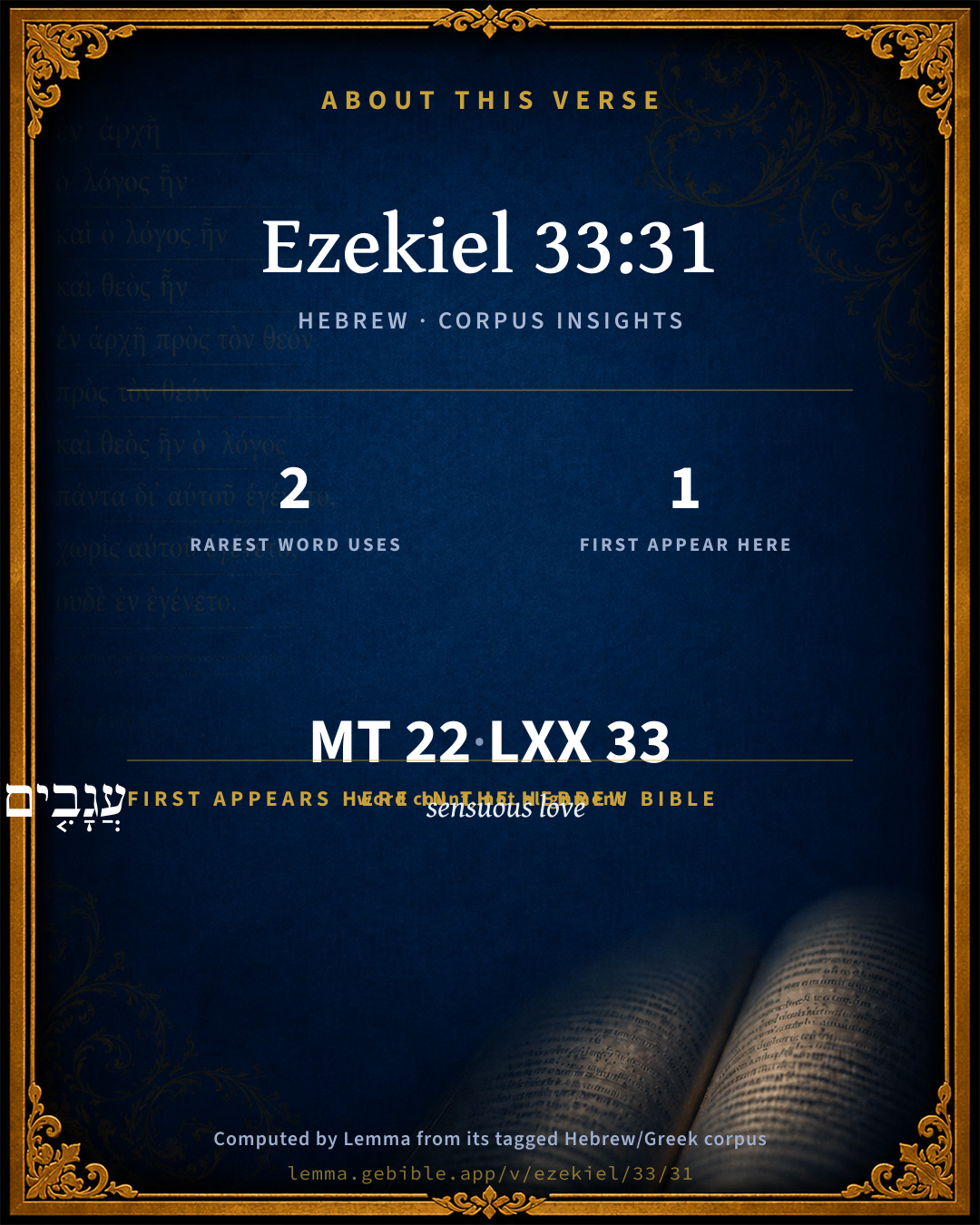
The rarest word here is עֲגָבִ֤ים sensuous love H5690 — appearing just 2 times in the whole Hebrew Bible.

First appearance in Scripture

This word makes its first canonical appearance in the Hebrew Bible here:

  • עֲגָבִ֤ים sensuous love H5690

Shared distinctive vocabulary

עֲגָבִ֤ים sensuous love H5690 occurs in 2 verses of the Hebrew Bible. Also found in:

Grammatical profile

  • 6 verbs
  • 9 nouns
  • 1 pronoun
  • 2 prepositions
  • 1 conjunction
  • 3 particles

Verb forms

  • וְיָב֣וֹאוּ Qal · Imperfect
  • וְיֵשְׁב֤וּ Qal · Imperfect
  • וְשָֽׁמְעוּ֙ Qal · Sequential Perfect
  • יַֽעֲשׂ֑וּ Qal · Imperfect
  • עֹשִׂ֔ים Qal · Participle Active
  • הֹלֵֽךְ Qal · Participle Active

Repetition

Words recur within this verse — often emphatic in Hebrew:

  • עָ֞ם people H5971 ×2
  • יַֽעֲשׂ֑וּ to do H6213 ×2

Hebrew & Septuagint length

In English translation the verse runs 40 words from the Hebrew and 36 from the Septuagint (LXX English) — closely comparable.

A rough comparison of the two English renderings, which tokenize alike — not a word-level alignment.

Word counts can differ between the Hebrew and the Greek without any difference in meaning — e.g. the Hebrew direct-object marker אֵת has no separate Greek word, and Greek often adds the article ὁ.

In the original languages it is 22 Hebrew tokens and 33 Greek tokens — but the two are counted differently (Hebrew bundles its prefixes and suffixes into one token; the Greek is in lemma form), so that isn’t a like-for-like length.

Cross-references

28

Topical passages linked to Ezekiel 33:31 in the Treasury of Scripture Knowledge — connected by theme and wording, ordered by reader-vote popularity; previews shown in the World English Bible.

  • Matthew 13:22 What was sown among the thorns, this is he who hears the word, but the cares of this age and the deceitfulness of riches choke the word, and he becomes unfruitful.
  • Psalms 78:36–37 But they flattered him with their mouth, And lied to him with their tongue.
  • James 1:22–24 But be doers of the word, and not only hearers, deluding your own selves.
  • Isaiah 29:13 The Lord said, Because this people draw near [to me], and with their mouth and with their lips to honor me, but have removed their heart far from me, and their fear of me is a commandment of men which has been taught [them];
  • Luke 11:28 But he said, "On the contrary, blessed are those who hear the word of God, and keep it."
  • James 2:14–16 What good is it, my brothers, if a man says he has faith, but has no works? Can faith save him?
  • Jeremiah 44:16 As for the word that you have spoken to us in the name of Yahweh, we will not listen to you.
  • Ezekiel 8:1 It happened in the sixth year, in the sixth [month], in the fifth [day] of the month, as I sat in my house, and the elders of Judah sat before me, that the hand of the Lord Yahweh fell there on me.
  • Luke 6:48–49 He is like a man building a house, who dug and went deep, and laid a foundation on the rock. When a flood arose, the stream broke against that house, and could not shake it, because it was founded on the rock.
  • 1 Timothy 6:9–10 But those who are determined to be rich fall into a temptation and a snare and many foolish and harmful lusts, such as drown men in ruin and destruction.
  • 1 John 3:17–18 But whoever has the world's goods, and sees his brother in need, and closes his heart of compassion against him, how does the love of God remain in him?
  • Isaiah 28:13 Therefore shall the word of Yahweh be to them precept on precept, precept on precept; line on line, line on line; here a little, there a little; that they may go, and fall backward, and be broken, and snared, and taken.
  • Deuteronomy 5:28–29 Yahweh heard the voice of your words, when you spoke to me; and Yahweh said to me, I have heard the voice of the words of this people, which they have spoken to you: they have well said all that they have spoken.
  • Jeremiah 23:33–38 When this people, or the prophet, or a priest, shall ask you, saying, What is the burden of Yahweh? then shall you tell them, What burden! I will cast you off, says Yahweh.
  • Luke 8:21 But he answered them, "My mother and my brothers are these who hear the word of God, and do it."
  • Luke 10:39 She had a sister called Mary, who also sat at Jesus' feet, and heard his word.
  • Jeremiah 43:1–7 It happened that, when Jeremiah had made an end of speaking to all the people all the words of Yahweh their God, with which Yahweh their God had sent him to them, even all these words,
  • Ezekiel 14:1 Then came certain of the elders of Israel to me, and sat before me.
  • Ezekiel 20:1–32 It happened in the seventh year, in the fifth [month], the tenth [day] of the month, that certain of the elders of Israel came to inquire of Yahweh, and sat before me.
  • Ezekiel 22:27 Her princes in the midst of it are like wolves ravening the prey, to shed blood, [and] to destroy souls, that they may get dishonest gain.
  • Matthew 6:24 "No one can serve two masters, for either he will hate the one and love the other; or else he will be devoted to one and despise the other. You can't serve both God and Mammon.
  • Matthew 7:24–27 "Everyone therefore who hears these words of mine, and does them, I will liken him to a wise man, who built his house on a rock.
  • Matthew 19:22 But when the young man heard the saying, he went away sad, for he was one who had great possessions.
  • Luke 12:15–21 He said to them, "Beware! Keep yourselves from covetousness, for a man's life doesn't consist of the abundance of the things which he possesses."
  • Luke 16:14 The Pharisees, who were lovers of money, also heard all these things, and they scoffed at him.
  • Acts 10:33 Therefore I sent to you at once, and it was good of you to come. Now therefore we are all here present in the sight of God to hear all things that have been commanded you by God."
  • Ephesians 5:5 Know this for sure, that no sexually immoral person, nor unclean person, nor covetous man, who is an idolater, has any inheritance in the Kingdom of Christ and God.
  • Jeremiah 6:16–17 Thus says Yahweh, Stand you in the ways and see, and ask for the old paths, where is the good way; and walk therein, and you shall find rest for your souls: but they said, We will not walk [therein].

Cross-references courtesy of OpenBible.info (CC BY 4.0).

Hebrew and Greek witnesses Masoretic Hebrew ↔ Greek Septuagint

The same verse in the two great witnesses to the Old Testament, shown verse-for-verse.

These are two independent witnesses, not word-aligned to each other, and the Septuagint is shown in lemma (dictionary) form.

Hebrew Ezekiel 33:31 Masoretic · Westminster Leningrad Codex

וְיָב֣וֹאוּ אֵ֠לֶיךָ כִּמְבוֹא עָ֞ם וְיֵשְׁב֤וּ לְפָנֶ֨יךָ֙ עַמִּ֔י וְשָֽׁמְעוּ֙ אֶת דְּבָרֶ֔יךָ וְאוֹתָ֖ם לֹ֣א יַֽעֲשׂ֑וּ כִּֽי עֲגָבִ֤ים בְּפִיהֶם֙ הֵ֣מָּה עֹשִׂ֔ים אַחֲרֵ֥י בִצְעָ֖ם לִבָּ֥ם הֹלֵֽךְ

They come to you as the people comes, and they sit before you as my people, and they hear your words, but don't do them; for with their mouth they show much love, but their heart goes after their gain.

World English Bible · Public Domain

Greek LXX Ezekiel 33:31 Septuagint · lemma form

ἔρχομαι πρός σύ ὡς συνπορεύομαι λαός καί καταἧμαι ἐναντίον σύ καί ἀκούω ὁ ῥῆμα σύ καί αὐτός οὐ μή ποιέω ὅτι ψεῦδος ἐν ὁ στόμα αὐτός καί ὀπίσω ὁ μίασμα ὁ καρδία αὐτός

They approach you as a people comes together, and sit before you, and hear your words, but they will not do them: for there is falsehood in their mouth, and their heart goes after their pollutions.

LXX2012 (modern English Septuagint) · Public Domain

On this verse, The Cambridge Bible for Schools and Colleges discusses the Septuagint’s reading. Read the note in Commentary ↓

Hebrew: Westminster Leningrad Codex (CC BY 4.0). Greek: Septuagint (public domain); English from LXX2012 (modern English Septuagint) (Public Domain). How the Septuagint differs from the Hebrew →

Targum (Aramaic paraphrase)

1

The Targum is the ancient Jewish Aramaic paraphrase of the Hebrew Scriptures — an interpretive translation, not the Hebrew text itself. Onkelos (literal) and Pseudo-Jonathan (expansive) render the Torah, and Jonathan the Prophets. Coverage is partial: where no permissively-licensed English translation exists for a verse, only the Aramaic is shown. This is verse-level text, not a word-by-word alignment to the Hebrew.

  1. Targum Jonathan Prophets (Joshua–Malachi)
    וְיֵיתוּן עֲלָךְ כְּמֵיתֵי גַבְרִין תַּלְמִידִין וִיתִיבוּן קֳדָמָךְ עַמִי וְשָׁמְעִין יַת פִּתְגָמָךְ וְיַתְהוֹן לָא יַעְבְּדוּן אֲרֵי תּוּלְעָבָא בְּפוּמְהוֹן אִינוּן עָבְדִין בָּתַר מָמוֹן אוּנְסֵיהוֹן לִבְּהוֹן טָעֵי:

    (no public-domain English translation for this verse)

    Targum Jonathan — Aramaic: “Mikraot Gedolot” (public domain). English: “Sefaria Community Translation” (CC0 1.0 (public-domain dedication)); “London "Chaldee Paraphrase," 1871” (public domain). Text via Sefaria.

Commentary

Notes on Ezekiel 33:31 from classic Christian and Jewish commentators (each source and its license shown beneath its notes). The classic Christian expositions comment on the surrounding passage and are grouped to its opening verse, so a note may address several verses; the Jewish commentaries on the Tanakh (Rashi and others) are per-verse, so they appear only where the commentator wrote on this verse.

Lemma curates 59 commentaries, every one of them public domain or Creative Commons licensed, each selected and text-cleaned for this edition rather than reprinted as found. About our sources →

Trapp's Complete Commentary

John Trapp

Eze 33:31 And they come unto thee as the people cometh, and they sit before thee [as] my people, and they hear thy words, but they will not do them: for with their mouth they shew much love, [but] their heart goeth after their covetousness.

Ver. 31. And they come unto thee.] Very goodly.

And they sit before thee.] Very demurely, and, to see to, devoutly, taking up all the seats.

They hear thy words.] But they were as heartless in hearing, as they were listless in praying. {Eze 33:10}

They will not do them.] Of the Athenians also it was said of old, that they knew well what was good and right, but would do neither.

Their heart goeth after their covetousness.] Their heart is on their halfpenny, as we say; neither can the loadstone of God’s Word hale them one jot from the earth. It should be Sursum corda; up from the heart, but when many men’s bodies are in sacculis, in their purse, their hearts are in sacculis, in their purse, as Augustine complaineth; as serpents have their bodies in the water, their heads out of the water, so here; as those Gergesites, they more mind a swine sty than a sanctuary. {a}

{a} Haram domesticam arae Dominicae praefer.

John Trapp, A Commentary or Exposition upon All the Books of the Old and New Testament (1647–1656) — public domain. Text from a community e-Sword module.

Geneva Bible (1599)

Geneva Bible translators

This declareth that we ought to hear God’s word with such zeal and affection, that we should in all points obey it, else we abuse the word to our own condemnation, and make of his ministers, as though they were jests to serve men’s foolish fantasies.

Geneva Bible (1599) marginal notes — public domain. Text via Bolls.life.

Jamieson, Fausset & Brown

Robert Jamieson, A. R. Fausset & David Brown

as the people cometh--that is, in crowds, as disciples flock to their teacher.

sit before thee--on lower seats at thy feet, according to the Jewish custom of pupils (Deu 33:3; Kg2 4:38; Luk 10:39; Act 22:3).

as my people--though they are not.

hear . . . not do-- (Mat 13:20-21; Jam 1:23-24).

they show much love--literally, "make love," that is, act the part of lovers. Profess love to the Lord (Mat 7:21). GESENIUS translates, according to Arabic idiom, "They do the delights of God," that is, all that is agreeable to God. Vulgate translates, "They turn thy words into a song of their mouths."

heart goeth after . . . covetousness--the grand rival to the love of God; therefore called "idolatry," and therefore associated with impure carnal love, as both alike transfer the heart's affection from the Creator to the creature (Mat 13:22; Eph 5:5; Ti1 6:10).

Jamieson, Fausset & Brown — Commentary Critical and Explanatory on the Whole Bible (1871) — public domain (CC PDM 1.0). Text via the HelloAO Bible API.

Adam Clarke's Commentary

Verse 31. As the people cometh] As they are accustomed to come on public days, Sabbaths, &c.

With their mouth they show much love] They respected the prophet, but would not bend themselves to follow his precepts. They loved earthly things, and did not relish those of heaven.

Adam Clarke's Commentary on the Bible (1810–1826) — public domain. Text from a community e-Sword/MySword module.

Ellicott's Commentary for English Readers

(31) As the people cometh.—In the original, according to the coming of a people—i.e., in crowds. In the following clause, “as my people,” there is an emphasis on the pronoun, as the true people of God. Such was their outward bearing, while their inward disposition was far different.

A Bible Commentary for English Readers, edited by Charles John Ellicott (1878–1897) — public domain. Text from a community e-Sword module.

The Cambridge Bible for Schools and Colleges

gen. ed. J. J. S. Perowne

31. On “come unto thee” cf. Eze_8:1, Eze_14:1, Eze_20:1.

as my people] The construction is very hard. LXX. omits.

with their mouth … love] The language is peculiar, but can hardly have any other sense. LXX. Syr. read: for falsehood is in their mouth and their heart &c. The term “covetousness” or gain has, especially in later books, the general sense of advantage, self-advancement, Isa_56:11.

The Cambridge Bible for Schools and Colleges (gen. ed. J. J. S. Perowne; Cambridge University Press, 1878–1918) — public domain. Text from a community e-Sword module.

John Gill's Exposition

And when this cometh to pass,.... The prophecy before delivered out, concerning the desolations in the land of Israel, by the sword, pestilence, and wild beasts:

lo, it will come; whatever is predicted by the Lord; in the mouth of his prophets, certainly comes to pass: then shall they know that a prophet hath been among them; and acknowledge it; and particularly that Ezekiel was one, a true prophet of the Lord, by the exact accomplishment of his predictions.

Next: Ezekiel Chapter 34

John Gill's Exposition of the Whole Bible (1746–1763) — public domain (CC PDM 1.0). Text via the HelloAO Bible API.

Haydock's Catholic Bible Commentary

In to a religious meeting. (Chaldean) Perhaps they came on the sabbath to his house. Yet they made a just and song of his instructions. (Calmet) --- They heard them with pleasure, but did not reform their lives. (Haydock)

George Leo Haydock (1774–1849), Haydock's Catholic Family Bible and Commentary, 1859 edition — public domain. Excludes Psalms (Douay-Rheims chapter numbering differs from Protestant) and Deuterocanonical books (Catholic canon only).

Matthew Poole's English Annotations

Flocking to the school of some famous doctor, or as men and women flock to hear some famous preacher, or as they were wont to the synagogues to hear their learned scribes. So we find the elders of Judah, Eze 8:1, which see; so the disciples of the great rabbies sat at their feet; so is Saul said to be brought up at the feet of Gamaliel. By their outward deportments, you might judge them to be my people, and hear seemingly very attentive. They do only hear what thou sayest, but they will not do it. All their love is but from teeth outward, either to me, my word, or my prophet, saith God.

Their heart goeth after their covetousness; their desire, love, and care is about their gain, how to make thriving bargains, how to place out and secure their money with excessive and intolerable usury and increase.

Matthew Poole's English Annotations on the Holy Bible (1683–1685) — public domain. Text from a community e-Sword/MySword module.

John Wesley's Explanatory Notes

They come - As if they were really the people of God. They sit - So we find the elders of Judah, chap. viii, 1, so the disciples of the rabbis sat at their feet.

John Wesley, Explanatory Notes Upon the Whole Bible (1754–1765) — public domain. Text via the GEBible commentary corpus.

Rashi

Rabbi Shlomo Yitzchaki (Rashi)

and they will sit before you as My people as if they were My people.

jokes [Heb. עֲגָבִים,] laughter, related to עוּגָב, a flute.

their gain their stolen goods.

Rashi on the Tanakh — English translations: “The Judaica Press complete Tanach with Rashi, translated by A. J. Rosenberg” (CC BY 4.0); “Pentateuch with Rashi's commentary by M. Rosenbaum and A.M. Silbermann, 1929-1934” (public domain); “The Metsudah Tanach series, Lakewood, N.J” (CC BY 4.0); and “The Book of Joshua, Metsudah Publications, 1997” (CC BY 4.0). Text via Sefaria.

Lesson kit

Teaching starters — assembled from the data on this page, not authored interpretation. Every prompt links to the verse data it draws on. Edit before teaching.

Ezekiel, in the Prophets, opens this verse with 22 words (19 distinct Hebrew lemmas). Its most distinctive word is ʻegeb (“sensuous love”). A historical commentator’s framing appears above. Read the whole chapter for the surrounding context.

Discussion questions

  1. What does “sensuous love” (ʻegeb) contribute to the verse as a whole?
  2. This is the first place “sensuous love” appears in Scripture (first appears here). What does its debut here establish?
  3. How does Ezekiel 33:32, which shares the word «sensuous love», read alongside this verse?
  4. What does the repetition of “people” (2× in this one verse) do in this verse?
  5. These translations render this verse differently. What is at stake in choosing one wording over another?
  6. «וְיָב֣וֹאוּ» is a Qal Imperfect verb. How does that grammatical form shape the action described?
  7. Compare how Trapp's Complete Commentary and Geneva Bible (1599) read this verse. Where do they agree or differ?

Things to notice

Reading settings

Reading text

Shown beneath each verse's original-language words.

Old Testament
Old Testament edition

Read the OT as the Masoretic Hebrew (MT) or the Greek Septuagint (LXX).

English shown for the Greek Septuagint (in the Hebrew ↔ Greek comparison).

Comparing translations? Open the Compare panel on any verse page to stack up to four side by side.