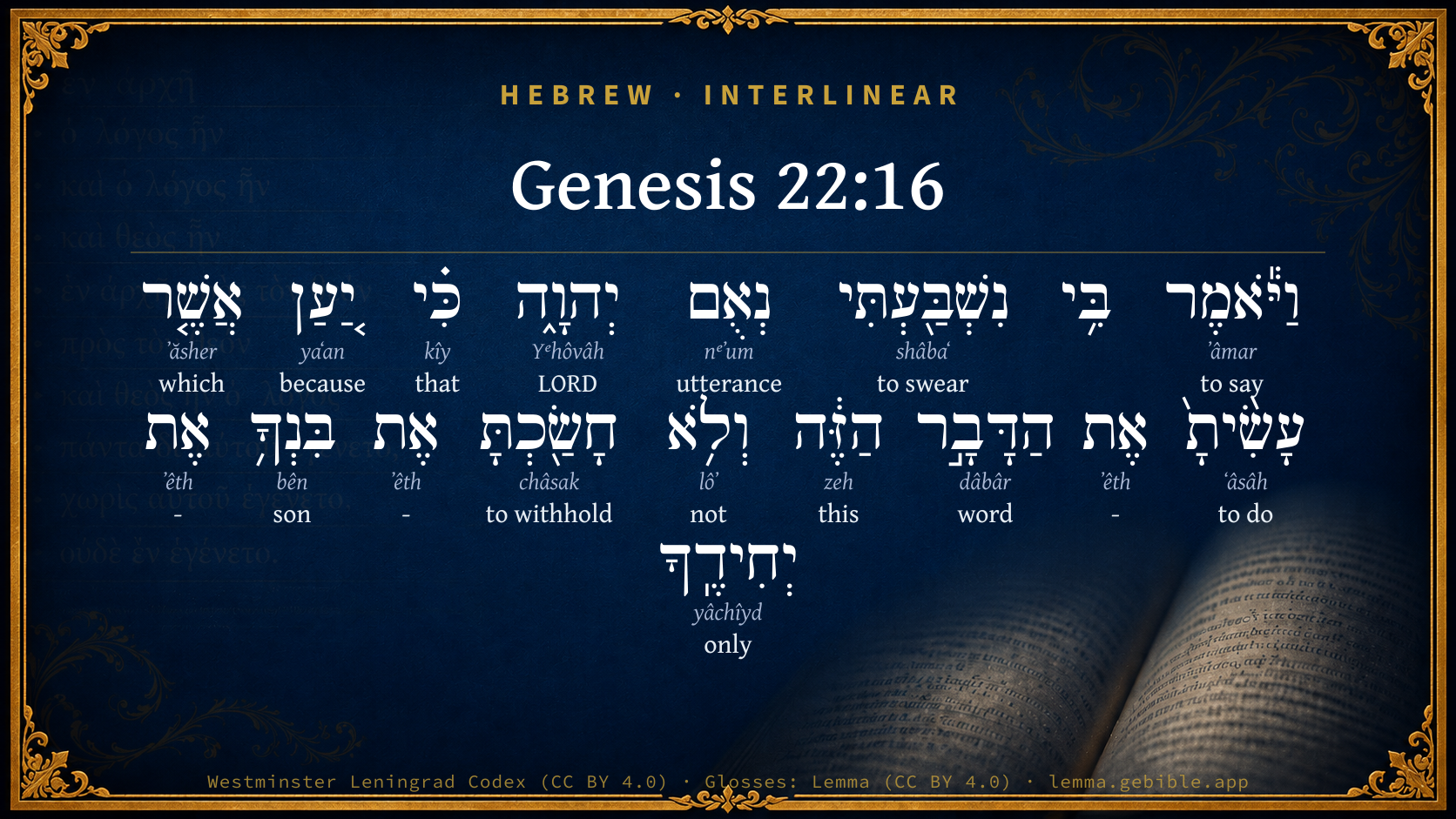
Genesis 22:16

Hebrew (Westminster Leningrad Codex) Genesis 22:16 appears in the Hebrew Old Testament. The text above is from the Westminster Leningrad Codex. Each word links to its Strong’s number, a concise gloss, and parsing drawn from the Open Scriptures Hebrew Bible morphology. Click any word for its full Brown-Driver-Briggs (BDB) entry.
Download image
Cite this verse

Genesis 22:16 (World English Bible). Public Domain. Lemma interlinear Bible study tool, https://lemma.gebible.app/v/genesis/22/16.

Show BibTeX & RIS
BibTeX
RIS
English Translation
and said, "I have sworn by myself, says Yahweh, because you have done this thing, and have not withheld your son, your only son,
World English Bible · Public Domain
Highlights Full analysis ↓
Download a study sheet

One document with this verse’s original text, its word-by-word gloss line, the meaning frame, cross-references with their text, attributed commentary, and full source and license credits — printable, and it pastes into notes with its structure intact.

This verse Autodidact and up

Study sheet (.html) Plain text (.txt)

A passage Seminary Student

Up to 50 verses in one chapter. A passage sheet keeps up to 6 commentary sources and 12 cross-references per verse, in the order this page ranks them, and says so on the sheet whenever that leaves anything out. Ask for a single verse and you get the Autodidact verse sheet above.

Everything on this page stays free to read, with no account — the sheet is a download of what is already on screen, not access to it.

Want to remove ads? Support Godless Engineer
Compare translations 3

The same verse in 3 English versions, stacked beneath the original-language interlinear above. Click any original word for its lexicon entry.

Each is an independent rendering of the whole verse — the interlinear is not word-aligned to these translations.

Highlighted words mark where these versions differ — a whole-verse word diff, not a word-by-word alignment.

  • World English Bible Public Domain
    and said, "I have sworn by myself, says Yahweh, because you have done this thing, and have not withheld your son, your only son,
  • King James Version Public Domain
    And said, By myself have I sworn, saith the LORD, for because thou hast done this thing, and hast not withheld thy son, thine only son:
  • unfoldingWord Literal Text CC BY-SA 4.0
    and said, “I swear by myself, a declaration of Yahweh, that it is because you have done this thing and have not withheld your son, your only,

unfoldingWord Literal Text — © unfoldingWord, licensed CC BY-SA 4.0. Word-aligned USFM3 via Door43 (git.door43.org/unfoldingWord/en_ult).

Versions to compare (up to 4)

3 of 4 selected

Show all 18 translations

Every available English version of this verse, each an independent rendering of the whole verse.

  • World English Bible Public Domain
    and said, "I have sworn by myself, says Yahweh, because you have done this thing, and have not withheld your son, your only son,
  • Berean Standard Bible Public Domain
    saying, “By Myself I have sworn, declares the LORD, that because you have done this and have not withheld your only son,
  • Majority Standard Bible Public Domain
    saying, “By Myself I have sworn, declares the LORD, that because you have done this and have not withheld your only son,
  • King James Version Public Domain
    And said, By myself have I sworn, saith the LORD, for because thou hast done this thing, and hast not withheld thy son, thine only son:
  • American Standard Version (1901) Public Domain
    and said, By myself have I sworn, saith Jehovah, because thou hast done this thing, and hast not withheld thy son, thine only son,
  • Revised Version (1885) Public Domain
    and said, By myself have I sworn, saith the LORD, because thou hast done this thing, and hast not withheld thy son, thine only son:
  • Geneva Bible (1599) Public Domain
    And saide, By my selfe haue I sworne (saith ye Lord) because thou hast done this thing, and hast not spared thine onely sonne,
  • Douay-Rheims (1899) Public Domain
    By my own self have I sworn, saith the Lord: because thou hast done this thing, and hast not spared thy only begotten son for my sake:
  • Young's Literal Translation Public Domain
    and saith, `By Myself I have sworn -- the affirmation of Jehovah -- that because thou hast done this thing, and hast not withheld thy son, thine only one --
  • Literal Standard Version CC BY-SA 4.0
    and says, “I have sworn by Myself—a declaration of YHWH—that because you have done this thing, and have not withheld your son, your only one,
  • Unlocked Literal Bible CC BY-SA 4.0
    and said—this is Yahweh's declaration—by myself I have sworn that because you have done this thing, and have not withheld your son, your only son,
  • unfoldingWord Literal Text CC BY-SA 4.0
    and said, “I swear by myself, a declaration of Yahweh, that it is because you have done this thing and have not withheld your son, your only,
  • Darby Bible Public Domain
    and said, By myself I swear, saith Jehovah, that, because thou hast done this, and hast not withheld thy son, thine only [son],
  • World Messianic Bible Public Domain
    and said, “‘I have sworn by myself,’ says the LORD, ‘because you have done this thing, and have not withheld your son, your only son,
  • Webster's Bible Public Domain
    And said, By myself have I sworn, saith the LORD, for because thou hast done this thing, and hast not withheld thy son, thy only son:
  • Free Bible Version CC BY-SA 4.0
    “I swear by myself, says the Lord, that because you have done this and didn't refuse to give me your son, your only son,
  • Bible in Basic English Public Domain
    Saying, I have taken an oath by my name, says the Lord, because you have done this and have not kept back from me your dearly loved only son,
  • JPS Tanakh (1917) Public Domain
    and said: 'By Myself have I sworn, saith the LORD, because thou hast done this thing, and hast not withheld thy son, thine only son,

Literal Standard Version (2020), Covenant Press — licensed CC BY-SA 4.0. Text via the HelloAO Bible API (eBible.org). Unlocked Literal Bible (unfoldingWord) — licensed CC BY-SA 4.0. Text via the HelloAO Bible API (eBible.org). unfoldingWord Literal Text — © unfoldingWord, licensed CC BY-SA 4.0. Word-aligned USFM3 via Door43 (git.door43.org/unfoldingWord/en_ult). Free Bible Version, Dr. Jonathan Gallagher — licensed CC BY-SA 4.0. Text via the HelloAO Bible API (eBible.org).

Word by word

More ways to search: Search by grammar → Find every occurrence → Compare this word →

Practice this passage: Drill this verse → Learn its vocabulary →

יְחִידֶֽךָ
yâchîyd
H3173
“only · your”
Adjective, Adjective, Masculine, Singular, Construct + Suffix, Personal, 2nd Person, Masculine, Singular
Part of Speech
Adjective
Type
Adjective
Gender
Masculine
Number
Singular
State
Construct
Full BDB Definition

Origin: from H3161

TWOT: 858a

only, only one, solitary, one (adjective) - only, unique, one - solitary - (TWOT) only begotten son - one (substantive)
  1. וַיֹּ֕אמֶר ʼâmar H559 “and · to say” Conjunction + Verb, Qal, Sequential Imperfect, 3rd Person, Masculine, Singular
  2. נִשְׁבַּ֖עְתִּי shâbaʻ H7650 “to swear” Verb, Niphal, Perfect, 1st Person, Common, Singular
  3. נְאֻם nᵉʼum H5002 “utterance of” Noun, Common, Masculine, Singular, Construct
  4. יְהוָ֑ה Yᵉhôvâh H3068 “LORD” Noun, Proper
  5. כִּ֗י kîy H3588 “that” Conjunction
  6. יַ֚עַן yaʻan H3282 “because” Conjunction
  7. אֲשֶׁ֤ר ʼăsher H834 “which” Particle, Relative
  8. עָשִׂ֨יתָ֙ ʻâsâh H6213 “to do” Verb, Qal, Perfect, 2nd Person, Masculine, Singular
  9. אֶת ʼêth H853 “-” Particle, Direct Object
  10. הַדָּבָ֣ר dâbâr H1697 “the · word” Particle, Definite Article + Noun, Common, Masculine, Singular, Absolute
  11. הַזֶּ֔ה zeh H2088 “the · this” Particle, Definite Article + Pronoun, Demonstrative, Masculine, Singular
  12. וְלֹ֥א lôʼ H3808 “and · not” Conjunction + Particle, Negative
  13. חָשַׂ֖כְתָּ châsak H2820 “to withhold” Verb, Qal, Perfect, 2nd Person, Masculine, Singular
  14. אֶת ʼêth H853 “-” Particle, Direct Object
  15. בִּנְךָ֥ bên H1121 “son · your” Noun, Common, Masculine, Singular, Construct + Suffix, Personal, 2nd Person, Masculine, Singular
  16. אֶת ʼêth H853 “-” Particle, Direct Object

About this verse

These counts appear in no published source. They are computed here, from the morphology-tagged text and Lemma’s own curated glosses. What Lemma adds →

18
words
15
distinct lemmas
Pentateuch
section

Notable vocabulary

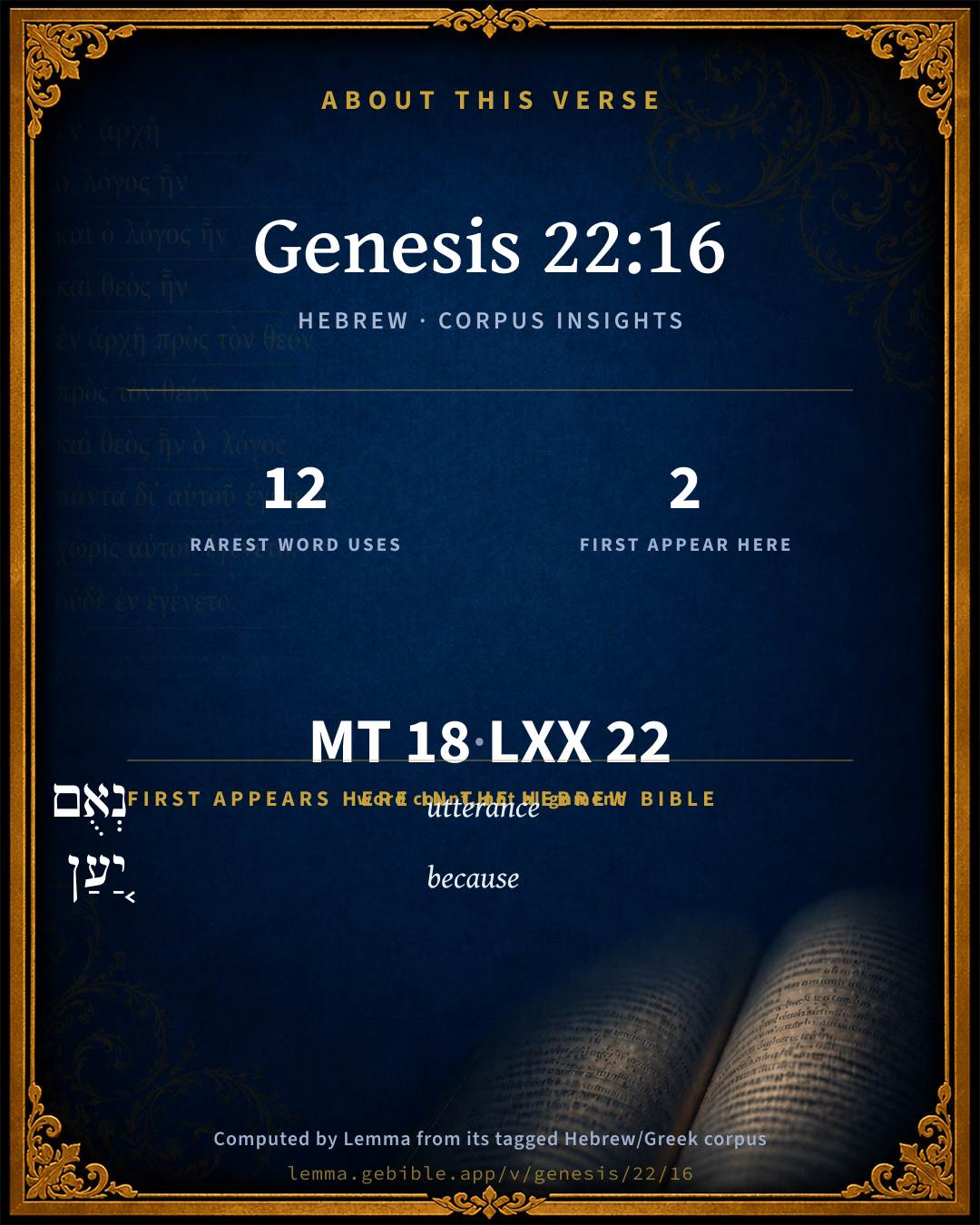
The rarest word here is יְחִידֶֽךָ only H3173 — appearing just 12 times in the whole Hebrew Bible.

First appearance in Scripture

These words make their first canonical appearance in the Hebrew Bible here:

  • נְאֻם utterance H5002
  • יַ֚עַן because H3282

Shared distinctive vocabulary

יְחִידֶֽךָ only H3173 occurs in 12 verses of the Hebrew Bible. Also found in:

Grammatical profile

  • 4 verbs
  • 4 nouns
  • 1 adjective
  • 1 pronoun
  • 1 preposition
  • 2 conjunctions
  • 5 particles

Verb forms

  • וַיֹּ֕אמֶר Qal · Sequential Imperfect
  • נִשְׁבַּ֖עְתִּי Niphal · Perfect
  • עָשִׂ֨יתָ֙ Qal · Perfect
  • חָשַׂ֖כְתָּ Qal · Perfect

Hebrew & Septuagint length

In English translation the verse runs 24 words from the Hebrew and 40 from the Septuagint (LXX English) — the Septuagint runs noticeably longer here. See the side-by-side →

A rough comparison of the two English renderings, which tokenize alike — not a word-level alignment.

Word counts can differ between the Hebrew and the Greek without any difference in meaning — e.g. the Hebrew direct-object marker אֵת has no separate Greek word, and Greek often adds the article ὁ.

In the original languages it is 18 Hebrew tokens and 22 Greek tokens — but the two are counted differently (Hebrew bundles its prefixes and suffixes into one token; the Greek is in lemma form), so that isn’t a like-for-like length.

Cross-references

9

Topical passages linked to Genesis 22:16 in the Treasury of Scripture Knowledge — connected by theme and wording, ordered by reader-vote popularity; previews shown in the World English Bible.

  • Luke 1:73 The oath which he spoke to Abraham, our father,
  • Hebrews 6:13–14 For when God made a promise to Abraham, since he could swear by none greater, he swore by himself,
  • Psalms 105:9 The covenant which he made with Abraham, His oath to Isaac,
  • Jeremiah 51:14 Yahweh of Hosts has sworn by himself, [saying], Surely I will fill you with men, as with the canker-worm; and they shall lift up a shout against you.
  • Jeremiah 49:13 For I have sworn by myself, says Yahweh, that Bozrah shall become an astonishment, a reproach, a waste, and a curse; and all the cities of it shall be perpetual wastes.
  • Romans 4:13–14 For the promise to Abraham and to his seed that he should be heir of the world wasn't through the law, but through the righteousness of faith.
  • Isaiah 45:23 By myself have I sworn, the word is gone forth from my mouth [in] righteousness, and shall not return, that to me every knee shall bow, every tongue shall swear.
  • Genesis 12:2 I will make of you a great nation. I will bless you, and make your name great. You will be a blessing.
  • Amos 6:8 "The Lord Yahweh has sworn by himself," says Yahweh, the God of hosts: "I abhor the pride of Jacob, And detest his fortresses. Therefore I will deliver up the city with all that is in it.

Cross-references courtesy of OpenBible.info (CC BY 4.0).

Hebrew and Greek witnesses Masoretic Hebrew ↔ Greek Septuagint

The same verse in the two great witnesses to the Old Testament, shown verse-for-verse.

Here the Septuagint runs noticeably longer than the Hebrew — LXX2012 (modern English Septuagint) 40 words vs World English Bible 24. A rough length comparison of the two English translations, not a word-level alignment — read both below.

These are two independent witnesses, not word-aligned to each other, and the Septuagint is shown in lemma (dictionary) form.

Hebrew Genesis 22:16 Masoretic · Westminster Leningrad Codex

וַיֹּ֕אמֶר בִּ֥י נִשְׁבַּ֖עְתִּי נְאֻם יְהוָ֑ה כִּ֗י יַ֚עַן אֲשֶׁ֤ר עָשִׂ֨יתָ֙ אֶת הַדָּבָ֣ר הַזֶּ֔ה וְלֹ֥א חָשַׂ֖כְתָּ אֶת בִּנְךָ֥ אֶת יְחִידֶֽךָ

and said, "I have sworn by myself, says Yahweh, because you have done this thing, and have not withheld your son, your only son,

World English Bible · Public Domain

Greek LXX Genesis 22:16 Septuagint · lemma form

λέγω κατά ἐμαυτοῦ ὄμνυμι λέγω κύριος ὅς εἵνεκεν ποιέω ὁ ῥῆμα οὗτος καί οὐ φείδομαι ὁ υἱός σύ ὁ ἀγαπητός διά ἐγώ

surely blessing I will bless you, and multiplying I will multiply your seed as the stars of heaven, and as the sand which is by the shore of the sea, and your seed shall inherit the cities of their enemies.

LXX2012 (modern English Septuagint) · Public Domain

Hebrew: Westminster Leningrad Codex (CC BY 4.0). Greek: Septuagint (public domain); English from LXX2012 (modern English Septuagint) (Public Domain). How the Septuagint differs from the Hebrew →

Targum (Aramaic paraphrase)

2

The Targum is the ancient Jewish Aramaic paraphrase of the Hebrew Scriptures — an interpretive translation, not the Hebrew text itself. Onkelos (literal) and Pseudo-Jonathan (expansive) render the Torah, and Jonathan the Prophets. Coverage is partial: where no permissively-licensed English translation exists for a verse, only the Aramaic is shown. This is verse-level text, not a word-by-word alignment to the Hebrew.

  1. Targum Onkelos Torah (Genesis–Deuteronomy)
    וַאֲמַר בְּמֵימְרִי קַיֵּמִית אֲמַר יְיָ אֲרֵי חֲלַף דִּי עֲבַדְתָּא יָת פִּתְגָּמָא הָדֵין וְלָא מְנַעְתָּא יָת בְּרָךְ יָת יְחִידָךְ

    (no public-domain English translation for this verse)

    Targum Onkelos — Aramaic: “Onkelos Genesis” (public domain); “Onkelos Exodus” (public domain); “Onkelos Leviticus” (public domain); “Onkelos Numbers” (public domain); “Onkelos Deuteronomy” (public domain). English: “Sefaria Community Translation” (CC0 1.0 (public-domain dedication)); “J.W. Etheridge. The Targums of Onkelos and Jonathan Ben Uzziel on the Pentateuch. London: Longmans, Green, 1862” (public domain). Text via Sefaria.

  2. Targum Pseudo-Jonathan Torah (Genesis–Deuteronomy)
    וְאָמַר בְּמֵימְרִי קַיֵימִית אָמַר יְיָ חוֹלַף דְעָבַדְתְּ יַת פִּתְגָמָא הָדֵין וְלָא מָנַעְתְּ יַת בְּרָךְ יַת יְחִידָךְ

    and said, By My Word have I sworn, saith the Lord, forasmuch as thou hast done this thing, and hast not withheld thy son, thy only begotten,

    Targum Pseudo-Jonathan — Aramaic: “Targum Jonathan on Genesis” (public domain); “Targum Jonathan on Exodus” (public domain); “Targum Jonathan on Leviticus” (public domain); “Targum Jonathan on Numbers” (public domain); “Targum Jonathan on Deuteronomy” (public domain). English: “The Targum of Jonathan ben Uzziel, trans. J. W. Etheridge, London, 1862” (public domain). Text via Sefaria.

Commentary

Notes on Genesis 22:16 from classic Christian and Jewish commentators (each source and its license shown beneath its notes). The classic Christian expositions comment on the surrounding passage and are grouped to its opening verse, so a note may address several verses; the Jewish commentaries on the Tanakh (Rashi and others) are per-verse, so they appear only where the commentator wrote on this verse.

Lemma curates 59 commentaries, every one of them public domain or Creative Commons licensed, each selected and text-cleaned for this edition rather than reprinted as found. About our sources →

Trapp's Complete Commentary

John Trapp

Gen 22:16 And said, By myself have I sworn, saith the LORD, for because thou hast done this thing, and hast not withheld thy son, thine only [son]:

Ver. 16. By myself have I sworn.] God swears for the further confirmation of our faith. For here he swore, not more for Abraham’s sake, than ours, as the apostle shows. {Heb 6:13-14; Heb 6:17-18} As when he spake with Jacob at Penuel, "there he spake with us"; {Hos 12:4} and what he said to Joshua, he said to all, "I will not leave thee, nor forsake thee". {Heb 13:5}

And hast not withheld thy son, thine only son.] And yet what was this to that sic without a sicut that hyperbole, that excess of love in God, that moved him to send his Son to die for our sins? He loved Christ far better than Abraham could love Isaac; and yet he gave him up freely, which Abraham would never have done without a command and to die as a malefactor, and by the hands of barbarous and bloody enemies; whereas Isaac was to die as a holy sacrifice, and by the hand of a tender father. How much more cause have we to say, Now I know the Lord loves me: and to swear as David did, to "keep his righteous judgments". {Psa 119:106}

John Trapp, A Commentary or Exposition upon All the Books of the Old and New Testament (1647–1656) — public domain. Text from a community e-Sword module.

The Biblical Illustrator

Joseph S. Exell

Gen_22:16

By Myself have I sworn

God Himself the foundation of our hopes

By Myself have I sworn.

By Himself God swears to us; by His power, His tenderness, His sympathy, He assures our hearts.

1. If we take up afresh any work for God, He is pledged--by Himself pledged to us--not to despise that work, to guide us in it, to accept it at our hands.

2. If we turn again to any cross--find the home darkened, or business difficult, or health still failing--if we find that holiday and rest do not sweep away the cloud: behind the cloud is God, strengthening for the cross is God, and by Himself He swears to us that, bearing that cross, it shall lead us to a crown.

3. If we are troubled by the dimness of the future, if perplexities thicken even as the years--and the responsibilities of the years--in-crease day by day, God is pledged--by Himself pledged--to guide every trustful follower. Only follow on to know the Lord. Why, beyond all that dim future there is heaven, our Fathers home and ours. And every step between the little now and that bright home is as sure as is that home and as is this now. (T. Gasqucine, B. A.)

The promise confirmed to Abraham by an oath

Often before had God promised, says Augustine, but never sworn. It was in recognition of the evidence which had just been afforded of His servants staunch loyalty to the covenant, that the Eternal was pleased in this unexampled manner to reduplicate securities for His own faithfulness, previous to this oath, Abraham had the word of God, and no more, on which to build his confidence. On that bare guarantee he had shown that he could build securely. Because he had judged it impossible for God to lie, therefore he had that day surrendered the one visible security which he possessed for the fulfilment of Gods word, by sacrificing the life on which its fulfilment turned. He trusted the All-truthful and Almighty to keep faith with His friend in His own way. For that very reason did a generous promiser vouchsafe to the man something more than a naked word. To him that hath shall be given. Because thou hast done this thing, and hast not withheld thy son, thine only one, from Me, therefore by Myself have I sworn that in blessing I will bless thee. Thenceforth, as the New Testament explains, the believer possessed, not one, but two immutable things on which to rest. Through Abrahams obedience have we all obtained this strong consolation. (J. O. Dykes, D. D.)

The Biblical Illustrator, edited by Joseph S. Exell (c. 1880s–1900s) — public domain. Text from a community e-Sword module.

Tyndale Open Study Notes

Tyndale Open Resources

22:16 by my own name: There is no higher name by which God can swear (Heb 6:13-17).

Tyndale Open Study Notes — © Tyndale Open Resources, licensed CC BY-SA 4.0. Text via the HelloAO Bible API.

Geneva Bible (1599)

Geneva Bible translators

Signifying, that there is no greater than he.

Geneva Bible (1599) marginal notes — public domain. Text via Bolls.life.

Adam Clarke's Commentary

Verse 16. By myself have I sworn] So we find that the person who was called the angel of the Lord is here called Jehovah; See Clarke on Ge 22:2. An oath or an appeal to God is, among men, an end to strife; as God could swear by no greater, he sware by himself: being willing more abundantly, says the apostle, to show unto the heirs of promise the immutability of his counsel, he confirmed it by an oath, that two immutable things, (his PROMISE and his OATH,) in which it was impossible for God to lie, we might have a strong consolation, who have fled for refuge to lay hold on the hope set before us. See Heb 6:13-18.

Adam Clarke's Commentary on the Bible (1810–1826) — public domain. Text from a community e-Sword/MySword module.

Ellicott's Commentary for English Readers

(16) By myself have I sworn, saith the Lord (Jehovah).—This solemn interposition of an oath (Heb_6:17), of which the present is the sole instance in Holy Scripture, plainly indicates that this trial of Abraham’s faith was of no common kind, and that its typical teaching is of no ordinary value. Abraham might have appealed to God’s own attributes, and said, Far be it from thee, Lord, to command a human sacrifice, and bid a father slay his son. He might have pleaded the promises bound up with Isaac’s life. But no, as soon as he is convinced that the command comes from God. he obeys, and, against hope, still believes that the promises will all be fulfilled in the sacrificed Isaac. He is thus the highest and most perfect example of faith, and by his offering of his son the Church received the assurance that the Son of God incarnate in the flesh would upon that very mountain offer the sacrifice Divinely necessary for the pardon of man’s sins.

The blessing now given to Abraham differs from those that precede it in three particulars. First, it is no longer a promise, but a solemn compact ratified by an oath. Next, it assures Abraham’s seed of victory, whereby the spiritual Israel is certified of the ultimate triumph of the Gospel. Lastly, it transfers to Abraham’s offspring the promise of being the means of blessedness to all mankind.

A Bible Commentary for English Readers, edited by Charles John Ellicott (1878–1897) — public domain. Text from a community e-Sword module.

The Cambridge Bible for Schools and Colleges

gen. ed. J. J. S. Perowne

16. By myself have I sworn] Cf. Exo_32:13; Isa_45:23; Heb_6:13-17.

The remembrance of this oath is frequently invoked, cf. Gen_24:7, Gen_26:3, Gen_50:24; Psa_105:9, “the covenant which he made with Abraham, and his oath unto Isaac”; Luk_1:73, “the oath which he sware unto Abraham our father.”

saith the Lord] Lit. “the Oracle” or “revelation of Jehovah”; a rare expression in narrative, cf. Num_14:28, 1Sa_2:30; but common in the Prophets, e.g. Jer_18:5. The Angel, speaking in the first person, identifies Himself with Jehovah (cf. Gen_16:10, Gen_21:18, Gen_31:13). The introduction of the prophetic formula, “Oracle of Jehovah,” into the words spoken by the Angel impersonating Jehovah, is peculiar.

The Cambridge Bible for Schools and Colleges (gen. ed. J. J. S. Perowne; Cambridge University Press, 1878–1918) — public domain. Text from a community e-Sword module.

John Gill's Exposition

That in blessing I will bless thee,.... With temporal and spiritual blessings; with the Spirit and all his graces; with Christ and redemption, justification, and salvation by him; and with eternal life, as the gift of God, through him:

and in multiplying I will multiply thy seed as the stars of the heaven, and as the sand which is upon the sea shore: both his natural seed, descending from him in the line of Isaac, and his spiritual seed, both among Jews and Gentiles, that tread in his steps; see Gen 13:15,

and thy seed shall possess the gate of his enemies: "gate" for "gates", where courts of judicature were held, and which are the security of cities and put for them, and which also include the whole country round about: so that this phrase is expressive of an entire jurisdiction and dominion over them; and was literally fulfilled in the times of Joshua, David, and Solomon; and spiritually in Christ, Abraham's principal seed, when he destroyed Satan and his principalities and powers; overcame the world; made an end of sin and abolished death; and delivered his people out the hands of all their enemies; and in all Abraham's spiritual seed, who are made more than conquerors over them, through Christ that has loved them.

John Gill's Exposition of the Whole Bible (1746–1763) — public domain (CC PDM 1.0). Text via the HelloAO Bible API.

Haydock's Catholic Bible Commentary

Own self; as he could not swear by any one greater. (Hebrews vi. 13; Jeremias xxii. 5.)

George Leo Haydock (1774–1849), Haydock's Catholic Family Bible and Commentary, 1859 edition — public domain. Excludes Psalms (Douay-Rheims chapter numbering differs from Protestant) and Deuterocanonical books (Catholic canon only).

Matthew Poole's English Annotations

By myself have I sworn: so the Lord swears by his name, Jer 44:26; by his soul, in the Hebrew text, Jer 51:14; by his holiness, Amo 4:2; which is the same with by himself here. Hence also it appears that the Angel who speaks here is Christ and God, because this is God’s prerogative to swear by himself, as appears from Heb 6:13.

Because thou hast done this thing; not that Abraham by this act did properly merit or purchase the following promises, as plainly appears, because the same things for substance had been freely promised to Abraham long before this time and action, Gen 12:2; 13:16, only what before was promised is now confirmed by an oath, as a testimony of that singular respect which God had to Abraham, and to this heroical instance of faith and obedience.

Matthew Poole's English Annotations on the Holy Bible (1683–1685) — public domain. Text from a community e-Sword/MySword module.

Whedon's Commentary on the Bible

Daniel D. Whedon

16. By myself have I sworn — “When God made promise to Abraham, because he could swear by no greater, he sware by himself.” Heb_6:13. Hanna observes, that this oath “was the last utterance that fell from the lips of God upon the ear of Abraham. He lived for fifty years and more thereafter, but that voice was never heard again. These late years rolled over him in peaceful, undisturbed repose.”

Because thou hast done this thing — This last act of faith was the crowning point in Abraham’s spiritual life, and in view of this especially — as summing up and representing in itself all other evidences of his faith — Jehovah repeats his promise.

Daniel D. Whedon (gen. ed.), Commentary on the Old and New Testaments (1874–1909) — public domain. Text from a community e-Sword module.

John Wesley's Explanatory Notes

Because thou hast done this thing, and hast not with-held thy son, thine only son - He lays a mighty emphasis upon that, and ver. 18, praises it as an act of obedience, in it thou hast obeyed my voice. By myself have I sworn - For he could swear by no greater.

John Wesley, Explanatory Notes Upon the Whole Bible (1754–1765) — public domain. Text via the GEBible commentary corpus.

Ramban (Nachmanides)

Rabbi Moshe ben Nachman (Ramban / Nachmanides)

BECAUSE THOU HAST DONE THIS THING. In the beginning He promised him that he would increase his descendants as the stars of heaven and the dust of the earth, but now He gave him the additional assurance that because thou hast done this great deed, He swore by His Great Name [that He would increase his descendants as the stars of heaven, and as the sand which is upon the seashore], and that his seed will possess the gate of its enemies. Thus Abraham was assured that no sin whatever would cause the destruction of his descendants, nor would they fall into the hand of their enemies and not rise again. Thus this constitutes a perfect Divine assurance of the redemption which is destined to come to us.

Ramban (Nachmanides) on the Tanakh — English translation: “Commentary on the Torah by Ramban (Nachmanides). Translated and annotated by Charles B. Chavel. New York, Shilo Pub. House, 1971-1976” (CC BY 4.0). Text via Sefaria.

Radak

Rabbi David Kimhi (Radak)

ויאמר בי נשבעתי, G’d added an oath to the blessing He had already bestowed on Avraham. When G’d swears an “oath” it is as if He were to say “by My life, etc.” Just as He is eternal and therefore will be able to keep His oath, so He can keep His oath to the children and grandchildren of the ones to whom He promises something by oath. While it is true that G’d does not need to swear an oath to assure us that He will keep His word, the new element in G’d swearing an oath is that even if the recipient of the oath did not keep his part of the bargain, i.e. sinned in the meantime, G’d promises that this will not invalidate His blessing, the one He confirms by an oath. Furthermore, He added another dimension to the existing blessing,

Radak on the Tanakh — English translations: “Sefaria Community Translation” (CC0 1.0 (public-domain dedication)); “Eliyahu Munk, HaChut Hameshulash” (CC BY 4.0); “Rabbi Mike Feuer, Jerusalem Anthology” (CC BY 4.0); and “R. David Kimhi on the first book of Psalms, Translated by R.G. Finch, London, 1919” (public domain). Text via Sefaria.

Lesson kit

Teaching starters — assembled from the data on this page, not authored interpretation. Every prompt links to the verse data it draws on. Edit before teaching.

Genesis, in the Pentateuch, opens this verse with 18 words (15 distinct Hebrew lemmas). Its most distinctive word is yâchîyd (“only”). The Greek Septuagint runs longer here. A historical commentator’s framing appears above. Read the whole chapter for the surrounding context.

Discussion questions

  1. The word yâchîyd carries the sense “only.” How does it shape the verse?
  2. 2 words make their first appearance in Scripture here. What does this debut establish?
  3. How does Genesis 22:2, which shares the word «only», read alongside this verse?
  4. The Septuagint runs longer here than the Hebrew. What might account for the difference?
  5. These translations render this verse differently; the difference is in the English rendering, not the original. What questions does that raise?
  6. «וַיֹּ֕אמֶר» is a Qal Sequential Imperfect verb. How does that grammatical form shape the action described?
  7. Compare how Trapp's Complete Commentary and The Biblical Illustrator read this verse. Where do they agree or differ?

Things to notice

Reading settings

Reading text

Shown beneath each verse's original-language words.

Old Testament
Old Testament edition

Read the OT as the Masoretic Hebrew (MT) or the Greek Septuagint (LXX).

English shown for the Greek Septuagint (in the Hebrew ↔ Greek comparison).

Comparing translations? Open the Compare panel on any verse page to stack up to four side by side.