Ezekiel 2:7

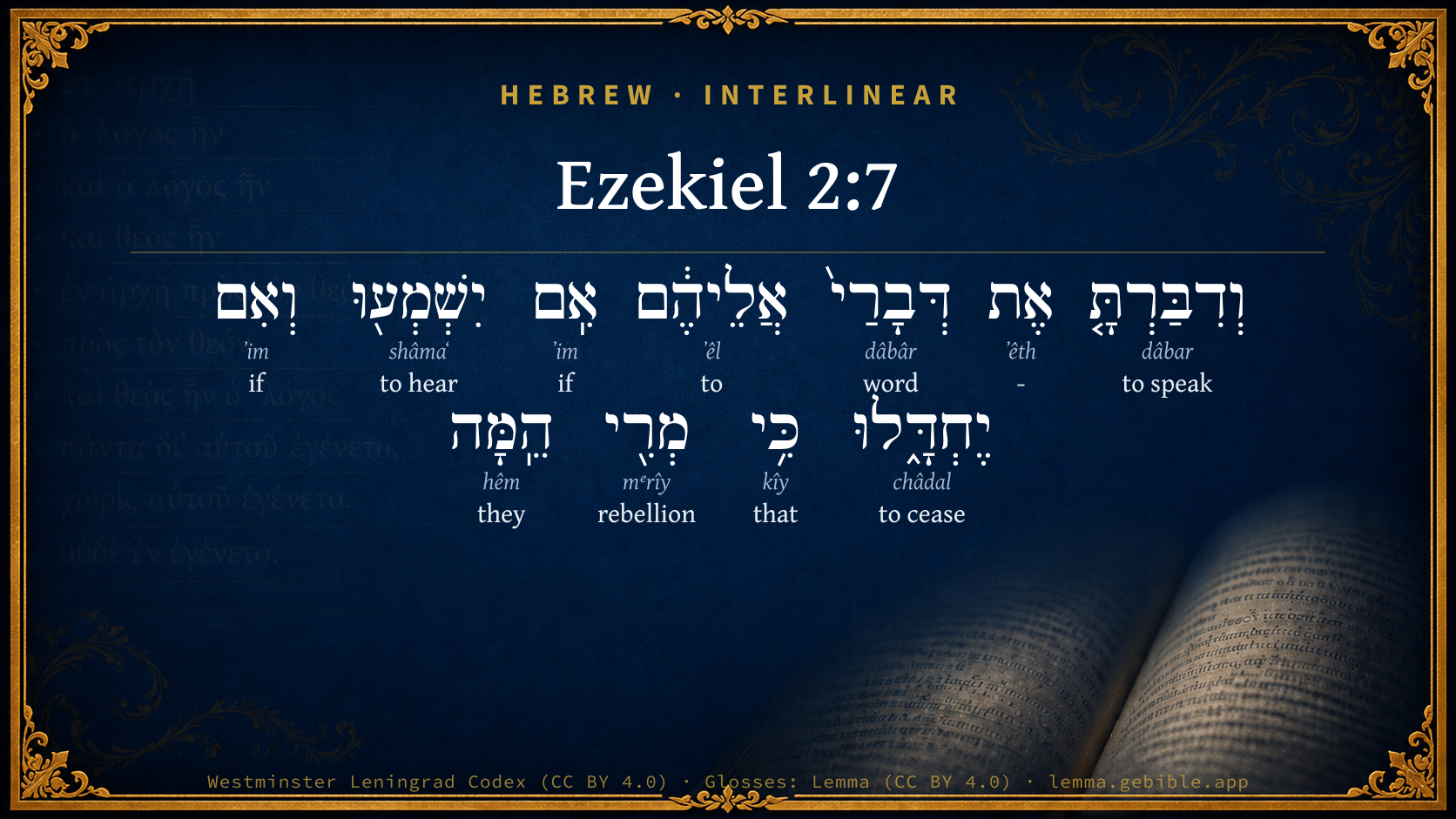
Hebrew (Westminster Leningrad Codex) Ezekiel 2:7 appears in the Hebrew Old Testament. The text above is from the Westminster Leningrad Codex. Each word links to its Strong’s number, a concise gloss, and parsing drawn from the Open Scriptures Hebrew Bible morphology. Click any word for its full Brown-Driver-Briggs (BDB) entry.
Download image
Cite this verse

Ezekiel 2:7 (World English Bible). Public Domain. Lemma interlinear Bible study tool, https://lemma.gebible.app/v/ezekiel/2/7.

Show BibTeX & RIS
BibTeX
RIS
English Translation
You shall speak my words to them, whether they will hear, or whether they will forbear; for they are most rebellious.
World English Bible · Public Domain
Download a study sheet

One document with this verse’s original text, its word-by-word gloss line, the meaning frame, cross-references with their text, attributed commentary, and full source and license credits — printable, and it pastes into notes with its structure intact.

This verse Autodidact and up

Study sheet (.html) Plain text (.txt)

A passage Seminary Student

Up to 50 verses in one chapter. A passage sheet keeps up to 6 commentary sources and 12 cross-references per verse, in the order this page ranks them, and says so on the sheet whenever that leaves anything out. Ask for a single verse and you get the Autodidact verse sheet above.

Everything on this page stays free to read, with no account — the sheet is a download of what is already on screen, not access to it.

Want to remove ads? Support Godless Engineer
Compare translations 3

The same verse in 3 English versions, stacked beneath the original-language interlinear above. Click any original word for its lexicon entry.

Each is an independent rendering of the whole verse — the interlinear is not word-aligned to these translations.

Highlighted words mark where these versions differ — a whole-verse word diff, not a word-by-word alignment.

  • World English Bible Public Domain
    You shall speak my words to them, whether they will hear, or whether they will forbear; for they are most rebellious.
  • King James Version Public Domain
    And thou shalt speak my words unto them, whether they will hear, or whether they will forbear: for they are most rebellious.
  • unfoldingWord Literal Text CC BY-SA 4.0
    But you will speak my words to them, whether they listen or not, because they are most rebellious.

unfoldingWord Literal Text — © unfoldingWord, licensed CC BY-SA 4.0. Word-aligned USFM3 via Door43 (git.door43.org/unfoldingWord/en_ult).

Versions to compare (up to 4)

3 of 4 selected

Show all 18 translations

Every available English version of this verse, each an independent rendering of the whole verse.

  • World English Bible Public Domain
    You shall speak my words to them, whether they will hear, or whether they will forbear; for they are most rebellious.
  • Berean Standard Bible Public Domain
    But speak My words to them, whether they listen or refuse to listen, for they are rebellious.
  • Majority Standard Bible Public Domain
    But speak My words to them, whether they listen or refuse to listen, for they are rebellious.
  • King James Version Public Domain
    And thou shalt speak my words unto them, whether they will hear, or whether they will forbear: for they are most rebellious.
  • American Standard Version (1901) Public Domain
    And thou shalt speak my words unto them, whether they will hear, or whether they will forbear; for they are most rebellious.
  • Revised Version (1885) Public Domain
    And thou shalt speak my words unto them, whether they will hear, or whether they will forbear: for they are most rebellious.
  • Geneva Bible (1599) Public Domain
    Therefore thou shalt speake my words vnto them: but surely they will not heare, neither will they in deede cease: for they are rebellious.
  • Douay-Rheims (1899) Public Domain
    And thou shalt speak my words to them, if perhaps they will hear, and forbear: for they provoke me to anger.
  • Young's Literal Translation Public Domain
    And thou hast spoken My words unto them, whether they hear or whether they forbear, for they `are' rebellious.
  • Literal Standard Version CC BY-SA 4.0
    and you have spoken My words to them, whether they hear or whether they refrain, for they [are] a rebellion.
  • Unlocked Literal Bible CC BY-SA 4.0
    But you will speak my words to them, whether they listen or not, because they are most rebellious.
  • unfoldingWord Literal Text CC BY-SA 4.0
    But you will speak my words to them, whether they listen or not, because they are most rebellious.
  • Darby Bible Public Domain
    And thou shalt speak my words unto them, whether they will hear or whether they will forbear; for they are rebellious.
  • World Messianic Bible Public Domain
    You shall speak my words to them, whether they will hear or whether they will refuse; for they are most rebellious.
  • Webster's Bible Public Domain
    And thou shalt speak my words to them, whether they will hear, or whether they will forbear: for they are most rebellious.
  • Free Bible Version CC BY-SA 4.0
    Just tell them what I say, whether they listen or not, because they're rebels.
  • Bible in Basic English Public Domain
    And you are to give them my words, if they give ear to you or if they do not: for they are uncontrolled.
  • JPS Tanakh (1917) Public Domain
    And thou shalt speak My words unto them, whether they will hear, or whether they will forbear; for they are most rebellious.

Literal Standard Version (2020), Covenant Press — licensed CC BY-SA 4.0. Text via the HelloAO Bible API (eBible.org). Unlocked Literal Bible (unfoldingWord) — licensed CC BY-SA 4.0. Text via the HelloAO Bible API (eBible.org). unfoldingWord Literal Text — © unfoldingWord, licensed CC BY-SA 4.0. Word-aligned USFM3 via Door43 (git.door43.org/unfoldingWord/en_ult). Free Bible Version, Dr. Jonathan Gallagher — licensed CC BY-SA 4.0. Text via the HelloAO Bible API (eBible.org).

Word by word

More ways to search: Search by grammar → Find every occurrence → Compare this word →

Practice this passage: Drill this verse → Learn its vocabulary →

About this verse

These counts appear in no published source. They are computed here, from the morphology-tagged text and Lemma’s own curated glosses. What Lemma adds →

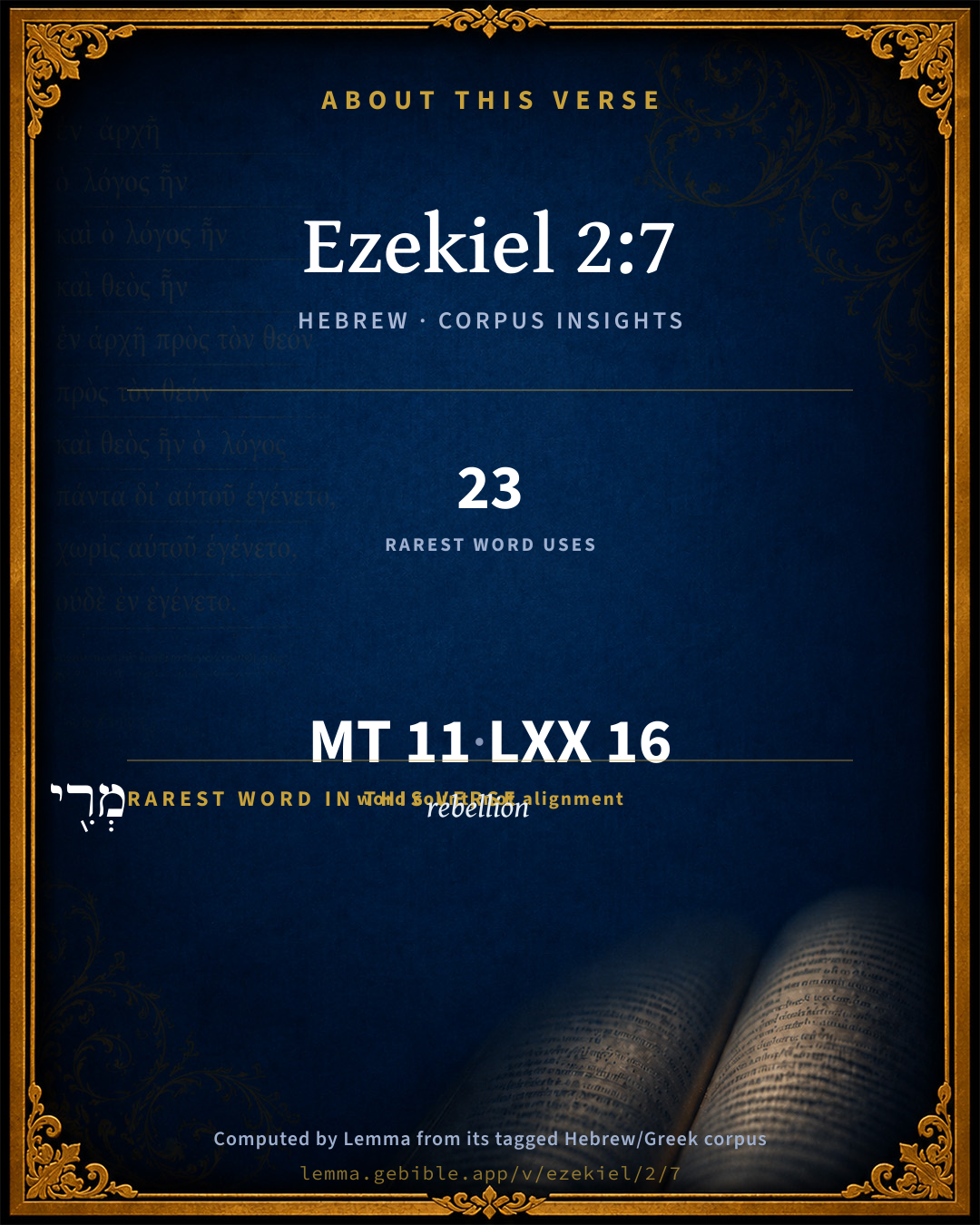
11
words
10
distinct lemmas
Prophets
section

Notable vocabulary

The rarest word here is מְרִ֖י rebellion H4805 — appearing just 23 times in the whole Hebrew Bible.

Shared distinctive vocabulary

מְרִ֖י rebellion H4805 occurs in 21 verses of the Hebrew Bible. Also found in:

Grammatical profile

  • 3 verbs
  • 2 nouns
  • 1 pronoun
  • 1 preposition
  • 3 conjunctions
  • 1 particle

Verb forms

  • וְדִבַּרְתָּ֤ Piel · Perfect
  • יִשְׁמְע֖וּ Qal · Imperfect
  • יֶחְדָּ֑לוּ Qal · Imperfect

Repetition

A word recurs within this verse — often emphatic in Hebrew:

  • אִֽם if H518 ×2

Hebrew & Septuagint length

In English translation the verse runs 21 words from the Hebrew and 20 from the Septuagint (LXX English) — closely comparable.

A rough comparison of the two English renderings, which tokenize alike — not a word-level alignment.

Word counts can differ between the Hebrew and the Greek without any difference in meaning — e.g. the Hebrew direct-object marker אֵת has no separate Greek word, and Greek often adds the article ὁ.

In the original languages it is 11 Hebrew tokens and 16 Greek tokens — but the two are counted differently (Hebrew bundles its prefixes and suffixes into one token; the Greek is in lemma form), so that isn’t a like-for-like length.

Cross-references

9

Topical passages linked to Ezekiel 2:7 in the Treasury of Scripture Knowledge — connected by theme and wording, ordered by reader-vote popularity; previews shown in the World English Bible.

  • Jeremiah 23:28 The prophet who has a dream, let him tell a dream; and he who has my word, let him speak my word faithfully. What is the straw to the wheat? says Yahweh.
  • Jeremiah 1:7 But Yahweh said to me, Don't say, I am a child; for to whoever I shall send you, you shall go, and whatever I shall command you, you shall speak.
  • Ezekiel 2:5 They, whether they will hear, or whether they will forbear, (for they are a rebellious house), yet shall know that there has been a prophet among them.
  • Ezekiel 3:10 Moreover he said to me, Son of man, all my words that I shall speak to you receive in your heart, and hear with your ears.
  • Ezekiel 3:17 Son of man, I have made you a watchman to the house of Israel: therefore hear the word at my mouth, and give them warning from me.
  • Jeremiah 1:17 You therefore gird up your loins, and arise, and speak to them all that I command you: don't be dismayed at them, lest I dismay you before them.
  • Jeremiah 26:2 Thus says Yahweh: Stand in the court of Yahweh's house, and speak to all the cities of Judah, which come to worship in Yahweh's house, all the words that I command you to speak to them; don't diminish a word.
  • Jonah 3:2 "Arise, go to Nineveh, that great city, and preach to it the message that I give you."
  • Matthew 28:20 teaching them to observe all things that I commanded you. Behold, I am with you always, even to the end of the age." Amen.

Cross-references courtesy of OpenBible.info (CC BY 4.0).

Hebrew and Greek witnesses Masoretic Hebrew ↔ Greek Septuagint

The same verse in the two great witnesses to the Old Testament, shown verse-for-verse.

These are two independent witnesses, not word-aligned to each other, and the Septuagint is shown in lemma (dictionary) form.

Hebrew Ezekiel 2:7 Masoretic · Westminster Leningrad Codex

וְדִבַּרְתָּ֤ אֶת דְּבָרַי֙ אֲלֵיהֶ֔ם אִֽם יִשְׁמְע֖וּ וְאִם יֶחְדָּ֑לוּ כִּ֥י מְרִ֖י הֵֽמָּה

You shall speak my words to them, whether they will hear, or whether they will forbear; for they are most rebellious.

World English Bible · Public Domain

Greek LXX Ezekiel 2:7 Septuagint · lemma form

καί λαλέω ὁ λόγος ἐγώ πρός αὐτός ἐάν ἄρα ἀκούω ἤ πτοέω διότι οἶκος παραπικραίνω εἰμί

And you shall speak my words to them, whether they will hear or fear: for it is a provoking house.

LXX2012 (modern English Septuagint) · Public Domain

Hebrew: Westminster Leningrad Codex (CC BY 4.0). Greek: Septuagint (public domain); English from LXX2012 (modern English Septuagint) (Public Domain). How the Septuagint differs from the Hebrew →

Targum (Aramaic paraphrase)

1

The Targum is the ancient Jewish Aramaic paraphrase of the Hebrew Scriptures — an interpretive translation, not the Hebrew text itself. Onkelos (literal) and Pseudo-Jonathan (expansive) render the Torah, and Jonathan the Prophets. Coverage is partial: where no permissively-licensed English translation exists for a verse, only the Aramaic is shown. This is verse-level text, not a word-by-word alignment to the Hebrew.

  1. Targum Jonathan Prophets (Joshua–Malachi)
    וְתִתְנַבֵּי יַת פִּתְגָמֵי נְבוּאֲתִי לְהוֹן אִם יְקַבְּלוּן אוּלְפָן וְאִם יִתְמַנְעוּן מִלְמֶחְטֵי אֲרֵי עַם סַרְבָן אִינוּן:

    (no public-domain English translation for this verse)

    Targum Jonathan — Aramaic: “Mikraot Gedolot” (public domain). English: “Sefaria Community Translation” (CC0 1.0 (public-domain dedication)); “London "Chaldee Paraphrase," 1871” (public domain). Text via Sefaria.

Commentary

Notes on Ezekiel 2:7 from classic Christian and Jewish commentators (each source and its license shown beneath its notes). The classic Christian expositions comment on the surrounding passage and are grouped to its opening verse, so a note may address several verses; the Jewish commentaries on the Tanakh (Rashi and others) are per-verse, so they appear only where the commentator wrote on this verse.

Lemma curates 59 commentaries, every one of them public domain or Creative Commons licensed, each selected and text-cleaned for this edition rather than reprinted as found. About our sources →

Trapp's Complete Commentary

John Trapp

Eze 2:7 And thou shalt speak my words unto them, whether they will hear, or whether they will forbear: for they [are] most rebellious.

Ver. 7. And thou shalt speak my words.] God’s word must be spoken, however it be taken.

Whether they will hear.] See Eze 2:5. Christ, once at least, preached away the most of his hearers. {Joh 6:66} Beza so delivered himself with that evidence and efficacy of truth in Colloquio Possiaceno, that Cardinal Lorrain wished that either he had been dumb, or that his hearers had been deaf. Too many of ours are so, &c.

For they are most rebellious.] Heb., Rebellion, in the abstract, as if they had been transformed into sin’s nature.

John Trapp, A Commentary or Exposition upon All the Books of the Old and New Testament (1647–1656) — public domain. Text from a community e-Sword module.

The Biblical Illustrator

Joseph S. Exell

Eze_2:7

Thou shalt speak My words unto them.

The ministerial commission

I. The parties concerned in this commission. These are, first, the Eternal God, our King and Creator and Judge, who issued this commission; secondly, the preachers of the Gospel who are appointed to execute it; thirdly, the hearers of the word, or, more generally, all who are within the sound of the Gospel, for whose behoof the commission was issued. We stand before you as the commissioned servant of the God with whom you have to do, invested with the office of conveying instrumentally His proclamation to your ears, telling you what He requires you to be and to do, and pointing out to you, and pressing upon your attention, His general mind and will regarding you. Do not mistake the messenger for a mediator. We stand to speak to you of God, and commissioned by Him, as we trust, but it is simply in the former of these capacities, and not at all in the latter. We stand, as it were, between the living and the dead; but it is as the golden channel through which spiritual life is conveyed from the one to the other.

II. The nature of the commission which is intrusted to us. Thou shalt speak My words unto them. What we are to declare unto you is the counsel of God, not of man; but of this whole counsel we are to be careful to keep nothing back. He has given us a written record of His mind and will, and we are to look for no further revelation. Our message is of a twofold character. To a certain extent it is such a message as a natural man, endowed with a conscience, and conscious of guilt, might have expected to issue from the holy sanctuary above. It speaks to him of the holiness and justice and omnipotence of Jehovah, and of his own guilt and depravity, and the fearful doom impending over him, as his own conscience speaks, but in language much more clear and explicit, and a thousandfold more loud and appalling. All this the foreboding and sin-laden spirit of man might have anticipated in a communication from heaven. But could it ever have entered into the heart of man or angel to conceive that this communication should also exhibit the amazing spectacle of a holy and offended God beseeching hell-deserving sinners to be reconciled, offering to the very guiltiest among them a full and free salvation, a salvation purchased by the blood of His own beloved Son?

III. The way in which this message is to be delivered and this commission to be executed. Thou shalt speak My words unto them, whether they will hear, or whether they will forbear. Is the ambassador of an earthly potentate at liberty to decline the duty which he has deliberately undertaken, and with which he has been intrusted, on account of obloquy or even danger attending the faithful performance of it? or is he at liberty to alter or modify the terms of his instructions in order to shield himself from reproach or from peril? Assuredly not. And shall the ambassadors of the King of kings venture to tamper with and distort the message which they were commissioned to deliver? Shall they presumptuously attempt to amend the terms on which the Lord of heaven and earth declares that He will treat with His rebellious subjects? or shall they leave out of the proclamation whatever it may be unpleasant to these subjects to hear? But then, again, thanks be to God, we are to preach the Gospel, the good news, among you; and the same obligation rests upon us to preach it faithfully and fully. After denouncing, as we are bound to do, every refuge of lies, we are eagerly to point you to the refuge set before you in the Gospel. And we must faithfully tell you, though we can but speak of it faintly, of the glory, and the excellence, and the suitableness of the salvation of the Gospel, of all that it is in itself, and of all that it brings along with it, of the grace here and the glory hereafter which it confers, and of its perfect accommodation to the case of every sinner among you, whether pardoned or unpardoned, whether born again or yet dead in trespasses and sins.

IV. The duty of those for whose behoof this commission has been issued. It will profit you nothing to attend upon a Gospel ministry, even though the word should there be spoken as never man spake it, if you do not receive that word with faith and love, lay it up in your hearts, and practise it in your lives. But oh! when you consider what is the nature of the message which we bear, can you help seeing that it is a glorious and blessed privilege, as well as a bounden duty, to attend to it? Do you not see that God commands nothing but what it will promote your own best interests to perform? and is not this a mighty additional motive for yielding obedience? (P. Hope, B. D.)

A prophets Commission

I. The minister of God receives his commission from the Lord.

II. The duty of the minister of God is to speak Gods words to the people.

1. First by study to understand, and then to proclaim the truths of the Bible.

2. This duty is--

(1) Imperative.

(2) Often painful (Eze_2:10).

Learn--

1. To honour Gods ministers.

2. To listen to their message as from God.

3. To beware of rebellion. (Homiletic Magazine.)

The Biblical Illustrator, edited by Joseph S. Exell (c. 1880s–1900s) — public domain. Text from a community e-Sword module.

Tyndale Open Study Notes

Tyndale Open Resources

2:7 Ezekiel would not be accountable for the people’s response to the message, only for his own faithful delivery of God’s word.

Tyndale Open Study Notes — © Tyndale Open Resources, licensed CC BY-SA 4.0. Text via the HelloAO Bible API.

Jamieson, Fausset & Brown

Robert Jamieson, A. R. Fausset & David Brown

most rebellious--literally, "rebellion" itself: its very essence.

Jamieson, Fausset & Brown — Commentary Critical and Explanatory on the Whole Bible (1871) — public domain (CC PDM 1.0). Text via the HelloAO Bible API.

Adam Clarke's Commentary

Verse 7. Whether they will hear] Whether they receive the message, or persecute thee for it, declare it to them, that they may be without excuse.

Adam Clarke's Commentary on the Bible (1810–1826) — public domain. Text from a community e-Sword/MySword module.

John Calvin's Commentaries

Again he repeats what he had said, with but the change of a few words, yet the meaning is the same, that the Prophet should not desist in the midst of his course, if he saw that he did not obtain what he wished and hoped for. For when we apply ourselves to what God commands, we ought to be of good cheer, and expect that some fruit of our labor may appear. We may, therefore, indulge both hopes and wishes, but if it should turn out otherwise than we anticipated, yet we ought to leave the result in the hands of God, and to proceed even to the goal in the discharge of our duty. To this end this sentence tends: thou, says he, shalt utter my words, or pronounce my words, whether they will hear, or whether they will forbear: that is, even if you sing a song to the deaf, according to the proverb, yet you shall not cease to utter my words: and he adds the reason, because they are a rebellious house. God admonishes his servant beforehand, that there was no reason why he should turn back although he should see no fruit of his labors, because he ought to determine this in his mind, although they have no ears yet he must speak in God’s name. It is certain, as we mentioned yesterday, that there were some, though few in number, to whom his teaching was useful, but he treats here of the people at large. We must learn, therefore, when God calls us to the office of teaching, not to regard the conduct of mankind. For if it please God to exercise us while we strive with the rebellious and refractory, yet God’s word must be uttered, because he commands it. It follows —

John Calvin's Commentaries (1540-1563) — public domain. Text from the Calvin Translation Society English edition (1840s-50s) via the Christian Classics Ethereal Library (ccel.org). Calvin's coverage is partial (roughly two-thirds of the Bible); uncommented books and verses are honest gaps, never fabricated. The 19th-century editor's footnotes and remarks are omitted so the notes are faithfully Calvin's own voice.

John Gill's Exposition

And thou shall speak my words unto them,.... Not his own words, but those the Lord should put into his mouth. The Targum is,

"and thou shall prophesy the words of my prophecy unto them:''

whether they will hear, or whether they will forbear; See Gill on Eze 2:5;

for they are most rebellious; or "rebellion" (c) itself; as the carnal mind is said to be "enmity" itself against God, Rom 8:7; which aggravates their character and state.

(c) "rebellio ipsi", Montanus, Polanus, Starckius; "inobedientia sunt", Cocceius.

John Gill's Exposition of the Whole Bible (1746–1763) — public domain (CC PDM 1.0). Text via the HelloAO Bible API.

Matthew Poole's English Annotations

Thou shalt speak my words unto them; declaring what I shall show thee, and in words which I will put into thy mouth.

Whether they will hear, or whether they will forbear: see Eze 2:5.

For they are most rebellious; Heb. rebellion in the abstract, by which the Hebrew (as some other languages do) expresseth the superlative degree, as we have it rightly translated.

Matthew Poole's English Annotations on the Holy Bible (1683–1685) — public domain. Text from a community e-Sword/MySword module.

Whedon's Commentary on the Bible

Daniel D. Whedon

7. Thou shalt speak my words — In spite of all the irritation naturally aroused by these piercing briers Ezekiel must not add one personal word to the message; nor must he keep back one syllable of it. It will seem to have no good effect; it will arouse such antagonisms that he will seem to be standing in a bed of scorpions. Let him still speak. It is the duty of the preacher to preach, not to convert.

Daniel D. Whedon (gen. ed.), Commentary on the Old and New Testaments (1874–1909) — public domain. Text from a community e-Sword module.

The Pulpit Commentary

Thou shalt speak my words, etc. The words conveyed

(1) a ground of encouragement in the fact that the words would be given by Jehovah (comp. Jer_1:7, Jer_1:17; Mat_10:19, Mat_10:20) and

(2) a warning against the intermingling of lower thoughts and a self-originated message. (Eze_13:7 Eze_22:28) They are most rebellious; literally, the Hebrew being a noun, they are rebellion, or stubbornness, itself.

Preaching to unwilling hearers.

There can be no more difficult or painful duty than that of a preacher to unwilling hearers. But it was seen in the case of Hebrew prophets; it was illustrated in Christ"s brave dealings with the Pharisees and Sadducees; and it must necessarily fall at times to the lot of every faithful Christian minister in the present day.

I IT IS THE DUTY OF THE PREACHER TO DELIVER A MESSAGE TO ALL KINDS OF HEARERS. He cannot select his favourite audience. He has no right to wait till men ask lop his message. He is the herald sent into the camp, who must declare the will of his Master, even though his hearers are too busy with their work or amusement to give him attention, or too unsympathetic to care to hear what he says. With most things the supply is regulated by the demand. The farmer will not grow more corn than the people need for food; the manufacturer turns out the largest quantity of those products that sell must widely. But this spirit of commerce should not obtain any footing in the Christian Church. Yet, no doubt, it has invaded the Church, and the temptation is to echo popular cries from the pulpit, and to bow to the will of the pew. Many people ask for short sermons, restive under the strain of attention to more lengthy discourses. Some wish for pleasant, cheerful themes; they are particularly desirous that no demands shall be made on their thinking faculties; they would luxuriute in sweet, soothing fancies. Then the temptation is to concede what is thus demanded. That is to lower the claims of truth. In this region it is necessary to create the right hunger, and here the supply must precede and exceed the demand. The negligence of the people is no reason for the preacher"s reticence.

II THE DUTY TO PREACH TO UNWILLING HEARERS RESTS ON DIVINE OBLIGATIONS AND ON HUMAN NEEDS.

1. Divine obligations. The preacher is not the slave of his people, but the servant of God. If he is sent to speak for God, a burden of responsibility is laid upon him. Moreover, he is the custodian of truth. Truth seeks the daylight and the free sir. Men have no right to imprison her because her presence in the busy world is sometimes unwelcome. God"s truth must be brought even where it is not sought, even where it is hated and rejected.

2. Human needs. They who are most reluctant to hear a message from Heaven most need that message, for their very indifference or opposition is a sign of that state of alienation which God is seeking to overcome. If the family were awake when the house was on fire there would be no necessity for the watchman to call to them. But in their sleep is their great danger. Just because they are indifferent they most need to be warned.

III THE RESPONSIBILITY OF THE PREACHER IS LIMITED TO THE FAITHFUL DELIVERY OF HIS MESSAGE. Mark this the delivery must be faithful. There is a snare for the preacher in our subject. He may lay the charge of the failure of his message against his hearers, when he ought to have taken it home to himself. Though he cannot command success, it is his duty to aim at it and to labour for it with the utmost assiduity. Possibly the message has not been rightly apprehended by him nor wisely and affectionately commended to the people. He may have been indolent in preparation. He may have been cold or stern, haughty or aloof from his hearers, when he should have approached them in a loving brotherly way. Or his own heart may not have opened to receive the message. How, then, can he expect his hearers to be interested in it? One cold heart can inspire no warmth in other cold hearts. But when the preacher has done his best in the strength of God, he must leave his message. At this point the responsibility shifts to the hearers. Even the words of him who spake as never man spake sometimes fell by the wayside and on stony ground. What wonder if ours seem to fail? The apparent failure of the faithful is indeed no real failure; the words may fail, but the man has not failed, for he has done his duty and no man can do more than that.

The Pulpit Commentary (1880–1919), ed. H.D.M. Spence-Jones & Joseph S. Exell — public domain. Text from a community e-Sword module.

unfoldingWord translationNotes

Door43 World Missions Community

General Information:

God continues to speak to Ezekiel.

are most rebellious

"are very rebellious" or "totally rebel against me"

house

This is a metonym for the family that lives in the house, in this case the Israelites, the descendants of Jacob over many years. See how you translated this in Ezekiel 2:5. AT: "people group" (See: Metonymy)

translationWords

house

unfoldingWord translationNotes — © Distant Shores Media and the Door43 World Missions Community, licensed CC BY-SA 4.0. Source: git.door43.org/Door43/en_tn.

Lesson kit

Teaching starters — assembled from the data on this page, not authored interpretation. Every prompt links to the verse data it draws on. Edit before teaching.

Ezekiel, in the Prophets, opens this verse with 11 words (10 distinct Hebrew lemmas). Its most distinctive word is mᵉrîy (“rebellion”). A historical commentator’s framing appears above. Read the whole chapter for the surrounding context.

Discussion questions

  1. The word mᵉrîy carries the sense “rebellion.” How does it shape the verse?
  2. Numbers 17:10 shares the word «rebellion» with this verse. How do the two illuminate each other?
  3. “if” occurs 2× in this one verse. What is the effect of the repetition?
  4. These translations render this verse differently; the difference is in the English rendering, not the original. What questions does that raise?
  5. The verb «וְדִבַּרְתָּ֤» is Piel Perfect. How does its form color the action?
  6. Reading how Trapp's Complete Commentary and The Biblical Illustrator read this verse, where do the two commentators agree and where do they part?

Things to notice

Reading settings

Reading text

Shown beneath each verse's original-language words.

Old Testament
Old Testament edition

Read the OT as the Masoretic Hebrew (MT) or the Greek Septuagint (LXX).

English shown for the Greek Septuagint (in the Hebrew ↔ Greek comparison).

Comparing translations? Open the Compare panel on any verse page to stack up to four side by side.