
1 Kings 12:9

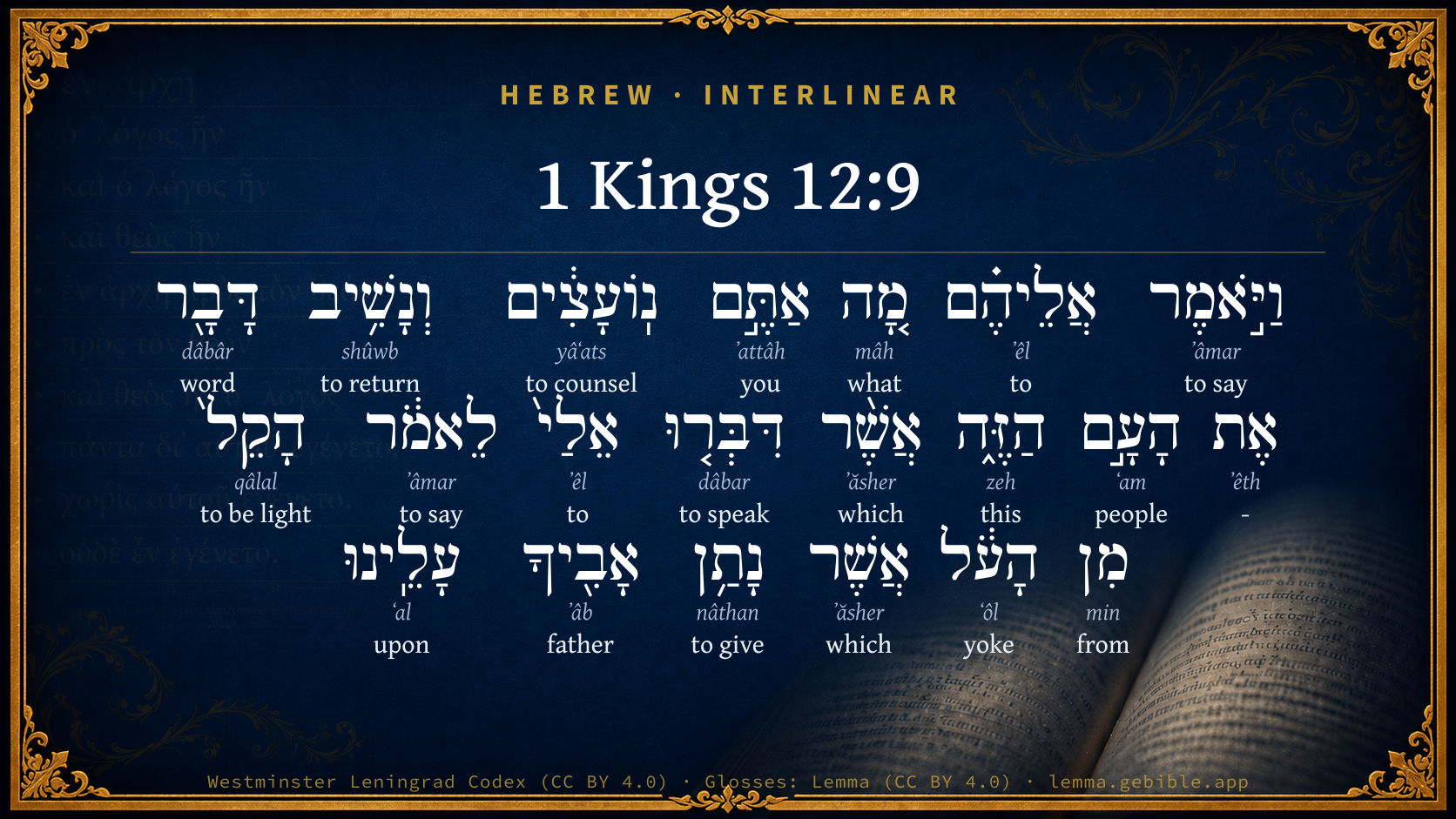
Hebrew (Westminster Leningrad Codex) 1 Kings 12:9 appears in the Hebrew Old Testament. The text above is from the Westminster Leningrad Codex. Each word links to its Strong’s number, a concise gloss, and parsing drawn from the Open Scriptures Hebrew Bible morphology. Click any word for its full Brown-Driver-Briggs (BDB) entry.
Download image
Cite this verse

1 Kings 12:9 (World English Bible). Public Domain. Lemma interlinear Bible study tool, https://lemma.gebible.app/v/1-kings/12/9.

Show BibTeX & RIS
BibTeX
RIS
English Translation
He said to them, What counsel do you give, that we may return answer to this people, who have spoken to me, saying, Make the yoke that your father did put on us lighter?
World English Bible · Public Domain
Download a study sheet

One document with this verse’s original text, its word-by-word gloss line, the meaning frame, cross-references with their text, attributed commentary, and full source and license credits — printable, and it pastes into notes with its structure intact.

This verse Autodidact and up

Study sheet (.html) Plain text (.txt)

A passage Seminary Student

Up to 50 verses in one chapter. A passage sheet keeps up to 6 commentary sources and 12 cross-references per verse, in the order this page ranks them, and says so on the sheet whenever that leaves anything out. Ask for a single verse and you get the Autodidact verse sheet above.

Everything on this page stays free to read, with no account — the sheet is a download of what is already on screen, not access to it.

Want to remove ads? Support Godless Engineer
Compare translations 3

The same verse in 3 English versions, stacked beneath the original-language interlinear above. Click any original word for its lexicon entry.

Each is an independent rendering of the whole verse — the interlinear is not word-aligned to these translations.

Highlighted words mark where these versions differ — a whole-verse word diff, not a word-by-word alignment.

  • World English Bible Public Domain
    He said to them, What counsel do you give, that we may return answer to this people, who have spoken to me, saying, Make the yoke that your father did put on us lighter?
  • King James Version Public Domain
    And he said unto them, What counsel give ye that we may answer this people, who have spoken to me, saying, Make the yoke which thy father did put upon us lighter?
  • unfoldingWord Literal Text CC BY-SA 4.0
    And he said to them, “How are you advising that we should answer a word this people who spoke to me saying, ‘Make lighter than the yoke that your father put on us’?”

unfoldingWord Literal Text — © unfoldingWord, licensed CC BY-SA 4.0. Word-aligned USFM3 via Door43 (git.door43.org/unfoldingWord/en_ult).

Versions to compare (up to 4)

3 of 4 selected

Show all 18 translations

Every available English version of this verse, each an independent rendering of the whole verse.

  • World English Bible Public Domain
    He said to them, What counsel do you give, that we may return answer to this people, who have spoken to me, saying, Make the yoke that your father did put on us lighter?
  • Berean Standard Bible Public Domain
    He asked them, “What message do you advise that we send back to these people who have spoken to me, saying, ‘Lighten the yoke your father put on us’?”
  • Majority Standard Bible Public Domain
    He asked them, “What message do you advise that we send back to these people who have spoken to me, saying, ‘Lighten the yoke your father put on us’?”
  • King James Version Public Domain
    And he said unto them, What counsel give ye that we may answer this people, who have spoken to me, saying, Make the yoke which thy father did put upon us lighter?
  • American Standard Version (1901) Public Domain
    And he said unto them, What counsel give ye, that we may return answer to this people, who have spoken to me, saying, Make the yoke that thy father did put upon us lighter?
  • Revised Version (1885) Public Domain
    And he said unto them, What counsel give ye, that we may return answer to this people, who have spoken to me, saying, Make the yoke that thy father did put upon us lighter?
  • Geneva Bible (1599) Public Domain
    And he said vnto them, What counsell giue ye, that we may answere this people, which haue spoken to me, saying, Make the yoke, which thy father did put vpon vs, lighter?
  • Douay-Rheims (1899) Public Domain
    And he said to them: What counsel do you give me, that I may answer this people, who have said to me: Make the yoke which thy father put upon us lighter?
  • Young's Literal Translation Public Domain
    and he saith unto them, `What are ye counselling, and we answer this people, who have spoken unto me, saying, Lighten `somewhat' of the yoke that thy father put upon us?'
  • Literal Standard Version CC BY-SA 4.0
    and he says to them, “What are you counseling, and we answer this people, who have spoken to me, saying, Lighten [some] of the yoke that your father put on us?”
  • Unlocked Literal Bible CC BY-SA 4.0
    He said to them, “What advice do you give me that we may answer the people who spoke to me and said, 'Lighten the yoke that your father put on us'?”
  • unfoldingWord Literal Text CC BY-SA 4.0
    And he said to them, “How are you advising that we should answer a word this people who spoke to me saying, ‘Make lighter than the yoke that your father put on us’?”
  • Darby Bible Public Domain
    And he said to them, What advice give ye that we may return answer to this people who have spoken to me saying, Lighten the yoke which thy father put upon us?
  • World Messianic Bible Public Domain
    He said to them, “What counsel do you give, that we may answer these people who have spoken to me, saying, ‘Make the yoke that your father put on us lighter’?”
  • Webster's Bible Public Domain
    And he said to them, What counsel give ye that we may answer this people, who have spoken to me, saying, Make the yoke which thy father did put upon us lighter?
  • Free Bible Version CC BY-SA 4.0
    He asked them, “What response do you advise that we send back to these people who have told me, ‘Lighten the burden your father put on us’?”
  • Bible in Basic English Public Domain
    And said to them, What is your opinion? What answer are we to give to this people who have said to me, Make less the weight of the yoke which your father put on us?
  • JPS Tanakh (1917) Public Domain
    And he said unto them: 'What counsel give ye, that we may return answer to this people, who have spoken to me, saying: Make the yoke that thy father did put upon us lighter?'

Literal Standard Version (2020), Covenant Press — licensed CC BY-SA 4.0. Text via the HelloAO Bible API (eBible.org). Unlocked Literal Bible (unfoldingWord) — licensed CC BY-SA 4.0. Text via the HelloAO Bible API (eBible.org). unfoldingWord Literal Text — © unfoldingWord, licensed CC BY-SA 4.0. Word-aligned USFM3 via Door43 (git.door43.org/unfoldingWord/en_ult). Free Bible Version, Dr. Jonathan Gallagher — licensed CC BY-SA 4.0. Text via the HelloAO Bible API (eBible.org).

Word by word

More ways to search: Search by grammar → Find every occurrence → Compare this word →

Practice this passage: Drill this verse → Learn its vocabulary →

הָעֹ֔ל
ʻôl
H5923
“the · yoke”
Particle, Definite Article + Noun, Common, Masculine, Singular, Absolute
Part of Speech
Particle + Noun
Type
Common
Gender
Masculine
Number
Singular
State
Absolute
Full BDB Definition

Origin: from H5953

TWOT: 1628a

yoke
  1. וַיֹּ֣אמֶר ʼâmar H559 “and · to say” Conjunction + Verb, Qal, Sequential Imperfect, 3rd Person, Masculine, Singular
  2. אֲלֵיהֶ֗ם ʼêl H413 “to · them” Preposition + Suffix, Personal, 3rd Person, Masculine, Plural
  3. מָ֚ה mâh H4100 “what” Particle, Interrogative
  4. אַתֶּ֣ם ʼattâh H859 “you” Pronoun, Personal, 2nd Person, Masculine, Plural
  5. נֽוֹעָצִ֔ים yâʻats H3289 “counseling” Verb, Niphal, Participle Active, Masculine, Plural, Absolute
  6. וְנָשִׁ֥יב shûwb H7725 “and · to return” Conjunction + Verb, Hiphil, Imperfect, 1st Person, Common, Plural
  7. דָּבָ֖ר dâbâr H1697 “word” Noun, Common, Masculine, Singular, Absolute
  8. אֶת ʼêth H853 “-” Particle, Direct Object
  9. הָעָ֣ם ʻam H5971 “the · people” Particle, Definite Article + Noun, Common, Masculine, Singular, Absolute
  10. הַזֶּ֑ה zeh H2088 “the · this” Particle, Definite Article + Pronoun, Demonstrative, Masculine, Singular
  11. אֲשֶׁ֨ר ʼăsher H834 “which” Particle, Relative
  12. דִּבְּר֤וּ dâbar H1696 “to speak” Verb, Piel, Perfect, 3rd Person, Common, Plural
  13. אֵלַי֙ ʼêl H413 “to · me” Preposition + Suffix, Personal, 1st Person, Common, Singular
  14. לֵאמֹ֔ר ʼâmar H559 “to say” Preposition + Verb, Qal, Infinitive Construct
  15. הָקֵל֙ qâlal H7043 “be light” Verb, Hiphil, Imperative, 2nd Person, Masculine, Singular
  16. מִן min H4480 “from” Preposition
  17. אֲשֶׁר ʼăsher H834 “which” Particle, Relative
  18. נָתַ֥ן nâthan H5414 “to give” Verb, Qal, Perfect, 3rd Person, Masculine, Singular
  19. אָבִ֖יךָ ʼâb H1 “father · your” Noun, Common, Masculine, Singular, Construct + Suffix, Personal, 2nd Person, Masculine, Singular
  20. עָלֵֽינוּ ʻal H5921 “upon · us” Preposition + Suffix, Personal, 1st Person, Common, Plural

About this verse

These counts appear in no published source. They are computed here, from the morphology-tagged text and Lemma’s own curated glosses. What Lemma adds →

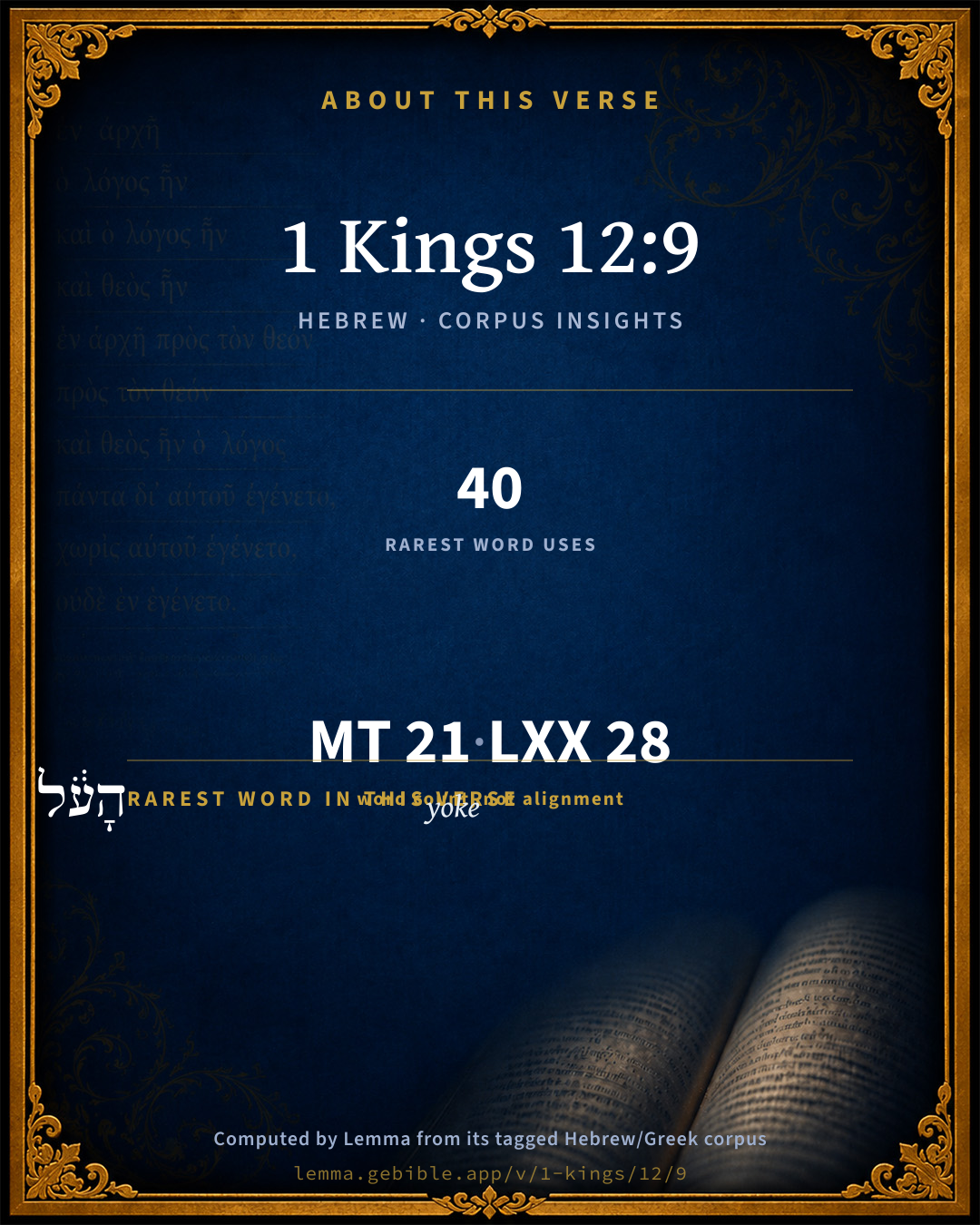
21
words
18
distinct lemmas
Historical
section

Shared distinctive vocabulary

הָעֹ֔ל yoke H5923 occurs in 34 verses of the Hebrew Bible. Also found in:

Grammatical profile

  • 7 verbs
  • 4 nouns
  • 2 pronouns
  • 4 prepositions
  • 4 particles

Verb forms

  • וַיֹּ֣אמֶר Qal · Sequential Imperfect
  • נֽוֹעָצִ֔ים Niphal · Participle Active
  • וְנָשִׁ֥יב Hiphil · Imperfect
  • דִּבְּר֤וּ Piel · Perfect
  • לֵאמֹ֔ר Qal · Infinitive Construct
  • הָקֵל֙ Hiphil · Imperative
  • נָתַ֥ן Qal · Perfect

Repetition

Words recur within this verse — often emphatic in Hebrew:

  • וַיֹּ֣אמֶר to say H559 ×2
  • אֲלֵיהֶ֗ם to H413 ×2
  • אֲשֶׁ֨ר which H834 ×2

Hebrew & Septuagint length

In English translation the verse runs 34 words from the Hebrew and 35 from the Septuagint (LXX English) — closely comparable.

A rough comparison of the two English renderings, which tokenize alike — not a word-level alignment.

Word counts can differ between the Hebrew and the Greek without any difference in meaning — e.g. the Hebrew direct-object marker אֵת has no separate Greek word, and Greek often adds the article ὁ.

In the original languages it is 21 Hebrew tokens and 28 Greek tokens — but the two are counted differently (Hebrew bundles its prefixes and suffixes into one token; the Greek is in lemma form), so that isn’t a like-for-like length.

Cross-references

4

Topical passages linked to 1 Kings 12:9 in the Treasury of Scripture Knowledge — connected by theme and wording, ordered by reader-vote popularity; previews shown in the World English Bible.

  • 2 Samuel 17:5–6 Then said Absalom, Call now Hushai the Archite also, and let us hear likewise what he says.
  • 1 Kings 22:6–8 Then the king of Israel gathered the prophets together, about four hundred men, and said to them, Shall I go against Ramoth-gilead to battle, or shall I forbear? They said, Go up; for the Lord will deliver it into the hand of the king.
  • 2 Chronicles 10:9 He said to them, What counsel give you, that we may return answer to this people, who have spoken to me, saying, Make the yoke that your father did put on us lighter?
  • 2 Chronicles 18:5–7 Then the king of Israel gathered the prophets together, four hundred men, and said to them, Shall we go to Ramoth-gilead to battle, or shall I forbear? They said, Go up; for God will deliver it into the hand of the king.

Cross-references courtesy of OpenBible.info (CC BY 4.0).

Hebrew and Greek witnesses Masoretic Hebrew ↔ Greek Septuagint

The same verse in the two great witnesses to the Old Testament, shown verse-for-verse.

These are two independent witnesses, not word-aligned to each other, and the Septuagint is shown in lemma (dictionary) form.

Hebrew 1 Kings 12:9 Masoretic · Westminster Leningrad Codex

וַיֹּ֣אמֶר אֲלֵיהֶ֗ם מָ֚ה אַתֶּ֣ם נֽוֹעָצִ֔ים וְנָשִׁ֥יב דָּבָ֖ר אֶת הָעָ֣ם הַזֶּ֑ה אֲשֶׁ֨ר דִּבְּר֤וּ אֵלַי֙ לֵאמֹ֔ר הָקֵל֙ מִן הָעֹ֔ל אֲשֶׁר נָתַ֥ן אָבִ֖יךָ עָלֵֽינוּ

He said to them, What counsel do you give, that we may return answer to this people, who have spoken to me, saying, Make the yoke that your father did put on us lighter?

World English Bible · Public Domain

Greek LXX 1 Kings 12:9 Septuagint · lemma form

καί εἶπον αὐτός τίς σύ συνβουλεύω καί τίς ἀποκρίνω ὁ λαός οὗτος ὁ λαλέω πρός ἐγώ λέγω κουφίζω ἀπό ὁ κλοιός ὅς δίδωμι ὁ πατήρ σύ ἐπί ἐγώ

And he said to them, What counsel do you⌃ give? And what shall I answer to this people who speak to me, saying, Lighten somewhat of the yoke which your father has put upon us?

LXX2012 (modern English Septuagint) · Public Domain

Hebrew: Westminster Leningrad Codex (CC BY 4.0). Greek: Septuagint (public domain); English from LXX2012 (modern English Septuagint) (Public Domain). How the Septuagint differs from the Hebrew →

Targum (Aramaic paraphrase)

1

The Targum is the ancient Jewish Aramaic paraphrase of the Hebrew Scriptures — an interpretive translation, not the Hebrew text itself. Onkelos (literal) and Pseudo-Jonathan (expansive) render the Torah, and Jonathan the Prophets. Coverage is partial: where no permissively-licensed English translation exists for a verse, only the Aramaic is shown. This is verse-level text, not a word-by-word alignment to the Hebrew.

  1. Targum Jonathan Prophets (Joshua–Malachi)
    וַאֲמַר לְהוֹן מָה אַתּוּן מִתְמַלְכִין וּנְתֵיב פִּתְגָמָא יַת עַמָא הָדֵין דְמַלִילוּ עִמִי לְמֵימָר אֲקֵיל מִן נִירָא דִיהַב אֲבוּךְ עֲלָנָא:

    (no public-domain English translation for this verse)

    Targum Jonathan — Aramaic: “Mikraot Gedolot” (public domain). English: “Sefaria Community Translation” (CC0 1.0 (public-domain dedication)); “London "Chaldee Paraphrase," 1871” (public domain). Text via Sefaria.

Commentary

Notes on 1 Kings 12:9 from classic Christian and Jewish commentators (each source and its license shown beneath its notes). The classic Christian expositions comment on the surrounding passage and are grouped to its opening verse, so a note may address several verses; the Jewish commentaries on the Tanakh (Rashi and others) are per-verse, so they appear only where the commentator wrote on this verse.

Lemma curates 59 commentaries, every one of them public domain or Creative Commons licensed, each selected and text-cleaned for this edition rather than reprinted as found. About our sources →

Trapp's Complete Commentary

John Trapp

1Ki 12:9 And he said unto them, What counsel give ye that we may answer this people, who have spoken to me, saying, Make the yoke which thy father did put upon us lighter?

Ver. 9. Make the yoke.] He mentioneth not the people’s promise - "and we will serve thee" {1Ki 12:4} - as not serving to his purpose.

John Trapp, A Commentary or Exposition upon All the Books of the Old and New Testament (1647–1656) — public domain. Text from a community e-Sword module.

Geneva Bible (1599)

Geneva Bible translators

There is nothing harder for them that are in authority, than to bridle their affections, and to follow good counsel.

Geneva Bible (1599) marginal notes — public domain. Text via Bolls.life.

The Cambridge Bible for Schools and Colleges

gen. ed. J. J. S. Perowne

9. that we may answer] Better, ‘may return answer’ as the words are precisely those of 1Ki_12:6. It is noteworthy that Rehoboam includes the young counsellors with himself and says ‘we’ when he speaks to them, but he employs the singular number ‘I’ in 1Ki_12:6, when addressing the older men. He appears to have dispensed summarily with the services of his father’s advisers, and taken others into his confidence. One among several marks of folly which are to be found in the history of this business.

The Cambridge Bible for Schools and Colleges (gen. ed. J. J. S. Perowne; Cambridge University Press, 1878–1918) — public domain. Text from a community e-Sword module.

John Gill's Exposition

And he said unto them, what counsel give ye, that we may answer this people, saying,.... See Gill on Kg1 12:4.

.

1 Kings 12:10

kg1 12:10

kg1 12:10

kg1 12:10And the young men that were grown up with him, spake unto him, saying,.... Gave him the following advice:

thus shalt thou speak unto this people that spake unto thee, saying; as is said, Kg1 12:4.

thus shall thou say unto them, my little finger shall be thicker than my father's loins; or, "is thicker" (g) signifying that he had more strength and power than his father had, and that he would make them know it, and they should feel the weight of it, and instead of lessening he would increase their taxes; for also hereby was intimated, that his glory, grandeur, and magnificence, was greater than his father's, especially when he first came to the kingdom, and therefore required the same taxes, or greater, to support it; and perhaps reference may be had to the difference of their age, Solomon being a child, or a very young man, when he came to the throne; whereas Rehoboam was upwards of forty years of age, and capable of judging what was fit to be done, and not to be talked to and treated after this manner, nor to receive the kingdom upon a condition of the people's prescribing.

(g) "grossior est", V. L. Pagninus; "densior est", Junius & Tremellius, Piscator.

John Gill's Exposition of the Whole Bible (1746–1763) — public domain (CC PDM 1.0). Text via the HelloAO Bible API.

The Pulpit Commentary

And he said unto them, What counsel give ye emphatic in the original that we it is noticeable how Rehoboam identifies these young men with himself. He employs a different expression when addressing the old men (ver. 6). The A.V perhaps gives its force by the translation, "that I may answer," etc.; lit., "to answer" may answer this people who have spoken to me, saying, Make the yoke which thy father did put upon us lighter?

The Pulpit Commentary (1880–1919), ed. H.D.M. Spence-Jones & Joseph S. Exell — public domain. Text from a community e-Sword module.

Lesson kit

Teaching starters — assembled from the data on this page, not authored interpretation. Every prompt links to the verse data it draws on. Edit before teaching.

1 Kings, in the Historical, opens this verse with 21 words (18 distinct Hebrew lemmas). Its most distinctive word is ʻôl (“yoke”). A historical commentator’s framing appears above. Read the whole chapter for the surrounding context.

Discussion questions

  1. How does “yoke” (ʻôl) shape what this verse is saying?
  2. How does Genesis 27:40, which shares the word «yoke», read alongside this verse?
  3. What does the repetition of “to say” (2× in this one verse) do in this verse?
  4. These translations render this verse differently; the difference is in the English rendering, not the original. What questions does that raise?
  5. «וַיֹּ֣אמֶר» is a Qal Sequential Imperfect verb. How does that grammatical form shape the action described?
  6. Compare how Trapp's Complete Commentary and Geneva Bible (1599) read this verse. Where do they agree or differ?

Things to notice

Reading settings

Reading text

Shown beneath each verse's original-language words.

Old Testament
Old Testament edition

Read the OT as the Masoretic Hebrew (MT) or the Greek Septuagint (LXX).

English shown for the Greek Septuagint (in the Hebrew ↔ Greek comparison).

Comparing translations? Open the Compare panel on any verse page to stack up to four side by side.