
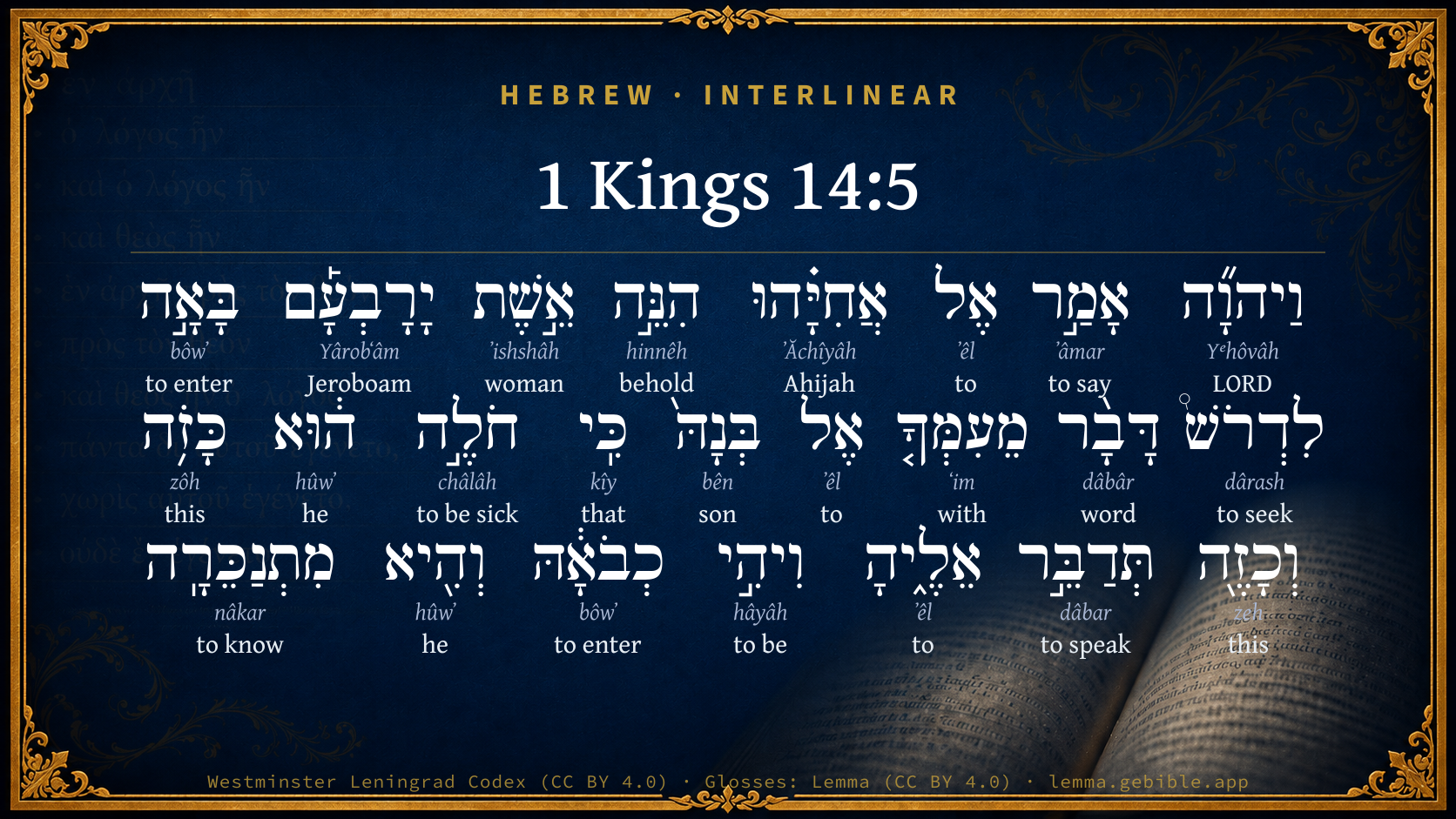
1 Kings 14:5

Hebrew (Westminster Leningrad Codex) 1 Kings 14:5 appears in the Hebrew Old Testament. The text above is from the Westminster Leningrad Codex. Each word links to its Strong’s number, a concise gloss, and parsing drawn from the Open Scriptures Hebrew Bible morphology. Click any word for its full Brown-Driver-Briggs (BDB) entry.
Download image
Cite this verse

1 Kings 14:5 (World English Bible). Public Domain. Lemma interlinear Bible study tool, https://lemma.gebible.app/v/1-kings/14/5.

Show BibTeX & RIS
BibTeX
RIS
English Translation
Yahweh said to Ahijah, Behold, the wife of Jeroboam comes to inquire of you concerning her son; for he is sick: thus and thus shall you tell her; for it will be, when she comes in, that she will feign herself to be another woman.
World English Bible · Public Domain
Download a study sheet

One document with this verse’s original text, its word-by-word gloss line, the meaning frame, cross-references with their text, attributed commentary, and full source and license credits — printable, and it pastes into notes with its structure intact.

This verse Autodidact and up

Study sheet (.html) Plain text (.txt)

A passage Seminary Student

Up to 50 verses in one chapter. A passage sheet keeps up to 6 commentary sources and 12 cross-references per verse, in the order this page ranks them, and says so on the sheet whenever that leaves anything out. Ask for a single verse and you get the Autodidact verse sheet above.

Everything on this page stays free to read, with no account — the sheet is a download of what is already on screen, not access to it.

Want to remove ads? Support Godless Engineer
Compare translations 3

The same verse in 3 English versions, stacked beneath the original-language interlinear above. Click any original word for its lexicon entry.

Each is an independent rendering of the whole verse — the interlinear is not word-aligned to these translations.

Highlighted words mark where these versions differ — a whole-verse word diff, not a word-by-word alignment.

  • World English Bible Public Domain
    Yahweh said to Ahijah, Behold, the wife of Jeroboam comes to inquire of you concerning her son; for he is sick: thus and thus shall you tell her; for it will be, when she comes in, that she will feign herself to be another woman.
  • King James Version Public Domain
    And the LORD said unto Ahijah, Behold, the wife of Jeroboam cometh to ask a thing of thee for her son; for he is sick: thus and thus shalt thou say unto her: for it shall be, when she cometh in, that she shall feign herself to be another woman.
  • unfoldingWord Literal Text CC BY-SA 4.0
    And Yahweh said to Ahijah, “Behold, the wife of Jeroboam is coming to seek a word from you about her son, for he is sick. Like this and like this you shall speak to her. And it will happen when she comes that she will be disguising herself.”

unfoldingWord Literal Text — © unfoldingWord, licensed CC BY-SA 4.0. Word-aligned USFM3 via Door43 (git.door43.org/unfoldingWord/en_ult).

Versions to compare (up to 4)

3 of 4 selected

Show all 18 translations

Every available English version of this verse, each an independent rendering of the whole verse.

  • World English Bible Public Domain
    Yahweh said to Ahijah, Behold, the wife of Jeroboam comes to inquire of you concerning her son; for he is sick: thus and thus shall you tell her; for it will be, when she comes in, that she will feign herself to be another woman.
  • Berean Standard Bible Public Domain
    But the LORD had said to Ahijah, “Behold, the wife of Jeroboam is coming to ask you about her son, for he is ill. You are to say such and such to her, because when she arrives, she will be disguised.”
  • Majority Standard Bible Public Domain
    But the LORD had said to Ahijah, “Behold, the wife of Jeroboam is coming to ask you about her son, for he is ill. You are to say such and such to her, because when she arrives, she will be disguised.”
  • King James Version Public Domain
    And the LORD said unto Ahijah, Behold, the wife of Jeroboam cometh to ask a thing of thee for her son; for he is sick: thus and thus shalt thou say unto her: for it shall be, when she cometh in, that she shall feign herself to be another woman.
  • American Standard Version (1901) Public Domain
    And Jehovah said unto Ahijah, Behold, the wife of Jeroboam cometh to inquire of thee concerning her son; for he is sick: thus and thus shalt thou say unto her; for it will be, when she cometh in, that she will feign herself to be another woman.
  • Revised Version (1885) Public Domain
    And the LORD said unto Ahijah, Behold, the wife of Jeroboam cometh to inquire of thee concerning her son; for he is sick: thus and thus shalt thou say unto her: for it shall be, when she cometh in, that she shall feign herself to be another woman.
  • Geneva Bible (1599) Public Domain
    Then the Lord saide vnto Ahiiah, Beholde, the wife of Ieroboam commeth to aske a thing of thee for her sonne, for he is sicke: thus and thus shalt thou say vnto her: for when shee commeth in, shee shall feine her selfe to be another.
  • Douay-Rheims (1899) Public Domain
    And the Lord said to Ahias: Behold the wife of Jeroboam cometh in, to consult thee concerning her son that is sick: thus and thus shalt thou speak to her. So when she was coming in, and made as if she were another woman,
  • Young's Literal Translation Public Domain
    And Jehovah said unto Ahijah, `Lo, the wife of Jeroboam is coming to seek a word from thee concerning her son, for he is sick; thus and thus thou dost speak unto her, and it cometh to pass at her coming in, that she is making herself strange.'
  • Literal Standard Version CC BY-SA 4.0
    And YHWH said to Ahijah, “Behold, the wife of Jeroboam is coming to seek a word from you concerning her son, for he is sick; thus and thus you speak to her, and it comes to pass at her coming in, that she is making herself strange.”
  • Unlocked Literal Bible CC BY-SA 4.0
    Yahweh said to Ahijah, “Look, the wife of Jeroboam is coming to seek advice from you regarding her son, for he is sick. Say such and such to her, because when she comes, she will act as if she were some other woman.”
  • unfoldingWord Literal Text CC BY-SA 4.0
    And Yahweh said to Ahijah, “Behold, the wife of Jeroboam is coming to seek a word from you about her son, for he is sick. Like this and like this you shall speak to her. And it will happen when she comes that she will be disguising herself.”
  • Darby Bible Public Domain
    And Jehovah said to Ahijah, Behold, the wife of Jeroboam cometh to ask a thing of thee about her son; for he is sick: thus and thus shalt thou say unto her; for it shall be, when she cometh in, that she shall feign to be another.
  • World Messianic Bible Public Domain
    The LORD said to Ahijah, “Behold, Jeroboam’s wife is coming to inquire of you concerning her son, for he is sick. Tell her such and such; for it will be, when she comes in, that she will pretend to be another woman.”
  • Webster's Bible Public Domain
    And the LORD said to Ahijah, Behold, the wife of Jeroboam cometh to ask a thing of thee for her son; for he is sick: thus and thus shalt thou say to her: for it shall be, when she cometh in, that she will feign herself to be another woman.
  • Free Bible Version CC BY-SA 4.0
    But the Lord had told Ahijah, “Look, Jeroboam's wife is coming to ask you about her son, because he's ill. This is what you are to tell her, because she'll come in disguise.”
  • Bible in Basic English Public Domain
    And the Lord had said to Ahijah, The wife of Jeroboam is coming to get news from you about her son, who is ill; give her such and such an answer; for she will make herself seem to be another woman.
  • JPS Tanakh (1917) Public Domain
    Now the LORD had said unto Ahijah: 'Behold, the wife of Jeroboam cometh to inquire of thee concerning her son; for he is sick; thus and thus shalt thou say unto her; for it will be, when she cometh in, that she will feign herself to be another woman.'

Literal Standard Version (2020), Covenant Press — licensed CC BY-SA 4.0. Text via the HelloAO Bible API (eBible.org). Unlocked Literal Bible (unfoldingWord) — licensed CC BY-SA 4.0. Text via the HelloAO Bible API (eBible.org). unfoldingWord Literal Text — © unfoldingWord, licensed CC BY-SA 4.0. Word-aligned USFM3 via Door43 (git.door43.org/unfoldingWord/en_ult). Free Bible Version, Dr. Jonathan Gallagher — licensed CC BY-SA 4.0. Text via the HelloAO Bible API (eBible.org).

Word by word

More ways to search: Search by grammar → Find every occurrence → Compare this word →

Practice this passage: Drill this verse → Learn its vocabulary →

כָּזֹ֥ה
zôh
H2090
“like/as · this”
Preposition + Pronoun, Demonstrative, Feminine, Singular
Part of Speech
Preposition + Pronoun
Type
Demonstrative
Gender
Feminine
Number
Singular
Full BDB Definition

Origin: for H2088

TWOT: None

this
  1. וַיהוָ֞ה Yᵉhôvâh H3068 “and · LORD” Conjunction + Noun, Proper
  2. אָמַ֣ר ʼâmar H559 “to say” Verb, Qal, Perfect, 3rd Person, Masculine, Singular
  3. אֶל ʼêl H413 “to” Preposition
  4. אֲחִיָּ֗הוּ ʼĂchîyâh H281 “Ahijah” Noun, Proper
  5. הִנֵּ֣ה hinnêh H2009 “behold” Particle, Demonstrative
  6. אֵ֣שֶׁת ʼishshâh H802 “woman of” Noun, Common, Feminine, Singular, Construct
  7. יָרָבְעָ֡ם Yârobʻâm H3379 “Jeroboam” Noun, Proper
  8. בָּאָ֣ה bôwʼ H935 “entering” Verb, Qal, Participle Active, Feminine, Singular, Absolute
  9. לִדְרֹשׁ֩ dârash H1875 “to seek” Preposition + Verb, Qal, Infinitive Construct
  10. דָּבָ֨ר dâbâr H1697 “word” Noun, Common, Masculine, Singular, Absolute
  11. מֵעִמְּךָ֤ ʻim H5973 “from · with · you” Preposition + Preposition + Suffix, Personal, 2nd Person, Masculine, Singular
  12. אֶל ʼêl H413 “to” Preposition
  13. בְּנָהּ֙ bên H1121 “son · her” Noun, Common, Masculine, Singular, Construct + Suffix, Personal, 3rd Person, Feminine, Singular
  14. כִּֽי kîy H3588 “that” Conjunction
  15. חֹלֶ֣ה châlâh H2470 “being sick” Verb, Qal, Participle Active, Masculine, Singular, Absolute
  16. ה֔וּא hûwʼ H1931 “he” Pronoun, Personal, 3rd Person, Masculine, Singular
  17. וְכָזֶ֖ה zeh H2088 “and · like/as · this” Conjunction + Preposition + Pronoun, Demonstrative, Masculine, Singular
  18. תְּדַבֵּ֣ר dâbar H1696 “to speak” Verb, Piel, Imperfect, 2nd Person, Masculine, Singular
  19. אֵלֶ֑יהָ ʼêl H413 “to · her” Preposition + Suffix, Personal, 3rd Person, Feminine, Singular
  20. וִיהִ֣י hâyâh H1961 “and · to be” Conjunction + Verb, Qal, Jussive, 3rd Person, Masculine, Singular
  21. כְבֹאָ֔הּ bôwʼ H935 “like/as · to enter · her” Preposition + Verb, Qal, Infinitive Construct + Suffix, Personal, 3rd Person, Feminine, Singular
  22. וְהִ֖יא hûwʼ H1931 “and · he” Conjunction + Pronoun, Personal, 3rd Person, Feminine, Singular
  23. מִתְנַכֵּרָֽה nâkar H5234 “knowing” Verb, Hithpael, Participle Active, Feminine, Singular, Absolute

About this verse

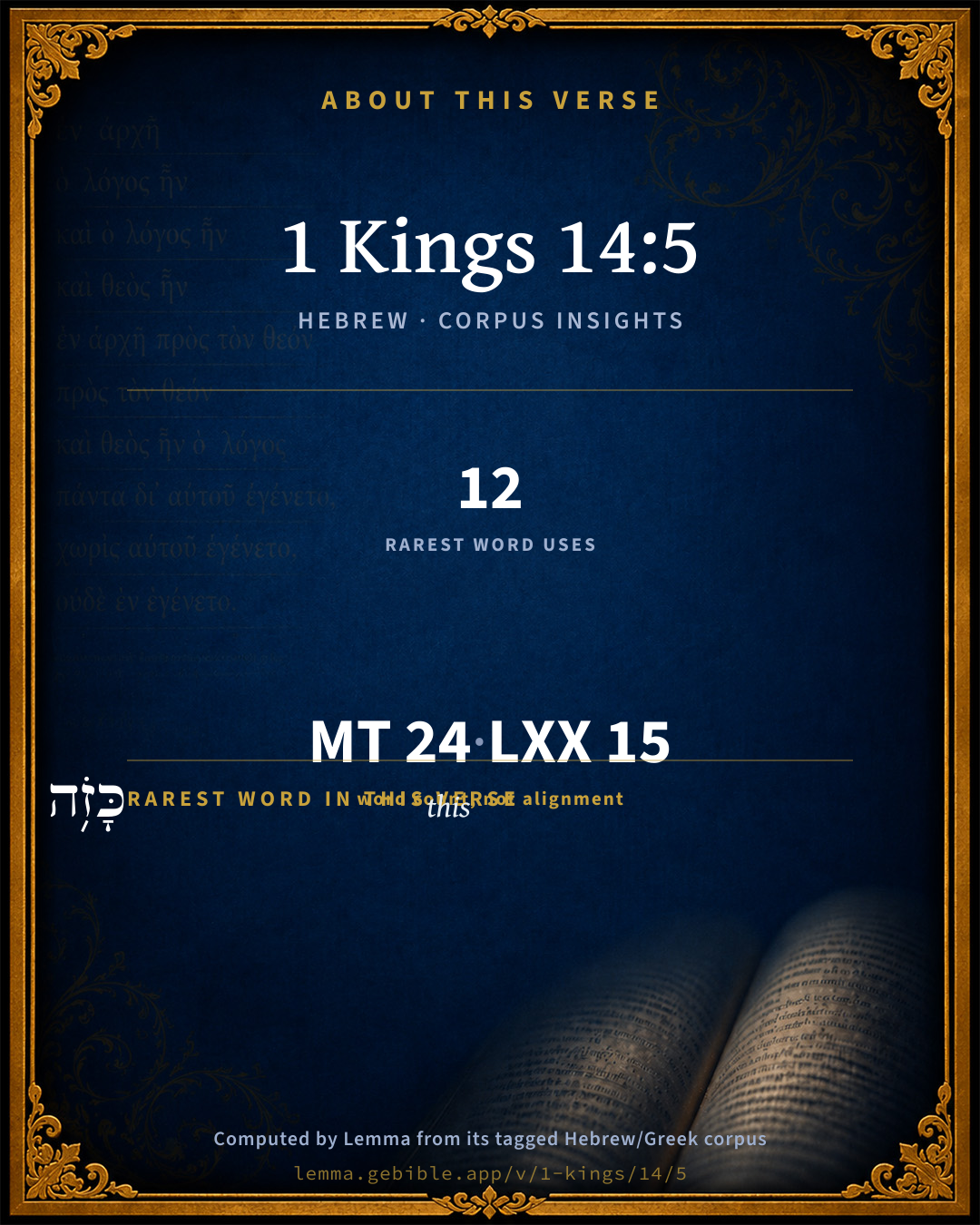
These counts appear in no published source. They are computed here, from the morphology-tagged text and Lemma’s own curated glosses. What Lemma adds →

24
words
20
distinct lemmas
Historical
section

Notable vocabulary

The rarest word here is כָּזֹ֥ה this H2090 — appearing just 12 times in the whole Hebrew Bible.

Shared distinctive vocabulary

כָּזֹ֥ה this H2090 occurs in 12 verses of the Hebrew Bible. Also found in:

Grammatical profile

  • 8 verbs
  • 6 nouns
  • 4 pronouns
  • 4 prepositions
  • 1 conjunction
  • 1 particle

Verb forms

  • אָמַ֣ר Qal · Perfect
  • בָּאָ֣ה Qal · Participle Active
  • לִדְרֹשׁ֩ Qal · Infinitive Construct
  • חֹלֶ֣ה Qal · Participle Active
  • תְּדַבֵּ֣ר Piel · Imperfect
  • וִיהִ֣י Qal · Jussive
  • כְבֹאָ֔הּ Qal · Infinitive Construct
  • מִתְנַכֵּרָֽה Hithpael · Participle Active

Repetition

Words recur within this verse — often emphatic in Hebrew:

  • בָּאָ֣ה to enter H935 ×2
  • אֶל to H413 ×3
  • ה֔וּא he H1931 ×2

Hebrew & Septuagint length

In the original languages it is 24 Hebrew tokens and 15 Greek tokens — but the two are counted differently (Hebrew bundles its prefixes and suffixes into one token; the Greek is in lemma form), so that isn’t a like-for-like length.

Cross-references

6

Topical passages linked to 1 Kings 14:5 in the Treasury of Scripture Knowledge — connected by theme and wording, ordered by reader-vote popularity; previews shown in the World English Bible.

  • 2 Kings 4:27 When she came to the man of God to the hill, she caught hold of his feet. Gehazi came near to thrust her away; but the man of God said, Let her alone: for her soul is vexed within her; and Yahweh has hid it from me, and has not told me.
  • 2 Kings 6:8–12 Now the king of Syria was warring against Israel; and he took counsel with his servants, saying, In such and such a place shall be my camp.
  • Psalms 139:1–4 Yahweh, you have searched me, And you know me.
  • Proverbs 21:30 There is no wisdom nor understanding Nor counsel against Yahweh.
  • Amos 3:7 Surely the Lord Yahweh will do nothing, Unless he reveals his secret to his servants the prophets.
  • Acts 10:19–20 While Peter was pondering the vision, the Spirit said to him, "Behold, three men seek you.

Cross-references courtesy of OpenBible.info (CC BY 4.0).

Hebrew and Greek witnesses Masoretic Hebrew ↔ Greek Septuagint

The same verse in the two great witnesses to the Old Testament, shown verse-for-verse.

These are two independent witnesses, not word-aligned to each other, and the Septuagint is shown in lemma (dictionary) form.

Hebrew 1 Kings 14:5 Masoretic · Westminster Leningrad Codex

וַיהוָ֞ה אָמַ֣ר אֶל אֲחִיָּ֗הוּ הִנֵּ֣ה אֵ֣שֶׁת יָרָבְעָ֡ם בָּאָ֣ה לִדְרֹשׁ֩ דָּבָ֨ר מֵעִמְּךָ֤ אֶל בְּנָהּ֙ כִּֽי חֹלֶ֣ה ה֔וּא כָּזֹ֥ה וְכָזֶ֖ה תְּדַבֵּ֣ר אֵלֶ֑יהָ וִיהִ֣י כְבֹאָ֔הּ וְהִ֖יא מִתְנַכֵּרָֽה

Yahweh said to Ahijah, Behold, the wife of Jeroboam comes to inquire of you concerning her son; for he is sick: thus and thus shall you tell her; for it will be, when she comes in, that she will feign herself to be another woman.

World English Bible · Public Domain

Greek LXX 1 Kings 14:5 Septuagint · lemma form

καί γίγνομαι ἐν ὁ ἐνιαυτός ὁ πέμπτος βασιλεύω ροβοαμ ἀναβαίνω σουσακιμ βασιλεύς αἴγυπτος ἐπί ἰερουσαλήμ

No English rendering of this Greek verse — the small residue in the structurally divergent books.

Hebrew: Westminster Leningrad Codex (CC BY 4.0). Greek: Septuagint (public domain); English from a public-domain English Septuagint. How the Septuagint differs from the Hebrew →

Targum (Aramaic paraphrase)

1

The Targum is the ancient Jewish Aramaic paraphrase of the Hebrew Scriptures — an interpretive translation, not the Hebrew text itself. Onkelos (literal) and Pseudo-Jonathan (expansive) render the Torah, and Jonathan the Prophets. Coverage is partial: where no permissively-licensed English translation exists for a verse, only the Aramaic is shown. This is verse-level text, not a word-by-word alignment to the Hebrew.

  1. Targum Jonathan Prophets (Joshua–Malachi)
    וַיָי אֲמַר לַאֲחִיָה הָא אִתַּת יָרָבְעָם אַתְיָא לְמִתְבַּע פִּתְגַם מִנָךְ עַל בְּרָהּ אֲרֵי מְרַע הוּא כְּדֵין וּכְדֵין תְּמַלֵיל עִמָהּ וִיהִי כְּמֵיעֲלָהּ וְהִיא מִשְׁתַּנְיָא:

    (no public-domain English translation for this verse)

    Targum Jonathan — Aramaic: “Mikraot Gedolot” (public domain). English: “Sefaria Community Translation” (CC0 1.0 (public-domain dedication)); “London "Chaldee Paraphrase," 1871” (public domain). Text via Sefaria.

Commentary

Notes on 1 Kings 14:5 from classic Christian and Jewish commentators (each source and its license shown beneath its notes). The classic Christian expositions comment on the surrounding passage and are grouped to its opening verse, so a note may address several verses; the Jewish commentaries on the Tanakh (Rashi and others) are per-verse, so they appear only where the commentator wrote on this verse.

Lemma curates 59 commentaries, every one of them public domain or Creative Commons licensed, each selected and text-cleaned for this edition rather than reprinted as found. About our sources →

Trapp's Complete Commentary

John Trapp

1Ki 14:5 And the LORD said unto Ahijah, Behold, the wife of Jeroboam cometh to ask a thing of thee for her son; for he [is] sick: thus and thus shalt thou say unto her: for it shall be, when she cometh in, that she shall feign herself [to be] another [woman].

Ver. 5. She shall feign herself to be another woman.] Ut ipsa agit extraneam. She would have deceived the prophet, if she could; so would hypocrites deceive God of heaven, if they knew how. But he is too wise to be cajoled or cheated.

John Trapp, A Commentary or Exposition upon All the Books of the Old and New Testament (1647–1656) — public domain. Text from a community e-Sword module.

Tyndale Open Study Notes

Tyndale Open Resources

14:5 the answer I give you: The Lord often instructed prophets to deliver only the message that he gave them (see 22:14; Num 22:38; 23:12; Jer 7:2; Amos 7:14-15).

Tyndale Open Study Notes — © Tyndale Open Resources, licensed CC BY-SA 4.0. Text via the HelloAO Bible API.

Geneva Bible (1599)

Geneva Bible translators

Then the wife of Jeroboam.

Geneva Bible (1599) marginal notes — public domain. Text via Bolls.life.

Adam Clarke's Commentary

Verse 5. Feign herself to be another woman.] It would have been discreditable to Jeroboam's calves, if it had been known that he had consulted a prophet of Jehovah.

Adam Clarke's Commentary on the Bible (1810–1826) — public domain. Text from a community e-Sword/MySword module.

The Cambridge Bible for Schools and Colleges

gen. ed. J. J. S. Perowne

5. to ask a thing of thee] The precise expression is not found again. The R.V. gives the rendering ‘to inquire’, which is most common for the verb, and regards the noun as expository, and so leaves it unrendered. The rendering of the A.V. misrepresents the mission. It was not to ask something for her son, but to inquire concerning him.

thus and thus shalt thou say] The writer, knowing that immediately he will record the conversation, abbreviates his story thus to avoid repeating twice the same words. The same expression is found in Jdg_18:4.

The Cambridge Bible for Schools and Colleges (gen. ed. J. J. S. Perowne; Cambridge University Press, 1878–1918) — public domain. Text from a community e-Sword module.

John Gill's Exposition

And it was so, when Ahijah heard the sound of her feet, as she came in at the door,.... Of the room where the prophet was:

that he said, come in, thou wife of Jeroboam, why feignest thou thyself to be another? which must greatly surprise and confound her, as well as lay open to her the folly of her and her husband to imagine that she could be secreted from God, and a prophet of his; or that a prophet could tell her what was future, and yet not know her that was present; and this might serve to assure her, and so her husband, that what the prophet after delivered would certainly come to pass:

for I am sent to thee with heavy tidings; or hard things, such as would be very disagreeable to her and her husband.

John Gill's Exposition of the Whole Bible (1746–1763) — public domain (CC PDM 1.0). Text via the HelloAO Bible API.

Albert Barnes' Notes on the Bible

Feign herself to be another woman - literally, “she shall make herself strange,” i. e., “she shall come in disguised.” So 1Ki 14:6.

Albert Barnes' Notes on the Bible (1834–1885) — public domain. Text from a community e-Sword/MySword module.

The Pulpit Commentary

And the Lord said unto Ahijah the attempted deceit was frustrated by a direct revelation, the same which disclosed the fate of the child. "God laughs in heaven at the frivolous fetches of crafty politicians" (Hall). Behold, the wife of Jeroboam cometh to ask a thing of thee for her son or concerning la, properly "to," ad, has the meaning of de, after verbs of speaking. Cf. Gen_20:2; 1Sa_4:19, etc.; Jer_40:16. Gesenius remarks on the similar use of eijv in the New Testament: (Act_2:25; Eph_5:32) for he is sick: thus and thus cf. Jud_1:18:4; 2Sa_11:25. hzO is a form of taOz shalt thou say unto her, for it shall be, when she cometh in, that she shall feign herself to be another woman Heb. make herself strange.

The Pulpit Commentary (1880–1919), ed. H.D.M. Spence-Jones & Joseph S. Exell — public domain. Text from a community e-Sword module.

Rashi

Rabbi Shlomo Yitzchaki (Rashi)

She will be in disguise. As though it was not she.

Rashi on the Tanakh — English translations: “The Judaica Press complete Tanach with Rashi, translated by A. J. Rosenberg” (CC BY 4.0); “Pentateuch with Rashi's commentary by M. Rosenbaum and A.M. Silbermann, 1929-1934” (public domain); “The Metsudah Tanach series, Lakewood, N.J” (CC BY 4.0); and “The Book of Joshua, Metsudah Publications, 1997” (CC BY 4.0). Text via Sefaria.

Lesson kit

Teaching starters — assembled from the data on this page, not authored interpretation. Every prompt links to the verse data it draws on. Edit before teaching.

1 Kings, in the Historical, opens this verse with 24 words (20 distinct Hebrew lemmas). Its most distinctive word is zôh (“this”). A historical commentator’s framing appears above. Read the whole chapter for the surrounding context.

Discussion questions

  1. What does “this” (zôh) contribute to the verse as a whole?
  2. How does Judges 18:4, which shares the word «this», read alongside this verse?
  3. What does the repetition of “to enter” (2× in this one verse) do in this verse?
  4. These translations render this verse differently; the difference is in the English rendering, not the original. What questions does that raise?
  5. «אָמַ֣ר» is a Qal Perfect verb. How does that grammatical form shape the action described?
  6. Compare how Trapp's Complete Commentary and Tyndale Open Study Notes read this verse. Where do they agree or differ?

Things to notice

Reading settings

Reading text

Shown beneath each verse's original-language words.

Old Testament
Old Testament edition

Read the OT as the Masoretic Hebrew (MT) or the Greek Septuagint (LXX).

English shown for the Greek Septuagint (in the Hebrew ↔ Greek comparison).

Comparing translations? Open the Compare panel on any verse page to stack up to four side by side.