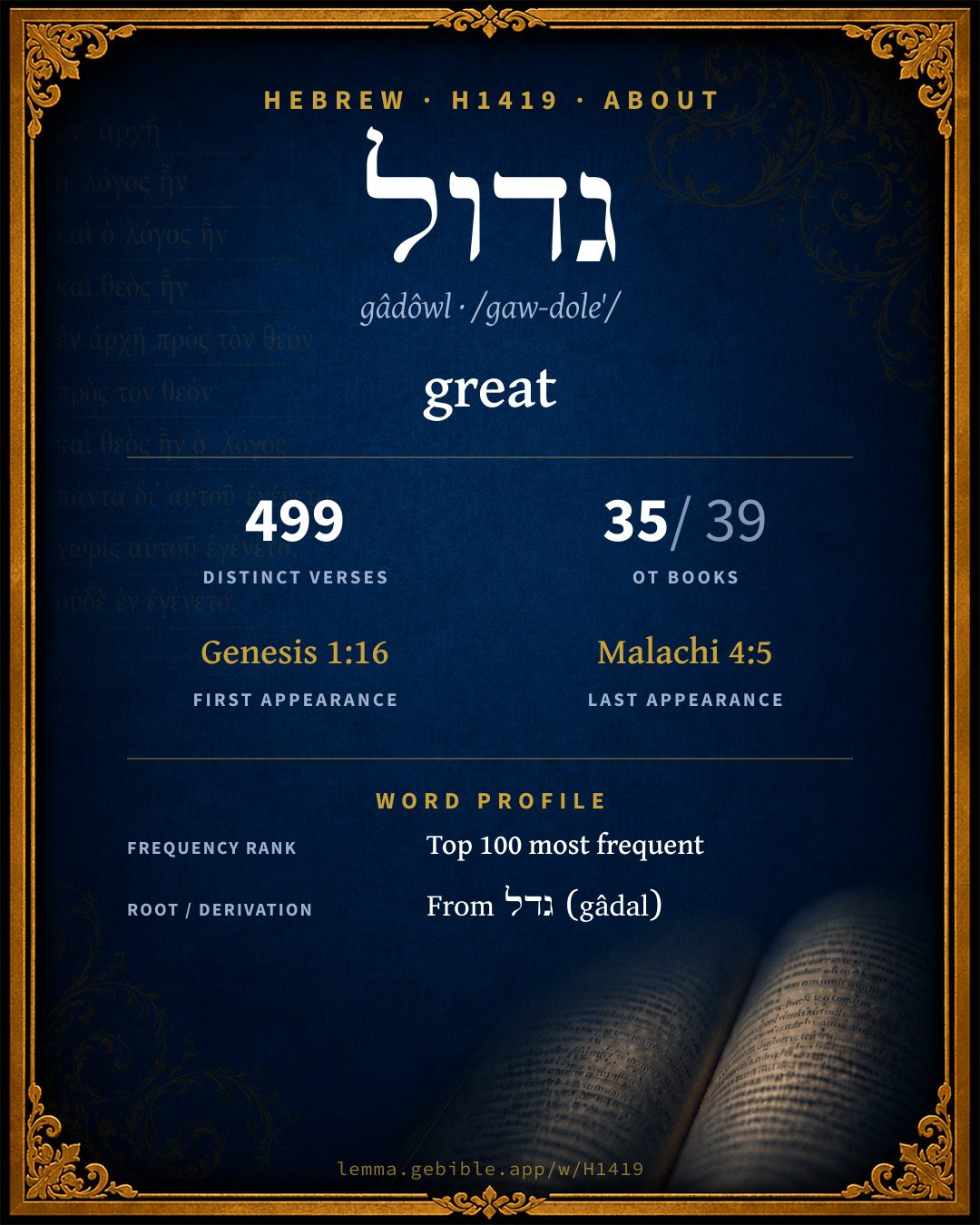
גָּדוֹל
great
‘great’ is one of 12 main senses fuller range ↓
Full lexicon entry — Brown-Driver-Briggs (BDB)
From Brown-Driver-Briggs (BDB)
Where this word appears
See every Absolute-state word in the Hebrew Bible →
Grammar key — what these labels mean
Part of speech
- Adjective
- A word that describes or qualifies a noun.
Stem
- Qal
- The basic, simple active stem — the plain form of the verb (“he wrote”).
Form
- Infinitive Absolute
- An unbound verbal noun, often intensifying or standing in for a finite verb.
State
- Absolute
- The independent form of a noun, not bound to a following word.
- Construct
- A noun bound to a following noun in a possessive / “of” relationship (the construct chain).
Gender
- Masculine
- Grammatically masculine.
- Feminine
- Grammatically feminine.
Number
- Singular
- One.
- Plural
- More than one (in Hebrew, generally three or more).
26 verses where H1419 appears in the Absolute state in the Book of 2 Kings. Filtered view — show all forms. Click any verse to open its interlinear word-by-word view. Verse text shown in the World English Bible for context — . Each verse’s Hebrew form is shown with its reference; the English is not keyword-highlighted, since the data carries no word-level English alignment. Use “Compare translations” on any verse to read it across multiple English versions. This concordance covers the Hebrew Bible; Septuagint (Greek Old Testament) occurrences are not indexed here.
2 Kings
- 2 Kings 3:27 גָּד֖וֹל adj Adjective ms Then he took his eldest son who would have reigned in his place, and offered him for a burnt offering on the wall. There was great wrath against Israel: and they departed from him, and returned to their own land.
- 2 Kings 4:8 גְדוֹלָ֔ה adj Adjective fs It fell on a day, that Elisha passed to Shunem, where was a great woman; and she constrained him to eat bread. So it was, that as often as he passed by, he turned in there to eat bread.
- 2 Kings 4:38 הַ/גְּדוֹלָ֔ה ptcl def.art + Adjective Adjective fs Elisha came again to Gilgal. There was a dearth in the land; and the sons of the prophets were sitting before him; and he said to his servant, Set on the great pot, and boil stew for the sons of the prophets.
- 2 Kings 5:1 גָּד֨וֹל adj Adjective ms Now Naaman, captain of the host of the king of Syria, was a great man with his master, and honorable, because by him Yahweh had given victory to Syria: he was also a mighty man of valor, [but he was] a leper.
- 2 Kings 5:13 גָּד֗וֹל adj Adjective ms His servants came near, and spoke to him, and said, My father, if the prophet had bid you do some great thing, wouldn't you have done it? how much rather then, when he says to you, Wash, and be clean?
- 2 Kings 6:23 גְדוֹלָ֗ה adj Adjective fs He prepared great provision for them; and when they had eaten and drunk, he sent them away, and they went to their master. The bands of Syria came no more into the land of Israel.
- 2 Kings 6:25 גָּדוֹל֙ adj Adjective ms There was a great famine in Samaria: and, behold, they besieged it, until a donkey's head was sold for eighty [pieces] of silver, and the fourth part of a kab of dove's dung for five [pieces] of silver.
- 2 Kings 7:6 גָּד֑וֹל adj Adjective ms For the Lord had made the host of the Syrians to hear a noise of chariots, and a noise of horses, even the noise of a great host: and they said one to another, Behold, the king of Israel has hired against us the kings of the Hittites, and the kings of the Egyptians, to come on us.
- 2 Kings 8:4 הַ/גְּדֹל֖וֹת ptcl def.art + Adjective Adjective fp Now the king was talking with Gehazi the servant of the man of God, saying, Please tell me all the great things that Elisha has done.
- 2 Kings 8:13 הַ/גָּד֖וֹל ptcl def.art + Adjective Adjective ms Hazael said, But what is your servant, who is but a dog, that he should do this great thing? Elisha answered, Yahweh has shown me that you shall be king over Syria.
- 2 Kings 10:19 גָּד֥וֹל adj Adjective ms Now therefore call to me all the prophets of Baal, all his worshippers, and all his priests; let none be wanting: for I have a great sacrifice [to do] to Baal; whoever shall be wanting, he shall not live. But Jehu did it in subtlety, to the intent that he might destroy the worshippers of Baal.
- 2 Kings 12:10 הַ/גָּד֔וֹל ptcl def.art + Adjective Adjective ms It was so, when they saw that there was much money in the chest, that the king's scribe and the high priest came up, and they put up in bags and counted the money that was found in the house of Yahweh.
- 2 Kings 16:15 הַ/גָּד֡וֹל ptcl def.art + Adjective Adjective ms King Ahaz commanded Urijah the priest, saying, On the great altar burn the morning burnt offering, and the evening meal-offering, and the king's burnt offering, and his meal-offering, with the burnt offering of all the people of the land, and their meal-offering, and their drink-offerings; and sprinkle on it all the blood of the burnt offering, and all the blood of the sacrifice: but the brazen altar shall be for me to inquire by.
- 2 Kings 17:21 גְדוֹלָֽה adj Adjective fs For he tore Israel from the house of David; and they made Jeroboam the son of Nebat king: and Jeroboam drove Israel from following Yahweh, and made them sin a great sin.
- 2 Kings 17:36 גָּד֛וֹל adj Adjective ms but Yahweh, who brought you up out of the land of Egypt with great power and with an outstretched arm, him shall you fear, and to him shall you bow yourselves, and to him shall you sacrifice:
- 2 Kings 18:19 הַ/גָּדוֹל֙ ptcl def.art + Adjective Adjective ms Rabshakeh said to them, Say you now to Hezekiah, Thus says the great king, the king of Assyria, What confidence is this in which you trust?
- 2 Kings 18:28 גָּד֖וֹל הַ/גָּד֖וֹל adj Adjective ms ptcl def.art + Adjective Adjective ms Then Rabshakeh stood, and cried with a loud voice in the Jews' language, and spoke, saying, Hear you the word of the great king, the king of Assyria.
- 2 Kings 20:3 גָדֽוֹל adj Adjective ms Remember now, Yahweh, I beg you, how I have walked before you in truth and with a perfect heart, and have done that which is good in your sight. Hezekiah wept sore.
- 2 Kings 22:4 הַ/גָּד֔וֹל ptcl def.art + Adjective Adjective ms Go up to Hilkiah the high priest, that he may sum the money which is brought into the house of Yahweh, which the keepers of the threshold have gathered of the people:
- 2 Kings 22:8 הַ/גָּדוֹל֙ ptcl def.art + Adjective Adjective ms Hilkiah the high priest said to Shaphan the scribe, I have found the book of the law in the house of Yahweh. Hilkiah delivered the book to Shaphan, and he read it.
- 2 Kings 22:13 גְדוֹלָ֞ה adj Adjective fs Go you, inquire of Yahweh for me, and for the people, and for all Judah, concerning the words of this book that is found; for great is the wrath of Yahweh that is kindled against us, because our fathers have not listened to the words of this book, to do according to all that which is written concerning us.
- 2 Kings 23:2 גָּד֑וֹל adj Adjective ms The king went up to the house of Yahweh, and all the men of Judah and all the inhabitants of Jerusalem with him, and the priests, and the prophets, and all the people, both small and great: and he read in their ears all the words of the book of the covenant which was found in the house of Yahweh.
- 2 Kings 23:4 הַ/גָּד֜וֹל ptcl def.art + Adjective Adjective ms The king commanded Hilkiah the high priest, and the priests of the second order, and the keepers of the threshold, to bring forth out of the temple of Yahweh all the vessels that were made for Baal, and for the Asherah, and for all the host of the sky, and he burned them outside of Jerusalem in the fields of the Kidron, and carried the ashes of them to Bethel.
- 2 Kings 23:26 הַ/גָּד֔וֹל ptcl def.art + Adjective Adjective ms Notwithstanding, Yahweh didn't turn from the fierceness of his great wrath, with which his anger was kindled against Judah, because of all the provocation with which Manasseh had provoked him.
- 2 Kings 25:9 גָּד֖וֹל adj Adjective ms He burnt the house of Yahweh, and the king's house; and all the houses of Jerusalem, even every great house, burnt he with fire.
- 2 Kings 25:26 גָּדוֹל֙ adj Adjective ms All the people, both small and great, and the captains of the forces, arose, and came to Egypt; for they were afraid of the Chaldeans.
About this entry
At a glance — auto-summarized from this page’s data, not written by a person. Every figure links to its source below. This summary describes the numbers; it doesn’t interpret them.
“great” is the headline sense of the Hebrew word גדול (gâdôwl). Carrying more than one sense, it rewards its full sense range. The Hebrew Bible uses it across 499 verses — common. First canonically at Genesis 1:16, it enters the text early. It shares a root with גדל, גדל and גדל. The sections below give every sense, occurrence, and version rendering.
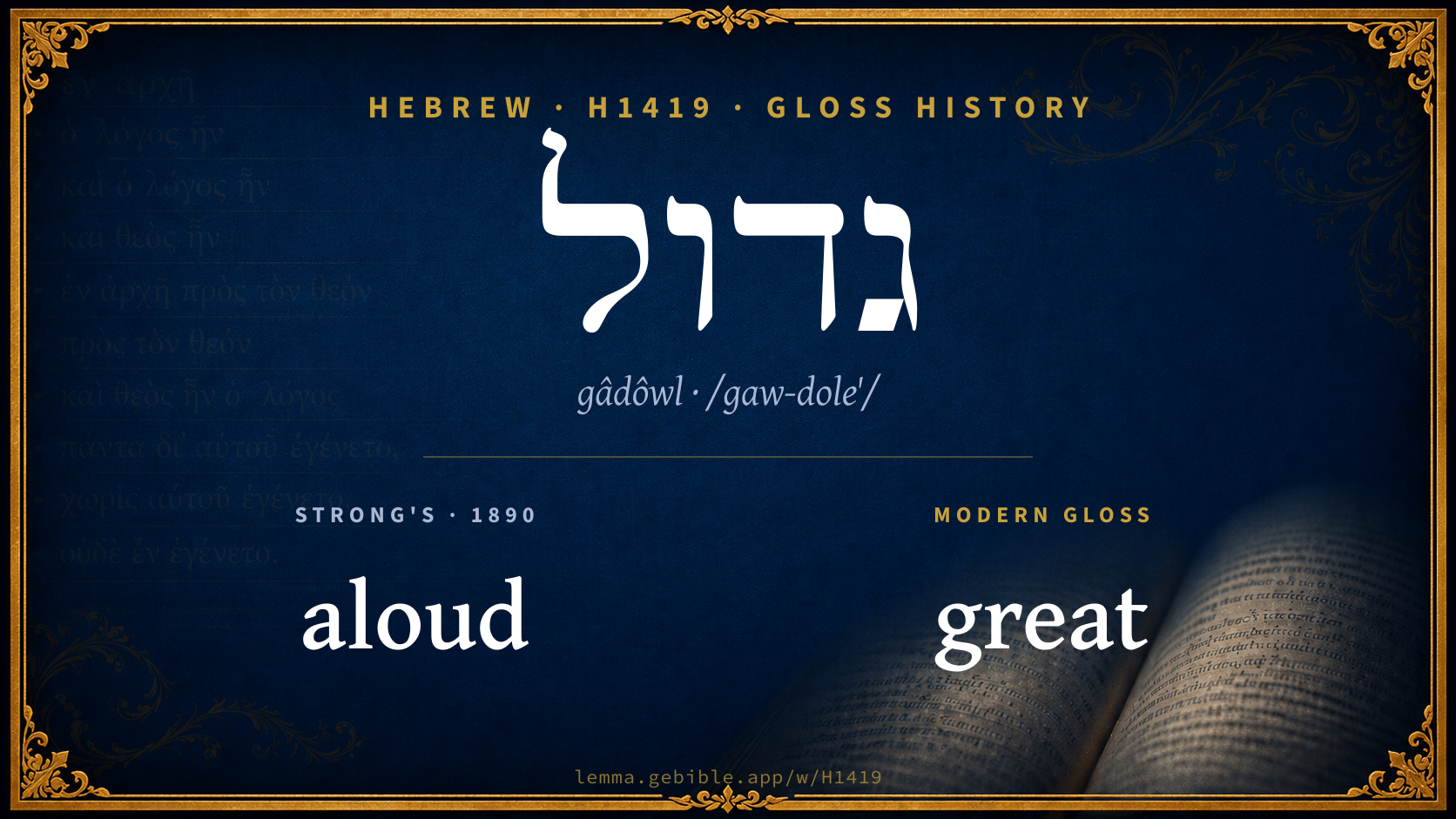
Gloss history
Strong's 1890 vs modern scholarship
About this word
Strong's H1419 catalogs a Hebrew word from the Hebrew Old Testament.
These counts are not copied from any lexicon or concordance. They are computed here, from the morphology-tagged Hebrew Old Testament. What Lemma adds →
- 499
- distinct verses
- The word appears in 499 distinct verses.
- 35 / 39
- OT books
- The word appears in 35 of 39 Old Testament books.
- #93
- by frequency
- Top 100 most frequent Hebrew words (rank 93 of 8,640 Hebrew words by occurrence).
View all 499 occurrences in the concordance →
Most concentrated in
- Jeremiah 47 verses 9%
- Deuteronomy 41 verses 8%
- 1 Samuel 34 verses 7%
By section of the Old Testament
By traditional corpus
Conventional, traditional groupings — biblical authorship is debated, so this is a traditional corpus grouping, not an authorship claim. Each share is this word’s portion of its verses in that division of the Hebrew canon. Each figure is a share of the word’s 499 distinct verses.
- Prophets (Nevi'im) 269 verses · 54%
- Writings (Ketuvim) 134 verses · 27%
- Torah (Pentateuch) 96 verses · 19%
How translations render this word
Counts come from each version’s own published word-to-Strong’s tagging or interlinear alignment — an approximate guide to how each version renders this word, not a word-level alignment the data otherwise carries. Because each total is that version’s own tagged count, the per-version totals vary from one another and need not match the appearance or distinct-verse counts above. These counts may also differ from a printed concordance because Lemma counts each distinctly tagged rendering and does not collapse phrase taggings into a single head-word total. This is a fixed set of word-tagged versions (KJV, ASV, BSB, ULT) and does not change with the reading translation you choose elsewhere. Each version’s license is shown beside its name below (and on Sources).
BDB lists this Strong’s number as 2 distinct words (homographs). Each count above pools all of them and is not split by sense — see the Senses section below. A low-frequency rendering may belong to a different one of those words, not the primary meaning.
- King James Version†: Great 284×, High 20×, Loud 19×
- American Standard Version†: Great 263×, High 19×, Loud 18×
- Berean Standard Bible†: Great 230×, Large 27×, High 20×
- unfoldingWord Literal Text†: Great 371×, Is great 14×, Large 13×
King James Version Public Domain
Renders H1419 across 525† tagged occurrences — most commonly:
Plus other, less common renderings. Plus 87 renderings that appear only once — usually multi-word phrases or single function words the recovered tagging swept in, not distinct renderings. Not rendered by a distinct English word in 4 further occurrences.
American Standard Version Public Domain
Renders H1419 across 524† tagged occurrences — most commonly:
Plus other, less common renderings. Plus 111 renderings that appear only once — usually multi-word phrases or single function words the recovered tagging swept in, not distinct renderings.
Berean Standard Bible Public Domain
Renders H1419 across 501† tagged occurrences — most commonly:
Plus other, less common renderings. Plus 75 renderings that appear only once — usually multi-word phrases or single function words the recovered tagging swept in, not distinct renderings. Not rendered by a distinct English word in 22 further occurrences.
unfoldingWord Literal Text CC BY-SA 4.0
Renders H1419 across 524† tagged occurrences — most commonly:
Plus other, less common renderings. Plus 36 renderings that appear only once — usually multi-word phrases or single function words the recovered tagging swept in, not distinct renderings.
13 senses and sub-senses in the full BDB
What do BDB’s symbols mean?
BDB uses these scholarly abbreviations:
| Symbol | Meaning |
|---|---|
| 𝔊 | the Septuagint (the ancient Greek translation, LXX) |
| 𝔙 | the Vulgate (the Latin translation) |
| 𝔖 | the Syriac version (the Peshitta) |
| 𝔗 | the Targum (the Aramaic translation) |
| ψ | the Psalms |
| √ | root (the underlying root or stem) |
| ‖ | parallel passage (a synonymous or contrasted parallel) |
| † | the dagger: every passage where the word occurs is cited |
The 13 senses and sub-senses the full Brown-Driver-Briggs lexicon distinguishes for this word, in lexicon order (not ranked by frequency), with BDB’s own verbatim wording and sub-sense lettering. Shown in Hebrew script with BDB’s own scholarly abbreviations. The condensed entry is in the Lexicon Entry tab. See also the Forms in the corpus table below.
גדול I great
- 1. in magnitude and extent, e.g. sea Nu 34:6, river Gn 15:18, wilderness Dt 1:19, rain 1 K 18:45, mountain Zc 4:7, city Gn 10:12, house Je 52:13, altar Jos 22:10, throne 2 Ch 9:17, sea-monsters Gn 1:21, fish Jon 2:1, eagle Ez 17:3, terebinth 2 S 18:9, substance Gn 15:14, wealth Dn 11:2, victory 1 S 19:5; 1 S 19:22 בּוֹר הַגָּדוֹל read ב׳ הַגֹּרֶן according to 𝔊 We Dr. e.g. Numbers 34:6
- 2. in number, e.g. nation Gn 12:2, congregation Je 31:8, camp 1 Ch 12:22, army Ez 17:17, sacrifice 2 K 10:19. slaughter Dt 28:59 1 S 4:17. e.g. Genesis 12:2
- 3. in intensity, fear Dt 4:34, weeping Is 38:3, power כּחַ Ex 32:11, joy Jon 4:6, anger Dt 29:23, indignation Je 21:5, sin Gn 20:9, iniquity Gn 4:13, evil Gn 39:9, trespass Ez 9:7. e.g. Deuteronomy 4:34
- 4. in sound, loud voice Gn 39:14, cry Ex 11:6, shout Jos 6:5. e.g. Genesis 39:14
- 5. in age, elder, eldest, son Gn 27:1, daughter Gn 29:16, brother Gn 10:21, sister Ez 16:46. e.g. Genesis 27:1
- 6. in importance,
- a. things †(הַ)דָּבָר (הַ)גָּדֹל an important thing or affair Ex 18:22 Dt 4:32 1 S 12:16 2 K 5:13; 8:13; יום יהוה Je 30:7 Ho 2:2 Jo 2:11; 3:4 Zp 1:14 Mal 3:23. e.g. Exodus 18:22
- b. of men, great, distinguished, Moses Ex 11:3, David 2 S 5:10, Job Jb 1:3, Mordecai Est 9:4, kings Ec 9:14 Je 27:7; especially of king of Assyrian הַמֶּלֶךְ הַגָּדוֹל 2 K 18:19, 28 = Is 36:4, 13, = Assyrian šarru rabbu, šarru dannu, e.g. KB i. 94, 1. 1; הַכֹּהֵן הַגָּדוֹל the h. p. Lv 21:10 + 20 times; (הָ)אִישׁ גָּדוֹל 1 S 25:2 2 S 19:33 2 K 5:1; אִשָּׁה גְדוֹלָה 2 K 4:8; †גָּדוֹל a great man 2 S 3:38 Mi 7:3; לֹא תֶהְדַּר פְּנֵי גָדוֹל thou shalt not honour (favour) the person of a great man (opp. דָּל) Lv 19:15 (H); †(הַ)גְּדוֹלִים the great 2 S 7:9 = 1 Ch 17:8 Ne 11:14 (vid. infr.) Pr 18:16; 25:6 Je 5:5 (2 K 10:11 𝔊L ἀγχιστεύοντας, Klo גֹּאֲלָיו); further גְּדֹלֵי הָעִיר 2 K 10:6; (כָּל־)גְּדֹלָיו 2 K 10:11; Jon 3:7; כָּל־גְּדוֹלֶיהָ Na 3:10. e.g. Exodus 11:3
- c. †of God, himself 2 Ch 2:4 Ne 4:8; 8:6 ψ 86:10; 99:2; 135:5; 147:5 Is 12:6 Je 10:6; (הָ)אֵל (הַ)גָּדוֹל Dt 7:21; 10:17 Ne 1:5; 9:32 ψ 77:14; 95:3 Je 32:18 Dn 9:4; גדול מכל האלהים Ex 18:11; גדול ומהלל מאד 1 Ch 16:25 ψ 48:2; 96:4; 145:3; מלך גדול ψ 47:3; 95:3 Mal 1:14; †his works Dt 11:7 Ju 2:7 ψ 111:2, †glory ψ 21:6; 138:5, †name Jos 7:9 1 S 12:22 1 K 8:42 2 Ch 6:32 ψ 76:2; 99:3 Je 10:6; 44:26 Ez 36:23 Mal 1:11(×2), mercy 1 K 3:6 2 Ch 1:8 ψ 57:11; 86:13; 108:5, goodness Ne 9:25, compassion Is 54:7. e.g. 2 Chronicles 2:4
- 7. in phrases †עוֹד הַיּוֹם גָּדוֹל it is yet high day (Fr. grand jour, Germ. hoch am Tage, the day is at its height) Gn 29:7; †כַּקָּטֹן כַּגָּדֹל (or reverse) as well small as great Dt 1:17 1 Ch 25:8; 26:13 2 Ch 31:15; †(לְ)מִקָּטֹן וְעַד גָּדוֹל (or reverse) from small to great Gn 19:11 1 S 5:9; 30:2, 19 2 K 23:2; 25:26 2 Ch 15:13; 34:30 Est 1:5, 20 Je 6:13; 8:10; 31:34; 42:1, 8; 44:12 Jon 3:5. e.g. Genesis 29:7
- 8. cstr. גְּדֹל (הַ)כְּנָפַיִם great of wings Ez 17:3, 7, so of anger Pr 19:19 (Qr); usually of God, in power Na 1:3, counsel, Je 32:19, mercy ψ 145:8. e.g. Ezekiel 17:3
- 9. as subst. concr. †עשׂה גדלות do great things, of God’s great acts of redemption and judgment Dt 10:21 Jb 5:9; 9:10; 37:5 ψ 71:19; 106:21; of the miracles of Elisha 2 K 8:4; of things too great and so presumptuous, haughty תבקשׁ ג׳ Je 45:5; מדברת ג׳ ψ 12:4; לא הלכתי בג׳ ψ 131:1 (cf. Biblical Aramaic Dn 7:8, 11, 20; also Rev 13:5). e.g. Deuteronomy 10:21
- 10. †as subst. neut. greatness of arm Ex 15:16; cf. גָּבֹהַּ 4. e.g. Exodus 15:16
גדול II m. father of Zabdiel Ne 11
Senses from the full Brown-Driver-Briggs lexicon (Brown, Driver, Briggs; Oxford 1906 — public domain), digitized via Sefaria, supplemented by the OpenScriptures HebrewLexicon (CC BY 4.0). Full attribution on Sources.
Word origin
I. adj. great—ג׳ Gn 4:13 + 279 times; גָּדֹל Dt 26:8 + 22 times; cstr. גְּדוֹל Ex 15:16 belongs rather sub גֹּ֫דֶל Ez 17:3, 7, גְּדֹל Ex 15:16 Je 32:19, גְּדָל־ Pr 19:19, גְּדָו֯ל־ ψ 145:8 Na 1:3; sf. גְּדוֹלָם Je 6:13 + 2 times; pl. גְּדוֹלִים Ex 7:4 + 11 times, גְּדֹלִים Gn 12:17 + 22 times; cstr. גְּדֹלֵי ψ 79:11 2 K 10:6; sf. גְּדֹלָיו 2 K 10:11 Jon 3:7; גְּדוֹלָיהָ Na 3:10; f. גְּדוֹלָה Nu 22:18 + 96 times; גְּדֹלָה Gn 15:12 + 31 times; pl. גְּדוֹלֹת Ne 9:26; 12:31, גְּדֹלוֹת Dt 27:2 + 30 times, גְּדֹלֹת Nu 13:28 + 7 times;—great,
I. n.pr.m. father of Zabdiel Ne 11:14 (RV & so most; but 𝔊 RVm al. the great).
— Brown-Driver-Briggs (Oxford 1906, public domain), digitized via Sefaria, supplemented by the OpenScriptures HebrewLexicon (CC BY 4.0). See Sources.
Derived from גדל (gâdal) (H1431) — to grow.
Jastrow Dictionary
A second Hebrew/Aramaic lexicon for comparison, covering Aramaic and post-biblical (Talmudic, Targumic, Midrashic) usage that the biblical-Hebrew BDB does not. Matched by lemma rather than by Strong’s number, so a lemma may carry more than one Jastrow headword (shown separately below), and the entries cover usage well beyond the Bible.
גָּדוֹל
- 1. great, distinguished; (noun) a great man, leader. Sabb. 94ᵇ, a. fr. ג׳ כבוד הבריות וכ׳ human dignity is something great, for it overrules a prohibitive law &c. Ned. 49ᵇ ג׳ מלאכה וכ׳ labor is something great, for it honors him who pursues it.—Sot. I, 9 ג׳ ממנו his superior. Gen. R. s. 100 גְּדוֹל העולמים the Great One of the worlds, the Lord.—Snh. 21ᵇ גְּ׳ העולם a world-renowned man (Solomon). M. Kat. 22ᵃ גְּ׳ הדור a prominent man of his days. Y. ib. III, 82ᶜ top גְּ׳ המשפחה the chief of the family; a. v. fr.
- 2. adult, of age, older. Yeb. II, 8 בג׳ on the eldest brother. Ib. XIII, 11 ג׳ וקטנה if one of the brother’s widows is of age, and the other a minor; a. fr.—כהן גדול (abbr. כ"ג) Highpriest. Ib. IX, 1; a. fr.—Pl. גְּדוֹלִים, גְּדוֹלִין; גְּדוֹלוֹת. Koh. R. to VII, 8 גְּדוֹלֵי הדור scholars, v. supra; ג׳ ירושלים prominent citizens of Jerusalem.—Ab. Zar. 18ᵃ ג׳ רומי Roman dignitaries; a. fr.—Ber. 23ᵇ, a. e. גדולים (sub. נקבים) the larger functions of the body, movement of the bowels; v. דַּק.
גִּדּוּל
- , v. גִּידּוּל
A Dictionary of the Targumim, the Talmud Babli and Yerushalmi, and the Midrashic Literature (Marcus Jastrow; London, Luzac, 1903) — Public Domain. Digitized via Sefaria. Digitized via Sefaria. Full attribution on Sources.
Forms in the corpus
The 185 distinct written forms H1419 takes in the Hebrew Bible, most frequent first — each parse links to that state’s occurrences in the concordance. Hebrew forms include their vowel points and cantillation, so a single lemma takes many written forms.
The 60 most common forms are shown; 125 rarer forms follow in the full concordance.
Same root — word family
Other BDB entries built from the same root as H1419, grouped by Strong’s listed origin. These share a root / origin per the lexicon — not necessarily a shared meaning. Each links to that word’s own entry.
Derives from
Shares the same root
- גדל gâdêl H1432 growing up
- גדל gôdel H1433 greatness
- גדל gᵉdil H1434 tassels
- מגדל migdâl H4026 tower
Derived from this word
Proper names from this root
People and places named from this root — a name, not an additional meaning of the word.
- גדל Giddêl H1435 Giddel
- גדליה Gᵉdalyâh H1436 Gedaliah
- גדלתי Giddaltîy H1437 Giddalti
- יגדליהו Yigdalyâhûw H3012 Igdaliah
Compare all same-root words → Showing 4 of 11 — not the complete family. 4 of the same-root words are proper names (people or places). They share a root, not necessarily a meaning.
Septuagint verse parallels
This word appears in 454 verses that also exist in the Greek Old Testament (Septuagint), out of the 499 Hebrew verses it occurs in. You can read those verses in Greek by switching the Old Testament edition to the Septuagint.
Read these verses in the Septuagint
- Genesis 1:16
- Exodus 3:3
- Leviticus 19:15
- Numbers 13:28
- Deuteronomy 1:7
- Joshua 1:4
- Judges 2:7
- 1 Samuel 2:17
- 2 Samuel 3:38
- 1 Kings 1:40
- 2 Kings 3:27
- 1 Chronicles 11:9
This is a verse-level parallel only — the same verses exist in both the Hebrew and Greek Old Testaments. No word-level Hebrew↔Greek correspondence is claimed: the data carries no such alignment, so no Greek word is shown as this Hebrew word’s translation. Coverage is not total — the Septuagint omits the deuterocanon and renumbers the Psalms, so some Hebrew verses have no direct Greek parallel.