
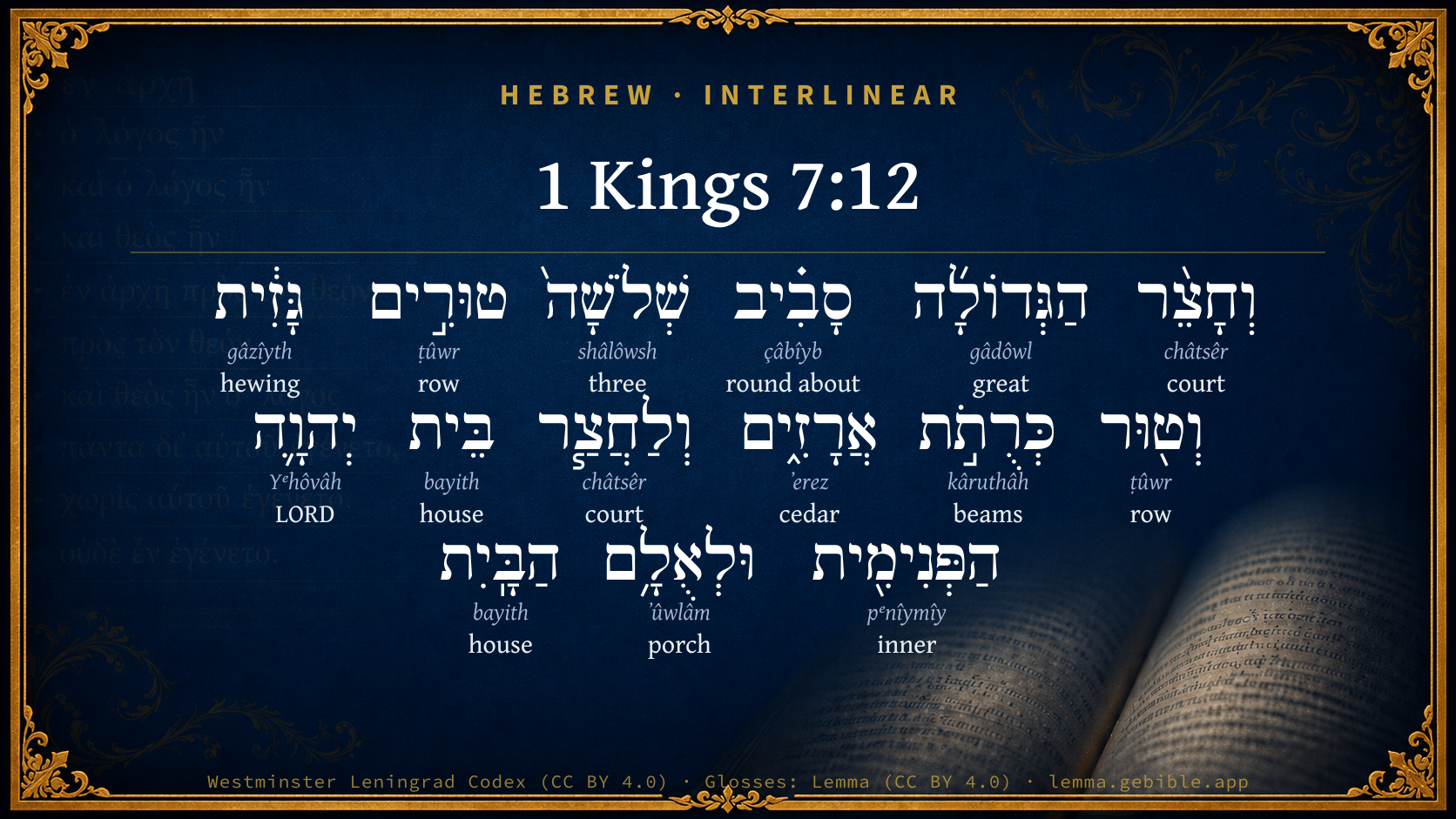
1 Kings 7:12

Hebrew (Westminster Leningrad Codex) 1 Kings 7:12 appears in the Hebrew Old Testament. The text above is from the Westminster Leningrad Codex. Each word links to its Strong’s number, a concise gloss, and parsing drawn from the Open Scriptures Hebrew Bible morphology. Click any word for its full Brown-Driver-Briggs (BDB) entry.
Download image
Cite this verse

1 Kings 7:12 (World English Bible). Public Domain. Lemma interlinear Bible study tool, https://lemma.gebible.app/v/1-kings/7/12.

Show BibTeX & RIS
BibTeX
RIS
English Translation
The great court round about had three courses of hewn stone, and a course of cedar beams; like as the inner court of the house of Yahweh, and the porch of the house.
World English Bible · Public Domain
Download a study sheet

One document with this verse’s original text, its word-by-word gloss line, the meaning frame, cross-references with their text, attributed commentary, and full source and license credits — printable, and it pastes into notes with its structure intact.

This verse Autodidact and up

Study sheet (.html) Plain text (.txt)

A passage Seminary Student

Up to 50 verses in one chapter. A passage sheet keeps up to 6 commentary sources and 12 cross-references per verse, in the order this page ranks them, and says so on the sheet whenever that leaves anything out. Ask for a single verse and you get the Autodidact verse sheet above.

Everything on this page stays free to read, with no account — the sheet is a download of what is already on screen, not access to it.

Want to remove ads? Support Godless Engineer
Compare translations 3

The same verse in 3 English versions, stacked beneath the original-language interlinear above. Click any original word for its lexicon entry.

Each is an independent rendering of the whole verse — the interlinear is not word-aligned to these translations.

Highlighted words mark where these versions differ — a whole-verse word diff, not a word-by-word alignment.

  • World English Bible Public Domain
    The great court round about had three courses of hewn stone, and a course of cedar beams; like as the inner court of the house of Yahweh, and the porch of the house.
  • King James Version Public Domain
    And the great court round about was with three rows of hewed stones, and a row of cedar beams, both for the inner court of the house of the LORD, and for the porch of the house.
  • unfoldingWord Literal Text CC BY-SA 4.0
    And a great courtyard all around, three rows hewn stone and a row of beams of cedar, and for the inner courtyard of the house of Yahweh and for the porch of the house.

unfoldingWord Literal Text — © unfoldingWord, licensed CC BY-SA 4.0. Word-aligned USFM3 via Door43 (git.door43.org/unfoldingWord/en_ult).

Versions to compare (up to 4)

3 of 4 selected

Show all 18 translations

Every available English version of this verse, each an independent rendering of the whole verse.

  • World English Bible Public Domain
    The great court round about had three courses of hewn stone, and a course of cedar beams; like as the inner court of the house of Yahweh, and the porch of the house.
  • Berean Standard Bible Public Domain
    The great courtyard was surrounded by three rows of dressed stone and a row of trimmed cedar beams, as were the inner courtyard and portico of the house of the LORD.
  • Majority Standard Bible Public Domain
    The great courtyard was surrounded by three rows of dressed stone and a row of trimmed cedar beams, as were the inner courtyard and portico of the house of the LORD.
  • King James Version Public Domain
    And the great court round about was with three rows of hewed stones, and a row of cedar beams, both for the inner court of the house of the LORD, and for the porch of the house.
  • American Standard Version (1901) Public Domain
    And the great court round about had three courses of hewn stone, and a course of cedar beams; like as the inner court of the house of Jehovah, and the porch of the house.
  • Revised Version (1885) Public Domain
    And the great court round about had three rows of hewn stone, and a row of cedar beams; like as the inner court of the house of the LORD, and the porch of the house.
  • Geneva Bible (1599) Public Domain
    And the great court round about was with three rowes of hewed stones, and a rowe of cedar beames: so was it to ye inner court of the house of the Lord, and to the porche of the house.
  • Douay-Rheims (1899) Public Domain
    And the greater court was made round with three rows of hewed stones, and one row of planks of cedar, moreover also in the inner court of the house of the Lord, and in the porch of the house.
  • Young's Literal Translation Public Domain
    and the great court round about `is' three rows of hewn work, and a row of cedar-beams, even for the inner court of the house of Jehovah, and for the porch of the house.
  • Literal Standard Version CC BY-SA 4.0
    and the great court around [is] three rows of hewn work, and a row of cedar-beams, even for the inner court of the house of YHWH, and for the porch of the house.
  • Unlocked Literal Bible CC BY-SA 4.0
    The great courtyard surrounding the palace had three rows of cut stone and a row of cedar beams like the courtyard of the temple of Yahweh and the temple portico.
  • unfoldingWord Literal Text CC BY-SA 4.0
    And a great courtyard all around, three rows hewn stone and a row of beams of cedar, and for the inner courtyard of the house of Yahweh and for the porch of the house.
  • Darby Bible Public Domain
    And the great court round about had three rows of hewn stones, and a row of cedar-beams; and so it was for the inner court of the house of Jehovah, and the porch of the house.
  • World Messianic Bible Public Domain
    The great court around had three courses of cut stone with a course of cedar beams, like the inner court of the LORD’s house and the porch of the house.
  • Webster's Bible Public Domain
    And the great court around was with three rows of hewn stones, and a row of cedar beams, both for the inner court of the house of the LORD, and for the porch of the house.
  • Free Bible Version CC BY-SA 4.0
    Around the great courtyard, the inner courtyard, and the porch of the Lord's Temple were three courses of dressed stone and a course of cedar beams.
  • Bible in Basic English Public Domain
    The great outer square all round was walled with three lines of squared stones and a line of cedar-wood boards, round about the open square inside the house of the Lord and the covered room of the king's house.
  • JPS Tanakh (1917) Public Domain
    And the great court round about had three rows of hewn stone, and a row of cedar beams, like as the inner court of the house of the LORD, and the court of the porch of the house.

Literal Standard Version (2020), Covenant Press — licensed CC BY-SA 4.0. Text via the HelloAO Bible API (eBible.org). Unlocked Literal Bible (unfoldingWord) — licensed CC BY-SA 4.0. Text via the HelloAO Bible API (eBible.org). unfoldingWord Literal Text — © unfoldingWord, licensed CC BY-SA 4.0. Word-aligned USFM3 via Door43 (git.door43.org/unfoldingWord/en_ult). Free Bible Version, Dr. Jonathan Gallagher — licensed CC BY-SA 4.0. Text via the HelloAO Bible API (eBible.org).

Word by word

More ways to search: Search by grammar → Find every occurrence → Compare this word →

Practice this passage: Drill this verse → Learn its vocabulary →

כְּרֻתֹ֣ת
kâruthâh
H3773
“beams of”
Noun, Common, Feminine, Plural, Construct
Part of Speech
Noun
Type
Common
Gender
Feminine
Number
Plural
State
Construct
Full BDB Definition

Origin: passive participle of H3772

TWOT: 1048b

beams, hewn beams
  1. וְחָצֵ֨ר châtsêr H2691 “and · court” Conjunction + Noun, Common, Both, Singular, Absolute
  2. הַגְּדוֹלָ֜ה gâdôwl H1419 “the · great” Particle, Definite Article + Adjective, Adjective, Feminine, Singular, Absolute
  3. סָבִ֗יב çâbîyb H5439 “round about” Noun, Common, Both, Singular, Absolute
  4. שְׁלֹשָׁה֙ shâlôwsh H7969 “three” Adjective, Cardinal number, Masculine, Singular, Absolute
  5. טוּרִ֣ים ṭûwr H2905 “rows” Noun, Common, Masculine, Plural, Absolute
  6. גָּזִ֔ית gâzîyth H1496 “hewing” Noun, Common, Feminine, Singular, Absolute
  7. וְט֖וּר ṭûwr H2905 “and · row of” Conjunction + Noun, Common, Masculine, Singular, Construct
  8. אֲרָזִ֑ים ʼerez H730 “cedars” Noun, Common, Masculine, Plural, Absolute
  9. וְלַחֲצַ֧ר châtsêr H2691 “and · to/for · court of” Conjunction + Preposition + Noun, Common, Both, Singular, Construct
  10. בֵּית bayith H1004 “house of” Noun, Common, Masculine, Singular, Construct
  11. יְהוָ֛ה Yᵉhôvâh H3068 “LORD” Noun, Proper
  12. הַפְּנִימִ֖ית pᵉnîymîy H6442 “the · inner” Particle, Definite Article + Adjective, Adjective, Feminine, Singular, Absolute
  13. וּלְאֻלָ֥ם ʼûwlâm H197 “and · to/for · porch of” Conjunction + Preposition + Noun, Common, Masculine, Singular, Construct
  14. הַבָּֽיִת bayith H1004 “the · house” Particle, Definite Article + Noun, Common, Masculine, Singular, Absolute

About this verse

These counts appear in no published source. They are computed here, from the morphology-tagged text and Lemma’s own curated glosses. What Lemma adds →

15
words
12
distinct lemmas
Historical
section

Notable vocabulary

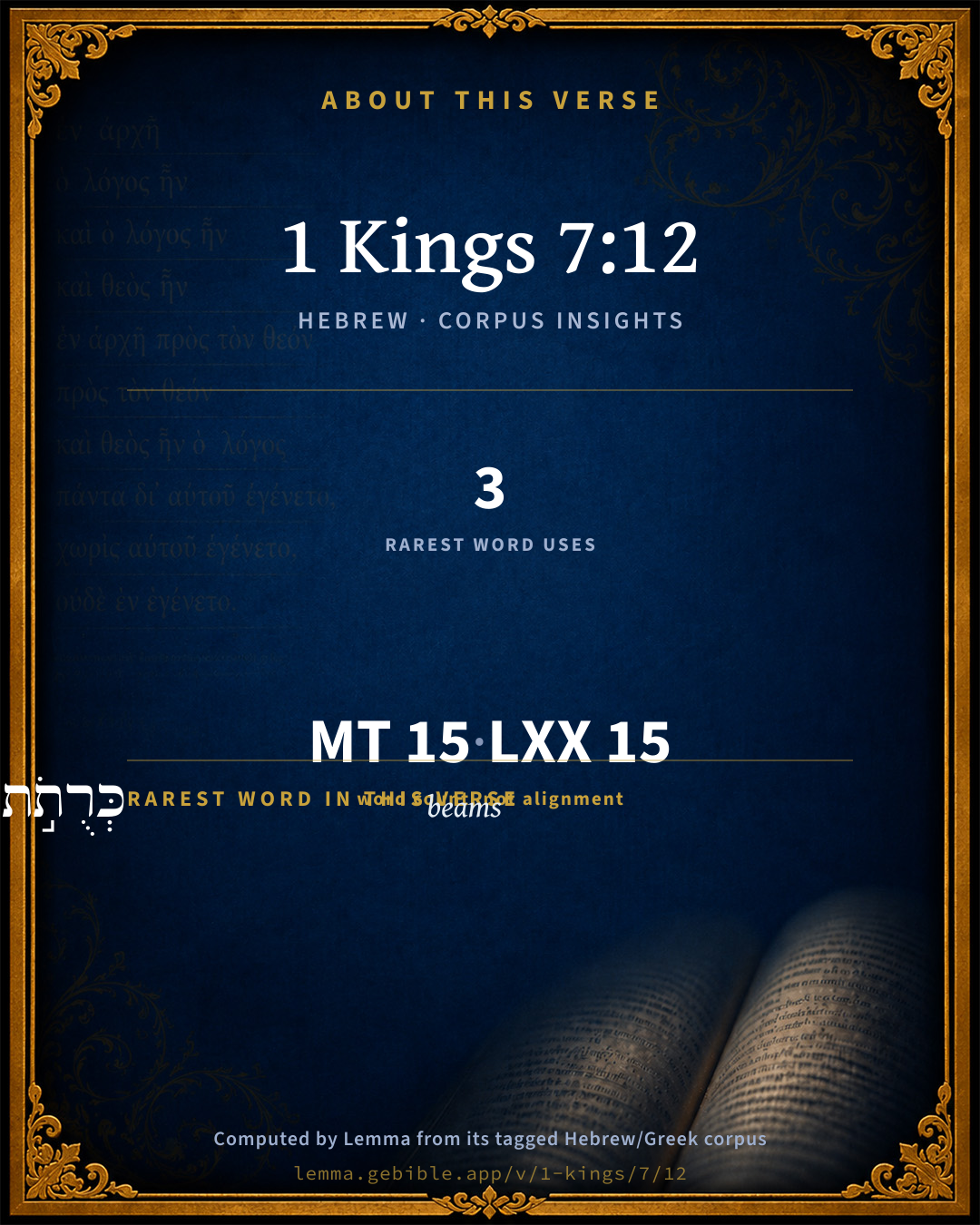
The rarest word here is כְּרֻתֹ֣ת beams H3773 — appearing just 3 times in the whole Hebrew Bible.

Shared distinctive vocabulary

כְּרֻתֹ֣ת beams H3773 occurs in 3 verses of the Hebrew Bible. Also found in:

Grammatical profile

  • 12 nouns
  • 3 adjectives

Repetition

Words recur within this verse — often emphatic in Hebrew:

  • וְחָצֵ֨ר court H2691 ×2
  • טוּרִ֣ים row H2905 ×2
  • בֵּית house H1004 ×2

Hebrew & Septuagint length

In the original languages it is 15 Hebrew tokens and 15 Greek tokens — but the two are counted differently (Hebrew bundles its prefixes and suffixes into one token; the Greek is in lemma form), so that isn’t a like-for-like length.

Cross-references

5

Topical passages linked to 1 Kings 7:12 in the Treasury of Scripture Knowledge — connected by theme and wording, ordered by reader-vote popularity; previews shown in the World English Bible.

  • 1 Kings 6:36 He built the inner court with three courses of hewn stone, and a course of cedar beams.
  • 1 Kings 7:6 He made the porch of pillars; the length of it was fifty cubits, and the breadth of it thirty cubits; and a porch before them; and pillars and a threshold before them.
  • John 10:23 It was winter, and Jesus was walking in the temple, in Solomon's porch.
  • Acts 3:11 As the lame man who was healed held on to Peter and John, all the people ran together to them in the porch that is called Solomon's, greatly wondering.
  • Acts 5:12 By the hands of the apostles many signs and wonders were done among the people. They were all with one accord in Solomon's porch.

Cross-references courtesy of OpenBible.info (CC BY 4.0).

Hebrew and Greek witnesses Masoretic Hebrew ↔ Greek Septuagint

The same verse in the two great witnesses to the Old Testament, shown verse-for-verse.

These are two independent witnesses, not word-aligned to each other, and the Septuagint is shown in lemma (dictionary) form.

Hebrew 1 Kings 7:12 Masoretic · Westminster Leningrad Codex

וְחָצֵ֨ר הַגְּדוֹלָ֜ה סָבִ֗יב שְׁלֹשָׁה֙ טוּרִ֣ים גָּזִ֔ית וְט֖וּר כְּרֻתֹ֣ת אֲרָזִ֑ים וְלַחֲצַ֧ר בֵּית יְהוָ֛ה הַפְּנִימִ֖ית וּלְאֻלָ֥ם הַבָּֽיִת

The great court round about had three courses of hewn stone, and a course of cedar beams; like as the inner court of the house of Yahweh, and the porch of the house.

World English Bible · Public Domain

Greek LXX 1 Kings 7:12 Septuagint · lemma form

καί ὁ χεῖλος αὐτός ὡς ἔργον χεῖλος ποτήριον βλαστός κρίνον καί ὁ πάχος αὐτός παλαιστή

No English rendering of this Greek verse — the small residue in the structurally divergent books.

Hebrew: Westminster Leningrad Codex (CC BY 4.0). Greek: Septuagint (public domain); English from a public-domain English Septuagint. How the Septuagint differs from the Hebrew →

Targum (Aramaic paraphrase)

1

The Targum is the ancient Jewish Aramaic paraphrase of the Hebrew Scriptures — an interpretive translation, not the Hebrew text itself. Onkelos (literal) and Pseudo-Jonathan (expansive) render the Torah, and Jonathan the Prophets. Coverage is partial: where no permissively-licensed English translation exists for a verse, only the Aramaic is shown. This is verse-level text, not a word-by-word alignment to the Hebrew.

  1. Targum Jonathan Prophets (Joshua–Malachi)
    וְדָרְתָא רַבְּתָא סְחוֹר סְחוֹר תְּלָתָא סִדְרִין דְאֶבֶן טָבָא וְסִדְרָא חַד דְמָרֵישׁ אֲעֵי אַרְזִין וּלְדָרַת בֵּית מַקְדְשָׁא דַייָ גַוְיָתָא וּלְאוּלַמָא דְבֵיתָא:

    (no public-domain English translation for this verse)

    Targum Jonathan — Aramaic: “Mikraot Gedolot” (public domain). English: “Sefaria Community Translation” (CC0 1.0 (public-domain dedication)); “London "Chaldee Paraphrase," 1871” (public domain). Text via Sefaria.

Commentary

Notes on 1 Kings 7:12 from classic Christian and Jewish commentators (each source and its license shown beneath its notes). The classic Christian expositions comment on the surrounding passage and are grouped to its opening verse, so a note may address several verses; the Jewish commentaries on the Tanakh (Rashi and others) are per-verse, so they appear only where the commentator wrote on this verse.

Lemma curates 59 commentaries, every one of them public domain or Creative Commons licensed, each selected and text-cleaned for this edition rather than reprinted as found. About our sources →

Trapp's Complete Commentary

John Trapp

1Ki 7:12 And the great court round about [was] with three rows of hewed stones, and a row of cedar beams, both for the inner court of the house of the LORD, and for the porch of the house.

Ver. 12. And the great court round about.] Surrounding the king’s house.

Both for the inward court of the house of the Lord,] i.e., Like that inward court, 1Ki 6:36.

And for the porch, &c.] The king’s house had the like porch before it, as God’s house had.

John Trapp, A Commentary or Exposition upon All the Books of the Old and New Testament (1647–1656) — public domain. Text from a community e-Sword module.

Joseph Benson's Commentary

1Ki 7:12. And the great court — Namely, of Solomon’s palace, mentioned 1Ki 7:8. Was with three rows of hewed stones, &c. — Just like the inner court of the Lord’s house, (1Ki 6:36,) and so the following words are to be understood. Both, for the inner court — Or, rather, as for the inner court, &c.; for so the particle ו, vau, sometimes signifies. And for the porch of the house — Namely, Solomon’s own house.

Joseph Benson's Commentary on the Old and New Testaments (1811–1818) — public domain. Text from a community e-Sword module.

Tyndale Open Study Notes

Tyndale Open Resources

7:12 The great courtyard that encircled the Temple and palace complex provided a gathering place for the people (see Jer 7:1-2; 36:10).

Tyndale Open Study Notes — © Tyndale Open Resources, licensed CC BY-SA 4.0. Text via the HelloAO Bible API.

Geneva Bible (1599)

Geneva Bible translators

As the Lord’s house was built, so was this: only the great court of Solomon’s house was uncovered.

Geneva Bible (1599) marginal notes — public domain. Text via Bolls.life.

Jamieson, Fausset & Brown

Robert Jamieson, A. R. Fausset & David Brown

for the inner court of the house of the Lord--should be, as in the inner court of the house of the Lord; the meaning is, that in this palace, as in the temple, rows of hewed stones and the cedar beams formed the enclosing wall.

Jamieson, Fausset & Brown — Commentary Critical and Explanatory on the Whole Bible (1871) — public domain (CC PDM 1.0). Text via the HelloAO Bible API.

Ellicott's Commentary for English Readers

(12) The great court.—Finally, “the great court” round about is said to have resembled the “inner court” of the Temple, having an enclosure of three rows of stones, probably of large size, with a cedar coping. It seems evidently to have enclosed the whole palace, and may have contained quarters for the guards and the household. There must have been, of course, inner courts, round which both the more public and the more private buildings of the palace were grouped.

A Bible Commentary for English Readers, edited by Charles John Ellicott (1878–1897) — public domain. Text from a community e-Sword module.

The Cambridge Bible for Schools and Colleges

gen. ed. J. J. S. Perowne

12. And the great court round about] The words are the same as in 1Ki_6:36. The great court was the hindmost part of all the palace grounds, and was apparently higher than the level of the front part. The way in which it was enclosed was by a low wall (sunk fence) as was done for the inner-court of the Temple.

both for the inner court of the house of the Lord] The conjunction with which this sentence begins is the usual copulative. But the sense should be ‘like as the inner court, &c.’ (Cf. 1Ki_6:34.) Hence some have conjectured כ = as, instead of ו = and or both. The R.V. has given the true sense in the text ‘like as the inner court of the house of the Lord, and the porch of the house,’ and has put the literal translation on the margin. There is no great difficulty in gathering the former sense from the latter. We have only to take the construction to be ‘and thus was it done for the inner court &c.… and for.’

the porch of the house] Probably the porch intended is that spoken of in 1Ki_6:3. ‘The house’ without any defining words can only be taken of the Temple; so that we cannot understand any porch in Solomon’s own house.

The Cambridge Bible for Schools and Colleges (gen. ed. J. J. S. Perowne; Cambridge University Press, 1878–1918) — public domain. Text from a community e-Sword module.

John Gill's Exposition

And King Solomon sent and fetched Hiram out of Tyre. Not the king of Tyre, but an artificer in it, after described, whom Solomon had heard and upon his request Huram sent him to him, Ch2 2:13 his name is called Hyperon by Clemens of Alexandria (l).

(l) Stromat. l. 1. p. 332.

John Gill's Exposition of the Whole Bible (1746–1763) — public domain (CC PDM 1.0). Text via the HelloAO Bible API.

Albert Barnes' Notes on the Bible

The palace, like the temple, had two courts 1Ki 6:36, not, however, one immediately within the other. The lesser court of the palace seems to have been a private inner court among the buildings 1Ki 7:8. The greater court was outside all the buildings, surrounding the palace on every side. Assyrian palaces had always such an external court, and had generally one or more inner courts or quadrangles.

Both for the inner court - By a slight alteration of the text, the meaning would be “as (was done) in the inner court, etc. and in the porch.”

Albert Barnes' Notes on the Bible (1834–1885) — public domain. Text from a community e-Sword/MySword module.

Haydock's Catholic Bible Commentary

Cedar, in regular courses with the stones, chap. vi. 36. Public places were often made in a circular form, and were thus rendered more beautiful. The palace of Solomon might have enclosed the court in this manner, or there were buildings on all the four sides, made of three courses of fine large stones, with the fourth of cedar beams, till the whole was completed. The ancients built for posterity, as we may perceive from the huge stones, well connected, which still reman in the ruins of Egyptian, Greek, and Roman architecture.

George Leo Haydock (1774–1849), Haydock's Catholic Family Bible and Commentary, 1859 edition — public domain. Excludes Psalms (Douay-Rheims chapter numbering differs from Protestant) and Deuterocanonical books (Catholic canon only).

Matthew Poole's English Annotations

The great court, to wit, of Solomon’s dwelling-house, mentioned 1Ki 7:8.

A row of cedar beams; of which See Poole "1Ki 6:36".

Both for the inner court of the house of the Lord, or, as (Heb. and, which is oft used in that sense for a particle of comparison or similitude, as Pro 11:25; 17:3; Pro 25:23) for the inner court, &c., i.e. as it was in that inner court, of which the very same thing is said 1Ki 6:36. Otherwise it might seem very improper and impertinent to speak of the court of the Lord’s house here, where he is treating only of Solomon’s house.

For the porch of the house, or, of this house, to wit, of which I am here speaking, i.e. of the king’s house, the porch where of had pillars, 1Ki 7:6, and these both of stone and cedar, as may seem most probable, because the other pillars were such. And whereas the number and quality of the pillars of the porch was omitted, 1Ki 7:6, that defect is here supplied, and we are implicitly acquainted with both of them. But this I speak with submission.

Matthew Poole's English Annotations on the Holy Bible (1683–1685) — public domain. Text from a community e-Sword/MySword module.

Whedon's Commentary on the Bible

Daniel D. Whedon

12. The great court round about — The great enclosure or park in which all the palatial buildings stood. (H H H in plan.)

Three rows of hewed stones — Or three layers of hewn stone. See note on 1Ki_6:36. If this view of this obscure verse be correct, it follows that the great court of the palace was not a cultivated park, but a solid artificial platform of stone-work, covered by a cedar flooring. This is the more probable since all the palace buildings were set upon a vast artificial platform raised upon the southern slope of Mount Moriah.

Both for the inner court of the house of the Lord — The meaning is, that the pavement of the great court of the palace, like that of the inner court of the temple, (see 1Ki_6:36,) consisted of three layers of hewn stone placed one upon another, with a layer of cedar planks fastened on the top of them.

And for the porch of the house — That is, the porch of the palace had a similar pavement.

Here ends the Bible account of Solomon’s palace. But it is manifestly not an exhaustive or minute description; and it is likely that there were various apartments, and perhaps whole buildings, of less importance that receive no mention here. Josephus adds that he built other edifices for pleasure, and long cloisters, and a magnificent dining room, and various other things which it seems not to have been the purpose of the sacred historian to mention or describe.

Daniel D. Whedon (gen. ed.), Commentary on the Old and New Testaments (1874–1909) — public domain. Text from a community e-Sword module.

The Pulpit Commentary

And the great court round about The palace, again like the temple, had two courts. The lesser is referred to in ver. 8, and was enclosed among the buildings. The great court probably surrounded the entire structure was enclosed by a wall with three rows of hewed stones, and a row of cedar beams The latter formed the coping. The wall of the court of the palace thus resembled that of the temple. See on, 1Ki_6:36. In all these coincidences we have tokens of the same designing hand both for the inner court of the house of the Lord. This sudden digression from the court of the palace to the temple is suspicious, and suggests either a mistranslation or corruption of the text. The historian evidently meant to say that the wall of the court, in its three rows of stones and its cedar coping, resembled the inner court of the temple; and, according to some grammarians (Gesen., Ewald), this meaning may well be conveyed by the text as it stands, w in Hebrew serving sometimes to institute a comparison (Pro_25:3, Pro_25:12, 20 26:14, etc.) "As in the court," etc. But the instances just cited, being proverbs or apophthegms, are not strictly parallel with our text. It seems better, on the whole, however, to retain the text in this sense than to replace. w by k, reading rxjlk or rxjk for rxjlw. rxjhk (Horsley) is quite inadmissible, as the constr, case never has the art., and for the porch of the house. It is almost impossible to decide whether the porch of judgment (ver. 7) or the porch of the temple is here meant. The immediate context favours the latter. But this does not seem to have had any court or enclosing wall other than the inner court. Rawlinson decides for the porch of judgment, "which," he says, "had a planking of cedar over the stone pavement" (ver. 7). But ver. 7 (where see note) rather excludes than in-eludes the pavement. The reference is probably to the "court within the porch," mentioned in ver. 8.

After this brief account of the royal palaces, the author proceeds to mention the vessels, etc., used in the temple service, prefacing his description by a few words respecting the great Tyrian artist, by whom they were for the most part cast, and possibly designed also.

The Pulpit Commentary (1880–1919), ed. H.D.M. Spence-Jones & Joseph S. Exell — public domain. Text from a community e-Sword module.

John Wesley's Explanatory Notes

The court - Namely, of Solomon's dwelling-house mentioned, ver. 8.

John Wesley, Explanatory Notes Upon the Whole Bible (1754–1765) — public domain. Text via the GEBible commentary corpus.

Rashi

Rabbi Shlomo Yitzchaki (Rashi)

Three rows of cut stones. The wall was made of three tiers of stone and a tier of wood on them.

Rashi on the Tanakh — English translations: “The Judaica Press complete Tanach with Rashi, translated by A. J. Rosenberg” (CC BY 4.0); “Pentateuch with Rashi's commentary by M. Rosenbaum and A.M. Silbermann, 1929-1934” (public domain); “The Metsudah Tanach series, Lakewood, N.J” (CC BY 4.0); and “The Book of Joshua, Metsudah Publications, 1997” (CC BY 4.0). Text via Sefaria.

Lesson kit

Teaching starters — assembled from the data on this page, not authored interpretation. Every prompt links to the verse data it draws on. Edit before teaching.

1 Kings, in the Historical, opens this verse with 15 words (12 distinct Hebrew lemmas). Its most distinctive word is kâruthâh (“beams”). A historical commentator’s framing appears above. Read the whole chapter for the surrounding context.

Discussion questions

  1. How does “beams” (kâruthâh) shape what this verse is saying?
  2. How does 1 Kings 6:36, which shares the word «beams», read alongside this verse?
  3. What does the repetition of “court” (2× in this one verse) do in this verse?
  4. These translations render this verse differently. What is at stake in choosing one wording over another?
  5. Compare how Trapp's Complete Commentary and Joseph Benson's Commentary read this verse. Where do they agree or differ?

Things to notice

Reading settings

Reading text

Shown beneath each verse's original-language words.

Old Testament
Old Testament edition

Read the OT as the Masoretic Hebrew (MT) or the Greek Septuagint (LXX).

English shown for the Greek Septuagint (in the Hebrew ↔ Greek comparison).

Comparing translations? Open the Compare panel on any verse page to stack up to four side by side.