
Ezekiel 17:3

Hebrew (Westminster Leningrad Codex) Ezekiel 17:3 appears in the Hebrew Old Testament. The text above is from the Westminster Leningrad Codex. Each word links to its Strong’s number, a concise gloss, and parsing drawn from the Open Scriptures Hebrew Bible morphology. Click any word for its full Brown-Driver-Briggs (BDB) entry.
Download image
Cite this verse

Ezekiel 17:3 (World English Bible). Public Domain. Lemma interlinear Bible study tool, https://lemma.gebible.app/v/ezekiel/17/3.

Show BibTeX & RIS
BibTeX
RIS
English Translation
and say, Thus says the Lord Yahweh: A great eagle with great wings and long feathers, full of feathers, which had various colors, came to Lebanon, and took the top of the cedar:
World English Bible · Public Domain
Highlights
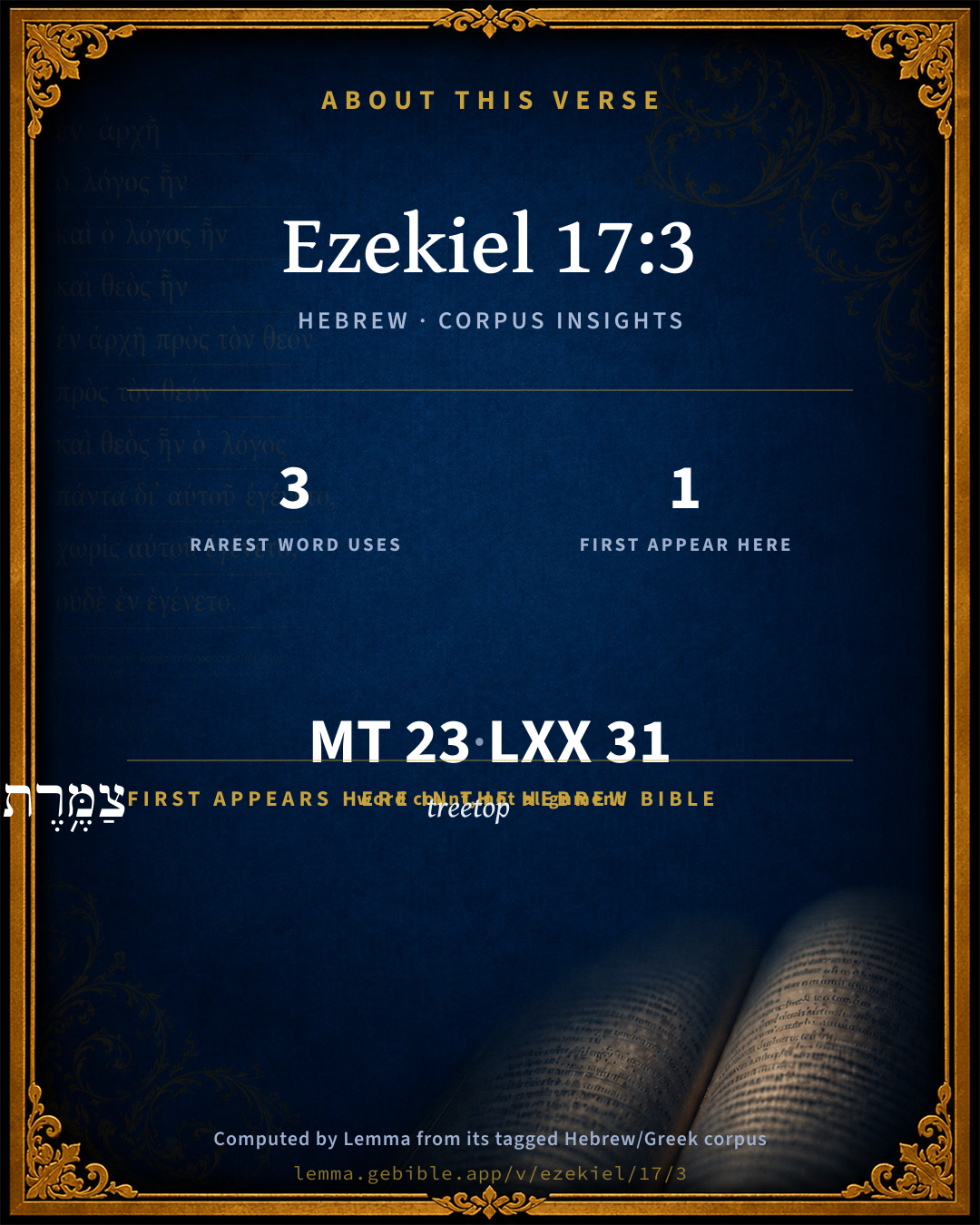
  • 1 first appearance in the Hebrew Bible
Full analysis ↓
Download a study sheet

One document with this verse’s original text, its word-by-word gloss line, the meaning frame, cross-references with their text, attributed commentary, and full source and license credits — printable, and it pastes into notes with its structure intact.

This verse Autodidact and up

Study sheet (.html) Plain text (.txt)

A passage Seminary Student

Up to 50 verses in one chapter. A passage sheet keeps up to 6 commentary sources and 12 cross-references per verse, in the order this page ranks them, and says so on the sheet whenever that leaves anything out. Ask for a single verse and you get the Autodidact verse sheet above.

Everything on this page stays free to read, with no account — the sheet is a download of what is already on screen, not access to it.

Want to remove ads? Support Godless Engineer
Compare translations 3

The same verse in 3 English versions, stacked beneath the original-language interlinear above. Click any original word for its lexicon entry.

Each is an independent rendering of the whole verse — the interlinear is not word-aligned to these translations.

Highlighted words mark where these versions differ — a whole-verse word diff, not a word-by-word alignment.

  • World English Bible Public Domain
    and say, Thus says the Lord Yahweh: A great eagle with great wings and long feathers, full of feathers, which had various colors, came to Lebanon, and took the top of the cedar:
  • King James Version Public Domain
    And say, Thus saith the Lord GOD; A great eagle with great wings, longwinged, full of feathers, which had divers colours, came unto Lebanon, and took the highest branch of the cedar:
  • unfoldingWord Literal Text CC BY-SA 4.0
    Say, ‘The Lord Yahweh says this: A large eagle with large wings and long pinions, full of feathers, and that was multicolored went to Lebanon and took hold of the top of a cedar tree.

unfoldingWord Literal Text — © unfoldingWord, licensed CC BY-SA 4.0. Word-aligned USFM3 via Door43 (git.door43.org/unfoldingWord/en_ult).

Versions to compare (up to 4)

3 of 4 selected

Show all 18 translations

Every available English version of this verse, each an independent rendering of the whole verse.

  • World English Bible Public Domain
    and say, Thus says the Lord Yahweh: A great eagle with great wings and long feathers, full of feathers, which had various colors, came to Lebanon, and took the top of the cedar:
  • Berean Standard Bible Public Domain
    and tell them that this is what the Lord GOD says: ‘A great eagle with great wings and long pinions, full of feathers of many colors, came to Lebanon and took away the top of the cedar.
  • Majority Standard Bible Public Domain
    and tell them that this is what the Lord GOD says: ‘A great eagle with great wings and long pinions, full of feathers of many colors, came to Lebanon and took away the top of the cedar.
  • King James Version Public Domain
    And say, Thus saith the Lord GOD; A great eagle with great wings, longwinged, full of feathers, which had divers colours, came unto Lebanon, and took the highest branch of the cedar:
  • American Standard Version (1901) Public Domain
    and say, Thus saith the Lord Jehovah: A great eagle with great wings and long pinions, full of feathers, which had divers colors, came unto Lebanon, and took the top of the cedar:
  • Revised Version (1885) Public Domain
    and say, Thus saith the Lord GOD: A great eagle with great wings and long pinions, full of feathers, which had divers colours, came unto Lebanon, and took the top of the cedar:
  • Geneva Bible (1599) Public Domain
    And say, Thus saith the Lord God, The great eagle with great wings, and long wings, and ful of fethers, which had diuers colours, came vnto Lebanon, and tooke the highest branch of the cedar,
  • Douay-Rheims (1899) Public Domain
    And say: Thus saith the Lord God: A large eagle with great wings, long-limbed, full of feathers, and of variety, came to Libanus, and took away the marrow of the cedar.
  • Young's Literal Translation Public Domain
    and thou hast said: Thus said the Lord Jehovah: The great eagle, great-winged, long-pinioned, Full of feathers, that hath diverse colours, Hath come in unto Lebanon, And it taketh the foliage of the cedar,
  • Literal Standard Version CC BY-SA 4.0
    and you have said, Thus said Lord YHWH: The great eagle, great-winged, long-pinioned, || Full of feathers, that has diverse colors, || Has come to Lebanon, || And he takes the foliage of the cedar,
  • Unlocked Literal Bible CC BY-SA 4.0
    Say, 'The Lord Yahweh says this: A large eagle with large wings and long pinions, full of feathers, and that was multicolored went to Lebanon and took hold of the top of a cedar tree.
  • unfoldingWord Literal Text CC BY-SA 4.0
    Say, ‘The Lord Yahweh says this: A large eagle with large wings and long pinions, full of feathers, and that was multicolored went to Lebanon and took hold of the top of a cedar tree.
  • Darby Bible Public Domain
    and say, Thus saith the Lord Jehovah: A great eagle with great wings, long-pinioned, full of feathers, which was of divers colours, came unto Lebanon, and took the highest branch of the cedar.
  • World Messianic Bible Public Domain
    and say, ‘The Lord GOD says: “A great eagle with great wings and long feathers, full of feathers which had various colors, came to Lebanon and took the top of the cedar.
  • Webster's Bible Public Domain
    And say, Thus saith the Lord GOD; A great eagle with great wings, long-winged, full of feathers, which had divers colors, came to Lebanon, and took the highest branch of the cedar:
  • Free Bible Version CC BY-SA 4.0
    Tell them that this is what the Lord God says: There was a great eagle that had large wings, long feathers, and multi-colored plumage. It came to Lebanon and took off the top of the cedar.
  • Bible in Basic English Public Domain
    And say, This is what the Lord has said: A great eagle with great wings, full of long feathers of different colours, came to Lebanon, and took the top of the cedar:
  • JPS Tanakh (1917) Public Domain
    and say: Thus saith the Lord GOD: A great eagle with great wings and long pinions, full of feathers, which had divers colours, came unto Lebanon, and took the top of the cedar;

Literal Standard Version (2020), Covenant Press — licensed CC BY-SA 4.0. Text via the HelloAO Bible API (eBible.org). Unlocked Literal Bible (unfoldingWord) — licensed CC BY-SA 4.0. Text via the HelloAO Bible API (eBible.org). unfoldingWord Literal Text — © unfoldingWord, licensed CC BY-SA 4.0. Word-aligned USFM3 via Door43 (git.door43.org/unfoldingWord/en_ult). Free Bible Version, Dr. Jonathan Gallagher — licensed CC BY-SA 4.0. Text via the HelloAO Bible API (eBible.org).

Word by word

More ways to search: Search by grammar → Find every occurrence → Compare this word →

Practice this passage: Drill this verse → Learn its vocabulary →

הָאֵ֔בֶר
ʼêber
H83
“the · wing”
Particle, Definite Article + Noun, Common, Masculine, Singular, Absolute
Part of Speech
Particle + Noun
Type
Common
Gender
Masculine
Number
Singular
State
Absolute
Full BDB Definition

Origin: from H82

TWOT: 13a

pinion, wing - of bird (dove, eagle) - of Babylonian king (figuratively)
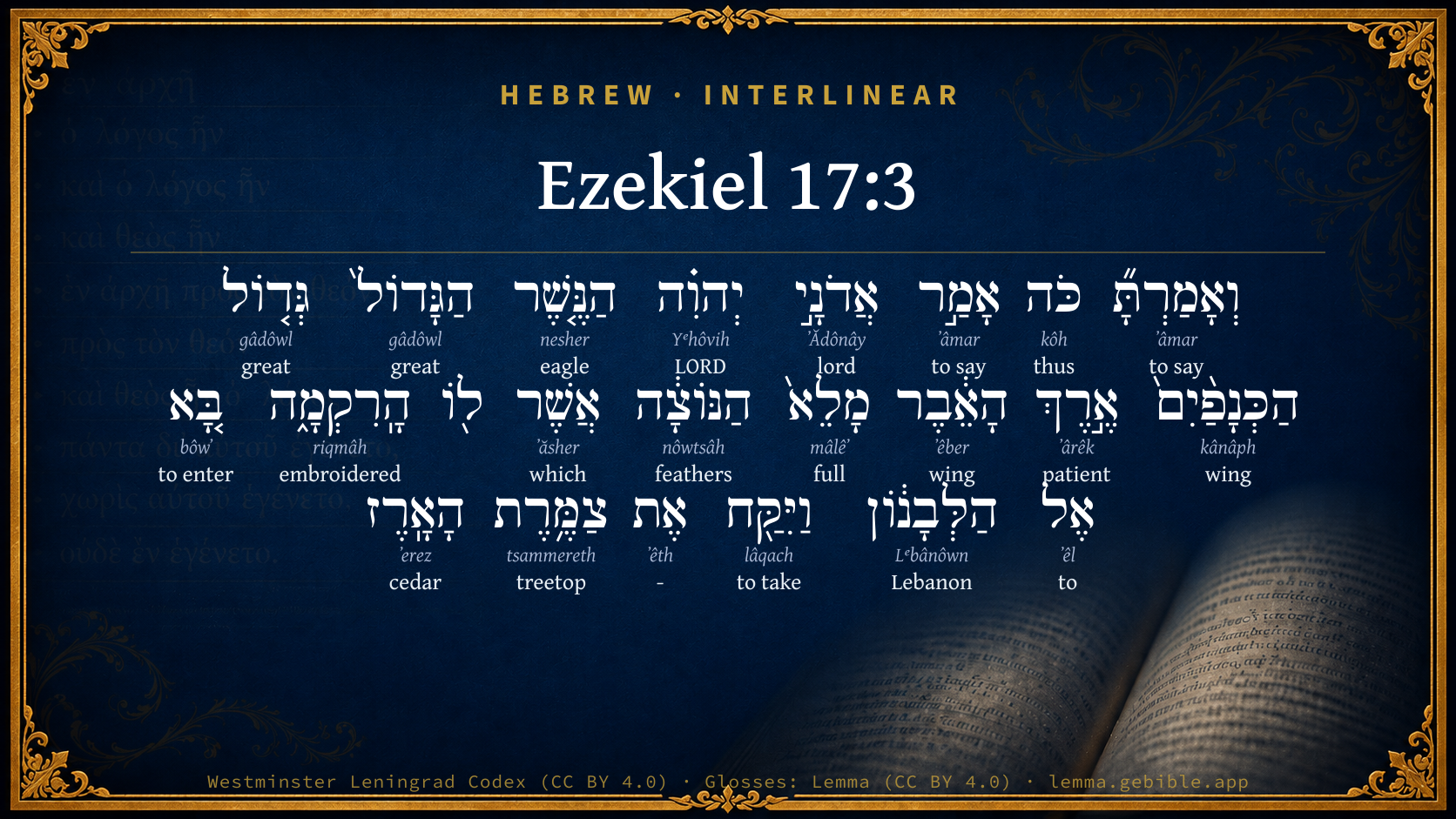
  1. וְאָמַרְתָּ֞ ʼâmar H559 “and · to say” Conjunction + Verb, Qal, Sequential Perfect, 2nd Person, Masculine, Singular
  2. כֹּה kôh H3541 “thus” Adverb
  3. אָמַ֣ר ʼâmar H559 “to say” Verb, Qal, Perfect, 3rd Person, Masculine, Singular
  4. אֲדֹנָ֣י ʼĂdônây H136 “Lord · my” Noun, Common, Masculine, Plural, Construct + Suffix, Personal, 1st Person, Common, Singular
  5. יְהוִ֗ה Yᵉhôvih H3069 “LORD” Noun, Proper
  6. הַנֶּ֤שֶׁר nesher H5404 “the · eagle” Particle, Definite Article + Noun, Common, Masculine, Singular, Absolute
  7. הַגָּדוֹל֙ gâdôwl H1419 “the · great” Particle, Definite Article + Adjective, Adjective, Masculine, Singular, Absolute
  8. גְּד֤וֹל gâdôwl H1419 “great of” Adjective, Adjective, Masculine, Singular, Construct
  9. הַכְּנָפַ֨יִם֙ kânâph H3671 “the · wings” Particle, Definite Article + Noun, Common, Feminine, Dual, Absolute
  10. אֶ֣רֶךְ ʼârêk H750 “patient of” Adjective, Adjective, Masculine, Singular, Construct
  11. מָלֵא֙ mâlêʼ H4392 “full” Adjective, Adjective, Masculine, Singular, Absolute
  12. הַנּוֹצָ֔ה nôwtsâh H5133 “the · feathers” Particle, Definite Article + Noun, Common, Feminine, Singular, Absolute
  13. אֲשֶׁר ʼăsher H834 “which” Particle, Relative
  14. הָֽרִקְמָ֑ה riqmâh H7553 “the · embroidered” Particle, Definite Article + Noun, Common, Feminine, Singular, Absolute
  15. בָּ֚א bôwʼ H935 “to enter” Verb, Qal, Perfect, 3rd Person, Masculine, Singular
  16. אֶל ʼêl H413 “to” Preposition
  17. הַלְּבָנ֔וֹן Lᵉbânôwn H3844 “the · Lebanon” Particle, Definite Article + Noun, Proper
  18. וַיִּקַּ֖ח lâqach H3947 “and · to take” Conjunction + Verb, Qal, Sequential Imperfect, 3rd Person, Masculine, Singular
  19. אֶת ʼêth H853 “-” Particle, Direct Object
  20. צַמֶּ֥רֶת tsammereth H6788 “treetop of” Noun, Common, Feminine, Singular, Construct
  21. הָאָֽרֶז ʼerez H730 “the · cedar” Particle, Definite Article + Noun, Common, Masculine, Singular, Absolute

About this verse

These counts appear in no published source. They are computed here, from the morphology-tagged text and Lemma’s own curated glosses. What Lemma adds →

23
words
20
distinct lemmas
Prophets
section

Notable vocabulary

The rarest word here is הָאֵ֔בֶר wing H83 — appearing just 3 times in the whole Hebrew Bible.

First appearance in Scripture

This word makes its first canonical appearance in the Hebrew Bible here:

  • צַמֶּ֥רֶת treetop H6788

Shared distinctive vocabulary

הָאֵ֔בֶר wing H83 occurs in 3 verses of the Hebrew Bible. Also found in:

Grammatical profile

  • 4 verbs
  • 10 nouns
  • 4 adjectives
  • 2 prepositions
  • 1 adverb
  • 2 particles

Verb forms

  • וְאָמַרְתָּ֞ Qal · Sequential Perfect
  • אָמַ֣ר Qal · Perfect
  • בָּ֚א Qal · Perfect
  • וַיִּקַּ֖ח Qal · Sequential Imperfect

Repetition

Words recur within this verse — often emphatic in Hebrew:

  • וְאָמַרְתָּ֞ to say H559 ×2
  • הַגָּדוֹל֙ great H1419 ×2

Hebrew & Septuagint length

In English translation the verse runs 33 words from the Hebrew and 38 from the Septuagint (LXX English) — closely comparable.

A rough comparison of the two English renderings, which tokenize alike — not a word-level alignment.

Word counts can differ between the Hebrew and the Greek without any difference in meaning — e.g. the Hebrew direct-object marker אֵת has no separate Greek word, and Greek often adds the article ὁ.

In the original languages it is 23 Hebrew tokens and 31 Greek tokens — but the two are counted differently (Hebrew bundles its prefixes and suffixes into one token; the Greek is in lemma form), so that isn’t a like-for-like length.

Cross-references

16

Topical passages linked to Ezekiel 17:3 in the Treasury of Scripture Knowledge — connected by theme and wording, ordered by reader-vote popularity; previews shown in the World English Bible.

  • Jeremiah 48:40 For thus says Yahweh: Behold, he shall fly as an eagle, and shall spread out his wings against Moab.
  • Hosea 8:1 "Put the trumpet to your lips! Something like an eagle is over Yahweh's house, Because they have broken my covenant, And rebelled against my law.
  • Ezekiel 17:7 There was also another great eagle with great wings and many feathers: and, behold, this vine did bend its roots toward him, and shot forth its branches toward him, from the beds of its plantation, that he might water it.
  • Daniel 4:22 it is you, O king, that are grown and become strong; for your greatness is grown, and reaches to the sky, and your dominion to the end of the earth.
  • Deuteronomy 28:49 Yahweh will bring a nation against you from far, from the end of the earth, as the eagle flies; a nation whose language you shall not understand;
  • 2 Kings 24:10–16 At that time the servants of Nebuchadnezzar king of Babylon came up to Jerusalem, and the city was besieged.
  • 2 Chronicles 36:9–10 Jehoiachin was eight years old when he began to reign; and he reigned three months and ten days in Jerusalem: and he did that which was evil in the sight of Yahweh.
  • Jeremiah 4:13 Behold, he shall come up as clouds, and his chariots [shall be] as the whirlwind: his horses are swifter than eagles. Woe to us! for we are ruined.
  • Jeremiah 22:23–28 Inhabitant of Lebanon, who makes your nest in the cedars, how greatly to be pitied shall you be when pangs come on you, the pain as of a woman in travail!
  • Jeremiah 24:1 Yahweh shown me, and, behold, two baskets of figs set before the temple of Yahweh, after that Nebuchadrezzar king of Babylon had carried away captive Jeconiah the son of Jehoiakim, king of Judah, and the princes of Judah, with the craftsmen and smiths, from Jerusalem, and had brought them to Babylon.
  • Jeremiah 49:16 As for your terror, the pride of your heart has deceived you, O you who dwell in the clefts of the rock, who hold the height of the hill: though you should make your nest as high as the eagle, I will bring you down from there, says Yahweh.
  • Lamentations 4:19 Our pursuers were swifter than the eagles of the sky: They chased us on the mountains, they laid wait for us in the wilderness.
  • Ezekiel 17:12–21 Say now to the rebellious house, Don't you know what these things mean? tell them, Behold, the king of Babylon came to Jerusalem, and took the king of it, and the princes of it, and brought them to him to Babylon:
  • Daniel 2:38 and wherever the children of men dwell, the animals of the field and the birds of the sky has he given into your hand, and has made you to rule over them all: you are the head of gold.
  • Daniel 7:4 The first was like a lion, and had eagle's wings: I saw until the wings of it were plucked, and it was lifted up from the earth, and made to stand on two feet as a man; and a man's heart was given to it.
  • Matthew 24:28 For wherever the carcass is, there will the vultures be gathered together.

Cross-references courtesy of OpenBible.info (CC BY 4.0).

Hebrew and Greek witnesses Masoretic Hebrew ↔ Greek Septuagint

The same verse in the two great witnesses to the Old Testament, shown verse-for-verse.

These are two independent witnesses, not word-aligned to each other, and the Septuagint is shown in lemma (dictionary) form.

Hebrew Ezekiel 17:3 Masoretic · Westminster Leningrad Codex

וְאָמַרְתָּ֞ כֹּה אָמַ֣ר אֲדֹנָ֣י יְהוִ֗ה הַנֶּ֤שֶׁר הַגָּדוֹל֙ גְּד֤וֹל הַכְּנָפַ֨יִם֙ אֶ֣רֶךְ הָאֵ֔בֶר מָלֵא֙ הַנּוֹצָ֔ה אֲשֶׁר ל֖וֹ הָֽרִקְמָ֑ה בָּ֚א אֶל הַלְּבָנ֔וֹן וַיִּקַּ֖ח אֶת צַמֶּ֥רֶת הָאָֽרֶז

and say, Thus says the Lord Yahweh: A great eagle with great wings and long feathers, full of feathers, which had various colors, came to Lebanon, and took the top of the cedar:

World English Bible · Public Domain

Greek LXX Ezekiel 17:3 Septuagint · lemma form

καί εἶπον ὅδε λέγω κύριος ὁ ἀετός ὁ μέγας ὁ μεγαλοπτέρυγος ὁ μακρός ὁ ἔκτασις πλήρης ὄνυξ ὅς ἔχω ὁ ἥγημα εἰςἔρχομαι εἰς ὁ λίβανος καί λαμβάνω ὁ ἐπίλεκτος ὁ κέδρος

and you shall say, Thus says the Lord; A great eagle with large wings, spreading them out very far, with many claws, which has the design of entering into Libanus—and he took the choice branches of the cedar:

LXX2012 (modern English Septuagint) · Public Domain

On this verse, John Gill's Exposition discusses the Septuagint’s reading. Read the note in Commentary ↓

Hebrew: Westminster Leningrad Codex (CC BY 4.0). Greek: Septuagint (public domain); English from LXX2012 (modern English Septuagint) (Public Domain). How the Septuagint differs from the Hebrew →

Targum (Aramaic paraphrase)

1

The Targum is the ancient Jewish Aramaic paraphrase of the Hebrew Scriptures — an interpretive translation, not the Hebrew text itself. Onkelos (literal) and Pseudo-Jonathan (expansive) render the Torah, and Jonathan the Prophets. Coverage is partial: where no permissively-licensed English translation exists for a verse, only the Aramaic is shown. This is verse-level text, not a word-by-word alignment to the Hebrew.

  1. Targum Jonathan Prophets (Joshua–Malachi)
    וְתֵימַר כִּדְנַן אֲמַר יְיָ אֱלֹהִים נִשְׁרָא רַבָּא רַב גַפִּין אֲרִיךְ אֵיבְרָן חָפֵי כַנְפִין דִילֵהּ צִיוּרִין אֲתָא לְלִבְנָן וּנְסֵיב יַת עוֹבַרְתָּא דְאַרְזָא רָמָא:

    (no public-domain English translation for this verse)

    Targum Jonathan — Aramaic: “Mikraot Gedolot” (public domain). English: “Sefaria Community Translation” (CC0 1.0 (public-domain dedication)); “London "Chaldee Paraphrase," 1871” (public domain). Text via Sefaria.

Commentary

Notes on Ezekiel 17:3 from classic Christian and Jewish commentators (each source and its license shown beneath its notes). The classic Christian expositions comment on the surrounding passage and are grouped to its opening verse, so a note may address several verses; the Jewish commentaries on the Tanakh (Rashi and others) are per-verse, so they appear only where the commentator wrote on this verse.

Lemma curates 59 commentaries, every one of them public domain or Creative Commons licensed, each selected and text-cleaned for this edition rather than reprinted as found. About our sources →

Trapp's Complete Commentary

John Trapp

Eze 17:3 And say, Thus saith the Lord GOD; A great eagle with great wings, longwinged, full of feathers, which had divers colours, came unto Lebanon, and took the highest branch of the cedar:

Ver. 3. A great eagle with great wings.] An eagle, that king of birds, is a fit emblem of an emperor; {a} as it is here of Nebuchadnezzar the Great. {Eze 17:12 Jer 48:40; Jer 49:22} Monarchs, as eagles, have quick eyes, long talons, fly high pitches, aim at great matters, strive to get above all others, choose themselves high and firm seats, &c. See Job 39:27-30, with the notes. Ajax is called αιτος, an eagle, in Pindarus; so is King Pyrrhus in Plutarch, and took delight in that title. The Spaniard was well laughed at by Captain Drake and his forces when they took Santo Domingo, 1585, and found in the townhall the King of Spain’s arms, and under them a globe of the world, out of which issued, not a well-plumed eagle, but a flying home, with this inscription, Non sufficit orbis the world is not enough. We could not so well bridle his Pegasus at Santo Domingo, yet we put a stop to him at Jamaica; but we have lately pulled his plumes in Flanders to some purpose, by gaining from him Dunkirk, now {b} held by the English, and likewise Berghen, another place of great strength, now held by the French; the good news whereof came to us yesterday, being June 27, 1658. Praised be the holy name of God for ever.

Came unto Lebanon,] i.e., Unto Judea, which lieth near the forest of Lebanon, which forest also lieth in the way from Babylon to Judea.

And took the highest branch of the cedar.] Taleam, the top branch. This was Jeconiah. {2Ki 24:12}

{a} Vide Pier. in Hieroglyph.

{b} This was written June 28, 1658.

John Trapp, A Commentary or Exposition upon All the Books of the Old and New Testament (1647–1656) — public domain. Text from a community e-Sword module.

Joseph Benson's Commentary

Eze 17:3-6. A great eagle with great wings — The eagle is the king of birds, swift, strong, and rapacious. And this great eagle, according to all interpreters, represents Nebuchadnezzar. Its “greatness, long wings, beautiful, abundant, and well-coloured plumage, denote the force and greatness of his empire, the rapidity of his conquests, and the number of his subjects. The Scripture has in other places described this prince under the figure of an eagle. See Jer 48:40-45; Dan 7:4. By his coming to Lebanon, and taking the highest branch of the cedar, is meant his invasion of Judea, his investing the city of Jerusalem, and taking King Jehoiachin and the princes captive.” — Calmet. He cropped off the top of his young twigs — Both the king of Judah, now eighteen years old, and the nobles and chief of the land. And carried it into a land of traffic — “Babylon, and the country about it, being the seat of a universal monarchy, must needs have been a place of great trade. Strabo takes notice that the merchants who travelled by land to Babylon went through the country of the Abrabians, called Scenitæ, lib. 16. p. 747; and vessels of great burden came up the river Euphrates to the walls of it from the Persian gulf.” See Pliny’s Nat. Hist., 50. 6. c. 26; and Lowth. He took also of the seed of the land — Of the king’s seed, as it is explained Eze 17:13: that is, Zedekiah, whom the king of Babylon made king of Judah instead of Jehoiachin; first exacting an oath of him, that he would be true to him, and pay him tribute. And he planted it in a fruitful field — Hebrew, בשׂדת זרע, in a field of seed, that is, proper for seed: he placed it by great waters, and set it as a willow-tree — Judea was a fruitful country and well watered, (see Deu 8:7,) where Zedekiah flourished as a willow-tree, that thrives best in moist ground, Isa 44:4. And it became a spreading vine of low stature, &c. — Though Zedekiah flourished, yet he enjoyed but a tributary kingdom under the king of Babylon, and acknowledged him as his lord and sovereign: see Eze 17:14.

Joseph Benson's Commentary on the Old and New Testaments (1811–1818) — public domain. Text from a community e-Sword module.

Tyndale Open Study Notes

Tyndale Open Resources

17:3-6 Babylon was the city filled with merchants (see 16:29).

Tyndale Open Study Notes — © Tyndale Open Resources, licensed CC BY-SA 4.0. Text via the HelloAO Bible API.

Geneva Bible (1599)

Geneva Bible translators

That is, Nebuchadnezzar, who hath great power, riches, and many countries under him, shall come to Jerusalem, and take away Jeconiah the King, as verse 12.

Geneva Bible (1599) marginal notes — public domain. Text via Bolls.life.

Jamieson, Fausset & Brown

Robert Jamieson, A. R. Fausset & David Brown

eagle--the king of birds. The literal Hebrew is, "the great eagle." The symbol of the Assyrian supreme god, Nisroch; so applied to "the great king" of Babylon, his vicegerent on earth (Jer 48:40; Jer 49:22). His "wings" are his great forces. Such symbols were familiar to the Jews, who saw them portrayed on the great buildings of Babylon; such as are now seen in the Assyrian remains.

long-winged--implying the wide extent of his empire.

full of feathers--when they have been renewed after moulting; and so in the full freshness of renovated youth (Psa 103:5; Isa 40:31). Answering to the many peoples which, as tributaries, constituted the strength of Babylon:

divers colours--the golden eagle, marked with star-like spots, supposed to be the largest of eagles [BOCHART]. Answering to the variety of languages, habits, and costumes of the peoples subject to Babylon.

came unto Lebanon--continuing the metaphor: as the eagle frequents mountains, not cities. The temple at Jerusalem was called "Lebanon" by the Jews [EUSEBIUS], because its woodwork was wholly of cedars of Lebanon. "The mountain of the Lord's house" (Isa 2:2). Jerusalem, however, is chiefly meant, the chief seat of civil honor, as Lebanon was of external elevation.

took the highest branch--King Jeconiah, then but eighteen years old, and many of the chiefs and people with him (Kg2 24:8, Kg2 24:12-16). The Hebrew for "highest branch" is, properly, the fleece-like tuft at the top of the tree. (So in Eze 31:3-14). The cedar, as a tall tree, is the symbol of kingly elevation (compare Dan 4:10-12).

Jamieson, Fausset & Brown — Commentary Critical and Explanatory on the Whole Bible (1871) — public domain (CC PDM 1.0). Text via the HelloAO Bible API.

Adam Clarke's Commentary

Verse 3. A great eagle] Nebuchadnezzar. See Jer 48:40; Jer 49:22; Da 7:4. And see here, Eze 17:12, where it is so applied.

Great wings] Extensive empire.

Long-winged] Rapid in his conquests.

Full of feathers] Having multitudes of subjects.

Divers colours] People of various nations.

Came unto Lebanon] Came against Judea.

The highest branch] King Jehoiachin he took captive to Babylon.

The cedar] The Jewish state and king.

Adam Clarke's Commentary on the Bible (1810–1826) — public domain. Text from a community e-Sword/MySword module.

John Calvin's Commentaries

Here the Prophet reasons from the greater to the less: for if Nebuchadnezzar was able to subdue the whole kingdom with ease, when as yet the Jews were untouched, how much more readily would he overthrow them when wretched and all but ruined: for nothing remained which was not threatened with ruin; and this is the meaning of the Prophet. But he compares King Nebuchadnezzar to an eagle, whom he says was great, and then with large or extended wings. There is no doubt that by wings, feathers, and plumes, he means the regions and peoples over which Nebuchadnezzar presided; for we know that the Chaldaeans possessed the monarchy of the East. Since, therefore, so many regions and people obeyed Nebuchadnezzar’s sway, it is not surprising that the Prophet calls him a great eagle, with ample wings, and with numerous feathers or plumes; for where he now says, מלא הנוצה, mela henotzeh, full of feathers, he will shortly say, רב נוצה, reb notzeh, many feathers, when speaking of the king of Egypt. He says, the wings were of divers colors; it is the same noun which the Prophet used in the last chapter, when he said that the people were clad in precious garments; for thus the Hebrews speak of Phrygian texture: hence he compares the wings of the king of Babylon to a woven garment, resplendent with various colors; for although Nebuchadnezzar held his throne at only one place, yet he had seized and subdued many tributaries on all sides. This, therefore, is the reason for this variety; — but I cannot proceed further at present.

John Calvin's Commentaries (1540-1563) — public domain. Text from the Calvin Translation Society English edition (1840s-50s) via the Christian Classics Ethereal Library (ccel.org). Calvin's coverage is partial (roughly two-thirds of the Bible); uncommented books and verses are honest gaps, never fabricated. The 19th-century editor's footnotes and remarks are omitted so the notes are faithfully Calvin's own voice.

Ellicott's Commentary for English Readers

(3) A great eagle with great wings.—In the original “the great eagle.” This is explained in Eze_17:12 of “the king of Babylon.” Nebuchadnezzar is compared to an eagle also in Jer_48:40; Jer_49:22; and Cyrus to a bird of prey in Isa_46:11. He has great and long wings, because he has already flown victoriously over wide-spread lands; and he is “full of feathers which had divers colours,” because he had embraced in his empire a variety of nations differing in languages, manners, and customs.

Came unto Lebanon.—Jerusalem is called Lebanon, as in Jer_22:23; because Lebanon is the home of the cedar, and the royal palace in Jerusalem was so rich in cedar as to be called “the house of the forest of Lebanon” (1Ki_7:2).

The highest branch.—This is a word occurring only in Ezekiel (Eze_17:22, and Eze_31:3-4; Eze_31:10). It is of uncertain etymology, but is explained in Eze_17:4 as meaning “the top of his young twigs.” The English branch hardly conveys the exact idea, and it would be better to translate “topshoot.”

A Bible Commentary for English Readers, edited by Charles John Ellicott (1878–1897) — public domain. Text from a community e-Sword module.

The Cambridge Bible for Schools and Colleges

gen. ed. J. J. S. Perowne

3. longwinged] With long pinions. The eagle was also of “divers colours” or speckled, with reference possibly to the very diverse nationalities included in the Babylonian empire.

came unto Lebanon] The figure of the eagle coming to Lebanon and cropping off the highest branch and top of the young twigs (Eze_17:4) represents the carrying off of those highest in the land of Israel. Lebanon as opposed to Babylon is the mountain of Palestine; the cedar, the tree of Lebanon, appears to represent the royal Davidic house (Eze_17:12; Eze_17:22), and its highest branches king Jehoiachin and the princes who were carried away to Babylon (Eze_17:12). On “land of traffic” (Eze_17:4), cf. ch. Eze_16:29.

The Cambridge Bible for Schools and Colleges (gen. ed. J. J. S. Perowne; Cambridge University Press, 1878–1918) — public domain. Text from a community e-Sword module.

John Gill's Exposition

He cropped off the top of his young twigs,.... By which are meant the princes of the land, or the several branches of the royal family; the top of which was King Jeconiah, who was but young and tender, being but eighteen years of age when he began his reign, and this was within three months after; and who was no more able to withstand the force of the king of Babylon, than a tender twig so ravenous a bird as an eagle, Kg2 24:8; whose superior power and strength is signified by the cropping off of a tender twig:

and carried it into a land of traffic; not into the land of Canaan, as the Septuagint, and some other versions, literally render it; but into Babylon, which was become a place of great merchandise, through the great concourse of people to it, and the large additions made to the empire:

he set it in a city of merchants; meaning the city of Babylon, perhaps in particular, as distinct from the country before mentioned: the word for "merchants" signifies "apothecaries" or "druggists" (p); and may design such merchants as traded in sweet spices and aromatic drugs. The words may be rendered, "and brought it out of the land of Canaan" (q); out of which Jeconiah and his nobles were carried by the king of Babylon; so the particle sometimes signifies "from", or "out of", as in Kg1 8:30; and others (r), "and in a city of merchants he set it"; in Babylon, famous for merchants; whom the Jews, being captives, were obliged to attend in a servile manner.

(p) "aromatariorum", Junius & Tremellius, Polinus. So Stockius, p. 1017. (q) "tetra Chanaan", Texelius, Phoenix, l. 3. c. 4. sect. 6. p. 205. (r) Vid. Noldii Concord. Part. Ebr. p. 56.

John Gill's Exposition of the Whole Bible (1746–1763) — public domain (CC PDM 1.0). Text via the HelloAO Bible API.

Albert Barnes' Notes on the Bible

A great eagle ... - Probably the golden eagle, whose plumage has the variety of color here depicted. The eagle (the king of birds) is a natural representative of monarchs (compare, Jer 48:40), and was an Assyrian emblem.

With great wings, Iongwinged - literally, “great of wing, long of pinion,” because he has swept victoriously over widely distant lands - of divers colors, because his subjects are of various races and tongues. Jerusalem is here called “Lebanon” because Lebanon is the proper home of the cedar. The “highest branch” or “topshoot” is Jeconiah, the rightful king of Jerusalem, the “young twigs” are his children and the princes carried by Nebuchadnezzar to Babylon.

Albert Barnes' Notes on the Bible (1834–1885) — public domain. Text from a community e-Sword/MySword module.

Haydock's Catholic Bible Commentary

A large eagle. Nabuchodonosor, king of Babylon. (Challoner) --- The multitude of his subjects, and his rapid and cruel conquests, are designated. (Calmet) --- He spoils the vineyard of Jerusalem, notwithstanding the Jews had applied to another eagle, the king of Egypt, ver. 12. (Worthington) --- Libanus. That is, Jerusalem; (Challoner) or invaded the country, (Calmet) entering by Libanus. (Haydock) --- Cedar. King Jechonias (Challoner) and his nobles, (4 Kings xxiv. 11.) with the most precious effects.

George Leo Haydock (1774–1849), Haydock's Catholic Family Bible and Commentary, 1859 edition — public domain. Excludes Psalms (Douay-Rheims chapter numbering differs from Protestant) and Deuterocanonical books (Catholic canon only).

Matthew Poole's English Annotations

A great eagle; Nebuchadnezzar, king of Babylon, as Eze 17:12, compared to a great eagle, king of birds, swift, strong, rapacious, and of a lofty flight.

With great wings; mighty provinces on each side of his kingdom.

Long-winged; his kingdom was vastly extended, as Dan 3:3; 4:1; the greatest king then living.

Full of feathers; his kingdom was very full of people.

Which had divers colours; were of divers nations, languages, and manners, so that this eagle, nay be well thought to be that sort which is greatest in the kind, and best resembleth him, who was the greatest monarch in the world at that time.

Came; invaded with a mighty army; he came not as a traveller to please his curiosity, but as an invader to enlarge his dominion.

Unto Lebanon; either the temple built with cedars of Lebanon; or Jerusalem, the chief city of the country where this great, fruitful, and pleasant hill was; or the whole country set forth by its chiefest hill, which runs about a hundred and twenty-five miles in length, and encloseth the land of Judea on the north side.

Took; took captive and carried away with him.

The highest branch; the king of Judah, Jehoiachin.

Of the cedar; either the royal family, or rather, the whole nation of the Jews.

Matthew Poole's English Annotations on the Holy Bible (1683–1685) — public domain. Text from a community e-Sword/MySword module.

Whedon's Commentary on the Bible

Daniel D. Whedon

3. A great eagle with great wings — This well described Nebuchadnezzar, swift, strong, and rapacious, whose mighty provinces were widespread (long-winged) and full of people (feathers), composed of all manner of nations, languages and manners (diverse colors). — Wesley. The figure of the eagle as applied to conquerors was a common one and had also been used by Jeremiah of Nebuchadnezzar (Jer_49:22).

The highest branch of the cedar — The cedar was the royal tree of Palestine, as Lebanon was its most royal mountain. The highest branch of the cedar was the king Jehoiachin and the “top of his young twigs” (Eze_17:4) symbolized the princes of the royal house (Eze_17:12; Eze_17:22).

Daniel D. Whedon (gen. ed.), Commentary on the Old and New Testaments (1874–1909) — public domain. Text from a community e-Sword module.

The Pulpit Commentary

The eagle with great wings and long pinions (Revised Version) probably the golden eagle, the largest species of the genus stands for Nebuchadnezzar, as it does in Jer_48:40 Jer_49:22. in Isa_46:11 the "ravenous bird" represents Cyrus. Possibly the eagle head of the Assyrian god Nisroch (2Ki_19:37; Isa_37:38) may have impressed the symbolism on Ezekiel"s mind. A doubtful etymology gives "the great eagle" as the meaning of Nisroch. The divers colours indicate the variety of the nations under the king"s sway. (Dan_3:4:4:1) If the cedar was chosen to t,e the symbol of the monarchy of Judah, then it followed that Lebanon, as the special home of the cedar, should take its place in the parable. Possibly the fact that one of the stateliest palaces of Solomon was known as the "house of the forest of Lebanon" (1Ki_7:2 1Ki_10:17, 1Ki_10:21) may have made the symbolism specially suggestive. The word for highest branch is peculiar to Ezekiel (here and in ver. 22). The branch so carried off was carried into "a land of traffick" (Hebrew, LXX, and Vulgate, "a land of Canaan," the word being generalized in its meaning, as in Eze_16:29) i.e. to Babylon, as preeminently the merchant city of the time. This, of course, refers to Nebuchadnezzar"s deportation of Jeconiah and the more eminent citizens of Jerusalem. (2Ki_24:8-15)

Vers. 3-10. The parable of the two eagles.

I THE FIRST EAGLE AND THE CEDAR. The eagle is the King of Babylon. The cedar is the house of David. Nebuchadnezzar cut off the topmost twigs of this tree when he deported Jehoiakim and his court to Babylon.

1. God uses powerful instruments. The eagle is the king of birds. The one here described is of exceptional splendour, with variegated plumage (ver. 3). Nebuchadnezzar was the most powerful monarch of his age, and he carried with him the glory of conquest over various nations, together with those resources which he drew from them which added to the sweep of his mighty wings of victory. Yet this awful tyrant was a puppet in the hands of the King of kings, who used him to work out deep designs of providence.

2. Earthly greatness is no security against ruin. The house of David was great, ancient, and glorious, like a cedar of Lebanon among the trees of the forest. No cattle of the field could pluck the topmost twigs that waved proudly in the wind. But the eagle swooped down upon them, tore them off, and bore them away to his distant eyrie, with greater ease than if they had been obscure boughs of lowly shrubs. The greatness of the house of David did not protect Jehoiakim against Nebuchadnezzar when the Babylonian monarch seized that wretched king and carried him captive to Chaldea. There is an earthly exaltation which springs from the favour of Heaven. Yet when that favour is lost, all its former glory will not save it. Let no one boast in his privileges and attainments; they are flimsy shields before the fiery darts of judgment.

II THE SECOND EAGLE AND THE VINE. This eagle is Pharaoh of Egypt. The vine is Zedekiah, whom Nebuchadnezzar set up as king in Jerusalem in place of Jehoiachin.

1. It is better to be fruitful than famous. If Zedekiah had acted wisely he might have had a sale, though a humble, reign. He could no longer rule in pride, like Jehoiakim before him, as the top twig of a glorious cedar; but as a lowly young vine, feeble and small, he might bear good fruit. A humble, useful life is better than one of proud pretensions, and safer too; for the vine would not have attracted the destroying eagle if it had grown in quiet.

2. The feeble are tempted to seek inefficient help. The vine appealed to a second eagle. Zedekiah sought an alliance with Pharaoh. This was bad policy, for it was certain to provoke the vengeance of Babylon, and then even the might of the ancient empire of Egypt would be unequal to cope with the enraged power from the Euphrates, even if Pharaoh proved true to his alliance in the hour of need. But Zedekiah was more than politically foolish. He had lost faith in God, the one sure Protector of Israel. Men trust to policy, money, friendship, etc. But no earthly alliance will save in the hour of greatest need.

3. Confidence in a worthless defence will lead to ruin. The vine had better never have appealed to the second eagle. Zedekiah suffered grievously through leaning on Egypt. If we turn from our true Refuge to any earthly supports, we shall not only find them fail us; we shall also provoke wrath and judgment. Deceitful cunning will only aggravate the fate of the sinner. Zedekiah"s treachery made his doom the more certain.

The Pulpit Commentary (1880–1919), ed. H.D.M. Spence-Jones & Joseph S. Exell — public domain. Text from a community e-Sword module.

John Wesley's Explanatory Notes

A great eagle - Nebuchadnezzar king of Babylon is compared to a great eagle, the king of birds, swift, strong, rapacious. Great wings - Mighty provinces on each side of his kingdom. Long winged - His kingdom was widely extended. Full of feathers - And full of people. Divers colours - Who were of divert nations, languages and manners. Lebanon - Jerusalem the chief city of the country where this great, fruitful and pleasant hill was. And took - Took, captive and carried away with him the king of Judah, Jehoiachin. The cedar - The nation.

John Wesley, Explanatory Notes Upon the Whole Bible (1754–1765) — public domain. Text via the GEBible commentary corpus.

Rashi

Rabbi Shlomo Yitzchaki (Rashi)

long pinions Heb. אֵבֶר like כָּנָף, wing, aile in French. Another explanation: as its apparent meaning, an expression of actual limbs.

diverse colors Heb. קָרְמָה [lit. embroidered]. Its feathers are beautiful and ornate.

the lofty top of the cedar Heb. צַמֶרֶת, all the foliage of the tree, cime in French. This is a parable representing Jehoiakim and his mighty men.

Rashi on the Tanakh — English translations: “The Judaica Press complete Tanach with Rashi, translated by A. J. Rosenberg” (CC BY 4.0); “Pentateuch with Rashi's commentary by M. Rosenbaum and A.M. Silbermann, 1929-1934” (public domain); “The Metsudah Tanach series, Lakewood, N.J” (CC BY 4.0); and “The Book of Joshua, Metsudah Publications, 1997” (CC BY 4.0). Text via Sefaria.

Lesson kit

Teaching starters — assembled from the data on this page, not authored interpretation. Every prompt links to the verse data it draws on. Edit before teaching.

Ezekiel, in the Prophets, opens this verse with 23 words (20 distinct Hebrew lemmas). Its most distinctive word is ʼêber (“wing”). A historical commentator’s framing appears above. Read the whole chapter for the surrounding context.

Discussion questions

  1. The word ʼêber carries the sense “wing.” How does it shape the verse?
  2. The word “treetop” first appears here in Scripture. What is being introduced at this debut?
  3. Psalms 55:6 shares the word «wing» with this verse. How do the two illuminate each other?
  4. “to say” occurs 2× in this one verse. What is the effect of the repetition?
  5. These translations render this verse differently. What is at stake in choosing one wording over another?
  6. The verb «וְאָמַרְתָּ֞» is Qal Sequential Perfect. How does its form color the action?
  7. Reading how Trapp's Complete Commentary and Joseph Benson's Commentary read this verse, where do the two commentators agree and where do they part?

Things to notice

Reading settings

Reading text

Shown beneath each verse's original-language words.

Old Testament
Old Testament edition

Read the OT as the Masoretic Hebrew (MT) or the Greek Septuagint (LXX).

English shown for the Greek Septuagint (in the Hebrew ↔ Greek comparison).

Comparing translations? Open the Compare panel on any verse page to stack up to four side by side.