

Job 5:9

Hebrew (Westminster Leningrad Codex) Job 5:9 appears in the Hebrew Old Testament. The text above is from the Westminster Leningrad Codex. Each word links to its Strong’s number, a concise gloss, and parsing drawn from the Open Scriptures Hebrew Bible morphology. Click any word for its full Brown-Driver-Briggs (BDB) entry.
Download image
Cite this verse

Job 5:9 (World English Bible). Public Domain. Lemma interlinear Bible study tool, https://lemma.gebible.app/v/job/5/9.

Show BibTeX & RIS
BibTeX
RIS
English Translation
Who does great things that can't be fathomed, Marvelous things without number;
World English Bible · Public Domain
Download a study sheet

One document with this verse’s original text, its word-by-word gloss line, the meaning frame, cross-references with their text, attributed commentary, and full source and license credits — printable, and it pastes into notes with its structure intact.

This verse Autodidact and up

Study sheet (.html) Plain text (.txt)

A passage Seminary Student

Up to 50 verses in one chapter. A passage sheet keeps up to 6 commentary sources and 12 cross-references per verse, in the order this page ranks them, and says so on the sheet whenever that leaves anything out. Ask for a single verse and you get the Autodidact verse sheet above.

Everything on this page stays free to read, with no account — the sheet is a download of what is already on screen, not access to it.

Want to remove ads? Support Godless Engineer
Compare translations 3

The same verse in 3 English versions, stacked beneath the original-language interlinear above. Click any original word for its lexicon entry.

Each is an independent rendering of the whole verse — the interlinear is not word-aligned to these translations.

Highlighted words mark where these versions differ — a whole-verse word diff, not a word-by-word alignment.

  • World English Bible Public Domain
    Who does great things that can't be fathomed, Marvelous things without number;
  • King James Version Public Domain
    Which doeth great things and unsearchable; marvellous things without number:
  • unfoldingWord Literal Text CC BY-SA 4.0
    the one doing great and no searching, marvelous until no number,

unfoldingWord Literal Text — © unfoldingWord, licensed CC BY-SA 4.0. Word-aligned USFM3 via Door43 (git.door43.org/unfoldingWord/en_ult).

Versions to compare (up to 4)

3 of 4 selected

Show all 18 translations

Every available English version of this verse, each an independent rendering of the whole verse.

  • World English Bible Public Domain
    Who does great things that can't be fathomed, Marvelous things without number;
  • Berean Standard Bible Public Domain
    the One who does great and unsearchable things, wonders without number.
  • Majority Standard Bible Public Domain
    the One who does great and unsearchable things, wonders without number.
  • King James Version Public Domain
    Which doeth great things and unsearchable; marvellous things without number:
  • American Standard Version (1901) Public Domain
    Who doeth great things and unsearchable, Marvellous things without number:
  • Revised Version (1885) Public Domain
    Which doeth great things and unsearchable; marvelous things without number:
  • Geneva Bible (1599) Public Domain
    Which doeth great things and vnsearchable, and marueilous things without nomber.
  • Douay-Rheims (1899) Public Domain
    Who doth great things and unsearchable and wonderful things without number:
  • Young's Literal Translation Public Domain
    Doing great things, and there is no searching. Wonderful, till there is no numbering.
  • Literal Standard Version CC BY-SA 4.0
    Doing great things, and there is no searching. Wonderful, until there is no numbering.
  • Unlocked Literal Bible CC BY-SA 4.0
    he who does great and unsearchable things, marvelous things without number.
  • unfoldingWord Literal Text CC BY-SA 4.0
    the one doing great and no searching, marvelous until no number,
  • Darby Bible Public Domain
    Who doeth great things and unsearchable, marvellous things without number;
  • World Messianic Bible Public Domain
    who does great things that can’t be fathomed, marvelous things without number;
  • Webster's Bible Public Domain
    Who doeth great things and unsearchable; wonderful things without number:
  • Free Bible Version CC BY-SA 4.0
    He is the one who does amazing, incredible things; miracles that can't be counted!
  • Bible in Basic English Public Domain
    Who does great things outside our knowledge, wonders without number:
  • JPS Tanakh (1917) Public Domain
    Who doeth great things and unsearchable, marvellous things without number;

Literal Standard Version (2020), Covenant Press — licensed CC BY-SA 4.0. Text via the HelloAO Bible API (eBible.org). Unlocked Literal Bible (unfoldingWord) — licensed CC BY-SA 4.0. Text via the HelloAO Bible API (eBible.org). unfoldingWord Literal Text — © unfoldingWord, licensed CC BY-SA 4.0. Word-aligned USFM3 via Door43 (git.door43.org/unfoldingWord/en_ult). Free Bible Version, Dr. Jonathan Gallagher — licensed CC BY-SA 4.0. Text via the HelloAO Bible API (eBible.org).

Word by word

More ways to search: Search by grammar → Find every occurrence → Compare this word →

Practice this passage: Drill this verse → Learn its vocabulary →

About this verse

These counts appear in no published source. They are computed here, from the morphology-tagged text and Lemma’s own curated glosses. What Lemma adds →

8
words
7
distinct lemmas
Wisdom
section

Notable vocabulary

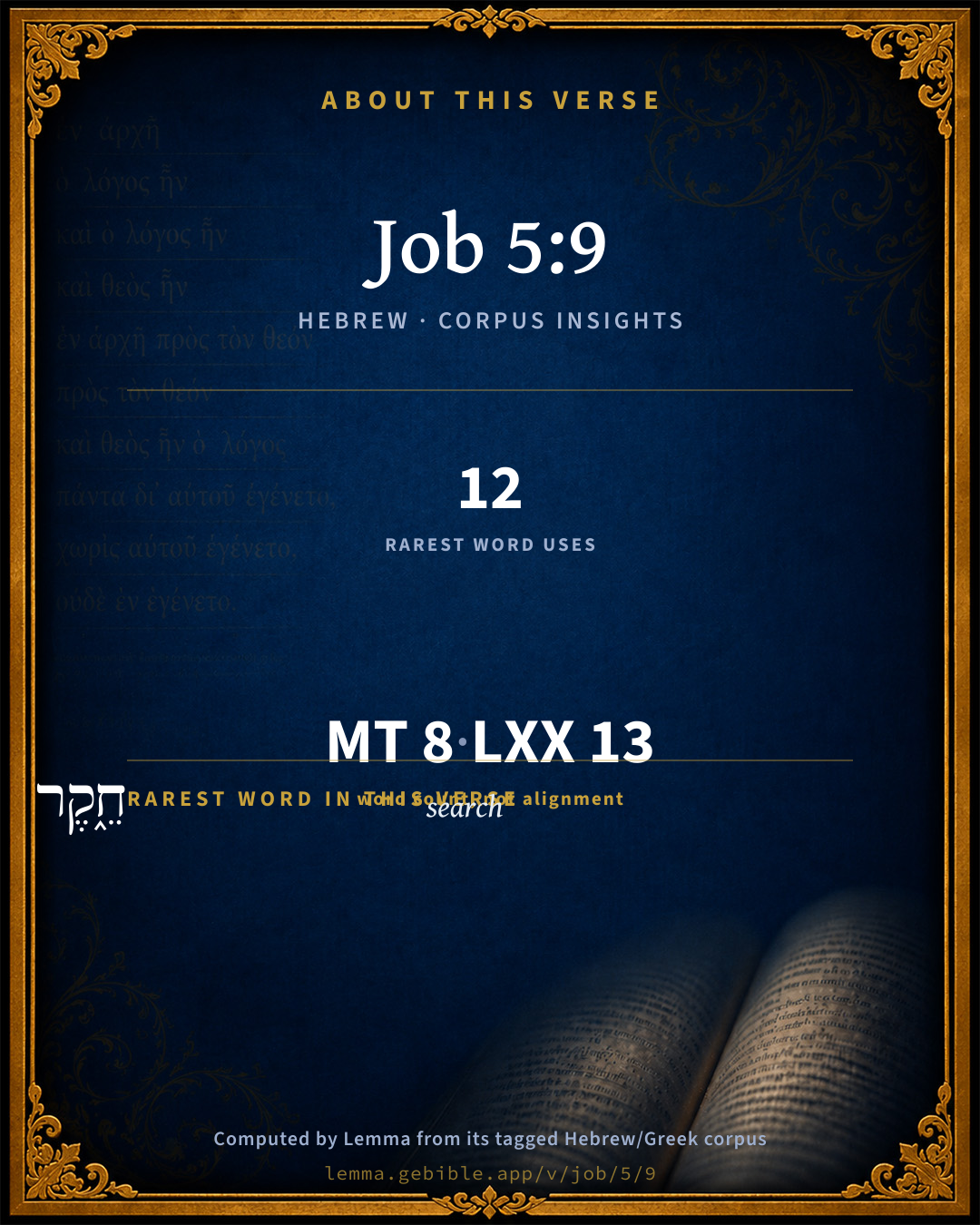
The rarest word here is חֵ֑קֶר search H2714 — appearing just 12 times in the whole Hebrew Bible.

Shared distinctive vocabulary

חֵ֑קֶר search H2714 occurs in 12 verses of the Hebrew Bible. Also found in:

Grammatical profile

  • 2 verbs
  • 2 nouns
  • 1 adjective
  • 1 preposition
  • 2 particles

Verb forms

  • עֹשֶׂ֣ה Qal · Participle Active
  • נִ֝פְלָא֗וֹת Niphal · Participle Active

Repetition

A word recurs within this verse — often emphatic in Hebrew:

  • וְאֵ֣ין nothing H369 ×2

Hebrew & Septuagint length

In English translation the verse runs 12 words from the Hebrew and 17 from the Septuagint (LXX English) — the Septuagint runs noticeably longer here. See the side-by-side →

A rough comparison of the two English renderings, which tokenize alike — not a word-level alignment.

Word counts can differ between the Hebrew and the Greek without any difference in meaning — e.g. the Hebrew direct-object marker אֵת has no separate Greek word, and Greek often adds the article ὁ.

In the original languages it is 8 Hebrew tokens and 13 Greek tokens — but the two are counted differently (Hebrew bundles its prefixes and suffixes into one token; the Greek is in lemma form), so that isn’t a like-for-like length.

Cross-references

11

Topical passages linked to Job 5:9 in the Treasury of Scripture Knowledge — connected by theme and wording, ordered by reader-vote popularity; previews shown in the World English Bible.

  • Psalms 40:5 Many, Yahweh, my God, are the wonderful works which you have done, And your thoughts which are toward us. They can't be set in order to you; If I would declare and speak of them, they are more than can be numbered.
  • Job 9:10 Who does great things past finding out, Yes, marvelous things without number.
  • Psalms 72:18 Praise be to Yahweh God, the God of Israel, Who alone does marvelous deeds.
  • Psalms 86:10 For you are great, and do wondrous things. You are God alone.
  • Job 11:7–9 "Can you fathom the mystery of God? Or can you probe the limits of the Almighty?
  • Job 37:5 God thunders marvelously with his voice. He does great things, which we can't comprehend.
  • Job 26:5–14 "Those who are deceased tremble, Those beneath the waters and all that live in them.
  • Isaiah 40:28 Have you not known? have you not heard? The everlasting God, Yahweh, the Creator of the ends of the earth, doesn't faint, neither is weary; there is no searching of his understanding.
  • Romans 11:33 Oh the depth of the riches both of the wisdom and the knowledge of God! How unsearchable are his judgments, and his ways past tracing out!
  • Psalms 139:18 If I would count them, they are more in number than the sand. When I wake up, I am still with you.
  • Job 42:3 You asked, 'Who is this who hides counsel without knowledge?' Therefore I have uttered that which I did not understand, Things too wonderful for me, which I didn't know.

Cross-references courtesy of OpenBible.info (CC BY 4.0).

Hebrew and Greek witnesses Masoretic Hebrew ↔ Greek Septuagint

The same verse in the two great witnesses to the Old Testament, shown verse-for-verse.

Here the Septuagint runs noticeably longer than the Hebrew — LXX2012 (modern English Septuagint) 17 words vs World English Bible 12. A rough length comparison of the two English translations, not a word-level alignment — read both below.

These are two independent witnesses, not word-aligned to each other, and the Septuagint is shown in lemma (dictionary) form.

Hebrew Job 5:9 Masoretic · Westminster Leningrad Codex

עֹשֶׂ֣ה גְ֭דֹלוֹת וְאֵ֣ין חֵ֑קֶר נִ֝פְלָא֗וֹת עַד אֵ֥ין מִסְפָּֽר

Who does great things that can't be fathomed, Marvelous things without number;

World English Bible · Public Domain

Greek LXX Job 5:9 Septuagint · lemma form

ὁ ποιέω μέγας καί ἀνεξιχνίαστος ἔνδοξος τε καί ἐξαίσιος ὅς οὐ εἰμί ἀριθμός

who does great things and untraceable, glorious things also, and marvelous, of which there is no number:

LXX2012 (modern English Septuagint) · Public Domain

On this verse, Albert Barnes' Notes on the Bible discusses the Septuagint’s reading. Read the note in Commentary ↓

Hebrew: Westminster Leningrad Codex (CC BY 4.0). Greek: Septuagint (public domain); English from LXX2012 (modern English Septuagint) (Public Domain). How the Septuagint differs from the Hebrew →

Commentary

Notes on Job 5:9 from classic Christian and Jewish commentators (each source and its license shown beneath its notes). The classic Christian expositions comment on the surrounding passage and are grouped to its opening verse, so a note may address several verses; the Jewish commentaries on the Tanakh (Rashi and others) are per-verse, so they appear only where the commentator wrote on this verse.

Lemma curates 59 commentaries, every one of them public domain or Creative Commons licensed, each selected and text-cleaned for this edition rather than reprinted as found. About our sources →

Trapp's Complete Commentary

John Trapp

Job 5:9 Which doeth great things and unsearchable; marvellous things without number:

Ver. 9. Which doth great things and unsearchable] The better to persuade Job to take his counsel, he entereth into a large description of God’s attributes, his power, wisdom, justice, mercy, &c., all which are clearly seen in his works of wonder as in a mirror, or as on a theatre. These he is ever in doing, as the word here signifieth; and showeth himself great in great things, and not little in the least, dum nemora culicis et pulicis disponit (Aug.), yea, he useth to be greater in smaller things than in bigger. The soul is more operative in ants than in elephants; in dwarfs than in giants. So he delights to help his people with a little help, Dan 11:34 (that through weaker means they may see his greatest strength), to magnify his power in pardoning their many and mighty sins, Num 14:17-18 Mic 7:18; to illustrate his power in their perseverance and wonderful preservation amidst a world of evils and enemies, Joh 10:29 1Pe 1:5; to fulfil his promises, seem they never so improbable or impossible, Jer 32:14-15; to answer prayers that look as if lost, and to do for his people exceeding abundantly above all that they can ask or think, according to the power that worketh in them, Eph 3:20. All this Eliphaz would have Job to consider, that he might not cast away his confidence, but seek to God, and turn his talk to him, as Beza turneth the foregoing words.

And unsearchable] Heb. And no search, for they are fathomless, and past finding out, Rom 11:33. This Eliphaz might say, to stop Job’s curiosity; and to humble him for his sin, in inquiring too much into the reason of God’s so severe dealing with him, Job 3:1-26; in prying too far, or too boldly, into the secret workings of God. It should suffice us to know that the will of God is the rule of right, that his judgments are sometimes secret, always just; that it is extreme folly to reprehend what we cannot comprehend (we may as soon comprehend the sea in a cockleshell as the unsearchable things of God in our narrow and shallow understandings); that at the last day all things shall be cleared up, and every mouth stopped, when exquisite reasons of all God’s proceedings (which now seem not so well carried) shall be produced, and wisdom shall be justified of her children.

Marvellous things] Such as the wisest may well wonder at. God is the only Thaumaturgus, the great wonder worker; and these marvels are more ordinary than the most are, either at all either aware of, or affected with. To let pass those wonders of the creation (for which, see Psa 136:4-7), Canst thou tell how the bones grow in her that is with child, saith Solomon? Ecc 11:5. Mirificatus sum mirabilibus operis tuis, so Montanus rendereth that of David, Psa 139:14, "I am fearfully and wonderfully made; marvellous are thy works," &c. Galen, that great naturalist, was much amazed at the motion of the lungs in man’s body, and would needs offer sacrifices therefore to that God whom he knew not (Fernel. de abd. Rer. Caus.). Who can give a natural reason of the strength of the lower limbs, of the heat in the stomach, of the colours in the rainbow, of the ebbing and flowing of the sea, or but of this ordinary occurrence, that chaff is so cold, that it keeps snow hidden within it from melting, and in addition, so warm, that it hasteneth the ripening of apples? Well might Eliphaz say, that God doth marvellous things without number.

John Trapp, A Commentary or Exposition upon All the Books of the Old and New Testament (1647–1656) — public domain. Text from a community e-Sword module.

Albert Barnes' Notes on the Bible

Which doeth great things - The object of this is, to show why Job should commit his cause to God. The reason suggested is, that he had showed himself qualified to govern the world by the great and wonderful acts which he performed. Eliphaz, therefore, proceeds to expatiate on what God had done, and thus states the ancient belief in regard to his sovereignty over the world. This strain of reasoning continues to the end of the chapter. There is great beauty and force in it; and though we have, through the revelations of the New Testament, some more enlarged views of the government of God and of the design of affliction, yet perhaps there can be found nowhere a more beautiful argument to lead people to put confidence in God. The reason here stated is, that God does “great things,” and, therefore, we should commit ourselves to him. His works are vast and boundless; they are such as to impress the mind with a sense of his own immensity; and in such a being we should confide rather than in a feeble creature’s arm. Who, when he contemplates the vast universe which God has made, and surveys the starry world under the light of the modern astronomy, can doubt that God does “great things,” and that the interests which we commit to him are safe?

And unsearchable - Margin, “There is no search.” Septuagint ἀνεξιχνίαστα anecichniasta) - “whose footsteps cannot be traced.” The Hebrew word חקר chêqer means searching out or examining; and the idea is here, that it is impossible fully to search out and comprehend what God does. See Job 11:7. This is stated as a reason why we should look to him. We should expect things in his administration which we cannot understand. The argument of Eliphaz seems to be, that it was a matter of indisputable fact that there are many things in the government of God which are above our comprehension; and when he afflicts us, we should feel that this is a part of the doings of the incomprehensible God. Such mysterious dealings are to be expected, and they should not be allowed for a moment to shake our confidence in him.

Marvellous things - Things that are wonderful, and are fitted to excite amazement. See the notes at Isa 9:6.

Without number - Margin, “Until there be no number.” The sense is, that it is impossible to estimate the number of those things in the universe over which he presides which are adapted to excite admiration. If the view of the universe entertained in the time of Eliphaz was fitted to overwhelm the mind by its vastness and by the number of the objects which were created, this astonishment is much greater now that the telescope has disclosed the wonders of the heavens above to man, and the microscope the not less amazing wonders of the world beneath him. Leuwenhoeck, by the aid of the microscope, discovered, he supposed, a thousand million animalculae, whose united bulk did not exceed the size of a grain of sand - all of whom are distinct formations, with all the array of functions necessary to life. Of the number also of the larger works of God, much interesting and overpowering truth is presented by the science of modern astronomy.

As an instance of this, we may refer to the Milky Way, or the whitish, irregular zone, that goes round the whole heavens, and that can be seen at any season of the year, but particularly in the months of August, September, and November. “This vast portion of the heavens is found to consist wholly of stars, crowded into immense clusters. On first presenting a telescope of considerable power to this splendid zone, we are lost in astonishment at the number, the variety, and the beautiful configuration of the stars of which it is composed. In certain parts of it, every slight motion of the telescope presents now groups and new configurations; and the new and wondrous scene is continued over a space of many degrees in succession. In several fields of view, occupying a space of not more than twice the breadth of the moon, you perceive more of these twinkling luminaries, than all the stars visible to the naked eye throughout the whole canopy of heaven. The late Sir W. Herschel, in passing his telescope along a space of this zone fifteen degrees long, and two broad, descried at least fifty thousand stars, large enough to be distinctly counted; besides which, he suspected twice as many more, which could be seen only now and then by faint glimpses for lack of sufficient light; that is, fifty times more than the acutest eye can discern in the whole heavens during the clearest night; and the space which they occupy is only the one thousand three hundred and seventy-fifth part of the visible canopy of the sky.

On another occasion this astronomer perceived nearly six hundred stars in one field of view of his telescope; so that in the space of a quarter of an hour, one hundred and sixteen thousand stars passed in review before him. Now, were we to suppose every part of this zone equally filled with stars as the places now alluded to, there would be found in the Milky Way alone, no less than twenty million, one hundred and ninety thousand stars. In regard to the distance of some of these stars, it has been ascertained that some of the more remote are not less than five hundred times the distance of the nearest fixed star, or nearly two thousand billion of miles; a distance so great, that light, which flies at the rate of twelve million miles every minute, would require one thousand six hundred and forty years before it could traverse this mighty interval! The Milky Way is now, with good reason, considered to be the cluster of stars in which our sun is situated; and all the stars visible to the naked eye are only a few scattered orbs near the extremity of this cluster.

Yet there is reason also to believe that the Milky Way, of which our system forms a part, is no mere than a single nebula, of which several thousands have already been discovered, which compose the universe; and that it bears no more proportion to the whole siderial heavens than a small dusky speck which our telescopes enable us to descry in the heavens. Three thousand nebulae have already been discovered. Suppose the number of stars in the whole Milky Way to be no more than ten million, and that each of the nebulae, at an average, contains the same number; supposing further, that only two thousand of the three thousand nebulae are resolvable into stars, and that the other thousand are masses of a shining fluid, not yet condensed by the Almighty into luminous globes, the number of stars or suns comprehended in that portion of the firmament which is within the reach of our telescopes, is twenty thousand million.” Yet all this may be as nothing compared with the parts of the universe which we are unable to discover. See in the Christian Keepsake for 1840, an article by Thomas Dick, entitled” An Idea of the Universe;” compare the notes at Job 9:9.

Supplementary Note to Job 5:9

The labors of astronomers, aided by instruments of remarkable accuracy and power, and by improved methods of observation, are ever adding to our knowledge of the “wonderful things without number” which render the mechanism of the heavens such a spectacle of sublimity. Among the most interesting and beautiful of the celestial phenomena are the star clusters and nebulae. A small number of the star-clusters are bright enough to be distinguished by the naked eye, to which they appear as a faint cloudlike patch of light; but it is only when the telescope is used that their real character becomes known, and they are then seen to be vast conglomerations of stars-connected systems of suns. The greater number are of a rounded and apparently globular form, the stars being densely crowded together in the center; though others are very irregular in shape. Those of a globular form often consist of an astonishingly great number of stars. “Herschel has calculated that many clusters contain 5,000 collected in a space, the apparent dimensions of which are scarcely the tenth part of the surface of the lunar disk.” “The beautiful cluster in Aquarius, which Sir John Herschel’s drawing exhibits as fine luminous dust, when examined through the Earl of Rosse’s powerful reflector, appeared like a magnificent globular cluster, entirely separated into stars. But the most beautiful specimen of this kind is without doubt the splendid cluster in Toucan, quite visible to the naked eye, in the vicinity of the smaller Magellanic cloud, in a region of the southern sky entirely void of stars. The condensation at the center of this cluster is extremely decided; there are three perfectly distinct gradations, and the orange red color of the central agglomeration contrasts wonderfully with the white light of the concentric envelopes.”

It was formerly supposed by many that all nebulae were resolvable into star-clusters, and that it was only the want of instruments of sufficient power that prevented this from being done; but spectrum analysis has now demonstrated what was before conjectured, that although there may be many nebulae that would appear as distinct stars if more powerful instruments were brought to bear upon them, there are others of a different nature, consisting, namely, of glowing masses of gaseous matter. The forms assumed by nebulae are extremely varied, and some of them very remarkable. The round or globular form is very common; others resemble rings, circular or oval; others are conical or fanshaped, resembling the tail of a comet; some consist of spirals, radiating from a common nucleus; while many assume forms so irregular and bizarre as to be difficult to describe. The names given to some of them, such as the Crab Nebula, the Dumb-bell Nebula, the Fish-mouth Nebula (Nebula in Orion, see Plate), sufficiently intimate the striking aspects that they sometimes present.

Many of the nebulae, in which the separate stars could not previously be distinguished, have been resolved by Lord Rosse’s great telescope; while others as seen by it have very different shapes from what less powerful instruments gave them. This is the case with the Dumb-bell Nebula in particular, its form as described and figured by Sir John Herschel being considerably different from that in our engraving, which shows its aspect under Lord Rosse’s telescope. “Two luminous masses symmetrically placed and bound together by a rather short neck, the whole surrounded with a light nebulous envelope of oval form, gave it a very marked appearance of regularity. This aspect was, however, modified by Lord Rosse’s telescope of three feet aperture, and the nebulous masses showed a decided tendency to resolvability. Later still, with the six-feet telescope, numerous stars were observed standing out, however, on a nebulous ground. The general aspect retains its primitive shape, less regular, but striking nevertheless. “With regard to the nebula in Orion we extract the following passage from Guillemin’s “The Heavens,” edited by John N. Lockyer, F. R. A.S., the work from which the above passages are taken: - “Sir John Herschel compares the brightest portion to the head of a monstrous animal, the mouth of which is open, and the nose of which is in the form of a trunk. Hence, its name, the Fish-mouth Nebula. It is at the edge of the opening, in a space free from nebula that the four brightest of the components of θ (th) (a sevenfold star, that is, a connected system of seven stars which appear to the naked eye a single luminous point) are to be found; around, but principally above the trapezium formed by these four stars is a luminous region, with a mottled appearance, which Lord Rosse and Bond have partly resolved. This region is remarkable on account, not only of the brilliancy of its lights, but also of the numerous centers where this light is condensed, and each of which appears to form a stellar cluster.

The rectangular form of the whole is also worthy of attention. The nebulous masses surrounding it, the light of which is much fainter than that of the central region, are lost gradually; according to Bond they assume a spiral form as indicated in the drawing executed by that astronomer” (from which our engraving is taken). Writing soon after Lord Rosse’s observation had resolved the nebula of Orion, Dr. Nichol says: - “The great cluster in Hercules has long dazzled the heart with its splendors; but we have learned now, that among circular and compact galaxies, a class to which the nebulous stars belong, there are multitudes which infinitely surpass it; nay, that schemes of being rise above it, sun becoming nearer to sun, until their skies must be one blaze of light, a throng of burning activities! But far aloft stands Orion, the pre-eminent glory and wonder of the starry universe! - It would seem almost that if all other clusters, hitherto gauged, were collected and compressed into one, they would not surpass this mighty group, in which every wisp, every wrinkle, is a sand heap of stars. There are cases in which, though imagination has quailed, reason may still adventure inquiry, and prolong its speculations; but at times we are brought to a limit across which no human faculty has the strength to penetrate, and where, as if at the very footstool of the secret throne, we can only bend our heads, and silently adore!” “These facts furnish a most impressive commentary upon the words of Eliphaz - which doeth great things and unsearchable, “marvelous things until there be no number” (margin) - and become the more significant from their connection with the constellation of orion, which is more than once mentioned in the book of Job” Job 9:9; Job 38:31.

Albert Barnes' Notes on the Bible (1834–1885) — public domain. Text from a community e-Sword/MySword module.

Joseph Benson's Commentary

Job 5:9. Which doth great things and unsearchable — Here Eliphaz enters upon a discourse of the infinite perfection of God’s nature and works; which he does as an argument to enforce the exhortation to seek and commit his cause to God, Job 5:8, because God was infinitely able either to punish him yet far worse, if he continued to provoke him, or to raise him from the dust, if he humbly addressed himself to him: and that, by a representation of God’s excellence and glory, and of that vast disproportion which was between God and Job, he might convince Job of his great sin in speaking so boldly and irreverently of him. Marvellous things — Which (though common, and therefore neglected and despised, yet) are matter of wonder to the wisest men. The works of nature are mysteries: the most curious searches come far short of full discoveries; and the works of Providence are still more deep and unaccountable.

Joseph Benson's Commentary on the Old and New Testaments (1811–1818) — public domain. Text from a community e-Sword module.

Tyndale Open Study Notes

Tyndale Open Resources

5:9-16 Eliphaz’s doxology praised God as the wonder-working Creator and Sustainer of the universe (5:9-10) and as the righteous Judge who brings down the powerful and lifts up the poor (5:11-16).

5:9-10 Job’s region depended upon rain rather than irrigation (see 36:27-28).

Tyndale Open Study Notes — © Tyndale Open Resources, licensed CC BY-SA 4.0. Text via the HelloAO Bible API.

Geneva Bible (1599)

Geneva Bible translators

He counselleth Job to humble himself unto God to whom all creatures are subject and whose works declare that man is inexcusable except he glorify God in all his works.

Geneva Bible (1599) marginal notes — public domain. Text via Bolls.life.

Adam Clarke's Commentary

Verse 9. Which doeth great things] No work, however complicated, is too deep for his counsel to plan; none, however stupendous, is too great for his power to execute. He who is upright is always safe in referring his cause to God, and trusting in him.

Adam Clarke's Commentary on the Bible (1810–1826) — public domain. Text from a community e-Sword/MySword module.

The Cambridge Bible for Schools and Colleges

gen. ed. J. J. S. Perowne

9. This description of God as great in power and wonderful in working supports the implied exhortation in Job_5:8. Eliphaz in Job’s place would commit his cause, or exactly as we say colloquially, his case, unto God, for He, being great and wonderful in His ways, is capable of dealing with it, perplexed and mysterious though it be. A touch of humanity seems here almost to get the better of the moral and religious severity of Eliphaz.

The Cambridge Bible for Schools and Colleges (gen. ed. J. J. S. Perowne; Cambridge University Press, 1878–1918) — public domain. Text from a community e-Sword module.

John Gill's Exposition

Which doeth great things,.... The things of creation are great things, the making of the heavens and the earth, and all therein, by the word of the Almighty, out of nothing, and which is a display of great power, wisdom, and goodness; the things of Providence are great things, which God is always doing; as the upholding all things in being by the word of his power, governing the whole universe, ordering all things in it, supplying and feeding all creatures, men and beasts; and especially the things of grace are great things, the covenant of grace, and its blessings, redemption by Jesus Christ, the work of grace upon the heart, the quickening and enlightening dead and dark sinners, taking away their hearts of stone and giving them hearts of flesh, and constantly supplying them with his grace for the finishing of it; the consideration of all which is a great encouragement to seek the Lord in time of need, as well as of what follows concerning them:

and unsearchable; the things of nature; many of them are such as puzzle the greatest philosophers, who are not able, with all their sagacity and penetration, to find out the causes and reasons of them; and in providence the way of God is often in the deep, and is not to be tracked and followed; and the dispensations of his grace to the sons of men are so sovereign and distinguishing, that it made the apostle say, speaking of them, "O the depth", &c. Rom 11:33; and there are some things not to be inquired into, nor can they be searched out; secret things belong to God, as his purposes relating to the eternal state of particular persons, and the times and seasons of various future events, as the day of judgment, &c.

marvellous things; in nature, as the formation of man and all creatures; in providence, and it may be respect may be had to the wonders done in Egypt, and the marvellous things in the field of Zoan, the plagues of Egypt, and the deliverance of Israel, and their passage through the Red sea; which were things done much about this time, or before it, as some think, and of which Eliphaz might have heard, and were fresh in his memory; and wonderful things are done in grace, as the effects of marvellous loving kindness: and those

without number; the works of God are manifold, and not to be counted; the stars of heaven, the fowls of the air, the beasts of the field, and cattle on a thousand hills, the fishes of the sea, small and great, see Psa 104:25; to which may be added, those animalcules, of which a billion do not exceed the size of a small grain of sand, as they may be seen through a microscope (h); the various things done every day in providence, the special blessings of goodness, and the kind thoughts of the heart of God, which, if one attempt to reckon up, they are more than can be numbered, Psa 40:5.

(h) Leuwenhoeck apud Scheuchzer. Physic. Sacr. vol. 4. p. 667.

John Gill's Exposition of the Whole Bible (1746–1763) — public domain (CC PDM 1.0). Text via the HelloAO Bible API.

Matthew Poole's English Annotations

Here Eliphaz enters upon a discourse of the infinite perfection and greatness of God’s nature and works; which he doth partly as an argument to enforce the exhortation to seek and commit his cause to God, Job 5:8, because God was infinitely able, either to punish him yet far worse, if he continued to provoke him, or to raise him from the dust, if he humbly addressed himself to him; and partly that by a true representation of God’s excellency and glory, and of that vast disproportion which was between God and Job, he might both convince Job of his great sin in speaking so boldly and irreverently of him, and prevent his relapse into the same miscarriage.

Unsearchable; either such things as we may not boldly and curiously search into, Deu 29:29; Rom 11:33; Col 2:18; or such as by searching we cannot find out, Job 11:7; such as we cannot thoroughly understand, either the works themselves, or God’s way and manner of doing them, or God’s designs or ends in doing them. And therefore, O Job, thou art guilty of great impiety and folly to censure the ways and works of God as unreasonable, Job 3:11,20, because thou dost not fully understand the nature and use of them.

Marvellous things; which (though common, as the following works are, and therefore neglected and despised, yet) are just matter of wonder even to the wisest men.

Matthew Poole's English Annotations on the Holy Bible (1683–1685) — public domain. Text from a community e-Sword/MySword module.

Whedon's Commentary on the Bible

Daniel D. Whedon

9. Without number — Literally, “Till there be no number.” Each avenue of research opens upon the infinite. Science has brought to light worlds of creative might of which Eliphaz had not dreamed. The commonest textbooks of science furnish abundant illustrations of the text.

Daniel D. Whedon (gen. ed.), Commentary on the Old and New Testaments (1874–1909) — public domain. Text from a community e-Sword module.

The Pulpit Commentary

Which doeth great things and unsearchable. These are reasons why Job should "seek unto God." "Great things are those which he has done." There is none like unto him. His ways are "unsearchable;" no one may think fully to search them and seek them out. (comp. Job_9:10 Psa_145:3 Rom_11:33) It may be that, if Job will appeal to him, a result will follow that at present seems impossible. For he doeth marvellous things without number. (comp. Psa_40:5 Psa_72:18 Psa_77:14 Psa_136:4) Eliphaz proceeds to mention some of them.

The great works of God.

I THE CREATION OF THE UNIVERSE. A signal display of Divine power and wisdom.

II THE GOVERNMENT OF THE WORLD. A striking evidence of the Divine omniscience and omnipresence.

III THE REDEMPTION OF THE RACE. A sublime revelation of Divine grace and compassion.

I GOD"S CREATURE.

1. Made by God. (Job_28:26 Job_38:28 Jer_14:22)

2. Sent by God. (Psa_65:10 Psa_68:9 Jer_5:24)

3. Withheld by God. (1Ki_17:1 Amo_4:7 Zec_14:17)

II EARTH"S SERVANT.

1. Cleansing the atmosphere.

2. Fertilizing the soil.

3. Filling the rivers.

4. Moderating the heat,

III MAN"S TEACHER.

1. A symbol of truth. (Deu_32:2 Isa 4)

2. An emblem of grace. (Psa_68:9 Hos_6:3 Psa_72:6)

3. A picture of prosperity. (Job_29:23)

Learn:

1. To value the gift. (1Ki_8:36)

2. To fear the Giver (Jer_5:24) of rain.

The Pulpit Commentary (1880–1919), ed. H.D.M. Spence-Jones & Joseph S. Exell — public domain. Text from a community e-Sword module.

John Wesley's Explanatory Notes

Who, &c. - Here Eliphaz enters upon a discourse of the infinite perfection of God's nature and works; which he doth as an argument to enforce the exhortation to seek and commit his cause to God, ver. 8, because God was infinitely able either to punish him yet far worse, if he continued to provoke him; or to raise him from the dust, if he humbly addressed himself to him: and that by a representation of God's excellency and glory, and of that vast disproportion which was between God and Job, he might convince Job of his great sin in speaking so boldly and irreverently of him. marvelous - Which (though common, and therefore neglected and despised, yet) are matter of wonder to the wisest men. The works of nature are mysteries: the most curious searches come far short of full discoveries: and the works of Providence are still more deep and unaccountable.

John Wesley, Explanatory Notes Upon the Whole Bible (1754–1765) — public domain. Text via the GEBible commentary corpus.

Lesson kit

Teaching starters — assembled from the data on this page, not authored interpretation. Every prompt links to the verse data it draws on. Edit before teaching.

Job, in the Wisdom, opens this verse with 8 words (7 distinct Hebrew lemmas). Its most distinctive word is chêqer (“search”). The Greek Septuagint runs longer here. A historical commentator’s framing appears above. Read the whole chapter for the surrounding context.

Discussion questions

  1. The word chêqer carries the sense “search.” How does it shape the verse?
  2. How does Judges 5:16, which shares the word «search», read alongside this verse?
  3. What does the repetition of “nothing” (2× in this one verse) do in this verse?
  4. The Septuagint runs longer here than the Hebrew. What might account for the difference?
  5. The translations on this page render this verse differently — a whole-verse word diff, not a word-by-word alignment. What might account for the different wordings?
  6. «עֹשֶׂ֣ה» is a Qal Participle Active verb. How does that grammatical form shape the action described?
  7. Compare how Trapp's Complete Commentary and Albert Barnes' Notes on the Bible read this verse. Where do they agree or differ?

Things to notice

Reading settings

Reading text

Shown beneath each verse's original-language words.

Old Testament
Old Testament edition

Read the OT as the Masoretic Hebrew (MT) or the Greek Septuagint (LXX).

English shown for the Greek Septuagint (in the Hebrew ↔ Greek comparison).

Comparing translations? Open the Compare panel on any verse page to stack up to four side by side.