1 Kings 7:10

Hebrew (Westminster Leningrad Codex) 1 Kings 7:10 appears in the Hebrew Old Testament. The text above is from the Westminster Leningrad Codex. Each word links to its Strong’s number, a concise gloss, and parsing drawn from the Open Scriptures Hebrew Bible morphology. Click any word for its full Brown-Driver-Briggs (BDB) entry.
Download image
Cite this verse

1 Kings 7:10 (World English Bible). Public Domain. Lemma interlinear Bible study tool, https://lemma.gebible.app/v/1-kings/7/10.

Show BibTeX & RIS
BibTeX
RIS
English Translation
The foundation was of costly stones, even great stones, stones of ten cubits, and stones of eight cubits.
World English Bible · Public Domain
Download a study sheet

One document with this verse’s original text, its word-by-word gloss line, the meaning frame, cross-references with their text, attributed commentary, and full source and license credits — printable, and it pastes into notes with its structure intact.

This verse Autodidact and up

Study sheet (.html) Plain text (.txt)

A passage Seminary Student

Up to 50 verses in one chapter. A passage sheet keeps up to 6 commentary sources and 12 cross-references per verse, in the order this page ranks them, and says so on the sheet whenever that leaves anything out. Ask for a single verse and you get the Autodidact verse sheet above.

Everything on this page stays free to read, with no account — the sheet is a download of what is already on screen, not access to it.

Want to remove ads? Support Godless Engineer
Compare translations 3

The same verse in 3 English versions, stacked beneath the original-language interlinear above. Click any original word for its lexicon entry.

Each is an independent rendering of the whole verse — the interlinear is not word-aligned to these translations.

Highlighted words mark where these versions differ — a whole-verse word diff, not a word-by-word alignment.

  • World English Bible Public Domain
    The foundation was of costly stones, even great stones, stones of ten cubits, and stones of eight cubits.
  • King James Version Public Domain
    And the foundation was of costly stones, even great stones, stones of ten cubits, and stones of eight cubits.
  • unfoldingWord Literal Text CC BY-SA 4.0
    And it was founded with valuable stones, great stones, stones of ten cubits and stones of eight cubits.

unfoldingWord Literal Text — © unfoldingWord, licensed CC BY-SA 4.0. Word-aligned USFM3 via Door43 (git.door43.org/unfoldingWord/en_ult).

Versions to compare (up to 4)

3 of 4 selected

Show all 18 translations

Every available English version of this verse, each an independent rendering of the whole verse.

  • World English Bible Public Domain
    The foundation was of costly stones, even great stones, stones of ten cubits, and stones of eight cubits.
  • Berean Standard Bible Public Domain
    The foundations were laid with large, costly stones, some ten cubits long and some eight cubits long.
  • Majority Standard Bible Public Domain
    The foundations were laid with large, costly stones, some ten cubits long and some eight cubits long.
  • King James Version Public Domain
    And the foundation was of costly stones, even great stones, stones of ten cubits, and stones of eight cubits.
  • American Standard Version (1901) Public Domain
    And the foundation was of costly stones, even great stones, stones of ten cubits, and stones of eight cubits.
  • Revised Version (1885) Public Domain
    And the foundation was of costly stones, even great stones, stones of ten cubits, and stones of eight cubits.
  • Geneva Bible (1599) Public Domain
    And the foundation was of costly stones, and great stones, euen of stones of ten cubites, and stones of eight cubites.
  • Douay-Rheims (1899) Public Domain
    And the foundations were of costly stones, great stones of ten cubits or eight cubits:
  • Young's Literal Translation Public Domain
    And the foundation `is' of precious stone, great stones, stones of ten cubits, and stones of eight cubits;
  • Literal Standard Version CC BY-SA 4.0
    And the foundation [is] of precious stones, great stones, stones of ten cubits, and stones of eight cubits;
  • Unlocked Literal Bible CC BY-SA 4.0
    The foundation was constructed with very large, costly stones of eight and ten cubits in length.
  • unfoldingWord Literal Text CC BY-SA 4.0
    And it was founded with valuable stones, great stones, stones of ten cubits and stones of eight cubits.
  • Darby Bible Public Domain
    And the foundations were of costly stones, great stones, stones of ten cubits and stones of eight cubits.
  • World Messianic Bible Public Domain
    The foundation was of costly stones, even great stones, stones of ten cubits and stones of eight cubits.
  • Webster's Bible Public Domain
    And the foundation was of costly stones, even great stones; stones of ten cubits, and stones of eight cubits.
  • Free Bible Version CC BY-SA 4.0
    The foundations were laid with very large top-quality stones, between eight and ten cubits long.
  • Bible in Basic English Public Domain
    And the base was of great masses of highly priced stone, some ten cubits and some eight cubits square.
  • JPS Tanakh (1917) Public Domain
    And the foundation was of costly stones, even great stones, stones of ten cubits, and stones of eight cubits.

Literal Standard Version (2020), Covenant Press — licensed CC BY-SA 4.0. Text via the HelloAO Bible API (eBible.org). Unlocked Literal Bible (unfoldingWord) — licensed CC BY-SA 4.0. Text via the HelloAO Bible API (eBible.org). unfoldingWord Literal Text — © unfoldingWord, licensed CC BY-SA 4.0. Word-aligned USFM3 via Door43 (git.door43.org/unfoldingWord/en_ult). Free Bible Version, Dr. Jonathan Gallagher — licensed CC BY-SA 4.0. Text via the HelloAO Bible API (eBible.org).

Word by word

More ways to search: Search by grammar → Find every occurrence → Compare this word →

Practice this passage: Drill this verse → Learn its vocabulary →

יְקָר֖וֹת
yâqâr
H3368
“precious”
Adjective, Adjective, Feminine, Plural, Absolute
Part of Speech
Adjective
Type
Adjective
Gender
Feminine
Number
Plural
State
Absolute
Full BDB Definition

Origin: from H3365

TWOT: 905a

valuable, prized, weighty, precious, rare, splendid - precious - costly - precious, highly valued - precious stones or jewels - rare - glorious, splendid - weighty, influential
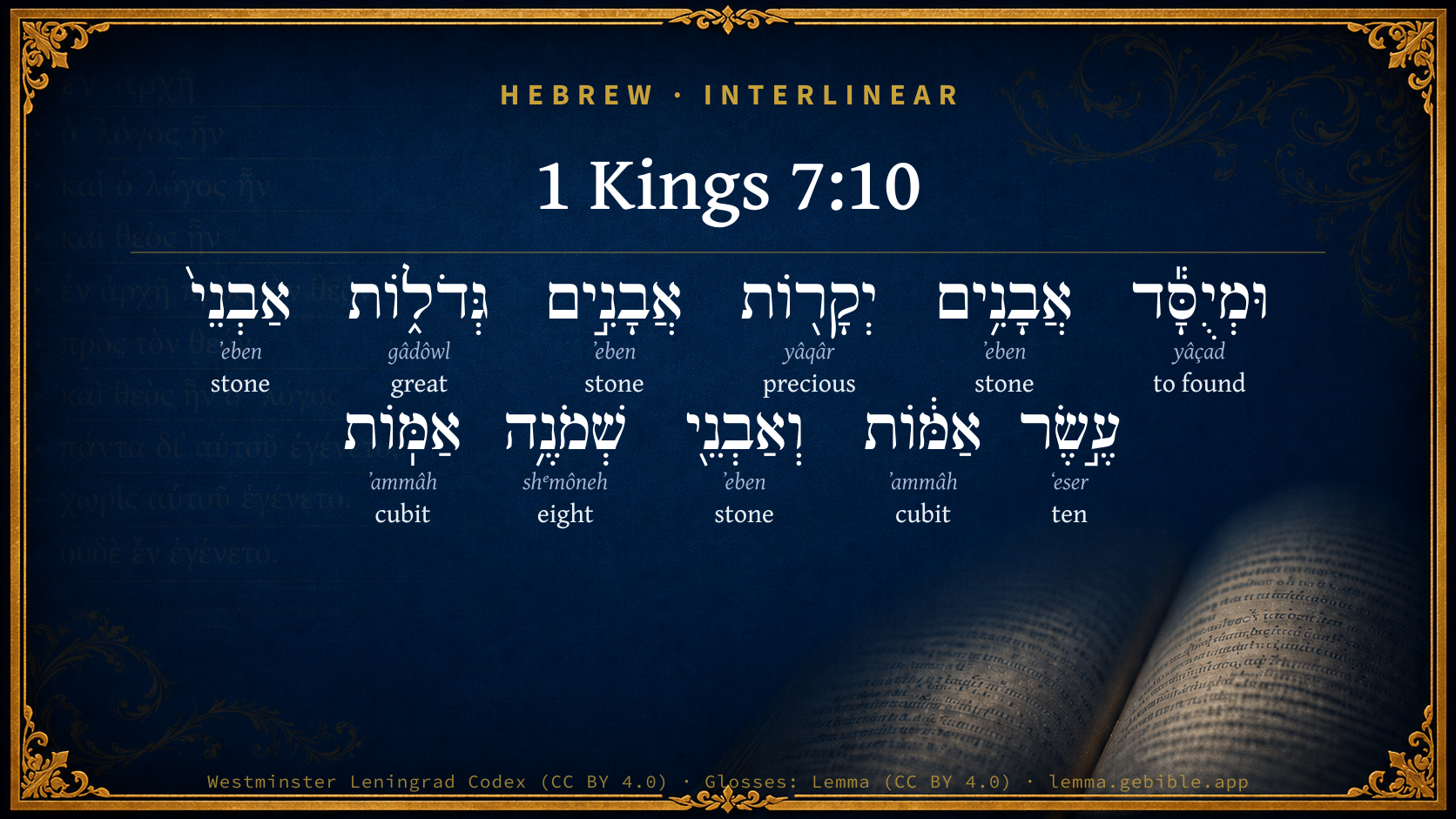
  1. וּמְיֻסָּ֕ד yâçad H3245 “and · founded” Conjunction + Verb, Pual, Participle Passive, Masculine, Singular, Absolute
  2. אֲבָנִ֥ים ʼeben H68 “stones” Noun, Common, Feminine, Plural, Absolute
  3. אֲבָנִ֣ים ʼeben H68 “stones” Noun, Common, Feminine, Plural, Absolute
  4. גְּדֹל֑וֹת gâdôwl H1419 “great” Adjective, Adjective, Feminine, Plural, Absolute
  5. אַבְנֵי֙ ʼeben H68 “stones of” Noun, Common, Feminine, Plural, Construct
  6. עֶ֣שֶׂר ʻeser H6235 “ten” Adjective, Cardinal number, Feminine, Singular, Absolute
  7. אַמּ֔וֹת ʼammâh H520 “cubits” Noun, Common, Feminine, Plural, Absolute
  8. וְאַבְנֵ֖י ʼeben H68 “and · stones of” Conjunction + Noun, Common, Feminine, Plural, Construct
  9. שְׁמֹנֶ֥ה shᵉmôneh H8083 “eight” Adjective, Cardinal number, Feminine, Singular, Absolute
  10. אַמּֽוֹת ʼammâh H520 “cubits” Noun, Common, Feminine, Plural, Absolute

About this verse

These counts appear in no published source. They are computed here, from the morphology-tagged text and Lemma’s own curated glosses. What Lemma adds →

11
words
7
distinct lemmas
Historical
section

Shared distinctive vocabulary

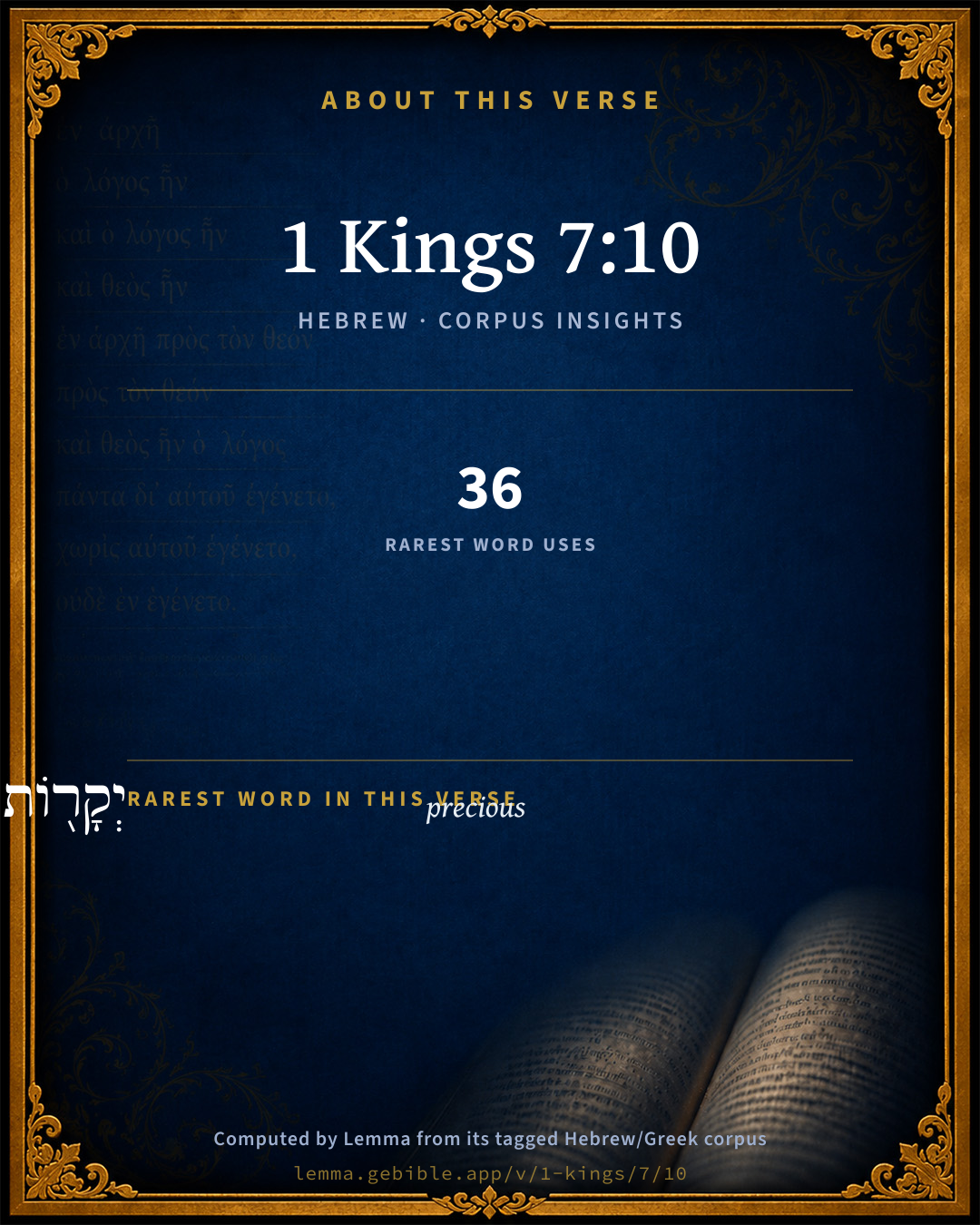
יְקָר֖וֹת precious H3368 occurs in 36 verses of the Hebrew Bible. Also found in:

Grammatical profile

  • 1 verb
  • 6 nouns
  • 4 adjectives

Verb forms

  • וּמְיֻסָּ֕ד Pual · Participle Passive

Repetition

Words recur within this verse — often emphatic in Hebrew:

  • אֲבָנִ֥ים stone H68 ×4
  • אַמּ֔וֹת cubit H520 ×2

Cross-references

4

Topical passages linked to 1 Kings 7:10 in the Treasury of Scripture Knowledge — connected by theme and wording, ordered by reader-vote popularity; previews shown in the World English Bible.

  • Revelation 21:19–20 The foundations of the city's wall were adorned with all kinds of precious stones. The first foundation was jasper; the second, sapphire; the third, chalcedony; the fourth, emerald;
  • Isaiah 28:16 therefore thus says the Lord Yahweh, Behold, I lay in Zion for a foundation a stone, a tried stone, a precious corner -[stone] of sure foundation: he who believes shall not be in haste.
  • Isaiah 54:11 you afflicted, tossed with tempest, and not comforted, behold, I will set your stones in beautiful colors, and lay your foundations with sapphires.
  • 1 Corinthians 3:10–11 According to the grace of God which was given to me, as a wise master builder I laid a foundation, and another builds on it. But let each man be careful how he builds on it.

Cross-references courtesy of OpenBible.info (CC BY 4.0).

Hebrew and Greek witnesses Masoretic Hebrew ↔ Greek Septuagint

The same verse in the two great witnesses to the Old Testament, shown verse-for-verse.

These are two independent witnesses, not word-aligned to each other, and the Septuagint is shown in lemma (dictionary) form.

Hebrew 1 Kings 7:10 Masoretic · Westminster Leningrad Codex

וּמְיֻסָּ֕ד אֲבָנִ֥ים יְקָר֖וֹת אֲבָנִ֣ים גְּדֹל֑וֹת אַבְנֵי֙ עֶ֣שֶׂר אַמּ֔וֹת וְאַבְנֵ֖י שְׁמֹנֶ֥ה אַמּֽוֹת

The foundation was of costly stones, even great stones, stones of ten cubits, and stones of eight cubits.

World English Bible · Public Domain

Greek LXX 1 Kings 7:10 Septuagint · lemma form

καί ποιέω ὁ θάλασσα δέκα ἐν πῆχυς ἀπό ὁ χεῖλος αὐτός ἕως ὁ χεῖλος αὐτός στρογγύλος κύκλος ὁ αὐτός πέντε ἐν πῆχυς ὁ ὕψος αὐτός καί συνἄγω τρεῖς καί τριάκοντα ἐν πῆχυς κυκλόω αὐτός

No English rendering of this Greek verse — the small residue in the structurally divergent books.

On this verse, The Pulpit Commentary discusses the Septuagint’s reading. Read the note in Commentary ↓

Hebrew: Westminster Leningrad Codex (CC BY 4.0). Greek: Septuagint (public domain); English from a public-domain English Septuagint. How the Septuagint differs from the Hebrew →

Targum (Aramaic paraphrase)

1

The Targum is the ancient Jewish Aramaic paraphrase of the Hebrew Scriptures — an interpretive translation, not the Hebrew text itself. Onkelos (literal) and Pseudo-Jonathan (expansive) render the Torah, and Jonathan the Prophets. Coverage is partial: where no permissively-licensed English translation exists for a verse, only the Aramaic is shown. This is verse-level text, not a word-by-word alignment to the Hebrew.

  1. Targum Jonathan Prophets (Joshua–Malachi)
    וּמְשֻׁכְלָל בְּאַבְנִין טָבָן אַבְנִין רַבְרְבָן אַבְנֵי עֲסַר אַמִין וְאַבְנֵי תַמְנֵי אַמִין:

    (no public-domain English translation for this verse)

    Targum Jonathan — Aramaic: “Mikraot Gedolot” (public domain). English: “Sefaria Community Translation” (CC0 1.0 (public-domain dedication)); “London "Chaldee Paraphrase," 1871” (public domain). Text via Sefaria.

Commentary

Notes on 1 Kings 7:10 from classic Christian and Jewish commentators (each source and its license shown beneath its notes). The classic Christian expositions comment on the surrounding passage and are grouped to its opening verse, so a note may address several verses; the Jewish commentaries on the Tanakh (Rashi and others) are per-verse, so they appear only where the commentator wrote on this verse.

Lemma curates 59 commentaries, every one of them public domain or Creative Commons licensed, each selected and text-cleaned for this edition rather than reprinted as found. About our sources →

Trapp's Complete Commentary

John Trapp

1Ki 7:10 And the foundation [was of] costly stones, even great stones, stones of ten cubits, and stones of eight cubits.

Ver. 10. And the foundatlon was of costly stones.] Heb., Precious; yet not of emeralds, carbuncles, sapphires, as Isa 54:11, but of marble, porphyry, &c., which were longlasting.

Even great stones.] Which therefore were the closer together, and the surer.

John Trapp, A Commentary or Exposition upon All the Books of the Old and New Testament (1647–1656) — public domain. Text from a community e-Sword module.

Joseph Benson's Commentary

1Ki 7:10-11. The foundation was of costly stones — By costly stones, mentioned here, and in the foregoing and following verses, are not meant precious stones, but stones that, being larger, firmer, and better polished than others, were of greater price: probably they were large blocks of marble, squared and polished on all sides. Stones of ten cubits — Not ten cubits square, which would have been unnecessary, and would have rendered them unportable and unmanageable, but of such measure as is generally used in measuring stones and timber; and thus also the following eight cubits are to be understood. And above — That is, in the roof, or upper part; for this is opposed to the foundation. Were costly stones and cedars — Intermixed the one with the other. Thus the roof was finished after the same manner with the lower parts.

Joseph Benson's Commentary on the Old and New Testaments (1811–1818) — public domain. Text from a community e-Sword module.

Jamieson, Fausset & Brown

Robert Jamieson, A. R. Fausset & David Brown

the foundation was of costly stones, even great stones--Enormous stones, corresponding exactly with the dimensions given, are found in Jerusalem at this day. Not only the walls from the foundation to the roof beams were built of large hewn stones, but the spacious court around the palace was also paved with great square stones.

Jamieson, Fausset & Brown — Commentary Critical and Explanatory on the Whole Bible (1871) — public domain (CC PDM 1.0). Text via the HelloAO Bible API.

The Cambridge Bible for Schools and Colleges

gen. ed. J. J. S. Perowne

10. And the foundation] Even that work which was to be buried out of sight was of the same quality.

ten cubits … eight cubits] Probably we have here the greatest dimension, the length. We are left to imagine the breadth and thickness which would be proportional in stones of 15 feet and 12 feet long.

The Cambridge Bible for Schools and Colleges (gen. ed. J. J. S. Perowne; Cambridge University Press, 1878–1918) — public domain. Text from a community e-Sword module.

John Gill's Exposition

And above were costly stones,.... Above the foundation, from thence to the top of the buildings; the whole walls were made of such right up to the ceiling:

after the measure of hewed stones; which, according to the Rabbins, as Kimchi says, were five hands breadth:

and cedars; beams of cedars over them, or these, both the foundation and the walls, were lined with them.

John Gill's Exposition of the Whole Bible (1746–1763) — public domain (CC PDM 1.0). Text via the HelloAO Bible API.

Albert Barnes' Notes on the Bible

See the 1Ki 5:17 note.

Albert Barnes' Notes on the Bible (1834–1885) — public domain. Text from a community e-Sword/MySword module.

Matthew Poole's English Annotations

Stones of ten cubits; not square, which would have been both unnecessary, and unportable, and unmanageable; but of solid measure, by which stones and timber are usually measured; and so they were only two cubits square, but there were twenty solid cubits contained in them. And so also the following

eight cubits are to be understood.

Matthew Poole's English Annotations on the Holy Bible (1683–1685) — public domain. Text from a community e-Sword/MySword module.

Whedon's Commentary on the Bible

Daniel D. Whedon

10. Even great stones — These foundation stones were costly because of their great size rather than of the vast amount of labour required in hewing them.

Ten cubits — About fifteen feet. See note on 1Ki_5:17.

Daniel D. Whedon (gen. ed.), Commentary on the Old and New Testaments (1874–1909) — public domain. Text from a community e-Sword module.

The Pulpit Commentary

And the foundation was of costly stones, even great stones Bahr says, "Even the foundations which from without were not seen, were composed of these great stones." But the meaning evidently is that the foundation stones were larger than those reared upon them, stones of ten cubits i.e., ten cubits long, and of proportionate width, etc. , and stones of eight cubits. The foundations of the palaces, consequently, were much less than those of the temple platform, some of which would measure 16 cubits. (See note on 1Ki_5:17)

All these i.e. buildings, palaces were of costly or precious; cf. 1Ki 5:30 and vers. 10, 11 stones, according to the measures of hewed stones lit., of squaring or hewing, same word in, 1Ki 5:30 1Ki_6:36 and, Isa_9:9, etc. All the stones in these several buildings were shaped to certain specified dimensions sawed with saws rrG is obviously an onomatopoetic word, like our saw. Gesenius cites sairw, serro, etc. The Egyptians, whose saws were apparently all single handed, do not seem to have applied this instrument to stone, but part of a double-handed saw was found at Nimrud (Layard, p. 195, and Dict. Bib., art. "Saw). That saws were in common use and were made of iron is implied in, 2Sa_12:31 within and without It is not quite clear whether the meaning is that the two surfaces exposed to view, one within and the other without, the building were shaped with saws, or that the inner and hidden surface of the stone was thus smoothed as well as the exposed parts, even from the foundation unto the coping or corbels. It is generally agreed (Gesen., Keil, Bight) that the reference is to the "projecting stones on which the beams rest," though Thenius would understand battlements (Deu_22:8) to be intended. But for these a different word is always used, and the LXX geisov signifies the projection of the roof, not an erection upon it, and so on the outside toward the great court i.e., the pavement of the court was of sawed stones (see ver. 12).

The Pulpit Commentary (1880–1919), ed. H.D.M. Spence-Jones & Joseph S. Exell — public domain. Text from a community e-Sword module.

Rashi

Rabbi Shlomo Yitzchaki (Rashi)

The foundation was, etc., [of] huge stones. And the foundation which was in the ground was of stones greater than the [standard] size of cut [stones].

Rashi on the Tanakh — English translations: “The Judaica Press complete Tanach with Rashi, translated by A. J. Rosenberg” (CC BY 4.0); “Pentateuch with Rashi's commentary by M. Rosenbaum and A.M. Silbermann, 1929-1934” (public domain); “The Metsudah Tanach series, Lakewood, N.J” (CC BY 4.0); and “The Book of Joshua, Metsudah Publications, 1997” (CC BY 4.0). Text via Sefaria.

Lesson kit

Teaching starters — assembled from the data on this page, not authored interpretation. Every prompt links to the verse data it draws on. Edit before teaching.

1 Kings, in the Historical, opens this verse with 11 words (7 distinct Hebrew lemmas). Its most distinctive word is yâqâr (“precious”). A historical commentator’s framing appears above. Read the whole chapter for the surrounding context.

Discussion questions

  1. The word yâqâr carries the sense “precious.” How does it shape the verse?
  2. How does 1 Samuel 3:1, which shares the word «precious», read alongside this verse?
  3. What does the repetition of “stone” (4× in this one verse) do in this verse?
  4. The translations on this page render this verse differently — a whole-verse word diff, not a word-by-word alignment. What might account for the different wordings?
  5. «וּמְיֻסָּ֕ד» is a Pual Participle Passive verb. How does that grammatical form shape the action described?
  6. Compare how Trapp's Complete Commentary and Joseph Benson's Commentary read this verse. Where do they agree or differ?

Things to notice

  • These translations choose different wording for 5 words in this verse.
  • “stone” occurs 4× in this single verse.
  • 7 distinct Hebrew lemmas span 11 words in this verse.

Reading settings

Reading text

Shown beneath each verse's original-language words.

Old Testament
Old Testament edition

Read the OT as the Masoretic Hebrew (MT) or the Greek Septuagint (LXX).

English shown for the Greek Septuagint (in the Hebrew ↔ Greek comparison).

Comparing translations? Open the Compare panel on any verse page to stack up to four side by side.