
Jeremiah 36:7

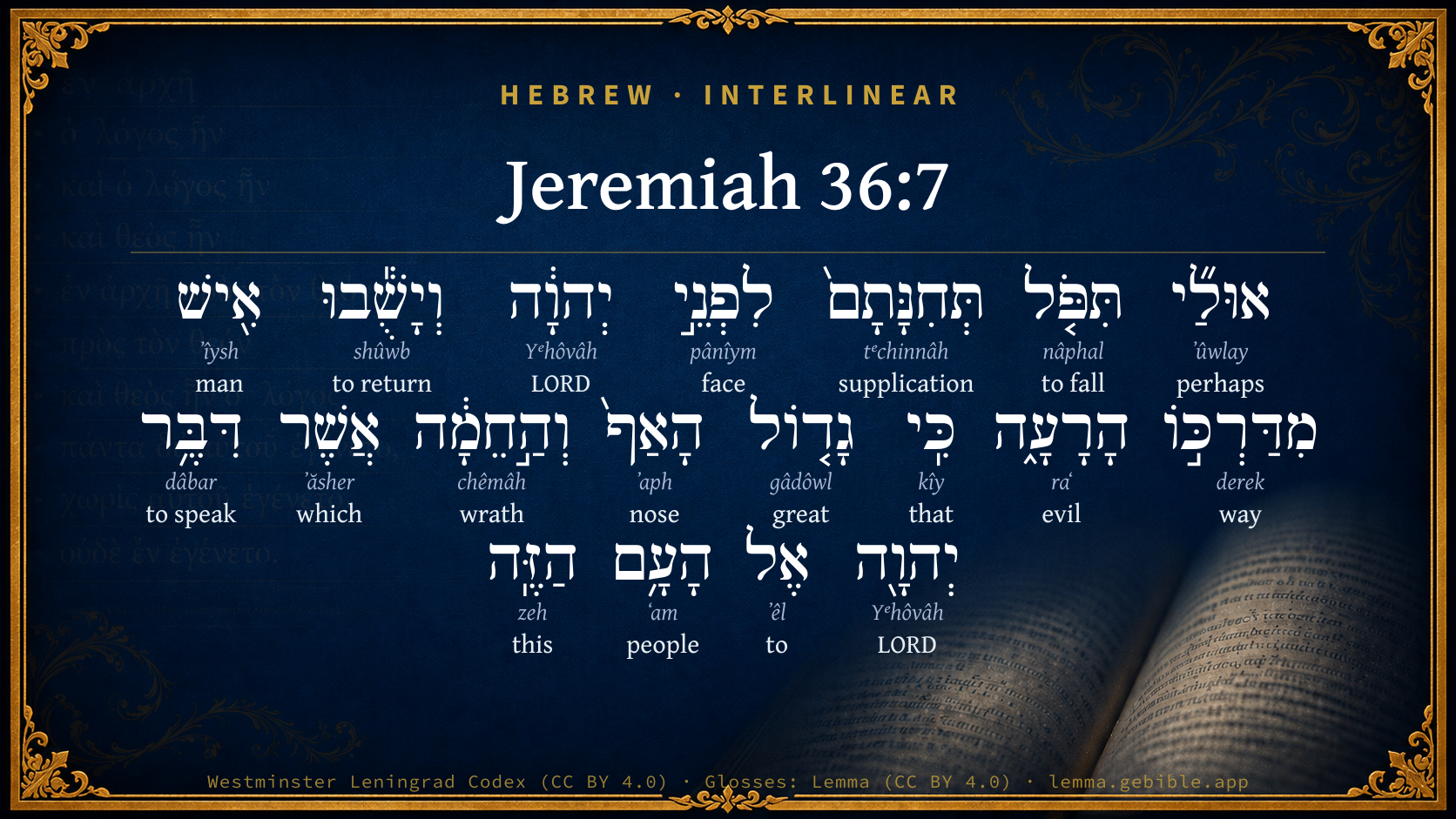
Hebrew (Westminster Leningrad Codex) Jeremiah 36:7 appears in the Hebrew Old Testament. The text above is from the Westminster Leningrad Codex. Each word links to its Strong’s number, a concise gloss, and parsing drawn from the Open Scriptures Hebrew Bible morphology. Click any word for its full Brown-Driver-Briggs (BDB) entry.
Download image
Cite this verse

Jeremiah 36:7 (World English Bible). Public Domain. Lemma interlinear Bible study tool, https://lemma.gebible.app/v/jeremiah/36/7.

Show BibTeX & RIS
BibTeX
RIS
English Translation
It may be they will present their supplication before Yahweh, and will return everyone from his evil way; for great is the anger and the wrath that Yahweh has pronounced against this people.
World English Bible · Public Domain
Download a study sheet

One document with this verse’s original text, its word-by-word gloss line, the meaning frame, cross-references with their text, attributed commentary, and full source and license credits — printable, and it pastes into notes with its structure intact.

This verse Autodidact and up

Study sheet (.html) Plain text (.txt)

A passage Seminary Student

Up to 50 verses in one chapter. A passage sheet keeps up to 6 commentary sources and 12 cross-references per verse, in the order this page ranks them, and says so on the sheet whenever that leaves anything out. Ask for a single verse and you get the Autodidact verse sheet above.

Everything on this page stays free to read, with no account — the sheet is a download of what is already on screen, not access to it.

Want to remove ads? Support Godless Engineer
Compare translations 3

The same verse in 3 English versions, stacked beneath the original-language interlinear above. Click any original word for its lexicon entry.

Each is an independent rendering of the whole verse — the interlinear is not word-aligned to these translations.

Highlighted words mark where these versions differ — a whole-verse word diff, not a word-by-word alignment.

  • World English Bible Public Domain
    It may be they will present their supplication before Yahweh, and will return everyone from his evil way; for great is the anger and the wrath that Yahweh has pronounced against this people.
  • King James Version Public Domain
    It may be they will present their supplication before the LORD, and will return every one from his evil way: for great is the anger and the fury that the LORD hath pronounced against this people.
  • unfoldingWord Literal Text CC BY-SA 4.0
    Perhaps their pleas for mercy will come before Yahweh. Perhaps each person will turn from his wicked way, since the wrath and fury that Yahweh has proclaimed against this people are severe.”

unfoldingWord Literal Text — © unfoldingWord, licensed CC BY-SA 4.0. Word-aligned USFM3 via Door43 (git.door43.org/unfoldingWord/en_ult).

Versions to compare (up to 4)

3 of 4 selected

Show all 18 translations

Every available English version of this verse, each an independent rendering of the whole verse.

  • World English Bible Public Domain
    It may be they will present their supplication before Yahweh, and will return everyone from his evil way; for great is the anger and the wrath that Yahweh has pronounced against this people.
  • Berean Standard Bible Public Domain
    Perhaps they will bring their petition before the LORD, and each one will turn from his wicked way; for great are the anger and fury that the LORD has pronounced against this people.”
  • Majority Standard Bible Public Domain
    Perhaps they will bring their petition before the LORD, and each one will turn from his wicked way; for great are the anger and fury that the LORD has pronounced against this people.”
  • King James Version Public Domain
    It may be they will present their supplication before the LORD, and will return every one from his evil way: for great is the anger and the fury that the LORD hath pronounced against this people.
  • American Standard Version (1901) Public Domain
    It may be they will present their supplication before Jehovah, and will return every one from his evil way; for great is the anger and the wrath that Jehovah hath pronounced against this people.
  • Revised Version (1885) Public Domain
    It may be they will present their supplication before the LORD, and will return every one from his evil way: for great is the anger and the fury that the LORD hath pronounced against this people.
  • Geneva Bible (1599) Public Domain
    It may be that they will pray before the Lord, and euery one returne from his euill way, for great is the anger and the wrath, that the Lord hath declared against this people.
  • Douay-Rheims (1899) Public Domain
    If so be they may present their supplication before the Lord, and may return every one from his wicked way: for great is the wrath and indignation which the Lord hath pronounced against this people.
  • Young's Literal Translation Public Domain
    if so be their supplication doth fall before Jehovah, and they turn back each from his evil way, for great `is' the anger and the fury that Jehovah hath spoken concerning this people.'
  • Literal Standard Version CC BY-SA 4.0
    perhaps their supplication so falls before YHWH, and they each turn back from his evil way, for the anger and the fury that YHWH has spoken concerning this people [is] great.”
  • Unlocked Literal Bible CC BY-SA 4.0
    Perhaps their pleas for mercy will come before Yahweh. Perhaps each person will turn from his wicked way, since the wrath and fury that Yahweh has proclaimed against this people are severe.”
  • unfoldingWord Literal Text CC BY-SA 4.0
    Perhaps their pleas for mercy will come before Yahweh. Perhaps each person will turn from his wicked way, since the wrath and fury that Yahweh has proclaimed against this people are severe.”
  • Darby Bible Public Domain
    It may be they will present their supplication before Jehovah, and that they will return every one from his evil way; for great is the anger and the fury that Jehovah hath pronounced against this people.
  • World Messianic Bible Public Domain
    It may be they will present their supplication before the LORD, and will each return from his evil way; for the LORD has pronounced great anger and wrath against this people.”
  • Webster's Bible Public Domain
    It may be they will present their supplication before the LORD, and will return every one from his evil way: for great is the anger and the fury that the LORD hath pronounced against this people.
  • Free Bible Version CC BY-SA 4.0
    Maybe they will come and ask the Lord for forgiveness, and all of them will stop their evil ways, for the Lord is threatening terrible anger against them.”
  • Bible in Basic English Public Domain
    It may be that their prayer for grace will go up to the Lord, and that every man will be turned from his evil ways: for great is the wrath and the passion made clear by the Lord against this people.
  • JPS Tanakh (1917) Public Domain
    It may be they will present their supplication before the LORD, and will return every one from his evil way; for great is the anger and the fury that the LORD hath pronounced against this people.'

Literal Standard Version (2020), Covenant Press — licensed CC BY-SA 4.0. Text via the HelloAO Bible API (eBible.org). Unlocked Literal Bible (unfoldingWord) — licensed CC BY-SA 4.0. Text via the HelloAO Bible API (eBible.org). unfoldingWord Literal Text — © unfoldingWord, licensed CC BY-SA 4.0. Word-aligned USFM3 via Door43 (git.door43.org/unfoldingWord/en_ult). Free Bible Version, Dr. Jonathan Gallagher — licensed CC BY-SA 4.0. Text via the HelloAO Bible API (eBible.org).

Word by word

More ways to search: Search by grammar → Find every occurrence → Compare this word →

Practice this passage: Drill this verse → Learn its vocabulary →

תְּחִנָּתָם֙
tᵉchinnâh
H8467
“supplication · their”
Noun, Common, Feminine, Singular, Construct + Suffix, Personal, 3rd Person, Masculine, Plural
Part of Speech
Noun
Type
Common
Gender
Feminine
Number
Singular
State
Construct
Full BDB Definition

Origin: from H2603

TWOT: 694f

favour, supplication, supplication for favour - favour - supplication for favour
  1. אוּלַ֞י ʼûwlay H194 “perhaps” Adverb
  2. תִּפֹּ֤ל nâphal H5307 “to fall” Verb, Qal, Imperfect, 3rd Person, Feminine, Singular
  3. לִפְנֵ֣י pânîym H6440 “to/for · face(s) of” Preposition + Noun, Common, Both, Plural, Construct
  4. יְהוָ֔ה Yᵉhôvâh H3068 “LORD” Noun, Proper
  5. וְיָשֻׁ֕בוּ shûwb H7725 “and · to return” Conjunction + Verb, Qal, Imperfect, 3rd Person, Masculine, Plural
  6. אִ֖ישׁ ʼîysh H376 “man” Noun, Common, Masculine, Singular, Absolute
  7. מִדַּרְכּ֣וֹ derek H1870 “from · way · his” Preposition + Noun, Common, Both, Singular, Construct + Suffix, Personal, 3rd Person, Masculine, Singular
  8. הָרָעָ֑ה raʻ H7451 “the · evil” Particle, Definite Article + Adjective, Adjective, Feminine, Singular, Absolute
  9. כִּֽי kîy H3588 “that” Conjunction
  10. גָד֤וֹל gâdôwl H1419 “great” Adjective, Adjective, Masculine, Singular, Absolute
  11. הָאַף֙ ʼaph H639 “the · nose” Particle, Definite Article + Noun, Common, Masculine, Singular, Absolute
  12. וְהַ֣חֵמָ֔ה chêmâh H2534 “and · the · wrath” Conjunction + Particle, Definite Article + Noun, Common, Feminine, Singular, Absolute
  13. אֲשֶׁר ʼăsher H834 “which” Particle, Relative
  14. דִּבֶּ֥ר dâbar H1696 “to speak” Verb, Piel, Perfect, 3rd Person, Masculine, Singular
  15. יְהוָ֖ה Yᵉhôvâh H3068 “LORD” Noun, Proper
  16. אֶל ʼêl H413 “to” Preposition
  17. הָעָ֥ם ʻam H5971 “the · people” Particle, Definite Article + Noun, Common, Masculine, Singular, Absolute
  18. הַזֶּֽה zeh H2088 “the · this” Particle, Definite Article + Pronoun, Demonstrative, Masculine, Singular

About this verse

These counts appear in no published source. They are computed here, from the morphology-tagged text and Lemma’s own curated glosses. What Lemma adds →

19
words
18
distinct lemmas
Prophets
section

Notable vocabulary

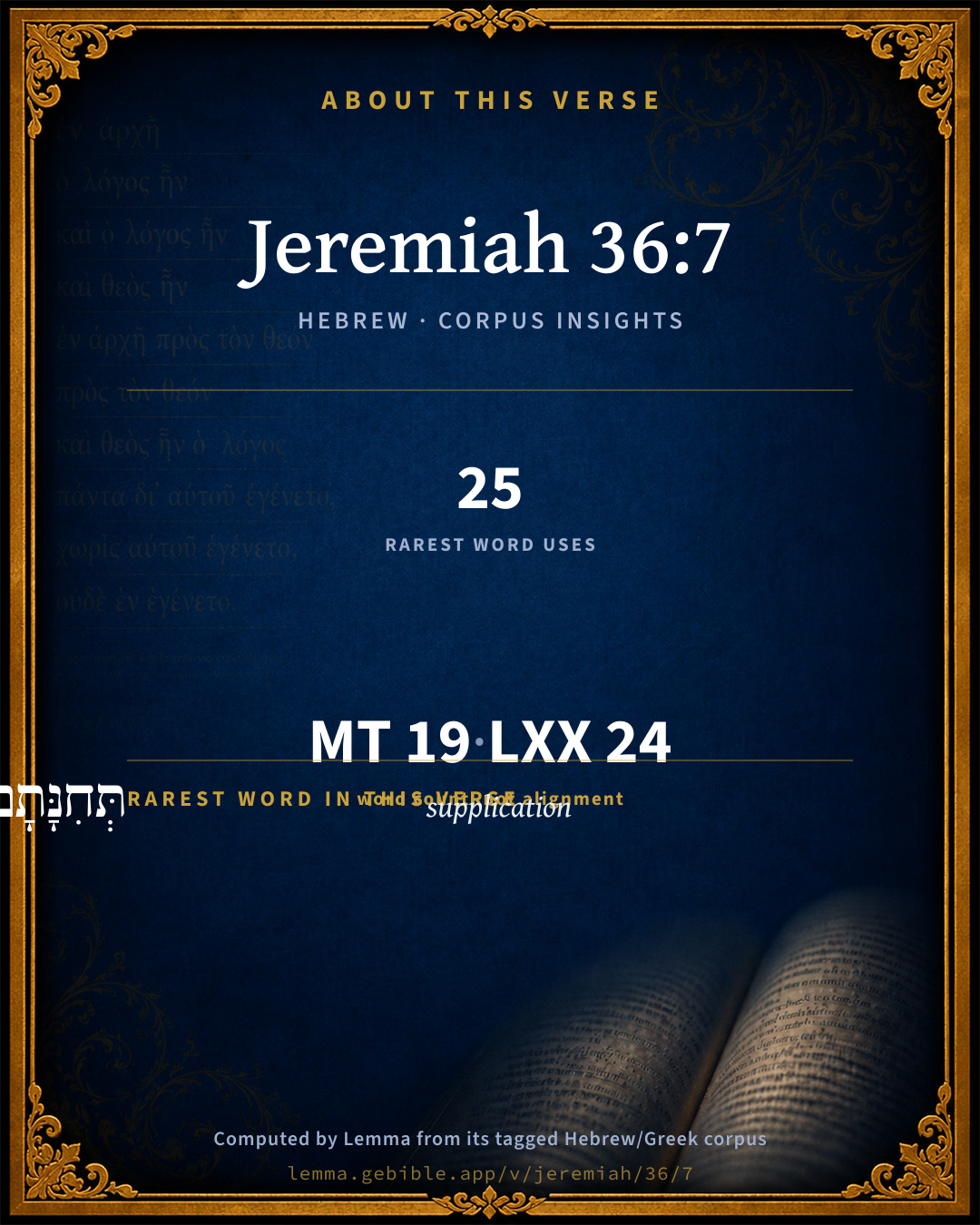
The rarest word here is תְּחִנָּתָם֙ supplication H8467 — appearing just 25 times in the whole Hebrew Bible.

Shared distinctive vocabulary

תְּחִנָּתָם֙ supplication H8467 occurs in 24 verses of the Hebrew Bible. Also found in:

Grammatical profile

  • 3 verbs
  • 9 nouns
  • 2 adjectives
  • 1 pronoun
  • 1 preposition
  • 1 conjunction
  • 1 adverb
  • 1 particle

Verb forms

  • תִּפֹּ֤ל Qal · Imperfect
  • וְיָשֻׁ֕בוּ Qal · Imperfect
  • דִּבֶּ֥ר Piel · Perfect

Repetition

A word recurs within this verse — often emphatic in Hebrew:

  • יְהוָ֔ה LORD H3068 ×2

Hebrew & Septuagint length

In the original languages it is 19 Hebrew tokens and 24 Greek tokens — but the two are counted differently (Hebrew bundles its prefixes and suffixes into one token; the Greek is in lemma form), so that isn’t a like-for-like length.

Cross-references

28

Topical passages linked to Jeremiah 36:7 in the Treasury of Scripture Knowledge — connected by theme and wording, ordered by reader-vote popularity; previews shown in the World English Bible.

  • Jeremiah 36:3 It may be that the house of Judah will hear all the evil which I purpose to do to them; that they may return every man from his evil way; that I may forgive their iniquity and their sin.
  • 2 Kings 22:13 Go you, inquire of Yahweh for me, and for the people, and for all Judah, concerning the words of this book that is found; for great is the wrath of Yahweh that is kindled against us, because our fathers have not listened to the words of this book, to do according to all that which is written concerning us.
  • 2 Kings 22:17 Because they have forsaken me, and have burned incense to other gods, that they might provoke me to anger with all the work of their hands, therefore my wrath shall be kindled against this place, and it shall not be quenched.
  • 2 Chronicles 33:12–13 When he was in distress, he begged Yahweh his God, and humbled himself greatly before the God of his fathers.
  • Jeremiah 4:4 Circumcise yourselves to Yahweh, and take away the foreskins of your heart, you men of Judah and inhabitants of Jerusalem; lest my wrath go forth like fire, and burn so that none can quench it, because of the evil of your doings.
  • Jeremiah 21:5 I myself will fight against you with an outstretched hand and with a strong arm, even in anger, and in wrath, and in great indignation.
  • Lamentations 4:11 Yahweh has accomplished his wrath, he has poured out his fierce anger; He has kindled a fire in Zion, which has devoured the foundations of it.
  • Hosea 5:15–6:1 I will go and return to my place, until they acknowledge their offense, And seek my face. In their affliction they will seek me earnestly."
  • Deuteronomy 28:15–68 But it shall come to pass, if you will not listen to the voice of Yahweh your God, to observe to do all his commandments and his statutes which I command you this day, that all these curses shall come on you, and overtake you.
  • Deuteronomy 29:18–28 lest there should be among you man, or woman, or family, or tribe, whose heart turns away this day from Yahweh our God, to go to serve the gods of those nations; lest there should be among you a root that bears gall and wormwood;
  • Deuteronomy 31:17 Then my anger shall be kindled against them in that day, and I will forsake them, and I will hide my face from them, and they shall be devoured, and many evils and troubles shall come on them; so that they will say in that day, Haven't these evils come on us because our God is not among us?
  • 1 Kings 8:33–36 When your people Israel are struck down before the enemy, because they have sinned against you; if they turn again to you, and confess your name, and pray and make supplication to you in this house:
  • 2 Chronicles 34:21 Go you, inquire of Yahweh for me, and for those who are left in Israel and in Judah, concerning the words of the book that is found; for great is the wrath of Yahweh that is poured out on us, because our fathers have not kept the word of Yahweh, to do according to all that is written in this book.
  • Jeremiah 1:3 It came also in the days of Jehoiakim the son of Josiah, king of Judah, to the end of the eleventh year of Zedekiah, the son of Josiah, king of Judah, to the carrying away of Jerusalem captive in the fifth month.
  • Jeremiah 16:10 It shall happen, when you shall show this people all these words, and they shall tell you, Why has Yahweh pronounced all this great evil against us? or what is our iniquity? or what is our sin that we have committed against Yahweh our God?
  • Jeremiah 19:15 Thus says Yahweh of Hosts, the God of Israel, Behold, I will bring on this city and on all its towns all the evil that I have pronounced against it; because they have made their neck stiff, that they may not hear my words.
  • Jeremiah 25:5 saying, Return you now everyone from his evil way, and from the evil of your doings, and dwell in the land that Yahweh has given to you and to your fathers, from of old and even forevermore;
  • Jeremiah 26:3 It may be they will listen, and turn every man from his evil way; that I may repent me of the evil which I purpose to do to them because of the evil of their doings.
  • Ezekiel 5:13 Thus shall my anger be accomplished, and I will cause my wrath toward them to rest, and I shall be comforted; and they shall know that I, Yahweh, have spoken in my zeal, when I have accomplished my wrath on them.
  • Ezekiel 8:18 Therefore will I also deal in wrath; my eye shall not spare, neither will I have pity; and though they cry in my ears with a loud voice, yet will I not hear them.
  • Ezekiel 13:13 Therefore thus says the Lord Yahweh: I will even tear it with a stormy wind in my wrath; and there shall be an overflowing shower in my anger, and great hailstones in wrath to consume it.
  • Ezekiel 20:33 As I live, says the Lord Yahweh, surely with a mighty hand, and with an outstretched arm, and with wrath poured out, will I be king over you:
  • Ezekiel 22:20 As they gather silver and brass and iron and lead and tin into the midst of the furnace, to blow the fire on it, to melt it; so will I gather you in my anger and in my wrath, and I will lay you there, and melt you.
  • Ezekiel 24:8–13 That it may cause wrath to come up to take vengeance, I have set her blood on the bare rock, that it should not be covered.
  • Daniel 9:13 As it is written in the law of Moses, all this evil is come on us: yet have we not entreated the favor of Yahweh our God, that we should turn from our iniquities, and have discernment in your truth.
  • Hosea 14:1–3 Israel, return to Yahweh your God; For you have fallen because of your sin.
  • Jonah 3:8 but let them be covered with sackcloth, both man and animal, and let them cry mightily to God. Yes, let them turn everyone from his evil way, and from the violence that is in his hands.
  • Zechariah 1:4 Don't you be like your fathers, to whom the former prophets proclaimed, saying: Thus says Yahweh of hosts, 'Return now from your evil ways, and from your evil doings;' but they did not hear, nor listen to me, says Yahweh.

Cross-references courtesy of OpenBible.info (CC BY 4.0).

Hebrew and Greek witnesses Masoretic Hebrew ↔ Greek Septuagint

The same verse in the two great witnesses to the Old Testament, shown verse-for-verse.

These are two independent witnesses, not word-aligned to each other, and the Septuagint is shown in lemma (dictionary) form.

Hebrew Jeremiah 36:7 Masoretic · Westminster Leningrad Codex

אוּלַ֞י תִּפֹּ֤ל תְּחִנָּתָם֙ לִפְנֵ֣י יְהוָ֔ה וְיָשֻׁ֕בוּ אִ֖ישׁ מִדַּרְכּ֣וֹ הָרָעָ֑ה כִּֽי גָד֤וֹל הָאַף֙ וְהַ֣חֵמָ֔ה אֲשֶׁר דִּבֶּ֥ר יְהוָ֖ה אֶל הָעָ֥ם הַזֶּֽה

It may be they will present their supplication before Yahweh, and will return everyone from his evil way; for great is the anger and the wrath that Yahweh has pronounced against this people.

World English Bible · Public Domain

Greek LXX Structure differs

In the Septuagint, Jeremiah is about an eighth shorter than the Hebrew and arranges its material differently — the Oracles Against the Nations (Hebrew chapters 46–51) appear in the middle of the Greek book, after 25:13. Because the chapter and verse boundaries do not line up, a verse-for-verse comparison with the Hebrew is not shown.

A verse-for-verse comparison isn’t shown here because the chapters and verses don’t line up. Switch to the LXX edition with the MT / LXX toggle above to read the Greek directly.

Hebrew: Westminster Leningrad Codex (CC BY 4.0). Greek: Septuagint (public domain); English from a public-domain English Septuagint. How the Septuagint differs from the Hebrew →

Targum (Aramaic paraphrase)

1

The Targum is the ancient Jewish Aramaic paraphrase of the Hebrew Scriptures — an interpretive translation, not the Hebrew text itself. Onkelos (literal) and Pseudo-Jonathan (expansive) render the Torah, and Jonathan the Prophets. Coverage is partial: where no permissively-licensed English translation exists for a verse, only the Aramaic is shown. This is verse-level text, not a word-by-word alignment to the Hebrew.

  1. Targum Jonathan Prophets (Joshua–Malachi)
    מָאִים תִּתְקַבֵּיל בְעוּתְהוֹן קֳדָם יְיָ וִיתוּבוּן גְבַר מֵאוֹרְחָתֵיהּ בִּישְׁתָא אֲרֵי רַב רוּגְזָא וְחֵימְתָא דִגְזַר יְיָ עַל עַמָא הָדֵין:

    (no public-domain English translation for this verse)

    Targum Jonathan — Aramaic: “Mikraot Gedolot” (public domain). English: “Sefaria Community Translation” (CC0 1.0 (public-domain dedication)); “London "Chaldee Paraphrase," 1871” (public domain). Text via Sefaria.

Commentary

Notes on Jeremiah 36:7 from classic Christian and Jewish commentators (each source and its license shown beneath its notes). The classic Christian expositions comment on the surrounding passage and are grouped to its opening verse, so a note may address several verses; the Jewish commentaries on the Tanakh (Rashi and others) are per-verse, so they appear only where the commentator wrote on this verse.

Lemma curates 59 commentaries, every one of them public domain or Creative Commons licensed, each selected and text-cleaned for this edition rather than reprinted as found. About our sources →

Trapp's Complete Commentary

John Trapp

Jer 36:7 It may be they will present their supplication before the LORD, and will return every one from his evil way: for great [is] the anger and the fury that the LORD hath pronounced against this people.

Ver. 7. It may be they will present their supplication.] Heb., Their supplication will fall before the Lord. Fasting of itself is but a "bodily exercise," and profiteth little. If the soul be not afflicted, rebel flesh tamed, prayers edged, and reformation effected, men fast to no purpose. {Isa 58:3; Isa 58:5 Zec 5:5; Zec 5:7}

John Trapp, A Commentary or Exposition upon All the Books of the Old and New Testament (1647–1656) — public domain. Text from a community e-Sword module.

Joseph Benson's Commentary

Jer 36:7-8. It may be they will present their supplications — Hebrew, תפל תחנתם לפני יהוה, peradventure they may prostrate themselves in supplication before Jehovah; or, more literally, their supplication may fall before Jehovah, which, undoubtedly, says Blaney, “respects the humble posture of the supplicant in presenting it:” see note on Jer 36:3. In the subsequent part of the verse, the words anger and fury (or, wrath, as החמה, should rather be rendered) are put by a metonymy for the effects of them, namely, the heavy judgments which, in consequence thereof, Jehovah had denounced against this people. We learn from this verse that prayer and reformation are the most likely means that can be used to turn away God’s wrath when it is ready to fall upon a sinful nation.

Joseph Benson's Commentary on the Old and New Testaments (1811–1818) — public domain. Text from a community e-Sword module.

Tyndale Open Study Notes

Tyndale Open Resources

36:7 Jeremiah repeated the purpose for writing the scroll (36:3) and reading it in public. • Perhaps . . . turn from their evil ways: The people could still receive the Lord’s forgiveness and avert his anger.

Tyndale Open Study Notes — © Tyndale Open Resources, licensed CC BY-SA 4.0. Text via the HelloAO Bible API.

Geneva Bible (1599)

Geneva Bible translators

He showeth that fasting without prayer and repentance, availeth nothing, but is mere hypocrisy.

Geneva Bible (1599) marginal notes — public domain. Text via Bolls.life.

Jamieson, Fausset & Brown

Robert Jamieson, A. R. Fausset & David Brown

present . . . supplication--literally, "supplication shall fall"; alluding to the prostrate attitude of the supplicants (Deu 9:25; Mat 26:39), as petitioners fall at the feet of a king in the East. So Hebrew, Jer 38:26; Dan 9:18, Margin.

Jamieson, Fausset & Brown — Commentary Critical and Explanatory on the Whole Bible (1871) — public domain (CC PDM 1.0). Text via the HelloAO Bible API.

Adam Clarke's Commentary

Verse 7. Present their supplication] "Let their supplication fall," that they may fall down before God, and deplore their sins.

Adam Clarke's Commentary on the Bible (1810–1826) — public domain. Text from a community e-Sword/MySword module.

John Calvin's Commentaries

Jeremiah, after having dictated to the scribe Baruch what he had before preached to the people, repeats what the object was, which we have previously observed; for it was God’s will to make the trial, whether the people could by any means be restored to a sound mind. This had, indeed, been in vain attempted for a long time; but God was yet willing to proceed to the utmost extent in his mercy. Hence Jeremiah now declares the purpose for which he wished the book to be read to the people. Nor is there a doubt but that Baruch had been thus admonished, that he might exhort the people to repentance as it were from the mouth of Jeremiah.

Now, there are two things mentioned as necessary in order to obtain pardon, — prayer, and turning or conversion. For if any one only in words seeks to be reconciled to God, he will not succeed. Turning or conversion cannot be separated from prayer. But then were a sinner to repent a thousand times, he would still remain exposed to God’s judgment; for reconciliation, by which we are absolved, does not depend on repentance, but on the gratuitous favor of God; for God does not receive us into favor because he sees that we are changed to a better mind, as though conversion were the cause of pardon; but he embraces us according to his gratuitous mercy. This, then, is the reason why Jeremiah joins together these two things — prayer, and conversion or repentance; for as I have said, hypocrites confess in words their sins and seek pardon, but it is with a feigned or a double heart. Hence that prayer may be genuine, repentance must be added, by which men shew that they loathe themselves. And then, ou the other hand, it is not enough for us to turn or repent, except the sinner flees to the mercy of God, for pardon flows from that fountain; for God, as it has been said, does not forgive us for any merit in us, but because it seemeth him good to bury our sins. The sum of the whole is, that God would have the prophecies of Jeremiah to be recited before the whole people, as they were conducive to their safety and salvation. The manner is described, — that the people were humbly to pray and also really to repent.

As to the expression, It may be, a prayer will fall, we have elsewhere explained its meaning. The Scripture speaks of prayer, that it rises and that it falls. Both expressions are suitable, though to be understood in a different way; for prayer cannot be rightly offered except man ascends and falls. These two things seem contrary, but they well agree together; nay, they cannot be separated. For in prayer two things are necessary — faith and humility: by faith we rise up to God, and by humility we lie prostrate on the ground. This is the reason why Scripture often says that prayer ascends, for we cannot pray as we ought unless we raise upwards our minds; and faith, sustained by promises, elevates us above all the world. Thus then prayer is raised upwards by faith; but by humility it falls down on the earth; for fear ought to be connected with faith. And as faith in our hearts produces alacrity by confidence, so also conscience casts us down and lays us prostrate. We now understand the meaning of the expression.

He adds, Because great is the wrath and indignation which Jehovah hath pronounced, or hath spoken, against this people. By wrath and indignation we are to understand God’s vengeance, the cause being put for the effect. But the Prophet intimates, that except men are wholly blinded, and as it were estranged in mind, they ought to be very deeply touched, when God sets before them some dreadful judgment. When God chastises some slight fault, and when he does not so very grievously threaten us, we ought to feel alarmed; but when God shews his wrath to be so kindled that final ruin ought to be dreaded, we must be stupid indeed, if such a threatening does not terrify us. Then the Prophet says that there was no hope of relaxation, for God had pronounced no light or common judgment on the people; but he shews that he was prepared to destroy the whole nation, as the Jews had deserved extreme punishment.

John Calvin's Commentaries (1540-1563) — public domain. Text from the Calvin Translation Society English edition (1840s-50s) via the Christian Classics Ethereal Library (ccel.org). Calvin's coverage is partial (roughly two-thirds of the Bible); uncommented books and verses are honest gaps, never fabricated. The 19th-century editor's footnotes and remarks are omitted so the notes are faithfully Calvin's own voice.

The Cambridge Bible for Schools and Colleges

gen. ed. J. J. S. Perowne

7. they will present their supplication] mg. their supplication will fall. The attitude of the petitioners is transferred in thought to the petition. Cp. the phrase in several other places (Jer_37:20, Jer_38:26, etc.), and sometimes (Jer_37:20, Jer_42:2) with the further sense, which also seems to belong to it here, of acceptance.

The Cambridge Bible for Schools and Colleges (gen. ed. J. J. S. Perowne; Cambridge University Press, 1878–1918) — public domain. Text from a community e-Sword module.

John Gill's Exposition

It may be they will present their supplication before the Lord,.... Or, "perhaps their supplication will fall" (o); they will present it in an humble manner before him; alluding to the prostration of their bodies, and dejection of their countenances, in prayer:

and will return every man from his evil way; not only pray for mercy, but repent of sin, and reform; without which mercy is not to be expected:

for great is the anger and fury that the Lord hath pronounced against this people; a very sore judgment, no less than the utter destruction of their city, temple, and nation.

(o) "forte, vel fortasse cadet deprecatio eorum", Piscator, Schmidt. So Pagninus, Montanus, &c.

John Gill's Exposition of the Whole Bible (1746–1763) — public domain (CC PDM 1.0). Text via the HelloAO Bible API.

Albert Barnes' Notes on the Bible

They will present their supplication - i. e., humbly. See the margin. The phrase also contained the idea of the prayer being accepted.

Albert Barnes' Notes on the Bible (1834–1885) — public domain. Text from a community e-Sword/MySword module.

Haydock's Catholic Bible Commentary

They. Literally, "their supplication may fall prostrate before," &c. (Haydock) --- It is personified. So Homer represents (Calmet) "supplications," as daughters of Jupiter, lame, and with eyes averted, (Iliad ix.) to shew how we ought to pray. Jeremias finds means to instruct the people: the word of God is not bound, 2 Timothy ii. 9. (Calmet) --- As many refused to hear his discourses, God ordered him to write what might be a perpetual warning and reproach, or testimony against them. (Worthington)

George Leo Haydock (1774–1849), Haydock's Catholic Family Bible and Commentary, 1859 edition — public domain. Excludes Psalms (Douay-Rheims chapter numbering differs from Protestant) and Deuterocanonical books (Catholic canon only).

Matthew Poole's English Annotations

We had an expression like this Jer 36:3; it teacheth us that the only means to turn away God’s fierce anger ready to fall upon people is prayer and reformation.

Matthew Poole's English Annotations on the Holy Bible (1683–1685) — public domain. Text from a community e-Sword/MySword module.

Whedon's Commentary on the Bible

Daniel D. Whedon

7. They will present their supplication — The original is more beautiful — their supplication shall fall; alluding to the prostrate attitude of the supplicants.

Daniel D. Whedon (gen. ed.), Commentary on the Old and New Testaments (1874–1909) — public domain. Text from a community e-Sword module.

The Pulpit Commentary

They will present their supplication; literally, their supplication will fall (as margin). The phrase seems to be suggested by the gesture of a suppliant. Hence humility is one idea; but success is entirely another. That which lights down before one"s eyes cannot be disregarded. Hence, in Jer_37:20 and Jer_42:2, the Authorized Version renders, "be accepted." This is, at any rate, a better rendering than that quoted above, which is both weak in itself and obscures the connection. And will return; rather, so that they return. "Returning," i.e. repentance, is necessary, because their "evil ways" have provoked Jehovah to "great anger and fury;" but is only possible by the Divine help. (comp. Act_5:31, "To give repentance unto Israel Hence prayer is the first duty.

The Pulpit Commentary (1880–1919), ed. H.D.M. Spence-Jones & Joseph S. Exell — public domain. Text from a community e-Sword module.

unfoldingWord translationNotes

Door43 World Missions Community

General Information:

Jeremiah continues to give instructions to Baruch.

Perhaps their pleas

"It is possible that their pleas"

their pleas for mercy will come before Yahweh

"Yahweh will hear them plead for mercy and do as they ask"

their pleas for mercy

The word "their" refers to the people in the house of Yahweh and the people of Judah who had come to the house of Yahweh from their cities.

from his wicked way

Yahweh speaks of a person's lifestyle as if it were a "way" or path along which the person walks. See how you translated this in Jeremiah 18:11. AT: "his wicked way of living" (See: Metaphor)

the wrath and fury

"the anger and rage"

translationWords

plea

mercy

Yahweh

evil

wrath

preach

people group

Baruch

Jeremiah

prophet

word of God

house of God

unfoldingWord translationNotes — © Distant Shores Media and the Door43 World Missions Community, licensed CC BY-SA 4.0. Source: git.door43.org/Door43/en_tn.

Lesson kit

Teaching starters — assembled from the data on this page, not authored interpretation. Every prompt links to the verse data it draws on. Edit before teaching.

Jeremiah, in the Prophets, opens this verse with 19 words (18 distinct Hebrew lemmas). Its most distinctive word is tᵉchinnâh (“supplication”). A historical commentator’s framing appears above. Read the whole chapter for the surrounding context.

Discussion questions

  1. How does “supplication” (tᵉchinnâh) shape what this verse is saying?
  2. How does Joshua 11:20, which shares the word «supplication», read alongside this verse?
  3. What does the repetition of “LORD” (2× in this one verse) do in this verse?
  4. These translations render this verse differently. What is at stake in choosing one wording over another?
  5. «תִּפֹּ֤ל» is a Qal Imperfect verb. How does that grammatical form shape the action described?
  6. Compare how Trapp's Complete Commentary and Joseph Benson's Commentary read this verse. Where do they agree or differ?

Things to notice

Reading settings

Reading text

Shown beneath each verse's original-language words.

Old Testament
Old Testament edition

Read the OT as the Masoretic Hebrew (MT) or the Greek Septuagint (LXX).

English shown for the Greek Septuagint (in the Hebrew ↔ Greek comparison).

Comparing translations? Open the Compare panel on any verse page to stack up to four side by side.