Genesis 48:11

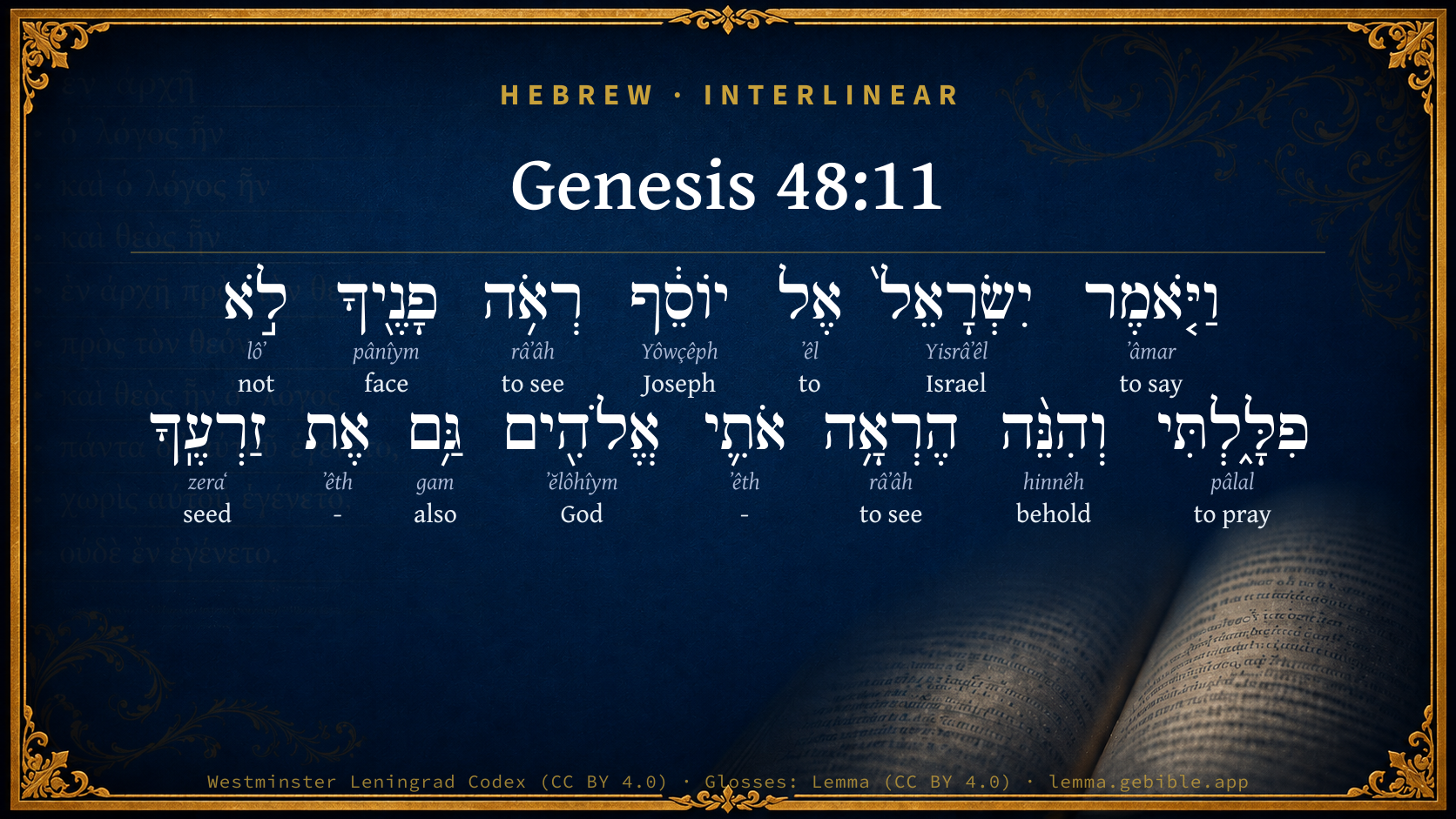
Hebrew (Westminster Leningrad Codex) Genesis 48:11 appears in the Hebrew Old Testament. The text above is from the Westminster Leningrad Codex. Each word links to its Strong’s number, a concise gloss, and parsing drawn from the Open Scriptures Hebrew Bible morphology. Click any word for its full Brown-Driver-Briggs (BDB) entry.
Download image
Cite this verse

Genesis 48:11 (World English Bible). Public Domain. Lemma interlinear Bible study tool, https://lemma.gebible.app/v/genesis/48/11.

Show BibTeX & RIS
BibTeX
RIS
English Translation
Israel said to Joseph, "I didn't think I would see your face, and, behold, God has let me see your seed also."
World English Bible · Public Domain
Download a study sheet

One document with this verse’s original text, its word-by-word gloss line, the meaning frame, cross-references with their text, attributed commentary, and full source and license credits — printable, and it pastes into notes with its structure intact.

This verse Autodidact and up

Study sheet (.html) Plain text (.txt)

A passage Seminary Student

Up to 50 verses in one chapter. A passage sheet keeps up to 6 commentary sources and 12 cross-references per verse, in the order this page ranks them, and says so on the sheet whenever that leaves anything out. Ask for a single verse and you get the Autodidact verse sheet above.

Everything on this page stays free to read, with no account — the sheet is a download of what is already on screen, not access to it.

Want to remove ads? Support Godless Engineer
Compare translations 3

The same verse in 3 English versions, stacked beneath the original-language interlinear above. Click any original word for its lexicon entry.

Each is an independent rendering of the whole verse — the interlinear is not word-aligned to these translations.

Highlighted words mark where these versions differ — a whole-verse word diff, not a word-by-word alignment.

  • World English Bible Public Domain
    Israel said to Joseph, "I didn't think I would see your face, and, behold, God has let me see your seed also."
  • King James Version Public Domain
    And Israel said unto Joseph, I had not thought to see thy face: and, lo, God hath showed me also thy seed.
  • unfoldingWord Literal Text CC BY-SA 4.0
    Then Israel said to Joseph, “I did not expect to see your face, but behold, God has let me see also your offspring!”

unfoldingWord Literal Text — © unfoldingWord, licensed CC BY-SA 4.0. Word-aligned USFM3 via Door43 (git.door43.org/unfoldingWord/en_ult).

Versions to compare (up to 4)

3 of 4 selected

Show all 18 translations

Every available English version of this verse, each an independent rendering of the whole verse.

  • World English Bible Public Domain
    Israel said to Joseph, "I didn't think I would see your face, and, behold, God has let me see your seed also."
  • Berean Standard Bible Public Domain
    “I never expected to see your face again,” Israel said to Joseph, “but now God has let me see your children as well.”
  • Majority Standard Bible Public Domain
    “I never expected to see your face again,” Israel said to Joseph, “but now God has let me see your children as well.”
  • King James Version Public Domain
    And Israel said unto Joseph, I had not thought to see thy face: and, lo, God hath showed me also thy seed.
  • American Standard Version (1901) Public Domain
    And Israel said unto Joseph, I had not thought to see thy face: and, lo, God hath let me see thy seed also.
  • Revised Version (1885) Public Domain
    And Israel said unto Joseph, I had not thought to see thy face: and, lo, God hath let me see thy seed also.
  • Geneva Bible (1599) Public Domain
    And Israel sayde vnto Ioseph, I had not thought to haue seene thy face: yet lo, God hath shewed me also thy seede.
  • Douay-Rheims (1899) Public Domain
    And said to his son: I am not deprived of seeing thee: moreover God hath shewed me thy seed.
  • Young's Literal Translation Public Domain
    and Israel saith unto Joseph, `To see thy face I had not thought, and lo, God hath shewed me also thy seed.'
  • Literal Standard Version CC BY-SA 4.0
    and Israel says to Joseph, “I had not thought [possible] to see your face, and behold, God has also showed me your seed.”
  • Unlocked Literal Bible CC BY-SA 4.0
    Israel said to Joseph, “I never expected to see your face again, but God has even allowed me to see your children.”
  • unfoldingWord Literal Text CC BY-SA 4.0
    Then Israel said to Joseph, “I did not expect to see your face, but behold, God has let me see also your offspring!”
  • Darby Bible Public Domain
    And Israel said to Joseph, I had not thought to see thy face; and behold, God has let me see also thy seed.
  • World Messianic Bible Public Domain
    Israel said to Joseph, “I didn’t think I would see your face, and behold, God has let me see your offspring also.”
  • Webster's Bible Public Domain
    And Israel said to Joseph, I had not thought to see thy face: and lo, God hath shown me also thy seed.
  • Free Bible Version CC BY-SA 4.0
    Israel said to Joseph, “I never thought I'd see your face again, and now God has even let me see your children!”
  • Bible in Basic English Public Domain
    And Israel said to Joseph, I had no hope of seeing your face again, but God in his mercy has let me see you and your children.
  • JPS Tanakh (1917) Public Domain
    And Israel said unto Joseph: 'I had not thought to see thy face; and, lo, God hath let me see thy seed also.'

Literal Standard Version (2020), Covenant Press — licensed CC BY-SA 4.0. Text via the HelloAO Bible API (eBible.org). Unlocked Literal Bible (unfoldingWord) — licensed CC BY-SA 4.0. Text via the HelloAO Bible API (eBible.org). unfoldingWord Literal Text — © unfoldingWord, licensed CC BY-SA 4.0. Word-aligned USFM3 via Door43 (git.door43.org/unfoldingWord/en_ult). Free Bible Version, Dr. Jonathan Gallagher — licensed CC BY-SA 4.0. Text via the HelloAO Bible API (eBible.org).

Word by word

More ways to search: Search by grammar → Find every occurrence → Compare this word →

Practice this passage: Drill this verse → Learn its vocabulary →

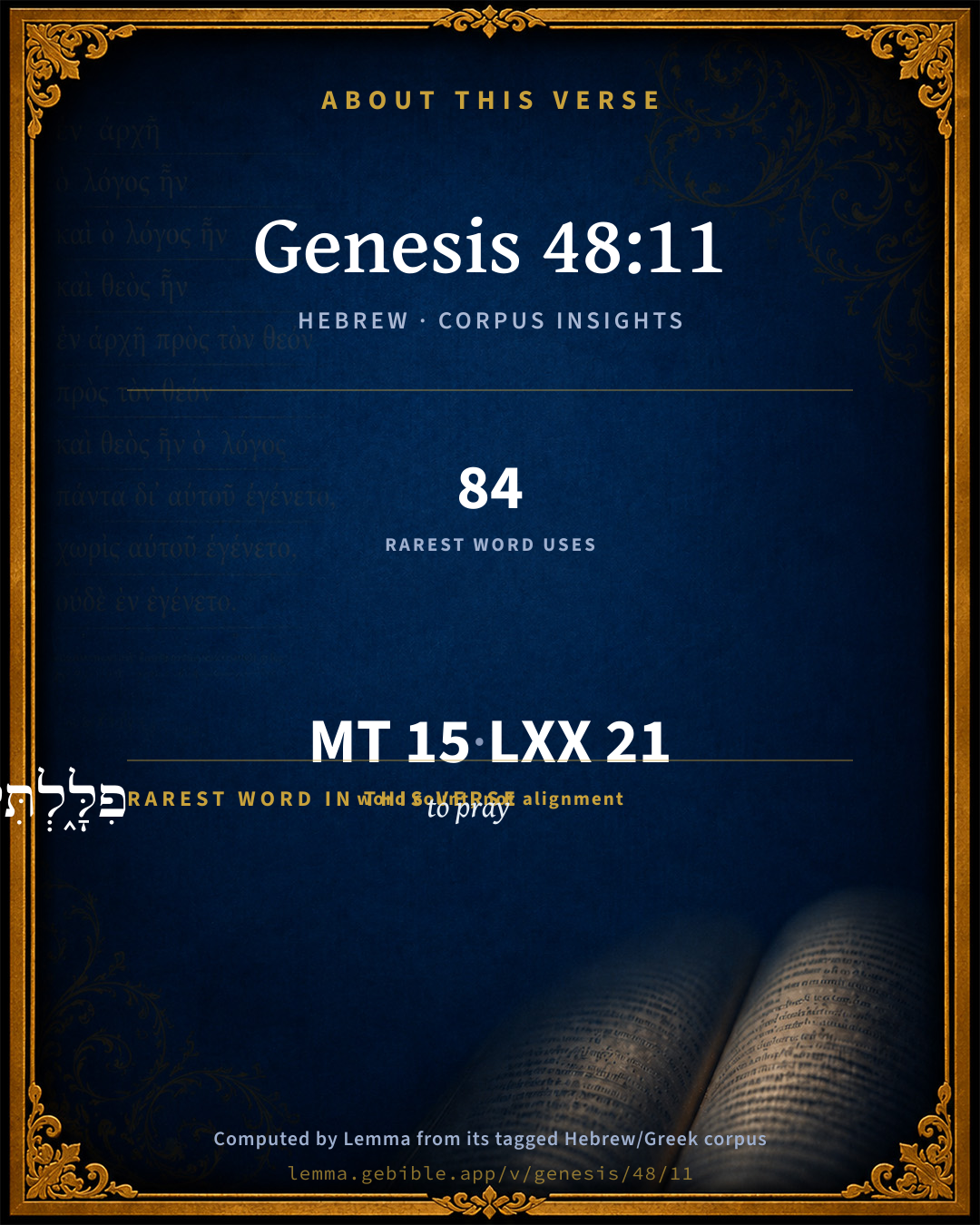
פִלָּ֑לְתִּי
pâlal
H6419
“to pray”
Verb, Piel, Perfect, 1st Person, Common, Singular
Part of Speech
Verb
Stem
Piel
Form
Perfect
Person
1st Person
Gender
Common
Number
Singular
Full BDB Definition

Origin: a primitive root

TWOT: 1776

to intervene, interpose, pray - (Piel) to mediate, judge - (Hithpael) - to intercede - to pray
  1. וַיֹּ֤אמֶר ʼâmar H559 “and · to say” Conjunction + Verb, Qal, Sequential Imperfect, 3rd Person, Masculine, Singular
  2. יִשְׂרָאֵל֙ Yisrâʼêl H3478 “Israel” Noun, Proper
  3. אֶל ʼêl H413 “to” Preposition
  4. יוֹסֵ֔ף Yôwçêph H3130 “Joseph” Noun, Proper
  5. רְאֹ֥ה râʼâh H7200 “to see” Verb, Qal, Infinitive Construct
  6. פָנֶ֖יךָ pânîym H6440 “face(s) · your” Noun, Common, Both, Plural, Construct + Suffix, Personal, 2nd Person, Masculine, Singular
  7. לֹ֣א lôʼ H3808 “not” Particle, Negative
  8. וְהִנֵּ֨ה hinnêh H2009 “and · behold” Conjunction + Particle, Demonstrative
  9. הֶרְאָ֥ה râʼâh H7200 “to see” Verb, Hiphil, Perfect, 3rd Person, Masculine, Singular
  10. אֹתִ֛י ʼêth H853 “- · me” Particle, Direct Object + Suffix, Personal, 1st Person, Common, Singular
  11. אֱלֹהִ֖ים ʼĕlôhîym H430 “God(s)” Noun, Common, Masculine, Plural, Absolute
  12. גַּ֥ם gam H1571 “also” Particle, Accusative
  13. אֶת ʼêth H853 “-” Particle, Direct Object
  14. זַרְעֶֽךָ zeraʻ H2233 “seed · your” Noun, Common, Masculine, Singular, Construct + Suffix, Personal, 2nd Person, Masculine, Singular

About this verse

These counts appear in no published source. They are computed here, from the morphology-tagged text and Lemma’s own curated glosses. What Lemma adds →

15
words
13
distinct lemmas
Pentateuch
section

Grammatical profile

  • 4 verbs
  • 5 nouns
  • 1 preposition
  • 5 particles

Verb forms

  • וַיֹּ֤אמֶר Qal · Sequential Imperfect
  • רְאֹ֥ה Qal · Infinitive Construct
  • פִלָּ֑לְתִּי Piel · Perfect
  • הֶרְאָ֥ה Hiphil · Perfect

Repetition

A word recurs within this verse — often emphatic in Hebrew:

  • רְאֹ֥ה to see H7200 ×2

Hebrew & Septuagint length

In English translation the verse runs 22 words from the Hebrew and 24 from the Septuagint (LXX English) — closely comparable.

A rough comparison of the two English renderings, which tokenize alike — not a word-level alignment.

Word counts can differ between the Hebrew and the Greek without any difference in meaning — e.g. the Hebrew direct-object marker אֵת has no separate Greek word, and Greek often adds the article ὁ.

In the original languages it is 15 Hebrew tokens and 21 Greek tokens — but the two are counted differently (Hebrew bundles its prefixes and suffixes into one token; the Greek is in lemma form), so that isn’t a like-for-like length.

Cross-references

5

Topical passages linked to Genesis 48:11 in the Treasury of Scripture Knowledge — connected by theme and wording, ordered by reader-vote popularity; previews shown in the World English Bible.

  • Ephesians 3:20 Now to him who is able to do exceedingly abundantly above all that we ask or think, according to the power that works in us,
  • Genesis 45:26 They told him, saying, "Joseph is still alive, and he is ruler over all the land of Egypt." His heart fainted, for he didn't believe them.
  • Genesis 37:33 He recognized it, and said, "It is my son's coat. An evil animal has devoured him. Joseph is without doubt torn in pieces."
  • Genesis 37:35 All his sons and all his daughters rose up to comfort him; but he refused to be comforted. He said, "For I will go down to Sheol to my son mourning." His father wept for him.
  • Genesis 42:36 Jacob, their father, said to them, "You have bereaved me of my children! Joseph is no more, Simeon is no more, and you want to take Benjamin away. All these things are against me."

Cross-references courtesy of OpenBible.info (CC BY 4.0).

Hebrew and Greek witnesses Masoretic Hebrew ↔ Greek Septuagint

The same verse in the two great witnesses to the Old Testament, shown verse-for-verse.

These are two independent witnesses, not word-aligned to each other, and the Septuagint is shown in lemma (dictionary) form.

Hebrew Genesis 48:11 Masoretic · Westminster Leningrad Codex

וַיֹּ֤אמֶר יִשְׂרָאֵל֙ אֶל יוֹסֵ֔ף רְאֹ֥ה פָנֶ֖יךָ לֹ֣א פִלָּ֑לְתִּי וְהִנֵּ֨ה הֶרְאָ֥ה אֹתִ֛י אֱלֹהִ֖ים גַּ֥ם אֶת זַרְעֶֽךָ

Israel said to Joseph, "I didn't think I would see your face, and, behold, God has let me see your seed also."

World English Bible · Public Domain

Greek LXX Genesis 48:11 Septuagint · lemma form

καί εἶπον ἰσραήλ πρός ιωσηφ ἰδού ὁ πρόσωπον σύ οὐ στερέω καί ἰδού δεικνύω ἐγώ ὁ θεός καί ὁ σπέρμα σύ

And Israel said to Joseph, Behold, I have not been deprived of seeing your face, and behold! God has showed me your seed also.

LXX2012 (modern English Septuagint) · Public Domain

On this verse, The Pulpit Commentary discusses the Septuagint’s reading. Read the note in Commentary ↓

Hebrew: Westminster Leningrad Codex (CC BY 4.0). Greek: Septuagint (public domain); English from LXX2012 (modern English Septuagint) (Public Domain). How the Septuagint differs from the Hebrew →

Targum (Aramaic paraphrase)

2

The Targum is the ancient Jewish Aramaic paraphrase of the Hebrew Scriptures — an interpretive translation, not the Hebrew text itself. Onkelos (literal) and Pseudo-Jonathan (expansive) render the Torah, and Jonathan the Prophets. Coverage is partial: where no permissively-licensed English translation exists for a verse, only the Aramaic is shown. This is verse-level text, not a word-by-word alignment to the Hebrew.

  1. Targum Onkelos Torah (Genesis–Deuteronomy)
    וַאֲמַר יִשְׂרָאֵל לְיוֹסֵף לְמֶחֱזֵי אַפָיךְ לָא סְבָרִית וְהָא אַחֲזִי יָתִי יְיָ אַף יָת בְּנָיךְ

    (no public-domain English translation for this verse)

    Targum Onkelos — Aramaic: “Onkelos Genesis” (public domain); “Onkelos Exodus” (public domain); “Onkelos Leviticus” (public domain); “Onkelos Numbers” (public domain); “Onkelos Deuteronomy” (public domain). English: “Sefaria Community Translation” (CC0 1.0 (public-domain dedication)); “J.W. Etheridge. The Targums of Onkelos and Jonathan Ben Uzziel on the Pentateuch. London: Longmans, Green, 1862” (public domain). Text via Sefaria.

  2. Targum Pseudo-Jonathan Torah (Genesis–Deuteronomy)
    וַאֲמַר יִשְרָאֵל לְיוֹסֵף מֵיחְמֵי סְבַר אַפָּךְ לָא חֲשִׁיבִית וְהָא אַחְמֵי יָתִי יְיָ אוּף יַת בְּנָךְ

    And Israel said to Joseph, To see thy face I had not reckoned, but, behold, the Lord hath also showed me thy sons.

    Targum Pseudo-Jonathan — Aramaic: “Targum Jonathan on Genesis” (public domain); “Targum Jonathan on Exodus” (public domain); “Targum Jonathan on Leviticus” (public domain); “Targum Jonathan on Numbers” (public domain); “Targum Jonathan on Deuteronomy” (public domain). English: “The Targum of Jonathan ben Uzziel, trans. J. W. Etheridge, London, 1862” (public domain). Text via Sefaria.

Commentary

Notes on Genesis 48:11 from classic Christian and Jewish commentators (each source and its license shown beneath its notes). The classic Christian expositions comment on the surrounding passage and are grouped to its opening verse, so a note may address several verses; the Jewish commentaries on the Tanakh (Rashi and others) are per-verse, so they appear only where the commentator wrote on this verse.

Lemma curates 59 commentaries, every one of them public domain or Creative Commons licensed, each selected and text-cleaned for this edition rather than reprinted as found. About our sources →

Trapp's Complete Commentary

John Trapp

Gen 48:11 And Israel said unto Joseph, I had not thought to see thy face: and, lo, God hath shewed me also thy seed.

Ver. 11. I had not thought to see thy face.] God delights to outbid the hopes of his people, and to be better to them than their deserts, than their desires, yea, than their faith. {Isa 54:2-3; Isa 54:12; Isa 54:14} As it is storied of a certain emperor, that he delighted in no undertakings so much as in those that his counsellors and captains held impossible: and he seldom miscarried. So God, Exo 15:11.

John Trapp, A Commentary or Exposition upon All the Books of the Old and New Testament (1647–1656) — public domain. Text from a community e-Sword module.

Joseph Benson's Commentary

Gen 48:11. I had not thought to see thy face — Having many years given him up for lost; and, lo, God hath showed me also thy seed! — See here, how these two good men own God in their comforts. Joseph saith, They are my sons whom God has given me — And to magnify the favour he adds, in this place of my banishment, slavery, and imprisonment. Jacob saith here, God hath showed me thy seed — Our comforts are then doubly sweet to us, when we see them coming from God’s hand.

Joseph Benson's Commentary on the Old and New Testaments (1811–1818) — public domain. Text from a community e-Sword module.

Adam Clarke's Commentary

Verse 11. I had not thought to see thy face] There is much delicacy and much tenderness in these expressions. He feels himself now amply recompensed for his long grief and trouble on account of the supposed death of Joseph, in seeing not only himself but his two sons, whom God, by an especial act of favour, is about to add to the number of his own. Thus we find that as Reuben and Simeon were heads of two distinct tribes in Israel, so were Ephraim and Manasseh; because Jacob, in a sort of sacramental way, had adopted them with equal privileges to those of his own sons.

Adam Clarke's Commentary on the Bible (1810–1826) — public domain. Text from a community e-Sword/MySword module.

The Cambridge Bible for Schools and Colleges

gen. ed. J. J. S. Perowne

11. thy seed also] This expression, like the question in Gen_48:8, seems to imply that Jacob had not before set eyes upon the sons of Joseph.

The Cambridge Bible for Schools and Colleges (gen. ed. J. J. S. Perowne; Cambridge University Press, 1878–1918) — public domain. Text from a community e-Sword module.

John Gill's Exposition

And Israel said unto Joseph, I had not thought to see thy face,.... Some years ago he never expected to have seen him any more; he had given him up for lost, as a dead man, when his sons brought him his coat dipped in blood; and by reason of the long course of years which passed before ever he heard anything of him:

and, lo, God hath showed me also thy seed; it was an additional favour to see his offspring; it can hardly be thought, that in a course of seventeen years he had been in Egypt, he had not seen them before, only he takes this opportunity, which was the last he should have of expressing his pleasure on this occasion.

John Gill's Exposition of the Whole Bible (1746–1763) — public domain (CC PDM 1.0). Text via the HelloAO Bible API.

Haydock's Catholic Bible Commentary

Deprived. Hebrew, "I did not expect; or, I durst not pray" to God for a thing which I thought impossible; I mean, the happiness of seeing thee; and lo, God, &c.

George Leo Haydock (1774–1849), Haydock's Catholic Family Bible and Commentary, 1859 edition — public domain. Excludes Psalms (Douay-Rheims chapter numbering differs from Protestant) and Deuterocanonical books (Catholic canon only).

The Pulpit Commentary

And Israel said unto Joseph, I had not thought to see thy face: and, lo, God (Elohim) hath showed me also thy seed. The first half of Israel s utterance is rendered by the LXX "Idoupou sou oujk ejsterhqhn"

The Pulpit Commentary (1880–1919), ed. H.D.M. Spence-Jones & Joseph S. Exell — public domain. Text from a community e-Sword module.

John Wesley's Explanatory Notes

I had not thought to see thy face, (having many years given him up for lost) and lo God hath shewed me also thy seed? - See here, How these two good men own God in their comforts. Joseph saith, They are my sons whom God has given me - And to magnify the favour he adds, in this place of my banishment, slavery and imprisonment. Jacob saith here, God hath shewed me thy seed - Our comforts are then doubly sweet to us, when we see them coming from God's hand.

John Wesley, Explanatory Notes Upon the Whole Bible (1754–1765) — public domain. Text via the GEBible commentary corpus.

unfoldingWord translationNotes

Door43 World Missions Community

to see your face again

Here "face" stands for the whole person. AT: "to see you again" (See: Synecdoche)

between Israel's knees

When Joseph placed his sons on Israel's lap or knees it was a sign that Israel was adopting them. This gave the children special inheritance rights from Jacob. (See: Symbolic Action)

then he bowed with his face to the earth

Joseph bowed down to show honor to his father. (See: Symbolic Action)

Manasseh in his left hand toward Israel's right hand

Joseph places the boys so that Israel will put his right hand on Manasseh. Manasseh was the oldest brother and the right hand was the sign he would receive the greater blessing. (See: Symbolic Action)

translationWords

bow

right hand

unfoldingWord translationNotes — © Distant Shores Media and the Door43 World Missions Community, licensed CC BY-SA 4.0. Source: git.door43.org/Door43/en_tn.

Rashi

Rabbi Shlomo Yitzchaki (Rashi)

לא פללתי I HAD NOT CONTEMPLATED — I had never dared to cherish the thought that I would again see your face. פללתי is an expression for thinking, like the noun in (Isaiah 16:3) “Give counsel, carry out the thought (פלילה)”.

Rashi on the Tanakh — English translations: “The Judaica Press complete Tanach with Rashi, translated by A. J. Rosenberg” (CC BY 4.0); “Pentateuch with Rashi's commentary by M. Rosenbaum and A.M. Silbermann, 1929-1934” (public domain); “The Metsudah Tanach series, Lakewood, N.J” (CC BY 4.0); and “The Book of Joshua, Metsudah Publications, 1997” (CC BY 4.0). Text via Sefaria.

Radak

Rabbi David Kimhi (Radak)

לא פללתי, related to the word ונתן בפלילים (Exodus 21,22) meaning here “I have not judged the situation and responsibility by myself but have left it to independent judges who are without prejudice.” As far as Joseph’s fate was concerned, Yaakov said that he had not arrived at definitive conclusions but had not dared hope that he would ever see him again. Some commentators relate the word פללתי to the word תפלה, prayer, in which case Yaakov was saying to Joseph that he had not prayed to G’d concerning being reunited with Joseph in this life as he had considered it a forbidden, vain prayer, i.e. uttering the Lord’s name in vain, seeing that all the evidence he had at his disposal indicated that Joseph was already dead. (compare Midrash Lekach Tov on this paragraph)

Radak on the Tanakh — English translations: “Sefaria Community Translation” (CC0 1.0 (public-domain dedication)); “Eliyahu Munk, HaChut Hameshulash” (CC BY 4.0); “Rabbi Mike Feuer, Jerusalem Anthology” (CC BY 4.0); and “R. David Kimhi on the first book of Psalms, Translated by R.G. Finch, London, 1919” (public domain). Text via Sefaria.

Lesson kit

Teaching starters — assembled from the data on this page, not authored interpretation. Every prompt links to the verse data it draws on. Edit before teaching.

Genesis, in the Pentateuch, opens this verse with 15 words (13 distinct Hebrew lemmas). Its most distinctive word is pâlal (“to pray”). A historical commentator’s framing appears above. Read the whole chapter for the surrounding context.

Discussion questions

  1. What does “to pray” (pâlal) contribute to the verse as a whole?
  2. Ephesians 3:20 shares this passage’s theme. How do the two illuminate each other?
  3. “to see” occurs 2× in this one verse. What is the effect of the repetition?
  4. These translations render this verse differently; the difference is in the English rendering, not the original. What questions does that raise?
  5. The verb «וַיֹּ֤אמֶר» is Qal Sequential Imperfect. How does its form color the action?
  6. Reading how Trapp's Complete Commentary and Joseph Benson's Commentary read this verse, where do the two commentators agree and where do they part?

Things to notice

Reading settings

Reading text

Shown beneath each verse's original-language words.

Old Testament
Old Testament edition

Read the OT as the Masoretic Hebrew (MT) or the Greek Septuagint (LXX).

English shown for the Greek Septuagint (in the Hebrew ↔ Greek comparison).

Comparing translations? Open the Compare panel on any verse page to stack up to four side by side.