
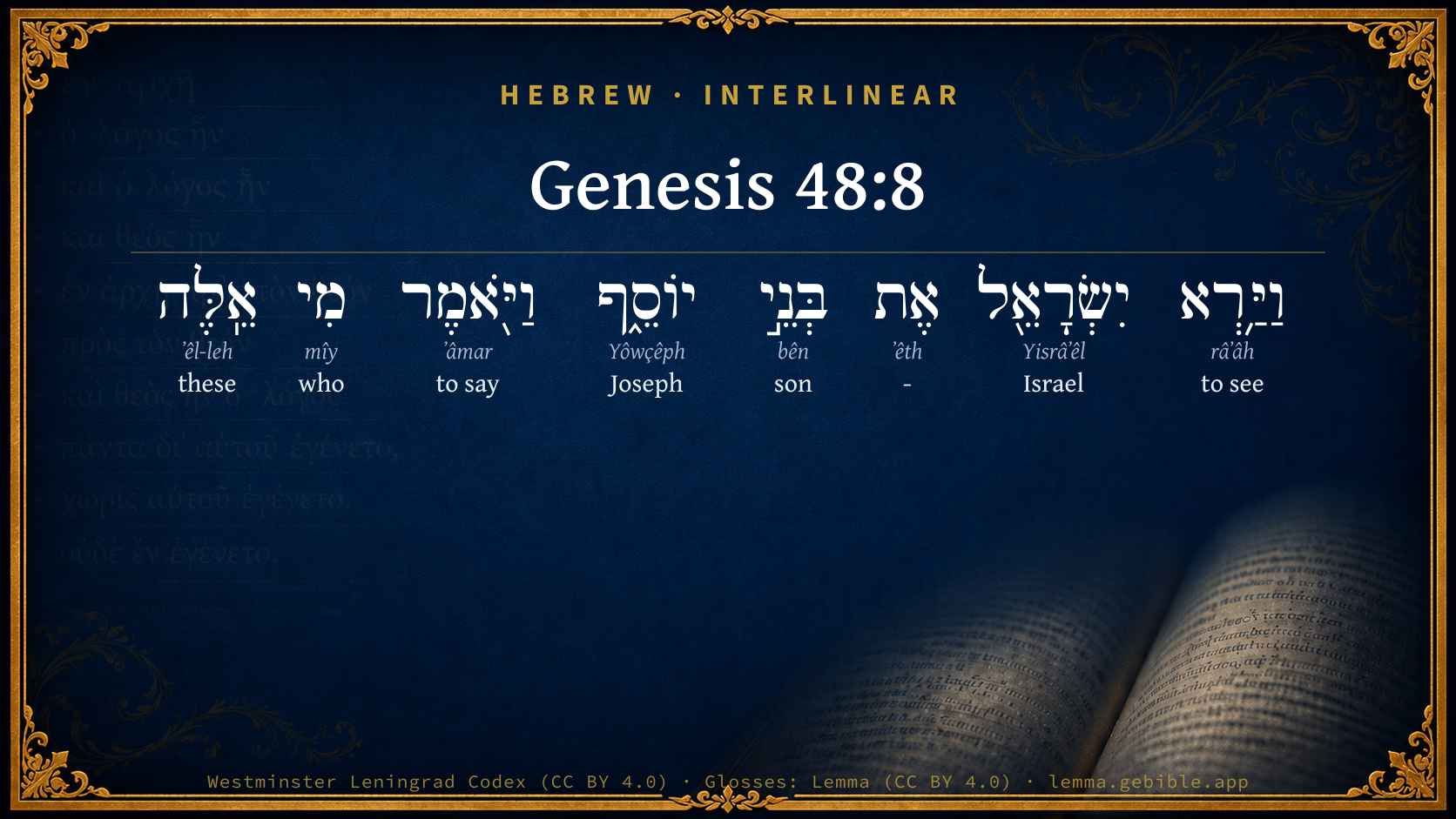
Genesis 48:8

Hebrew (Westminster Leningrad Codex) Genesis 48:8 appears in the Hebrew Old Testament. The text above is from the Westminster Leningrad Codex. Each word links to its Strong’s number, a concise gloss, and parsing drawn from the Open Scriptures Hebrew Bible morphology. Click any word for its full Brown-Driver-Briggs (BDB) entry.
Download image
Cite this verse

Genesis 48:8 (World English Bible). Public Domain. Lemma interlinear Bible study tool, https://lemma.gebible.app/v/genesis/48/8.

Show BibTeX & RIS
BibTeX
RIS
English Translation
Israel saw Joseph's sons, and said, "Who are these?"
World English Bible · Public Domain
Download a study sheet

One document with this verse’s original text, its word-by-word gloss line, the meaning frame, cross-references with their text, attributed commentary, and full source and license credits — printable, and it pastes into notes with its structure intact.

This verse Autodidact and up

Study sheet (.html) Plain text (.txt)

A passage Seminary Student

Up to 50 verses in one chapter. A passage sheet keeps up to 6 commentary sources and 12 cross-references per verse, in the order this page ranks them, and says so on the sheet whenever that leaves anything out. Ask for a single verse and you get the Autodidact verse sheet above.

Everything on this page stays free to read, with no account — the sheet is a download of what is already on screen, not access to it.

Want to remove ads? Support Godless Engineer
Compare translations 3

The same verse in 3 English versions, stacked beneath the original-language interlinear above. Click any original word for its lexicon entry.

Each is an independent rendering of the whole verse — the interlinear is not word-aligned to these translations.

Highlighted words mark where these versions differ — a whole-verse word diff, not a word-by-word alignment.

  • World English Bible Public Domain
    Israel saw Joseph's sons, and said, "Who are these?"
  • King James Version Public Domain
    And Israel beheld Joseph's sons, and said, Who are these?
  • unfoldingWord Literal Text CC BY-SA 4.0
    Then Israel saw the sons of Joseph and said, “Who these?”

unfoldingWord Literal Text — © unfoldingWord, licensed CC BY-SA 4.0. Word-aligned USFM3 via Door43 (git.door43.org/unfoldingWord/en_ult).

Versions to compare (up to 4)

3 of 4 selected

Show all 18 translations

Every available English version of this verse, each an independent rendering of the whole verse.

  • World English Bible Public Domain
    Israel saw Joseph's sons, and said, "Who are these?"
  • Berean Standard Bible Public Domain
    When Israel saw the sons of Joseph, he asked, “Who are these?”
  • Majority Standard Bible Public Domain
    When Israel saw the sons of Joseph, he asked, “Who are these?”
  • King James Version Public Domain
    And Israel beheld Joseph's sons, and said, Who are these?
  • American Standard Version (1901) Public Domain
    And Israel beheld Joseph's sons, and said, Who are these?
  • Revised Version (1885) Public Domain
    And Israel beheld Joseph’s sons, and said, Who are these?
  • Geneva Bible (1599) Public Domain
    Then Israel beheld Iosephs sonnes and sayd, Whose are these?
  • Douay-Rheims (1899) Public Domain
    Then seeing his sons, he said to him: Who are these?
  • Young's Literal Translation Public Domain
    And Israel seeth the sons of Joseph, and saith, `Who `are' these?'
  • Literal Standard Version CC BY-SA 4.0
    And Israel sees the sons of Joseph and says, “Who [are] these?”
  • Unlocked Literal Bible CC BY-SA 4.0
    When Israel saw Joseph's sons, he said, “Whose are these?”
  • unfoldingWord Literal Text CC BY-SA 4.0
    Then Israel saw the sons of Joseph and said, “Who these?”
  • Darby Bible Public Domain
    And Israel beheld Joseph's sons, and said, Who are these?
  • World Messianic Bible Public Domain
    Israel saw Joseph’s sons, and said, “Who are these?”
  • Webster's Bible Public Domain
    And Israel beheld Joseph's sons, and said, Who are these?
  • Free Bible Version CC BY-SA 4.0
    Israel saw Joseph's sons and said, “So these are your sons?”
  • Bible in Basic English Public Domain
    Then Israel, looking at Joseph's sons, said, Who are these?
  • JPS Tanakh (1917) Public Domain
    And Israel beheld Joseph's sons, and said: 'Who are these?'

Literal Standard Version (2020), Covenant Press — licensed CC BY-SA 4.0. Text via the HelloAO Bible API (eBible.org). Unlocked Literal Bible (unfoldingWord) — licensed CC BY-SA 4.0. Text via the HelloAO Bible API (eBible.org). unfoldingWord Literal Text — © unfoldingWord, licensed CC BY-SA 4.0. Word-aligned USFM3 via Door43 (git.door43.org/unfoldingWord/en_ult). Free Bible Version, Dr. Jonathan Gallagher — licensed CC BY-SA 4.0. Text via the HelloAO Bible API (eBible.org).

Word by word

More ways to search: Search by grammar → Find every occurrence → Compare this word →

Practice this passage: Drill this verse → Learn its vocabulary →

About this verse

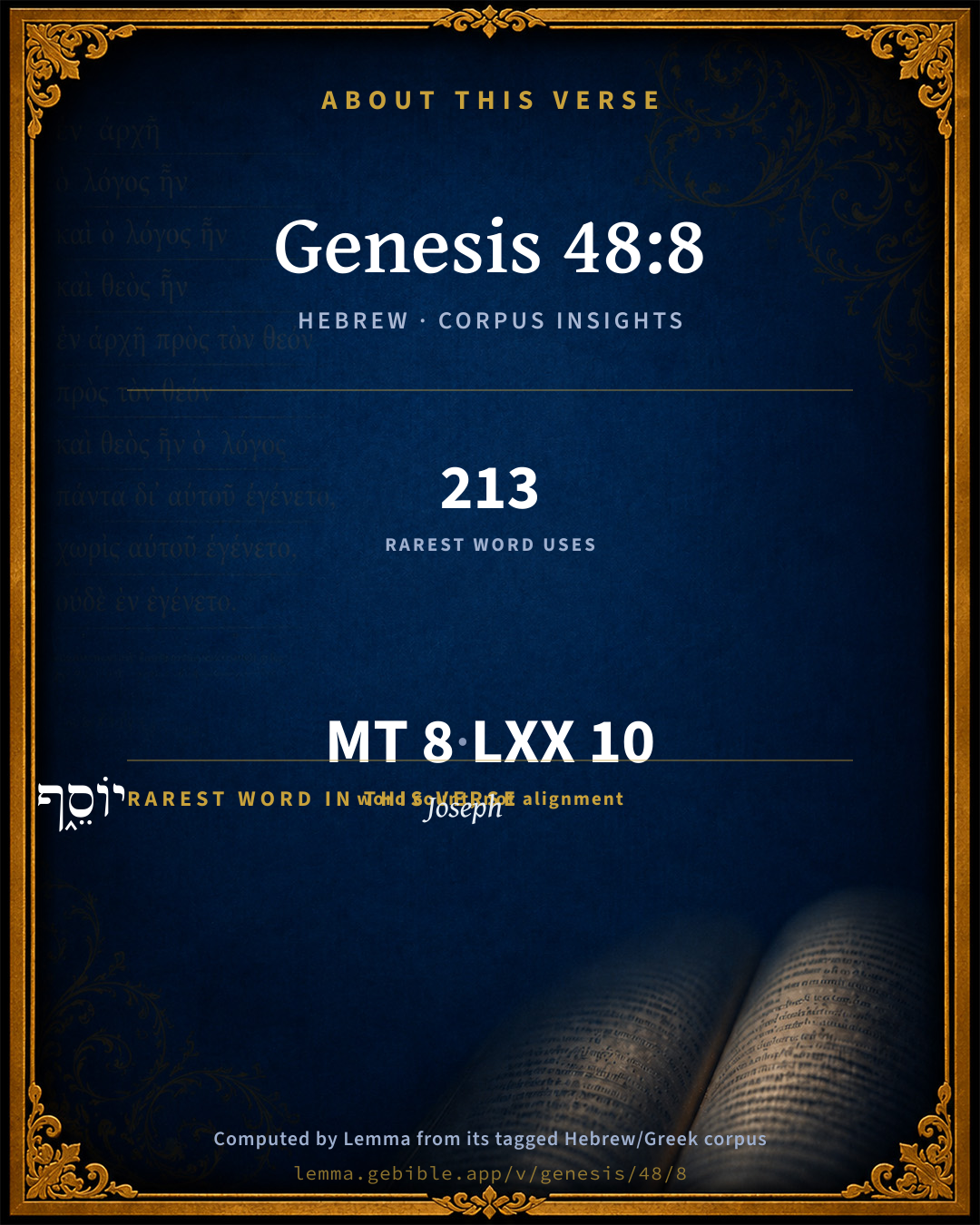
These counts appear in no published source. They are computed here, from the morphology-tagged text and Lemma’s own curated glosses. What Lemma adds →

8
words
8
distinct lemmas
Pentateuch
section

Grammatical profile

  • 2 verbs
  • 3 nouns
  • 1 pronoun
  • 2 particles

Verb forms

  • וַיַּ֥רְא Qal · Sequential Imperfect
  • וַיֹּ֖אמֶר Qal · Sequential Imperfect

Hebrew & Septuagint length

In English translation the verse runs 9 words from the Hebrew and 15 from the Septuagint (LXX English) — the Septuagint runs noticeably longer here. See the side-by-side →

A rough comparison of the two English renderings, which tokenize alike — not a word-level alignment.

Word counts can differ between the Hebrew and the Greek without any difference in meaning — e.g. the Hebrew direct-object marker אֵת has no separate Greek word, and Greek often adds the article ὁ.

In the original languages it is 8 Hebrew tokens and 10 Greek tokens — but the two are counted differently (Hebrew bundles its prefixes and suffixes into one token; the Greek is in lemma form), so that isn’t a like-for-like length.

Hebrew and Greek witnesses Masoretic Hebrew ↔ Greek Septuagint

The same verse in the two great witnesses to the Old Testament, shown verse-for-verse.

Here the Septuagint runs noticeably longer than the Hebrew — LXX2012 (modern English Septuagint) 15 words vs World English Bible 9. A rough length comparison of the two English translations, not a word-level alignment — read both below.

These are two independent witnesses, not word-aligned to each other, and the Septuagint is shown in lemma (dictionary) form.

Hebrew Genesis 48:8 Masoretic · Westminster Leningrad Codex

וַיַּ֥רְא יִשְׂרָאֵ֖ל אֶת בְּנֵ֣י יוֹסֵ֑ף וַיֹּ֖אמֶר מִי אֵֽלֶּה

Israel saw Joseph's sons, and said, "Who are these?"

World English Bible · Public Domain

Greek LXX Genesis 48:8 Septuagint · lemma form

ὁράω δέ ἰσραήλ ὁ υἱός ιωσηφ εἶπον τίς σύ οὗτος

And when Israel saw the sons of Joseph, he said, Who are these to you?

LXX2012 (modern English Septuagint) · Public Domain

On this verse, The Preacher's Complete Homiletical Commentary discusses the Septuagint’s reading. Read the note in Commentary ↓

Hebrew: Westminster Leningrad Codex (CC BY 4.0). Greek: Septuagint (public domain); English from LXX2012 (modern English Septuagint) (Public Domain). How the Septuagint differs from the Hebrew →

Targum (Aramaic paraphrase)

2

The Targum is the ancient Jewish Aramaic paraphrase of the Hebrew Scriptures — an interpretive translation, not the Hebrew text itself. Onkelos (literal) and Pseudo-Jonathan (expansive) render the Torah, and Jonathan the Prophets. Coverage is partial: where no permissively-licensed English translation exists for a verse, only the Aramaic is shown. This is verse-level text, not a word-by-word alignment to the Hebrew.

  1. Targum Onkelos Torah (Genesis–Deuteronomy)
    וַחֲזָא יִשְׂרָאֵל יָת בְּנֵי יוֹסֵף וַאֲמַר מַן אִלֵּין

    (no public-domain English translation for this verse)

    Targum Onkelos — Aramaic: “Onkelos Genesis” (public domain); “Onkelos Exodus” (public domain); “Onkelos Leviticus” (public domain); “Onkelos Numbers” (public domain); “Onkelos Deuteronomy” (public domain). English: “Sefaria Community Translation” (CC0 1.0 (public-domain dedication)); “J.W. Etheridge. The Targums of Onkelos and Jonathan Ben Uzziel on the Pentateuch. London: Longmans, Green, 1862” (public domain). Text via Sefaria.

  2. Targum Pseudo-Jonathan Torah (Genesis–Deuteronomy)
    וַחֲמָא יִשְרָאֵל יַת בְּנוֹי דְיוֹסֵף וַאֲמַר מִן מַאן אִתְיְלִידוּ לָךְ אִלֵין

    And Israel looked at the sons of Joseph and said, From whom are these born to thee?

    Targum Pseudo-Jonathan — Aramaic: “Targum Jonathan on Genesis” (public domain); “Targum Jonathan on Exodus” (public domain); “Targum Jonathan on Leviticus” (public domain); “Targum Jonathan on Numbers” (public domain); “Targum Jonathan on Deuteronomy” (public domain). English: “The Targum of Jonathan ben Uzziel, trans. J. W. Etheridge, London, 1862” (public domain). Text via Sefaria.

Commentary

Notes on Genesis 48:8 from classic Christian and Jewish commentators (each source and its license shown beneath its notes). The classic Christian expositions comment on the surrounding passage and are grouped to its opening verse, so a note may address several verses; the Jewish commentaries on the Tanakh (Rashi and others) are per-verse, so they appear only where the commentator wrote on this verse.

Lemma curates 59 commentaries, every one of them public domain or Creative Commons licensed, each selected and text-cleaned for this edition rather than reprinted as found. About our sources →

Trapp's Complete Commentary

John Trapp

Gen 48:8 And Israel beheld Joseph’s sons, and said, Who [are] these?

Ver. 8. Who are these?] Here Jacob, seeing Joseph’s two sons, and now first understanding who they were, breaks off his speech to Joseph, till the two last verses of the chapter, and starts blessing his sons; teaching us to be "ready to every good word and work," {Tit 3:1} laying hold of every hint that God puts into our hands, accounting it a mercy that we may have opportunity.

John Trapp, A Commentary or Exposition upon All the Books of the Old and New Testament (1647–1656) — public domain. Text from a community e-Sword module.

The Biblical Illustrator

Joseph S. Exell

Gen_48:8-14

Israel beheld Josephs sons

Lessons

1.

Prudence in good men may divert nature from the remembrance of sad events. About Rachel.

2. Weak nature may see in part that which it doth not discern. So Jacob.

3. Reason suggests inquiry to know what sight doth not discern (Gen_48:8).

4. Sons in strength should help the weakness of aged parents. So Joseph to his father.

5. It concerns fathers to own their children especially in order to a blessing. So Joseph his.

6. Godly parents account their children Gods gift unto them. So Joseph.

7. It is a mercy remarkable to have children for blessing in a strange place.

8. Gracious fathers desire their childrens children to bless them (Gen_48:9).

9. Old age makes the saints subject to the same infirmities as other men. So to Jacob.

10. Dimness of sight is a usual symptom of old age.

11. Weakness in sight makes mistakes that need direction in the holiest men.

12. Good fathers yield to the desires of bringing children to them that can bless them.

13. Kisses and embracings are not unseemly from holy ancestors to their seeds seed in order to blessing (Gen_48:10).

14. It is meet for the holy ancestors to acquaint the sons of Gods dealings, with them.

15. Hopelessness of mercy with good souls makes them remember it more sweetly.

16. Gods mercies sometimes over-reach hope and expectation of His people.

17. Saints delight to show their over-abounding mercies to His praise (Gen_48:11).

18. Suitable motions to dispose for a ministerial blessing is but meet.

19. Filial obeisance in honour of parents is a just duty in expectation of a blessing (Gen_48:12).

20. There are right-hand and left-hand blessings, which God giveth by His ministers, greater and less.

21. Good men may aim one to the right, and another to the left.hand blessing, whom God changeth.

22. It is needful to come near So the ministers of blessing if men desire to have it (Gen_48:13). (G. Hughes, B. D.)

The Biblical Illustrator, edited by Joseph S. Exell (c. 1880s–1900s) — public domain. Text from a community e-Sword module.

The Preacher's Complete Homiletical Commentary

Joseph S. Exell (gen. ed.)

CRITICAL NOTES.—

Gen_48:12. And Joseph brought them out from between his knees.] “His,” i.e., Jacob’s. He was in a sitting posture, and in embracing them had drawn them between his knees.—

Gen_48:14. And Israel stretched out his right hand, and laid it upon Ephraim’s head.] This is the first mention of the imposition of hands in blessing. Also used for the investiture of office. In both senses, retained by the Christian Church (Num_27:18; Num_27:23; Deu_24:9; Mat_19:13; Act_6:6; Act_8:17). Guiding his hands wittingly. The LXX, Vulgate, and Syriac have, he changed, or crossed his hands. The expression denotes a conscious and intelligent purpose.—

Gen_48:15. And he blessed Joseph.] In Ephraim and Manasseh, his representatives. The two are comprehended in the dying blessing of Jacob (Gen_49:22); and of Moses (Deu_33:13, etc.). The God which fed me. “Fed,” i.e., guided and tended me as a shepherd (Psalms 23; Psa_28:9).—

Gen_48:16. The angel.] The angel of God’s presence (Isa_63:9); the Covenant angel. Redeemed me from all evil. Heb. Goel: the same as the word used for “Redeemer” in Job_19:25. And let my name be named on them, and the names of my fathers, Abraham and Isaac. “My name,” i.e. Israel; and let them be counted Abraham’s seed and Isaac’s. There is special reference to the blessing of the Divine promise on the seed of Abraham and Isaac (Gen_21:12). (Alford.)—

Gen_48:20. In thee shall Israel bless.] “The tribe of Joseph was only regarded as an example of prosperity for the rest of the Hebrews, whereas the Israelites were viewed as the cause of blessing for all the other nations.” (Kalisch.)—

MAIN HOMILETICS OF THE PARAGRAPH—Gen_48:8-20

THE BLESSING OF EPHRAIM AND MANASSEH

I. Its nature and property.

1. They were blessed in the person of Joseph. He is blessed in his sons. (Gen_48:15; Gen_48:20.) The principle is recognised of blessing mankind in the name and for the sake of another.

2. With the covenant blessing. Not with that of the gods of Egypt, though he had cause to be grateful to that nation. He would have his children to know the true fount of blessedness. He invoked the blessing of the God of his fathers. (Gen_48:15.) The assurance that others have shared the gifts of grace with us is a support to our faith. We of the Church belong to a holy nation, which has a great and venerable past.

3. With the blessing of which he himself had experience. “The God which fed me all my life long until this day.” (Gen_48:15.) He felt that God had tended and cared for him like a shepherd. This speech was dear to all the patriarchs, and was a favourite image with David and the prophets. In Jacob’s lips, the figure is singularly appropriate, for he remembered his shepherd life with Laban. Jacob also invoked the blessing of “the angel which redeemed him from all evil.” This was that covenant angel with whom he wrestled, even God appearing as his Redeemer. The chief aspect under which he contemplates God is that of one who rescues from evil—“the Deliverer.” (Rom_11:26.) This idea is represented in its various forms by the words “Kinsman,” “Redeemer,” “Vindicator,” “Rescuer,” or “Avenger.” (Isa_49:26; Isa_43:1; Exo_6:6; Psa_19:14; Psa_103:4; Jer_50:34; Hos_13:14; Job_19:25.)

4. With a different blessing for each. He bestows the larger blessing upon the younger. (Gen_48:19.)

II. Its outward form. It was conveyed by the imposition of hands. (Gen_48:14.) The blessing was not merely a wish or a hope, but a reality. This laying on of hands was the outward means or symbol of its conveyance. Outward forms impress, they steady the mind, and assist contemplation. The blessing was as real as the outward act which accompanied it, the reality of nature leading on to the reality of grace.

III. Its warrant.

1. The covenant position in which God had placed him. He stood with his fathers, Abraham and Isaac, in the same covenant relation with God. (Gen_48:15-16.)

2. The act was divinely directed. Old Jacob crossed his hands, and thus in bestowing the blessing reversed the order of nature. (Gen_48:14; Gen_48:17.) He refused to be corrected by Joseph, for though his sight was dim, his spiritual eye discerned the will of God. He guided his hands “wittingly,” with full knowledge of the decree of the Most High. God, who distributes His gifts as He will, prefers the younger to the elder. Nature and grace often take cross directions. Jacob had spiritual insight and foresight. He was a true prophet of God, and this was his warrant for that great act of faith when he “blessed both the sons of Joseph.” (Heb_11:21).

SUGGESTIVE COMMENTS ON THE VERSES

Gen_48:8-9. The dying hour must have made an impression on those young men. In death itself there is nothing naturally instructive; but in this death there was simplicity; they saw the sight of an old man gathered ripe unto his fathers, and they would remember in their gaiety and strength what all life at last must come to.—(Robertson).

Gen_48:10. Perhaps this might remind Jacob of his conduct to his old blind father, Isaac. In him we see all the powers of life fading, and we are tempted to say, Can this live for ever? The eye cannot see God, therefore the eye fails; the ear cannot hear Him, therefore it is filled with dust; but faith and love, the things that are to survive the grave, exist in their strength up to the grave.—(Robertson).

Gen_48:11. How much better is God to us than our fears! Only let us wait with faith and patience, and our desponding thoughts will be turned into songs of praise.—(Fuller).

God delights to outbid the hopes of His people, and to be better to them than their deserts, than their desires, yea, than their faith (Isa_54:2-3; Isa_54:12; Isa_54:14). As it is storied of a certain emperor, that he delighted in no undertakings so much as in those that his counsellors and captains held impossible, and he seldom miscarried. So God—Exo_15:11.—(Trapp).

Gen_48:11-14. As a man and a father Jacob would have been of the same mind with Joseph, but as a prophet he must give the richest blessing to him who was to partake most richly of the blessings of heaven. The appearance is as if his hands knew what they were about; they seemed to move themselves intelligently; they performed the office of the eye.—(Bush).

Joseph did this for the best; but “God only wise” had otherwise ordered it. We many times think we do well, when it proves much otherwise. “Lean not therefore to thine own understanding,” saith the wise man (Pro_3:5); but make out to him that “dwells with prudence.” (Pro_8:12.)—(Trapp.)

Gen_48:15. This is the highest praise that can be given to ancestors; this is the crown of all commendation, to have walked with God as a man walketh with his friend. This is better than a thousand escutcheons. “The God which fed me all my life long.” Jacob looks beyond all second causes, and sees, as once at Bethel, God on the top of the ladder. (Genesis 28.)—(Trapp.)

The Lord had been his shepherd, had kept and led him, as well as supplied all his wants. The Lord fed him when he was in his father’s house; when he procured his food by toil at Laban’s house; the Lord fed him even when in Egypt his beloved son supplied all his wants.—(Bush.)

Gen_48:16. This is the all-sufficient Friend who wards off evil by himself satisfying the demands of justice and resisting the devices of malice. There is a beautiful propriety of feeling in Jacob ascribing to his father the walking before God, while he thankfully acknowledges the grace of the Quickener and Justifier to himself. The Angel is explicitly applied to the Supreme Being in this ministerial function. The God is the emphatic description of the true, living God, as contra-distinguished from all false gods. Jacob’s threefold periphrases is intended to describe the one God, who wills, works, and wards. And let my name be named on them. Let them be counted among my immediate sons, and let them be related to Abraham and Isaac, as my other sons are. This is the only thing that is special in the blessing. Let them grow into a multitude. The word “grow” in the original refers to the spawning or extraordinary increase of the finny tribe. The after history of Ephraim and Manasseh will be found to correspond with this special prediction.—(Murphy.)

God’s people are said to have His name called upon them (Deu_28:11,—Heb. “That the name of the Lord is called upon thee.” Let us endeavour to be an honour and a praise to that worthy name by which we are called.—(Bush).

Gen_48:17-19. Here are a couple of Holy prophets differing in their judgments; yet not about the substance of the blessing, but the circumstance of it. Wonder not though such things still fall out in the true Church, and the doctors sometimes divided in points less material, and that touch not the foundation.—(Trapp).

One reason why the Most High does not follow the rules which men would prescribe to Him in the distribution of His favours undoubtedly is, that we may learn not to glory in the flesh, but in the Lord. Were He to dispense His bounties according to such rules as might appear reasonable to us, high thoughts of human worth would be apt to be cherished, and losing our impressions of Divine sovereignty, we should be tempted to “sacrifice to our own net, and burn incense to our own drag.”—(Bush).

Gen_48:20. How God sometimes prefers the younger to the elder, we may see in the case of Shem who was preferred to Japheth, in the case of Isaac who was preferred to Ishmael, of Jacob who was preferred to Esau, of Judah and Joseph who were preferred to Reuben, of Moses who was preferred to Aaron, and finally, of David, who was preferred to all his brethren.

God make thee as Ephraim and Manasseh. A form of speech to this day in use among the Jews. As they greet with it men and their young companions, so it is also said to wives and young women: God make thee as Sarah and Rebecca.—(Lange.)

The Preacher's Complete Homiletical Commentary (gen. ed. Joseph S. Exell; Funk & Wagnalls, c. 1892) — public domain (pre-1929). A full-Bible homiletical/sermon-outline anthology covering 65 of 66 books (2 John is absent from the source module). Text from a community e-Sword module.

Keil & Delitzsch

C. F. Keil & F. Delitzsch

The Blessing of Ephraim and Manasseh. - Gen 48:8. Jacob now for the first time caught sight of Joseph's sons, who had come with him, and inquired who they were; for "the eyes of Israel were heavy (dim) with age, so that he could not see well" (Gen 48:10). The feeble old man, too, may not have seen the youths for some years, so that he did not recognise them again. On Joseph's answering, "My sons whom God hath given he mere," he replied, "Bring them to me then (קחם־נא), that I may bless them;" and he kissed and embraced them, when Joseph had brought them near, expressing his joy, that whereas he never expected to see Joseph's face again, God had permitted him to see his seed. ראה for ראות, like עשׂו (Gen 31:28). עלּל: to decide; here, to judge, to think.

Keil & Delitzsch — Biblical Commentary on the Old Testament (1861–1891) — public domain (CC PDM 1.0). Text via the HelloAO Bible API. (Old Testament only.)

Matthew Henry's Commentary

Here is, I. The blessing with which Jacob blessed the two sons of Joseph, which is the more remarkable because the apostle makes such particular mention of it (Heb 11:21), while he says nothing of the blessing which Jacob pronounced on the rest of his sons, though that also was done in faith. Observe here,

1. Jacob was blind for age, Gen 48:10. It is one of the common infirmities of old age. Those that look out at the windows are darkened, Ecc 12:3. It is folly to walk in the sight of our eyes, and to suffer our hearts to go after them, while we know death will shortly close them, and we do not know but some accident between us and death may darken them. Jacob, like his father before him, when he was old, was dim-sighted. Note, (1.) Those that have the honour of age must therewith be content to take the burden of it. (2.) The eye of faith may be very clear even when the eye of the body is very much clouded.

2. Jacob was very fond of Joseph's sons: He kissed them and embraced them, Gen 48:10. It is common for old people to have a very particular affection for their grand-children, perhaps more than they had for their own children when they were little, which Solomon gives a reason for (Pro 17:6), Children's children are the crown of old men. With what satisfaction does Jacob say here (Gen 48:11), I had not thought to see thy face (having many years given him up for lost), and, lo, God has shown me also thy seed! See here, (1.) How these two good men own God in their comforts. Joseph says (Gen 48:9), They are my sons whom God has given me, and, to magnify the favour, he adds, "In this place of my banishment, slavery, and imprisonment." Jacob says here, God has shown me thy seed. Our comforts are then doubly sweet to us when we see them coming from God's hand. (2.) How often God, in his merciful providences, outdoes our expectations, and thus greatly magnifies his favours. He not only prevents our fears, but exceeds our hopes. We may apply this to the promise which is made to us and to our children. We could not have thought that we should have been taken into covenant with God ourselves, considering how guilty and corrupt we are; and yet, lo, he has shown us our seed also in covenant with him.

3. Before he entails his blessing, he recounts his experiences of God's goodness to him. He had spoken (Gen 48:3) of God's appearing to him. The particular visits of his grace, and the special communion we have sometimes had with him, ought never to be forgotten. But (Gen 48:15, Gen 48:16) he mentions the constant care which the divine Providence had taken of him all his days. (1.) He had fed him all his life long unto this day, Gen 48:15. Note, As long as we have lived in this world we have had continual experience of God's goodness to us, in providing for the support of our natural life. Our bodies have called for daily food, and no little has gone to feed us, yet we have never wanted food convenient. He that has fed us all our life long surely will not fail us at last. (2.) He had by his angel redeemed him from all evil, Gen 48:16. A great deal of hardship he had known in his time, but God had graciously kept him from the evil of his troubles. Now that he was dying he looked upon himself as redeemed from all evil, and bidding an everlasting farewell to sin and sorrow. Christ, the Angel of the covenant, is he that redeems us from all evil, Ti2 4:18. Note, [1.] It becomes the servants of God, when they are old and dying, to witness for our God that they have found him gracious. [2.] Our experiences of God's goodness to us are improvable, both for the encouragement of others to serve God, and for encouragement to us in blessing them and praying for them.

4. When he confers the blessing and name of Abraham and Isaac upon them he recommends the pattern and example of Abraham and Isaac to them, Gen 48:15. He calls God the God before whom his fathers Abraham and Isaac walked, that is, in whom they believed, whom they observed and obeyed, and with whom they kept up communion in instituted ordinances, according to the condition of the covenant. Walk before me, Gen 17:1. Note, (1.) Those that would inherit the blessing of their godly ancestors, and have the benefit of God's covenant with them, must tread in the steps of their piety. (2.) It should recommend religion and the service of God to us that God was the God of our fathers, and that they had satisfaction in walking before him.

5. In blessing them, he crossed hands. Joseph placed them so as that Jacob's right hand should be put on the head of Manasseh the elder, Gen 48:12, Gen 48:13. But Jacob would put it on the head of Ephraim the younger, Gen 48:14. This displeased Joseph, who was willing to support the reputation of his first-born, and would therefore have removed his father's hands, Gen 48:17, Gen 48:18. But Jacob gave him to understand that he know what he did, and that he did it not by mistake, nor in a humour, nor from a partial affection to one more than the other, but from a spirit of prophecy, and in compliance with the divine counsels. Manasseh should be great, but truly Ephraim should be greater. When the tribes were mustered in the wilderness, Ephraim was more numerous than Manasseh, and had the standard of that squadron (Num 1:32, Num 1:33, Num 1:35; Num 2:18, Num 2:20), and is named first, Psa 80:2. Joshua was of that tribe, so was Jeroboam. The tribe of Manasseh was divided, one half on one side Jordan, the other half on the other side, which made it the less powerful and considerable. In the foresight of this, Jacob crossed hands. Note. (1.) God, in bestowing his blessings upon his people, gives more to some than to others, more gifts, graces, and comforts, and more of the good things of this life. (2.) He often gives most to those that are least likely. He chooses the weak things of the world; raises the poor out of the dust. Grace observes not the order of nature, nor does God prefer those whom we think fittest to be preferred, but as it pleases him. It is observable how often God, by the distinguishing favours of his covenant, advanced the younger above the elder, Abel above Cain, Shem above Japheth, Abraham above Nahor and Haran, Isaac above Ishmael, Jacob above Esau; Judah and Joseph were preferred before Reuben, Moses before Aaron, David and Solomon before their elder brethren. See Sa1 16:7. He tied the Jews to observe the birthright (Deu 21:17), but he never tied himself to observe it. Some make this typical of the preference given to the Gentiles above the Jews; the Gentile converts were much more numerous than those of the Jews. See Gal 4:27. Thus free grace becomes more illustrious.

II. The particular tokens of his favour to Joseph. 1. He left with him the promise of their return out of Egypt, as a sacred trust: I die, but God shall be with you, and bring you again, Gen 48:21. Accordingly, Joseph, when he died, left it with his brethren, Gen 50:24. This assurance was given them, and carefully preserved among them, that they might neither love Egypt too much when it favoured them, nor fear it too much when it frowned upon them. These words of Jacob furnish us with comfort in reference to the death of our friends: They die; but God shall be with us, and his gracious presence is sufficient to make up the loss: they leave us, but he will never fail us. Further, He will bring us to the land of our fathers, the heavenly Canaan, whither our godly fathers have gone before us. If God be with us while we stay behind in this world, and will receive us shortly to be with those that have gone before to a better world, we ought not to sorrow as those that have no hope. 2. He bestowed one portion upon him above his brethren, Gen 48:22. The lands bequeathed are described to be those which he took out of the hand of the Amorite with his sword, and with his bow. He purchased them first (Jos 24:32), and, it seems, was afterwards disseized of them by the Amorites, but retook them by the sword, repelling force by force, and recovering his right by violence when he could not otherwise recover it. These lands he settled upon Joseph; mention is made of this grant, Joh 4:5. Pursuant to it, this parcel of ground was given to the tribe of Ephraim as their right, and the lot was never cast upon it; and in it Joseph's bones were buried, which perhaps Jacob had an eye to as much as to any thing in this settlement. Note, It may sometimes be both just and prudent to give some children portions above the rest; but a grave is that which we can most count upon as our own in this earth.

Matthew Henry's Commentary on the Whole Bible (1708–1710) — public domain (CC PDM 1.0). Text via the HelloAO Bible API.

Adam Clarke's Commentary

Verse 8. Who are these?] At Ge 48:10 it is said, that Jacob's eyes were dim for age, that he could not see - could not discern any object unless it were near him; therefore, though he saw Ephraim and Manasseh, yet he could not distinguish them till they were brought nigh unto him.

Adam Clarke's Commentary on the Bible (1810–1826) — public domain. Text from a community e-Sword/MySword module.

John Calvin's Commentaries

8. And Israel beheld Joseph’s sons. I have no doubt that he had inquired concerning the youths, before he called them his heirs. But in the narration of Moses there is a hysteron proteron. And in the answer of Joseph we observe, what we have elsewhere alluded to, that the fruit of the womb is not born by chance, but is to be reckoned among the precious gifts of God. This confession indeed finds a ready utterance from the tongues of all; but there are few who heartily acknowledge that their seed has been given them by God. And hence a large proportion of man’s offspring becomes continually more and more degenerate: because the ingratitude of the world renders it unable to perceive the effect of the blessings of God. We must now briefly consider the design of Moses: which was to show that a solemn symbol was interposed, by which the adoption might be ratified. Jacob puts his hands upon his grandsons; for what end? Truly to prove that he gave them a place among his sons: and thus constitutes Joseph who was one, into two chiefs. For this was not his wish as a private person; according to the manner in which fathers and grandfathers are wont to pray for prosperity to their descendants: but a divine authority suggested it, as was afterwards proved by the event. Therefore he commands them to be brought near to him, that he might confer on them a new honor, as if he had been appointed the dispenser of it by the Lord; and Joseph, on the other hand, begins with adoration, giving thanks to God.

John Calvin's Commentaries (1540-1563) — public domain. Text from the Calvin Translation Society English edition (1840s-50s) via the Christian Classics Ethereal Library (ccel.org). Calvin's coverage is partial (roughly two-thirds of the Bible); uncommented books and verses are honest gaps, never fabricated. The 19th-century editor's footnotes and remarks are omitted so the notes are faithfully Calvin's own voice.

Ellicott's Commentary for English Readers

(8) Who are these?—This question is asked as the solemn turning of the discourse to the young men who were now to be invested with the patriarchal rank. They were at this time about eighteen or twenty years of age.

A Bible Commentary for English Readers, edited by Charles John Ellicott (1878–1897) — public domain. Text from a community e-Sword module.

The Cambridge Bible for Schools and Colleges

gen. ed. J. J. S. Perowne

8. And Israel] The narrative resumes the thread which was interrupted at Gen_48:3 by the insertion of the P version. The incident about to be described was regarded as of national significance. Of the two divisions of Joseph, the younger one became the more powerful. The blessing of Jacob implies the ratification of the relation of the two new tribes to the older ones and to each other.

beheld … Who are these?] Jacob enquires as if he had not before seen the sons of Joseph. Jacob was in Goshen: Joseph and his sons lived not far off. It is possible the question is due to the old man’s blindness (Gen_48:10). He discerned faintly that there were two other persons with Joseph. But it is more probable that this story stands by itself, and that it assumes that Jacob had not before met Joseph’s sons.

The Cambridge Bible for Schools and Colleges (gen. ed. J. J. S. Perowne; Cambridge University Press, 1878–1918) — public domain. Text from a community e-Sword module.

John Gill's Exposition

And Israel beheld Joseph's sons,.... Ephraim and Manasseh, of whom he had been speaking as if they were absent, and he might not know until now that they were present, for his eyes were dim that he could not see clearly, Gen 49:10; he saw two young men standing by Joseph, but knew not who they were, and therefore asked the following question:

and said, who are these? whose sons are they? the Targum of Jonathan is,"of whom were these born to thee?''as if he knew them to be his sons, only inquired who the mother of them was; but the answer shows he knew them not to be his sons, and as for his wife, he could not be ignorant who she was.

John Gill's Exposition of the Whole Bible (1746–1763) — public domain (CC PDM 1.0). Text via the HelloAO Bible API.

Matthew Poole's English Annotations

For Jacob’s eyes were dim through age and infirmity, as is observed Gen 48:10, and therefore he could not distinctly discern them.

Matthew Poole's English Annotations on the Holy Bible (1683–1685) — public domain. Text from a community e-Sword/MySword module.

Whedon's Commentary on the Bible

Daniel D. Whedon

8-13. “Israel groped to embrace the children whom his dim eyes could not see, and Joseph placed them between his knees, and afterwards withdrew them (Gen_5:12,) to present them in the order of their age for his dying blessing. Joseph expected that the chief blessing would be given to the eldest, Manasseh, and so placed him that the dim-eyed Jacob would naturally lay the right hand upon his head.” — Newhall.

Daniel D. Whedon (gen. ed.), Commentary on the Old and New Testaments (1874–1909) — public domain. Text from a community e-Sword module.

The Pulpit Commentary

And Israel beheld Joseph"s sons, and said, Who are these? The failing sight of the patriarch (ver. 10) probably was the reason why he did not sooner recognize his grandchildren, and the fact that he did not at first discern their presence shows that his adoption of them into the number of the theocratic family was prompted not by the accidental impulse of a natural affection excited through beholding the youths, but by the inward promptings of the Spirit of God.

The Pulpit Commentary (1880–1919), ed. H.D.M. Spence-Jones & Joseph S. Exell — public domain. Text from a community e-Sword module.

Kretzmann's Popular Commentary

Paul E. Kretzmann

The Blessing upon Ephraim and Manasseh

v. 8. And Israel beheld Joseph’s sons and said, Who are these? The eyes of Jacob being dim with age, he had not noticed the presence of the two young men till now.

v. 9. And Joseph said unto his father, They are my sons, whom God hath given me in this place. And he said, Bring them, I pray thee, unto me, and I will bless them. Till now they had stood at a respectful distance, as becomes young people in the presence of their elders.

v. 10. Now the eyes of Israel were dim for age, so that he could not see, just as his father’s had been at the time he blessed his sons. And he brought them near unto him; and he kissed them and embraced them. The grandfather had probably not seen the boys for years, and was overjoyed at the meeting.

v. 11. And Israel said unto Joseph, I had not thought to see thy face, he had not even dared to suppose that so much joy would be his; and, lo, God hath showed me also thy seed, these children.

v. 12. And Joseph brought them out from between his knees, where Jacob had held them in a fond embrace, and he bowed himself with his face to the earth, awaiting the blessing which his father was ready to give.

v. 13. And Joseph took them both, Ephraim in his right hand toward Israel’s left hand, and Manasseh in his left hand toward Israel’s right hand, and brought them near unto him, his idea being that Jacob would thus naturally place his right hand on the head of Manasseh as he blessed the boys.

v. 14. And Israel stretched out his right hand, and laid it upon Ephraim’s head, who was the younger, and his left hand upon Manasseh’s head, guiding his hands wittingly; for Manasseh was the first-born; he purposely placed the younger before the older, although this made it necessary for him to cross his arms.

v. 15. And he blessed Joseph and said, God, before whom my fathers Abraham and Isaac did walk, the God which fed me all my life long unto this day,

v. 16. the Angel, the Son of God, who had assisted his fathers as well as himself at various times, which redeemed me from all evil, both of body and of soul, bless the lads; and let my name be named on them and the name of my fathers Abraham and Isaac; in them the dignity and the faith of the patriarchs was to be continued, in them God’s gifts of grace and salvation should be renewed, even as they had been received by their fathers; and let them grow into a multitude in the midst of the earth, their increase should be as great as that of the fishes in the sea. Thus did Jacob confess his heartfelt gratitude to God, both as his Shepherd and as his Savior, and the threefold mention of God may well have reference to the Trinity.

v. 17. And when Joseph saw that his father laid his right hand upon the head of Ephraim, it displeased him, for the laying on of hands was a symbol of the transfer of spiritual gifts, and the right hand typified the greater share of these blessings; and he held up his father’s hand, he gently took hold of it and supported it, to remove it from Ephraim’s head unto Manasseh’s head, thinking that his father had made a mistake without being conscious of it.

v. 18. And Joseph said unto his father, Not so, my father; for this is the first-born; put thy right hand upon his head.

v. 19. And his father refused and said, I know it, my son, I know it, he was well aware of the fact that Manasseh, and not Ephraim, was the firstborn: he (Manasseh) also shall become a people, and he also shall be great; but truly his younger brother shall be greater than he, and his seed shall become a multitude of nations. It was not merely an old man’s whim or caprice, but Jacob was acting with prophetic insight and wisdom and transmitting the blessing of the Lord. As a matter of fact, the tribe of Ephraim did pass the tribe of Manasseh in numbers and power, finally assuming the leadership of the northern tribes.

v. 20. And he blessed them that day, saying, In thee (Joseph) shall Israel bless, saying, God make thee as Ephraim and as Manasseh; and he set Ephraim before Manasseh. So great and unusual was the blessing of God upon these two tribes that it became proverbial among the children of Israel and was used in special formulas of well-wishing.

v. 21. And Israel said unto Joseph, Behold, I die; he knew that his end was now very near; but God shall be with you, and bring you again unto the land of your fathers. He thus passed on the prophetic promise which he had received at Beersheba, Gen 46:4.

v. 22. Moreover, I have given to thee one portion above thy brethren, a strip of land in Canaan, which I took out of the hand of the Amorite with my sword and with my bow. This is also a prophetic saying and refers to the time when the children of Israel conquered the Land of Promise and drove out the Canaanites before them, at which time Joseph obtained the land which contained Shechem, where also his bones were laid to rest. Thus did Jacob give to his son Joseph the field at Shechem, Joh 4:5. And it was the Lord who, through Jacob, fixed the destiny of these descendants, just as He governs the entire universe according to His will.

Paul E. Kretzmann, Popular Commentary of the Bible (1921–1924) — public domain. Text from a community e-Sword module.

unfoldingWord translationNotes

Door43 World Missions Community

Whose are these?

"Whose sons are these?"

bless

A father would often pronounce a formal blessing on his children or grandchildren.

Now Israel's eyes ... could not see

The word "Now" is used here to mark a change from the story to background information about Israel. (See: Background Information)

he kissed them

"Israel kissed them"

translationWords

Jacob

Joseph (OT)

bless

kiss

unfoldingWord translationNotes — © Distant Shores Media and the Door43 World Missions Community, licensed CC BY-SA 4.0. Source: git.door43.org/Door43/en_tn.

Rashi

Rabbi Shlomo Yitzchaki (Rashi)

וירא ישראל את בני יוסף AND ISRAEL SAW JOSEPH’S SONS — he wished to bless them but the Divine Presence departed from him because he saw that from Ephraim would be born the wicked kings Jeroboam and Ahab, and from Manasseh Jehu and his sous (Midrash Tanchuma, Vayechi 6).

ויאמר מי אלה AND HE SAID “WHO ARE THESE?” — Whence come these who are unfitted for blessing?

Rashi on the Tanakh — English translations: “The Judaica Press complete Tanach with Rashi, translated by A. J. Rosenberg” (CC BY 4.0); “Pentateuch with Rashi's commentary by M. Rosenbaum and A.M. Silbermann, 1929-1934” (public domain); “The Metsudah Tanach series, Lakewood, N.J” (CC BY 4.0); and “The Book of Joshua, Metsudah Publications, 1997” (CC BY 4.0). Text via Sefaria.

Radak

Rabbi David Kimhi (Radak)

וירא, he saw them from a distance and was unable to make out who they were due to his failing eyesight. This is why, even when they were already quite close to him, he had to ask: “who are these lads?”

Radak on the Tanakh — English translations: “Sefaria Community Translation” (CC0 1.0 (public-domain dedication)); “Eliyahu Munk, HaChut Hameshulash” (CC BY 4.0); “Rabbi Mike Feuer, Jerusalem Anthology” (CC BY 4.0); and “R. David Kimhi on the first book of Psalms, Translated by R.G. Finch, London, 1919” (public domain). Text via Sefaria.

Lesson kit

Teaching starters — assembled from the data on this page, not authored interpretation. Every prompt links to the verse data it draws on. Edit before teaching.

Genesis, in the Pentateuch, opens this verse with 8 words (8 distinct Hebrew lemmas). Its most distinctive word is Yôwçêph (“Joseph”). The Greek Septuagint runs longer here. A historical commentator’s framing appears above. Read the whole chapter for the surrounding context.

Discussion questions

  1. What does “Joseph” (Yôwçêph) contribute to the verse as a whole?
  2. Compared with the Hebrew, the Septuagint runs longer here. What questions does that raise?
  3. The translations on this page render this verse differently — a whole-verse word diff, not a word-by-word alignment. What might account for the different wordings?
  4. The verb «וַיַּ֥רְא» is Qal Sequential Imperfect. How does its form color the action?
  5. Reading how Trapp's Complete Commentary and The Biblical Illustrator read this verse, where do the two commentators agree and where do they part?

Things to notice

Reading settings

Reading text

Shown beneath each verse's original-language words.

Old Testament
Old Testament edition

Read the OT as the Masoretic Hebrew (MT) or the Greek Septuagint (LXX).

English shown for the Greek Septuagint (in the Hebrew ↔ Greek comparison).

Comparing translations? Open the Compare panel on any verse page to stack up to four side by side.