

Acts 13:23
Greek (Tischendorf 8th ed.) Acts 13:23 appears in the Greek New Testament. The text above is from the Tischendorf 8th edition. Each word links to its Strong’s number and a concise gloss. Click any word for its full Thayer’s Greek Lexicon entry.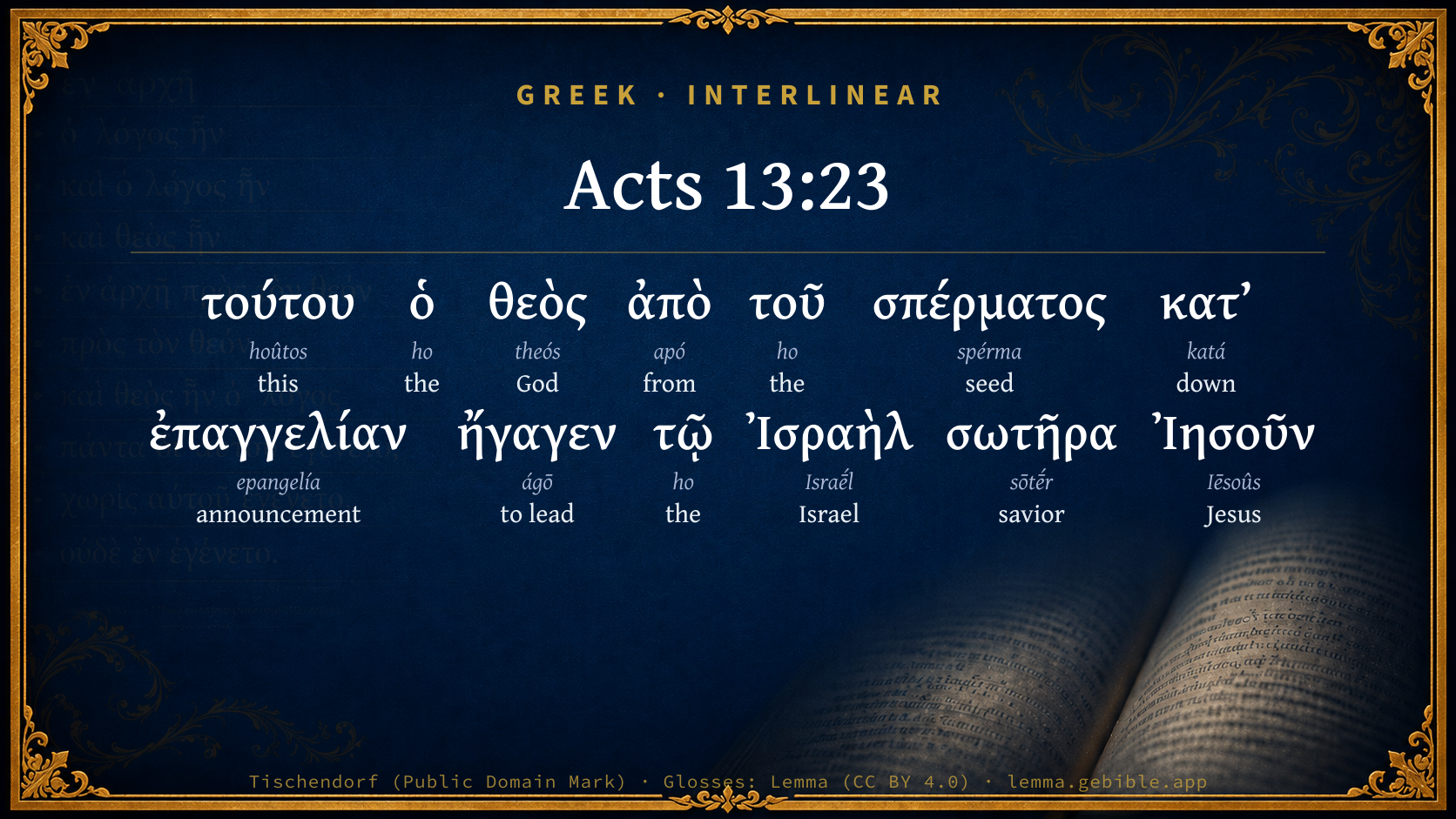
From this man's seed, God has brought salvation to Israel according to his promise,
Download a study sheet
One document with this verse’s original text, its word-by-word gloss line, the meaning frame, cross-references with their text, attributed commentary, and full source and license credits — printable, and it pastes into notes with its structure intact.
This verse Autodidact and up
A passage Seminary Student
Up to 50 verses in one chapter. A passage sheet keeps up to 6 commentary sources and 12 cross-references per verse, in the order this page ranks them, and says so on the sheet whenever that leaves anything out. Ask for a single verse and you get the Autodidact verse sheet above.
Everything on this page stays free to read, with no account — the sheet is a download of what is already on screen, not access to it.
Compare translations 3
The same verse in 3 English versions, stacked beneath the original-language interlinear above. Click any original word for its lexicon entry.
Each is an independent rendering of the whole verse — the interlinear is not word-aligned to these translations.
Highlighted words mark where these versions differ — a whole-verse word diff, not a word-by-word alignment.
-
World English Bible Public Domain
From this man's seed, God has brought salvation to Israel according to his promise,
-
King James Version Public Domain
Of this man's seed hath God according to his promise raised unto Israel a Saviour, Jesus:
-
unfoldingWord Literal Text CC BY-SA 4.0
From the seed of this one, according to promise, God brought to Israel a Savior, Jesus,
unfoldingWord Literal Text — © unfoldingWord, licensed CC BY-SA 4.0. Word-aligned USFM3 via Door43 (git.door43.org/unfoldingWord/en_ult).
Show all 19 translations
Every available English version of this verse, each an independent rendering of the whole verse.
-
World English Bible Public Domain
From this man's seed, God has brought salvation to Israel according to his promise,
-
Berean Standard Bible Public Domain
From the descendants of this man, God has brought to Israel the Savior Jesus, as He promised.
-
Majority Standard Bible Public Domain
From the descendants of this man, God has brought to Israel salvation, as He promised.
-
King James Version Public Domain
Of this man's seed hath God according to his promise raised unto Israel a Saviour, Jesus:
-
American Standard Version (1901) Public Domain
Of this man's seed hath God according to promise brought unto Israel a Saviour, Jesus;
-
Revised Version (1885) Public Domain
Of this man’s seed hath God according to promise brought unto Israel a Saviour, Jesus;
-
Geneva Bible (1599) Public Domain
Of this mans seede hath God according to his promise raised vp to Israel, ye Sauiour Iesus:
-
Douay-Rheims (1899) Public Domain
Of this man's seed God according to his promise, hath raised up to Israel a Saviour, Jesus:
-
Young's Literal Translation Public Domain
`Of this one's seed God, according to promise, did raise to Israel a Saviour -- Jesus,
-
Literal Standard Version CC BY-SA 4.0
Of this one’s seed, God, according to promise, raised to Israel a Savior—Jesus,
-
Unlocked Literal Bible CC BY-SA 4.0
From this man's descendants God has brought to Israel a savior, Jesus, as he promised to do.
-
unfoldingWord Literal Text CC BY-SA 4.0
From the seed of this one, according to promise, God brought to Israel a Savior, Jesus,
-
Darby Bible Public Domain
Of this man's seed according to promise has God brought to Israel a Saviour, Jesus;
-
World Messianic Bible Public Domain
From this man’s offspring, God has brought salvation to Israel according to his promise,
-
Webster's Bible Public Domain
Of this man's offspring hath God, according to his promise, raised up to Israel a Savior, Jesus:
-
Free Bible Version CC BY-SA 4.0
Jesus is David's descendant; he is the Savior that God promised to bring to Israel.
-
Bible in Basic English Public Domain
From this man's seed has God given to Israel a Saviour, even Jesus, as he gave his word;
-
Text-Critical English NT CC BY 4.0
From this man's offspring God brought salvation to Israel, according to his promise,
-
Tyndale New Testament (1534) Public Domain
Of this manes seed hath God (accordinge to his promes) brought forth to the people of Israel a saviour one Iesus
Literal Standard Version (2020), Covenant Press — licensed CC BY-SA 4.0. Text via the HelloAO Bible API (eBible.org). Unlocked Literal Bible (unfoldingWord) — licensed CC BY-SA 4.0. Text via the HelloAO Bible API (eBible.org). unfoldingWord Literal Text — © unfoldingWord, licensed CC BY-SA 4.0. Word-aligned USFM3 via Door43 (git.door43.org/unfoldingWord/en_ult). Free Bible Version, Dr. Jonathan Gallagher — licensed CC BY-SA 4.0. Text via the HelloAO Bible API (eBible.org).
Word by word
More ways to search: Search by grammar → Find every occurrence → Compare this word →
Practice this passage: Drill this verse → Learn its vocabulary →
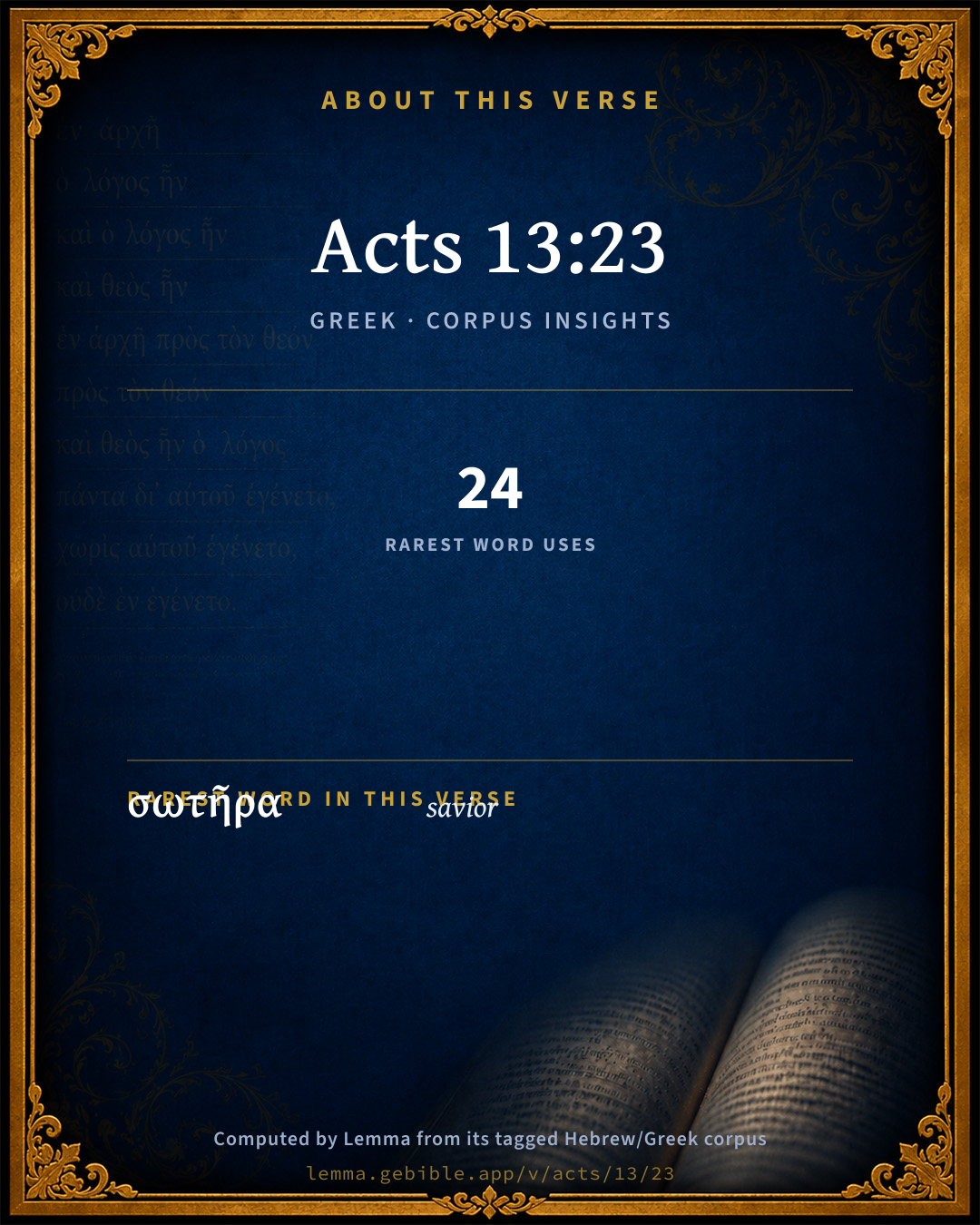
- Appears 24× in the Greek New Testament
- First appears at Luke 1:47
- Part of Speech
- Noun
- Case
- Accusative
- Number
- Singular
- Gender
- Masculine
Full Thayer's Definition
- τούτου hoûtos G3778 “this” Demonstrative pronoun, Genitive, Singular, Masculine
- ὁ ho G3588 “the” Article, Nominative, Singular, Masculine
- θεὸς theós G2316 “God” Noun, Nominative, Singular, Masculine
- ἀπὸ apó G575 “from” Preposition
- τοῦ ho G3588 “the” Article, Genitive, Singular, Neuter
- σπέρματος spérma G4690 “seed” Noun, Genitive, Singular, Neuter
- κατ’ katá G2596 “down” Preposition
- ἐπαγγελίαν epangelía G1860 “announcement” Noun, Accusative, Singular, Feminine
- ἤγαγεν ágō G71 “to lead” Verb, Aorist, Active, Indicative, 3rd person, Singular
- τῷ ho G3588 “the” Article, Dative, Singular, Masculine
- Ἰσραὴλ Israḗl G2474 “Israel” Noun, Proper, indeclinable
- σωτῆρα sōtḗr G4990 “savior” Noun, Accusative, Singular, Masculine
- Ἰησοῦν Iēsoûs G2424 “Jesus” Noun, Accusative, Singular, Masculine
About this verse
These counts appear in no published source. They are computed here, from the morphology-tagged text and Lemma’s own curated glosses. What Lemma adds →
- 13
- words
- 11
- distinct lemmas
- Acts
- section
Cross-references
40Topical passages linked to Acts 13:23 in the Treasury of Scripture Knowledge — connected by theme and wording, ordered by reader-vote popularity; previews shown in the World English Bible.
- Matthew 1:1 The book of the generation of Jesus Christ, the son of David, the son of Abraham.
- Psalms 132:11 Yahweh has sworn to David in truth. He will not turn from it: "I will set the fruit of your body on your throne.
- Revelation 22:16 I, Jesus, have sent my angel to testify these things to you for the assemblies. I am the root and the offspring of David; the Bright and Morning Star."
- Acts 13:32 We bring you good news of the promise made to the fathers,
- Titus 3:3–6 For we were also once foolish, disobedient, deceived, serving various lusts and pleasures, living in malice and envy, hateful, and hating one another.
- Jude 1:25 to God our Savior, who alone is wise, be glory and majesty, dominion and power, both now and forever. Amen.
- 2 Samuel 7:12 When your days are fulfilled, and you shall sleep with your fathers, I will set up your seed after you, who shall proceed out of your bowels, and I will establish his kingdom.
- Psalms 89:35–37 Once have I sworn by my holiness, I will not lie to David.
- Isaiah 11:1 There shall come forth a shoot out of the stock of Jesse, and a branch out of his roots shall bear fruit.
- Isaiah 11:10 It shall happen in that day, that the root of Jesse, who stands for an ensign of the peoples, to him shall the nations seek; and his resting-place shall be glorious.
- Jeremiah 23:5–6 Behold, the days come, says Yahweh, that I will raise to David a righteous Branch, and he shall reign as king and deal wisely, and shall execute justice and righteousness in the land.
- Jeremiah 33:15–17 In those days, and at that time, will I cause a Branch of righteousness to grow up to David; and he shall execute justice and righteousness in the land.
- John 7:42 Hasn't the Scripture said that the Christ comes of the seed of David, and from Bethlehem, the village where David was?"
- Romans 1:3 concerning his Son, who was born of the seed of David according to the flesh,
- Titus 2:10–14 not stealing, but showing all good fidelity; that they may adorn the doctrine of God, our Savior, in all things.
- 2 Peter 3:2 that you should remember the words which were spoken before by the holy prophets, and the commandments of us, the apostles of the Lord and Savior:
- Isaiah 7:13 He said, "Listen now, house of David: Is it not enough for you to try the patience of men, that you will try the patience of my God also?
- Isaiah 43:11 I, even I, am Yahweh; and besides me there is no savior.
- Isaiah 45:21 Declare you, and bring [it] forth; yes, let them take counsel together: who has shown this from ancient time? who has declared it of old? Haven't I, Yahweh? and there is no God else besides me, a just God and a Savior; there is no one besides me.
- Amos 9:11 In that day I will raise up the tent of David who is fallen, and close up its breaches, and I will raise up its ruins, and I will build it as in the days of old;
- Zechariah 9:9 Rejoice greatly, daughter of Zion! Shout, daughter of Jerusalem! Behold, your king comes to you! He is righteous, and having salvation; Lowly, and riding on a donkey, Even on a colt, the foal of a donkey.
- Matthew 1:21 She shall bring forth a son. You shall call his name Jesus, for it is he who shall save his people from their sins."
- Matthew 21:9 The multitudes who went before him, and who followed kept shouting, "Hosanna to the son of David! Blessed is he who comes in the name of the Lord! Hosanna in the highest!"
- Matthew 22:42 saying, "What do you think of the Christ? Whose son is he?" They said to him, "Of David."
- Luke 1:31–33 Behold, you will conceive in your womb, and bring forth a son, and will call his name 'Jesus.'
- Luke 1:69 And has raised up a horn of salvation for us in the house of his servant David
- Luke 2:10–11 The angel said to them, "Don't be afraid, for behold, I bring you good news of great joy which will be to all the people.
- John 4:42 They said to the woman, "Now we believe, not because of your speaking; for we have heard for ourselves, and know that this is indeed the Christ, the Savior of the world."
- Acts 2:30 Therefore, being a prophet, and knowing that God had sworn with an oath to him that of the fruit of his body, according to the flesh, he would raise up the Christ to sit on his throne,
- Acts 2:32–36 This Jesus God raised up, to which we all are witnesses.
- Acts 3:26 God, having raised up his servant, Jesus, sent him to you first, to bless you, in turning away everyone of you from your wickedness."
- Acts 4:12 There is salvation in none other, for neither is there any other name under heaven, that is given among men, by which we must be saved!"
- Acts 5:30–31 The God of our fathers raised up Jesus, whom you killed, hanging him on a tree.
- Romans 11:26 and so all Israel will be saved. Even as it is written, "There will come out of Zion the Deliverer, And he will turn away ungodliness from Jacob.
- Titus 1:4 to Titus, my true child according to a common faith: Grace, mercy, and peace from God the Father and the Lord Jesus Christ our Savior.
- 2 Peter 1:1 Simon Peter, a servant and apostle of Jesus Christ, to those who have obtained a like precious faith with us in the righteousness of our God and Savior, Jesus Christ:
- 2 Peter 1:11 For thus will be richly supplied to you the entrance into the eternal Kingdom of our Lord and Savior, Jesus Christ.
- 2 Peter 2:20 For if, after they have escaped the defilement of the world through the knowledge of the Lord and Savior Jesus Christ, they are again entangled therein and overcome, the last state has become worse with them than the first.
- 2 Peter 3:18 But grow in the grace and knowledge of our Lord and Savior Jesus Christ. To him be the glory both now and forever. Amen.
- 1 John 4:14 We have seen and testify that the Father has sent the Son as the Savior of the world.
Cross-references courtesy of OpenBible.info (CC BY 4.0).
Where the printed editions differ
2 variantsPlaces in this verse where the major printed Greek editions disagree on the wording in a way that affects the translation — a comparison of editions, not a manuscript-by-manuscript collation. The editions are the modern critical texts (Nestlé-Aland 28/27, SBL, Westcott-Hort, Tregelles, Tyndale House) and the traditional texts behind the KJV (the Textus Receptus and the Byzantine/Majority text). It is not a claim about which reading is original.
-
Different wording
ἤγαγεν
“has brought”
In NA28NA27TynSBLWHTregByz Not in TRἤγειρεν (ēgeiren) 'he raised up' occurs in traditional manuscripts (TR) instead of ἤγαγεν (ēgagen) 'has brought' in older manuscripts (NA28+NA27+Tyn+SBL+WH+Treg+Byz)
-
Different wording
σωτῆρα
“[the] Savior”
In NA28NA27TynSBLWHTregTR Not in Byzσωτηρίαν (sōtērian) 'salvation' occurs in a few manuscripts (Byz) instead of σωτῆρα (sōtēra) '[the] Savior' in older manuscripts (NA28+NA27+Tyn+SBL+WH+Treg+TR)
Textual data: Translators Amalgamated Greek New Testament (STEPBible TAGNT) · CC BY 4.0.
Lesson kit
Teaching starters — assembled from the data on this page, not authored interpretation. Every prompt links to the verse data it draws on. Edit before teaching.
Acts, in the Acts, opens this verse with 13 words (11 distinct Greek lemmas). Its most distinctive word is sōtḗr (“savior”). A historical commentator’s framing appears above. Read the whole chapter for the surrounding context.
Discussion questions
- What does “savior” (sōtḗr) contribute to the verse as a whole?
- Luke 1:47 shares the word «savior» with this verse. How do the two illuminate each other?
- “the” occurs 3× in this one verse. What is the effect of the repetition?
- These translations render this verse differently; the difference is in the English rendering, not the original. What questions does that raise?
- Reading how Joseph Benson's Commentary and Tyndale Open Study Notes read this verse, where do the two commentators agree and where do they part?
Things to notice
- These translations choose different wording for 9 words in this verse.
- “the” occurs 3× in this single verse.
- 11 distinct Greek lemmas span 13 words in this verse.
Commentary
Notes on Acts 13:23 from classic Christian and Jewish commentators (each source and its license shown beneath its notes). The classic Christian expositions comment on the surrounding passage and are grouped to its opening verse, so a note may address several verses; the Jewish commentaries on the Tanakh (Rashi and others) are per-verse, so they appear only where the commentator wrote on this verse.
Lemma curates 59 commentaries, every one of them public domain or Creative Commons licensed, each selected and text-cleaned for this edition rather than reprinted as found. About our sources →
Joseph Benson's Commentary
Joseph Benson's Commentary on the Old and New Testaments (1811–1818) — public domain. Text from a community e-Sword module.
Tyndale Open Study Notes
Tyndale Open Resources
Tyndale Open Study Notes — © Tyndale Open Resources, licensed CC BY-SA 4.0. Text via the HelloAO Bible API.
Bengel's Gnomon
Johann Albrecht Bengel
Bengel's Gnomon of the New Testament — English translation (T&T Clark, Edinburgh, 1860) — public domain. Text from a community e-Sword module.
Meyer's Critical & Exegetical Commentary
Heinrich August Wilhelm Meyer
Meyer — Critical and Exegetical Commentary on the New Testament — English translation by Peter Christie, edited by Frederick Crombie (T&T Clark, 1880) — public domain. Text from a community e-Sword module.
Expositor's Greek Testament
ed. W. Robertson Nicoll
The Expositor's Greek Testament, edited by W. Robertson Nicoll (1897–1910) — public domain. Text from a community e-Sword module.
Geneva Bible (1599)
Geneva Bible translators
Geneva Bible (1599) marginal notes — public domain. Text via Bolls.life.
Jamieson, Fausset & Brown
Robert Jamieson, A. R. Fausset & David Brown
Jamieson, Fausset & Brown — Commentary Critical and Explanatory on the Whole Bible (1871) — public domain (CC PDM 1.0). Text via the HelloAO Bible API.
Adam Clarke's Commentary
Adam Clarke's Commentary on the Bible (1810–1826) — public domain. Text from a community e-Sword/MySword module.
John Calvin's Commentaries
John Calvin's Commentaries (1540-1563) — public domain. Text from the Calvin Translation Society English edition (1840s-50s) via the Christian Classics Ethereal Library (ccel.org). Calvin's coverage is partial (roughly two-thirds of the Bible); uncommented books and verses are honest gaps, never fabricated. The 19th-century editor's footnotes and remarks are omitted so the notes are faithfully Calvin's own voice.
Ellicott's Commentary for English Readers
A Bible Commentary for English Readers, edited by Charles John Ellicott (1878–1897) — public domain. Text from a community e-Sword module.
The Cambridge Bible for Schools and Colleges
gen. ed. J. J. S. Perowne
The Cambridge Bible for Schools and Colleges (gen. ed. J. J. S. Perowne; Cambridge University Press, 1878–1918) — public domain. Text from a community e-Sword module.
John Gill's Exposition
John Gill's Exposition of the Whole Bible (1746–1763) — public domain (CC PDM 1.0). Text via the HelloAO Bible API.
Trapp's Complete Commentary
John Trapp
John Trapp, A Commentary or Exposition upon All the Books of the Old and New Testament (1647–1656) — public domain. Text from a community e-Sword module.
Albert Barnes' Notes on the Bible
Albert Barnes' Notes on the Bible (1834–1885) — public domain. Text from a community e-Sword/MySword module.
Matthew Poole's English Annotations
Matthew Poole's English Annotations on the Holy Bible (1683–1685) — public domain. Text from a community e-Sword/MySword module.
Whedon's Commentary on the Bible
Daniel D. Whedon
Daniel D. Whedon (gen. ed.), Commentary on the Old and New Testaments (1874–1909) — public domain. Text from a community e-Sword module.
The Pulpit Commentary
The Pulpit Commentary (1880–1919), ed. H.D.M. Spence-Jones & Joseph S. Exell — public domain. Text from a community e-Sword module.
Scofield Reference Notes
C. I. Scofield
The Scofield Reference Bible (1917 edition), notes by C. I. Scofield — public domain. Text from a community e-Sword module.
Kretzmann's Popular Commentary
Paul E. Kretzmann
Paul E. Kretzmann, Popular Commentary of the Bible (1921–1924) — public domain. Text from a community e-Sword module.
Godbey's Commentary on the New Testament
William B. Godbey
William B. Godbey, Commentary on the New Testament (1896–1900) — public domain. Text from a community e-Sword module.
McGarvey & Pendleton's Commentaries
J. W. McGarvey
J. W. McGarvey (with Philip Y. Pendleton), Commentaries on the New Testament (The Fourfold Gospel, 1914; Acts; and the epistles) — public domain. Text from a community e-Sword/MySword module.
The People's New Testament
B. W. Johnson
B. W. Johnson's The People's New Testament with Notes (1889–1891) — public domain. Electronic text from the Christian Classics Ethereal Library (CCEL) ThML edition.
unfoldingWord translationNotes
Door43 World Missions Community
unfoldingWord translationNotes — © Distant Shores Media and the Door43 World Missions Community, licensed CC BY-SA 4.0. Source: git.door43.org/Door43/en_tn.
Cambridge Greek Testament for Schools and Colleges
Cambridge Greek Testament for Schools and Colleges (Cambridge University Press, 1896; 21 vols, various authors incl. Carr, Maclear, Plummer, Farrar, Lumby, Moule, M. R. James, Simcox) — public domain. Text from a community e-Sword module.
Alford’s Greek Testament
Henry Alford
Henry Alford, The Greek Testament (1849–1861) — public domain. Text from a community e-Sword module.