
Philippians 3:5

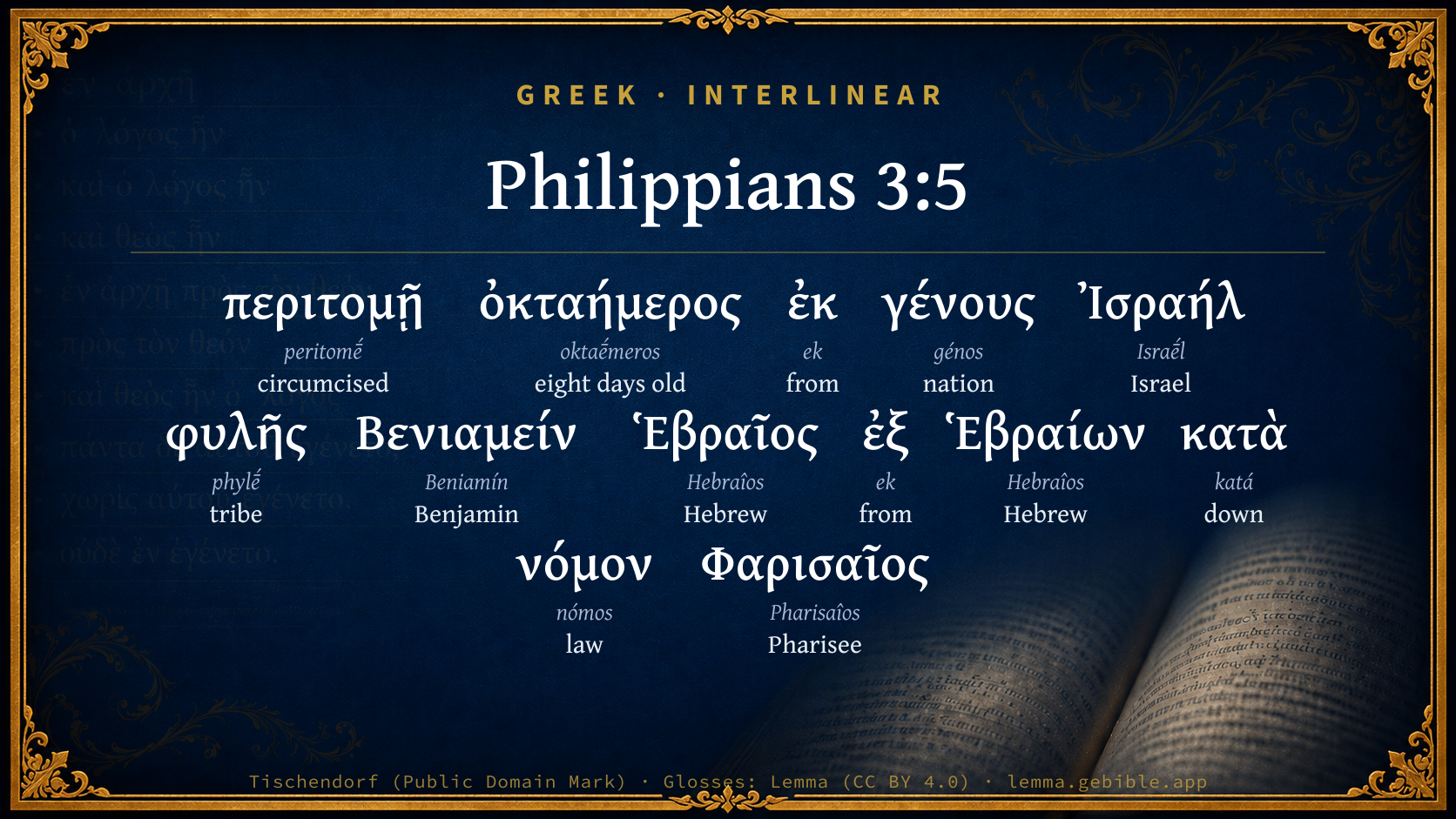
Greek (Tischendorf 8th ed.) Philippians 3:5 appears in the Greek New Testament. The text above is from the Tischendorf 8th edition. Each word links to its Strong’s number and a concise gloss. Click any word for its full Thayer’s Greek Lexicon entry.
Download image
Cite this verse

Philippians 3:5 (World English Bible). Public Domain. Lemma interlinear Bible study tool, https://lemma.gebible.app/v/philippians/3/5.

Show BibTeX & RIS
BibTeX
RIS
English Translation
circumcised the eighth day, of the stock of Israel, of the tribe of Benjamin, a Hebrew of Hebrews; concerning the law, a Pharisee;
World English Bible · Public Domain
Highlights
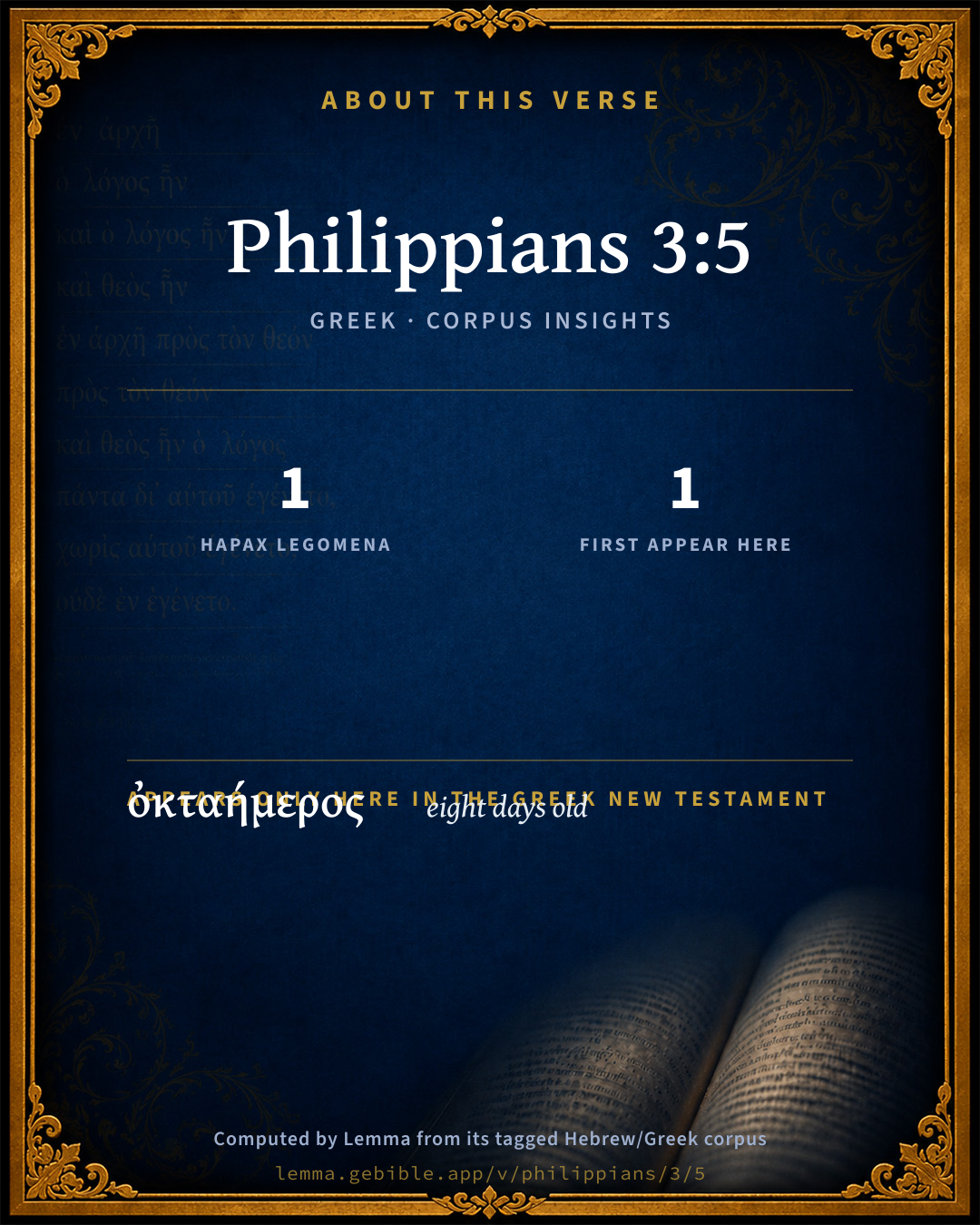
  • 1 hapax legomenon — only here in the Greek New Testament
  • 1 first appearance in the Greek New Testament
Full analysis ↓
Download a study sheet

One document with this verse’s original text, its word-by-word gloss line, the meaning frame, cross-references with their text, attributed commentary, and full source and license credits — printable, and it pastes into notes with its structure intact.

This verse Autodidact and up

Study sheet (.html) Plain text (.txt)

A passage Seminary Student

Up to 50 verses in one chapter. A passage sheet keeps up to 6 commentary sources and 12 cross-references per verse, in the order this page ranks them, and says so on the sheet whenever that leaves anything out. Ask for a single verse and you get the Autodidact verse sheet above.

Everything on this page stays free to read, with no account — the sheet is a download of what is already on screen, not access to it.

Want to remove ads? Support Godless Engineer
Compare translations 3

The same verse in 3 English versions, stacked beneath the original-language interlinear above. Click any original word for its lexicon entry.

Each is an independent rendering of the whole verse — the interlinear is not word-aligned to these translations.

Highlighted words mark where these versions differ — a whole-verse word diff, not a word-by-word alignment.

  • World English Bible Public Domain
    circumcised the eighth day, of the stock of Israel, of the tribe of Benjamin, a Hebrew of Hebrews; concerning the law, a Pharisee;
  • King James Version Public Domain
    Circumcised the eighth day, of the stock of Israel, of the tribe of Benjamin, an Hebrew of the Hebrews; as touching the law, a Pharisee;
  • unfoldingWord Literal Text CC BY-SA 4.0
    circumcision on the eighth day, from the nation of Israel, of the tribe of Benjamin, a Hebrew of Hebrews; according to the law, a Pharisee;

unfoldingWord Literal Text — © unfoldingWord, licensed CC BY-SA 4.0. Word-aligned USFM3 via Door43 (git.door43.org/unfoldingWord/en_ult).

Versions to compare (up to 4)

3 of 4 selected

Show all 19 translations

Every available English version of this verse, each an independent rendering of the whole verse.

  • World English Bible Public Domain
    circumcised the eighth day, of the stock of Israel, of the tribe of Benjamin, a Hebrew of Hebrews; concerning the law, a Pharisee;
  • Berean Standard Bible Public Domain
    circumcised on the eighth day, of the people of Israel, of the tribe of Benjamin; a Hebrew of Hebrews; as to the law, a Pharisee;
  • Majority Standard Bible Public Domain
    circumcised on the eighth day, of the people of Israel, of the tribe of Benjamin; a Hebrew of Hebrews; as to the law, a Pharisee;
  • King James Version Public Domain
    Circumcised the eighth day, of the stock of Israel, of the tribe of Benjamin, an Hebrew of the Hebrews; as touching the law, a Pharisee;
  • American Standard Version (1901) Public Domain
    circumcised the eighth day, of the stock of Israel, of the tribe of Benjamin, a Hebrew of Hebrews; as touching the law, a Pharisee;
  • Revised Version (1885) Public Domain
    circumcised the eighth day, of the stock of Israel, of the tribe of Benjamin, a Hebrew of Hebrews; as touching the law, a Pharisee;
  • Geneva Bible (1599) Public Domain
    Circumcised the eight day, of the kinred of Israel, of the tribe of Beniamin, an Ebrewe of the Ebrewes, by the Lawe a Pharise.
  • Douay-Rheims (1899) Public Domain
    Being circumcised the eighth day, of the stock of Israel, of the tribe of Benjamin, an Hebrew of the Hebrews; according to the law, a Pharisee:
  • Young's Literal Translation Public Domain
    circumcision on the eighth day! of the race of Israel! of the tribe of Benjamin! a Hebrew of Hebrews! according to law a Pharisee!
  • Literal Standard Version CC BY-SA 4.0
    circumcision on the eighth day! Of the race of Israel! Of the tribe of Benjamin! A Hebrew of Hebrews! According to law—a Pharisee!
  • Unlocked Literal Bible CC BY-SA 4.0
    I was circumcised on the eighth day, of the people of Israel, of the tribe of Benjamin, a Hebrew of Hebrews; with regard to the law, a Pharisee.
  • unfoldingWord Literal Text CC BY-SA 4.0
    circumcision on the eighth day, from the nation of Israel, of the tribe of Benjamin, a Hebrew of Hebrews; according to the law, a Pharisee;
  • Darby Bible Public Domain
    as to circumcision, [I received it] the eighth day; of [the] race of Israel, of [the] tribe of Benjamin, Hebrew of Hebrews; as to [the] law, a Pharisee;
  • World Messianic Bible Public Domain
    circumcised the eighth day, of the stock of Israel, of the tribe of Benjamin, a Hebrew of Hebrews; concerning the law, a Pharisee;
  • Webster's Bible Public Domain
    Circumcised the eighth day, of the stock of Israel, of the tribe of Benjamin, a Hebrew of the Hebrews; with respect to the law, a Pharisee;
  • Free Bible Version CC BY-SA 4.0
    I was circumcised on the eighth day, I'm an Israelite of the tribe of Benjamin, a true Hebrew. Regarding legal observance I'm a Pharisee;
  • Bible in Basic English Public Domain
    Being given circumcision on the eighth day, of the nation of Israel, of the tribe of Benjamin, a Hebrew of Hebrews; in relation to the law, a Pharisee:
  • Text-Critical English NT CC BY 4.0
    circumcised on the eighth day, of the people of Israel, of the tribe of Benjamin, a Hebrew of Hebrews; as to the law, a Pharisee;
  • Tyndale New Testament (1534) Public Domain
    circumcised the eyght daye of the kynred of Israhell of the trybe of Beniamyn an Ebrue borne of the Ebrues: as concernynge the lawe a pharisaye

Literal Standard Version (2020), Covenant Press — licensed CC BY-SA 4.0. Text via the HelloAO Bible API (eBible.org). Unlocked Literal Bible (unfoldingWord) — licensed CC BY-SA 4.0. Text via the HelloAO Bible API (eBible.org). unfoldingWord Literal Text — © unfoldingWord, licensed CC BY-SA 4.0. Word-aligned USFM3 via Door43 (git.door43.org/unfoldingWord/en_ult). Free Bible Version, Dr. Jonathan Gallagher — licensed CC BY-SA 4.0. Text via the HelloAO Bible API (eBible.org).

Word by word

More ways to search: Search by grammar → Find every occurrence → Compare this word →

Practice this passage: Drill this verse → Learn its vocabulary →

About this verse

These counts appear in no published source. They are computed here, from the morphology-tagged text and Lemma’s own curated glosses. What Lemma adds →

13
words
11
distinct lemmas
Pauline Epistles
section

Notable vocabulary

1 hapax legomenon — a word that appears only here in the entire Greek New Testament:

  • ὀκταήμερος eight days old G3637

First appearance in Scripture

This word makes its first canonical appearance in the Greek New Testament here:

  • ὀκταήμερος eight days old G3637

Shared distinctive vocabulary

Βενιαμείν Benjamin G958 occurs in 4 verses of the Greek New Testament. Also found in:
Repetition

Words recur within this verse:

  • Ἑβραῖος Hebrew G1445 ×2
  • ἐκ from G1537 ×2

Cross-references

15

Topical passages linked to Philippians 3:5 in the Treasury of Scripture Knowledge — connected by theme and wording, ordered by reader-vote popularity; previews shown in the World English Bible.

  • 2 Corinthians 11:22 Are they Hebrews? So am I. Are they Israelites? So am I. Are they the seed of Abraham? So am I.
  • Romans 11:1 I ask then, Did God reject his people? May it never be! For I also am an Israelite, a descendant of Abraham, of the tribe of Benjamin.
  • Acts 23:6 But when Paul perceived that the one part were Sadducees and the other Pharisees, he cried out in the council, "Men and brothers, I am a Pharisee, a son of Pharisees. Concerning the hope and resurrection of the dead I am being judged!"
  • Genesis 17:12 He who is eight days old will be circumcised among you, every male throughout your generations, he who is born in the house, or bought with money of any foreigner who is not of your seed.
  • Acts 22:3 "I am indeed a Jew, born in Tarsus of Cilicia, but brought up in this city at the feet of Gamaliel, instructed according to the strict manner of the law of our fathers, being zealous for God, even as you all are this day.
  • Acts 26:4–5 "Indeed, all the Jews know my way of life from my youth up, which was from the beginning among my own nation and at Jerusalem;
  • Luke 1:59 It happened on the eighth day, that they came to circumcise the child; and they would have called him Zacharias, after the name of the father.
  • Luke 2:21 When eight days were fulfilled for the circumcision of the child, his name was called Jesus, which was given by the angel before he was conceived in the womb.
  • John 7:21–24 Jesus answered them, "I did one work, and you all marvel because of it.
  • Genesis 14:13 One who had escaped came and told Abram, the Hebrew. Now he lived by the oaks of Mamre, the Amorite, brother of Eshcol, and brother of Aner; and these were allies of Abram.
  • Genesis 40:15 For indeed, I was stolen away out of the land of the Hebrews, and here also have I done nothing that they should put me into the dungeon."
  • 1 Samuel 4:6 When the Philistines heard the noise of the shout, they said, What means the noise of this great shout in the camp of the Hebrews? They understood that the ark of Yahweh was come into the camp.
  • Jonah 1:9 He said to them, "I am a Hebrew, and I fear Yahweh, the God of heaven, who has made the sea and the dry land."
  • Acts 6:1 Now in those days, when the number of the disciples was multiplying, a complaint arose from the Grecian Jews against the Hebrews because their widows were neglected in the daily service.
  • Genesis 41:12 There was with us there a young man, a Hebrew, servant to the captain of the guard, and we told him, and he interpreted to us our dreams. To each man according to his dream he interpreted.

Cross-references courtesy of OpenBible.info (CC BY 4.0).

Commentary

Notes on Philippians 3:5 from classic Christian and Jewish commentators (each source and its license shown beneath its notes). The classic Christian expositions comment on the surrounding passage and are grouped to its opening verse, so a note may address several verses; the Jewish commentaries on the Tanakh (Rashi and others) are per-verse, so they appear only where the commentator wrote on this verse.

Lemma curates 59 commentaries, every one of them public domain or Creative Commons licensed, each selected and text-cleaned for this edition rather than reprinted as found. About our sources →

Tyndale Open Study Notes

Tyndale Open Resources

3:5-6 If anyone could rely on Jewish credentials, Paul could: He practiced the strictest obedience to the Jewish law and was extremely zealous for the Jewish religion.

3:5 circumcised when I was eight days old: See Gen 17:12; Lev 12:3; Luke 1:59; 2:21. • Paul was a member of the Pharisees, the Jewish sect known for its strict observance of the law (see Acts 23:6; 26:5).

Tyndale Open Study Notes — © Tyndale Open Resources, licensed CC BY-SA 4.0. Text via the HelloAO Bible API.

Bengel's Gnomon

Johann Albrecht Bengel

Php 3:5. Περιτομὴ ὀκταήμερος,[36] circumcision on the eighth day) These heads [of carnal glorying], counted very briefly as it were on the fingers, render the discourse very plain. Moreover, for the sake of brevity, he puts together the abstract and concrete—circumcision, a Hebrew: as in Col 3:11.—ὀκταήμερος, on the eighth day) not putting it off until full age.—Βενιαμὶν, Benjamin) son of Rachel, not of the maid-servant.—ἐξ Ἑβραίων, of the Hebrews) not a proselyte, and neither the one parent nor the other being of the Gentiles.—Φαρισαῖος, a Pharisee) of the most rigid description [“of the straitest sect,” Act 26:5].

[36] The oldest authorities have περιτομῇ, i.e. Being an eighth day person in respect to my circumcision. So fg Lucif. “circumcisione:” Vulg. “circumcisus octavo die.”—ED.

Bengel's Gnomon of the New Testament — English translation (T&T Clark, Edinburgh, 1860) — public domain. Text from a community e-Sword module.

Meyer's Critical & Exegetical Commentary

Heinrich August Wilhelm Meyer

Php_3:5-6. Predicates of the ἐγώ, by which that ἐγὼ μᾶλλον is justified.

If those Judaizers were, as may be inferred from our passage, partly proselytes (to these the περιτ. ὀκταήμ. stands in contrast), partly persons whose Jewish descent was not so noble and pure as that implied in ἐκ γένους.… Ἑβραίων, and if they could not boast of any such law-strictness, zealous activity, and righteousness, as is described in κατὰ νόμον … ἄμεμπτος; and if, on the other hand, there were found conjoined in the case of Paul the elements here adduced of ancient theocratic legitimacy and perfection; the ἐγὼ μᾶλλον in Php_3:4 was completely made good.

περιτομῇ ὀκταήμ.] in respect to circumcision an eighth-day-one, not older, as were the proselytes who were only circumcised at a later period of life. The eighth-day character in the relation specified by περιτομῇ is conceived as a quality of the persons concerned, which distinguishes them from those circumcised later.[156] The reading περιτομή as nominative (some min. and Fathers, Erasmus, Vatablus, Cornelius a Lapide, Mill, Bengel, Matthies, Heinrichs, and others, also Elz. 1624, 1633, not 1641), so that it would stand in the concrete sense (circumcisus), is erroneous, because this usage occurs only collectively.

ἐκ γένους Ἰσρ.] that is, a descendant of Jacob, not, therefore, possibly of Idumaean blood. The theocratic name Ἰσρ. corresponds entirely with the design of the passage. Comp. on Eph_2:12. On what follows, comp. 2Co_11:22; Rom_11:1.

ΦΥΛῆς ΒΕΝΙΑΜ.] therefore not, possibly, an Ephraimite (Ezr_4:1); a climactic more precise definition of the εὐγένεια; εὐγενὴς γὰρ ἡ φύσις κἀξ εὐγενῶν Soph. Phil. 862 (874). For its fuller exhibition Paul finally specifies the last feature of his lineage: Ἑβραῖος ἐξ Ἑβρ., that is, a Hebrew born of Hebrew parents, so that his mother also was a Hebrew woman. His lineage is not carried further back in respect to both parents, because it was not the custom to trace back the genealogy of the wives. Inappropriate to the context is the rendering of Michaelis, following Chrysostom, Oecumenius, and Theophylact: one speaking Hebrew, born of Hebrew-speaking parents. It is also erroneous, following the Greek Fathers, to take ἐξ Ἑβρ. of the tota majorum series (Beza, Grotius, Storr, Matthies, Baumgarten-Crusius, and others), because this was after the two previously specified points self-evident. If, among his ancestors, Paul had had one who was a non-Hebrew, he would not have been descended from Jacob and Benjamin, but from the non-Hebrew and his forefathers. For instances of expressions quite similar to Ἑβρ. ἐξ Ἑβρ., used to denote the identity, as conditioned by birth, of a mans position with that of his parents, see Wetstein and Kypke; they occur very frequently in classic authors.

ΚΑΤᾺ ΝΌΜΟΝ Κ.Τ.Λ.] After his Jewish ΕὐΓΈΝΕΙΑ there now follows his distinguished personal position in Judaism, set forth in a threefold climactic gradation: (1) In respect of the law (of Moses) a Pharisee. Comp. Act_26:5; Act_22:6. The Pharisees stood in the closest and strictest relation to the law, as they with their traditions were regarded as the most orthodox expositors, defenders, and observers of it. The interpretation of νόμον, not in its habitual historic sense, but generally as regular rule (Beza) or disciplina (αἵρεσις) (Castalio, Wolf, Grotius, Storr, Heinrichs, Rheinwald, Hoelemann, and others), is all the more erroneous, since the validity of the Mosaic law in Christianity was the very principle upheld by those Judaizers; see also below, δικαιοσ. τ. ἐν νόμῳ. (2) In respect of zeal (zealous maintenance and championship of the law-religion, 1Ma_2:58; Act_21:20; Gal_1:14), a persecutor of the church. Comp. Gal_1:13 f. The present participle is used as a substantive, comp. on Gal_1:23. What Paul, to his deep grief, had been (1Co_15:8 f.; 1Ti_1:13), he, with a bitter recalling of his former distinction in Judaism, throws, by way of confronting the Jewish zealots, into the scale, as a characteristic predicate not yet extinct. And precisely thus, unaccompanied by any ποτέ as in Gal_1:23, it carries from the standpoint to which he has now attained very strong weight (in opposition to Hofmann, who holds the present sense to be impossible here). (3) In respect to righteousness, which is grounded on the law, having become blameless (Php_2:15), having carried it so far (not: having borne myself so, as Hofmann renders it; comp. on Php_2:15), that human judgment finds nothing in me to blame in this respect! That which is here denoted by δικ. ἡ ἐν νόμῳ is not substantially different from ΔΙΚ. Ἡ ἘΚ ΝΌΜΟΥ in Php_3:9; comp. Rom_10:5. It has its basis in the law, so far as it consists in the accordance of its nature with the character and the rules of that institute (Gal_3:11; Gal_5:4), and proceeds from the law, so far as it is produced by the precepts of the latter which man follows. In opposition to the correlation with Php_3:9 de Wette interprets: the righteousness valid in the state of law (comp. Rom_2:12). Calvin appropriately observes that Paul means totam justitiam legis, but communi hominum existimatione; that it is not, therefore, the real moral fulfilment of the law, but its justitia externa literalis. Comp. J. Müller, v. d. Sünde, I. p. 59, ed. 5.

[156] For instances of the personal use of such nomina dialia, see especially Wetstein on Joh_11:39; comp. generally Kühner, II. 1, p. 234 f.

Meyer — Critical and Exegetical Commentary on the New Testament — English translation by Peter Christie, edited by Frederick Crombie (T&T Clark, 1880) — public domain. Text from a community e-Sword module.

Expositor's Greek Testament

ed. W. Robertson Nicoll

Phi 3:5 . The Apostle seems to feel a certain natural pride in recounting his hereditary privileges. περιτομῇ ὀκταήμ . The dative of περιτ . must be read, expressing the sphere to which ὀκταήμ . belongs. Literally: “Eight-days-old as regards my circumcision”. A.V. satisfies the requirements. He was born in Judaism, and lost none of its advantages from the outset. Proselytes were circumcised as adults. For the usage in this sense see the elaborate list of parallels in Wetstein on Joh 11:39 . ἐκ γένους Ἰ . ἐκ often denotes the class or country of a man, e.g. , Joh 3:1 . Paul shared in the glories of the covenant-people. Israel was the theocratic name. φυλῆς Β . B. This tribe stood high in Jewish estimation, not only as descending from Rachel, Jacob’s best-loved wife, but as remaining loyal to the house of David, and, after the exile, forming with Judah the foundation of the future nation. Ἑβρ . ἐξ Ἑβρ . For the phrase cf. Herodt., 2, 143, Πίρωμιν ἐκ Πιρώμιος ; Plat., Phaedr. , 246 [32] A , ἀγαθοὶ καὶ ἐξ ἀγαθῶν . The force of these words has been variously estimated. Lft [33] . and others draw a contrast between Ἑβραῖος and Ἑλληνιστής , the former being a Jew who retained the Hebrew language and customs (see Act 6:1 ). But Euseb., H.E. , 2, 4, 2, applies the designation to Philo, and in Praep. Evang. , xiii., 11, 2, to Aristobulus, both of them Greek-speaking Jews with little if any knowledge of Hebrew. Cf. 2Co 11:22 . The Greek Comm [34] . , Th. Mps [35] . and Thdrt [36] . , believe that, in using the ancient name, Paul wishes to emphasise the purity of his lineage. Probably they are right. κατὰ νόμον . Are we to distinguish between νόμος and ὁ νόμος in Paul? Attempts have been made (notably that of Gifford, Romans in Speaker’s Comm [37] . , pp. 41 48) to show that when Paul omits the article he is thinking mainly of the principle of law as a method of justification in opposition to faith, etc. In our judgment it has been made abundantly clear by Grafe ( Die paulinische Lehre vom Gesetz , pp. 1 11) that, for the Apostle, νόμος with or without the article means the O.T. revelation of the will of God. He makes no distinction between a general conception of Divine law and the special one of the Mosaic law. The Mosaic law is for him the Divine law pure and simple, and therefore has a universal bearing. There are, of course, modifications of this central idea, but they can all be satisfactorily accounted for. Often the insertion or omission of the article with νόμος is entirely a question of formal grammar. Here νόμος is plainly the law of Moses. φαρισαῖος . Cf. Act 23:6 . For an interesting discussion of the influence of the school of Hillel upon Paul see Wabnitz, Revue Théol. , xiii., p. 287 ff. The survivals of Rabbinic doctrines and methods in Paul’s thought, however, must neither be exaggerated, nor, because they are Rabbinic, be contemptuously dismissed. “If God was not moving in the Rabbinic thought of Christ’s day, what reason have we to say He … moves in the thought of to-day?” (P. T. Forsyth). Almost certainly Paul’s family must have been in thorough sympathy with strict Judaism. No doubt he would be disowned by them, and this, as Ramsay notes ( St. Paul , p. 36), would give special force to his words in Phi 3:8 infr.

[32] Codex Alexandrinus (sæc. v.), at the British Museum, published in photographic facsimile by Sir E. M. Thompson (1879).

[33] Lightfoot.

[34] Commentators.

[35] . Mps. Theodore of Mopsuestia.

[36] drt. Theodoret.

[37] Commentators.

The Expositor's Greek Testament, edited by W. Robertson Nicoll (1897–1910) — public domain. Text from a community e-Sword module.

Jamieson, Fausset & Brown

Robert Jamieson, A. R. Fausset & David Brown

In three particulars he shows how he "might have confidence in the flesh" (Phi 3:4): (1) His pure Jewish blood. (2) His legal preciseness and high status as such. (3) His zeal for the law. The Greek is literally, "Being in circumcision an eighth day person," that is, not one circumcised in later life as a proselyte, but on the eighth day after birth, as the law directed in the case of Jew-born infants.

of the tribe of Benjamin--son of Rachel, not of the maid-servant [BENGEL].

Hebrew of the Hebrews--neither one or other parent being Gentile. The "Hebrew," wherever he dwelt, retained the language of his fathers. Thus Paul, though settled in Tarsus, a Greek city, calls himself a Hebrew. A "Grecian" or Hellenist, on the other hand, in the New Testament, is the term used for a "Greek-speaking" Jew [TRENCH].

touching the law--that is, as to legal status and strictness.

a Pharisee--"of the straitest sect" (Act 26:5).

Jamieson, Fausset & Brown — Commentary Critical and Explanatory on the Whole Bible (1871) — public domain (CC PDM 1.0). Text via the HelloAO Bible API.

Adam Clarke's Commentary

Verse 5. Circumcised the eighth day] This was the time that the law required the males to be circumcised; and we find, from Ge 17:14, both in the Samaritan Pentateuch and in the Septuagint, though the clause is now lost out of the common Hebrew text, that the male child, which is not circumcised the eighth day, shall be cut off from among his people: this precept was literally observed in the case of St. Paul.

Of the stock of Israel] Regularly descended from the patriarch Jacob.

Of the tribe of Benjamin] The most favourite son of that patriarch and a tribe that did not revolt with Jeroboam, 1Kgs 12:21, nor pollute the worship of God by idolatry.

A Hebrew of the Hebrews] Though born in a heathen country, Tarsus, yet both my parents were Hebrews; nor has there ever been any strange blood mixed with that of our family.

Touching the law, a Pharisee] One that not only received the law and the prophets as coming from God; but belonged to that sect which, of all others, was most scrupulously attached to it.

Adam Clarke's Commentary on the Bible (1810–1826) — public domain. Text from a community e-Sword/MySword module.

John Calvin's Commentaries

5. Circumcised on the eighth day It is literally— “The circumcision of the eighth day.” There is no difference, however, in the sense, for the meaning is, that he was circumcised in the proper manner, and according to the appointment of the law . Now this customary circumcision was reckoned of superior value; and, besides, it was a token of the race to which he belonged; on which he touches immediately afterwards. For the case was not the same as to foreigners, for after they had become proselytes they were circumcised in youth, or when grown up to manhood, and sometimes even in old age. He says, accordingly, that he is of the race of Israel He names the tribe , — not, in my opinion, on the ground that the tribe of Benjamin had a superiorityof excellence above others, but for shewing more fully that he belonged to the race of Israel, as it was the custom that every one was numbered according to his particular tribe. With the same view he adds still farther, that he is an Hebrew of the Hebrews For this name was the most ancient, as being that by which Abraham himself is designated by Moses. (Genesis 14:13.) The sum, therefore, is this — that Paul was descended from the seed of Jacob from the most ancient date, so that he could reckon up grandfathers and great-grandfathers, and could even go still farther back.

According to the law, a Pharisee Having spoken of the nobility of his descent, he now proceeds to speak of special endowments of persons, as they are called. It is very generally known, that the sect of the Pharisees was celebrated above the others for the renown in which it was held for sanctity and for doctrine. He states, that he belonged to that sect. The common opinion is, that the Pharisees were so called from a term signifying separation ; but I approve rather of what I learned at one time from Capito, a man of sacred memory , that it was because they boasted that they were endowed with the gift of interpreting Scripture, for פרש (parash,) among the Hebrews, conveys the idea of interpretation. While others declared themselves to be literals , they preferred to be regarded as Pharisees , as being in possession of the interpretations of the ancients. And assuredly it is manifest that, under the pretext of antiquity, they corrupted the whole of Scripture by their inventions; but as they, at the same time, retained some sound interpretations, handed down by the ancients, they were held in the highest esteem.

But what is meant by the clause, according to the law? For unquestionably nothing is more opposed to the law of God than sects, for in it is communicated the truth of God, which is the bond of unity. Besides this, Josephus tells us in the 13th book of his Antiquities, that all the sects took their rise during the high priesthood of Jonathan. Paul employs the term law, not in its strict sense, to denote the doctrine of religion, however much corrupted it was at that time, as Christianity is at this day in the Papacy. As, however, there were many that were in the rank of teachers, who were less skillful, and exercised he makes mention also of his zeal. It was, indeed, a very heinous sin on the part of Paul to persecute the Church, but as he had to dispute with unprincipled persons, who, by mixing up Christ with Moses, pretended zeal for the law, he mentions, on the other hand, that he was so keen a zealot of the law, that on that ground he persecuted the Church

John Calvin's Commentaries (1540-1563) — public domain. Text from the Calvin Translation Society English edition (1840s-50s) via the Christian Classics Ethereal Library (ccel.org). Calvin's coverage is partial (roughly two-thirds of the Bible); uncommented books and verses are honest gaps, never fabricated. The 19th-century editor's footnotes and remarks are omitted so the notes are faithfully Calvin's own voice.

Ellicott's Commentary for English Readers

(5) Circumcised the eighth day—i.e., a Jew born, not a proselyte.

Of the stock of Israel—i.e., emphatically, a true scion of the covenanted stock, the royal race of the “Prince of God.”

Of the tribe of Benjamin—i.e., the tribe of the first king, whose name the Apostle bore; the tribe to whom belonged the holy city; the one tribe faithful to the house of Judah in the apostasy of the rest.

An Hebrew of the Hebrews.—Properly, a Hebrew descended from Hebrews. The Hebrew Jew, who retained, wherever born, the old tongue, education, and customs of his fathers, held himself superior to the Grecian or Hellenist, who had to assimilate himself, as to the language, so to the thoughts and habits, of the heathen around him. St. Paul united the advantages both of the true Hebrew, brought up at the feet of Gamaliel, and of the Hellenist of Tarsus, familiar with Greek language, literature, and thought. Compare his own words to his countrymen from the steps of the Temple as illustrating the whole passage: “I verily am a Jew, born in Tarsus, a city in Cilicia, yet brought up in this city at the feet of Gamaliel, and taught according to the perfect manner of the law of the fathers, and was zealous before God . . . and I persecuted this way unto the death” (Act_22:3-4).

As touching the law, a Pharisee.—Comp. Act_23:6, “I am a Pharisee, and the son of Pharisees;” and Act_26:5, “according to the straitest sect of our religion I lived a Pharisee.” In these words St. Paul passes from his inherited Judaic privileges, to the intense Judaism of his own personal life.

(5, 6) The comparison with the celebrated passage in 2Co_11:18-23 is striking, in respect not only of similarity of substance, but of the change of tone from the indignant and impassioned abruptness of the earlier Epistle to the calm impressiveness of this. The first belongs to the crisis of the struggle, the other to its close. We have also a parallel, though less complete, in Rom_11:1, “I also am an Israelite, of the stock of Abraham, of the tribe of Benjamin.”

A Bible Commentary for English Readers, edited by Charles John Ellicott (1878–1897) — public domain. Text from a community e-Sword module.

The Cambridge Bible for Schools and Colleges

gen. ed. J. J. S. Perowne

5. Circumcised &c.] Quite lit., “as to circumcision, eight days old.” See Gen_17:12; Luk_2:21. He was neither a proselyte, circumcised as an adult, nor an Ishmaelite, circumcised (as Josephus tells us, Antiquities, xii. i. § 2; see Gen_17:25) at thirteen, but a member of the covenant from infancy.

Israel] The name may refer here either to the original and individual Israel, Jacob (Gen_32:28 &c.), or to the collective Israel, the chosen nation. The former is more likely, in view of the next clause, and would besides be the more vivid and emphatic reference; “one of the race descended from God’s Prince.”

The words Israel, Israelite, indicate specially the sacred privileges and dignity of the Covenant People as such; see Trench, N.T. Synonyms, § xxxix., and Lightfoot, on Gal_6:16. Cp. Rom_9:4; Rom_11:1; 2Co_11:22; Eph_2:12; and see Joh_1:47; Joh_1:49.

Benjamin] So he had previously said, Rom_11:1. See Act_13:21 for another mention by St Paul of his tribe, though in another connexion. He names his tribe, not only to emphasize his nationality, but no doubt because the Benjamites, descendants of the last and much loved son of Jacob, had given the nation its first lawful king (whose name the Apostle bore), and had with Judah remained “faithful among the faithless” at the great Disruption (1Ki_12:21). Ehud early in O.T. history (Judges 3), and Mordecai late (Est_2:5), were Benjamites. It is interesting to trace in St Paul’s character some of the characteristics of this small but remarkable tribe; stern courage and persistent fidelity. But certainly it was something better than Benjamite “obstinacy and persistency” (Smith’s Bible Dict., s.v. Benjamin) which made him resist the entreaties of the disciples and avow himself ready to die for the Lord (Act_21:12-13).—See further, Conybeare and Howson, Life &c. of St Paul, ch. 2.

a Hebrew of the Hebrews] With R.V., omit “the.” Cp. again 2Co_11:22. The words mean that he was a Hebrew and of Hebrew lineage.—What is a “Hebrew” in N.T. phraseology? In O.T. the word is the distinctive national term, as against other national terms, as Egyptian, Philistine &c.; and is thus the term by which a heathen would designate an Israelite. By the N.T. era its bearing had changed, and in the N.T. (not in later Christian writers, or in Jewish and pagan writers,) it designates the Jew who retained, more or less fully, his national language and manners, as against the “Hellenist” who habitually spoke Greek and largely conformed to Gentile customs. See Act_6:1. The “Hebrew” would thus naturally regard himself as one of the élite of his race, from the historical and traditional point of view. See further, Trench, as quoted just above on “Israel,” and Conybeare and Howson, ch. 2.

the law] Lit., “law”; but here, as often, the article is omitted because not needed before a word defined by use or context. Obviously the Mosaic ordinances are mainly intended.

a Pharisee] So he declares himself Act_23:6; Act_26:5. And see Act_22:3; Gal_1:14. “The Pharisees … were the enthusiasts of the later Judaism” (Conybeare and Howson, as above); the zealous and rigid votaries of religious legal precision, elaborate devotion, vigorous proselytism, and exclusive privilege. St Paul was “the son of Pharisees” (Act_23:6; though Lightfoot suggests that this means “disciple of Pharisees”; improbably, as it seems to us), and the student-follower of the Pharisee (Act_5:34) Gamaliel, probably “Rabban” Gamaliel, grandson of Hillel. Cp. Act_22:3.

The Cambridge Bible for Schools and Colleges (gen. ed. J. J. S. Perowne; Cambridge University Press, 1878–1918) — public domain. Text from a community e-Sword module.

John Gill's Exposition

Circumcised the eighth day,.... Circumcision was an appointment of God to Abraham, and his male issue; to him and them God gave the covenant of circumcision: this to Abraham personally was a sign and seal, that the righteousness of faith, which he had while he was an uncircumcised person, should come upon the uncircumcised Gentiles in the times or the Messiah, when the Gospel should come among them; and it was a distinguishing character of the Jews from the Gentiles, until the coming of Christ; it was typical of the effusion of his blood to cleanse from all the impurity of original and actual sin, and represented the circumcision of the heart. The Jews valued themselves much upon it, and treated the Gentiles with contempt for the want of it; and would neither converse with them in a civil or religious way, because they were uncircumcised: but the apostle was no Gentile, or an uncircumcised person; he had this mark in his flesh to glory in as well as others, if it had been lawful to trust in it; he was the subject of this ordinance while it was a standing one, and before it was abolished by Christ; and it was performed on him at the precise time fixed in the original institution of it, which was not always observed; for not to take notice of Jewish proselytes; who were circumcised at any age, when they became such, whether in youth, manhood, or old age; and which by the way shows, that the apostle was no proselyte, but a natural Jew; Gershom, the son of Moses, was not circumcised till some years after his birth; and all the while the children of Israel were in the wilderness this ordinance was neglected, till Joshua had led them into Canaan's land, and then he circumcised all that generation that was born in the wilderness, some of whom must be near forty years of age; and in after times it was usual with the Jews, for one reason or another, to put off circumcision to a longer time. Take the following story as an illustration of this (q):

"it is a tradition of R. Nathan; once, says he, I went to the cities of the sea, and a woman came to me who had circumcised her first son, and he died; the second, and he died; the third she brought to me; I saw him that he was red, I said unto her, my daughter, "wait a while" for him till his blood is swallowed up in him; she waited for him a while, and circumcised him, and he lived; and they called him Nathan the Babylonian, after my name. And again another time I went to the province of Cappadocia (the Jerusalem Talmud (r) has it Caesarea of Cappadocia), a certain woman came to me, who had circumcised her first son, and he died; the second, and he died; the third, (the above Talmud adds, and he died, the fourth,) she brought to me, I saw that he was green, I inspected him, and the blood of the covenant was not in him, I said unto her, my daughter, "tarry a while" for him; (the Jerusalem Talmud has it, , "let him alone to another time";) till his blood fall in him, she waited for him, and circumcised him, and he lived; and they called him Nathan the Babylonian, after my name.

The Jewish canon, with regard to the time of circumcision, runs thus (s):

"an infant may be circumcised at eight days, or at nine, or at ten, or at eleven, or at twelve, neither less nor more (not less than eight, nor more than twelve), how? according to its course at eight. If it is born between the two evenings, it is circumcised on the ninth day; if between the two evenings of the sabbath eve, it is circumcised on the tenth day; if on a feast day after the sabbath, it is circumcised on the eleventh; if on the two days of the beginning of the year, it is circumcised on the twelfth. An infant that is sick, they do not circumcise him until he is recovered.

And in the last case, they reckon seven days from the time of the recovery of the child, as Maimonides (t) observes; with whom may be read other cases, in which circumcision was not always performed on the eighth day, but sometimes was deferred, and sometimes it was done the same day the child was born. But circumcision on the eighth day was reckoned most valid and authentic, and according to rule; and therefore it is not without reason, that the apostle mentions the time of his circumcision, and puts an emphasis upon it,

Of the stock of Israel; this is said to distinguish him from an Ishmaelite, or an Edomite, who were circumcised, and from the son of a proselyte, who might be circumcised on the eighth day; but he was a natural Israelite, to whom the various privileges belonged, mentioned in Rom 9:4; and therefore had as much reason to trust in the flesh as any Israelite whatever,

Of the tribe of Benjamin; who was a genuine and legitimate son of Jacob, whom he had by his lawful and beloved wife Rachel. Of which tribe was the first king of Israel, whose name was Saul, Sa1 9:1, and which was the apostle's first and Jewish name, and which perhaps was common in that tribe on that account. In this tribe stood the city of Jerusalem, and the temple of the Lord; this tribe retained the true worship of God with Judah, when the ten tribes revolted and worshipped the calves at Dan and Bethel, and returned with Judah from captivity, when the others did not. And the apostle was not only able to make himself appear to be of the stock Israel, but could name the tribe to which he belonged, which many of the Jews, that were of one, or rather of the ten tribes, were not able to do, and may be his chief reason for mentioning this circumstance,

An Hebrew of the Hebrews; not so called only because he could trace his pedigree from Abraham the Hebrew, or understood, and could speak the Hebrew language, which the Hellenistic Jews could not, or was an illustrious one among them, but because both his parents were Hebrews; he was an Hebrew by the father and mother's side both; he was a genuine Hebrew. The Arabians have the same way of speaking; and with them a genuine Arab is called an Arab of the Arabs (u) as here. Some there were whose mothers were Hebrews, and their fathers Gentiles; such an one was Timothy, Act 16:1; and there were others whose fathers were Hebrews, and their mothers Gentiles; and these are thought by some to be the same the Talmudists (w) call, "profane": they not being reckoned so holy as such whose fathers and mothers were both Hebrews; of which the latter gloried over the other,

As touching the law, a Pharisee: with respect to the interpretation and observance of the law, which was according to the traditions of the elders, and not the literal and genuine sense of it, he followed; and was of the sect of the Pharisees, which was strictest sect among the Jews, and in the greatest esteem among the people: and though they had put many false glosses on the Scripture, and held many erroneous principles, and were very tenacious of human traditions, yet they were preferable to the Sadducees, who denied the resurrection of the dead, and other things; and were more zealous in their devotion and religion, and more strict in their morals, and external holiness of life and conversation. They separated and distinguished themselves hereby from other people, and hence they had their name; See Gill on Mat 3:7. Now the apostle was not only a Pharisee, but the son of one; he was always brought up in that strict sect and severe way, Act 23:6.

(q) T. Bab. Cholin, fol. 47. 2. (r) T. Hieros. Yebamot, fol. 7. 4. (s) Misn. Sabbat, c. 19. sect. 5. Vid. Maimon. & Bartenora in ib. & Misn. Eracin, c. 2. sect. 2. & Bartenora in ib. (t) Hilch. Mila, c. 1. 16. (u) Pocock. Specim. A. ab. Hist. p. 3, 9. (w) T. Bab. Kiddushin, fol. 69. 1.

John Gill's Exposition of the Whole Bible (1746–1763) — public domain (CC PDM 1.0). Text via the HelloAO Bible API.

Trapp's Complete Commentary

John Trapp

5 Circumcised the eighth day, of the stock of Israel, of the tribe of Benjamin, an Hebrew of the Hebrews; as touching the law, a Pharisee;

Ver. 5. A Hebrew of the Hebrews] That is, by both father’s and mother’s side. Some think that hereby he argueth the ancientness of his stock and lineage, as being continued from Abraham, called the Hebrew; or from Eber. (Dr Airay.) Sed genus et proavos, &c. Of some ancient families it may be said as of some books, that they are adorandae rubiginis, of more antiquity than authority or respect.

John Trapp, A Commentary or Exposition upon All the Books of the Old and New Testament (1647–1656) — public domain. Text from a community e-Sword module.

Albert Barnes' Notes on the Bible

Circumcised the eighth day - That is, he was circumcised in exact compliance with the law. If there was any ground confidence from such compliance with the law, he had it. The law required that circumcision should be performed on the eighth day Gen 17:12; Lev 12:3; Luk 1:59; but it is probable that, in some cases, this was delayed on account of sickness, or from some other cause; and, in the case of proselytes, it was not performed until adult age; see Act 16:3. But Paul says that, in his case, the law had been literally complied with; and, consequently, all the advantage which could be derived from such a compliance, was his.

Of the stock of Israel - Descended from the patriarch Israel, or Jacob; and, therefore, able to trace his genealogy back as far as any Jew could. He was not a proselyte himself from among the pagan, nor were any of his ancestors proselytes. He had all the advantages which could be derived from a regular descent from the venerable founders of the Jewish nation. He was thus distinguished from the Edomites and others who practiced circumcision; from the Samaritans, who were made up of a mixture of people; and from many, even among the Jews, whose ancestors had been once pagan, and who had become proselytes.

Of the tribe of Benjamin - Benjamin was one of the two tribes which remained when the ten tribes revolted under Jeroboam, and, with the tribe of Judah, it ever afterward maintained its allegiance to God. The idea of Paul is, that he was not one of the revolted tribes, but that he had as high a claim to the honor of being a Jew as anyone could boast. The tribe of Benjamin, also, was located near the temple, and indeed it has been said that the temple was on the dividing line between that tribe and the tribe of Judah; and it might have been supposed that there was some advantage in securing salvation from having been born and reared so near where the holy rites of religion were celebrated. If there were any such derived from the proximity of the tribe to the temple, he could claim it; for, though his birth was in another place, yet he was a member of the tribe.

An Hebrew of the Hebrews - This is the Hebrew mode of expressing the superlative degree; and the idea is, that Paul enjoyed every advantage which could possibly be derived from the fact of being a Hebrew. He had a lineal descent from the very ancestor of the nation; he belonged to a tribe that was as honorable as any other, and that had its location near the very center of religious influence; and he was an Hebrew by both his parents, with no admixture of Gentile blood. On this fact - that no one of his ancestors had been a proselyte, or of Gentile extraction - a Jew would pride himself much; and Paul says that he was entitled to all the advantage which could be derived from it.

As touching the law, a Pharisee - In my views of the law, and in my manner of observing it, I was of the straitest sect - a Pharisee; see the notes at Act 26:5. The Pharisees were distinguished among the Jewish sects for their rigid adherence to the letter of the law, and had endeavored to guard it from the possibility of violation by throwing around it a vast body of traditions, which they considered to be equally binding with the written law; see the notes at Mat 3:7. The Sadducees were much less strict; and Paul here says that whatever advantage could be derived from the most rigid adherence to the letter of the law, was his.

Albert Barnes' Notes on the Bible (1834–1885) — public domain. Text from a community e-Sword/MySword module.

Matthew Poole's English Annotations

Circumcised the eighth day; or, there was, or I had, the eighth day circumcision; so it may by a usual supply of the verb be read, (as also what follows), without a metonymy. He begins with his birth privilege, intimating that he was not proselyted, but born within the pale of the church, and dedicated to God under the seal of the covenant at the day of God’s appointment, Gen 17:12.

Of the stock of Israel; not sprung from ethnic parents, not an Ishmaelite, or Edomite, but a genuine Israelite, Rom 11:1; 2Co 11:22.

Of the tribe of Benjamin; of that more honest division where the temple stood, Jos 18:28, of the tribe of Benjamin, the son of beloved Rachel, and his father’s darling, Gen 44:20; under God’s special protection, Deu 33:12, forward in the reformation, Ezr 1:5.

An Hebrew of the Hebrews; a true descendant by Jacob from Abraham the father of the faithful, called an Hebrew, (Eber joined not in building Babel), Gen 10:21,25; 14:13; 1Sa 4:6; signifying that he was of the truly ancient lineage which retained the Hebrew tongue, Joh 8:33,39; Ac 22:2; Rom 4:12; 2Co 11:22.

As touching the law, a Pharisee; by religion and stricter observation of the law, according to the prescript most in vogue, of that sect which for learning, knowledge of the Scripture, and reputation for holiness, was the most eminent, Act 26:5; yea, and his father was of this order before him, Act 23:6.

Matthew Poole's English Annotations on the Holy Bible (1683–1685) — public domain. Text from a community e-Sword/MySword module.

Whedon's Commentary on the Bible

Daniel D. Whedon

5. Circumcised the eighth day—So a born Jew, and not a proselyte circumcised in adult years, or, like Ishmael, after the age of thirteen.

Stock of Israel—Of the true theocratic race, and no son of proselytes. Tribe of Benjamin, which never revolted, and, united with Judah, perpetuated the nationality.

Hebrew of the Hebrews—Of pure Hebrew ancestry on both sides, with no admixture of foreign blood for near two thousand years. The genealogical tables would show this. As to purity of lineage, no Jew could claim more, and few so much. A proselyte, a descendant of a proselyte, a Jew in whose ancestry, however remote, was a Gentile, like Ruth the Moabitess, or one who had lost his tribal record, or could not prove his descent, would fail here; and here is where the apostle’s zealous opponents failed. In blood and birth he was their superior, as he also was in fidelity to his religion. Touching the law of Moses, that is, as to the regard paid to it, he was a Pharisee, whose distinction was, the closest observance of its minutest precepts.

Daniel D. Whedon (gen. ed.), Commentary on the Old and New Testaments (1874–1909) — public domain. Text from a community e-Sword module.

The Pulpit Commentary

Circumcised the eighth day; literally, at circumcision eight days old. The apostle was not a proselyte, circumcised at his reception into the Jewish Church; nor an Ishmaelite, circumcised, like Ishmael, at the age of thirteen. Of the stock of Israel Neither were his parents proselytes; he was by descent an Israelite. He uses here the highest title of God"s ancient people, the title which implied the inheritance of the covenant made with Jacob. Other nations were descended from Abraham and Isaac; the Israelites alone could claim Jacob for their ancestor; they only could glory in the covenant name given to him when he wrestled all night long with the angel, and proved himself a prince with God (comp. Trench, "Synonyms of the New Testament," sect. 39.). Of the tribe of Benjamin. His family had preserved their genealogy; he came from the tribe which gave the first king to Israel; which never swerved in its allegiance to the house of David; which, after the Captivity, united with Judah and the Levites to go up and build the house of the Lord; (Ezr_1:5) the tribe of Esther and Mordecai; the tribe within whose boundary stood the holy city. A Hebrew of the Hebrews; rather, of Hebrews; omit the article. His father and mother were not only Israelites, but also they retained, though living at Tarsus, the Hebrew language and customs. St. Paul was not a Hellenist; he was brought up at Jerusalem under the great Rabban Gamaliel; he spoke Hebrew, (Act_21:40) and uses the Hebrew Scriptures as well as the Septuagint translation. All the descendants of Jacob were Israelites; those were called Hebrews distinctively who adhered to the use of the sacred language. (Act_6:1) As touching the Law, a Pharisee. He was by birth an Israelite, by education a Hebrew; he became by choice a Pharisee; (Act_23:6) he embraced the straitest sect "as regards Law," the sect which took the strictest view of the Law of Moses.

The Pulpit Commentary (1880–1919), ed. H.D.M. Spence-Jones & Joseph S. Exell — public domain. Text from a community e-Sword module.

John Wesley's Explanatory Notes

Circumcised the eighth day - Not at ripe age, as a proselyte. Of the tribe of Benjamin - Sprung from the wife, not the handmaid. An Hebrew of Hebrews - By both my parents; in everything, nation, religion, language. Touching the law, a pharisee - One of that sect who most accurately observe it.

John Wesley, Explanatory Notes Upon the Whole Bible (1754–1765) — public domain. Text via the GEBible commentary corpus.

The People's New Testament

B. W. Johnson

5. Circumcised the eighth day. As enjoined by the law (Luke 1:59). Of the stock of Israel. Descended from Israel (Jacob), who had the birthright of Isaac and Abraham. Of the tribe of Benjamin. A tribe descended from the beloved Rachel; a tribe that remained faithful when the Ten Tribes of Israel seceded, the tribe on whose soil Jerusalem and the temple stood. A Hebrew of the Hebrews. Hebrew by race, by religion, by education, and by custom. A Pharisee. A member of the strictest sect in Israel, “after the straitest manner of the sect.”

B. W. Johnson's The People's New Testament with Notes (1889–1891) — public domain. Electronic text from the Christian Classics Ethereal Library (CCEL) ThML edition.

Cambridge Greek Testament for Schools and Colleges

5. περιτομῇ. “As to circumcision.” For the dative of reference cp. e.g. Rom 12:10, τῇ φιλαδελφίᾳ φιλόστοργοι, τῇ σπουδῇ μὴ ὀκνηροί.

ὀκταήμερος. He was a born child of the covenant, and so received its seal as early as possible; no proselyte, circumcised as an adult; no Ishmaelite, waiting till he was thirteen (Gen 17:25); cf. Joseph. Antt. i. 13 § 1, Ἄραβες μετὰ ἔτος τρισκαιδέκατον [ποιοῦνται τὰς περιτομάς].

ἐκ γένους Ἰσραήλ. “Descended from Israel’s race.” “Israel” here may either be Israel collective, the chosen Nation, or Israel individual, the Patriarch who became “a prince with God” (Gen 32:28). The latter reference gives the more vivid emphasis, and so seems the more probable here.

See Trench, N.T. Synonyms, § xxxix, and Lightfoot on Gal 6:16, for the idea proper to the words Israel, Israelite. Lightfoot says, “Israel is the sacred name for the Jews, as the nation of the Theocracy, the people under God’s covenant. Compare Eph 2:12 ἀπηλλοτριωμένοι τῆς πολιτείας τοῦ Ἰσραήλ: Rom 9:4 οἵτινές εἰσιν Ἰσραηλῖται, ὧν ἡ υἱοθεσία κ.τ.λ.… Joh 1:48 ἴδε ἀληθῶς Ἰσραηλίτης.”

Βενιαμείν. So Rom 11:1; and cp. Act 13:21. His tribe might give him special occasion for πεποίθησις. Its head was Jacob’s much-loved son; it gave Israel its first lawful king (whose name the Apostle bore); and it had proved “faithful among the faithless” when, under Rehoboam, the Ten Tribes forsook the Davidic crown (1Ki 12:21). Ehud (Judges 3) and Mordecai (Est 2:5) were Benjamites. St Paul’s character nobly illustrates the courage and the fidelity of his tribe.—See further Conybeare and Howson, Life &c. of St Paul, ch. ii.

Ἑβραῖος ἐξ Ἑβραίων. “Hebrew, and of Hebrew parentage.” Cp. again 2Co 11:22.—In the O.T. and Apocrypha the word “Hebrew” (occurring about 40 times altogether) is the distinctive national term, by which an Israelite would describe himself, or be described, as against such similar terms as Philistine &c. But in the N.T. (not in later Christian writers, or in Jewish or pagan literature) it denotes the Jew who cherished his national language and manners, as distinguished from the “Hellenist,” who usually spoke Greek and largely conformed to Gentile customs. See Act 6:1. The “Hebrew” would thus pose as one of an inner national circle. See further Trench, ut supra, and Conyb. and Howson, ch. ii.

κατὰ νόμον. “The law,” in the sense of the Mosaic ordinances, is obviously intended. Here, as often, the article is omitted, because the word is otherwise sufficiently defined.

Φαρισαῖος. So Act 23:6; Act 26:5; cp. Gal 1:14. In rabbinic Hebrew the word is פְּרוּשִׁין, P’rûshîn, from פָּרַשׁ, “to separate, to define.” “Suidas s.v. quotes Cedrenus as follows, Φαρισαῖοι, οἱ ἑρμηνευόμενοι ἀφωρισμένοι· παρὰ τὸ μερίζειν καὶ ἀφορίζειν ἑαυτοὺς τῶν ἄλλων ἁπάντων εἴς τε τὸ καθαρώτατον τοῦ βίου καὶ ἀκριβέστατον, καὶ εἰς τὰ τοῦ νόμου ἐντάλματα” (Grimm, ed. Thayer, s.v.). See Josephus, Antt. xiii. 18, 23, xvii. 3, xviii. 2, for accounts of the Pharisees by a Pharisee of the Apostolic age. “The Pharisees were the enthusiasts of the later Judaism” (Conyb. and Howson, as above); the votaries of religious precision, elaborate devotion, vigorous proselytism, exclusive privilege, and the most intense nationalism. They were in high esteem with the common people, according to Josephus. He gives their numbers as about 6000 (Antt. xvii. 3); when an oath of allegiance to Herod I. was demanded, οἵδε οἱ ἄνδρες οὐκ ὤμοσαν, ὄντες ὑπὲρ ἑξακισχίλιοι.

St Paul was “son of a Pharisee” (Act 23:6; though Lightfoot here suggests that this means “a Pharisee’s disciple”); and the student and follower (Act 22:3) of the Pharisee (Act 5:34) Gamaliel, probably “Rabban” Gamaliel, grandson of Hillel.

Cambridge Greek Testament for Schools and Colleges (Cambridge University Press, 1896; 21 vols, various authors incl. Carr, Maclear, Plummer, Farrar, Lumby, Moule, M. R. James, Simcox) — public domain. Text from a community e-Sword module.

Alford’s Greek Testament

Henry Alford

5.] “predicates of the ἐγώ, justifying the ἐγὼ μᾶλλον,” Meyer. He compares himself with them in three particulars: 1. pure Jewish extraction: 2. legal exactitude and position: 3. legal zeal. In circumcision (i.e. ‘as regards circumcision:’ reff. Many (Erasm., Beng., all.) have taken περιτ. as nominative, and understood it concrete, ‘circumcisus,’ but wrongly, for the usage applies only collectively, see Winer, edn. 3 (not in edn. 6), § 31. 3), of eight days (Gen 17:12: as distinguished from those who, as proselytes, were circumcised in after life. For usage, see reff.), of the race, of Israel (cf. Rom 11:1; 2Co 11:22, οὔτε μὴν ἐκ προσηλύτων γεγέννημαι, ἀλλὰ τὸν Ἰσραὴλ αὐχῶ πρόγονον. Thdrt.), of the tribe of Benjamin (ὥστε τοῦ δοκιμωτέρου μέρους, Chrys.: or perhaps as Calv., merely ‘ut moris erat, singulos ex sua tribu censeri’), an Hebrew, of Hebrews (i.e. from Hebrew parents and ancestry (which the word parents was of course meant to imply in my earlier editions: not, as Ellic., to limit the assertion to St. Paul’s father and mother) on both sides: ἐντεῦθεν δείκνυσιν ὅτι οὐχὶ προσήλυτος, ἀλλʼ ἄνωθεν τῶν εὐδοκίμων Ἰουδαίων. ἐνῆν μὲν γὰρ εἶναι τοῦ Ἰσραήλ, ἀλλʼ οὐχ Ἑβραῖον ἐξ Ἑβραίων. πολλοὶ γὰρ καὶ διέφθειρον ἤδη τὸ πρᾶγμα, καὶ τῆς γλώσσης ἦσαν ἀμύητοι, ἑτέροις μεμιγμένοι ἔθνεσιν. Chrys.: see also Trench, Synonyms, § xxxix. p. 153 ff. So Demosth. adv. Androt. p. 614, δούλους ἐκ δούλων καλῶν ἑαυτοῦ βελτίους κ. ἐκ βελτιόνων: see other examples in Kypke and Wetst.), as regards the law (with reference to relative legal position and observance), a Pharisee (cf. Act 23:6; Act 26:5), as regards zeal (for the law), a persecutor of the church (of Christ: on the participle, see ref.: Ellic. holds the pres. part. to have an adjectival force, being predicate to a suppressed verb subst.), as regards righteousness which is in (as its element: consists in the keeping of) the law, become blameless (i.e. having carried this righteousness so far as to have become perfect in it, in the sight of men. Calvin well distinguishes between the real and apparent righteousness in the law—the former before God, never possessed by any man: the latter before men, here spoken of by Paul:—‘erat ergo hominum judicio sanctus, et immunis ab omni reprehensione. Rara sane laus, et prope singularis: videamus tamen quanti eam fecerit’).

Henry Alford, The Greek Testament (1849–1861) — public domain. Text from a community e-Sword module.

International Critical Commentary

5. περιτομῇ ὀκταήμερος: ‘eight days old in circumcision.’ Ὀκταήμερος not elsewhere in Bib. It denotes here not interval, but duration. ‘I was eight days old when circumcised.’ For the idiom, ‘an eight-day one,’ comp. τεταρταῖος, Joh 11:39; δευτεραῖοι, Act 28:13; and see Wetst. on Joh 11:39 for a long list of class. parallels. The dative is the dat. of reference. (See 2:7; 1Co 14:20, etc.; Win. xxxi. 6.) Paul was circumcised on the eighth day as a genuine Israelite (Gen 17:12; Lev 12:3). An Ishmaelite was circumcised in his thirteenth year (Gen 17:25).

He was not a proselyte, but of direct Israelitish descent: ἐκ γένους Ἰσραήλ, ‘of the race of Israel.’ (Comp. Rom 11:1.) He was descended from the patriarch Jacob, whose name of honor, bestowed by God himself (Gen 32:28), was the sacred name of the Jews as God’s covenant people (Rom 9:4; 2Co 11:22; Eph 2:12), and was therefore the Jews’ especial badge and title of honor. Their descent from Abraham they shared with the Ishmaelites; their descent from Abraham and Isaac, with the Edomites. The Israelite claimed descent from the patriarch, not as Jacob ‘the supplanter,’ but as Israel, ‘wrestler with God.’ (See Hos 12:3, Hos 12:4.) Ἰσραήλ is the appositive genit., and is the name of the race (γένος), as Gal 1:14; 2Co 11:26.

φυλῆς Βενιαμείν: Comp. Rom 11:1. Benjamin was the son of the beloved wife of Jacob (Gen 35:17, Gen 35:18). The tribe of Benjamin gave Israel its first king (1Sa 9:1, 1Sa 9:2). The tribe was alone faithful to Judah at the separation under Rehoboam (1 K. 12:21). After the return from exile, it formed with Judah the kernel of the new colony in Palestine (Ezr 4:1). The tribe always held the post of honor in the army. Hence the battle-cry, ‘After thee Benjamin!’ (Jud 1:5:14; Hos 5:8). Of the twelve patriarchs, Benjamin only was born in the Land of Promise. The great national deliverance commemorated in the feast of Purim was due to Mordecai, a Benjamite. Paul’s own name, Saul, was probably from the son of Kish, the Benjamite king.

But Paul’s descent was not only from the choice race and tribe, but from parents of the pure Hebrew stock. There is a climax.

Ἑβραῖος ἐξ Ἑβραίων: ‘a Hebrew sprung from Hebrews.’ (Comp. 2Co 11:22.) The Greek Ἑβραῖος (Lat. Hebraeus) comes through the Aramaic vernacular of Palestine (Hebrājā). Greek and Roman writers, however, rarely used it instead of Ἰουδαῖος (Judaeus) which prevailed after the exile. In the O.T. ‘Hebrew’ was used habitually and consistently to denote the descendants of Abraham as designated by foreigners, or as applied by the Hebrews themselves when addressing foreigners, or when speaking of themselves in contrast with other nations. The name by which the Hebrew nation habitually called itself was ‘Israel’ or ‘the Children of Israel.’ In the N.T. Ἐβραῖος appears in Act 6:1, where the native Palestinian Jewish-Christians are distinguished from the Hellenists or Greek-speaking Jews. This distinction marks a difference of language. The O.T. does not know the word ‘Hebrew’ with reference to language. The old Hebrew is called ‘the language of Canaan’ (Isa 19:18), indicating the close relationship of this Semitic tongue with that of the Canaanites, especially the Phœnicians. In the Apocr. and N.T. the term ‘Hebrew’ is used almost exclusively of the Aramaic vernacular. (See Joh 5:2, Joh 5:19:13, Joh 5:17, Joh 5:20; Act 21:40, Act 22:2, Act 26:14.) Here the term expresses the difference of language. Though a Hellenist, Paul was trained in the use of the Hebrew tongue by Hebrew-speaking parents. Though born outside of the Holy Land, yet as a child of Hebrew ancestors, and ‘the son of Pharisees’ (Act 23:6), in speech and habits of life he remained allied to the people of Palestine. He might have been an Israelite and not a Hebrew speaker; but he emphasises the fact that he was both a true Israelite and one who used the language of his forefathers. He was trained under a Hebrew teacher at Jerusalem (Act 22:3); he spoke Hebrew, i.e. Aramaic (Act 21:40, Act 22:2); and he quotes often from the Hebrew Scriptures. (See Riehm. Handw. des bibl. Alterthums, sub “Eber” and “Hebräer”; Trench, Syn. xxxix.)

Similar expressions, denoting position or character as resting upon birth from parents of like position and character, are common in class. (See Aristoph. Ran. 730; Soph. Elect. 589; Philoc. 384; Eur. Alc. 677; Hdt. ii. 143, etc.)

These four specifications of inherited privilege are summed up by Paul in Gal 2:15. Matheson, Spiritual Development of St. Paul, remarks that a man trained under such influences must, on every side, have been repelled by the spectacle of the cross of Jesus. He was required to accept him precisely at the point where his national characteristics were assailed (pp. 36, 37).

He now passes to advantages of a distinctly personal character, relating to his theological and ecclesiastical position.

κατὰ νόμον Φαρισαῖος: ‘as touching the law a Pharisee.’ (Comp. Act 22:3, Act 23:6, Act 26:5.)

νόμον: The Mosaic law, the standing authority of which was the principle on which the Judaisers insisted. This is confirmed by θρησκίας, Act 26:5; by the allusions here to concision and circumcision, and also by the fact that in all the words connected with νόμον in vs. 5, there is an immediate reference to the Jewish race and ideas. Moreover, δικαιος. τ. ἐν νομ. corresponds with similar phrases in Rom. and Gal. where the Mosaic law is contemplated, as Gal 3:11, Gal 3:12. It was the righteousness of the Mosaic system which Paul had abandoned for Christ.

These considerations do not seem to favor Lightf.’s explanation, “the Mosaic law regarded in the abstract as a principle of action, being coördinated with ζῆλος and δικαιοσύνην.”

No sharp distinction can be fixed between νόμ. and ὁ νόμ. It is unquestionable that νόμ. is used of the Mosaic law as well as ὁ νόμ. If Paul sometimes uses νόμ. in a wider sense,—of law considered as a principle, with the stress upon the conception of law itself, rather than upon its historical and outward form,—the Mosaic law is habitually in the background of his thought as the great embodiment and representative of the conception.

Φαρισαῖος: Belonging to the party of the most orthodox defenders, observers, and expounders of the law. There may be a subtle irony in these words. Paul never ceased to reverence the law itself as the expression of God’s holiness (Rom 2:13, Rom 2:20, Rom 2:3:31, Rom 2:7:7, Rom 2:12, Rom 2:14, etc.); but the Pharisees’ treatment of the law struck at its original dignity, since they made it void by the oral tradition with which they overlaid it. (See Mat 15:2, Mat 15:3, Mat 15:6; Mar 7:3, Mar 7:5, Mar 7:8, Mar 7:9, Mar 7:13; and comp. Jos. Antiq. xiii. 10, 6.) Paul then may mean, ‘I kept the law with Pharisaic strictness, practically dishonoring it; observing the traditions rather than the law itself.’ From this point of view comp. Gal 1:14.

5. Vital communion with Christ constitutes him a member of a heavenly commonwealth. To this his allegiance is rendered; by its laws his life is regulated; its members are his brethren. As a citizen of this commonwealth he eagerly awaits its consummation in the final triumph and eternal establishment of the Messianic kingdom (vs. 20).

International Critical Commentary — older volumes (1896–1929), various authors — public domain. Text from a community e-Sword module.

Vincent's Word Studies in the New Testament

Marvin R. Vincent

Circumcised the eighth day [περιτομη οκταημερος] . Lit., eight days old in circumcision; or passing the eighth day. For the idiom, see on Joh 11:39, and compare Act 28:13. Converts to Judaism were circumcised in maturity : Ishmaelites in their thirteenth year. He was thus shown to be neither a heathen nor an Ishmaelite.

Of the stock of Israel. Not a proselyte, but of the original stock [γενους] ; not grafted into the covenant race. A descendant of Jacob, not an Idumaean nor an Ishmaelite. For Israel, see on Act 3:12, and compare Rom 9:4; Rom 11:1; Joh 1:47. Descended not from Jacob, the supplanter, but from Israel, the prince of God. See Gen 32:28.

Of the tribe of Benjamin. Not from one of the lost tribes, but from that which gave to Israel its first king; which alone was faithful to Judah at the separation under Rehoboam, and which had always held the post of honor in the army. See Jud 5:14; Hos 5:8. Benjamin only of the twelve patriarchs was born in the land of promise. Mordecai, the deliverer of the Jews from Haman was a Benjamite. Paul 's own original name, Saul, was probably derived from Saul the son of Kish, the Benjamite.

A Hebrew of the Hebrews [εβραιος εξ εβραιων] . The (Hebrews) of the A. V. gives a wrong coloring to the phrase, as if Paul were claiming to be preeminently a Hebrew among other Hebrews He means a Hebrew from [εξ] Hebrew parents. Rev., a Hebrew of Hebrews, which is no special improvement. The expression implies characteristics of language and manners. He might be an Israelite and yet a child of Greek - speaking Jews : but his parents had retained their native tongue and customs, and he himself, while understanding and speaking Greek, also spoke in Hebrew on occasion. See Act 21:40; Act 22:2.

The law. The Mosaic law. See on Rom 2:12. The validity of that law was the principle upheld by the Judaizers.

A Pharisee. See Act 23:6; Gal 1:14. Compare on the whole verse, 2Co 11:22.

Marvin R. Vincent, Word Studies in the New Testament (1887–1900) — public domain. Text from a community e-Sword/MySword module.

Lesson kit

Teaching starters — assembled from the data on this page, not authored interpretation. Every prompt links to the verse data it draws on. Edit before teaching.

Philippians, in the Pauline Epistles, opens this verse with 13 words (11 distinct Greek lemmas). Its most distinctive word is oktaḗmeros (“eight days old”). A historical commentator’s framing appears above. Read the whole chapter for the surrounding context.

Discussion questions

  1. What does “eight days old” (oktaḗmeros) contribute to the verse as a whole?
  2. 1 word here appears nowhere else in the Greek New Testament. Why might the author reach for such rare wording?
  3. This is the first place “eight days old” appears in Scripture (first appears here). What does its debut here establish?
  4. How does Acts 13:21, which shares the word «Benjamin», read alongside this verse?
  5. What does the repetition of “Hebrew” (2× in this one verse) do in this verse?
  6. These translations render this verse differently. What is at stake in choosing one wording over another?
  7. Compare how Tyndale Open Study Notes and Bengel's Gnomon read this verse. Where do they agree or differ?

Things to notice

  • 1 word in this verse appears nowhere else in the Greek New Testament.
  • 1 word makes its first canonical appearance in Scripture here.
  • These translations choose different wording for 7 words in this verse.
  • “Hebrew” occurs 2× in this single verse.
  • 11 distinct Greek lemmas span 13 words in this verse.

Reading settings

Reading text

Shown beneath each verse's original-language words.

Old Testament
Old Testament edition

Read the OT as the Masoretic Hebrew (MT) or the Greek Septuagint (LXX).

English shown for the Greek Septuagint (in the Hebrew ↔ Greek comparison).

Comparing translations? Open the Compare panel on any verse page to stack up to four side by side.