
Exodus 1:13

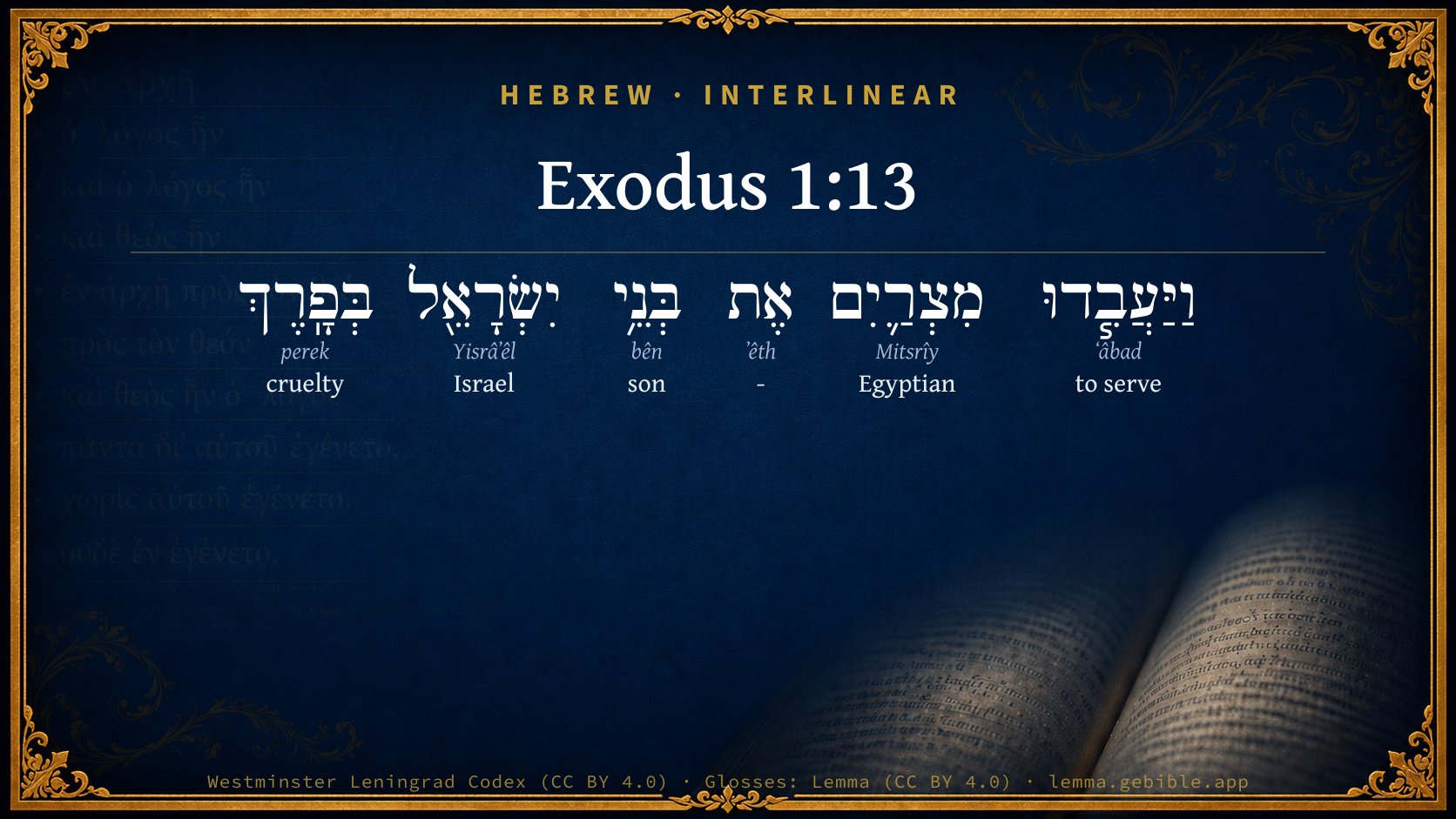
Hebrew (Westminster Leningrad Codex) Exodus 1:13 appears in the Hebrew Old Testament. The text above is from the Westminster Leningrad Codex. Each word links to its Strong’s number, a concise gloss, and parsing drawn from the Open Scriptures Hebrew Bible morphology. Click any word for its full Brown-Driver-Briggs (BDB) entry.
Download image
Cite this verse

Exodus 1:13 (World English Bible). Public Domain. Lemma interlinear Bible study tool, https://lemma.gebible.app/v/exodus/1/13.

Show BibTeX & RIS
BibTeX
RIS
English Translation
The Egyptians ruthlessly made the children of Israel serve,
World English Bible · Public Domain
Highlights
  • 1 first appearance in the Hebrew Bible
Full analysis ↓
Download a study sheet

One document with this verse’s original text, its word-by-word gloss line, the meaning frame, cross-references with their text, attributed commentary, and full source and license credits — printable, and it pastes into notes with its structure intact.

This verse Autodidact and up

Study sheet (.html) Plain text (.txt)

A passage Seminary Student

Up to 50 verses in one chapter. A passage sheet keeps up to 6 commentary sources and 12 cross-references per verse, in the order this page ranks them, and says so on the sheet whenever that leaves anything out. Ask for a single verse and you get the Autodidact verse sheet above.

Everything on this page stays free to read, with no account — the sheet is a download of what is already on screen, not access to it.

Want to remove ads? Support Godless Engineer
Compare translations 3

The same verse in 3 English versions, stacked beneath the original-language interlinear above. Click any original word for its lexicon entry.

Each is an independent rendering of the whole verse — the interlinear is not word-aligned to these translations.

Highlighted words mark where these versions differ — a whole-verse word diff, not a word-by-word alignment.

  • World English Bible Public Domain
    The Egyptians ruthlessly made the children of Israel serve,
  • King James Version Public Domain
    And the Egyptians made the children of Israel to serve with rigor:
  • unfoldingWord Literal Text CC BY-SA 4.0
    And the Egyptians enslaved the sons of Israel with rigor.

unfoldingWord Literal Text — © unfoldingWord, licensed CC BY-SA 4.0. Word-aligned USFM3 via Door43 (git.door43.org/unfoldingWord/en_ult).

Versions to compare (up to 4)

3 of 4 selected

Show all 18 translations

Every available English version of this verse, each an independent rendering of the whole verse.

  • World English Bible Public Domain
    The Egyptians ruthlessly made the children of Israel serve,
  • Berean Standard Bible Public Domain
    They worked the Israelites ruthlessly
  • Majority Standard Bible Public Domain
    They worked the Israelites ruthlessly
  • King James Version Public Domain
    And the Egyptians made the children of Israel to serve with rigor:
  • American Standard Version (1901) Public Domain
    And the Egyptians made the children of Israel to serve with rigor:
  • Revised Version (1885) Public Domain
    And the Egyptians made the children of Israel to serve with rigour:
  • Geneva Bible (1599) Public Domain
    Wherefore the Egyptians by crueltie caused the children of Israel to serue.
  • Douay-Rheims (1899) Public Domain
    And the Egyptians hated the children of Israel, and afflicted them and mocked them:
  • Young's Literal Translation Public Domain
    and the Egyptians cause the sons of Israel to serve with rigour,
  • Literal Standard Version CC BY-SA 4.0
    and the Egyptians cause the sons of Israel to serve with rigor,
  • Unlocked Literal Bible CC BY-SA 4.0
    The Egyptians made the Israelites work rigorously.
  • unfoldingWord Literal Text CC BY-SA 4.0
    And the Egyptians enslaved the sons of Israel with rigor.
  • Darby Bible Public Domain
    And the Egyptians made the children of Israel serve with harshness;
  • World Messianic Bible Public Domain
    The Egyptians ruthlessly made the children of Israel serve,
  • Webster's Bible Public Domain
    And the Egyptians made the children of Israel to serve with rigor.
  • Free Bible Version CC BY-SA 4.0
    The Egyptians worked the Israelites brutally,
  • Bible in Basic English Public Domain
    And they gave the children of Israel even harder work to do:
  • JPS Tanakh (1917) Public Domain
    And the Egyptians made the children of Israel to serve with rigour.

Literal Standard Version (2020), Covenant Press — licensed CC BY-SA 4.0. Text via the HelloAO Bible API (eBible.org). Unlocked Literal Bible (unfoldingWord) — licensed CC BY-SA 4.0. Text via the HelloAO Bible API (eBible.org). unfoldingWord Literal Text — © unfoldingWord, licensed CC BY-SA 4.0. Word-aligned USFM3 via Door43 (git.door43.org/unfoldingWord/en_ult). Free Bible Version, Dr. Jonathan Gallagher — licensed CC BY-SA 4.0. Text via the HelloAO Bible API (eBible.org).

Word by word

More ways to search: Search by grammar → Find every occurrence → Compare this word →

Practice this passage: Drill this verse → Learn its vocabulary →

About this verse

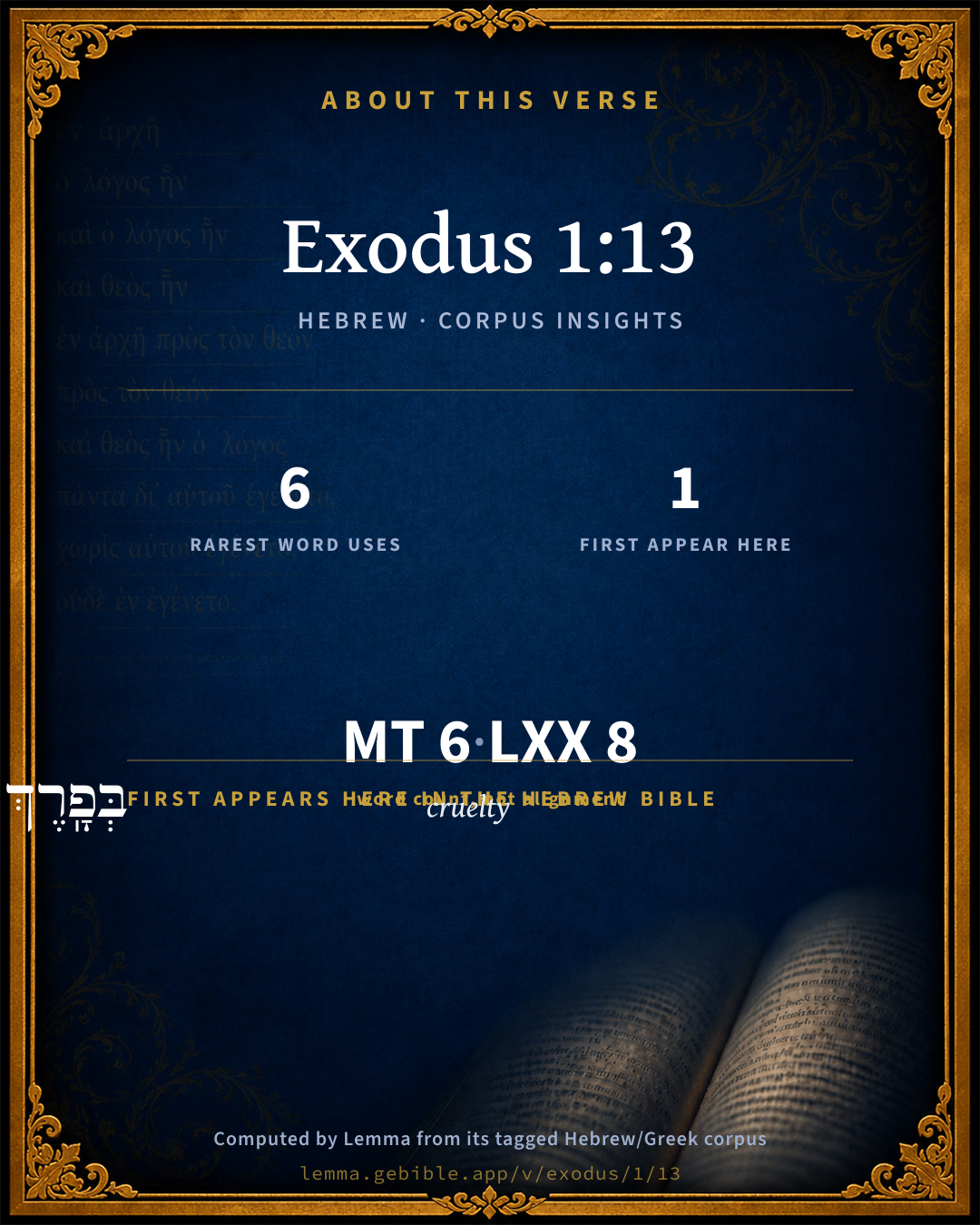
These counts appear in no published source. They are computed here, from the morphology-tagged text and Lemma’s own curated glosses. What Lemma adds →

6
words
6
distinct lemmas
Pentateuch
section

Notable vocabulary

The rarest word here is בְּפָֽרֶךְ cruelty H6531 — appearing just 6 times in the whole Hebrew Bible.

First appearance in Scripture

This word makes its first canonical appearance in the Hebrew Bible here:

  • בְּפָֽרֶךְ cruelty H6531

Shared distinctive vocabulary

בְּפָֽרֶךְ cruelty H6531 occurs in 6 verses of the Hebrew Bible. Also found in:

Grammatical profile

  • 1 verb
  • 4 nouns
  • 1 particle

Verb forms

  • וַיַּעֲבִ֧דוּ Hiphil · Sequential Imperfect

Hebrew & Septuagint length

In English translation the verse runs 9 words from the Hebrew and 11 from the Septuagint (LXX English) — closely comparable.

A rough comparison of the two English renderings, which tokenize alike — not a word-level alignment.

Word counts can differ between the Hebrew and the Greek without any difference in meaning — e.g. the Hebrew direct-object marker אֵת has no separate Greek word, and Greek often adds the article ὁ.

In the original languages it is 6 Hebrew tokens and 8 Greek tokens — but the two are counted differently (Hebrew bundles its prefixes and suffixes into one token; the Greek is in lemma form), so that isn’t a like-for-like length.

Cross-references

1

Topical passages linked to Exodus 1:13 in the Treasury of Scripture Knowledge — connected by theme and wording, ordered by reader-vote popularity; previews shown in the World English Bible.

  • Deuteronomy 4:20 But Yahweh has taken you, and brought you forth out of the iron furnace, out of Egypt, to be to him a people of inheritance, as at this day.

Cross-references courtesy of OpenBible.info (CC BY 4.0).

Hebrew and Greek witnesses Masoretic Hebrew ↔ Greek Septuagint

The same verse in the two great witnesses to the Old Testament, shown verse-for-verse.

These are two independent witnesses, not word-aligned to each other, and the Septuagint is shown in lemma (dictionary) form.

Hebrew Exodus 1:13 Masoretic · Westminster Leningrad Codex

וַיַּעֲבִ֧דוּ מִצְרַ֛יִם אֶת בְּנֵ֥י יִשְׂרָאֵ֖ל בְּפָֽרֶךְ

The Egyptians ruthlessly made the children of Israel serve,

World English Bible · Public Domain

Greek LXX Exodus 1:13 Septuagint · lemma form

καί καταδυναστεύω ὁ αἰγύπτιος ὁ υἱός ἰσραήλ βία

And the Egyptians tyrannized over the children of Israel by force.

LXX2012 (modern English Septuagint) · Public Domain

Hebrew: Westminster Leningrad Codex (CC BY 4.0). Greek: Septuagint (public domain); English from LXX2012 (modern English Septuagint) (Public Domain). How the Septuagint differs from the Hebrew →

Targum (Aramaic paraphrase)

2

The Targum is the ancient Jewish Aramaic paraphrase of the Hebrew Scriptures — an interpretive translation, not the Hebrew text itself. Onkelos (literal) and Pseudo-Jonathan (expansive) render the Torah, and Jonathan the Prophets. Coverage is partial: where no permissively-licensed English translation exists for a verse, only the Aramaic is shown. This is verse-level text, not a word-by-word alignment to the Hebrew.

  1. Targum Onkelos Torah (Genesis–Deuteronomy)
    וְאַפְלָחוּ מִצְרָאֵי יָת בְּנֵי יִשְׂרָאֵל בְּקַשְׁיוּ:

    (no public-domain English translation for this verse)

    Targum Onkelos — Aramaic: “Onkelos Genesis” (public domain); “Onkelos Exodus” (public domain); “Onkelos Leviticus” (public domain); “Onkelos Numbers” (public domain); “Onkelos Deuteronomy” (public domain). English: “Sefaria Community Translation” (CC0 1.0 (public-domain dedication)); “J.W. Etheridge. The Targums of Onkelos and Jonathan Ben Uzziel on the Pentateuch. London: Longmans, Green, 1862” (public domain). Text via Sefaria.

  2. Targum Pseudo-Jonathan Torah (Genesis–Deuteronomy)
    וְשַׁעֲבִּידוּ מִצְרָאֵי יַת בְּנֵי יִשְרָאֵל בְּקַשְׁיוּ

    And the Mizraee enslaved the sons of Israel,

    Targum Pseudo-Jonathan — Aramaic: “Targum Jonathan on Genesis” (public domain); “Targum Jonathan on Exodus” (public domain); “Targum Jonathan on Leviticus” (public domain); “Targum Jonathan on Numbers” (public domain); “Targum Jonathan on Deuteronomy” (public domain). English: “The Targum of Jonathan ben Uzziel, trans. J. W. Etheridge, London, 1862” (public domain). Text via Sefaria.

Commentary

Notes on Exodus 1:13 from classic Christian and Jewish commentators (each source and its license shown beneath its notes). The classic Christian expositions comment on the surrounding passage and are grouped to its opening verse, so a note may address several verses; the Jewish commentaries on the Tanakh (Rashi and others) are per-verse, so they appear only where the commentator wrote on this verse.

Lemma curates 59 commentaries, every one of them public domain or Creative Commons licensed, each selected and text-cleaned for this edition rather than reprinted as found. About our sources →

Trapp's Complete Commentary

John Trapp

Exo 1:13 And the Egyptians made the children of Israel to serve with rigour:

Ver. 13. To serve with rigour.] Heb. ( בפרך), With fierceness: {a} so thinking to cow out their spirits, and to exanimate them. So deals the Turk with the Christians.

{a} Quidam cam ferocia voce latina conferunt.

John Trapp, A Commentary or Exposition upon All the Books of the Old and New Testament (1647–1656) — public domain. Text from a community e-Sword module.

Joseph Benson's Commentary

Exo 1:13. With rigour — בפרךְbepareck, with cruelty, or tyranny; with hard words and cruel usage, without mercy or mitigation. This God permitted for wise and just reasons: 1st, As a punishment of the idolatry into which, it appears, many of them had fallen: 2d, To wean them from the land of Egypt, which was a plentiful, and, in many respects, a desirable land, and to quicken their desires after Canaan: 3d, To prepare the way for God’s glorious works, and Israel’s deliverance.

Joseph Benson's Commentary on the Old and New Testaments (1811–1818) — public domain. Text from a community e-Sword module.

The Preacher's Complete Homiletical Commentary

Joseph S. Exell (gen. ed.)

MAIN HOMILETICS OF THE PARAGRAPH.—Exo_1:13-14

THE DESPOTISM OF SIN

I. That it commences by suggesting a small tribute to the sinner. The Egyptian King, no doubt, suggested to the Israelites that great advantage might arise to them if they would enter into certain engagements or investments under his authority. This they did—paying heavy tribute—which they were unable to meet—and so placed themselves in his power.

1. Sin generally commences its tyranny by suggesting the probability of gain under its rule. It wins us by the hope of a good investment—whereby we may secure wealth—prosperity—fame. But when we commence to work out the contract we find that we have been lured by a false hope—a deceptive promise. We find ourselves involved in difficulties—numerous—complicated—depressing—ever increasing—until we are reduced from the position of tenant to that of slave. Never enter into any bargains with sin. They are sure to end in woe. They promise liberty—they give chains. The world is a great prison-house full of the dupes of sin.

(1.) Sin is cunning.

(2.) Sin has many counsellors.

(3.) Sin has many agencies. You are not a match for it.

II. That it succeeds in getting the sinner completely within its power. The Egyptians succeeded in getting the Israelites completely under their authority

1. Sin gets the sinner under its rule. It makes him obey the laws of hell. It makes him work the purposes of Satan. He must violate every holy instinct of his nature. He must reject the counsel of the Infinite. He becomes a subject of the infernal realm of being.

2. Sin makes the sinner subject to its counsel. The Israelites were enslaved as the result of a national consultation between the Egyptian king and his near advisers. Satan holds a council in reference to the moral servitude of human souls—the sinner yields to the unjust and unholy requirements of his fiendish companions.

3. Sin makes the sinner responsible to its authority. The Israelites were responsible to the king of Egypt for the kind and amount of service they rendered. He made them feel obligated to build the house, and to serve in the field. So the devil tries to bring men to do his work as though they were obligated to follow his bidding, so completely is the soul brought under Satanic power. It is conscious of its burden. It has not the energy to cast it away.

III. That it ultimately imposes upon the sinner an intolerable servitude.

1. The servitude of a bitter life. How sad the lives of these abject Israelites. Every day spent in unrequited toil—subject to heavy tribute—savage taskmasters—a fierce king—an envious nation—without hope of deliverance. Without free social intercourse—without happy domestic life. Sin renders life bitter—destroys friendly companionships—breaks up family comfort. Fills life with grief.

2. The servitude of hard work. The Egyptians made the Israelites build cities, and attend in the fields. The devil gives sinners hard work to do. Sinners often work harder than saints. Their toil is far more exhausting and fatiguing. Nor are sinners recompensed for their toil; Satan makes them build houses for other people! The unprofitableness—the folly of sin.

3. The servitude is degrading. The Israelites came into Egypt as a godly family, brought there by Joseph, who was distinguished as a God-fearing man. They were honoured by the king. They were respected by the people—Yet a few years afterwards they are employed as field-servants. What a transition in their position, and all because they yielded to the cunning allurements of a wicked king! So sin brings men from respect to derision—from plenty to beggary—from moral rulership to servitude, Repulse the first attempt of Satan to bind even a golden chain around your wrist, for, when fastened, you will find the gold to wear off, and disclose a steel manacle that will bruise your flesh. Sin degrades individuals—and nations.

THE SPIRITUAL BONDAGE OF MAN

I. It was an entire and universal bondage. The dominion of the oppressor had no merciful limit, nor mitigation. Every Israelite in Goshen was the bondservant of the Egyptians. The bondage of Satan knows no limit—no mercy:—

1. The understanding is depraved.

2. The will is perverted.

3. The affections are depraved.

II. The Israelites under a severe and cruel bondage.

III. The Israelites were in a helpless bondage. Every refinement of policy, every effort of power, every device of craft, was practised against them by the might and subtilty of a nation unrivalled in arts and arms. They could not escape of themselves. Satan has a close alliance with every appetite and affection of our nature. Difficult to get from under his tyranny [Buddicom’s Christian Exodus].

SUGGESTIVE COMMENTS ON THE VERSES

Exo_1:13-14. The sufferings of Israel were rendered more intense:—

1. As a punishment for their idolatry.

2. To inspire within them a deep hatred toward Egypt, so that through their perils in the wilderness they might not wish to return thither.

3. That the prospect of Canaan might animate and refresh their souls.

4. That after such excessive and unpaid labour they might fairly spoil the Egyptians on their departure.

5. That they might be aroused to earnest prayer for deliverance.

6. That the power and mercy of God might be more forcibly displayed in their freedom. Here is a true picture of tyranny:—i. Its rigour increases with failure. ii. It becomes more impious as it is in evident opposition to the Divine providence. iii. It discards all the claims of humanity. iv. It ends in its own defeat and overthrow.

It is the cruel design of persecutors to make God’s freemen their slaves.

Wicked persecutors are the more rigorous to those whom God favoureth.

Some men take a delight in making the lives of God’s people miserable.

Men are slow to be taught that, by their mad schemes, they are fighting against God.

By the Work of this bondage the Israelites, getting instructed in civilized life, were being prepared for their future home.

The Preacher's Complete Homiletical Commentary (gen. ed. Joseph S. Exell; Funk & Wagnalls, c. 1892) — public domain (pre-1929). A full-Bible homiletical/sermon-outline anthology covering 65 of 66 books (2 John is absent from the source module). Text from a community e-Sword module.

Jamieson, Fausset & Brown

Robert Jamieson, A. R. Fausset & David Brown

The Egyptians . . . made their lives bitter with hard bondage, in mortar, and in brick--Ruins of great brick buildings are found in all parts of Egypt. The use of crude brick, baked in the sun, was universal in upper and lower Egypt, both for public and private buildings; all but the temples themselves were of crude brick. It is worthy of remark that more bricks bearing the name of Thothmes III, who is supposed to have been the king of Egypt at the time of the Exodus, have been discovered than of any other period [WILKINSON]. Parties of these brickmakers are seen depicted on the ancient monuments with "taskmasters," some standing, others in a sitting posture beside the laborers, with their uplifted sticks in their hands.

Jamieson, Fausset & Brown — Commentary Critical and Explanatory on the Whole Bible (1871) — public domain (CC PDM 1.0). Text via the HelloAO Bible API.

Adam Clarke's Commentary

Verse 13. To serve with rigour] בפרך bepharech, with cruelty, great oppression; being ferocious with them. The word fierce is supposed by some to be derived from the Hebrew, as well as the Latin ferox, from which we more immediately bring our English term. This kind of cruelty to slaves, and ferociousness, unfeelingness, and hard-heartedness, were particularly forbidden to the children of Israel. See Le 25:43, Le 25:46, where the same word is used: Thou shalt not rule over him with RIGOUR, but shalt fear thy God.

Adam Clarke's Commentary on the Bible (1810–1826) — public domain. Text from a community e-Sword/MySword module.

Ellicott's Commentary for English Readers

(13) With rigour.—Forced labour in Egypt was of a very severe character. Those condemned to it worked from morning to night under the rod of a task-master, which was freely applied to their legs or backs, if they rested their weary limbs for a moment. (See Records of the Past, vol. viii. p. 149; Chabas, Mélanges Egyptolo-giques, vol. ii. p. 121). The heat of the sun was great; the burthens which the labourers had to carry were heavy, and the toil was incessant. Death often resulted from the, excessive work. According to Herodotus, a single monarch, Neco, destroyed in this way 120,000 of his subjects (Herod, ii. 158).

A Bible Commentary for English Readers, edited by Charles John Ellicott (1878–1897) — public domain. Text from a community e-Sword module.

The Cambridge Bible for Schools and Colleges

gen. ed. J. J. S. Perowne

13. with rigour] The rare word found otherwise only in v. 14, Lev_25:43; Lev_25:46; Lev_25:53 (all P or H); Eze_34:4. The root is not in use in Heb.; in Aram. it means to rub (Luk_6:1 Pesh.), or crush small.

13, 14. The parallel, from P, to vv. 11, 12, and continuation of v. 7. P states simply the fact of the oppression, without referring to the grounds prompting it.

The Cambridge Bible for Schools and Colleges (gen. ed. J. J. S. Perowne; Cambridge University Press, 1878–1918) — public domain. Text from a community e-Sword module.

John Gill's Exposition

And the Egyptians made the children of Israel to serve with rigour. Or with breach (c), with what might tend to break their strength; they laid heavier burdens upon them, obliged them to harder service, used them more cruelly and with greater fierceness, adding to their hard service ill words, and perhaps blows.

(c) "in fractione", Cajetan. apud Rivet.

John Gill's Exposition of the Whole Bible (1746–1763) — public domain (CC PDM 1.0). Text via the HelloAO Bible API.

Matthew Poole's English Annotations

Or, cruelty, or, tyranny; with hard words and cruel usage, without mercy or mitigation. This God permitted for wise and just reasons.

1. As a punishment of their idolatry, into which divers of them fell there. Jos 24:14; Eze 20:5,7,8; 23:8

2. To wean them from the land of Egypt, which otherwise was a plentiful and desirable land, and to quicken their desires after Canaan.

3. To prepare the way for God’s glorious works, and Israel’s deliverance.

Matthew Poole's English Annotations on the Holy Bible (1683–1685) — public domain. Text from a community e-Sword/MySword module.

Whedon's Commentary on the Bible

Daniel D. Whedon

13, 14. The nature of their toil is here more fully described.

Hard bondage — Rather, hard labour in clay and bricks, and all (kind of) service in the field. They were not made house-servants, or employed as artisans in any kind of skilled labour, but were set at the coarse work of brick-making for the great public buildings, canal digging, raising water from the river for irrigation, which is specially toilsome in Egypt, and similar rough outdoor labours. This remark applies only to this time of special oppression. Josephus says that they built the pyramids; but the great pyramids are made of stone, and were standing when Joseph went down into Egypt. A vast amount of brick was required for the walls of cities, fortresses, temple-courts, and private as well as public buildings. They were made of the Nile mud mixed with straw, and of clay without straw, baked in the sun, and their manufacture was a government monopoly. Immense piles of these bricks — the ruins of ancient works, many of them stamped with the hieroglyphs of the Pharaohs — are now found in the land of Goshen.

The opposite engraving represents a painting at Thebes, in the tomb of an officer of Thothmes III., of the eighteenth dynasty, and delineates all the processes of Egyptian brick-making, foreign captives being the labourers, directed by Egyptian task-masters.

It is a noteworthy fact, that, in an inscription of the twenty-second year of Amosis, alien labourers of some pastoral nation, like the Israelites, are described as carrying blocks of limestone from the Rufu quarries to Memphis. This, like the opposite picture, shows that events precisely like those narrated in the text were, according to the best chronology, transpiring in Egypt at the time when the Israelites were there.

Daniel D. Whedon (gen. ed.), Commentary on the Old and New Testaments (1874–1909) — public domain. Text from a community e-Sword module.

The Pulpit Commentary

The Egyptians made the children of Israel to serve with rigour. The word translated rigour is a very rare one. It is derived from a root which means "to break in pieces, to crush." The "rigour" would be shown especially in the free use of the stick by the taskmaster, and in the prolongation of the hours of work.

The Pulpit Commentary (1880–1919), ed. H.D.M. Spence-Jones & Joseph S. Exell — public domain. Text from a community e-Sword module.

unfoldingWord translationNotes

Door43 World Missions Community

made ... work rigorously

"made ... work very hard" or "harshly made ... work"

made their lives bitter

The difficult lives of the Israelites are spoken of as if they were bitter food that was difficult to eat. (See: Metaphor)

mortar

This was a wet glue or mud put between bricks or stones that held them together when it dried.

All their required work was hard

"The Egyptians made them work very hard" or "The Egyptians forced them to work very hard"

translationWords

life

unfoldingWord translationNotes — © Distant Shores Media and the Door43 World Missions Community, licensed CC BY-SA 4.0. Source: git.door43.org/Door43/en_tn.

Rashi

Rabbi Shlomo Yitzchaki (Rashi)

בפרך means with hard service which crushes (מפרכת) the body and shatters it (cf. Sotah 11b).

Rashi on the Tanakh — English translations: “The Judaica Press complete Tanach with Rashi, translated by A. J. Rosenberg” (CC BY 4.0); “Pentateuch with Rashi's commentary by M. Rosenbaum and A.M. Silbermann, 1929-1934” (public domain); “The Metsudah Tanach series, Lakewood, N.J” (CC BY 4.0); and “The Book of Joshua, Metsudah Publications, 1997” (CC BY 4.0). Text via Sefaria.

Lesson kit

Teaching starters — assembled from the data on this page, not authored interpretation. Every prompt links to the verse data it draws on. Edit before teaching.

Exodus, in the Pentateuch, opens this verse with 6 words (6 distinct Hebrew lemmas). Its most distinctive word is perek (“cruelty”). A historical commentator’s framing appears above. Read the whole chapter for the surrounding context.

Discussion questions

  1. How does “cruelty” (perek) shape what this verse is saying?
  2. This is the first place “cruelty” appears in Scripture (first appears here). What does its debut here establish?
  3. How does Exodus 1:14, which shares the word «cruelty», read alongside this verse?
  4. These translations render this verse differently. What is at stake in choosing one wording over another?
  5. «וַיַּעֲבִ֧דוּ» is a Hiphil Sequential Imperfect verb. How does that grammatical form shape the action described?
  6. Compare how Trapp's Complete Commentary and Joseph Benson's Commentary read this verse. Where do they agree or differ?

Things to notice

Reading settings

Reading text

Shown beneath each verse's original-language words.

Old Testament
Old Testament edition

Read the OT as the Masoretic Hebrew (MT) or the Greek Septuagint (LXX).

English shown for the Greek Septuagint (in the Hebrew ↔ Greek comparison).

Comparing translations? Open the Compare panel on any verse page to stack up to four side by side.