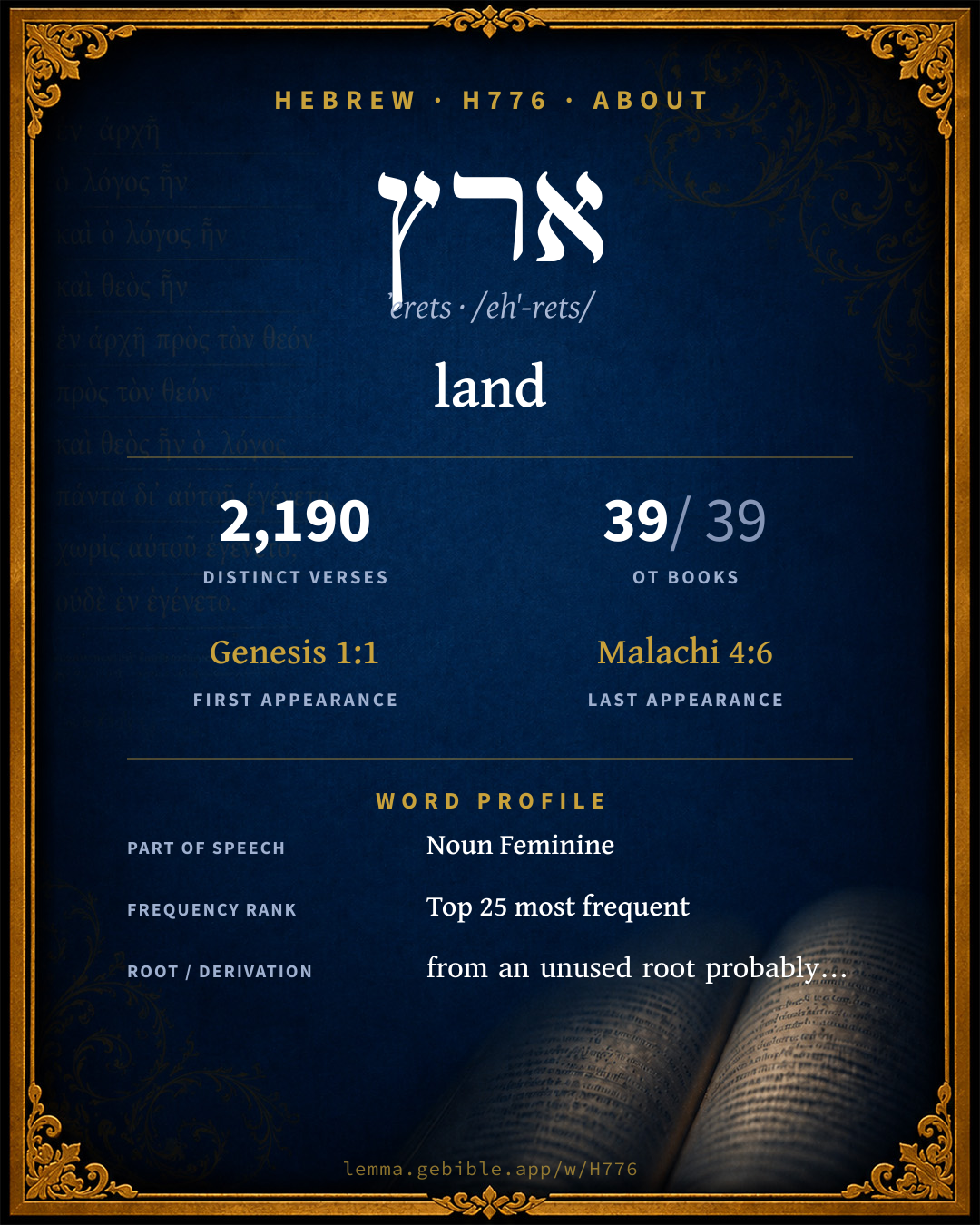
אֶ֫רֶץ
land
‘land’ is one of 4 main senses fuller range ↓
Full lexicon entry — Brown-Driver-Briggs (BDB)
From Brown-Driver-Briggs (BDB)
Where this word appears
See every Absolute-state word in the Hebrew Bible →
Grammar key — what these labels mean
Part of speech
- Noun
- A naming word — a person, place, thing, or idea.
Noun type
- Common
- A common noun — a general class of person, place, or thing (“king,” “city,” “water”), not a specific name.
State
- Absolute
- The independent form of a noun, not bound to a following word.
- Construct
- A noun bound to a following noun in a possessive / “of” relationship (the construct chain).
Gender
- Both
- Attested as both masculine and feminine.
Number
- Singular
- One.
- Plural
- More than one (in Hebrew, generally three or more).
34 verses where H776 appears in the Absolute state in the Book of 1 Samuel. Filtered view — show all forms. Click any verse to open its interlinear word-by-word view. Verse text shown in the World English Bible for context — . Each verse’s Hebrew form is shown with its reference; the English is not keyword-highlighted, since the data carries no word-level English alignment. Use “Compare translations” on any verse to read it across multiple English versions. This concordance covers the Hebrew Bible; Septuagint (Greek Old Testament) occurrences are not indexed here.
1 Samuel
- 1 Samuel 2:8 אֶ֔רֶץ n c bs He raises up the poor out of the dust, He lifts up the needy from the dunghill, To make them sit with princes, Inherit the throne of glory: For the pillars of the earth are Yahweh's, He has set the world on them.
- 1 Samuel 2:10 אָ֑רֶץ n c bs Those who strive with Yahweh shall be broken to pieces; Against them will he thunder in the sky: Yahweh will judge the ends of the earth; He will give strength to his king, Exalt the horn of his anointed.
- 1 Samuel 3:19 אָֽרְצָ/ה n c bs + sfx h Samuel grew, and Yahweh was with him, and did let none of his words fall to the ground.
- 1 Samuel 4:5 הָ/אָֽרֶץ ptcl def.art + n c bs When the ark of the covenant of Yahweh came into the camp, all Israel shouted with a great shout, so that the earth rang again.
- 1 Samuel 5:3 אַ֔רְצָ/ה n c bs + sfx dem When they of Ashdod arose early on the next day, behold, Dagon was fallen on his face to the ground before the ark of Yahweh. They took Dagon, and set him in his place again.
- 1 Samuel 5:4 אַ֔רְצָ/ה n c bs + sfx dem When they arose early on the next day morning, behold, Dagon was fallen on his face to the ground before the ark of Yahweh; and the head of Dagon and both the palms of his hands [lay] cut off on the threshold; only [the stump of] Dagon was left to him.
- 1 Samuel 6:5 הָ/אָ֔רֶץ אַרְצְ/כֶֽם ptcl def.art + n c bs n c bs cs + sfx pers 2mp Therefore you shall make images of your tumors, and images of your mice that mar the land; and you shall give glory to the God of Israel: peradventure he will lighten his hand from off you, and from off your gods, and from off your land.
- 1 Samuel 13:3 הָ/אָ֨רֶץ֙ ptcl def.art + n c bs Jonathan struck the garrison of the Philistines that was in Geba: and the Philistines heard of it. Saul blew the trumpet throughout all the land, saying, Let the Hebrews hear.
- 1 Samuel 14:15 הָ/אָ֔רֶץ ptcl def.art + n c bs There was a trembling in the camp, in the field, and among all the people; the garrison, and the spoilers, they also trembled; and the earth quaked: so there was an exceeding great trembling.
- 1 Samuel 14:25 הָ/אָ֖רֶץ ptcl def.art + n c bs All the people came into the forest; and there was honey on the ground.
- 1 Samuel 14:29 הָ/אָ֑רֶץ ptcl def.art + n c bs Then said Jonathan, My father has troubled the land. Please look how my eyes have been enlightened, because I tasted a little of this honey.
- 1 Samuel 14:32 אָ֑רְצָ/ה n c bs + sfx dem and the people flew on the spoil, and took sheep, and oxen, and calves, and killed them on the ground; and the people ate them with the blood.
- 1 Samuel 14:45 אַ֔רְצָ/ה n c bs + sfx dem The people said to Saul, Shall Jonathan die, who has worked this great salvation in Israel? Far from it: as Yahweh lives, there shall not one hair of his head fall to the ground; for he has worked with God this day. So the people rescued Jonathan, that he didn't die.
- 1 Samuel 17:46 הָ/אָ֑רֶץ הָ/אָ֔רֶץ ptcl def.art + n c bs ptcl def.art + n c bs This day will Yahweh deliver you into my hand; and I will strike you, and take your head from off you; and I will give the dead bodies of the host of the Philistines this day to the birds of the sky, and to the wild animals of the earth; that all the earth may know that there is a God in Israel,
- 1 Samuel 17:49 אָֽרְצָ/ה n c bs + sfx dem David put his hand in his bag, and took there a stone, and slang it, and struck the Philistine in his forehead; and the stone sank into his forehead, and he fell on his face to the earth.
- 1 Samuel 20:41 אַ֛רְצָ/ה n c bs + sfx dem As soon as the boy was gone, David arose out of [a place] toward the South, and fell on his face to the ground, and bowed himself three times: and they kissed one another, and wept one with another, until David exceeded.
- 1 Samuel 21:11 הָ/אָ֑רֶץ ptcl def.art + n c bs The servants of Achish said to him, "Isn't this David the king of the land? Didn't they sing one to another about him in dances, saying, 'Saul has slain his thousands, David his ten thousands?'"
- 1 Samuel 23:23 בָ/אָ֔רֶץ prep det + n c bs See therefore, and take knowledge of all the lurking-places where he hides himself, and come you again to me of a certainty, and I will go with you: and it shall happen, if he be in the land, that I will search him out among all the thousands of Judah.
- 1 Samuel 23:27 הָ/אָֽרֶץ ptcl def.art + n c bs But there came a messenger to Saul, saying, Haste you, and come; for the Philistines have made a raid on the land.
- 1 Samuel 24:8 אַ֖רְצָ/ה n c bs + sfx dem David also arose afterward, and went out of the cave, and cried after Saul, saying, My lord the king. When Saul looked behind him, David bowed with his face to the earth, and did obeisance.
- 1 Samuel 25:23 אָֽרֶץ n c bs When Abigail saw David, she hurried, and alighted from her donkey, and fell before David on her face, and bowed herself to the ground.
- 1 Samuel 25:41 אָ֑רְצָ/ה n c bs + sfx dem She arose, and bowed herself with her face to the earth, and said, Behold, your handmaid is a servant to wash the feet of the servants of my lord.
- 1 Samuel 26:7 בָ/אָ֖רֶץ prep det + n c bs So David and Abishai came to the people by night: and, behold, Saul lay sleeping within the place of the wagons, with his spear stuck in the ground at his head; and Abner and the people lay round about him.
- 1 Samuel 26:8 וּ/בָ/אָ֨רֶץ֙ conj + prep det + n c bs Then said Abishai to David, God has delivered up your enemy into your hand this day: now therefore please let me strike him with the spear to the earth at one stroke, and I will not strike him the second time.
- 1 Samuel 26:20 אַ֔רְצָ/ה n c bs + sfx dem Now therefore, don't let my blood fall to the earth away from the presence of Yahweh: for the king of Israel is come out to seek a flea, as when one does hunt a partridge in the mountains.
- 1 Samuel 27:8 הָ/אָ֨רֶץ֙ אֶ֥רֶץ ptcl def.art + n c bs n c bs cs David and his men went up, and made a raid on the Geshurites, and the Girzites, and the Amalekites; for those [nations] were the inhabitants of the land, who were of old, as you go to Shur, even to the land of Egypt.
- 1 Samuel 27:9 הָ/אָ֔רֶץ ptcl def.art + n c bs David struck the land, and saved neither man nor woman alive, and took away the sheep, and the oxen, and the donkeys, and the camels, and the clothing; and he returned, and came to Achish.
- 1 Samuel 28:3 מֵ/הָ/אָֽרֶץ prep + ptcl def.art + n c bs Now Samuel was dead, and all Israel had lamented him, and buried him in Ramah, even in his own city. Saul had put away those who had familiar spirits, and the wizards, out of the land.
- 1 Samuel 28:9 הָ/אָ֑רֶץ ptcl def.art + n c bs The woman said to him, Behold, you know what Saul has done, how he has cut off those who have familiar spirits, and the wizards, out of the land: why then lay you a snare for my life, to cause me to die?
- 1 Samuel 28:13 הָ/אָֽרֶץ ptcl def.art + n c bs The king said to her, Don't be afraid: for what do you see? The woman said to Saul, I see a god coming up out of the earth.
- 1 Samuel 28:14 אַ֖רְצָ/ה n c bs + sfx dem He said to her, What form is he of? She said, An old man comes up; and he is covered with a robe. Saul perceived that it was Samuel, and he bowed with his face to the ground, and did obeisance.
- 1 Samuel 28:20 אַ֔רְצָ/ה n c bs + sfx dem Then Saul fell immediately his full length on the earth, and was sore afraid, because of the words of Samuel: and there was no strength in him; for he had eaten no bread all the day, nor all the night.
- 1 Samuel 28:23 מֵֽ/הָ/אָ֔רֶץ prep + ptcl def.art + n c bs But he refused, and said, I will not eat. But his servants, together with the woman, constrained him; and he listened to their voice. So he arose from the earth, and sat on the bed.
- 1 Samuel 30:16 הָ/אָ֑רֶץ מֵ/אֶ֥רֶץ וּ/מֵ/אֶ֥רֶץ ptcl def.art + n c bs prep + n c bs cs conj + prep + n c bs cs When he had brought him down, behold, they were spread abroad over all the ground, eating and drinking, and dancing, because of all the great spoil that they had taken out of the land of the Philistines, and out of the land of Judah.
About this entry
At a glance — auto-summarized from this page’s data, not written by a person. Every figure links to its source below. This summary describes the numbers; it doesn’t interpret them.
At its core, ארץ (ʼerets) means “land.” Carrying more than one sense, it rewards its full sense range. Spanning 2,190 verses in 39 books, it ranks among the most common words of the Hebrew Bible. Scripture first uses it in Genesis 1:1. From the same root come ארע and ארצא. See the sense tree, 2,190-verse concordance, and the renderings breakdown below.
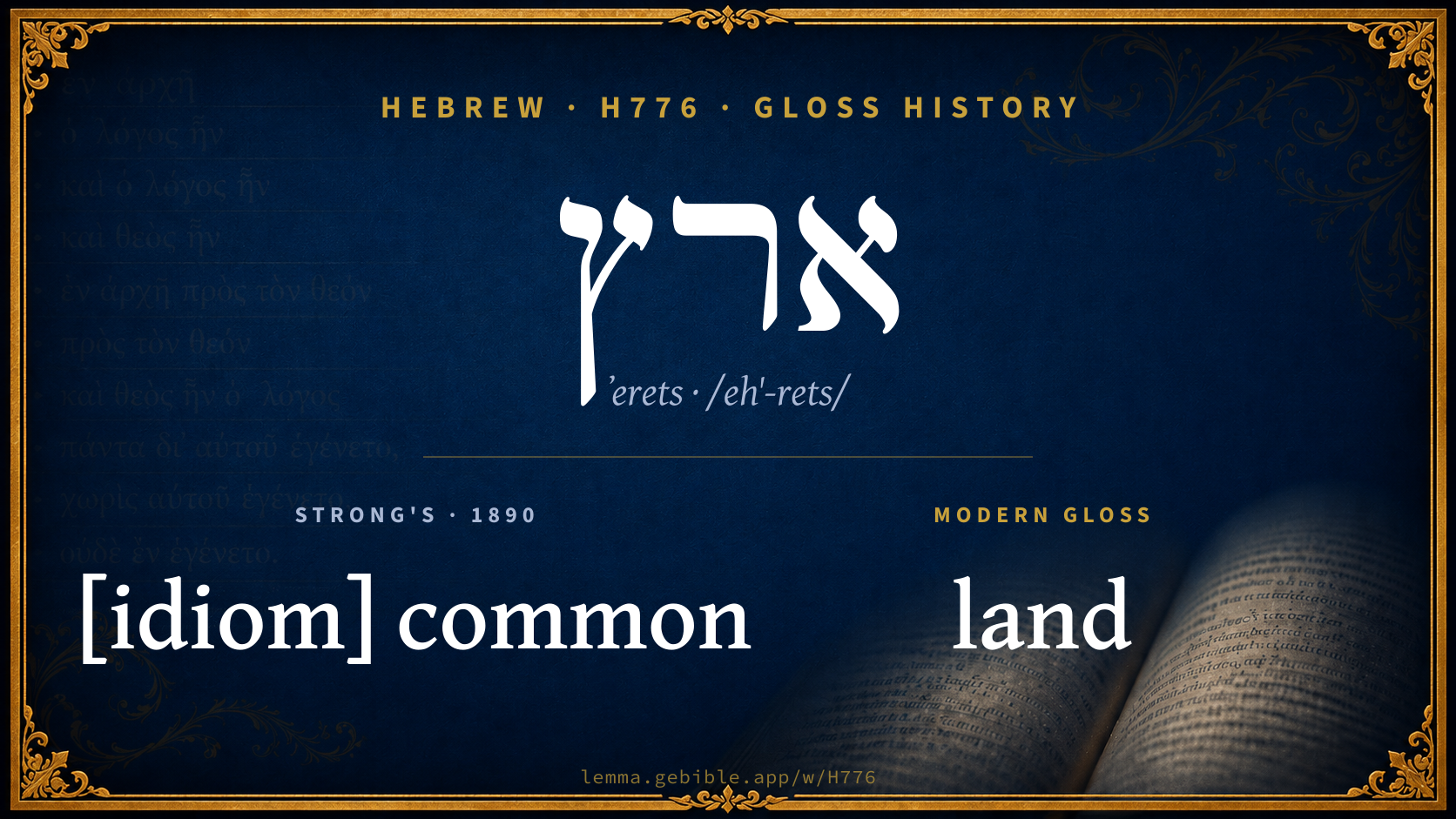
Gloss history
Strong's 1890 vs modern scholarship
About this word
Strong's H776 catalogs a Hebrew word from the Hebrew Old Testament.
These counts are not copied from any lexicon or concordance. They are computed here, from the morphology-tagged Hebrew Old Testament. What Lemma adds →
- 2,190
- distinct verses
- The word appears in 2,190 distinct verses.
- 39 / 39
- OT books
- The word appears in 39 of 39 Old Testament books.
- #17
- by frequency
- Top 25 most frequent Hebrew words (rank 17 of 8,640 Hebrew words by occurrence).
View all 2,190 occurrences in the concordance →
By section of the Old Testament
By traditional corpus
Conventional, traditional groupings — biblical authorship is debated, so this is a traditional corpus grouping, not an authorship claim. Each share is this word’s portion of its verses in that division of the Hebrew canon. Each figure is a share of the word’s 2,190 distinct verses.
- Prophets (Nevi'im) 1,038 verses · 47%
- Torah (Pentateuch) 705 verses · 32%
- Writings (Ketuvim) 447 verses · 20%
How translations render this word
Counts come from each version’s own published word-to-Strong’s tagging or interlinear alignment — an approximate guide to how each version renders this word, not a word-level alignment the data otherwise carries. Because each total is that version’s own tagged count, the per-version totals vary from one another and need not match the appearance or distinct-verse counts above. These counts may also differ from a printed concordance because Lemma counts each distinctly tagged rendering and does not collapse phrase taggings into a single head-word total. This is a fixed set of word-tagged versions (KJV, ASV, BSB, ULT) and does not change with the reading translation you choose elsewhere. Each version’s license is shown beside its name below (and on Sources).
- King James Version: Land 1,210×, Earth 543×, Ground 82×
- American Standard Version: Land 1,137×, Earth 505×, Ground 73×
- Berean Standard Bible: Land 1,415×, Earth 544×, Ground 117×
- unfoldingWord Literal Text: Land 994×, Earth 596×, Land of 491×
King James Version Public Domain
Renders H776 across 2,504 tagged occurrences — most commonly:
Plus other, less common renderings. Plus 180 renderings that appear only once — usually multi-word phrases or single function words the recovered tagging swept in, not distinct renderings.
American Standard Version Public Domain
Renders H776 across 2,502 tagged occurrences — most commonly:
Plus other, less common renderings. Plus 304 renderings that appear only once — usually multi-word phrases or single function words the recovered tagging swept in, not distinct renderings.
Berean Standard Bible Public Domain
Renders H776 across 2,375 tagged occurrences — most commonly:
Plus other, less common renderings. Plus 82 renderings that appear only once — usually multi-word phrases or single function words the recovered tagging swept in, not distinct renderings. Not rendered by a distinct English word in 108 further occurrences.
unfoldingWord Literal Text CC BY-SA 4.0
Renders H776 across 2,463 tagged occurrences — most commonly:
Plus other, less common renderings. Plus 60 renderings that appear only once — usually multi-word phrases or single function words the recovered tagging swept in, not distinct renderings.
18 senses and sub-senses in the full BDB
What do BDB’s symbols mean?
BDB uses these scholarly abbreviations:
| Symbol | Meaning |
|---|---|
| 𝔊 | the Septuagint (the ancient Greek translation, LXX) |
| 𝔙 | the Vulgate (the Latin translation) |
| 𝔖 | the Syriac version (the Peshitta) |
| 𝔗 | the Targum (the Aramaic translation) |
| ψ | the Psalms |
| √ | root (the underlying root or stem) |
| ‖ | parallel passage (a synonymous or contrasted parallel) |
| † | the dagger: every passage where the word occurs is cited |
The 18 senses and sub-senses the full Brown-Driver-Briggs lexicon distinguishes for this word, in lexicon order (not ranked by frequency), with BDB’s own verbatim wording and sub-sense lettering. Shown in Hebrew script with BDB’s own scholarly abbreviations. The condensed entry is in the Lexicon Entry tab. See also the Forms in the corpus table below.
- 1.
- a. earth, whole earth (opp. to a part) Gn 18:18, 25; 22:18 (= הָאֲדָמָה 12:3) Je 25:26, 29, 30; 26:6 Is 37:16, 20 = 2 K 19:15, 19 Zc 4:10, 14 +. e.g. Genesis 18:18
- b. earth, opp. to heaven, sky Gn 1:2 Ex 20:4 Dt 5:8; 30:19 Ju 5:4 La 2:1 Is 37:16 = 2 K 19:15 ψ 146:6 1 Ch 21:16; 29:11 2 Ch 2:11 +; as permanent Ec 1:4; built on foundations, or pillars 1 S 2:8 ψ 104:5 Jb 38:4 Is 48:13; 51:13, 16 cf. also Is 24:18 ψ 82:5; firm, so that its shaking is something terrible, & token of terrible power 1 S 14:5 2 S 22:8 = ψ 18:8 Jb 9:6 cf. ψ 46:3 & v 7; so also Am 8:8 Is 2:19, 21; 24:18, 19, 20 ψ 60:4; 77:19; 99:1; 114:7; as hung on nothing Jb 26:7; with waters under it Ex 20:4 = Dt 5:8 cf. Gn 7:11; personified, especially as addressed, called to witness, etc. Dt 32:1 Je 6:19; 22:29 Is 1:2 Mi 1:2 Jb 16:18. e.g. Genesis 1:2
- c. earth = inhabitants of earth Gn 6:11; 11:1 1 K 2:2; 10:24 ψ 33:8; 66:4 + cf. תֵּבֵל א׳ Pr 8:31 Jb 37:12. e.g. Genesis 6:11
- 2. land =
- a. country, territory, א׳ שִׁנְעָר Gn 10:10, א׳ מִצְרַיִם 21:21; cf. also 10:11; 11:28, 31; 13:10; 47:6, 27; 50:8 Is 7:18; 23:1, 13; 27:13 ψ 78:12 Je 25:20 1 Ch 1:43; personif. Is 62:4 Ec 10:16, 17. e.g. Genesis 10:10
- b. district, region Gn 19:28; 22:2 Jos 11:3 ψ 42:7. e.g. Genesis 19:28
- c. tribal territory Dt 34:2 Ju 21:21 1 S 9:4, 16; 13:7 1 K 15:20 Is 8:23; and still smaller territories 1 S 9:4, 5. e.g. Deuteronomy 34:2
- d. piece of ground Gn 23:15. e.g. Genesis 23:15
- e. specif. land of Canaan, or Israel Gn 11:31; 12:1, 5, 6, 7; 31:3 Lv 14:34 Dt 17:14; 18:9 2 K 5:2, 4 +; especially obj. of יָרַשׁ possess Dt 3:20 + often Dt ψ al.; so after נָחַל Jos 19:49 +; נָתַן Dt 1:21 +. f. = inhabitants of land Lv 19:29 Ez 14:13 + cf. Dt 24:4 Zc 12:12 etc. g. used even of Sheʾôl Jb 10:21, 22 (cf. Assyrian irṣit la târat, land without return, in Descent of Ishtar, v. Jr 10.65); v. also ψ 139:15 Is 44:23. e.g. Genesis 11:31
- 3.
- a. ground, surface of ground = אֲדָמָה q.v. Gn 1:26, 30; 18:2; 33:3; 38:9 Ex 4:3; 16:14 Ru 2:10 1 S 5:4 + very often in S. e.g. Genesis 1:26
- b. soil, as productive = אֲדָמָה Gn 1:11, 12 Lv 19:9; 25:19; 26:4 cf. Nu 14:7, 8 Is 36:17 = 2 K 18:32 ψ 72:6, 16; 107:34, 35 Ezr 9:12 Ne 9:35. e.g. Genesis 1:11
- 4. אֶרֶץ in phrases:
- a. people of the land עַם־הָא׳ of non-Israelites Gn 23:7, 12, 13 (P) Nu 14:9 (JE); as well as Isr. Lv 20:4 (H) 2 K 15:5; 16:15; 21:24(×2); especially common people, opp. officials, princes Lv 4:27 (P) Ez 7:27 2 K 11:18, 19. e.g. Genesis 23:7
- b. in measurements of distance, כִּבְרַת הָא׳ the space or distance of country (v. כּברה) Gn 35:16, so כִּבְרַת א׳ some distance Gn 48:7 2 K 5:19. e.g. Genesis 35:16
- c. אֶרֶץ הַמִּישׁוֹר the country of the plain, level or plain country Dt 4:33 Je 48:21; א׳ מִישׁוֹר fig. ψ 143:10 (but read אֹרַח 𝔖 Bi Gr Che, cf. ψ 27:11). e.g. Deuteronomy 4:33
- d. א׳חַיִּים land of the living ψ 27:13; א׳ הַחַיִּים ψ 142:6 +. e.g. Psalms 27:13
- e. קְצֵה הָא׳ end(s) of the earth Is 42:10; 43:6 (‖ רָחוֹק) ψ 135:7 Pr 17:24, so אַפְסֵי א׳ Pr 30:4 +; קְצוֹת הָא׳ Is 40:28; 41:5, 9. e.g. Isaiah 42:10
- 5. pl. אֲרָצוֹת is almost wholly late, Je 16:15 + 6 times Je; 23 times Ez; Is 36:20; 37:11 = 2 K 18:35; 19:11 (Is 37:18 read הַגּוֹיִם v. Che Di & cf. 2 K 19:17); 22 times Chr; Dn 9:7; 11:40, 42; ψ 105:44; 106:27; 107:3; 116:9; besides these only P Gn 10:5, 20, 31 Lv 26:36, 39, except Gn 26:3, 4 (JR) 41:54 (JE); it denotes lands, countries, often in contrast to Canaan, lands of the nations, etc., v. especially abs. Ez 20:32; 22:4; = the various petty divisions of Canaan afterward united under Israel’s control Gn 26:3, 4, cf. 1 Ch 13:2 אַרְצוֹת יִשְׂרָאֵל, 2 Ch 11:23 אַרְצוֹת יְהוּדָה. e.g. Jeremiah 16:15
Senses from the full Brown-Driver-Briggs lexicon (Brown, Driver, Briggs; Oxford 1906 — public domain), digitized via Sefaria, supplemented by the OpenScriptures HebrewLexicon (CC BY 4.0). Full attribution on Sources.
Word origin
n.f. Gn 10:11 & (seld.) m. Ez 21:24 earth, land (Ph. MI ארץ, Assyrian irṣitu COTGloss, Arabic أَرْضٌ, Sab. ארץֿ e.g. Os 9 DHMZMG 1875, 594, 614; Sem. Sprachf. 12, cf. PräBAS i. 374 n., Aramaic אֲרַע, ܐܰܪܥܳܐ )—א׳ abs. Gn 1:24 +; cstr. 2:11 +; אָ֑רֶץ 1:10 +; c. art. always הָאָ֫רֶץ 1:11 +; c. ה—ָloc. אַ֫רְצָה 11:31 +, (poet. = אָרֶץ Jb 34:13; cf. 1 S 25:23 1 K 1:31); sf. אַרְצִי 20:15 + אַרְצְךָ (אַרְצֶ֑ךָ) 12:1 +, etc.; pl. אֲרָצוֹת Je 28:8 + 65 times; cstr. אַרְצוֹת Ez 39:27 + 6 times; sf. אַרְצֹתָם Gn 10:5 + 2 times;—
— Brown-Driver-Briggs (Oxford 1906, public domain), digitized via Sefaria, supplemented by the OpenScriptures HebrewLexicon (CC BY 4.0). See Sources.
Origin: from an unused root probably meaning to be firm
Jastrow Dictionary
A second Hebrew/Aramaic lexicon for comparison, covering Aramaic and post-biblical (Talmudic, Targumic, Midrashic) usage that the biblical-Hebrew BDB does not. Matched by lemma rather than by Strong’s number, so a lemma may carry more than one Jastrow headword (shown separately below), and the entries cover usage well beyond the Bible.
אֶרֶץ
- רצץ; Ch. a. oth. dial. ארע fr. רעע to press together, stamp—from the rugged appearance of the surface after the subsidence of the waters) earth, dry land; country, land, field (opp. to town). Ex. R. s. 13 … threw dust upon the waters ונעשה א׳ and earth (crust) was formed.—א׳ ישראל (abbr. א"י) Palestine, opp. חוצה לָאָ׳, or מדינת הים foreign countries, or distant countries. Gitt. I, 2. Ib. 6ᵃ; a. fr.—הָאָרֶץ Palestine, Ḥull. 16ᵇ משנכנסו לא׳ since entering Palestine (under Joshua); a. fr.—עם הָאָ׳ (abbr. ע"ה) country people, hence illiterate, coarse, unrefined (often applied to an individual); pl. עַמֵּי הא׳, opp. תלמיד חכם. Sabb. 63ᵃ. Ḥull. 92ᵃ; a. v. fr.—Esp. ע"ה those not observing certain religious customs regarding tithes, levitical cleanness &c., opp. חָבֵר q. v. Dem. I, 2; a. fr.—Pl. אֲרָצוֹת. Shebi. IX, 2 שלש א׳ וכ׳ Palestine is divided into three countries with reference to the laws of the Sabbath year. Keth. 111ᵃ; a. e., v. עִיסָה; a. fr.
A Dictionary of the Targumim, the Talmud Babli and Yerushalmi, and the Midrashic Literature (Marcus Jastrow; London, Luzac, 1903) — Public Domain. Digitized via Sefaria. Digitized via Sefaria. Full attribution on Sources.
Forms in the corpus
The 297 distinct written forms H776 takes in the Hebrew Bible, most frequent first — each parse links to that state’s occurrences in the concordance. Hebrew forms include their vowel points and cantillation, so a single lemma takes many written forms.
The 60 most common forms are shown; 237 rarer forms follow in the full concordance.
Same root — word family
Other BDB entries built from the same root as H776, grouped by Strong’s listed origin. These share a root / origin per the lexicon — not necessarily a shared meaning. Each links to that word’s own entry.
Derived from this word
Proper names from this root
People and places named from this root — a name, not an additional meaning of the word.
Compare all same-root words → 1 of the same-root words is a proper name (a person or place). They share a root, not necessarily a meaning.
Septuagint verse parallels
This word appears in 2,063 verses that also exist in the Greek Old Testament (Septuagint), out of the 2,190 Hebrew verses it occurs in. You can read those verses in Greek by switching the Old Testament edition to the Septuagint.
Read these verses in the Septuagint
- Genesis 1:1
- Exodus 1:7
- Leviticus 4:27
- Numbers 1:1
- Deuteronomy 1:5
- Joshua 1:2
- Judges 1:2
- Ruth 1:1
- 1 Samuel 2:8
- 2 Samuel 1:2
- 1 Kings 1:23
- 2 Kings 2:15
This is a verse-level parallel only — the same verses exist in both the Hebrew and Greek Old Testaments. No word-level Hebrew↔Greek correspondence is claimed: the data carries no such alignment, so no Greek word is shown as this Hebrew word’s translation. Coverage is not total — the Septuagint omits the deuterocanon and renumbers the Psalms, so some Hebrew verses have no direct Greek parallel.