
1 Samuel 27:8

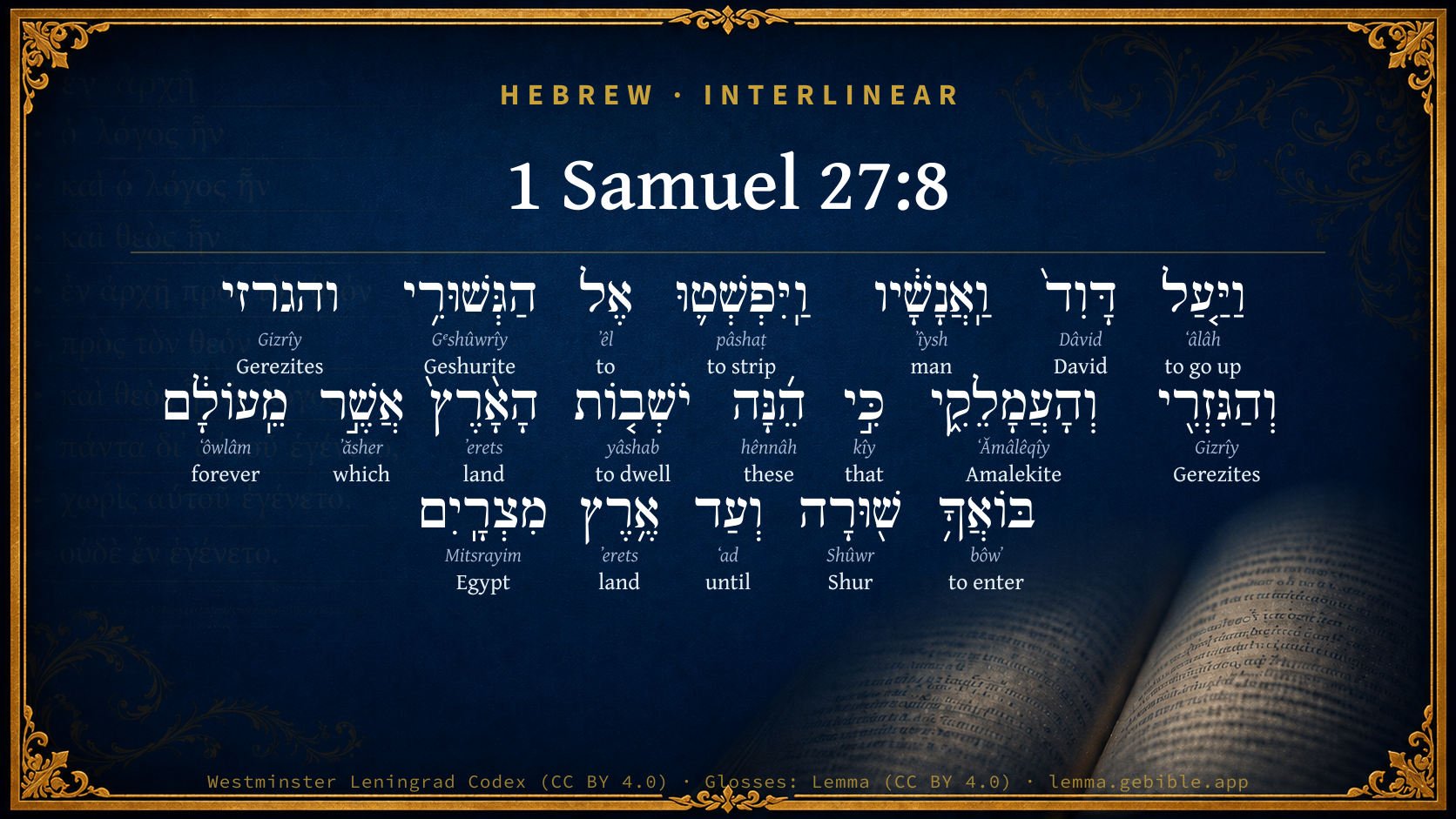
Hebrew (Westminster Leningrad Codex) 1 Samuel 27:8 appears in the Hebrew Old Testament. The text above is from the Westminster Leningrad Codex. Each word links to its Strong’s number, a concise gloss, and parsing drawn from the Open Scriptures Hebrew Bible morphology. Click any word for its full Brown-Driver-Briggs (BDB) entry.
Download image
Cite this verse

1 Samuel 27:8 (World English Bible). Public Domain. Lemma interlinear Bible study tool, https://lemma.gebible.app/v/1-samuel/27/8.

Show BibTeX & RIS
BibTeX
RIS
English Translation
David and his men went up, and made a raid on the Geshurites, and the Girzites, and the Amalekites; for those [nations] were the inhabitants of the land, who were of old, as you go to Shur, even to the land of Egypt.
World English Bible · Public Domain
Highlights
  • 1 first appearance in the Hebrew Bible
Full analysis ↓
Download a study sheet

One document with this verse’s original text, its word-by-word gloss line, the meaning frame, cross-references with their text, attributed commentary, and full source and license credits — printable, and it pastes into notes with its structure intact.

This verse Autodidact and up

Study sheet (.html) Plain text (.txt)

A passage Seminary Student

Up to 50 verses in one chapter. A passage sheet keeps up to 6 commentary sources and 12 cross-references per verse, in the order this page ranks them, and says so on the sheet whenever that leaves anything out. Ask for a single verse and you get the Autodidact verse sheet above.

Everything on this page stays free to read, with no account — the sheet is a download of what is already on screen, not access to it.

Want to remove ads? Support Godless Engineer
Compare translations 3

The same verse in 3 English versions, stacked beneath the original-language interlinear above. Click any original word for its lexicon entry.

Each is an independent rendering of the whole verse — the interlinear is not word-aligned to these translations.

Highlighted words mark where these versions differ — a whole-verse word diff, not a word-by-word alignment.

  • World English Bible Public Domain
    David and his men went up, and made a raid on the Geshurites, and the Girzites, and the Amalekites; for those [nations] were the inhabitants of the land, who were of old, as you go to Shur, even to the land of Egypt.
  • King James Version Public Domain
    And David and his men went up, and invaded the Geshurites, and the Gezrites, and the Amalekites: for those nations were of old the inhabitants of the land, as thou goest to Shur, even unto the land of Egypt.
  • unfoldingWord Literal Text CC BY-SA 4.0
    And David and his men went up and raided against the Geshurite and the Girzite and the Amalekite (for they were dwelling in the land, that from ancient times) in your going to Shur and to the land of Egypt.

unfoldingWord Literal Text — © unfoldingWord, licensed CC BY-SA 4.0. Word-aligned USFM3 via Door43 (git.door43.org/unfoldingWord/en_ult).

Versions to compare (up to 4)

3 of 4 selected

Show all 18 translations

Every available English version of this verse, each an independent rendering of the whole verse.

  • World English Bible Public Domain
    David and his men went up, and made a raid on the Geshurites, and the Girzites, and the Amalekites; for those [nations] were the inhabitants of the land, who were of old, as you go to Shur, even to the land of Egypt.
  • Berean Standard Bible Public Domain
    Now David and his men went up and raided the Geshurites, the Girzites, and the Amalekites. (From ancient times these people had inhabited the land extending to Shur and Egypt.)
  • Majority Standard Bible Public Domain
    Now David and his men went up and raided the Geshurites, the Girzites, and the Amalekites. (From ancient times these people had inhabited the land extending to Shur and Egypt.)
  • King James Version Public Domain
    And David and his men went up, and invaded the Geshurites, and the Gezrites, and the Amalekites: for those nations were of old the inhabitants of the land, as thou goest to Shur, even unto the land of Egypt.
  • American Standard Version (1901) Public Domain
    And David and his men went up, and made a raid upon the Geshurites, and the Girzites, and the Amalekites; for those `nations' were the inhabitants of the land, who were of old, as thou goest to Shur, even unto the land of Egypt.
  • Revised Version (1885) Public Domain
    And David and his men went up, and made a raid upon the Geshurites, and the Girzites, and the Amalekites: for those nations were the inhabitants of the land, which were of old, as thou goest to Shur, even unto the land of Egypt.
  • Geneva Bible (1599) Public Domain
    Then Dauid and his men went vp, and inuaded the Geshurites, and the Girzites, and the Amalekites: for they inhabited the lande from the beginning, from the way, as thou goest to Shur, euen vnto the lande of Egypt.
  • Douay-Rheims (1899) Public Domain
    And David and his men went up, and pillaged Gessuri, and Gerzi, and the Amalecites: for these were of old the inhabitants of the countries, as men go to Sur, even to the land of Egypt.
  • Young's Literal Translation Public Domain
    and David goeth up and his men, and they push unto the Geshurite, and the Gerizite, and the Amalekite, (for they are inhabitants of the land from of old), as thou comest in to Shur and unto the land of Egypt,
  • Literal Standard Version CC BY-SA 4.0
    and David and his men go up, and they push toward the Geshurite, and the Gerizite, and the Amalekite (for they are inhabitants of the land from of old), as you come to Shur and to the land of Egypt,
  • Unlocked Literal Bible CC BY-SA 4.0
    David and his men attacked various places, making raids on the Geshurites, the Girzites, and the Amalekites; for those nations were the inhabitants of the land, as you go to Shur, as far as the land of Egypt. They had been living there in the land from ancient times.
  • unfoldingWord Literal Text CC BY-SA 4.0
    And David and his men went up and raided against the Geshurite and the Girzite and the Amalekite (for they were dwelling in the land, that from ancient times) in your going to Shur and to the land of Egypt.
  • Darby Bible Public Domain
    And David and his men went up and made a raid upon the Geshurites, and the Gerzites, and the Amalekites: for those were of old the inhabitants of the land, as thou goest to Shur, and as far as the land of Egypt.
  • World Messianic Bible Public Domain
    David and his men went up and raided the Geshurites, the Girzites, and the Amalekites; for those were the inhabitants of the land who were of old, on the way to Shur, even to the land of Egypt.
  • Webster's Bible Public Domain
    And David and his men went up, and invaded the Geshurites, and the Gezrites, and the Amalekites: for those nations were of old the inhabitants of the land, as thou goest to Shur, even to the land of Egypt.
  • Free Bible Version CC BY-SA 4.0
    During that time David and his men were raiding the Geshurites, the Girzites, and the Amalekites. These people had lived in the land as far as Shur and Egypt from ancient times.
  • Bible in Basic English Public Domain
    And David and his men went up and made attacks on the Geshurites and the Girzites and the Amalekites; for these were the people who were living in the land from Telam on the way to Shur, as far as Egypt.
  • JPS Tanakh (1917) Public Domain
    And David and his men went up, and made a raid upon the Geshurites, and the Gizrites, and the Amalekites; for those were the inhabitants of the land, who were of old, as thou goest to Shur, even unto the land of Egypt.

Literal Standard Version (2020), Covenant Press — licensed CC BY-SA 4.0. Text via the HelloAO Bible API (eBible.org). Unlocked Literal Bible (unfoldingWord) — licensed CC BY-SA 4.0. Text via the HelloAO Bible API (eBible.org). unfoldingWord Literal Text — © unfoldingWord, licensed CC BY-SA 4.0. Word-aligned USFM3 via Door43 (git.door43.org/unfoldingWord/en_ult). Free Bible Version, Dr. Jonathan Gallagher — licensed CC BY-SA 4.0. Text via the HelloAO Bible API (eBible.org).

Word by word

More ways to search: Search by grammar → Find every occurrence → Compare this word →

Practice this passage: Drill this verse → Learn its vocabulary →

והגרזי
Gizrîy
H1511
“and · the · Gerezites”
Conjunction + Particle, Definite Article + Noun, Gentilic, Masculine, Singular, Absolute
Part of Speech
Conjunction + Particle + Noun
Type
Gentilic
Gender
Masculine
Number
Singular
State
Absolute
Full BDB Definition

Origin: patrial from H1507

TWOT: None

Gerezites = "the cutters off" - inhabitants of Gezer - inhabitants of Mt Gerizim?
  1. וַיַּ֤עַל ʻâlâh H5927 “and · to go up” Conjunction + Verb, Qal, Sequential Imperfect, 3rd Person, Masculine, Singular
  2. דָּוִד֙ Dâvid H1732 “David” Noun, Proper
  3. וַֽאֲנָשָׁ֔יו ʼîysh H376 “and · men · his” Conjunction + Noun, Common, Masculine, Plural, Construct + Suffix, Personal, 3rd Person, Masculine, Singular
  4. וַֽיִּפְשְׁט֛וּ pâshaṭ H6584 “and · to strip” Conjunction + Verb, Qal, Sequential Imperfect, 3rd Person, Masculine, Plural
  5. אֶל ʼêl H413 “to” Preposition
  6. הַגְּשׁוּרִ֥י Gᵉshûwrîy H1651 “the · Geshurite” Particle, Definite Article + Noun, Gentilic, Masculine, Singular, Absolute
  7. וְהַגִּזְרִ֖י Gizrîy H1511 “and · the · Gerezites” Conjunction + Particle, Definite Article + Noun, Gentilic, Masculine, Singular, Absolute
  8. וְהָעֲמָלֵקִ֑י ʻĂmâlêqîy H6003 “and · the · Amalekite” Conjunction + Particle, Definite Article + Noun, Gentilic, Masculine, Singular, Absolute
  9. כִּ֣י kîy H3588 “that” Conjunction
  10. הֵ֜נָּה hênnâh H2007 “these” Pronoun, Personal, 3rd Person, Feminine, Plural
  11. יֹשְׁב֤וֹת yâshab H3427 “dwelling” Verb, Qal, Participle Active, Feminine, Plural, Absolute
  12. הָאָ֨רֶץ֙ ʼerets H776 “the · land” Particle, Definite Article + Noun, Common, Both, Singular, Absolute
  13. אֲשֶׁ֣ר ʼăsher H834 “which” Particle, Relative
  14. מֵֽעוֹלָ֔ם ʻôwlâm H5769 “from · forever” Preposition + Noun, Common, Masculine, Singular, Absolute
  15. בּוֹאֲךָ֥ bôwʼ H935 “to enter · you” Verb, Qal, Infinitive Construct + Suffix, Personal, 2nd Person, Masculine, Singular
  16. שׁ֖וּרָה Shûwr H7793 “Shur · toward” Noun, Proper + Suffix, Demonstrative
  17. וְעַד ʻad H5704 “and · until” Conjunction + Preposition
  18. אֶ֥רֶץ ʼerets H776 “land of” Noun, Common, Both, Singular, Construct
  19. מִצְרָֽיִם Mitsrayim H4714 “Egypt” Noun, Proper

About this verse

These counts appear in no published source. They are computed here, from the morphology-tagged text and Lemma’s own curated glosses. What Lemma adds →

20
words
18
distinct lemmas
Historical
section

Notable vocabulary

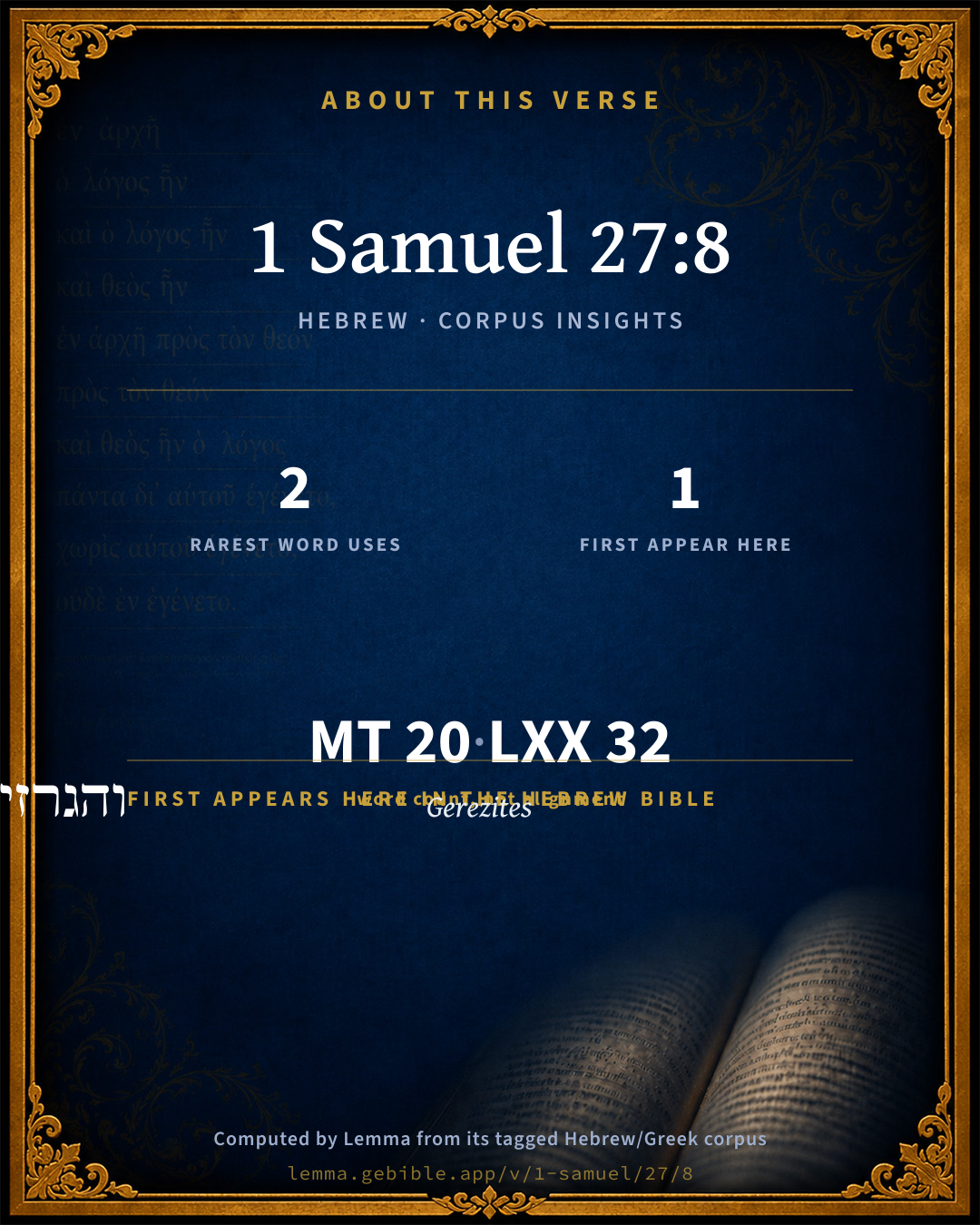
The rarest word here is והגרזי Gerezites H1511 — appearing just 2 times in the whole Hebrew Bible.

First appearance in Scripture

This word makes its first canonical appearance in the Hebrew Bible here:

  • והגרזי Gerezites H1511

Grammatical profile

  • 4 verbs
  • 11 nouns
  • 1 pronoun
  • 2 prepositions
  • 1 conjunction
  • 1 particle

Verb forms

  • וַיַּ֤עַל Qal · Sequential Imperfect
  • וַֽיִּפְשְׁט֛וּ Qal · Sequential Imperfect
  • יֹשְׁב֤וֹת Qal · Participle Active
  • בּוֹאֲךָ֥ Qal · Infinitive Construct

Repetition

Words recur within this verse — often emphatic in Hebrew:

  • והגרזי Gerezites H1511 ×2
  • הָאָ֨רֶץ֙ land H776 ×2

Hebrew & Septuagint length

In English translation the verse runs 43 words from the Hebrew and 44 from the Septuagint (LXX English) — closely comparable.

A rough comparison of the two English renderings, which tokenize alike — not a word-level alignment.

Word counts can differ between the Hebrew and the Greek without any difference in meaning — e.g. the Hebrew direct-object marker אֵת has no separate Greek word, and Greek often adds the article ὁ.

In the original languages it is 20 Hebrew tokens and 32 Greek tokens — but the two are counted differently (Hebrew bundles its prefixes and suffixes into one token; the Greek is in lemma form), so that isn’t a like-for-like length.

Cross-references

15

Topical passages linked to 1 Samuel 27:8 in the Treasury of Scripture Knowledge — connected by theme and wording, ordered by reader-vote popularity; previews shown in the World English Bible.

  • Joshua 13:2 This is the land that yet remains: all the regions of the Philistines, and all the Geshurites;
  • 1 Samuel 15:7–8 Saul struck the Amalekites, from Havilah as you go to Shur, that is before Egypt.
  • Joshua 13:13 Nevertheless the children of Israel didn't drive out the Geshurites, nor the Maacathites: but Geshur and Maacath dwell in the midst of Israel to this day.
  • Joshua 16:10 They didn't drive out the Canaanites who lived in Gezer: but the Canaanites dwell in the midst of Ephraim to this day, and are become servants to do forced labor.
  • Judges 1:29 Ephraim didn't drive out the Canaanites who lived in Gezer; but the Canaanites lived in Gezer among them.
  • Exodus 15:22 Moses led Israel onward from the Red Sea, and they went out into the wilderness of Shur; and they went three days in the wilderness, and found no water.
  • Exodus 17:8 Then Amalek came and fought with Israel in Rephidim.
  • Exodus 17:14–16 Yahweh said to Moses, "Write this for a memorial in a book, and rehearse it in the ears of Joshua: that I will utterly blot out the memory of Amalek from under the sky."
  • 1 Samuel 30:1 It happened, when David and his men were come to Ziklag on the third day, that the Amalekites had made a raid on the South, and on Ziklag, and had struck Ziklag, and burned it with fire,
  • 2 Samuel 13:37–38 But Absalom fled, and went to Talmai the son of Ammihur, king of Geshur. [David] mourned for his son every day.
  • 2 Samuel 14:23 So Joab arose and went to Geshur, and brought Absalom to Jerusalem.
  • 2 Samuel 14:32 Absalom answered Joab, Behold, I sent to you, saying, Come here, that I may send you to the king, to say, Why am I come from Geshur? it were better for me to be there still. Now therefore let me see the king's face; and if there be iniquity in me, let him kill me.
  • 2 Samuel 15:8 For your servant vowed a vow while I abode at Geshur in Syria, saying, If Yahweh shall indeed bring me again to Jerusalem, then I will serve Yahweh.
  • 1 Kings 9:15–17 This is the reason of the levy which king Solomon raised, to build the house of Yahweh, and his own house, and Millo, and the wall of Jerusalem, and Hazor, and Megiddo, and Gezer.
  • 1 Chronicles 2:23 Geshur and Aram took the towns of Jair from them, with Kenath, and the villages of it, even sixty cities. All these were the sons of Machir the father of Gilead.

Cross-references courtesy of OpenBible.info (CC BY 4.0).

Hebrew and Greek witnesses Masoretic Hebrew ↔ Greek Septuagint

The same verse in the two great witnesses to the Old Testament, shown verse-for-verse.

These are two independent witnesses, not word-aligned to each other, and the Septuagint is shown in lemma (dictionary) form.

Hebrew 1 Samuel 27:8 Masoretic · Westminster Leningrad Codex

וַיַּ֤עַל דָּוִד֙ וַֽאֲנָשָׁ֔יו וַֽיִּפְשְׁט֛וּ אֶל הַגְּשׁוּרִ֥י והגרזי וְהַגִּזְרִ֖י וְהָעֲמָלֵקִ֑י כִּ֣י הֵ֜נָּה יֹשְׁב֤וֹת הָאָ֨רֶץ֙ אֲשֶׁ֣ר מֵֽעוֹלָ֔ם בּוֹאֲךָ֥ שׁ֖וּרָה וְעַד אֶ֥רֶץ מִצְרָֽיִם

David and his men went up, and made a raid on the Geshurites, and the Girzites, and the Amalekites; for those [nations] were the inhabitants of the land, who were of old, as you go to Shur, even to the land of Egypt.

World English Bible · Public Domain

Greek LXX 1 Samuel 27:8 Septuagint · lemma form

καί ἀναβαίνω δαυίδ καί ὁ ἀνήρ αὐτός καί ἐπιτίθημι ἐπί πᾶς ὁ γεσιρι καί ἐπί ὁ αμαληκίτης καί ἰδού ὁ γῆ καταοἰκέω ἀπό ἀναἥκω ὁ ἀπό γελαμψουρ τειχίζω καί ἕως γῆ αἴγυπτος

And David and his men went up, and made an attack on all the Gesirites and on the Amalekites: and behold, the land was inhabited, (even the land from Gelampsur) by those who come from the fortified cities even to the land of Egypt.

LXX2012 (modern English Septuagint) · Public Domain

Hebrew: Westminster Leningrad Codex (CC BY 4.0). Greek: Septuagint (public domain); English from LXX2012 (modern English Septuagint) (Public Domain). How the Septuagint differs from the Hebrew →

Targum (Aramaic paraphrase)

1

The Targum is the ancient Jewish Aramaic paraphrase of the Hebrew Scriptures — an interpretive translation, not the Hebrew text itself. Onkelos (literal) and Pseudo-Jonathan (expansive) render the Torah, and Jonathan the Prophets. Coverage is partial: where no permissively-licensed English translation exists for a verse, only the Aramaic is shown. This is verse-level text, not a word-by-word alignment to the Hebrew.

  1. Targum Jonathan Prophets (Joshua–Malachi)
    וּסְלִיק דָוִד וְגַבְרוֹהִי וְאִתְנְגִידוּ עַל גְשׁוּרָאֵי וְעַל גִזְרָאֵי וַעֲמַלְקָאֵי אֲרֵי אִינוּן יַתְבַת אַרְעָא דְמֵעַלְמָא מַעֲלָנָא דְחַגְרָא וְעַד אַרְעָא דְמִצְרַיִם:

    (no public-domain English translation for this verse)

    Targum Jonathan — Aramaic: “Mikraot Gedolot” (public domain). English: “Sefaria Community Translation” (CC0 1.0 (public-domain dedication)); “London "Chaldee Paraphrase," 1871” (public domain). Text via Sefaria.

Commentary

Notes on 1 Samuel 27:8 from classic Christian and Jewish commentators (each source and its license shown beneath its notes). The classic Christian expositions comment on the surrounding passage and are grouped to its opening verse, so a note may address several verses; the Jewish commentaries on the Tanakh (Rashi and others) are per-verse, so they appear only where the commentator wrote on this verse.

Lemma curates 59 commentaries, every one of them public domain or Creative Commons licensed, each selected and text-cleaned for this edition rather than reprinted as found. About our sources →

Matthew Henry's Commentary

Here is an account of David's actions while he was in the land of the Philistines, a fierce attack he made upon some remains of the devoted nations, his success in it, and the representation he gave of it to Achish. 1. We may acquit him of injustice and cruelty in this action because those people whom he cut off were such as heaven had long since doomed to destruction, and he that did it was one whom heaven had ordained to dominion; so that the thing was very fit to be done, and he was very fit to do it. It was not for him that was anointed to fight the Lord's battles to sit still in sloth, however he might think fit, in modesty, to retire. He desired to be safe from Saul only that he might expose himself for Israel. He avenged an old quarrel that God had with these nations, and at the same time fetched in provisions for himself and his army, for by their swords they must live. The Amalekites were to be all cut off. Probably the Geshurites and Gezrites were branches of Amalek. Saul was rejected for sparing them, David makes up the deficiency of his obedience before he succeeds him. He smote them, and left none alive, Sa1 27:8, Sa1 27:9. The service paid itself, for they carried off abundance of spoil, which served for the subsistence of David's forces. 2. Yet we cannot acquit him of dissimulation with Achish in the account he gave him of this expedition. (1.) David, it seems, was not willing that he should know the truth, and therefore spared none to carry tidings to Gath (Sa1 27:11), not because he was ashamed of what he had done as a bad thing, but because he was afraid, if the Philistines knew it, they would be apprehensive of danger to themselves or their allies by harbouring him among them and would expel him from their coasts. It would be easy to conclude, If so he did, so will be his manner, and therefore he industriously conceals it from them, which, it seems, he could do by putting them all to the sword, for none of their neighbours would inform against him, nor perhaps would soon come to the knowledge of what was done, intelligence not being so readily communicated then as now. (2.) He hid it from Achish with an equivocation not at all becoming his character. Being asked which way he had made his sally, he answered, Against the south of Judah, v. 13. It was true he had invaded those countries that lay south of Judah, but he made Achish believe he had invaded those that lay south in Judah, the Ziphites for example, that had once and again betrayed him; so Achish understood him, and thence inferred that he had made his people Israel to abhor him, and so riveted himself in the interest of Achish. The fidelity of Achish to him, his good opinion of him, and the confidence he put in him, aggravate his sin in deceiving him thus, which, with some other such instances, David seems penitently to reflect upon when he prays, Remove from me the way of lying.

Matthew Henry's Commentary on the Whole Bible (1708–1710) — public domain (CC PDM 1.0). Text via the HelloAO Bible API.

Trapp's Complete Commentary

John Trapp

1Sa 27:8 And David and his men went up, and invaded the Geshurites, and the Gezrites, and the Amalekites: for those [nations were] of old the inhabitants of the land, as thou goest to Shur, even unto the land of Egypt.

Ver. 8. And the Gezrites.] Otherwise called Girgashites, as some hold.

And the Amalekites.] Whom Saul should have utterly rooted out, {1Sa 15:3; 1Sa 15:7; 1Sa 15:9} but did not. Quod defertur, non aufertur.

John Trapp, A Commentary or Exposition upon All the Books of the Old and New Testament (1647–1656) — public domain. Text from a community e-Sword module.

Joseph Benson's Commentary

1Sa 27:8. David and his men invaded the Geshurites, &c. — These were some remains of the Amorites, and other ancient inhabitants of the country; whom God, for their inveterate and incorrigible wickedness, had commanded to be extirpated. And they “were not confederate with Achish, but in a state of hostility with him; particularly the Amalekites, whom we find soon after making great depredations upon the Philistine territories, chap. 1Sa 30:16. David, therefore, did not act in the least dishonourably by him, but in reality for his service, in the attack he made on them. It is further to be remarked, that as those people were on the south of Judah, they made frequent incursions into the land, and were the avowed enemies of the Hebrews. This is certain at least of the Amalekites, the remnant of those whom Saul destroyed, (chap. 15.,) who had retired into remote and distant places. Of these frequent mention is made in the books of the Old Testament, as engaged in many expeditions to plunder the country and destroy the inhabitants. David, therefore, had a right to cut off those nations; as deserving the character of a man after God’s own heart, he was called upon to do it; and in doing it he served his country, without injuring his protector and friend.” — Chandler. But it has been objected, that it was unjustifiable in David, being a private man, to act thus without a warrant from Achish or from God, which it does not appear that he had. In answer to this it must be observed, that he did not act as a private man, but as one elected and anointed to the kingdom. And “the same Spirit of God which once inspired Saul with all regal virtues, was now gone over to David, and rested on him, and it were very strange if David, as king-elect of Israel, could have any guilt in doing that which Saul, as a king in possession, was deposed for not doing.” — Delaney.

Joseph Benson's Commentary on the Old and New Testaments (1811–1818) — public domain. Text from a community e-Sword module.

Tyndale Open Study Notes

Tyndale Open Resources

27:8 Geshurites . . . Girzites . . . Amalekites: These groups, who lived on the edges of the southern desert, had been troublesome to both Philistines and Israelites. (On the Amalekites, see 14:48; ch 15; on the Geshurites, see Josh 13:2, 13; 2 Sam 3:3.) • Shur was somewhere east of Egypt (1 Sam 15:7; Gen 16:7; 20:1; 25:18).

Tyndale Open Study Notes — © Tyndale Open Resources, licensed CC BY-SA 4.0. Text via the HelloAO Bible API.

Geneva Bible (1599)

Geneva Bible translators

These were the wicked Canaanites, whom God had appointed to be destroyed.

Geneva Bible (1599) marginal notes — public domain. Text via Bolls.life.

Jamieson, Fausset & Brown

Robert Jamieson, A. R. Fausset & David Brown

David . . . went up, and invaded the Geshurites--(See Jos 13:2).

and the Gezrites--or the Gerizi [GESENIUS], (Jos 12:12), some Arab horde which had once encamped there.

and the Amalekites--Part of the district occupied by them lay on the south of the land of Israel (Jdg 5:14; Jdg 12:15).

Jamieson, Fausset & Brown — Commentary Critical and Explanatory on the Whole Bible (1871) — public domain (CC PDM 1.0). Text via the HelloAO Bible API.

Ellicott's Commentary for English Readers

(8) Went up.—The expression is strictly accurate. The nomad tribes against whom his expeditions were directed dwelt on higher ground than David’s home at Ziklag, apparently on the wide extent of the mountain plateau, that high table-land at the north-east of the desert of Paran.

The Geshurites, and the Gezerites, and the Amalekites.—These were all “Bedaween” tribes, the scourge of the Israelitish families dwelling on the south of Canaan. It is not easy to identify the first two named of these nomades against whom David directed his operations. We hear of these Geshurites in the neighbourhood of Bashan (Deu_3:14), and of another tribe of them in Syria (2Sa_15:8). They were a widely scattered race of nomad Arabs. The Gezerites, or Gizrites, it has been supposed, were the remains of a once powerful race dispossessed by the Amorites. The third named, the Amalekites, were the remnant of that once powerful tribe destroyed by Saul in his famous war, when his disobedience incurred the wrath of Samuel.

For those nations were of old the inhabitants of the land, as thou goest to Shur, even unto the land of Egypt.—The grammar and construction of this sentence is confused and difficult. On the whole, the rendering and explanation of Erdmann in Lange seems the most satisfactory: “David . . . invaded the . . . and the Amalekites (for these were inhabitants of the land, who inhabited it of old) as far as Shur and Egypt.” Thus David’s raids extended as far as the desert frontier of Egypt.

A Bible Commentary for English Readers, edited by Charles John Ellicott (1878–1897) — public domain. Text from a community e-Sword module.

The Cambridge Bible for Schools and Colleges

gen. ed. J. J. S. Perowne

8–12. David’s raids upon neighbouring tribes

8. the Geshurites] A tribe dwelling south of Philistia near the Amalekites (see Jos_13:2), to be distinguished from the Geshurites in Syria (2Sa_15:8).

the Gezrites] These cannot be the inhabitants of Gezer (Jos_10:33), which was far away from the scene of David’s operations. The written text (Kthîbh) as distinguished from the traditional reading (Qrî) has Gerzites. It has been conjectured that this was an ancient Arab tribe which at one time wandered up northwards and gave its name to Mount Gerizim; as their neighbours the Amalekites left traces of former migrations in the name “the mountain of the Amalekites” in the territory of Ephraim (Jdg_12:15).

the Amalekites] Such remnants of them as had escaped from Saul’s sword. See on 1Sa_15:8.

those nations were of old, &c.] If the text is right, the E. V. gives the general sense correctly. The allusion to their ancient occupation of the district may be inserted with reference to the Amalekite attack upon Israel in the march from Egypt (Exo_17:8 ff.). But the Heb. is obscure, and possibly should be emended so as to give the sense, “for these nations inhabited the land from Telem until thou comest to Shur, and unto the land of Egypt.” Telem would be mentioned as the southernmost city of Israel. See on 1Sa_15:4.

The Cambridge Bible for Schools and Colleges (gen. ed. J. J. S. Perowne; Cambridge University Press, 1878–1918) — public domain. Text from a community e-Sword module.

John Gill's Exposition

And David and his men went up,.... From Ziklag, where they dwelt:

and invaded the Geshurites; some of the old inhabitants of the land of Canaan, the remains of the Amorites, whose land was given to the half tribe of Manasseh, but could never be expelled; and therefore David had a just right to invade them, and, if he could, either expel or destroy them; see Deu 3:14; these are the Geshurites which are joined with the Philistines, Jos 13:2,

and the Gezrites; the inhabitants of Gezer, which place fell to the tribe of Ephraim; but that tribe could not drive out the inhabitants of it, and therefore David now fell upon them as the enemies of Israel, and seized on their country, as belonging to them, Jos 16:3,

and the Amalekites; the sworn and implacable enemies of Israel, and whose memory they were laid under obligation to root out. These were such as had escaped the sword of Saul, and had fled to the more distant parts, against whom David now went; and perhaps these had fled to and mixed themselves with the people here mentioned:

for these nations were of old the inhabitants of the land; of the land of Canaan:

as thou goest to Shur, even unto the land of Egypt; see Sa1 15:7.

John Gill's Exposition of the Whole Bible (1746–1763) — public domain (CC PDM 1.0). Text via the HelloAO Bible API.

Albert Barnes' Notes on the Bible

The Geshurites bordered upon the Philistines, and lived in the mountainous district which terminates the desert on the northeast (marginal reference). They were a different tribe, or, at least, a different branch of it, from the Geshurites who lived on the northeast border of Bashan, and were Arameans 2Sa 15:8. The Gezrites, or Gerzites, may be connected with those who gave their name to Mount Gerizim.

Albert Barnes' Notes on the Bible (1834–1885) — public domain. Text from a community e-Sword/MySword module.

Haydock's Catholic Bible Commentary

Pillaged Gessuri, &c. These probably were enemies of the people of God; and some, if not all of them, were of the number of those whom God had ordered to be destroyed; which justifies David’s proceedings in their regard. Though it is to be observed here, that we are not under an obligation of justifying every thing that he did: for the Scripture, in relating what was done, doth not say that it was well done. And even such as are true servants of God, are not to be imitated in all they do. (Challoner) --- The nations of Chanaan, who inhabited as far as Egypt, and the Amalecites, who had escaped the arms of Saul, were devoted to destruction, Exodus xvii., &c. In such cases, any man might fall upon them, without any other formal declaration of war. (Calmet) --- There was another Gessuri of Syria, in the tribe of Manasses, across the Jordan. (Menochius) --- The country which these people inhabited, to the south of Palestine, was afterwards depopulated by the kings of Egypt and of Syria, in their continual wars, so that many of the cities which are mentioned in Scripture, were never known to profane geographers. (Calmet) --- St. Jerome, (Trad.) Sa, and others, think that David attacked some of the Philistines. But it is as probable at least that he would abstain from molesting them, whom had so generously afforded him an asylum. Salien concludes, that he did not attack the other nations, (except the Amalecites, who were sufficiently marked out for destruction, Deuteronomy xxv. 19,) without consulting the Lord, by the high priest, as he was accustomed to do in every difficulty. (Salien, the year of the world 2979) (Menochius) --- They all dwelt in part of the land of Chanaan, (Worthington) which was sufficient. (Haydock)

George Leo Haydock (1774–1849), Haydock's Catholic Family Bible and Commentary, 1859 edition — public domain. Excludes Psalms (Douay-Rheims chapter numbering differs from Protestant) and Deuterocanonical books (Catholic canon only).

Matthew Poole's English Annotations

The Gezrites were anciently seated in other places, Jos 12:12; 16:3, but for some reasons not now known they changed their seats, as was then very usual, and seated themselves, and had for some considerable time lived, near the Amalekites.

The Amalekites; the remnant of those whom Saul destroyed, 1Sa 15, who fled from his sword, and retired into remote and desert places.

Matthew Poole's English Annotations on the Holy Bible (1683–1685) — public domain. Text from a community e-Sword/MySword module.

Whedon's Commentary on the Bible

Daniel D. Whedon

8. The Geshurites — A nomadic people occupying the desert south of the Philistines. See at Jos_13:2; Jos_13:13.

The Gezrites — Rather, The Gerzites, as in the margin. Of these we have no certain trace elsewhere, but from this verse we readily infer that their territory was contiguous to that of the Geshurites and Amalekites.

The Amalekites — See Exo_17:8.

Shur — The name given to the wilderness extending from the Isthmus of Suez eastward to an indefinite extent, and comprising a considerable portion of Northern Arabia. Gen_16:7; Exo_15:22.

Daniel D. Whedon (gen. ed.), Commentary on the Old and New Testaments (1874–1909) — public domain. Text from a community e-Sword module.

The Pulpit Commentary

EXPEDITIONS OF DAVID FROM ZIKLAG (vers. 8-12).

Went up. The Geshurites inhabited the high table land which forms the northeastern portion of the wilderness of Paran. Like the Kenites, they seem to have broken up into scattered tribes, as we find one portion of them in the neighbourhood of Bashan, (Deu_3:14) and another in Syria. (2Sa_15:8) Probably, like the Amalekites, they were a Bedouin race, and so great wanderers. Hence the verb translated invaded is literally "spread themselves out" like a fan, so as to enclose these nomads, whose safety lay in flight. Gezrites. The written text has Girzites, which the Kri has changed into Gezrites, probably from a wish to connect a name never mentioned elsewhere with the town of Gezer. But Gezer lay far away in the west of Ephraim, and the connection suggested in modern times of the Girzites with Mount Gerizim in Central Palestine is more probable. They would thus be the remains of a once more powerful people, dispossessed by the Amorites, but who were now probably a very feeble remnant. For those nations, etc. The grammar and translation of this clause are both full of difficulties, but the following rendering is perhaps the least objectionable: "For these were (the families) inhabiting the land, which were of old, as thou goest towards Shur," etc. Families must be supplied because the participle inhabiting is feminine. What, then, the narrator means to say is that these three Bedouin tribes were the aboriginal inhabitants of the northwestern portion of the desert between Egypt and South Palestine. On the Amalekites see 1Sa_15:2. We need not wonder at finding them mentioned again so soon afterSaul"s expedition. A race of nomads would sustain no great harm from an expedition which soon began to occupy itself with capturing cattle. On Shur see 1Sa_15:7.

The Pulpit Commentary (1880–1919), ed. H.D.M. Spence-Jones & Joseph S. Exell — public domain. Text from a community e-Sword module.

John Wesley's Explanatory Notes

Amalekites - The remnant of those whom Saul destroyed, chap. xv, 3-9, who retired into remote and desert places.

John Wesley, Explanatory Notes Upon the Whole Bible (1754–1765) — public domain. Text via the GEBible commentary corpus.

Keil & Delitzsch

C. F. Keil & F. Delitzsch

From Ziklag David made an attack upon the Geshurites, Gerzites, and Amalekites, smote them without leaving a man alive, and returned with much booty. The occasion of this attack is not mentioned, as being a matter of indifference in relation to the chief object of the history; but it is no doubt to be sought for in plundering incursions made by these tribes into the land of Israel. For David would hardly have entered upon such a war in the situation in which he was placed at that time without some such occasion, seeing that it would be almost sure to bring him into suspicion with Achish, and endanger his safety. ויּעל, "he advanced," the verb being used, as it frequently is, to denote the advance of an army against a people or town (see at Jos 8:1). At the same time, the tribes which he attacked may have had their seat upon the mountain plateau in the northern portion of the desert of Paran, so that David was obliged to march up to reach them. פּשׁט, to invade for the purpose of devastation and plunder. Geshuri is a tribe mentioned in Jos 13:2 as living in the south of the territory of the Philistines, and is a different tribe from the Geshurites in the north-east of Gilead (Jos 12:5; Jos 13:11, Jos 13:13; Deu 3:14). These are the only passages in which they are mentioned. The Gerzites, or Gizrites according to the Keri, are entirely unknown. Bonfrere and Clericus suppose them to be the Gerreni spoken of in 2 Macc. 13:24, who inhabited the town of Gerra, between Rhinocolura and Pelusium (Strabo, xvi. 760), or Gerron (Ptol. iv. 5). This conjecture is a possible one, but is very uncertain nevertheless, as the Gerzites certainly dwelt somewhere in the desert of Arabia. At any rate Grotius and Ewald cannot be correct in their opinion that they were the inhabitants of Gezer (Jos 10:33). The Amalekites were the remnant of this old hereditary foe of the Israelites, who had taken to flight on Saul's war of extermination, and had now assembled again (see at Sa1 15:8-9). "For they inhabit the land, where you go from of old to Shur, even to the land of Egypt." The עשׁר before מעולם may be explained from the fact that בּואך is not adverbial here, but is construed according to its form as an infinitive: literally, "where from of old thy coming is to Shur." עשׁר cannot have crept into the text through a copyist's mistake, as such a mistake would not have found its way into all the MSS. The fact that the early translators did not render the word proves nothing against its genuineness, but merely shows that the translators regarded it as superfluous. Moreover, the Alexandrian text is decidedly faulty here, and עולם is confounded with עלם, ἀπὸ Γελάμ. Shur is the desert of Jifar, which is situated in front of Egypt (as in Sa1 15:7). These tribes were nomads, and had large flocks, which David took with him as booty when he had smitten the tribes themselves. After his return, David betook himself to Achish, to report to the Philistian king concerning his enterprise, and deceive him as to its true character.

Keil & Delitzsch — Biblical Commentary on the Old Testament (1861–1891) — public domain (CC PDM 1.0). Text via the HelloAO Bible API. (Old Testament only.)

Kretzmann's Popular Commentary

Paul E. Kretzmann

David’s Campaign Against the Heathen

v. 8. And David and his men, no longer under the direct observation of the Philistines, went up and invaded the Geshurites and the Gezrites, small nations living south of the Philistine territory, and the Amalekites, the nomadic tribes whom Saul had almost destroyed, 1Sa 15:7; for those nations were of old the inhabitants of the land, as thou goest to Shur, even unto the land of Egypt, on the Egyptian border.

v. 9. And David smote the land, and left neither man nor woman alive, since they would naturally inform against him, and took away the sheep, and the oxen, and the asses, and the camels, and the apparel, and returned and came to Achish, bringing this rich booty along.

v. 10. And Achish said, it was his custom to ask, Whither have ye made a road today? referring to their latest raid. And David said, Against the south of Judah and against the south of the Jerahmeelites and against the south of the Kenites, his geographical references being purposely vague and indefinite, in order to make Achish think that his expeditions were directed against some tribe of Israel or against their allies on the southern border.

v. 11. And David saved neither man nor woman alive to bring tidings to Gath, saying, Lest they should tell on us, David and his men, saying, So did David, and so will be his manner all the while he dwelleth in the country of the Philistines, that is, such was David’s custom while nominally under the jurisdiction of the Philistine king.

v. 12. And Achish believed David, saying, He hath made his people Israel utterly to abhor him, making himself a stench, a loathing, completely alienating himself from the Israelites; therefore he shall be my servant forever. Thus Achish was deceived, while David continued to harass and destroy the desert tribes which were a menace to Israel. Thus he, while receiving evil at the hand of Saul, rewarded good to the entire people of Israel, a fine example of love toward one’s enemies.

Paul E. Kretzmann, Popular Commentary of the Bible (1921–1924) — public domain. Text from a community e-Sword module.

unfoldingWord translationNotes

Door43 World Missions Community

making raids on

attacking and taking property many times (See: Idiom)

Girzites

A people group who apparently lived somewhere between Philistia and Egypt. (See: How to Translate Names)

as you go to Shur

Here "you" is being used as an indefinite pronoun that refers to anyone. AT: "on the way most people travel to Shur" (See: Pronouns)

Shur

region on the northeast border of Egypt (See: How to Translate Names)

Achish

the king of Gath (See: Pronouns)

translationWords

David

Geshur

Amalek

nation

Egypt

save

ewe

cow

donkey

camel

unfoldingWord translationNotes — © Distant Shores Media and the Door43 World Missions Community, licensed CC BY-SA 4.0. Source: git.door43.org/Door43/en_tn.

Rashi

Rabbi Shlomo Yitzchaki (Rashi)

Dovid…would go up. This is the present tense, i.e., he was always accustomed doing this.

In the direction of Shur. From the entrance of Shur.

Rashi on the Tanakh — English translations: “The Judaica Press complete Tanach with Rashi, translated by A. J. Rosenberg” (CC BY 4.0); “Pentateuch with Rashi's commentary by M. Rosenbaum and A.M. Silbermann, 1929-1934” (public domain); “The Metsudah Tanach series, Lakewood, N.J” (CC BY 4.0); and “The Book of Joshua, Metsudah Publications, 1997” (CC BY 4.0). Text via Sefaria.

Lesson kit

Teaching starters — assembled from the data on this page, not authored interpretation. Every prompt links to the verse data it draws on. Edit before teaching.

1 Samuel, in the Historical, opens this verse with 20 words (18 distinct Hebrew lemmas). Its most distinctive word is Gizrîy (“Gerezites”). A historical commentator’s framing appears above. Read the whole chapter for the surrounding context.

Discussion questions

  1. How does “Gerezites” (Gizrîy) shape what this verse is saying?
  2. This is the first place “Gerezites” appears in Scripture (first appears here). What does its debut here establish?
  3. How does Joshua 13:2, which shares this passage’s theme, read alongside this verse?
  4. What does the repetition of “Gerezites” (2× in this one verse) do in this verse?
  5. These translations render this verse differently. What is at stake in choosing one wording over another?
  6. «וַיַּ֤עַל» is a Qal Sequential Imperfect verb. How does that grammatical form shape the action described?
  7. Compare how Matthew Henry's Commentary and Trapp's Complete Commentary read this verse. Where do they agree or differ?

Things to notice

Reading settings

Reading text

Shown beneath each verse's original-language words.

Old Testament
Old Testament edition

Read the OT as the Masoretic Hebrew (MT) or the Greek Septuagint (LXX).

English shown for the Greek Septuagint (in the Hebrew ↔ Greek comparison).

Comparing translations? Open the Compare panel on any verse page to stack up to four side by side.