
1 Samuel 13:3

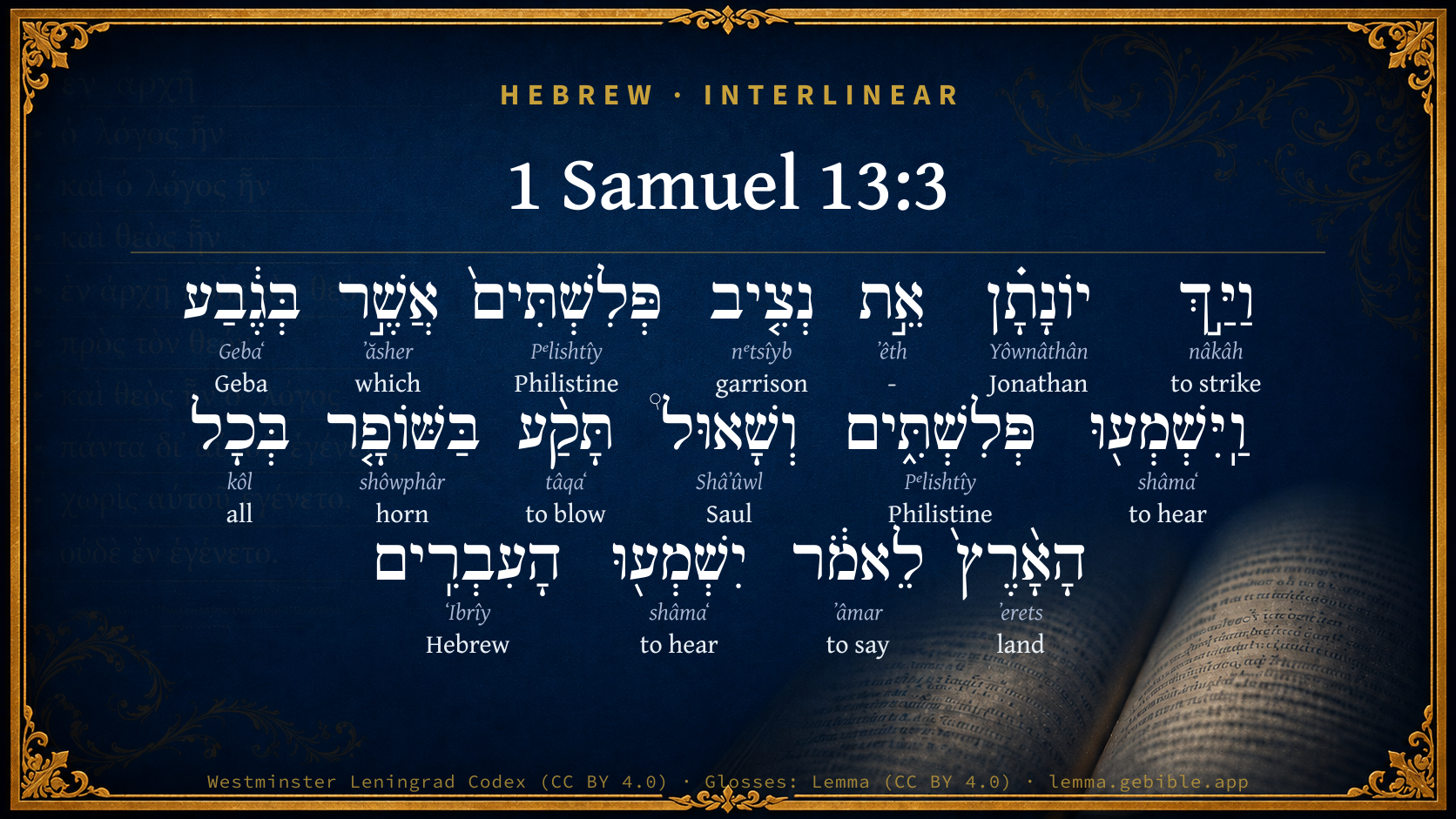
Hebrew (Westminster Leningrad Codex) 1 Samuel 13:3 appears in the Hebrew Old Testament. The text above is from the Westminster Leningrad Codex. Each word links to its Strong’s number, a concise gloss, and parsing drawn from the Open Scriptures Hebrew Bible morphology. Click any word for its full Brown-Driver-Briggs (BDB) entry.
Download image
Cite this verse

1 Samuel 13:3 (World English Bible). Public Domain. Lemma interlinear Bible study tool, https://lemma.gebible.app/v/1-samuel/13/3.

Show BibTeX & RIS
BibTeX
RIS
English Translation
Jonathan struck the garrison of the Philistines that was in Geba: and the Philistines heard of it. Saul blew the trumpet throughout all the land, saying, Let the Hebrews hear.
World English Bible · Public Domain
Download a study sheet

One document with this verse’s original text, its word-by-word gloss line, the meaning frame, cross-references with their text, attributed commentary, and full source and license credits — printable, and it pastes into notes with its structure intact.

This verse Autodidact and up

Study sheet (.html) Plain text (.txt)

A passage Seminary Student

Up to 50 verses in one chapter. A passage sheet keeps up to 6 commentary sources and 12 cross-references per verse, in the order this page ranks them, and says so on the sheet whenever that leaves anything out. Ask for a single verse and you get the Autodidact verse sheet above.

Everything on this page stays free to read, with no account — the sheet is a download of what is already on screen, not access to it.

Want to remove ads? Support Godless Engineer
Compare translations 3

The same verse in 3 English versions, stacked beneath the original-language interlinear above. Click any original word for its lexicon entry.

Each is an independent rendering of the whole verse — the interlinear is not word-aligned to these translations.

Highlighted words mark where these versions differ — a whole-verse word diff, not a word-by-word alignment.

  • World English Bible Public Domain
    Jonathan struck the garrison of the Philistines that was in Geba: and the Philistines heard of it. Saul blew the trumpet throughout all the land, saying, Let the Hebrews hear.
  • King James Version Public Domain
    And Jonathan smote the garrison of the Philistines that was in Geba, and the Philistines heard of it. And Saul blew the trumpet throughout all the land, saying, Let the Hebrews hear.
  • unfoldingWord Literal Text CC BY-SA 4.0
    And Jonathan struck the garrison of the Philistines that at Geba, and the Philistines heard. And Saul blew upon a shofar in all of the land, saying, “Let the Hebrews hear!”

unfoldingWord Literal Text — © unfoldingWord, licensed CC BY-SA 4.0. Word-aligned USFM3 via Door43 (git.door43.org/unfoldingWord/en_ult).

Versions to compare (up to 4)

3 of 4 selected

Show all 18 translations

Every available English version of this verse, each an independent rendering of the whole verse.

  • World English Bible Public Domain
    Jonathan struck the garrison of the Philistines that was in Geba: and the Philistines heard of it. Saul blew the trumpet throughout all the land, saying, Let the Hebrews hear.
  • Berean Standard Bible Public Domain
    Then Jonathan attacked the Philistine outpost at Geba, and the Philistines heard about it. So Saul blew the ram’s horn throughout the land, saying, “Let the Hebrews hear!”
  • Majority Standard Bible Public Domain
    Then Jonathan attacked the Philistine outpost at Geba, and the Philistines heard about it. So Saul blew the ram’s horn throughout the land, saying, “Let the Hebrews hear!”
  • King James Version Public Domain
    And Jonathan smote the garrison of the Philistines that was in Geba, and the Philistines heard of it. And Saul blew the trumpet throughout all the land, saying, Let the Hebrews hear.
  • American Standard Version (1901) Public Domain
    And Jonathan smote the garrison of the Philistines that was in Geba: and the Philistines heard of it. And Saul blew the trumpet throughout all the land, saying, Let the Hebrews hear.
  • Revised Version (1885) Public Domain
    And Jonathan smote the garrison of the Philistines that was in Geba, and the Philistines heard of it. And Saul blew the trumpet throughout all the land, saying, Let the Hebrews hear.
  • Geneva Bible (1599) Public Domain
    And Ionathan smote the garison of the Philistims, that was in the hill: and it came to the Philistims eares: and Saul blewe the trumpet throughout all the land, saying, Heare, O yee Ebrewes.
  • Douay-Rheims (1899) Public Domain
    And Jonathan smote the garrison of the Philistines which was in Gabaa. And when the Philistines had heard of it, Saul sounded the trumpet over all the land, saying: Let the Hebrews hear.
  • Young's Literal Translation Public Domain
    And Jonathan smiteth the garrison of the Philistines which `is' in Geba, and the Philistines hear, and Saul hath blown with a trumpet through all the land, saying, `Let the Hebrews hear.'
  • Literal Standard Version CC BY-SA 4.0
    And Jonathan strikes the garrison of the Philistines which [is] in Geba, and the Philistines hear, and Saul has blown with a horn through all the land, saying, “Let the Hebrews hear.”
  • Unlocked Literal Bible CC BY-SA 4.0
    Jonathan defeated the garrison of the Philistines that was at Geba and the Philistines heard of it. Then Saul blew the trumpet throughout all the land, saying, “Let the Hebrews hear.”
  • unfoldingWord Literal Text CC BY-SA 4.0
    And Jonathan struck the garrison of the Philistines that at Geba, and the Philistines heard. And Saul blew upon a shofar in all of the land, saying, “Let the Hebrews hear!”
  • Darby Bible Public Domain
    And Jonathan smote the outpost of the Philistines that was in Geba, and the Philistines heard [of it]. And Saul blew the trumpet throughout the land, saying, Let the Hebrews hear.
  • World Messianic Bible Public Domain
    Jonathan struck the garrison of the Philistines that was in Geba, and the Philistines heard of it. Saul blew the shofar throughout all the land, saying, “Let the Hebrews hear!”
  • Webster's Bible Public Domain
    And Jonathan smote the garrison of the Philistines that was in Geba; and the Philistines heard of it. And Saul blew the trumpet throughout all the land, saying, Let the Hebrews hear.
  • Free Bible Version CC BY-SA 4.0
    Jonathan attacked the Philistine garrison at Geba. The Philistines soon heard about it, so Saul had the trumpet call to arms sounded throughout the land, saying, “Hebrews, pay attention!”
  • Bible in Basic English Public Domain
    And Jonathan made an attack on the armed force of the Philistines stationed at Gibeah; and news was given to the Philistines that the Hebrews were turned against them. And Saul had a horn sounded through all the land,
  • JPS Tanakh (1917) Public Domain
    And Jonathan smote the garrison of the Philistines that was in Geba, and the Philistines heard of it. And Saul blew the horn throughout all the land, saying: 'Let the Hebrews hear.'

Literal Standard Version (2020), Covenant Press — licensed CC BY-SA 4.0. Text via the HelloAO Bible API (eBible.org). Unlocked Literal Bible (unfoldingWord) — licensed CC BY-SA 4.0. Text via the HelloAO Bible API (eBible.org). unfoldingWord Literal Text — © unfoldingWord, licensed CC BY-SA 4.0. Word-aligned USFM3 via Door43 (git.door43.org/unfoldingWord/en_ult). Free Bible Version, Dr. Jonathan Gallagher — licensed CC BY-SA 4.0. Text via the HelloAO Bible API (eBible.org).

Word by word

More ways to search: Search by grammar → Find every occurrence → Compare this word →

Practice this passage: Drill this verse → Learn its vocabulary →

נְצִ֤יב
nᵉtsîyb
H5333
“garrison of”
Noun, Common, Masculine, Singular, Construct
Part of Speech
Noun
Type
Common
Gender
Masculine
Number
Singular
State
Construct
Full BDB Definition

Origin: from H5324

TWOT: 1398b

set over, something placed, pillar, prefect, garrison, post - pillar - prefect, deputy
  1. וַיַּ֣ךְ nâkâh H5221 “and · to strike” Conjunction + Verb, Hiphil, Sequential Imperfect, 3rd Person, Masculine, Singular
  2. יוֹנָתָ֗ן Yôwnâthân H3129 “Jonathan” Noun, Proper
  3. אֵ֣ת ʼêth H853 “-” Particle, Direct Object
  4. פְּלִשְׁתִּים֙ Pᵉlishtîy H6430 “Philistines” Noun, Gentilic, Masculine, Plural, Absolute
  5. אֲשֶׁ֣ר ʼăsher H834 “which” Particle, Relative
  6. בְּגֶ֔בַע Gebaʻ H1387 “in/at · Geba” Preposition + Noun, Proper
  7. וַֽיִּשְׁמְע֖וּ shâmaʻ H8085 “and · to hear” Conjunction + Verb, Qal, Sequential Imperfect, 3rd Person, Masculine, Plural
  8. פְּלִשְׁתִּ֑ים Pᵉlishtîy H6430 “Philistines” Noun, Gentilic, Masculine, Plural, Absolute
  9. וְשָׁאוּל֩ Shâʼûwl H7586 “and · Saul” Conjunction + Noun, Proper
  10. תָּקַ֨ע tâqaʻ H8628 “to blow” Verb, Qal, Perfect, 3rd Person, Masculine, Singular
  11. בַּשּׁוֹפָ֤ר shôwphâr H7782 “in/at the · horn” Preposition, Determined + Noun, Common, Masculine, Singular, Absolute
  12. בְּכָל kôl H3605 “in/at · all of” Preposition + Noun, Common, Masculine, Singular, Construct
  13. הָאָ֨רֶץ֙ ʼerets H776 “the · land” Particle, Definite Article + Noun, Common, Both, Singular, Absolute
  14. לֵאמֹ֔ר ʼâmar H559 “to say” Preposition + Verb, Qal, Infinitive Construct
  15. יִשְׁמְע֖וּ shâmaʻ H8085 “to hear” Verb, Qal, Jussive, 3rd Person, Masculine, Plural
  16. הָעִבְרִֽים ʻIbrîy H5680 “the · Hebrews” Particle, Definite Article + Noun, Gentilic, Masculine, Plural, Absolute

About this verse

These counts appear in no published source. They are computed here, from the morphology-tagged text and Lemma’s own curated glosses. What Lemma adds →

17
words
15
distinct lemmas
Historical
section

Notable vocabulary

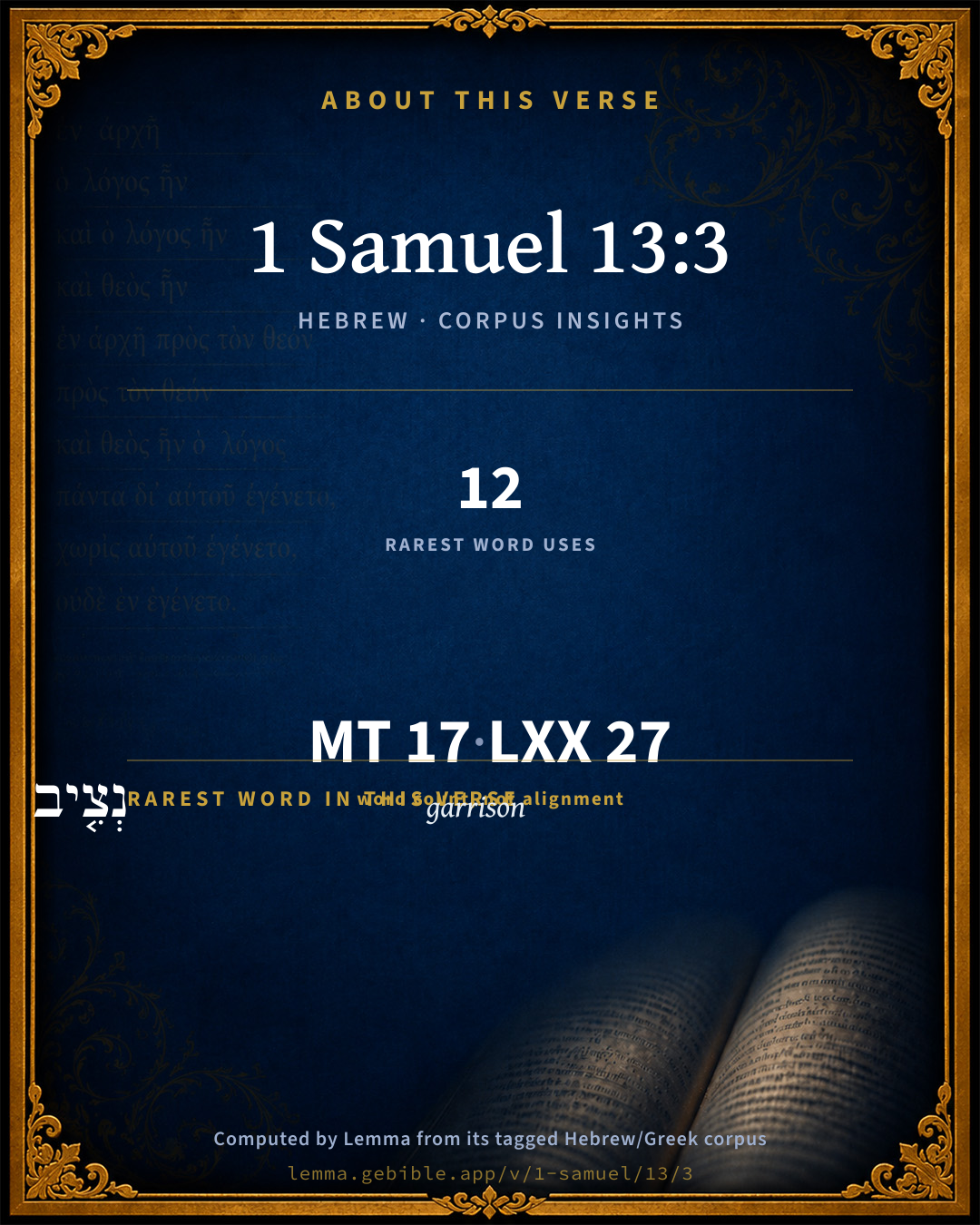
The rarest word here is נְצִ֤יב garrison H5333 — appearing just 12 times in the whole Hebrew Bible.

Shared distinctive vocabulary

נְצִ֤יב garrison H5333 occurs in 11 verses of the Hebrew Bible. Also found in:

Grammatical profile

  • 5 verbs
  • 10 nouns
  • 2 particles

Verb forms

  • וַיַּ֣ךְ Hiphil · Sequential Imperfect
  • וַֽיִּשְׁמְע֖וּ Qal · Sequential Imperfect
  • תָּקַ֨ע Qal · Perfect
  • לֵאמֹ֔ר Qal · Infinitive Construct
  • יִשְׁמְע֖וּ Qal · Jussive

Repetition

Words recur within this verse — often emphatic in Hebrew:

  • פְּלִשְׁתִּים֙ Philistine H6430 ×2
  • וַֽיִּשְׁמְע֖וּ to hear H8085 ×2

Hebrew & Septuagint length

In English translation the verse runs 30 words from the Hebrew and 32 from the Septuagint (LXX English) — closely comparable.

A rough comparison of the two English renderings, which tokenize alike — not a word-level alignment.

Word counts can differ between the Hebrew and the Greek without any difference in meaning — e.g. the Hebrew direct-object marker אֵת has no separate Greek word, and Greek often adds the article ὁ.

In the original languages it is 17 Hebrew tokens and 27 Greek tokens — but the two are counted differently (Hebrew bundles its prefixes and suffixes into one token; the Greek is in lemma form), so that isn’t a like-for-like length.

Cross-references

12

Topical passages linked to 1 Samuel 13:3 in the Treasury of Scripture Knowledge — connected by theme and wording, ordered by reader-vote popularity; previews shown in the World English Bible.

  • 1 Samuel 10:5 After that you shall come to the hill of God, where is the garrison of the Philistines: and it shall happen, when you are come there to the city, that you shall meet a band of prophets coming down from the high place with a psaltery, and a tambourine, and a pipe, and a harp, before them; and they will be prophesying:
  • Judges 3:27 It happened, when he had come, that he blew a trumpet in the hill-country of Ephraim; and the children of Israel went down with him from the hill-country, and he before them.
  • Judges 6:34 But the Spirit of Yahweh came on Gideon; and he blew a trumpet; and Abiezer was gathered together after him.
  • Joshua 18:24 and Chephar Ammoni, and Ophni, and Geba; twelve cities with their villages:
  • Joshua 21:17 Out of the tribe of Benjamin, Gibeon with its suburbs, Geba with its suburbs,
  • 1 Samuel 13:16 Saul, and Jonathan his son, and the people who were present with them, abode in Geba of Benjamin: but the Philistines encamped in Michmash.
  • 1 Samuel 14:1–6 Now it fell on a day, that Jonathan the son of Saul said to the young man who bore his armor, Come, and let us go over to the Philistines' garrison, that is on yonder side. But he didn't tell his father.
  • 2 Samuel 2:28 So Joab blew the trumpet; and all the people stood still, and pursued after Israel no more, neither fought they any more.
  • 2 Samuel 20:1 There happened to be there a base fellow, whose name was Sheba, the son of Bichri, a Benjamite: and he blew the trumpet, and said, We have no portion in David, neither have we inheritance in the son of Jesse: every man to his tents, Israel.
  • 2 Samuel 23:14 David was then in the stronghold; and the garrison of the Philistines was then in Bethlehem.
  • Isaiah 10:29 they are gone over the pass; they have taken up their lodging at Geba; Ramah trembles; Gibeah of Saul is fled.
  • Zechariah 14:10 All the land will be made like the Arabah, from Geba to Rimmon south of Jerusalem; and she will be lifted up, and will dwell in her place, from Benjamin's gate to the place of the first gate, to the corner gate, and from the tower of Hananel to the king's wine-presses.

Cross-references courtesy of OpenBible.info (CC BY 4.0).

Hebrew and Greek witnesses Masoretic Hebrew ↔ Greek Septuagint

The same verse in the two great witnesses to the Old Testament, shown verse-for-verse.

These are two independent witnesses, not word-aligned to each other, and the Septuagint is shown in lemma (dictionary) form.

Hebrew 1 Samuel 13:3 Masoretic · Westminster Leningrad Codex

וַיַּ֣ךְ יוֹנָתָ֗ן אֵ֣ת נְצִ֤יב פְּלִשְׁתִּים֙ אֲשֶׁ֣ר בְּגֶ֔בַע וַֽיִּשְׁמְע֖וּ פְּלִשְׁתִּ֑ים וְשָׁאוּל֩ תָּקַ֨ע בַּשּׁוֹפָ֤ר בְּכָל הָאָ֨רֶץ֙ לֵאמֹ֔ר יִשְׁמְע֖וּ הָעִבְרִֽים

Jonathan struck the garrison of the Philistines that was in Geba: and the Philistines heard of it. Saul blew the trumpet throughout all the land, saying, Let the Hebrews hear.

World English Bible · Public Domain

Greek LXX 1 Samuel 13:3 Septuagint · lemma form

καί πατάσσω ιωναθαν ὁ νασιβ ὁ ἀλλόφυλος ὁ ἐν ὁ βουνός καί ἀκούω ὁ ἀλλόφυλος καί σαούλ σάλπιγξ σαλπίζω εἰς πᾶς ὁ γῆ λέγω ἀθετέω ὁ δοῦλος

And Jonathan struck Nasib the Philistine that lived in the hill; and the Philistines hear of it, and Saul sounds the trumpet through all the land, saying, The servants have despised us.

LXX2012 (modern English Septuagint) · Public Domain

On this verse, Haydock's Catholic Bible Commentary discusses the Septuagint’s reading. Read the note in Commentary ↓

Hebrew: Westminster Leningrad Codex (CC BY 4.0). Greek: Septuagint (public domain); English from LXX2012 (modern English Septuagint) (Public Domain). How the Septuagint differs from the Hebrew →

Targum (Aramaic paraphrase)

1

The Targum is the ancient Jewish Aramaic paraphrase of the Hebrew Scriptures — an interpretive translation, not the Hebrew text itself. Onkelos (literal) and Pseudo-Jonathan (expansive) render the Torah, and Jonathan the Prophets. Coverage is partial: where no permissively-licensed English translation exists for a verse, only the Aramaic is shown. This is verse-level text, not a word-by-word alignment to the Hebrew.

  1. Targum Jonathan Prophets (Joshua–Malachi)
    וּמְחָא יוֹנָתָן יַת אִסְטַרְטִיגֵי פְלִישְׁתָּאֵי דִי בְגִבְעֲתָא וּשְׁמָעוּ פְלִשְׁתָּאֵי וְשָׁאוּל תָּקַע בְּשׁוֹפָרָא בְּכָל אַרְעָא לְמֵימַר יִשְׁמְעוּן יְהוּדָאֵי:

    (no public-domain English translation for this verse)

    Targum Jonathan — Aramaic: “Mikraot Gedolot” (public domain). English: “Sefaria Community Translation” (CC0 1.0 (public-domain dedication)); “London "Chaldee Paraphrase," 1871” (public domain). Text via Sefaria.

Commentary

Notes on 1 Samuel 13:3 from classic Christian and Jewish commentators (each source and its license shown beneath its notes). The classic Christian expositions comment on the surrounding passage and are grouped to its opening verse, so a note may address several verses; the Jewish commentaries on the Tanakh (Rashi and others) are per-verse, so they appear only where the commentator wrote on this verse.

Lemma curates 59 commentaries, every one of them public domain or Creative Commons licensed, each selected and text-cleaned for this edition rather than reprinted as found. About our sources →

Jamieson, Fausset & Brown

Robert Jamieson, A. R. Fausset & David Brown

HE CALLS THE HEBREWS TO GILGAL AGAINST THE PHILISTINES. (Sa1 13:3-4)

And Jonathan--that is, "God-given."

smote the garrison of the Philistines . . . in Geba--Geba and Gibeah were towns in Benjamin, very close to each other (Jos 18:24, Jos 18:28). The word rendered "garrison" is different from that of Sa1 13:23; Sa1 14:1, and signifies, literally, something erected; probably a pillar or flagstaff, indicative of Philistine ascendency. That the secret demolition of this standard, so obnoxious to a young and noble-hearted patriot, was the feat of Jonathan referred to, is evident from the words, "the Philistines heard of it," which is not the way we should expect an attack on a fortress to be noticed.

Saul blew the trumpet throughout all the land--This, a well-known sound, was the usual Hebrew war-summons; the first blast was answered by the beacon fire in the neighboring places. A second blast was blown--then answered by a fire in a more distant locality, whence the proclamation was speedily diffused over the whole country. As the Philistines resented what Jonathan had done as an overt attempt to throw off their yoke, a levy, en masse, of the people was immediately ordered, the rendezvous to be the old camping-ground at Gilgal.

Jamieson, Fausset & Brown — Commentary Critical and Explanatory on the Whole Bible (1871) — public domain (CC PDM 1.0). Text via the HelloAO Bible API.

Trapp's Complete Commentary

John Trapp

1Sa 13:3 And Jonathan smote the garrison of the Philistines that [was] in Geba, and the Philistines heard [of it]. And Saul blew the trumpet throughout all the land, saying, Let the Hebrews hear.

Ver. 3. And Jonathan smote the garrison of the Philistines.] By his father’s command no doubt, {1Sa 13:4} - else he might have been served as T. Manlius dealt by his son; for overcoming the enemy without order, he put him to death, - but {a} God was not consulted with, and therefore the issue of this that Jonathan did was not so happy.

That was in Geba.] Or, Gibeah, his own native country: here this iuvenis animosus et audax, this black prince - so he might be called for his dreaded acts in battle; for "from the blood of the slain, from the fat of the mighty, the bow of Jonathan turned not back"; {2Sa 1:22} likeas of our Black Prince it is said, {b} that he assailed no nation which he overcame not, he besieged no city which he took not - made his first enterprise and foiled the enemy. If it be demanded what weapons Jonathan and his regiment made use of, since they had scarcely any of iron, {1Sa 13:19} Lucretius answereth,

“ Arma antiqua manas, {c} ungues. ”

So Virgil,

“ … hic torre armatus obusto,

Stipitis hic gravidi nodis. ”

And again,

“ Stipitibus duris agitur, sudibusve praeustis. ” - Aeneid. 7.

And Saul blew the trumpet.] Omnes ad arma classico convocat, he sounds an alarm all the country over: for he knew how he had angered those wasps the Philistines.

{a} Livy.

{b} Speed, 723.

{c} Pugnis rem agebant, a quibus pugna dicitur. - Cassidor.

John Trapp, A Commentary or Exposition upon All the Books of the Old and New Testament (1647–1656) — public domain. Text from a community e-Sword module.

Joseph Benson's Commentary

1Sa 13:3-4. Jonathan smote the garrison of the Philistines — The Philistines, though subdued by Samuel at Eben-ezer, and driven out of the country, yet still retained possession of some strong-holds. Saul blew the trumpet — That is, he sent messengers to tell them all what Jonathan had done, and how the Philistines were enraged at it, and therefore what necessity there was of gathering themselves together for their own defence. Israel heard that Saul had smitten, &c. — Perhaps contrary to some treaty. That Israel was held in abomination with the Philistines — That is, that they were highly incensed to take revenge.

Joseph Benson's Commentary on the Old and New Testaments (1811–1818) — public domain. Text from a community e-Sword module.

Tyndale Open Study Notes

Tyndale Open Resources

13:3 Geba was located between Jonathan’s forces at Gibeah and Saul’s forces at Micmash. A deep gorge separated Geba and Micmash (see 13:23; 14:5). • The ram’s horn (Hebrew shofar) was used to raise a signal—e.g., to muster an army (Judg 3:27). For other uses, see Lev 25:9; 2 Sam 6:15; 15:10; 18:16; 20:1; Hos 5:8; Joel 2:15. • Non-Israelites often used the term Hebrews disdainfully (see 1 Sam 14:11; 29:3; see also Gen 39:14; 43:32). Saul might have used it to strike a nerve and arouse the people’s pride in their identity.

Tyndale Open Study Notes — © Tyndale Open Resources, licensed CC BY-SA 4.0. Text via the HelloAO Bible API.

Geneva Bible (1599)

Geneva Bible translators

That everyone should prepare themselves to war.

Of Kirjath Jearim, where the Ark was, 1 Sam. 10:5.

Geneva Bible (1599) marginal notes — public domain. Text via Bolls.life.

Adam Clarke's Commentary

Verse 3. Jonathan smote] He appears to have taken this garrison by surprise, for his men had no arms for a regular battle, or taking the place by storm. This is the first place in which this brave and excellent man appears; a man who bears one of the most amiable characters in the Bible.

Let the Hebrews hear.] Probably this means the people who dwelt beyond Jordan, who might very naturally be termed here העברים haibrim, from עבר abar, he passed over; those who are beyond the river Jordan: as Abraham was called עברי Ibri because he dwelt beyond the river Euphrates.

Adam Clarke's Commentary on the Bible (1810–1826) — public domain. Text from a community e-Sword/MySword module.

Ellicott's Commentary for English Readers

(3) And Jonathan smote the garrison.—Jonathan throughout this history appears as the perfect type of a warrior, according to the requirements of his age; he is everywhere the first in courage and activity and speed, slender also, and of well-made figure. This personal beauty and swiftness of foot in attack or retreat gained for him among the troops the name of “gazelle.” (The first lines of the song, 2Sa_1:19, can only be explained on the supposition that Jonathan was well known by this name in the army.) “In all this, as in his uprightness and fidelity, he showed himself the right worthy son of a king.”—Ewald. Some translate the word rightly rendered “garrison” as “pillar,” a sign of the authority of the Philistines; others—e.g., Ewald—as a proper name, supposing that the officer appointed to collect tribute from Israel in that part of the country is meant.

And Saul blew the trumpet.—This was evidently more than a communication of good news to the people. Saul intended it as a summons to Israel to prepare at once for war.

A Bible Commentary for English Readers, edited by Charles John Ellicott (1878–1897) — public domain. Text from a community e-Sword module.

The Cambridge Bible for Schools and Colleges

gen. ed. J. J. S. Perowne

3. the garrison of the Philistines] See note on 1Sa_10:5.

Saul blew the trumpet] Heralds blowing trumpets to attract attention carried the news of Jonathan’s daring exploit throughout the country to prepare the people for a speedy summons to fight for their liberty. Cp. Jdg_3:27; Jdg_6:34; 2Sa_20:1.

Let the Hebrews hear] The name “Hebrews” is generally employed only by foreigners, or in speaking to foreigners. See note on 1Sa_4:6. If the text is correct, it is here used (cp. 1Sa_13:7) to place the nationality of Israel in contrast with the Philistines, or to describe them from the Philistine point of view as the subject race. But the Sept. reads “The slaves have revolted,” and it may be conjectured that we should transpose the words, and read “The Philistines heard saying, The slaves (or, the Hebrews) have revolted.” The consonants of the Hebrew words for “slaves” and “Hebrews” are almost identical, and are constantly liable to be confused.

The Cambridge Bible for Schools and Colleges (gen. ed. J. J. S. Perowne; Cambridge University Press, 1878–1918) — public domain. Text from a community e-Sword module.

John Gill's Exposition

And Jonathan smote the garrison of the Philistines that was in Geba,.... Not the same with Gibeah of Benjamin, as Jarchi; for it can hardly be thought that Jonathan should place himself with his thousand men where the Philistines had a garrison; or that if this was the same with that in the preceding verse, that it should be called by another name in this; but Gibeah and Geba were two places, as Kimchi observes, both indeed in the tribe of Benjamin, and it is very probable not far from one another; see Jos 18:24. This seems to be the same with the hill of God, where was a garrison of the Philistines, Sa1 10:5, who after their defeat by Samuel contented themselves with some strong holds and garrisons in some parts of the land to keep Israel in awe; the Targum understands this of a single person, a governor of the Philistines in this place, whom Jonathan slew, and so Jarchi; and according to R. Isaiah he was one that was appointed to gather the tax for them:

and the Philistines heard of it, which alarmed them, and made them prepare for war:

and Saul blew the trumpet throughout all the land; not he in person, for he was at Gilgal, as the next verse shows; but he ordered it to be blown, being aware of the preparations the Philistines were making to attack him:

saying, let the Hebrews hear; both what his son had done, and what the Philistines were doing.

John Gill's Exposition of the Whole Bible (1746–1763) — public domain (CC PDM 1.0). Text via the HelloAO Bible API.

Albert Barnes' Notes on the Bible

This was the first act in the war of independence, and probably the first feat in arms of the young hero Jonathan.

Albert Barnes' Notes on the Bible (1834–1885) — public domain. Text from a community e-Sword/MySword module.

Haydock's Catholic Bible Commentary

Land. As soon as the next cities had heard the alarm, they sounded the trumpet, and so the news was conveyed to the most distant parts, in a short time, Judges iii. 27. --- Hebrews. Probably those "on the other side" of the Jordan, who presently came to the assistance of their brethren, ver. 7. (Osiander) --- It might also be the usual beginning of a proclamation. See Daniel iii. 4. (Menochius) --- Septuagint and Aquila have a instead of r, in hibrim. "Let the servants (subjects) attend." (Aquila) The slaves have rebelled," (Septuagint) meaning the Philistines, who ought to have been subject to Israel. (Haydock)

George Leo Haydock (1774–1849), Haydock's Catholic Family Bible and Commentary, 1859 edition — public domain. Excludes Psalms (Douay-Rheims chapter numbering differs from Protestant) and Deuterocanonical books (Catholic canon only).

Matthew Poole's English Annotations

The first design of Saul and Jonathan was to free then land from the garrisons which the Philistines had in it; and they first begin to clear their own country of Benjamin.

Geba; not the same place called Gibeah, 1Sa 13:2, (for if the place were the same, why should he vary the name of it in the same story, and in the next verse? nor is it likely that Jonathan would choose that place for his camp where the Philistines had a garrison,) but another place in the same tribe, in which there were two distinct places, Geba and Gibeah, Jos 18:24,28.

Let the Hebrews hear, i.e. he sent messengers to tell them all what Jonathan had done, and how the Philistines were enraged at it, and made great preparations for war; and therefore what necessity there was of gathering themselves together, and coming to him, for his and their own defence.

Matthew Poole's English Annotations on the Holy Bible (1683–1685) — public domain. Text from a community e-Sword/MySword module.

Whedon's Commentary on the Bible

Daniel D. Whedon

3. The garrison of the Philistines that was in Geba — Geba was situated between Gibeah and Michmash, about three miles from the former place and two from the latter. It was a city of Benjamin (Jos_18:24) assigned to the priests. Jos_21:17. The English version confounds it in 1Sa_13:16 with Gibeah. Its name still lingers in the modern Jeba, a small, half-ruined village on an eminence which commands an extensive view of the Dead Sea and the mountains beyond. “Across the deep ravine on the north,” says Robinson, “we could see the next village on our route, the ancient Michmash, lying directly over against Jeba in a direction about northeast.” Here, as on the heights of Gibeah, (1Sa_10:5,) the Philistines had intrenched themselves; though, this may have been the same garrison that is there mentioned, but which had in the meantime, while Israel was at war for the rescue of Jabesh-gilead, advanced as far as Geba. Jonathan probably took this garrison by surprise, as he and his armourbearer did the one mentioned in the following chapter.

The Philistines heard — And regarded it as an indication of hostile action on the part of the Israelites.

Saul blew the trumpet — Ordered it to be blown. The sound of the trumpet was the usual accompaniment of important proclamations, designed as a signal to arouse the attention of the people. Compare 2Sa_15:10; 2Sa_20:1; 1Ki_1:34; 2Ki_9:13.

Daniel D. Whedon (gen. ed.), Commentary on the Old and New Testaments (1874–1909) — public domain. Text from a community e-Sword module.

The Pulpit Commentary

In Geba. By this garrison the Philistines commanded the further end of the defile, and they had also another outpost beyond it near Gibeah itself. (1Sa_10:5) Probably neither of these garrisons was very strong, and Saul may have intended that Jonathan should attack them while he held the northern end of the pass, which would be the first place assailed by the Philistines in force. As regards the word translated garrison, attempts have been made to render it pillar, and to represent it as a token of Philistine supremacy which Jonathan threw down, while others, with the Septuagint, take it as a proper name; but the word smote is strongly in favour of the rendering of the A.V Let the Hebrews hear. Saul must have intended war when he thus posted himself and Jonathan in such commanding spots, and probably all this had been sketched out by Samuel. (see on 1Sa_10:8) He now summons all Israel to the war. It is strange that he should call the people "Hebrews," the Philistine title of contempt; but it is used again in ver. 7, and of course in ver. 19. The Septuagint reads, "Let the slaves revolt," but though followed by Josephus, the change of text is not probable.

The Pulpit Commentary (1880–1919), ed. H.D.M. Spence-Jones & Joseph S. Exell — public domain. Text from a community e-Sword module.

John Wesley's Explanatory Notes

Blew - That is, he sent messengers to tell them all what Jonathan had done, and how the Philistines were enraged at it, and therefore what necessity there was of gathering themselves together for their own defense.

John Wesley, Explanatory Notes Upon the Whole Bible (1754–1765) — public domain. Text via the GEBible commentary corpus.

unfoldingWord translationNotes

Door43 World Missions Community

garrison of the Philistines

"military base of the Philistines" or "military camp of the Philistines"

Geba

This is the name of the town that the Philistine garrison was stationed in. (See: How to Translate Names)

All Israel heard that Saul had defeated

Possible meanings are that 1) Saul was taking responsibility for Jonathan's actions or 2) Saul was taking credit for Jonathan's actions.

Israel had become a rotten smell to the Philistines

The Philistines hating the Israelites is spoken of as if the Israelites had become a bad smell that offended the Philistines. AT: "the Philistines hated the Israelites" (See: Metaphor)

the soldiers were summoned together to join Saul at Gilgal

This can be stated in active form. AT: "Saul called the soldiers together to join him at Gilgal" (See: Active or Passive)

translationWords

Philistines

trumpet

Hebrew

Gilgal

unfoldingWord translationNotes — © Distant Shores Media and the Door43 World Missions Community, licensed CC BY-SA 4.0. Source: git.door43.org/Door43/en_tn.

Rashi

Rabbi Shlomo Yitzchaki (Rashi)

The Philistine governor. They had a government official [who ruled] over Yisroel and they stationed him in Givas Binyomin.

Let the Hebrews hear. That we have rebelled against the Philistines and they should beware of them.

Rashi on the Tanakh — English translations: “The Judaica Press complete Tanach with Rashi, translated by A. J. Rosenberg” (CC BY 4.0); “Pentateuch with Rashi's commentary by M. Rosenbaum and A.M. Silbermann, 1929-1934” (public domain); “The Metsudah Tanach series, Lakewood, N.J” (CC BY 4.0); and “The Book of Joshua, Metsudah Publications, 1997” (CC BY 4.0). Text via Sefaria.

Lesson kit

Teaching starters — assembled from the data on this page, not authored interpretation. Every prompt links to the verse data it draws on. Edit before teaching.

1 Samuel, in the Historical, opens this verse with 17 words (15 distinct Hebrew lemmas). Its most distinctive word is nᵉtsîyb (“garrison”). A historical commentator’s framing appears above. Read the whole chapter for the surrounding context.

Discussion questions

  1. How does “garrison” (nᵉtsîyb) shape what this verse is saying?
  2. How does Genesis 19:26, which shares the word «garrison», read alongside this verse?
  3. What does the repetition of “Philistine” (2× in this one verse) do in this verse?
  4. The translations on this page render this verse differently — a whole-verse word diff, not a word-by-word alignment. What might account for the different wordings?
  5. «וַיַּ֣ךְ» is a Hiphil Sequential Imperfect verb. How does that grammatical form shape the action described?
  6. Compare how Jamieson, Fausset & Brown and Trapp's Complete Commentary read this verse. Where do they agree or differ?

Things to notice

Reading settings

Reading text

Shown beneath each verse's original-language words.

Old Testament
Old Testament edition

Read the OT as the Masoretic Hebrew (MT) or the Greek Septuagint (LXX).

English shown for the Greek Septuagint (in the Hebrew ↔ Greek comparison).

Comparing translations? Open the Compare panel on any verse page to stack up to four side by side.