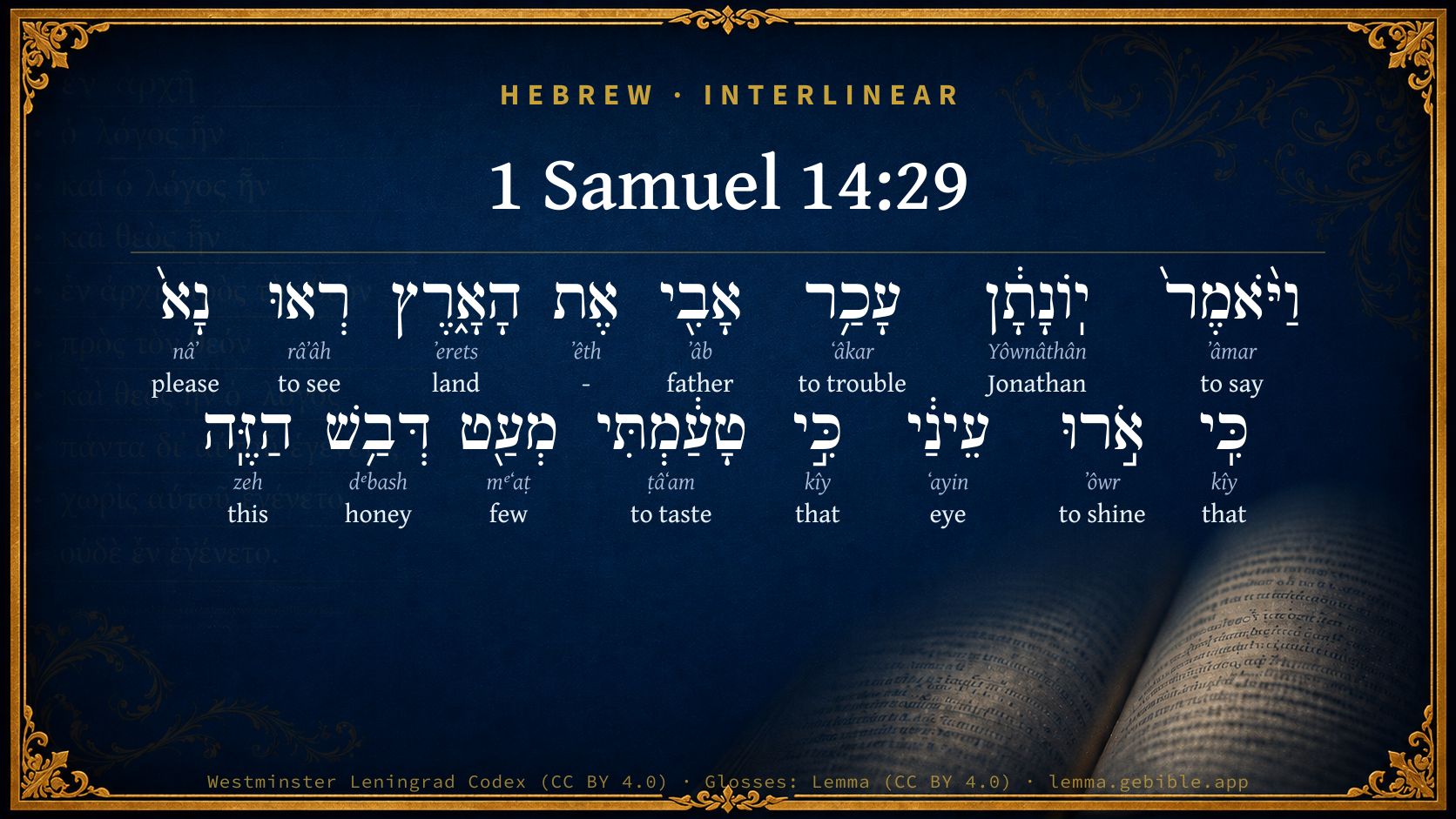
1 Samuel 14:29

Hebrew (Westminster Leningrad Codex) 1 Samuel 14:29 appears in the Hebrew Old Testament. The text above is from the Westminster Leningrad Codex. Each word links to its Strong’s number, a concise gloss, and parsing drawn from the Open Scriptures Hebrew Bible morphology. Click any word for its full Brown-Driver-Briggs (BDB) entry.
Download image
Cite this verse

1 Samuel 14:29 (World English Bible). Public Domain. Lemma interlinear Bible study tool, https://lemma.gebible.app/v/1-samuel/14/29.

Show BibTeX & RIS
BibTeX
RIS
English Translation
Then said Jonathan, My father has troubled the land. Please look how my eyes have been enlightened, because I tasted a little of this honey.
World English Bible · Public Domain
Download a study sheet

One document with this verse’s original text, its word-by-word gloss line, the meaning frame, cross-references with their text, attributed commentary, and full source and license credits — printable, and it pastes into notes with its structure intact.

This verse Autodidact and up

Study sheet (.html) Plain text (.txt)

A passage Seminary Student

Up to 50 verses in one chapter. A passage sheet keeps up to 6 commentary sources and 12 cross-references per verse, in the order this page ranks them, and says so on the sheet whenever that leaves anything out. Ask for a single verse and you get the Autodidact verse sheet above.

Everything on this page stays free to read, with no account — the sheet is a download of what is already on screen, not access to it.

Want to remove ads? Support Godless Engineer
Compare translations 3

The same verse in 3 English versions, stacked beneath the original-language interlinear above. Click any original word for its lexicon entry.

Each is an independent rendering of the whole verse — the interlinear is not word-aligned to these translations.

Highlighted words mark where these versions differ — a whole-verse word diff, not a word-by-word alignment.

  • World English Bible Public Domain
    Then said Jonathan, My father has troubled the land. Please look how my eyes have been enlightened, because I tasted a little of this honey.
  • King James Version Public Domain
    Then said Jonathan, My father hath troubled the land: see, I pray you, how mine eyes have been enlightened, because I tasted a little of this honey.
  • unfoldingWord Literal Text CC BY-SA 4.0
    And Jonathan said, “My father has troubled the land. See, please, that my eyes have brightened because I have tasted a little of this honey.

unfoldingWord Literal Text — © unfoldingWord, licensed CC BY-SA 4.0. Word-aligned USFM3 via Door43 (git.door43.org/unfoldingWord/en_ult).

Versions to compare (up to 4)

3 of 4 selected

Show all 18 translations

Every available English version of this verse, each an independent rendering of the whole verse.

  • World English Bible Public Domain
    Then said Jonathan, My father has troubled the land. Please look how my eyes have been enlightened, because I tasted a little of this honey.
  • Berean Standard Bible Public Domain
    “My father has brought trouble to the land,” Jonathan replied. “Just look at how my eyes have brightened because I tasted a little of this honey.
  • Majority Standard Bible Public Domain
    “My father has brought trouble to the land,” Jonathan replied. “Just look at how my eyes have brightened because I tasted a little of this honey.
  • King James Version Public Domain
    Then said Jonathan, My father hath troubled the land: see, I pray you, how mine eyes have been enlightened, because I tasted a little of this honey.
  • American Standard Version (1901) Public Domain
    Then said Jonathan, My father hath troubled the land: see, I pray you, how mine eyes have been enlightened, because I tasted a little of this honey.
  • Revised Version (1885) Public Domain
    Then said Jonathan, My father hath troubled the land: see, I pray you, how mine eyes have been enlightened, because I tasted a little of this honey.
  • Geneva Bible (1599) Public Domain
    Then said Ionathan, My father hath troubled the land: see nowe howe mine eyes are made cleare, because I haue tasted a litle of this honie:
  • Douay-Rheims (1899) Public Domain
    And Jonathan said: My father hath troubled the land: you have seen yourselves that my eyes are enlightened, because I tasted a little of this honey:
  • Young's Literal Translation Public Domain
    And Jonathan saith, `My father hath troubled the land; see, I pray you, that mine eyes have become bright because I tasted a little of this honey.
  • Literal Standard Version CC BY-SA 4.0
    And Jonathan says, “My father has troubled the land; now see that my eyes have become bright because I tasted a little of this honey.
  • Unlocked Literal Bible CC BY-SA 4.0
    Then Jonathan said, “My father has made trouble for the land. See how my eyes have become brightened because I tasted a little of this honey.
  • unfoldingWord Literal Text CC BY-SA 4.0
    And Jonathan said, “My father has troubled the land. See, please, that my eyes have brightened because I have tasted a little of this honey.
  • Darby Bible Public Domain
    And Jonathan said, My father has troubled the land: see, I pray you, that mine eyes are bright, because I tasted a little of this honey.
  • World Messianic Bible Public Domain
    Then Jonathan said, “My father has troubled the land. Please look how my eyes have brightened because I tasted a little of this honey.
  • Webster's Bible Public Domain
    Then said Jonathan, My father hath troubled the land: see, I pray you, how my eyes have been enlightened, because I tasted a little of this honey.
  • Free Bible Version CC BY-SA 4.0
    “My father has caused a whole lot of trouble for everyone,” Jonathan replied. “See how well I am because I've eaten a little of this honey.
  • Bible in Basic English Public Domain
    Then Jonathan said, My father has made trouble come on the land: now see how bright my eyes have become because I have taken a little of this honey.
  • JPS Tanakh (1917) Public Domain
    Then said Jonathan: 'My father hath troubled the land; see, I pray you, how mine eyes are brightened, because I tasted a little of this honey.

Literal Standard Version (2020), Covenant Press — licensed CC BY-SA 4.0. Text via the HelloAO Bible API (eBible.org). Unlocked Literal Bible (unfoldingWord) — licensed CC BY-SA 4.0. Text via the HelloAO Bible API (eBible.org). unfoldingWord Literal Text — © unfoldingWord, licensed CC BY-SA 4.0. Word-aligned USFM3 via Door43 (git.door43.org/unfoldingWord/en_ult). Free Bible Version, Dr. Jonathan Gallagher — licensed CC BY-SA 4.0. Text via the HelloAO Bible API (eBible.org).

Word by word

More ways to search: Search by grammar → Find every occurrence → Compare this word →

Practice this passage: Drill this verse → Learn its vocabulary →

טָעַ֔מְתִּי
ṭâʻam
H2938
“to taste”
Verb, Qal, Perfect, 1st Person, Common, Singular
Part of Speech
Verb
Stem
Qal
Form
Perfect
Person
1st Person
Gender
Common
Number
Singular
Full BDB Definition

Origin: a primitive root

TWOT: 815

to taste, perceive, eat - (Qal) to taste
  1. וַיֹּ֨אמֶר֙ ʼâmar H559 “and · to say” Conjunction + Verb, Qal, Sequential Imperfect, 3rd Person, Masculine, Singular
  2. יֽוֹנָתָ֔ן Yôwnâthân H3129 “Jonathan” Noun, Proper
  3. עָכַ֥ר ʻâkar H5916 “to trouble” Verb, Qal, Perfect, 3rd Person, Masculine, Singular
  4. אָבִ֖י ʼâb H1 “father · my” Noun, Common, Masculine, Singular, Construct + Suffix, Personal, 1st Person, Common, Singular
  5. אֶת ʼêth H853 “-” Particle, Direct Object
  6. הָאָ֑רֶץ ʼerets H776 “the · land” Particle, Definite Article + Noun, Common, Both, Singular, Absolute
  7. רְאוּ râʼâh H7200 “see” Verb, Qal, Imperative, 2nd Person, Masculine, Plural
  8. נָא֙ nâʼ H4994 “please” Particle, Exhortation
  9. כִּֽי kîy H3588 “that” Conjunction
  10. אֹ֣רוּ ʼôwr H215 “to shine” Verb, Qal, Perfect, 3rd Person, Common, Plural
  11. עֵינַ֔י ʻayin H5869 “eyes · my” Noun, Common, Both, Dual, Construct + Suffix, Personal, 1st Person, Common, Singular
  12. כִּ֣י kîy H3588 “that” Conjunction
  13. מְעַ֖ט mᵉʻaṭ H4592 “few of” Noun, Common, Masculine, Singular, Construct
  14. דְּבַ֥שׁ dᵉbash H1706 “honey” Noun, Common, Masculine, Singular, Absolute
  15. הַזֶּֽה zeh H2088 “the · this” Particle, Definite Article + Pronoun, Demonstrative, Masculine, Singular

About this verse

These counts appear in no published source. They are computed here, from the morphology-tagged text and Lemma’s own curated glosses. What Lemma adds →

16
words
15
distinct lemmas
Historical
section

Notable vocabulary

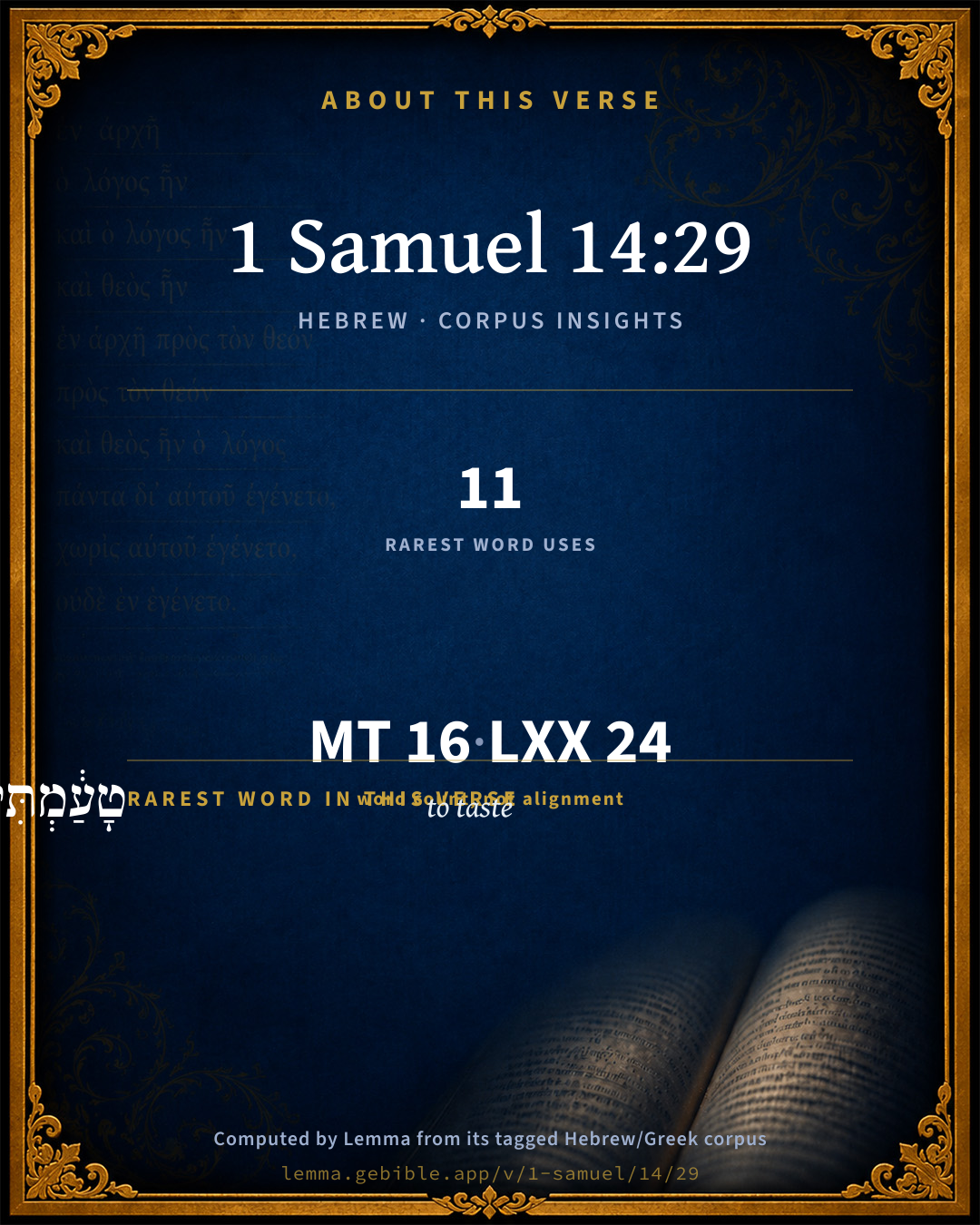
The rarest word here is טָעַ֔מְתִּי to taste H2938 — appearing just 11 times in the whole Hebrew Bible.

Shared distinctive vocabulary

טָעַ֔מְתִּי to taste H2938 occurs in 10 verses of the Hebrew Bible. Also found in:

Grammatical profile

  • 5 verbs
  • 6 nouns
  • 1 pronoun
  • 2 conjunctions
  • 2 particles

Verb forms

  • וַיֹּ֨אמֶר֙ Qal · Sequential Imperfect
  • עָכַ֥ר Qal · Perfect
  • רְאוּ Qal · Imperative
  • אֹ֣רוּ Qal · Perfect
  • טָעַ֔מְתִּי Qal · Perfect

Repetition

A word recurs within this verse — often emphatic in Hebrew:

  • כִּֽי that H3588 ×2

Hebrew & Septuagint length

In English translation the verse runs 25 words from the Hebrew and 29 from the Septuagint (LXX English) — closely comparable.

A rough comparison of the two English renderings, which tokenize alike — not a word-level alignment.

Word counts can differ between the Hebrew and the Greek without any difference in meaning — e.g. the Hebrew direct-object marker אֵת has no separate Greek word, and Greek often adds the article ὁ.

In the original languages it is 16 Hebrew tokens and 24 Greek tokens — but the two are counted differently (Hebrew bundles its prefixes and suffixes into one token; the Greek is in lemma form), so that isn’t a like-for-like length.

Cross-references

2

Topical passages linked to 1 Samuel 14:29 in the Treasury of Scripture Knowledge — connected by theme and wording, ordered by reader-vote popularity; previews shown in the World English Bible.

  • 1 Kings 18:18 He answered, I have not troubled Israel; but you, and your father's house, in that you have forsaken the commandments of Yahweh, and you have followed the Baals.
  • Joshua 7:25 Joshua said, Why have you troubled us? Yahweh shall trouble you this day. All Israel stoned him with stones; and they burned them with fire, and stoned them with stones.

Cross-references courtesy of OpenBible.info (CC BY 4.0).

Hebrew and Greek witnesses Masoretic Hebrew ↔ Greek Septuagint

The same verse in the two great witnesses to the Old Testament, shown verse-for-verse.

These are two independent witnesses, not word-aligned to each other, and the Septuagint is shown in lemma (dictionary) form.

Hebrew 1 Samuel 14:29 Masoretic · Westminster Leningrad Codex

וַיֹּ֨אמֶר֙ יֽוֹנָתָ֔ן עָכַ֥ר אָבִ֖י אֶת הָאָ֑רֶץ רְאוּ נָא֙ כִּֽי אֹ֣רוּ עֵינַ֔י כִּ֣י טָעַ֔מְתִּי מְעַ֖ט דְּבַ֥שׁ הַזֶּֽה

Then said Jonathan, My father has troubled the land. Please look how my eyes have been enlightened, because I tasted a little of this honey.

World English Bible · Public Domain

Greek LXX 1 Samuel 14:29 Septuagint · lemma form

καί γιγνώσκω ιωναθαν καί εἶπον ἀποἀλλάσσω ὁ πατήρ ἐγώ ὁ γῆ ὁράω δή ὅτι ὁράω ὁ ὀφθαλμός ἐγώ ὅτι γεύω βραχύς ὁ μέλι οὗτος

and Jonathan knew it, and said, My father has destroyed the land: see how my eyes have received sight now that I have tasted a little of this honey.

LXX2012 (modern English Septuagint) · Public Domain

Hebrew: Westminster Leningrad Codex (CC BY 4.0). Greek: Septuagint (public domain); English from LXX2012 (modern English Septuagint) (Public Domain). How the Septuagint differs from the Hebrew →

Targum (Aramaic paraphrase)

1

The Targum is the ancient Jewish Aramaic paraphrase of the Hebrew Scriptures — an interpretive translation, not the Hebrew text itself. Onkelos (literal) and Pseudo-Jonathan (expansive) render the Torah, and Jonathan the Prophets. Coverage is partial: where no permissively-licensed English translation exists for a verse, only the Aramaic is shown. This is verse-level text, not a word-by-word alignment to the Hebrew.

  1. Targum Jonathan Prophets (Joshua–Malachi)
    וַאֲמַר יוֹנָתָן עֲכַר אַבָּא יַת עַמָא דְאַרְעָא חֲזוֹ כְעַן אֲרֵי נַהֲרָא עֵינֵי אֲרֵי טְעֵימִית זְעֵיר דוּבְשָׁא הָדֵין:

    (no public-domain English translation for this verse)

    Targum Jonathan — Aramaic: “Mikraot Gedolot” (public domain). English: “Sefaria Community Translation” (CC0 1.0 (public-domain dedication)); “London "Chaldee Paraphrase," 1871” (public domain). Text via Sefaria.

Commentary

Notes on 1 Samuel 14:29 from classic Christian and Jewish commentators (each source and its license shown beneath its notes). The classic Christian expositions comment on the surrounding passage and are grouped to its opening verse, so a note may address several verses; the Jewish commentaries on the Tanakh (Rashi and others) are per-verse, so they appear only where the commentator wrote on this verse.

Lemma curates 59 commentaries, every one of them public domain or Creative Commons licensed, each selected and text-cleaned for this edition rather than reprinted as found. About our sources →

Trapp's Complete Commentary

John Trapp

1Sa 14:29 Then said Jonathan, My father hath troubled the land: see, I pray you, how mine eyes have been enlightened, because I tasted a little of this honey.

Ver. 29. My father hath troubled the land.] Iuveniliter hoc dixit Ionathas, saith one. {a} If Saul had done unadvisedly, yet Jonathan should not have reprehended his father’s act so publicly, for fear of a rebellion.

See, I pray you, how mine eyes have been enlightened.] So Hunniades was much refreshed, when, after a fight with the Turks, he supped with a shepherd, who brought him faint and almost famished to his poor cottage, and set before him bread and water, with a few onions. {b}

{a} A. Lapide.

{b} Turk. Hist., p. 310.

John Trapp, A Commentary or Exposition upon All the Books of the Old and New Testament (1647–1656) — public domain. Text from a community e-Sword module.

Tyndale Open Study Notes

Tyndale Open Resources

14:29 made trouble: Joshua had used this verb in speaking with Achan (Josh 7:25), and Jephthah had used it with his innocent daughter (Judg 11:35). Saul’s foolish oath limited Israel’s victory (1 Sam 14:30) and put his son’s life at risk (see also Josh 6:18; 1 Chr 2:7).

Tyndale Open Study Notes — © Tyndale Open Resources, licensed CC BY-SA 4.0. Text via the HelloAO Bible API.

Geneva Bible (1599)

Geneva Bible translators

By making this cruel law.

Geneva Bible (1599) marginal notes — public domain. Text via Bolls.life.

Ellicott's Commentary for English Readers

(29) My father hath troubled the land.—In other words, “My father’s ill-considered vow has done-grave harm to us in Israel. Had he not weakened the people, by hindering them from taking the needful refreshment, our victory would have been far more complete. Utter exhaustion has prevented us from following up our victory.”

A Bible Commentary for English Readers, edited by Charles John Ellicott (1878–1897) — public domain. Text from a community e-Sword module.

The Cambridge Bible for Schools and Colleges

gen. ed. J. J. S. Perowne

29. hath troubled] The word applied to Achan in Jos_7:25.

The Cambridge Bible for Schools and Colleges (gen. ed. J. J. S. Perowne; Cambridge University Press, 1878–1918) — public domain. Text from a community e-Sword module.

John Gill's Exposition

Then said Jonathan, my father hath troubled the land,.... The people of the land, as the Targum, the soldiers in his army; afflicted and distressed them, and made them uneasy in their minds, like troubled waters; the Arabic version is,"my father hath sinned against the people;''hath done them injury by forbidding them to eat. This was not wisely said by Jonathan; how much soever his father was to be blamed, it did not become him as a son thus to reflect upon him, and it might have tended to mutiny and sedition:

see, I pray you, how mine eyes have been enlightened, because I tasted a little of this honey; the benefit he received by it was very visible; it might easily be discerned that he was greatly refreshed with it, and his spirits invigorated by it; it was to be seen in the cheerfulness of his countenance, and the briskness of his eyes: and he suggests it would have had the same effect upon the people, had they eaten of it, as he had done.

John Gill's Exposition of the Whole Bible (1746–1763) — public domain (CC PDM 1.0). Text via the HelloAO Bible API.

Albert Barnes' Notes on the Bible

Hath troubled - The same word as was applied to Achan Jos 7:25, and gave its name to the valley of Achor. This additional reference to Joshua is remarkable (compare 1Sa 14:24).

Albert Barnes' Notes on the Bible (1834–1885) — public domain. Text from a community e-Sword/MySword module.

Haydock's Catholic Bible Commentary

Land. Chaldean, "the people of the land." (Menochius) --- He speaks his sentiments freely. But we ought not to find fault, in public, with the conduct of the prince. (Calmet) --- The people might have eaten a little without stopping the pursuit, as they generally carried provisions with them, or might find some easily on the road, so as to run with fresh vigour, (See Josue x.) and make ample amends for the time that they were delayed. (Haydock)

George Leo Haydock (1774–1849), Haydock's Catholic Family Bible and Commentary, 1859 edition — public domain. Excludes Psalms (Douay-Rheims chapter numbering differs from Protestant) and Deuterocanonical books (Catholic canon only).

Matthew Poole's English Annotations

The land, i.e. the people of the land, the whole army, whom by this rash oath he hath greatly injured. The zeal of defending himself makes him run into the other extreme of accusing his father, and that before the people, whom by this means he might have stirred up to a sedition.

Matthew Poole's English Annotations on the Holy Bible (1683–1685) — public domain. Text from a community e-Sword/MySword module.

Whedon's Commentary on the Bible

Daniel D. Whedon

29. My father hath troubled the land — Jonathan is quick to see the rashness and folly of his father’s oath, and to point out its injury to the Hebrews’ cause.

Daniel D. Whedon (gen. ed.), Commentary on the Old and New Testaments (1874–1909) — public domain. Text from a community e-Sword module.

The Pulpit Commentary

My father hath troubled the land. Ie. hath brought disaster upon it (see Gen_34:30; Jos_7:25) This disaster was the incompleteness of the victory, owing to the people being too exhausted to continue the pursuit.

The Pulpit Commentary (1880–1919), ed. H.D.M. Spence-Jones & Joseph S. Exell — public domain. Text from a community e-Sword module.

unfoldingWord translationNotes

Door43 World Missions Community

for the land

This is a metonym that represents the nation of Israel. AT: "for Israel" (See: Metonymy)

my eyes have become brightened

This idiom means that he was strengthened. AT: "I regained my strength" (See: Idiom)

How much better if the people ... that they found?

Jonathan uses this hypothetical question to state that the people should have been allowed to eat. This can be a statement. AT: "Our victory would have been better if the people had eaten freely today of the plunder that they took from their enemies." (See: Rhetorical Question and Hypothetical Situations)

plunder

This word refers to the things the people had taken from the battle with their enemy.

Because now the slaughter has not been great

Because the troops were not able to eat during the battle, as the day progressed, they became weaker. Because of this, they were not able to kill as many of the Philistines.

translationWords

trouble

slaughter

Philistines

unfoldingWord translationNotes — © Distant Shores Media and the Door43 World Missions Community, licensed CC BY-SA 4.0. Source: git.door43.org/Door43/en_tn.

Rashi

Rabbi Shlomo Yitzchaki (Rashi)

My father has brought distress to the [inhabitants of the] land. He confused [עָכַר] their thoughts and their salvation, like unclear [עֲכוּרִים] waters.

Rashi on the Tanakh — English translations: “The Judaica Press complete Tanach with Rashi, translated by A. J. Rosenberg” (CC BY 4.0); “Pentateuch with Rashi's commentary by M. Rosenbaum and A.M. Silbermann, 1929-1934” (public domain); “The Metsudah Tanach series, Lakewood, N.J” (CC BY 4.0); and “The Book of Joshua, Metsudah Publications, 1997” (CC BY 4.0). Text via Sefaria.

Lesson kit

Teaching starters — assembled from the data on this page, not authored interpretation. Every prompt links to the verse data it draws on. Edit before teaching.

1 Samuel, in the Historical, opens this verse with 16 words (15 distinct Hebrew lemmas). Its most distinctive word is ṭâʻam (“to taste”). A historical commentator’s framing appears above. Read the whole chapter for the surrounding context.

Discussion questions

  1. What does “to taste” (ṭâʻam) contribute to the verse as a whole?
  2. 1 Samuel 14:24 shares the word «to taste» with this verse. How do the two illuminate each other?
  3. “that” occurs 2× in this one verse. What is the effect of the repetition?
  4. The translations on this page render this verse differently — a whole-verse word diff, not a word-by-word alignment. What might account for the different wordings?
  5. The verb «וַיֹּ֨אמֶר֙» is Qal Sequential Imperfect. How does its form color the action?
  6. Reading how Trapp's Complete Commentary and Tyndale Open Study Notes read this verse, where do the two commentators agree and where do they part?

Things to notice

Reading settings

Reading text

Shown beneath each verse's original-language words.

Old Testament
Old Testament edition

Read the OT as the Masoretic Hebrew (MT) or the Greek Septuagint (LXX).

English shown for the Greek Septuagint (in the Hebrew ↔ Greek comparison).

Comparing translations? Open the Compare panel on any verse page to stack up to four side by side.