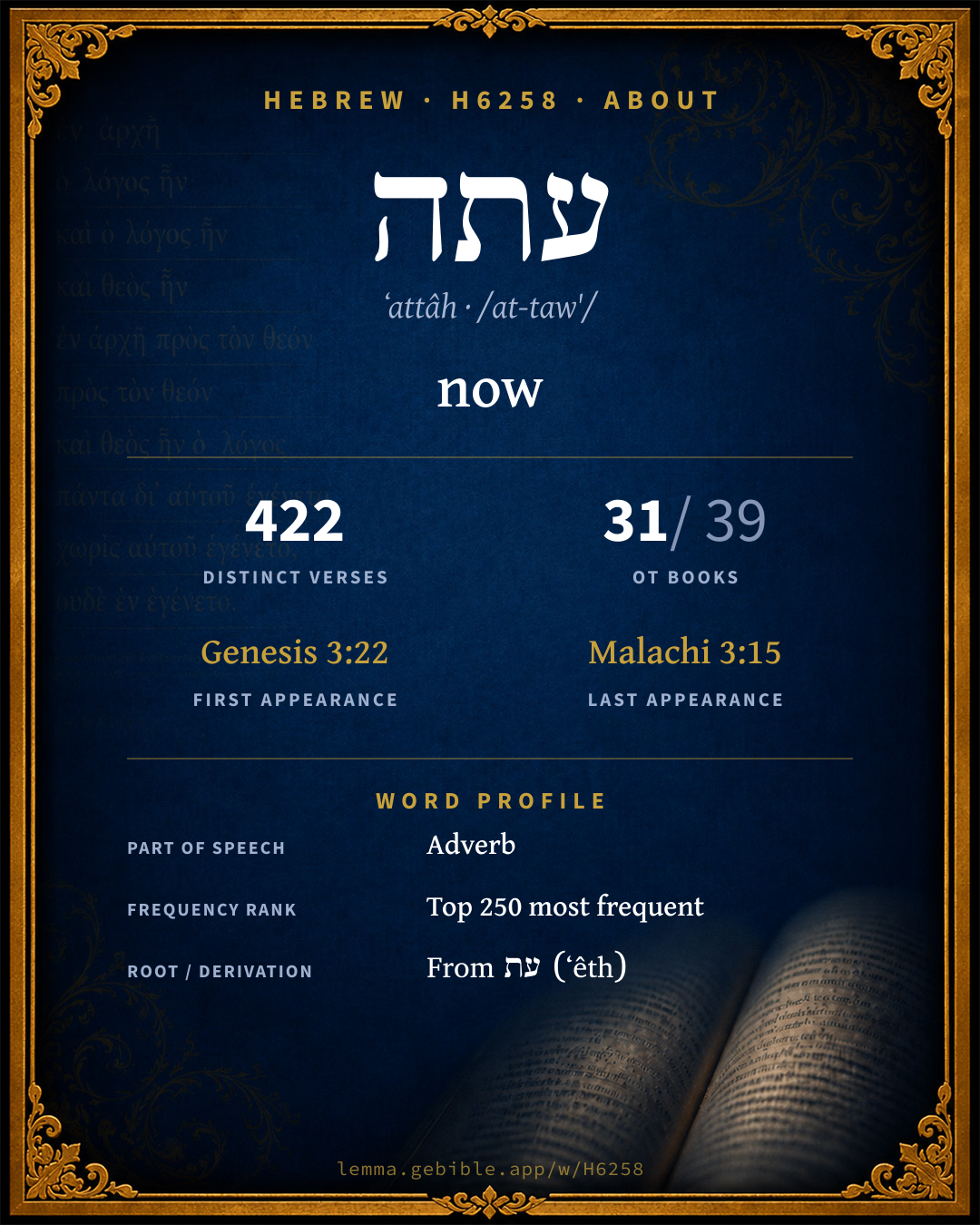
עַתָּ֫ה
now
‘now’ is one of 2 main senses fuller range ↓
Full lexicon entry — Brown-Driver-Briggs (BDB)
From Brown-Driver-Briggs (BDB)
Where this word appears
Grammar key — what these labels mean
Part of speech
- Adverb
- A word that modifies a verb, adjective, or other adverb.
Every verse where H6258 appears in the Book of Genesis — 40 distinct verses. Click any verse to open its interlinear word-by-word view. Verse text shown in the World English Bible for context — . Each verse’s Hebrew form is shown with its reference; the English is not keyword-highlighted, since the data carries no word-level English alignment. Use “Compare translations” on any verse to read it across multiple English versions. This concordance covers the Hebrew Bible; Septuagint (Greek Old Testament) occurrences are not indexed here.
Genesis
- Genesis 3:22 וְ/עַתָּ֣ה conj + adv Yahweh God said, "Behold, the man has become like one of us, knowing good and evil. Now, lest he put forth his hand, and also take of the tree of life, and eat, and live forever..."
- Genesis 4:11 וְ/עַתָּ֖ה conj + adv Now you are cursed because of the ground, which has opened its mouth to receive your brother's blood from your hand.
- Genesis 11:6 וְ/עַתָּה֙ conj + adv Yahweh said, "Behold, they are one people, and they have all one language; and this is what they begin to do. Now nothing will be withheld from them, which they intend to do.
- Genesis 12:19 וְ/עַתָּ֕ה conj + adv Why did you say, 'She is my sister,' so that I took her to be my wife? Now therefore, see your wife, take her, and go your way."
- Genesis 19:9 עַתָּ֕ה adv They said, "Stand back!" They said, "This one fellow came in to live as a foreigner, and he appoints himself a judge. Now will we deal worse with you, than with them!" They pressed hard on the man, even Lot, and drew near to break the door.
- Genesis 20:7 וְ/עַתָּ֗ה conj + adv Now therefore, restore the man's wife. For he is a prophet, and he will pray for you, and you will live. If you don't restore her, know for sure that you will die, you, and all who are yours."
- Genesis 21:23 וְ/עַתָּ֗ה conj + adv Now therefore swear to me here by God that you will not deal falsely with me, nor with my son, nor with my son's son. But according to the kindness that I have done to you, you shall do to me, and to the land in which you have lived as a foreigner."
- Genesis 22:12 עַתָּ֣ה adv He said, "Don't lay your hand on the boy, neither do anything to him. For now I know that you fear God, seeing you have not withheld your son, your only son, from me."
- Genesis 24:49 וְ֠/עַתָּה conj + adv Now if you will deal kindly and truly with my master, tell me. If not, tell me. That I may turn to the right hand, or to the left."
- Genesis 26:22 עַתָּ֞ה adv He left that place, and dug another well. They didn't argue over that one. He called it Rehoboth. He said, "For now Yahweh has made room for us, and we will be fruitful in the land."
- Genesis 26:29 עַתָּ֖ה adv that you will do us no harm, as we have not touched you, and as we have done to you nothing but good, and have sent you away in peace.' You are now the blessed of Yahweh."
- Genesis 27:3 וְ/עַתָּה֙ conj + adv Now therefore, please take your weapons, your quiver and your bow, and go out to the field, and take me venison.
- Genesis 27:8 וְ/עַתָּ֥ה conj + adv Now therefore, my son, obey my voice according to that which I command you.
- Genesis 27:36 עַתָּ֖ה adv He said, "Isn't he rightly named Jacob? For he has supplanted me these two times. He took away my birthright. See, now he has taken away my blessing." He said, "Haven't you reserved a blessing for me?"
- Genesis 27:43 וְ/עַתָּ֥ה conj + adv Now therefore, my son, obey my voice. Arise, flee to Laban, my brother, in Haran.
- Genesis 29:32 עַתָּ֖ה adv Leah conceived, and bore a son, and she named him Reuben. For she said, "Because Yahweh has looked at my affliction. For now my husband will love me."
- Genesis 29:34 עַתָּ֤ה adv She conceived again, and bare a son. Said, "Now this time will my husband be joined to me, because I have borne him three sons." Therefore was his name called Levi.
- Genesis 30:30 וְ/עַתָּ֗ה conj + adv For it was little which you had before I came, and it has increased to a multitude. Yahweh has blessed you wherever I turned. Now when will I provide for my own house also?"
- Genesis 31:13 עַתָּ֗ה adv I am the God of Bethel, where you anointed a pillar, where you vowed a vow to me. Now arise, get out from this land, and return to the land of your birth."
- Genesis 31:16 וְ/עַתָּ֗ה conj + adv For all the riches which God has taken away from our father, that is ours and our children's. Now then, whatever God has said to you, do."
- Genesis 31:28 עַתָּ֖ה adv and didn't allow me to kiss my sons and my daughters? Now have you done foolishly.
- Genesis 31:30 וְ/עַתָּה֙ conj + adv Now, you want to be gone, because you sore longed after your father's house, but why have you stolen my gods?"
- Genesis 31:42 עַתָּ֖ה adv Unless the God of my father, the God of Abraham, and the fear of Isaac, had been with me, surely now you would have sent me away empty. God has seen my affliction and the labor of my hands, and rebuked you last night."
- Genesis 31:44 וְ/עַתָּ֗ה conj + adv Now come, let us make a covenant, you and I; and let it be for a witness between me and you."
- Genesis 32:4 עָֽתָּה adv He commanded them, saying, "This is what you shall tell my lord, Esau: 'This is what your servant, Jacob, says. I have lived as a foreigner with Laban, and stayed until now.
- Genesis 32:10 וְ/עַתָּ֥ה conj + adv I am not worthy of the least of all the loving kindnesses, and of all the truth, which you have shown to your servant; for with just my staff I passed over this Jordan; and now I have become two companies.
- Genesis 37:20 וְ/עַתָּ֣ה conj + adv Come now therefore, and let's kill him, and cast him into one of the pits, and we will say, 'An evil animal has devoured him.' We will see what will become of his dreams."
- Genesis 41:33 וְ/עַתָּה֙ conj + adv Now therefore let Pharaoh look for a discreet and wise man, and set him over the land of Egypt.
- Genesis 43:10 עַתָּ֥ה adv for unless we had lingered, surely we would have returned a second time by now."
- Genesis 44:10 עַתָּ֥ה adv He said, "Now also let it be according to your words: he with whom it is found will be my bondservant; and you will be blameless."
- Genesis 44:30 וְ/עַתָּ֗ה conj + adv Now therefore when I come to your servant my father, and the boy is not with us; seeing that his life is bound up in the boy's life;
- Genesis 44:33 וְ/עַתָּ֗ה conj + adv Now therefore, please let your servant stay instead of the boy, a bondservant to my lord; and let the boy go up with his brothers.
- Genesis 45:5 וְ/עַתָּ֣ה conj + adv Now don't be grieved, nor angry with yourselves, that you sold me here, for God sent me before you to preserve life.
- Genesis 45:8 וְ/עַתָּ֗ה conj + adv So now it wasn't you who sent me here, but God, and he has made me a father to Pharaoh, lord of all his house, and ruler over all the land of Egypt.
- Genesis 46:34 עַ֔תָּה adv that you shall say, 'Your servants have been keepers of cattle from our youth even until now, both we, and our fathers:' that you may dwell in the land of Goshen; for every shepherd is an abomination to the Egyptians."
- Genesis 47:4 וְ/עַתָּ֛ה conj + adv They said to Pharaoh, "We have come to live as foreigners in the land, for there is no pasture for your servants' flocks. For the famine is severe in the land of Canaan. Now therefore, please let your servants dwell in the land of Goshen."
- Genesis 48:5 וְ/עַתָּ֡ה conj + adv Now your two sons, who were born to you in the land of Egypt before I came to you into Egypt, are mine; Ephraim and Manasseh, even as Reuben and Simeon, will be mine.
- Genesis 50:5 וְ/עַתָּ֗ה conj + adv 'My father made me swear, saying, "Behold, I am dying. Bury me in my grave which I have dug for myself in the land of Canaan." Now therefore, please let me go up and bury my father, and I will come again.'"
- Genesis 50:17 וְ/עַתָּה֙ conj + adv "So you shall tell Joseph, 'Now please forgive the disobedience of your brothers, and their sin, because they did evil to you.' Now, please forgive the disobedience of the servants of the God of your father." Joseph wept when they spoke to him.
- Genesis 50:21 וְ/עַתָּה֙ conj + adv Now therefore don't be afraid. I will nourish you and your little ones." He comforted them, and spoke kindly to them.
About this entry
At a glance — auto-summarized from this page’s data, not written by a person. Every figure links to its source below. This summary describes the numbers; it doesn’t interpret them.
At its core, עתה (ʻattâh) means “now.” Scripture first uses it in Genesis 3:22. With 422 verses in 31 books, it is a common word in the Hebrew Bible. Not a single-sense word: explore its full sense range. Sharing its root, it stands alongside עת, עתי and עת קצין. Each statement above links to its evidence; the full detail follows below.
Gloss history
Strong's 1890 vs modern scholarship

About this word
Strong's H6258 catalogs a Hebrew word from the Hebrew Old Testament.
These counts are not copied from any lexicon or concordance. They are computed here, from the morphology-tagged Hebrew Old Testament. What Lemma adds →
- 422
- distinct verses
- The word appears in 422 distinct verses.
- 31 / 39
- OT books
- The word appears in 31 of 39 Old Testament books.
- #112
- by frequency
- Top 250 most frequent Hebrew words (rank 112 of 8,640 Hebrew words by occurrence).
View all 422 occurrences in the concordance →
Most concentrated in
- 1 Samuel 44 verses 10%
- Genesis 40 verses 9%
- 2 Chronicles 29 verses 7%
By section of the Old Testament
By traditional corpus
Conventional, traditional groupings — biblical authorship is debated, so this is a traditional corpus grouping, not an authorship claim. Each share is this word’s portion of its verses in that division of the Hebrew canon. Each figure is a share of the word’s 422 distinct verses.
- Prophets (Nevi'im) 241 verses · 57%
- Writings (Ketuvim) 97 verses · 23%
- Torah (Pentateuch) 84 verses · 20%
How translations render this word
Counts come from each version’s own published word-to-Strong’s tagging or interlinear alignment — an approximate guide to how each version renders this word, not a word-level alignment the data otherwise carries. Because each total is that version’s own tagged count, the per-version totals vary from one another and need not match the appearance or distinct-verse counts above. These counts may also differ from a printed concordance because Lemma counts each distinctly tagged rendering and does not collapse phrase taggings into a single head-word total. This is a fixed set of word-tagged versions (KJV, ASV, BSB, ULT) and does not change with the reading translation you choose elsewhere. Each version’s license is shown beside its name below (and on Sources).
BDB lists this Strong’s number as 2 distinct words (homographs). Each count above pools all of them and is not split by sense — see the Senses section below. A low-frequency rendering may belong to a different one of those words, not the primary meaning.
- King James Version†: Now 2×
- American Standard Version†: Herein thou hast done foolishly for from henceforth 1×, Him 1×, Me 1×
- Berean Standard Bible†: Now 266×, Now therefore 38×, So 11×
- unfoldingWord Literal Text†: Now 416×, Then 2×
King James Version Public Domain
Renders H6258 across 9† tagged occurrences — most commonly:
Plus 7 renderings that appear only once — usually multi-word phrases or single function words the recovered tagging swept in, not distinct renderings.
American Standard Version Public Domain
Renders H6258 across 9† tagged occurrences — most commonly:
Berean Standard Bible Public Domain
Renders H6258 across 409† tagged occurrences — most commonly:
Plus other, less common renderings. Plus 36 renderings that appear only once — usually multi-word phrases or single function words the recovered tagging swept in, not distinct renderings. Not rendered by a distinct English word in 21 further occurrences.
unfoldingWord Literal Text CC BY-SA 4.0
Renders H6258 across 425† tagged occurrences — most commonly:
Plus 7 renderings that appear only once — usually multi-word phrases or single function words the recovered tagging swept in, not distinct renderings.
14 senses and sub-senses in the full BDB
What do BDB’s symbols mean?
BDB uses these scholarly abbreviations:
| Symbol | Meaning |
|---|---|
| 𝔊 | the Septuagint (the ancient Greek translation, LXX) |
| 𝔙 | the Vulgate (the Latin translation) |
| 𝔖 | the Syriac version (the Peshitta) |
| 𝔗 | the Targum (the Aramaic translation) |
| ψ | the Psalms |
| √ | root (the underlying root or stem) |
| ‖ | parallel passage (a synonymous or contrasted parallel) |
| † | the dagger: every passage where the word occurs is cited |
The 14 senses and sub-senses the full Brown-Driver-Briggs lexicon distinguishes for this word, in lexicon order (not ranked by frequency), with BDB’s own verbatim wording and sub-sense lettering. Shown in Hebrew script with BDB’s own scholarly abbreviations. The condensed entry is in the Lexicon Entry tab. See also the Forms in the corpus table below.
- 1.
- a. Gn 12:19 ועתה הנה אשׁתך and now, behold thy wife, 22:12 כי עתה ידעתי now I know (so Ex 18:11; Ju 17:13; 1 K 17:24 [עַתָּה זֶה], ψ 20:7), 26:22, 29; 27:36; 31:13, 28, etc., Ex 5:5 הן רבים עתה עם הארץ; whether in opp. to past time, as Gn 32:11; Jos 14:11 כְּכֹחִי אָז וּכְכֹחִי עָ֑תָּה, Ju 11:8; 1 K 12:4; Is 1:21 ועתה מרצהים, 16:14 Ho 2:9 כִּי טוֹב לִי אָז מֵעָ֑תָּה, 13:2; Jb 30:1 +, or to future, as Nu 24:17 אֶרְאֶנּוּ ולא עתה, Ju 8:6 הֲכַף זֶבַח וצ׳ עַתָּה־בְּיָדֶ֑ךָ, 1 S 2:16 כִּי עַתָּה תִּתֵּן; = after all Nu 22:38; Ju 8:2; = now at last 2 S 24:16; 1 K 19:4; 2 K 19:25; Ho 7:2; Je 4:12; and in the phr. מעתה ועד עולם †Is 9:6; 59:21; Mi 4:7 (v. infr.), ψ 113:2; 115:18; 121:8; 125:2; 131:3. e.g. Genesis 12:19
- b. of the imminent or impending future: Gn 19:9 עַתָּה נָרַע לְךָ מֵהֶם, 29:32 כי עתה יאהבני אישׁי, v 34 Ex 6:1 עתה תראה, Nu 11:23; 22:4; 2 S 20:6; Is 33:10 (ψ 12:6), 43:19; 49:19; Am 6:7 לכן עתה יִגְלוּ, Is 49:19; Mi 7:4, 10; Dn 10:20; and especially ἀσυνδέτως in Hos, introducing a punishment, Ho 4:16 עתה יִרְעֵם י׳ וגו׳ 5:7; 8:8, 13 (Je 14:10), 10:2. e.g. Genesis 19:9
- c. of a time ideally present (= then, from our point of view): Is 29:22 לא עתה יבושׁ יעקב, v b Ho 10:3; Mi 4:9, 10, 11, 14; 5:3. e.g. Isaiah 29:22
- d. describing a present state = as things are: 1 S 8:5 thou art old, etc., עתה שִׂימָה לנו מלך, 9:6; 13:12; 14:30; 25:7b; 27:1 now I shall be swept away one day, etc., 2 K 18:20, 25; Jb 6:21; 14:16; 16:7. e.g. 1 Samuel 8:5
- e. with an Imv., as an encouragement, implying that the time has come for the exhortation or advice to be followed, Gn 31:13 עתה קום צא, Ex 18:19 עתה שְׁמַע בקולי, Nu 22:11 Dt 2:13 Is 30:8. e.g. Genesis 31:13
- 2. Phrases:
- a. עַתָּה זֶה (זֶה 4 h) †1 K 17:24 2 K 5:22. e.g. 1 Kings 17:24
- b. ועתה and, now, or now, therefore (וְ 4), drawing a conclusion, especially (cf. 1 e) a practical one, from what has been stated: Gn 3:22 and now (since man has once been disobedinet), lest he put forth his hand, etc., 20:7; 21:23 וְעַתָּה הִשָּֽׁבְעָה לִי הֵ֫נָּה, 27:3, 8 ועתה בני שְׁמַע בקולי, 30:30; 31:16, 44; 37:20 + often, Is 5:3, 5; 36:8 ψ 2:10; Gn 11:6 ועתה לֹא־יִבָּצֵר מֵהֶם וגו׳, 31:30; 45:8; 2 S 19:11 ψ 39:8 ועתה מַה־קִּוִּיתִי אֲדֹנָי, Is 52:5. e.g. Genesis 3:22
- c. וְעַתָּה הִנֵּה stating the ground on which some conclusion or action is to be based, Ex 3:9 Jo 14:10(×2) 1 S 12:2; 24:21; 1 K 1:18; Je 40:4 (with ועתה usually repeated after the הנה-clause). e.g. Exodus 3:9
- d. גם עתה Gn 44:10; 1 S 12:16; 1 K 14:14; Jo 2:12; Jb 16:19. e.g. Genesis 44:10
- e. מֵעַתָּה from now, henceforth, Je 3:4; Is 48:6; Dn 10:17 (according to some, here = from just now), 2 Ch 16:9; מעתה ועד עולם, v. supr. 1 a end. e.g. Jeremiah 3:4
- f. עַד־עַתָּה until now, Gn 32:5 וָאֵחַר עד־ע׳, Dt 12:9 לא באתם עד ע׳ אל הנחלה (opp. to the fut.), 2 K 13:23; especially after clause with מִן, 46:34 מִנְּעוּרֵינוּ וְעַד־ע׳ (2 S 19:8 Ez 4:14), Ex 9:18; 2 K 8:6; Ru 2:7. e.g. Genesis 32:5
- g. כִּי עַתָּה for in this case, in our idiom, for then (עתה pointing to a condition assumed as a possible contingency; cf. Dr§ 141, 142); †(a) Ex 9:15 כי עתה שׁלחתי וגו׳ for then (if the intention expressed in v 14 had not existed) I should have put forth my hand, etc., Nu 22:29 כי עתה הֲרַגְתִּיךְ, 1 S 13:13; Jb 3:13; sq. impf. Jb 6:3 for then (if it were weighed, v 2) it would be heavier, etc., 13:19 for then would I be silent and die; (b) after a protasis, surely then Gn 31:42 + (see כִּי 1 d b, p. 472).— e.g. Exodus 9:15
- Read כְּמוֹ עַתָּ (𝔊 𝔙) as now, for כְּמוֹ עֵת Ez 16:57, עַתָּ נִשְׁבַּרְתְּ (𝔊 𝔖 𝔙) now art thou broken! for עֵת נִשְׁבֶּרֶת Ez 27:34, and prob. עַתָּ בָּא (Hi We Kö Now, cf. 𝔊 𝔖) for עֶת־בֹּא Hg 1:2; also עַתָּה for אַתָּה 1 K 1:20, and אַתָּה for עַתָּה v 18b; 2 S 18:3. e.g. Ezekiel 16:57
Senses from the full Brown-Driver-Briggs lexicon (Brown, Driver, Briggs; Oxford 1906 — public domain), digitized via Sefaria, supplemented by the OpenScriptures HebrewLexicon (CC BY 4.0). Full attribution on Sources.
Word origin
(also Ez 23:43 ψ 74:6 עת Kt, Qr עַתָּה), עָ֑֫תָּה Gn 32:5 +, adv. of time, now (proposes acc. of [’int], עֵת (Köii. 260), at the time, in partic. of the present time, i.e. now; cf. Germ. zur Zeit, Arabic اَلْآنَ at the time, i.e. now);—now:
— Brown-Driver-Briggs (Oxford 1906, public domain), digitized via Sefaria, supplemented by the OpenScriptures HebrewLexicon (CC BY 4.0). See Sources.
Derived from עת (ʻêth) (H6256) — time.
Jastrow Dictionary
A second Hebrew/Aramaic lexicon for comparison, covering Aramaic and post-biblical (Talmudic, Targumic, Midrashic) usage that the biblical-Hebrew BDB does not. Matched by lemma rather than by Strong’s number, so a lemma may carry more than one Jastrow headword (shown separately below), and the entries cover usage well beyond the Bible.
עַתָּה
- v. עֵת) now, this time. Ber. 46ᵃ מע׳ ועד עולם from now and forever. Tanḥ. Mishp. 18 וע׳ באתי and now I have come again; a. fr. [In Talm. mostly עכשיו.]—As a dialectic term: מֵעַ׳ from now, i.e. as a consequence; if this were so, then.—Y. Ab. Zar. I, 39ᵈ bot. מע׳ חטין אל ימכור וכ׳ according to this he ought not to sell him wheat &c.; a. fr.—Mostly: אֶלָּא מע׳. Succ. 2ᵃ א׳ מ׳ העושה סוכתו וכ׳ but according to this, if a man put up his Succah in Ashteroth Karnayim (v. עַשְׁתָּרוֹת), would you also say that it is no legitimate Succah? B. Kam. 17ᵇ; a. fr.—אֱמוֹר מע׳ say from now, i.e. learn from this, therefore. Tosef. Kel. B. Mets. V, 2. Sifré Deut. 334; a. fr.
A Dictionary of the Targumim, the Talmud Babli and Yerushalmi, and the Midrashic Literature (Marcus Jastrow; London, Luzac, 1903) — Public Domain. Digitized via Sefaria. Digitized via Sefaria. Full attribution on Sources.
Forms in the corpus
The 45 distinct written forms H6258 takes in the Hebrew Bible, most frequent first — each parse links to that state’s occurrences in the concordance. Hebrew forms include their vowel points and cantillation, so a single lemma takes many written forms.
| Form | Parsing | Example | Uses |
|---|---|---|---|
| וְ/עַתָּ֗ה | Adverb | Deuteronomy 10:22 | 80 |
| וְ/עַתָּה֙ | Adverb | Deuteronomy 5:25 | 39 |
| וְ/עַתָּ֣ה | Adverb | Daniel 9:15 | 36 |
| וְ/עַתָּ֕ה | Adverb | Daniel 11:2 | 26 |
| עַתָּה֙ | Adverb | Exodus 9:15 | 26 |
| וְ/עַתָּ֖ה | Adverb | Amos 7:16 | 21 |
| עַתָּ֖ה | Adverb | Daniel 10:11 | 19 |
| עַתָּ֣ה | Adverb | Exodus 6:1 | 19 |
| עַתָּ֗ה | Adverb | Deuteronomy 2:13 | 18 |
| וְ/עַתָּ֡ה | Adverb | Exodus 33:13 | 15 |
| וְ/עַתָּ֛ה | Adverb | Ezra 9:10 | 12 |
| וְ/עַתָּ֞ה | Adverb | Exodus 32:34 | 11 |
| וְ֠/עַתָּה | Adverb | Ezra 9:12 | 10 |
| עַתָּ֥ה | Adverb | Amos 6:7 | 10 |
| וְ/עַתָּ֥ה | Adverb | Genesis 27:8 | 8 |
| עַתָּ֛ה | Adverb | Ezekiel 23:43 | 8 |
| עַתָּ֕ה | Adverb | Genesis 19:9 | 7 |
| עַ֭תָּה | Adverb | Job 3:13 | 6 |
| עַתָּ֤ה | Adverb | Genesis 29:34 | 6 |
| עָֽתָּה | Adverb | Exodus 9:18 | 6 |
| עַ֔תָּה | Adverb | Ezekiel 4:14 | 5 |
| עַתָּ֞ה | Adverb | Exodus 18:19 | 5 |
| וְ/עַתָּ֤ה | Adverb | 1 Samuel 2:30 | 4 |
| וְ֭/עַתָּה | Adverb | Job 6:28 | 4 |
| וְ/עַתָּה֩ | Adverb | 1 Samuel 26:8 | 3 |
| מֵ/עַ֔תָּה | Adverb | 2 Chronicles 16:9 | 3 |
| מֵֽ֝/עַתָּ֗ה | Adverb | Psalms 113:2 | 3 |
| עָ֑תָּה | Adverb | Deuteronomy 12:9 | 3 |
| וְ֝/עַתָּ֗ה | Adverb | Job 42:5 | 2 |
| מֵ/עַתָּ֖ה | Adverb | Isaiah 59:21 | 2 |
| עַתָּ֡ה | Adverb | 2 Kings 5:22 | 2 |
| עַתָּ֨ה | Adverb | 2 Chronicles 29:31 | 2 |
| עַתָּה֩ | Adverb | 1 Samuel 15:3 | 2 |
| ו/עת | Adverb | Psalms 74:6 | 1 |
| וְ/עַתָּ֨ה | Adverb | Psalms 27:6 | 1 |
| מֵ/עַ֨תָּה֙ | Adverb | Daniel 10:17 | 1 |
| מֵ/עַתָּה֙ | Adverb | Isaiah 9:7 | 1 |
| מֵ/עָֽתָּה | Adverb | Hosea 2:7 | 1 |
| מֵ֝/עַתָּ֗ה | Adverb | Psalms 125:2 | 1 |
| מֵֽ/עַתָּ֥ה | Adverb | Psalms 115:18 | 1 |
| עַ֠תָּה | Adverb | 1 Samuel 13:12 | 1 |
| עַתָּ֔ה | Adverb | Numbers 24:17 | 1 |
| עַתָּ֜ה | Adverb | 2 Samuel 16:11 | 1 |
| עַתָּה֮ | Adverb | 2 Kings 4:26 | 1 |
| עת | Adverb | Ezekiel 23:43 | 1 |
Same root — word family
Other BDB entries built from the same root as H6258, grouped by Strong’s listed origin. These share a root / origin per the lexicon — not necessarily a shared meaning. Each links to that word’s own entry.
Derives from
Shares the same root
Proper names from this root
People and places named from this root — a name, not an additional meaning of the word.
Compare all same-root words → 1 of the same-root words is a proper name (a person or place). They share a root, not necessarily a meaning.
Septuagint verse parallels
This word appears in 410 verses that also exist in the Greek Old Testament (Septuagint), out of the 422 Hebrew verses it occurs in. You can read those verses in Greek by switching the Old Testament edition to the Septuagint.
Read these verses in the Septuagint
- Genesis 3:22
- Exodus 3:9
- Numbers 11:6
- Deuteronomy 2:13
- Joshua 1:2
- Judges 6:13
- Ruth 2:7
- 1 Samuel 2:16
- 2 Samuel 2:6
- 1 Kings 1:12
- 2 Kings 1:14
- 1 Chronicles 17:7
This is a verse-level parallel only — the same verses exist in both the Hebrew and Greek Old Testaments. No word-level Hebrew↔Greek correspondence is claimed: the data carries no such alignment, so no Greek word is shown as this Hebrew word’s translation. Coverage is not total — the Septuagint omits the deuterocanon and renumbers the Psalms, so some Hebrew verses have no direct Greek parallel.