
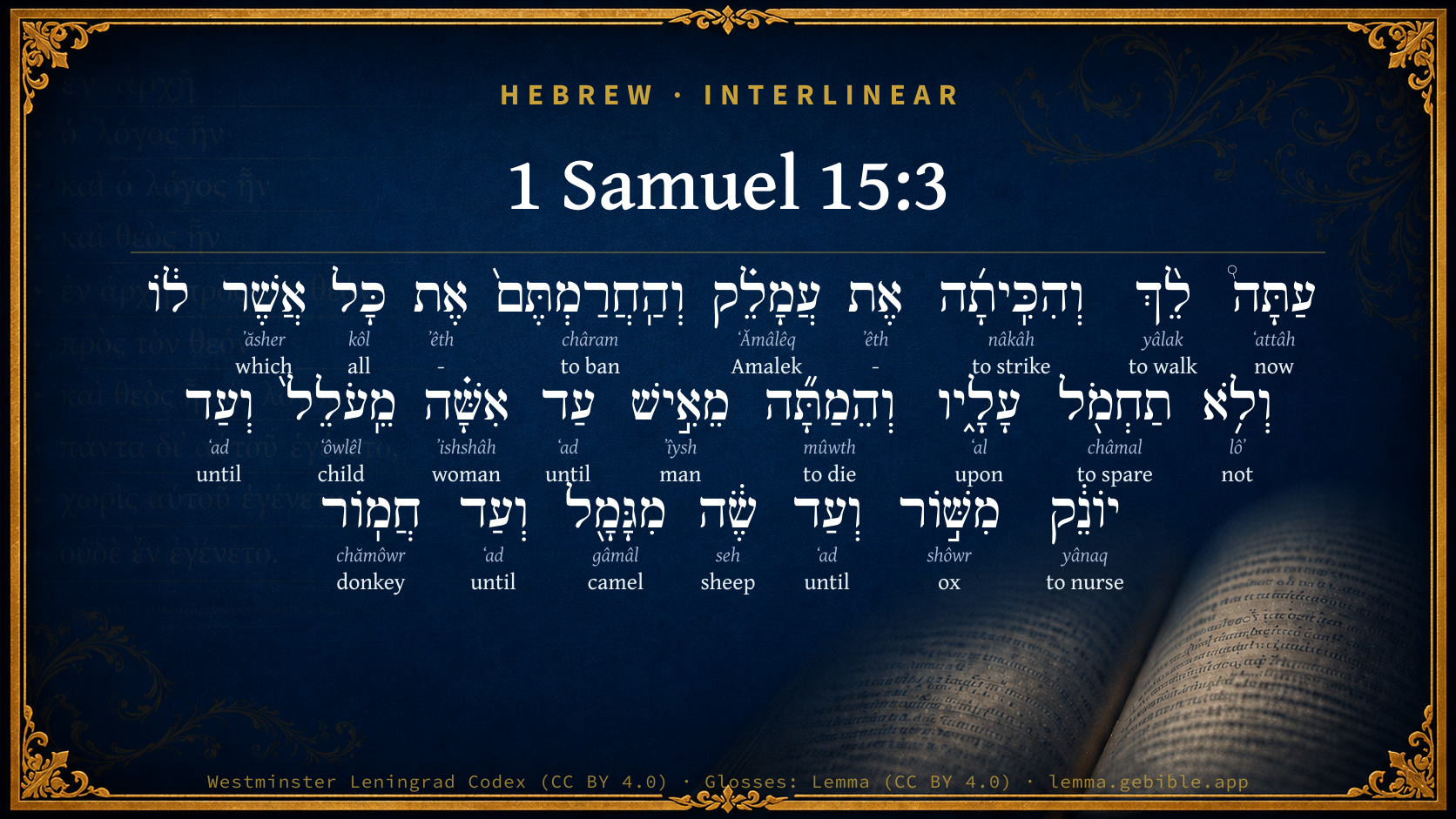
1 Samuel 15:3

Hebrew (Westminster Leningrad Codex) 1 Samuel 15:3 appears in the Hebrew Old Testament. The text above is from the Westminster Leningrad Codex. Each word links to its Strong’s number, a concise gloss, and parsing drawn from the Open Scriptures Hebrew Bible morphology. Click any word for its full Brown-Driver-Briggs (BDB) entry.
Download image
Cite this verse

1 Samuel 15:3 (World English Bible). Public Domain. Lemma interlinear Bible study tool, https://lemma.gebible.app/v/1-samuel/15/3.

Show BibTeX & RIS
BibTeX
RIS
English Translation
Now go and strike Amalek, and utterly destroy all that they have, and don't spare them; but kill both man and woman, infant and suckling, ox and sheep, camel and donkey.
World English Bible · Public Domain
Highlights Full analysis ↓
Download a study sheet

One document with this verse’s original text, its word-by-word gloss line, the meaning frame, cross-references with their text, attributed commentary, and full source and license credits — printable, and it pastes into notes with its structure intact.

This verse Autodidact and up

Study sheet (.html) Plain text (.txt)

A passage Seminary Student

Up to 50 verses in one chapter. A passage sheet keeps up to 6 commentary sources and 12 cross-references per verse, in the order this page ranks them, and says so on the sheet whenever that leaves anything out. Ask for a single verse and you get the Autodidact verse sheet above.

Everything on this page stays free to read, with no account — the sheet is a download of what is already on screen, not access to it.

Want to remove ads? Support Godless Engineer
Compare translations 3

The same verse in 3 English versions, stacked beneath the original-language interlinear above. Click any original word for its lexicon entry.

Each is an independent rendering of the whole verse — the interlinear is not word-aligned to these translations.

Highlighted words mark where these versions differ — a whole-verse word diff, not a word-by-word alignment.

  • World English Bible Public Domain
    Now go and strike Amalek, and utterly destroy all that they have, and don't spare them; but kill both man and woman, infant and suckling, ox and sheep, camel and donkey.
  • King James Version Public Domain
    Now go and smite Amalek, and utterly destroy all that they have, and spare them not; but slay both man and woman, infant and suckling, ox and sheep, camel and ass.
  • unfoldingWord Literal Text CC BY-SA 4.0
    Now go and strike Amalek and devote all that to him, and do not have compassion on him, but kill from man to woman, from child and to infant, from ox and to sheep, from camel and to donkey.’”

unfoldingWord Literal Text — © unfoldingWord, licensed CC BY-SA 4.0. Word-aligned USFM3 via Door43 (git.door43.org/unfoldingWord/en_ult).

Versions to compare (up to 4)

3 of 4 selected

Show all 18 translations

Every available English version of this verse, each an independent rendering of the whole verse.

  • World English Bible Public Domain
    Now go and strike Amalek, and utterly destroy all that they have, and don't spare them; but kill both man and woman, infant and suckling, ox and sheep, camel and donkey.
  • Berean Standard Bible Public Domain
    Now go and attack the Amalekites and devote to destruction all that belongs to them. Do not spare them, but put to death men and women, children and infants, oxen and sheep, camels and donkeys.’”
  • Majority Standard Bible Public Domain
    Now go and attack the Amalekites and devote to destruction all that belongs to them. Do not spare them, but put to death men and women, children and infants, oxen and sheep, camels and donkeys.’”
  • King James Version Public Domain
    Now go and smite Amalek, and utterly destroy all that they have, and spare them not; but slay both man and woman, infant and suckling, ox and sheep, camel and ass.
  • American Standard Version (1901) Public Domain
    Now go and smite Amalek, and utterly destroy all that they have, and spare them not; but slay both man and woman, infant and suckling, ox and sheep, camel and ass.
  • Revised Version (1885) Public Domain
    Now go and smite Amalek, and utterly destroy all that they have, and spare them not; but slay both man and woman, infant and suckling, ox and sheep, camel and ass.
  • Geneva Bible (1599) Public Domain
    Nowe therefore goe, and sinite Amalek, and destroy ye all that perteyneth vnto them, and haue no compassion on them, but slay both man and woman, both infant and suckling, both oxe, and sheepe, both camell, and asse.
  • Douay-Rheims (1899) Public Domain
    Now therefore go, and smite Amalec, and utterly destroy all that he hath: spare him not, nor covet any thing that is his: but slay both man and woman, child and suckling, ox and sheep, camel and ass.
  • Young's Literal Translation Public Domain
    Now, go, and thou hast smitten Amalek, and devoted all that it hath, and thou hast no pity on it, and hast put to death from man unto woman, from infant unto suckling, from ox unto sheep, from camel unto ass.'
  • Literal Standard Version CC BY-SA 4.0
    Now go, and you have struck Amalek, and devoted all that he has, and you have no pity on him, and have put to death from man to woman, from infant to suckling, from ox to sheep, from camel to donkey.”
  • Unlocked Literal Bible CC BY-SA 4.0
    Now go and attack Amalek and completely destroy all that they have. Do not spare them, but kill both man and woman, child and infant, ox and sheep, camel and donkey.'”
  • unfoldingWord Literal Text CC BY-SA 4.0
    Now go and strike Amalek and devote all that to him, and do not have compassion on him, but kill from man to woman, from child and to infant, from ox and to sheep, from camel and to donkey.’”
  • Darby Bible Public Domain
    Now go and smite Amalek, and destroy utterly all that they have, and spare them not, but slay both man and woman, infant and suckling, ox and sheep, camel and ass.
  • World Messianic Bible Public Domain
    Now go and strike Amalek, and utterly destroy all that they have, and don’t spare them; but kill both man and woman, infant and nursing baby, ox and sheep, camel and donkey.’”
  • Webster's Bible Public Domain
    Now go and smite Amalek, and utterly destroy all that they have, and spare them not; but slay both man and woman, infant and suckling, ox and sheep, camel and ass.
  • Free Bible Version CC BY-SA 4.0
    Go and attack the Amalekites and exterminate all of them. Don't spare anyone, but kill every man, woman, child, and baby; every ox, sheep, camel, and donkey.”
  • Bible in Basic English Public Domain
    Go now and put Amalek to the sword, putting to the curse all they have, without mercy: put to death every man and woman, every child and baby at the breast, every ox and sheep, camel and ass.
  • JPS Tanakh (1917) Public Domain
    Now go and smite Amalek, and utterly destroy all that they have, and spare them not; but slay both man and woman, infant and suckling, ox and sheep, camel and ass.'

Literal Standard Version (2020), Covenant Press — licensed CC BY-SA 4.0. Text via the HelloAO Bible API (eBible.org). Unlocked Literal Bible (unfoldingWord) — licensed CC BY-SA 4.0. Text via the HelloAO Bible API (eBible.org). unfoldingWord Literal Text — © unfoldingWord, licensed CC BY-SA 4.0. Word-aligned USFM3 via Door43 (git.door43.org/unfoldingWord/en_ult). Free Bible Version, Dr. Jonathan Gallagher — licensed CC BY-SA 4.0. Text via the HelloAO Bible API (eBible.org).

Word by word

More ways to search: Search by grammar → Find every occurrence → Compare this word →

Practice this passage: Drill this verse → Learn its vocabulary →

מֵֽעֹלֵל֙
ʻôwlêl
H5768
“from · child”
Preposition + Noun, Common, Masculine, Singular, Absolute
Part of Speech
Preposition + Noun
Type
Common
Gender
Masculine
Number
Singular
State
Absolute
Full BDB Definition

Origin: from H5763

TWOT: 1579c

child, boy
  1. עַתָּה֩ ʻattâh H6258 “now” Adverb
  2. לֵ֨ךְ yâlak H3212 “walk” Verb, Qal, Imperative, 2nd Person, Masculine, Singular
  3. וְהִכִּֽיתָ֜ה nâkâh H5221 “and · to strike” Conjunction + Verb, Hiphil, Sequential Perfect, 2nd Person, Masculine, Singular
  4. אֶת ʼêth H853 “-” Particle, Direct Object
  5. עֲמָלֵ֗ק ʻĂmâlêq H6002 “Amalek” Noun, Proper
  6. וְהַֽחֲרַמְתֶּם֙ châram H2763 “and · to ban” Conjunction + Verb, Hiphil, Sequential Perfect, 2nd Person, Masculine, Plural
  7. אֶת ʼêth H853 “-” Particle, Direct Object
  8. כָּל kôl H3605 “all of” Noun, Common, Masculine, Singular, Construct
  9. אֲשֶׁר ʼăsher H834 “which” Particle, Relative
  10. וְלֹ֥א lôʼ H3808 “and · not” Conjunction + Particle, Negative
  11. תַחְמֹ֖ל châmal H2550 “to spare” Verb, Qal, Imperfect, 2nd Person, Masculine, Singular
  12. עָלָ֑יו ʻal H5921 “upon · him” Preposition + Suffix, Personal, 3rd Person, Masculine, Singular
  13. וְהֵמַתָּ֞ה mûwth H4191 “and · to die” Conjunction + Verb, Hiphil, Sequential Perfect, 2nd Person, Masculine, Singular
  14. מֵאִ֣ישׁ ʼîysh H376 “from · man” Preposition + Noun, Common, Masculine, Singular, Absolute
  15. עַד ʻad H5704 “until” Preposition
  16. אִשָּׁ֗ה ʼishshâh H802 “woman” Noun, Common, Feminine, Singular, Absolute
  17. וְעַד ʻad H5704 “and · until” Conjunction + Preposition
  18. יוֹנֵ֔ק yânaq H3243 “nursing” Verb, Qal, Participle Active, Masculine, Singular, Absolute
  19. מִשּׁ֣וֹר shôwr H7794 “from · ox” Preposition + Noun, Common, Masculine, Singular, Absolute
  20. וְעַד ʻad H5704 “and · until” Conjunction + Preposition
  21. שֶׂ֔ה seh H7716 “sheep” Noun, Common, Both, Singular, Absolute
  22. מִגָּמָ֖ל gâmâl H1581 “from · camel” Preposition + Noun, Common, Masculine, Singular, Absolute
  23. וְעַד ʻad H5704 “and · until” Conjunction + Preposition
  24. חֲמֽוֹר chămôwr H2543 “donkey” Noun, Common, Both, Singular, Absolute

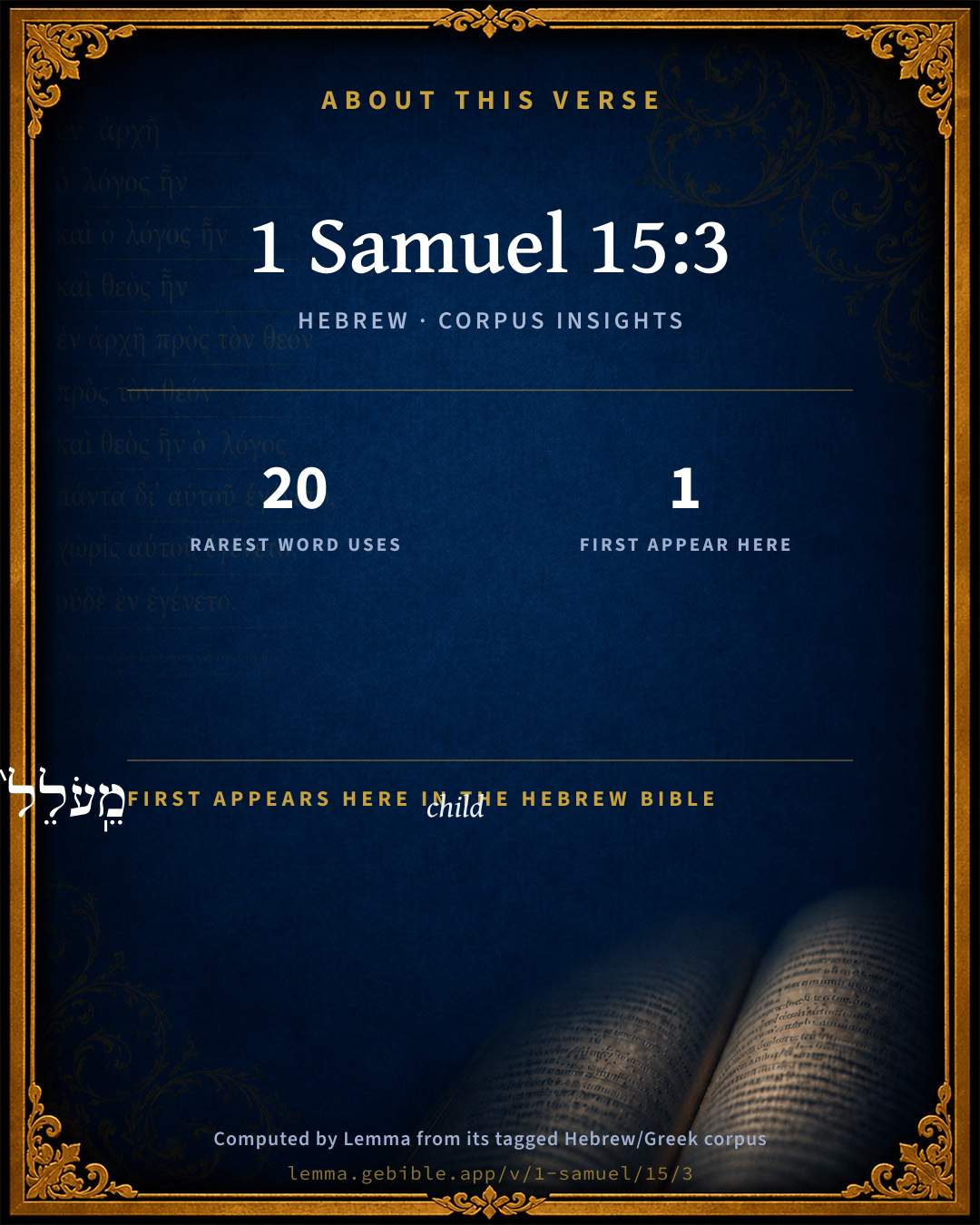
About this verse

These counts appear in no published source. They are computed here, from the morphology-tagged text and Lemma’s own curated glosses. What Lemma adds →

26
words
21
distinct lemmas
Historical
section

Notable vocabulary

The rarest word here is מֵֽעֹלֵל֙ child H5768 — appearing just 20 times in the whole Hebrew Bible.

First appearance in Scripture

This word makes its first canonical appearance in the Hebrew Bible here:

  • מֵֽעֹלֵל֙ child H5768

Shared distinctive vocabulary

מֵֽעֹלֵל֙ child H5768 occurs in 20 verses of the Hebrew Bible. Also found in:

Grammatical profile

  • 6 verbs
  • 9 nouns
  • 6 prepositions
  • 1 adverb
  • 4 particles

Verb forms

  • לֵ֨ךְ Qal · Imperative
  • וְהִכִּֽיתָ֜ה Hiphil · Sequential Perfect
  • וְהַֽחֲרַמְתֶּם֙ Hiphil · Sequential Perfect
  • תַחְמֹ֖ל Qal · Imperfect
  • וְהֵמַתָּ֞ה Hiphil · Sequential Perfect
  • יוֹנֵ֔ק Qal · Participle Active

Repetition

A word recurs within this verse — often emphatic in Hebrew:

Hebrew & Septuagint length

In English translation the verse runs 31 words from the Hebrew and 69 from the Septuagint (LXX English) — the Septuagint runs noticeably longer here. See the side-by-side →

A rough comparison of the two English renderings, which tokenize alike — not a word-level alignment.

Word counts can differ between the Hebrew and the Greek without any difference in meaning — e.g. the Hebrew direct-object marker אֵת has no separate Greek word, and Greek often adds the article ὁ.

Cross-references

11

Topical passages linked to 1 Samuel 15:3 in the Treasury of Scripture Knowledge — connected by theme and wording, ordered by reader-vote popularity; previews shown in the World English Bible.

  • Numbers 24:20 He looked at Amalek, and took up his parable, and said, Amalek was the first of the nations; But his latter end shall come to destruction.
  • Deuteronomy 20:16–18 But of the cities of these peoples, that Yahweh your God gives you for an inheritance, you shall save alive nothing that breathes;
  • Numbers 31:17 Now therefore kill every male among the little ones, and kill every woman who has known man by lying with him.
  • 1 Samuel 22:19 Nob, the city of the priests, struck he with the edge of the sword, both men and women, children and nursing babies, and oxen and donkeys and sheep, with the edge of the sword.
  • Isaiah 14:21–22 Prepare slaughter for his children for the iniquity of their fathers, that they not rise up, and possess the earth, and fill the surface of the world with cities.
  • Leviticus 27:28–29 "'Notwithstanding, no devoted thing, that a man shall devote to Yahweh of all that he has, whether of man or animal, or of the field of his possession, shall be sold or redeemed: every devoted thing is most holy to Yahweh.
  • Joshua 6:17–21 The city shall be devoted, even it and all that is therein, to Yahweh: only Rahab the prostitute shall live, she and all who are with her in the house, because she hid the messengers that we sent.
  • Genesis 3:17–18 To Adam he said, "Because you have listened to your wife's voice, and have eaten of the tree, of which I commanded you, saying, 'You shall not eat of it,' cursed is the ground for your sake. In toil you will eat of it all the days of your life.
  • Deuteronomy 13:15–16 you shall surely strike the inhabitants of that city with the edge of the sword, destroying it utterly, and all that is therein and the cattle of it, with the edge of the sword.
  • Romans 8:20–22 For the creation was subjected to vanity, not of its own will, but because of him who subjected it, in hope
  • Exodus 20:5 you shall not bow yourself down to them, nor serve them, for I, Yahweh your God, am a jealous God, visiting the iniquity of the fathers on the children, on the third and on the fourth generation of those who hate me,

Cross-references courtesy of OpenBible.info (CC BY 4.0).

Hebrew and Greek witnesses Masoretic Hebrew ↔ Greek Septuagint

The same verse in the two great witnesses to the Old Testament, shown verse-for-verse.

Here the Septuagint runs noticeably longer than the Hebrew — LXX2012 (modern English Septuagint) 69 words vs World English Bible 31. A rough length comparison of the two English translations, not a word-level alignment — read both below.

These are two independent witnesses, not word-aligned to each other, and the Septuagint is shown in lemma (dictionary) form.

Hebrew 1 Samuel 15:3 Masoretic · Westminster Leningrad Codex

עַתָּה֩ לֵ֨ךְ וְהִכִּֽיתָ֜ה אֶת עֲמָלֵ֗ק וְהַֽחֲרַמְתֶּם֙ אֶת כָּל אֲשֶׁר ל֔וֹ וְלֹ֥א תַחְמֹ֖ל עָלָ֑יו וְהֵמַתָּ֞ה מֵאִ֣ישׁ עַד אִשָּׁ֗ה מֵֽעֹלֵל֙ וְעַד יוֹנֵ֔ק מִשּׁ֣וֹר וְעַד שֶׂ֔ה מִגָּמָ֖ל וְעַד חֲמֽוֹר

Now go and strike Amalek, and utterly destroy all that they have, and don't spare them; but kill both man and woman, infant and suckling, ox and sheep, camel and donkey.

World English Bible · Public Domain

Greek LXX 1 Samuel 15:3 Septuagint · lemma form

καί νῦν πορεύομαι καί πατάσσω ὁ αμαληκ καί ιεριμ καί πᾶς ὁ αὐτός καί οὐ περιποιέω ἐκ αὐτός καί ἐκὀλεθρεύω αὐτός καί ἀναθεματίζω αὐτός καί πᾶς ὁ αὐτός καί οὐ φείδομαι ἀπό αὐτός καί ἀποκτείνω ἀπό ἀνήρ καί ἕως γυνή καί ἀπό νήπιος ἕως θηλάζω καί ἀπό μόσχος ἕως πρόβατον καί ἀπό κάμηλος ἕως ὄνος

And now go, and you shall strike Amalec and Hierim and all that belongs to him, and you shall not save anything of him alive, but you shall utterly destroy him: and you shall devote him and all his to destruction, and you shall spare nothing belonging to him; and you shall kill both man and woman, and infant and suckling, and calf and sheep, and camel and ass.

LXX2012 (modern English Septuagint) · Public Domain

Hebrew: Westminster Leningrad Codex (CC BY 4.0). Greek: Septuagint (public domain); English from LXX2012 (modern English Septuagint) (Public Domain). How the Septuagint differs from the Hebrew →

Targum (Aramaic paraphrase)

1

The Targum is the ancient Jewish Aramaic paraphrase of the Hebrew Scriptures — an interpretive translation, not the Hebrew text itself. Onkelos (literal) and Pseudo-Jonathan (expansive) render the Torah, and Jonathan the Prophets. Coverage is partial: where no permissively-licensed English translation exists for a verse, only the Aramaic is shown. This is verse-level text, not a word-by-word alignment to the Hebrew.

  1. Targum Jonathan Prophets (Joshua–Malachi)
    וּכְעַן אֱזִיל וְתִמְחֵי יַת דְבֵית עֲמָלֵק וּתְגַמַר יַת כָּל דִי לְהוֹן וְלָא תְחוּס עֲלֵיהוֹן וְתִקְטוֹל מִגְבַר עַד אִתְּתָא מֵעוּלֵים וְעַד יָנִיק מִתּוֹר וְעַד אִימַר מִגָמָל וְעַד חֲמָר:

    (no public-domain English translation for this verse)

    Targum Jonathan — Aramaic: “Mikraot Gedolot” (public domain). English: “Sefaria Community Translation” (CC0 1.0 (public-domain dedication)); “London "Chaldee Paraphrase," 1871” (public domain). Text via Sefaria.

Commentary

Notes on 1 Samuel 15:3 from classic Christian and Jewish commentators (each source and its license shown beneath its notes). The classic Christian expositions comment on the surrounding passage and are grouped to its opening verse, so a note may address several verses; the Jewish commentaries on the Tanakh (Rashi and others) are per-verse, so they appear only where the commentator wrote on this verse.

Lemma curates 59 commentaries, every one of them public domain or Creative Commons licensed, each selected and text-cleaned for this edition rather than reprinted as found. About our sources →

Trapp's Complete Commentary

John Trapp

1Sa 15:3 Now go and smite Amalek, and utterly destroy all that they have, and spare them not; but slay both man and woman, infant and suckling, ox and sheep, camel and ass.

Ver. 3. Now go and smite Amalek.] This God had twice threatened; {Exo 17:14 Deu 25:17} Ut ostenderet quam ex animo et omnino id vellet fieri. {a} The greater was Saul’s offence, in executing it so slackly.

And utterly destroy all that they have.] Oh the severity of God! Oh the venomous nature of sin! How evil and bitter a thing is it! {Jer 2:1-37} Aliorum perditio, tua sit cautio. Amalek, for molesting God’s Israel, is thus utterly destroyed. The Kenites, for showing them kindness, are graciously preserved.

{a} A. Lapide.

John Trapp, A Commentary or Exposition upon All the Books of the Old and New Testament (1647–1656) — public domain. Text from a community e-Sword module.

Joseph Benson's Commentary

1Sa 15:3. Go and smite Amalek, and utterly destroy all that they have, &c. — This heavy sentence was pronounced against them long before, (Exo 17:14,) and renewed at the Israelites’ entrance into Canaan, with a charge not to forget it, (Deu 25:19,) and now ordered to be put in execution. Slay both man and woman, infant and suckling — We are to consider these orders of God, given in Scripture, for the slaying the innocent with the guilty, even children and sucklings, who could have done no harm, in the same light as we do a plague or earthquake, or any other of God’s judgments in the earth, whereby the guiltless are cut off with the guilty; the reason of which, perhaps, may be, that the guilty, in such calamities, are more grievously afflicted and punished, by the cutting off their harmless children, than they would be by any thing that could befall themselves. And God can, and certainly does, crown elsewhere the innocent with happiness, great enough to reward them amply for the evils that fall upon them here. And, without doubt, every infant, however much its death may be lamented by its parents, receives a great favour and blessing from God by having death bestowed upon it in its infancy; as it is taken away from all the miseries of this life, in order to be made perfectly and eternally happy.

The reason, perhaps, of God’s ordering the beasts to be all killed, upon this and some other occasions of this sort, was, that the neighbouring nations might know that these terrible executions of the Israelites upon some particular nations, did not proceed from any views of profit or interest to themselves, but were done in obedience to the commands of the Lord of all, to punish those whose iniquity was full. For, had the Israelites been allowed to spare the cattle (which were then the chief riches of the nations) on these occasions, they would have appeared rather as the murderers of these people, for the sake of their riches, than the ministers of God’s wrath, to punish nations whose abominations made them ripe for destruction.

Joseph Benson's Commentary on the Old and New Testaments (1811–1818) — public domain. Text from a community e-Sword module.

Tyndale Open Study Notes

Tyndale Open Resources

15:3 completely destroy: See “Complete Dedication” Theme Note.

Tyndale Open Study Notes — © Tyndale Open Resources, licensed CC BY-SA 4.0. Text via the HelloAO Bible API.

Geneva Bible (1599)

Geneva Bible translators

That this might be an example of God’s vengeance against them that deal cruelly with his people.

Geneva Bible (1599) marginal notes — public domain. Text via Bolls.life.

Adam Clarke's Commentary

Verse 3. Slay both man and woman] Nothing could justify such an exterminating decree but the absolute authority of God. This was given: all the reasons of it we do not know; but this we know well, The Judge of all the earth doth right. This war was not for plunder, for God commanded that all the property as well as all the people should be destroyed.

Adam Clarke's Commentary on the Bible (1810–1826) — public domain. Text from a community e-Sword/MySword module.

Ellicott's Commentary for English Readers

(3) Smite Amalek, and utterly destroy . . .—For “utterly destroy” the Hebrew has the far stronger expression, “put under the ban” (cherem). Whatever was “put under the ban” in Israel was devoted to God, and whatever was so devoted could not be redeemed, but must be slain. Amalek was to be looked upon as accursed; human beings and cattle must be killed; whatever was capable of being destroyed by fire must be burnt. The cup of iniquity in this people was filled up. Its national existence, if prolonged, would simply have worked mischief to the commonwealth of nations. Israel here was simply the instrument of destruction used by the Almighty. It is vain to attempt in this and similar transactions to find materials for the blame or the praise of Israel. We must never forget that Israel stood in a peculiar relation to the unseen King, and that this nation was not unfrequently used as the visible scourge by which the All-Wise punished hopelessly hardened sinners, and deprived them of the power of working mischief. We might as well find fault with pestilence and famine, or the sword—those awful instruments of Divine justice and—though we often fail to see it now—of Divine mercy.

A Bible Commentary for English Readers, edited by Charles John Ellicott (1878–1897) — public domain. Text from a community e-Sword module.

The Cambridge Bible for Schools and Colleges

gen. ed. J. J. S. Perowne

3. utterly destroy all that they have] The word translated “utterly destroy” means “to ban,” or “to devote,” and hence since that which was cherem or “devoted” might not be taken as spoil, it comes to signify “utterly destroy.” See Lev_27:28-29; Jos_6:17 ff. The word is used in Samuel only in this chapter.

On the “moral difficulty” involved in this command see Note V. p. 240.

The Cambridge Bible for Schools and Colleges (gen. ed. J. J. S. Perowne; Cambridge University Press, 1878–1918) — public domain. Text from a community e-Sword module.

John Gill's Exposition

Now go and smite Amalek,.... This was one of the three things the Israelites were obliged to do when they came into the land of Canaan, as Kimchi observes; one was, to appoint a king over them, another, to build the house of the sanctuary, and the third, to blot out the name and memory of Amalek, see Deu 25:19 and this work was reserved for Saul, their first king:

and utterly destroy all that they have, and spare them not; all were to be devoted to destruction, and nothing remain to be made use of in any way, to any profit and advantage; living creatures were to be put to death, and everything else burnt and destroyed:

but slay both men and women, infant and suckling; neither sex nor age were to be regarded, no mercy and pity shown to any; they had shown none to Israel when weak and feeble, and by the law of retaliation none was to be exercised on them:

ox and sheep, camel and ass; though useful creatures, yet not to be spared; as not men, women, and children, through commiseration, so neither these through covetousness, and neither of them on any pretence whatsoever. Children suffered for their parents, and cattle because of their owners, and both were a punishment to their proprietors; an ox, or any other creature, might not be spared, lest it should be said, as Kimchi observes, this was the spoil of Amalek, and so the name and memory of Amalek would not be blotted out.

John Gill's Exposition of the Whole Bible (1746–1763) — public domain (CC PDM 1.0). Text via the HelloAO Bible API.

Albert Barnes' Notes on the Bible

Utterly destroy - Rather, “devote to destruction” (Lev 27:28 note). When a city or people were thus made cherem, everything living was to be destroyed, and no part of the spoil fall to the conquerors (compare 1Sa 15:21). The valuables were put into the sacred treasury.

Albert Barnes' Notes on the Bible (1834–1885) — public domain. Text from a community e-Sword/MySword module.

Haydock's Catholic Bible Commentary

Destroy, as a thing accursed. (Haydock) --- Child. The great master of life and death (who cuts off one half of mankind whilst they are children) has been pleased sometimes to ordain that children should be put to the sword, in detestation of the crimes of their parents, and that they might not live to follow the same wicked ways. But without such ordinance of God, it is not allowable in any wars, how just soever, to kill children. (Challoner) --- The Israelites were now to execute God’s orders with blind obedience, as he cannot be guilty of injustice. --- Nor covet....his, is omitted in Hebrew, &c. (Calmet) --- Amalec is stricken when the flesh is chastised---He is destroyed when we repress evil thoughts. (St. Gregory) (Worthington)

George Leo Haydock (1774–1849), Haydock's Catholic Family Bible and Commentary, 1859 edition — public domain. Excludes Psalms (Douay-Rheims chapter numbering differs from Protestant) and Deuterocanonical books (Catholic canon only).

Matthew Poole's English Annotations

All that they have, both persons and goods; kill all that live, and consume all things without life; for I will have no name nor remnant of that people, whom long since I have cursed and devoted to utter destruction.

Spare them not; show no compassion or favour to any of them. The same thing repeated to prevent mistake, and oblige Saul to the exact performance hereof; or, to leave him without excuse, in case of neglect.

Infant and suckling; for their parents’ crime and punishment; which was not unjust, because God is the supreme Lord and giver of life, and can require his own when he pleaseth; infants also are born in sin, Psa 51:5, and therefore liable to God’s wrath, Eph 2:3, and to death, Rom 5:12,14. Their death also was rather a mercy than a curse to them, as being the occasion of preventing the vast increase of their sin and punishment.

Ox and sheep, camel and ass; which being all made for man’s benefit, it is not strange nor unjust if they suffer with him, and for him and for the instruction of mankind.

Matthew Poole's English Annotations on the Holy Bible (1683–1685) — public domain. Text from a community e-Sword/MySword module.

Whedon's Commentary on the Bible

Daniel D. Whedon

3. Man and woman, infant and suckling — Who dares question the right of God to inflict such judgments upon a wicked and idolatrous nation? Jehovah is governor among the nations, and in order to chastise and destroy a wicked people he may with equal justice use the wasting pestilence or the armies of Israel. See note on Jos_6:21.

Ox and sheep, camel and ass — Such utter destruction of all the spoil would show that the Israelites fought not to enrich themselves with the possessions of their enemies, but simply as the ministers of God’s wrath to execute his judgments. Saul’s sparing of the best of the spoils was, therefore, a rash and offensive meddling with the Divine judgments. Like Achan’s offence, it was appropriating a part of the accursed thing to private use.

Daniel D. Whedon (gen. ed.), Commentary on the Old and New Testaments (1874–1909) — public domain. Text from a community e-Sword module.

The Pulpit Commentary

Utterly destroy. Hebrew, "put under the ban." The word herem, ban, properly signifies a thing set apart, especially one devoted to God; and whatever was so devoted could not be redeemed, but must be slain. When a country was put under the ban, all living things, men and cattle, were to be killed; no spoil might be taken, but it was to be burnt, and things indestructible by fire, as silver and gold, were to be brought into the treasury. Everything, in short, belonging to such a nation was looked upon as accursed. (see Num_21:2, Num_21:3)

The Pulpit Commentary (1880–1919), ed. H.D.M. Spence-Jones & Joseph S. Exell — public domain. Text from a community e-Sword module.

John Wesley's Explanatory Notes

Destroy - Both persons and goods, kill all that live, and consume all things without life, for I will have no name nor remnant of that people left, whom long since I have devoted to utter destruction. Spare not - Shew no compassion or favour to any of them. The same thing repeated to prevent mistake, and oblige Saul to the exact performance hereof. Slay, &c. - Which was not unjust, because God is the supreme Lord of life, and can require his own when he pleaseth; infants likewise are born in sin, and therefore liable to God's wrath. Their death also was rather a mercy than a curse, as being the occasion of preventing their sin and punishment. Ox, &c. - Which being all made for man's benefit, it is not strange if they suffer with him, for the instruction of mankind.

John Wesley, Explanatory Notes Upon the Whole Bible (1754–1765) — public domain. Text via the GEBible commentary corpus.

Rashi

Rabbi Shlomo Yitzchaki (Rashi)

Oxen and sheep. They were sorcerers, and they would change themselves to appear as animals.

Rashi on the Tanakh — English translations: “The Judaica Press complete Tanach with Rashi, translated by A. J. Rosenberg” (CC BY 4.0); “Pentateuch with Rashi's commentary by M. Rosenbaum and A.M. Silbermann, 1929-1934” (public domain); “The Metsudah Tanach series, Lakewood, N.J” (CC BY 4.0); and “The Book of Joshua, Metsudah Publications, 1997” (CC BY 4.0). Text via Sefaria.

Lesson kit

Teaching starters — assembled from the data on this page, not authored interpretation. Every prompt links to the verse data it draws on. Edit before teaching.

1 Samuel, in the Historical, opens this verse with 26 words (21 distinct Hebrew lemmas). Its most distinctive word is ʻôwlêl (“child”). The Greek Septuagint runs longer here. A historical commentator’s framing appears above. Read the whole chapter for the surrounding context.

Discussion questions

  1. What does “child” (ʻôwlêl) contribute to the verse as a whole?
  2. This is the first place “child” appears in Scripture (first appears here). What does its debut here establish?
  3. How does 1 Samuel 22:19, which shares the word «child», read alongside this verse?
  4. What does the repetition of “until” (4× in this one verse) do in this verse?
  5. The Septuagint runs longer here than the Hebrew. What might account for the difference?
  6. These translations render this verse differently; the difference is in the English rendering, not the original. What questions does that raise?
  7. «לֵ֨ךְ» is a Qal Imperative verb. How does that grammatical form shape the action described?
  8. Compare how Trapp's Complete Commentary and Joseph Benson's Commentary read this verse. Where do they agree or differ?

Things to notice

  • 1 word makes its first canonical appearance in Scripture here.
  • These translations choose different wording for 17 words in this verse.
  • “until” occurs 4× in this single verse.
  • 21 distinct Hebrew lemmas span 26 words in this verse.

Reading settings

Reading text

Shown beneath each verse's original-language words.

Old Testament
Old Testament edition

Read the OT as the Masoretic Hebrew (MT) or the Greek Septuagint (LXX).

English shown for the Greek Septuagint (in the Hebrew ↔ Greek comparison).

Comparing translations? Open the Compare panel on any verse page to stack up to four side by side.