1 Kings 17:24

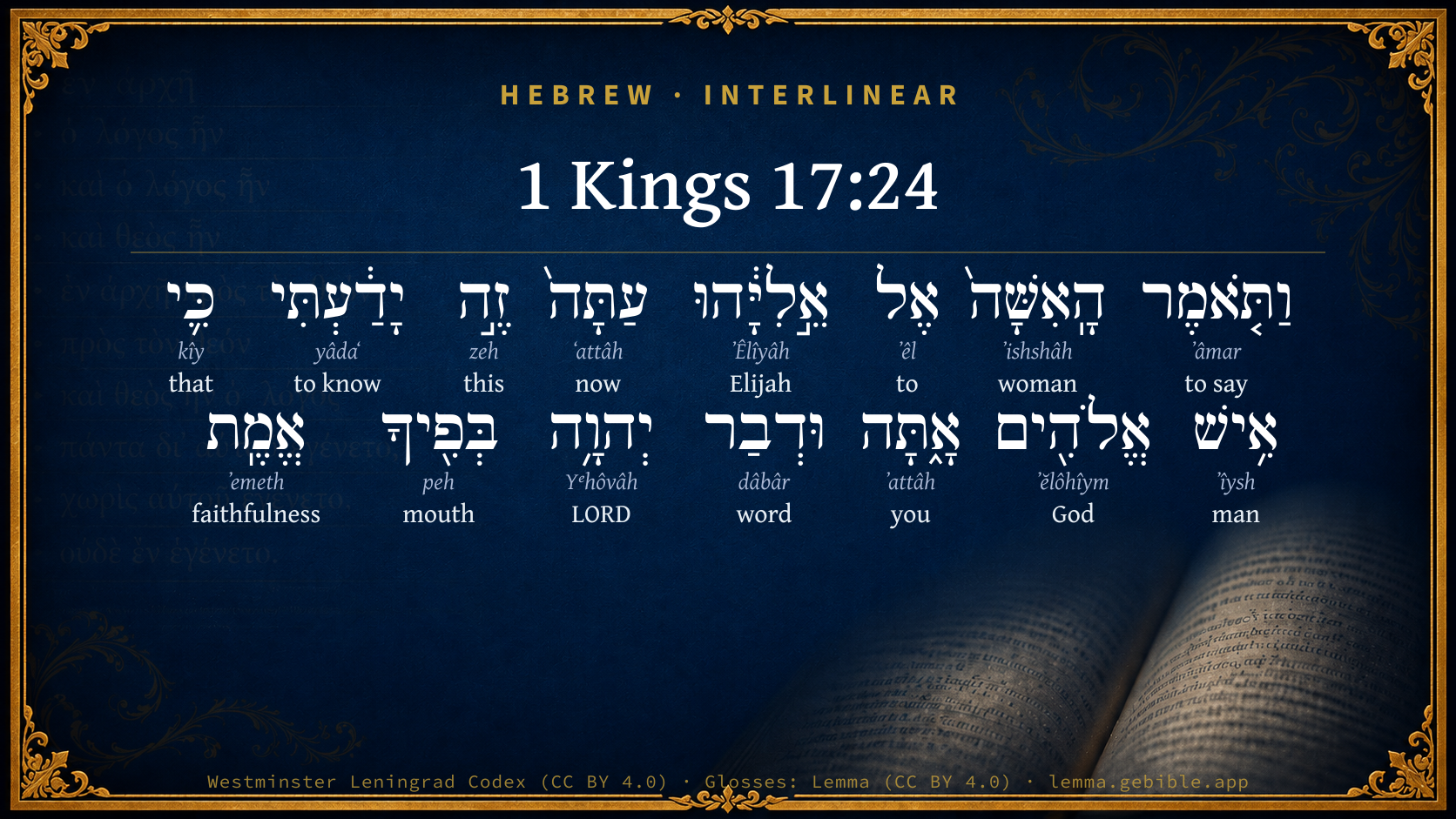
Hebrew (Westminster Leningrad Codex) 1 Kings 17:24 appears in the Hebrew Old Testament. The text above is from the Westminster Leningrad Codex. Each word links to its Strong’s number, a concise gloss, and parsing drawn from the Open Scriptures Hebrew Bible morphology. Click any word for its full Brown-Driver-Briggs (BDB) entry.
Download image
Cite this verse

1 Kings 17:24 (World English Bible). Public Domain. Lemma interlinear Bible study tool, https://lemma.gebible.app/v/1-kings/17/24.

Show BibTeX & RIS
BibTeX
RIS
English Translation
The woman said to Elijah, Now I know that you are a man of God, and that the word of Yahweh in your mouth is truth.
World English Bible · Public Domain
Download a study sheet

One document with this verse’s original text, its word-by-word gloss line, the meaning frame, cross-references with their text, attributed commentary, and full source and license credits — printable, and it pastes into notes with its structure intact.

This verse Autodidact and up

Study sheet (.html) Plain text (.txt)

A passage Seminary Student

Up to 50 verses in one chapter. A passage sheet keeps up to 6 commentary sources and 12 cross-references per verse, in the order this page ranks them, and says so on the sheet whenever that leaves anything out. Ask for a single verse and you get the Autodidact verse sheet above.

Everything on this page stays free to read, with no account — the sheet is a download of what is already on screen, not access to it.

Want to remove ads? Support Godless Engineer
Compare translations 3

The same verse in 3 English versions, stacked beneath the original-language interlinear above. Click any original word for its lexicon entry.

Each is an independent rendering of the whole verse — the interlinear is not word-aligned to these translations.

Highlighted words mark where these versions differ — a whole-verse word diff, not a word-by-word alignment.

  • World English Bible Public Domain
    The woman said to Elijah, Now I know that you are a man of God, and that the word of Yahweh in your mouth is truth.
  • King James Version Public Domain
    And the woman said to Elijah, Now by this I know that thou art a man of God, and that the word of the LORD in thy mouth is truth.
  • unfoldingWord Literal Text CC BY-SA 4.0
    And the woman said to Elijah, “Now I know this, that you a man of God and the word of Yahweh in your mouth truth.”

unfoldingWord Literal Text — © unfoldingWord, licensed CC BY-SA 4.0. Word-aligned USFM3 via Door43 (git.door43.org/unfoldingWord/en_ult).

Versions to compare (up to 4)

3 of 4 selected

Show all 18 translations

Every available English version of this verse, each an independent rendering of the whole verse.

  • World English Bible Public Domain
    The woman said to Elijah, Now I know that you are a man of God, and that the word of Yahweh in your mouth is truth.
  • Berean Standard Bible Public Domain
    Then the woman said to Elijah, “Now I know that you are a man of God and that the word of the LORD from your mouth is truth.”
  • Majority Standard Bible Public Domain
    Then the woman said to Elijah, “Now I know that you are a man of God and that the word of the LORD from your mouth is truth.”
  • King James Version Public Domain
    And the woman said to Elijah, Now by this I know that thou art a man of God, and that the word of the LORD in thy mouth is truth.
  • American Standard Version (1901) Public Domain
    And the woman said to Elijah, Now I know that thou art a man of God, and that the word of Jehovah in thy mouth is truth.
  • Revised Version (1885) Public Domain
    And the woman said to Elijah, Now I know that thou art a man of God, and that the word of the LORD in thy mouth is truth.
  • Geneva Bible (1599) Public Domain
    And the woman saide vnto Eliiah, Now I knowe that thou art a man of God, and that the worde of the Lord in thy mouth is true.
  • Douay-Rheims (1899) Public Domain
    And the woman said to Elias: Now, by this I know that thou art a man of God, and the word of the Lord in thy mouth is true.
  • Young's Literal Translation Public Domain
    And the woman saith unto Elijah, `Now, this I have known, that a man of God thou `art', and the word of Jehovah in thy mouth `is' truth.'
  • Literal Standard Version CC BY-SA 4.0
    And the woman says to Elijah, “Now [by] this I have known that you [are] a man of God, and the word of YHWH in your mouth [is] truth.”
  • Unlocked Literal Bible CC BY-SA 4.0
    The woman said to Elijah, “Now I know that you are a man of God, and that the word of Yahweh in your mouth is true.”
  • unfoldingWord Literal Text CC BY-SA 4.0
    And the woman said to Elijah, “Now I know this, that you a man of God and the word of Yahweh in your mouth truth.”
  • Darby Bible Public Domain
    And the woman said to Elijah, Now by this I know that thou art a man of God, and that the word of Jehovah in thy mouth is truth.
  • World Messianic Bible Public Domain
    The woman said to Elijah, “Now I know that you are a man of God, and that the LORD’s word in your mouth is truth.”
  • Webster's Bible Public Domain
    And the woman said to Elijah, Now by this I know that thou art a man of God, and that the word of the LORD in thy mouth is truth.
  • Free Bible Version CC BY-SA 4.0
    “Now I'm convinced that you are a man of God, and that what the Lord speaks through you is the truth,” the woman replied.
  • Bible in Basic English Public Domain
    Then the woman said to Elijah, Now I am certain that you are a man of God, and that the word of the Lord in your mouth is true.
  • JPS Tanakh (1917) Public Domain
    And the woman said to Elijah: 'Now I know that thou art a man of God, and that the word of the LORD in thy mouth is truth.'

Literal Standard Version (2020), Covenant Press — licensed CC BY-SA 4.0. Text via the HelloAO Bible API (eBible.org). Unlocked Literal Bible (unfoldingWord) — licensed CC BY-SA 4.0. Text via the HelloAO Bible API (eBible.org). unfoldingWord Literal Text — © unfoldingWord, licensed CC BY-SA 4.0. Word-aligned USFM3 via Door43 (git.door43.org/unfoldingWord/en_ult). Free Bible Version, Dr. Jonathan Gallagher — licensed CC BY-SA 4.0. Text via the HelloAO Bible API (eBible.org).

Word by word

More ways to search: Search by grammar → Find every occurrence → Compare this word →

Practice this passage: Drill this verse → Learn its vocabulary →

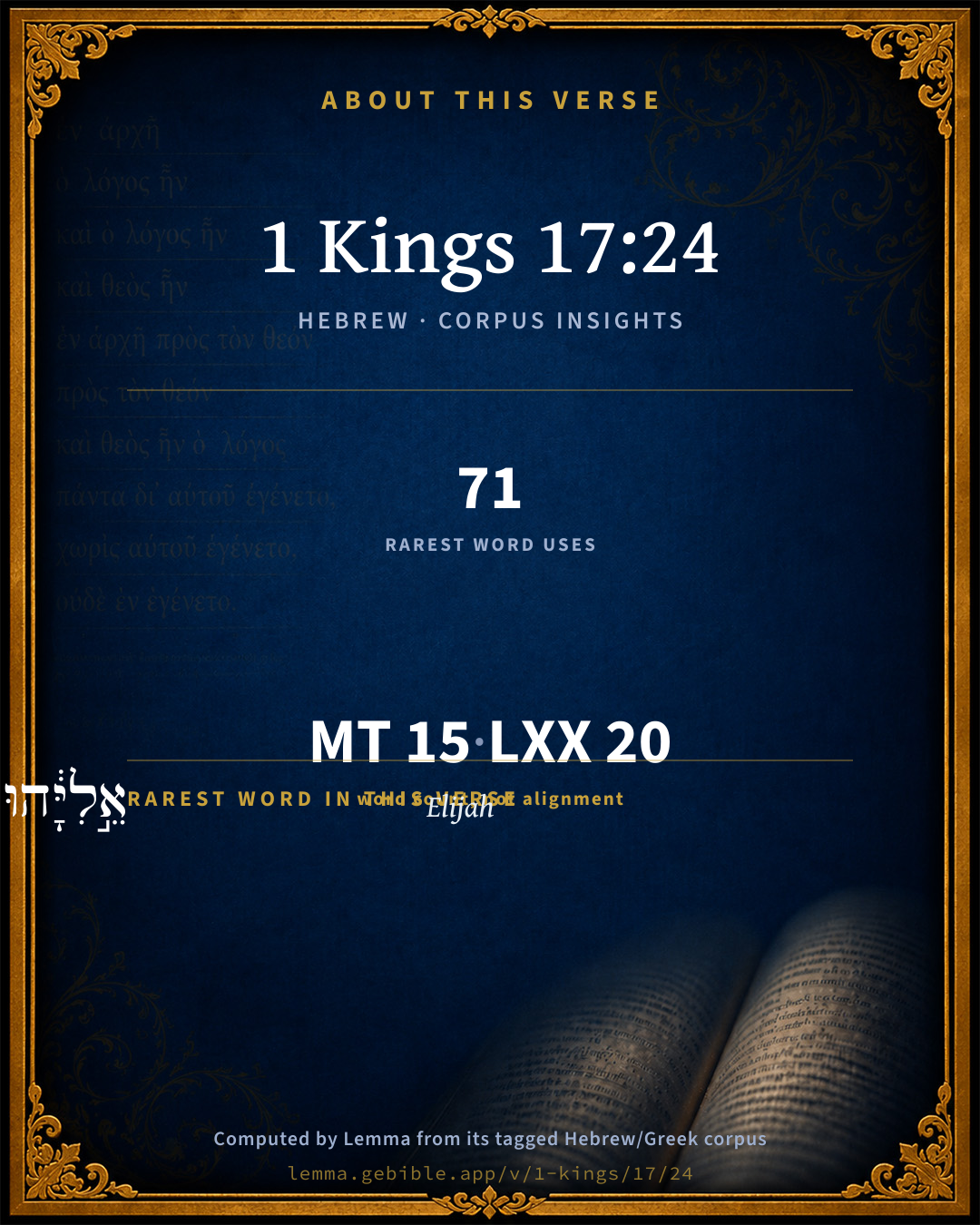
אֵ֣לִיָּ֔הוּ
ʼÊlîyâh
H452
“Elijah”
Noun, Proper
Part of Speech
Noun
Type
Proper
Full BDB Definition

Origin: from H410 and H3050

TWOT: None

Elijah or Eliah = "my God is Jehovah" or " Yah(u) is God" - the great prophet of the reign of Ahab - Benjamite son of Jeroham - a son of Elam with foreign wife during exile - a son of Harim, and priest, with foreign wife during exile
  1. וַתֹּ֤אמֶר ʼâmar H559 “and · to say” Conjunction + Verb, Qal, Sequential Imperfect, 3rd Person, Feminine, Singular
  2. הָֽאִשָּׁה֙ ʼishshâh H802 “the · woman” Particle, Definite Article + Noun, Common, Feminine, Singular, Absolute
  3. אֶל ʼêl H413 “to” Preposition
  4. עַתָּה֙ ʻattâh H6258 “now” Adverb
  5. זֶ֣ה zeh H2088 “this” Pronoun, Demonstrative, Masculine, Singular
  6. יָדַ֔עְתִּי yâdaʻ H3045 “to know” Verb, Qal, Perfect, 1st Person, Common, Singular
  7. כִּ֛י kîy H3588 “that” Conjunction
  8. אִ֥ישׁ ʼîysh H376 “man of” Noun, Common, Masculine, Singular, Construct
  9. אֱלֹהִ֖ים ʼĕlôhîym H430 “God(s)” Noun, Common, Masculine, Plural, Absolute
  10. אָ֑תָּה ʼattâh H859 “you” Pronoun, Personal, 2nd Person, Masculine, Singular
  11. וּדְבַר dâbâr H1697 “and · word of” Conjunction + Noun, Common, Masculine, Singular, Construct
  12. יְהוָ֥ה Yᵉhôvâh H3068 “LORD” Noun, Proper
  13. בְּפִ֖יךָ peh H6310 “in/at · mouth · your” Preposition + Noun, Common, Masculine, Singular, Construct + Suffix, Personal, 2nd Person, Masculine, Singular
  14. אֱמֶֽת ʼemeth H571 “faithfulness” Noun, Common, Feminine, Singular, Absolute

About this verse

These counts appear in no published source. They are computed here, from the morphology-tagged text and Lemma’s own curated glosses. What Lemma adds →

15
words
15
distinct lemmas
Historical
section

Grammatical profile

  • 2 verbs
  • 8 nouns
  • 2 pronouns
  • 1 preposition
  • 1 conjunction
  • 1 adverb

Verb forms

  • וַתֹּ֤אמֶר Qal · Sequential Imperfect
  • יָדַ֔עְתִּי Qal · Perfect

Hebrew & Septuagint length

In English translation the verse runs 26 words from the Hebrew and 27 from the Septuagint (LXX English) — closely comparable.

A rough comparison of the two English renderings, which tokenize alike — not a word-level alignment.

Word counts can differ between the Hebrew and the Greek without any difference in meaning — e.g. the Hebrew direct-object marker אֵת has no separate Greek word, and Greek often adds the article ὁ.

In the original languages it is 15 Hebrew tokens and 20 Greek tokens — but the two are counted differently (Hebrew bundles its prefixes and suffixes into one token; the Greek is in lemma form), so that isn’t a like-for-like length.

Cross-references

10

Topical passages linked to 1 Kings 17:24 in the Treasury of Scripture Knowledge — connected by theme and wording, ordered by reader-vote popularity; previews shown in the World English Bible.

  • John 16:30 Now we know that you know all things, and don't need for anyone to question you. By this we believe that you came forth from God."
  • John 2:11 This beginning of his signs Jesus did in Cana of Galilee, and revealed his glory; and his disciples believed in him.
  • John 3:2 The same came to him by night, and said to him, "Rabbi, we know that you are a teacher come from God, for no one can do these signs that you do, unless God is with him."
  • John 4:42–48 They said to the woman, "Now we believe, not because of your speaking; for we have heard for ourselves, and know that this is indeed the Christ, the Savior of the world."
  • 1 Thessalonians 2:13 For this cause we also thank God without ceasing, that, when you received from us the word of the message of God, you accepted it not as the word of men, but, as it is in truth, the word of God, which also works in you who believe.
  • 1 John 2:21 I have not written to you because you don't know the truth, but because you know it, and because no lie is of the truth.
  • Ecclesiastes 12:10 The Preacher sought to find out acceptable words, and that which was written blamelessly, words of truth.
  • John 11:15 I am glad for your sakes that I was not there, so that you may believe. Nevertheless, let's go to him."
  • John 11:42 I know that you always listen to me, but because of the multitude that stands around I said this, that they may believe that you sent me."
  • John 15:24 If I hadn't done among them the works which no one else did, they wouldn't have had sin. But now have they seen and also hated both me and my Father.

Cross-references courtesy of OpenBible.info (CC BY 4.0).

Hebrew and Greek witnesses Masoretic Hebrew ↔ Greek Septuagint

The same verse in the two great witnesses to the Old Testament, shown verse-for-verse.

These are two independent witnesses, not word-aligned to each other, and the Septuagint is shown in lemma (dictionary) form.

Hebrew 1 Kings 17:24 Masoretic · Westminster Leningrad Codex

וַתֹּ֤אמֶר הָֽאִשָּׁה֙ אֶל אֵ֣לִיָּ֔הוּ עַתָּה֙ זֶ֣ה יָדַ֔עְתִּי כִּ֛י אִ֥ישׁ אֱלֹהִ֖ים אָ֑תָּה וּדְבַר יְהוָ֥ה בְּפִ֖יךָ אֱמֶֽת

The woman said to Elijah, Now I know that you are a man of God, and that the word of Yahweh in your mouth is truth.

World English Bible · Public Domain

Greek LXX 1 Kings 17:24 Septuagint · lemma form

καί εἶπον ὁ γυνή πρός ηλιου ἰδού γιγνώσκω ὅτι ἄνθρωπος θεός εἰμί σύ καί ῥῆμα κύριος ἐν στόμα σύ ἀληθινός

And the woman said to Eliu, Behold, I know that you are a man of God, and the word of the Lord in your mouth is true.

LXX2012 (modern English Septuagint) · Public Domain

Hebrew: Westminster Leningrad Codex (CC BY 4.0). Greek: Septuagint (public domain); English from LXX2012 (modern English Septuagint) (Public Domain). How the Septuagint differs from the Hebrew →

Targum (Aramaic paraphrase)

1

The Targum is the ancient Jewish Aramaic paraphrase of the Hebrew Scriptures — an interpretive translation, not the Hebrew text itself. Onkelos (literal) and Pseudo-Jonathan (expansive) render the Torah, and Jonathan the Prophets. Coverage is partial: where no permissively-licensed English translation exists for a verse, only the Aramaic is shown. This is verse-level text, not a word-by-word alignment to the Hebrew.

  1. Targum Jonathan Prophets (Joshua–Malachi)
    וַאֲמַרַת אִתְּתָא לְאֵלִיָהוּ כְּעַן דֵין יְדַעְנָא אֲרֵי נְבִיָא דַייָ אַתְּ וּפִתְגָמָא דַייָ בְּפוּמָךְ אִינוּן קְשׁוֹט:

    (no public-domain English translation for this verse)

    Targum Jonathan — Aramaic: “Mikraot Gedolot” (public domain). English: “Sefaria Community Translation” (CC0 1.0 (public-domain dedication)); “London "Chaldee Paraphrase," 1871” (public domain). Text via Sefaria.

Commentary

Notes on 1 Kings 17:24 from classic Christian and Jewish commentators (each source and its license shown beneath its notes). The classic Christian expositions comment on the surrounding passage and are grouped to its opening verse, so a note may address several verses; the Jewish commentaries on the Tanakh (Rashi and others) are per-verse, so they appear only where the commentator wrote on this verse.

Lemma curates 59 commentaries, every one of them public domain or Creative Commons licensed, each selected and text-cleaned for this edition rather than reprinted as found. About our sources →

Trapp's Complete Commentary

John Trapp

1Ki 17:24 And the woman said to Elijah, Now by this I know that thou [art] a man of God, [and] that the word of the LORD in thy mouth [is] truth.

Ver. 24. Now by this I know.] I am better assured of that which also I knew and believed before. So Joh 6:69; "we believe and are sure."

John Trapp, A Commentary or Exposition upon All the Books of the Old and New Testament (1647–1656) — public domain. Text from a community e-Sword module.

The Biblical Illustrator

Joseph S. Exell

1Ki_17:24

I know that thou art a man of God.

Elijah

1. From whom does the testimonial come? I know. These are the words of the heathen villager, a poor widow, living in an out-of-the-way place, probably as ignorant as she was poor. Possibly she had heard nothing of the controversy about Baal, and knew nothing of Elijahs great work; yet she it is who sets up as a judge in the matter. I know. Quite so. Everybody is a judge of goodness. Like love, for which goodness is only another name, it is a thing which everybody can see and know and honour. There is no ignorance in the matter of goodness.

(1) It is a testimonial from one of another religion. She was a heathen, belonging to another nation. She had her own notions of things, and held them as tenaciously as Elijah held to his religion. To her his belief and worship might be all unmeaning, possibly at first a matter of ridicule, even of scorn. Yet she cannot withhold her hearty confession, full of admiration, almost of envy--I know that thou art a man of God. Goodness is greater than sects and more than names. Let the world see the goodness, and they do not care what church that man goes to; whether he uses a prayer book or not matters to nobody, or whether he is led up to service by a peal of bells or a big drum. I know, said she. How much there was she did not know about the man. She had never seen him as the prophet of fire; had probably never heard how he had gone into the presence of the king and queen, and before all the priests of Baal, and the assembled hosts of Israel, and spoken the word of the Lord. Goodness is like love again in this, and like God whose name is Love, it is everywhere and in everything.

(2) That this testimony comes from the right place. I know, said this good woman of Zarephath. I think if anybody had questioned her right to an opinion she would have quickly silenced them. The man lived in my house. I ought to know. There is nobody in the land who has seen more of him than I have, and I know that he is a man of God. You may accept that testimony. Depend upon it, if those at home do not believe in us, the less profession we make elsewhere the better. Our certificates of church membership are signed by the minister; it were well if they were countersigned at home.

2. Let us look at the character: a man of God. It is a grand title--the grandest ever conferred on any man. Let us think that day after day the character of each of us is being built up for eternity. The spirit and aim of the life is making more fixed and defined that which we shall be for ever. Let every one of us ask himself, Am I a man, a woman, of God? Whatever else we are, all must be a failure if we are not that. Whatever else we are, the best and highest life is ours only if we have surrendered ourselves to the love and service of God.

(1) The man of God is much more than merely a religious person. There were many such, I doubt not, in those times; as there are in these. Listen to this one: It is a mistake, he says quite angrily--I knew it would be, and I said so all along--this religion of Jezebels is all very well for the people of Phoenicia where she comes from; but it is not natural to bring it down here. It does not suit our soil. Here is another religious person. But hush--please do not speak so loud. Yes, he trusts that he is a true worshipper certainly--in heart, you know, in heart--and that is everything; isnt it? But please dont mention it--he would rather that it was not known. Just now the times are really very trying, very; and it is difficult to know how to act for the best. To offend the queen would be so very damaging to ones prospects; and really Jezebel is so passionate that she would stop at nothing. Altogether it is very difficult to be what one would. So I do just go up to Jezreel and bow before Baal--only go through the form, you know, for the sake of peace; but at the heart I am, of course, a true Israelite. We know that man too. You may call him by very few names that are not too good. He certainly is no man of God.

(2) A man of God! Make room for Elijah. A man who is given up to God; who lives to know Gods will and to do it through and through him with all his might. Wherever that man goes, all know and feel that the God of Israel liveth. Think of the land from which God Himself is shut out: His voice is not heard; His authority is ignored; His worship is neglected. But here is one in whom God comes again into the very midst of men. That is ever the man of God--he brings a new light, by which things are seen aright: a new standard by which men do correct their estimate of things. Right and wrong are no mere names, but stand out sharply and severed from one another by a gulf like that which separates heaven from hell. Look at England in the last century, and at the transformation that was wrought from end to end of the land through the preaching of the Wesleys and Whitefield. Here and there, in town and village, some one got converted, and became a man or woman of God. Then there entered into the place a new light, a new conscience, a new authority. But many are children of God who do not become men of God. Feed upon the word; dwell in communion with God; exercise yourself day by day in His service. Set yourself every day in His strength to serve Him at any cost, and put yourself at His disposal; check and test yourself by the thought of His will. Push out after higher things; live in this spirit and exercise it in faithfulness to God and service to men: then shall this high joy and dignity be ours--we shall come to be enrolled amongst the men of God. (M. G. Pearse.)

Charged with blessing

Touch the hand of a man who is being thrilled by a galvanic battery, and you will feel the shock. So, if we are charged with Holy Ghost power, those who come into contact with us will soon discover it. There is more connection with the name and character of Barnabas than appears. The man filled with the Spirit became a son of consolation to others.

The Biblical Illustrator, edited by Joseph S. Exell (c. 1880s–1900s) — public domain. Text from a community e-Sword module.

Geneva Bible (1599)

Geneva Bible translators

So hard a thing it is to depend on God, except we be confirmed by miracles.

Geneva Bible (1599) marginal notes — public domain. Text via Bolls.life.

Adam Clarke's Commentary

Verse 24. The word of the Lord in thy mouth is truth.] Three grand effects were produced by this temporary affliction:

1. The woman was led to examine her heart, and try her ways;

2. The power of God became highly manifest in the resurrection of the child;

3. She was convinced that the word of the Lord was truth, and that not one syllable of it could fall to the ground.

Through a little suffering all this good was obtained.

THE subject in the fourth verse of this chapter deserves a more particular consideration.

I have commanded the ravens to feed thee. - It is contended that if we consider ערבים orebim to signify ravens, we shall find any interpretation on this ground to be clogged with difficulties. I need mention but a few. The raven is an unclean bird, And these ye shall have in abomination among the fowls - every raven after his kind; Le 11:13-15; that is, every species of this genus shall be considered by you unclean and abominable. Is it therefore likely that God would employ this most unclean bird to feed his prophet? Besides, where could the ravens get any flesh that was not unclean? Carrion is their food; and would God send any thing of this kind to his prophet? Again: If the flesh was clean which God sent, where could ravens get it? Here must be at least three miracles: one to bring from some table the flesh to the ravens; another, to induce the ravenous bird to give it up; and the third, to conquer its timidity towards man, so that it could come to the prophet without fear. Now, although God might employ a fowl that would naturally strive to prey on the flesh, and oblige it, contrary to its nature, to give it up; yet it is by no means likely that he would employ a bird that his own law had pronounced abominable. Again, he could not have employed this means without working a variety of miracles at the same time, in order to accomplish one simple end; and this is never God's method: his plan is ever to accomplish the greatest purposes by the simplest means.

The original word orebim has been considered by some as meaning merchants, persons occasionally trading through that country, whom God directed, by inspiration, to supply the prophet with food. To get a constant supply from such hands in an extraordinary way was miracle enough; it showed the superintendence of God, and that the hearts of all men are in his hands.

But in answer to this it is said, that the "original word never signifies merchants; and that the learned Bochart has proved this." I have carefully read over cap. 13, part. ii., lib. 2, of the Hierozoicon of this author, where he discusses this subject; and think that he has never succeeded less than in his attempt to prove that ravens are meant in this passage. He allows that the Tyrian merchants are described by this periphrasis, ערבי מערבך, the occupiers of thy merchandise, Eze 27:27; and asserts that ערבים orebim, per se, mercatores nusquam significat, "by itself, never signifies merchants." Now, with perfect deference to so great an authority, I assert that ערבי oreby, the contracted form of ערבים orebim, does signify merchants, both in Eze 27:9 and Eze 27:27, and that מערב maarab signifies a place for merchandise, the market - place or bazaar, in Eze 27:9; Eze 27:13; Eze 27:17; Eze 27:19; as also the goods sold in such places, Eze 27:33; and therefore that ערבים for aught proved to the contrary, signify merchants in the text.

As to Bochart's objection, that, the prophet being ordered to go to the brook Cherith, that he might lie hid, and the place of his retreat not be known, if any traders or merchants supplied his wants, they would most likely discover where he was, c., I think there is no weight in it for the men might be as well bound by the secret inspiration of God not to discover the place of his retreat, as they were to supply his wants; besides, they might have been of the number of those seven thousand men who had not bowed their knees to the image of Baal, and consequently would not inform Ahab and Jezebel of their prophet's hiding place.

Some have supposed that the original means Arabians; but Bochart contends that there were no Arabians in that district: this is certainly more than he or any other man can prove. Colonies of Arabs, and hordes and families of the same people, have been widely scattered over different places for the purpose of temporal sojournment and trade; for they were a wandering people, and often to be found in different districts remote enough from the place of their birth. But, letting this pass merely for what it is worth, and feeling as I do the weight of the objections that may be brought against the supposition of ravens being the agents employed to feed the prophet, I would observe that there was a town or city of the name of Orbo, that was not far from the place where Elijah was commanded to hide himself. In Bereshith Rabba, a rabbinical comment on Genesis, we have these words עיר היא בתחום ביתשאן ושמה ערבו ir hi bithchom Beithshean, veshemo Orbo; "There is a town in the vicinity of Beth-shan, (Scythopolis,) and its name is Orbo." We may add to this from St. Jerome, Orbim, accolae villae in finibus Arabum, Eliae dederunt alimenta; "The Orbim, inhabitants of a town in the confines of the Arabs, gave nourishment to Elijah." Now, I consider Jerome's testimony to be of great worth, because he spent several years in the holy land, that he might acquire the most correct notion possible of the language and geography of the country, as well as of the customs and habits of the people, in order to his translating the sacred writings, and explaining them. Had there not been such a place in his time, he could not have written as above: and although in this place the common printed editions of the Vulgate have corvi, "crows or ravens;" yet in 2Ch 21:16, St. Jerome translates the same word ערבים, "the Arabians;" and the same in Ne 4:7; it is therefore most likely that the inhabitants of Oreb or Orbo, as mentioned above, furnished the aliment by which the prophet was sustained; and that they did this being specially moved thereto by the Spirit of the Lord. Add to all these testimonies that of the Arabic version, which considers the words as meaning a people, [Arabic] Orabim, and not ravens or fowls of any kind. In such a case this version is high authority.

It is contended that those who think the miracle is lost if the ravens be not admitted, are bound to show,

1. With what propriety the raven, an unclean animal, could be employed?

2. Why the dove, or some such clean creature, was not preferred?

3. How the ravens could get properly dressed flesh to bring to the prophet?

4. From whose table it was taken; and by what means?

5. Whether it be consistent with the wisdom of God, and his general conduct, to work a tissue of miracles where one was sufficient?

6. And whether it be not best, in all cases of this kind, to adopt that mode of interpretation which is most simple; the wisdom, goodness, and providence of God being as equally apparent as in those cases where a multitude of miracles are resorted to in order to solve difficulties?

Adam Clarke's Commentary on the Bible (1810–1826) — public domain. Text from a community e-Sword/MySword module.

Ellicott's Commentary for English Readers

(24) Now by this I know . . .—In these words we trace the final victory of faith, brought out by the crowning mercy of the restoration of her son. First, the widow had spoken of Jehovah from without, as “the Lord thy God” (1Ki_17:14); next, had come to recognise Him as God (1Ki_17:18); now she not only believes, as she had never believed before, that His servant is “a man of God”; but, in accepting the “word of Jehovah” in his mouth as “the truth,” seems undoubtedly to express conversion to Him. (Compare the stages of faith in the nobleman at Capernaum, Joh_4:47; Joh_4:50; Joh_4:53.)

A Bible Commentary for English Readers, edited by Charles John Ellicott (1878–1897) — public domain. Text from a community e-Sword module.

The Cambridge Bible for Schools and Colleges

gen. ed. J. J. S. Perowne

24. Now by this] R.V. omits the last two words. The italics of A.V. shew that there is nothing in the Hebrew for ‘by,’ and the word rendered ‘this’ is only a particle to strengthen the adverb ‘now.’ The same two words are rendered in A.V. by ‘now’ simply in Rth_2:7 and should be so translated here. In 2Ki_5:22 they are translated ‘even now.’

I know that thou art a man of God] She had so addressed him above in 1Ki_17:18, but what she desires now to express is her firm assurance. The mercy of her son’s restoration spake more surely of God’s messenger than did the stroke of his death. Jewish tradition represents this boy as the servant who afterwards accompanied Elijah, and finally became the prophet Jonah. (See Jerome, Preface to Jonah.)

the word of the Lord in thy mouth is truth] This is more than to say that the word which the prophet speaks is truth; or than that the word of the Lord is in his mouth. It expresses a conviction that the Lord Jehovah in whose name Elijah speaks is the true God. Whatever stage her religious belief had before reached, she now advances beyond it, and acknowledges Jehovah as truth itself.

The Cambridge Bible for Schools and Colleges (gen. ed. J. J. S. Perowne; Cambridge University Press, 1878–1918) — public domain. Text from a community e-Sword module.

Haydock's Catholic Bible Commentary

True. She saw the force of miracles; (Haydock) and now was, at least, thoroughly converted. (Salien)

George Leo Haydock (1774–1849), Haydock's Catholic Family Bible and Commentary, 1859 edition — public domain. Excludes Psalms (Douay-Rheims chapter numbering differs from Protestant) and Deuterocanonical books (Catholic canon only).

Matthew Poole's English Annotations

Now by this I know; now I am assured of that concerning which I began upon this sad occasion to doubt.

That the word of the Lord in thy mouth is truth; that the God whom thou professest is the true God, and the doctrine and religion which thou teachest is the only true religion; and therefore henceforth I wholly renounce the worship of idols.

Matthew Poole's English Annotations on the Holy Bible (1683–1685) — public domain. Text from a community e-Sword/MySword module.

The Pulpit Commentary

And the woman said to Elijah, Now by this Heb. this. Gesenius interprets hz hT just now. Similarly Bahr, nunmehr I know that thou art a man of God not that she had doubted it before. See ver. 18. In the face of what Elijah had done for her, she could not doubt it. Allthat she means is that this is a great fresh proof of his mission, and that the word of the Lord in thy mouth is truth. This last word tm,a" from which Amittai (Jon_1:1) is formed, perhaps gave rise to the tradition that this boy was afterwards known as the prophet Jonah. Amiitai was held to have been this widow"s husband.

The Pulpit Commentary (1880–1919), ed. H.D.M. Spence-Jones & Joseph S. Exell — public domain. Text from a community e-Sword module.

Lesson kit

Teaching starters — assembled from the data on this page, not authored interpretation. Every prompt links to the verse data it draws on. Edit before teaching.

1 Kings, in the Historical, opens this verse with 15 words (15 distinct Hebrew lemmas). Its most distinctive word is ʼÊlîyâh (“Elijah”). A historical commentator’s framing appears above. Read the whole chapter for the surrounding context.

Discussion questions

  1. What does “Elijah” (ʼÊlîyâh) contribute to the verse as a whole?
  2. How does John 16:30, which shares this passage’s theme, read alongside this verse?
  3. The translations on this page render this verse differently — a whole-verse word diff, not a word-by-word alignment. What might account for the different wordings?
  4. «וַתֹּ֤אמֶר» is a Qal Sequential Imperfect verb. How does that grammatical form shape the action described?
  5. Compare how Trapp's Complete Commentary and The Biblical Illustrator read this verse. Where do they agree or differ?

Things to notice

Reading settings

Reading text

Shown beneath each verse's original-language words.

Old Testament
Old Testament edition

Read the OT as the Masoretic Hebrew (MT) or the Greek Septuagint (LXX).

English shown for the Greek Septuagint (in the Hebrew ↔ Greek comparison).

Comparing translations? Open the Compare panel on any verse page to stack up to four side by side.