
Isaiah 29:22

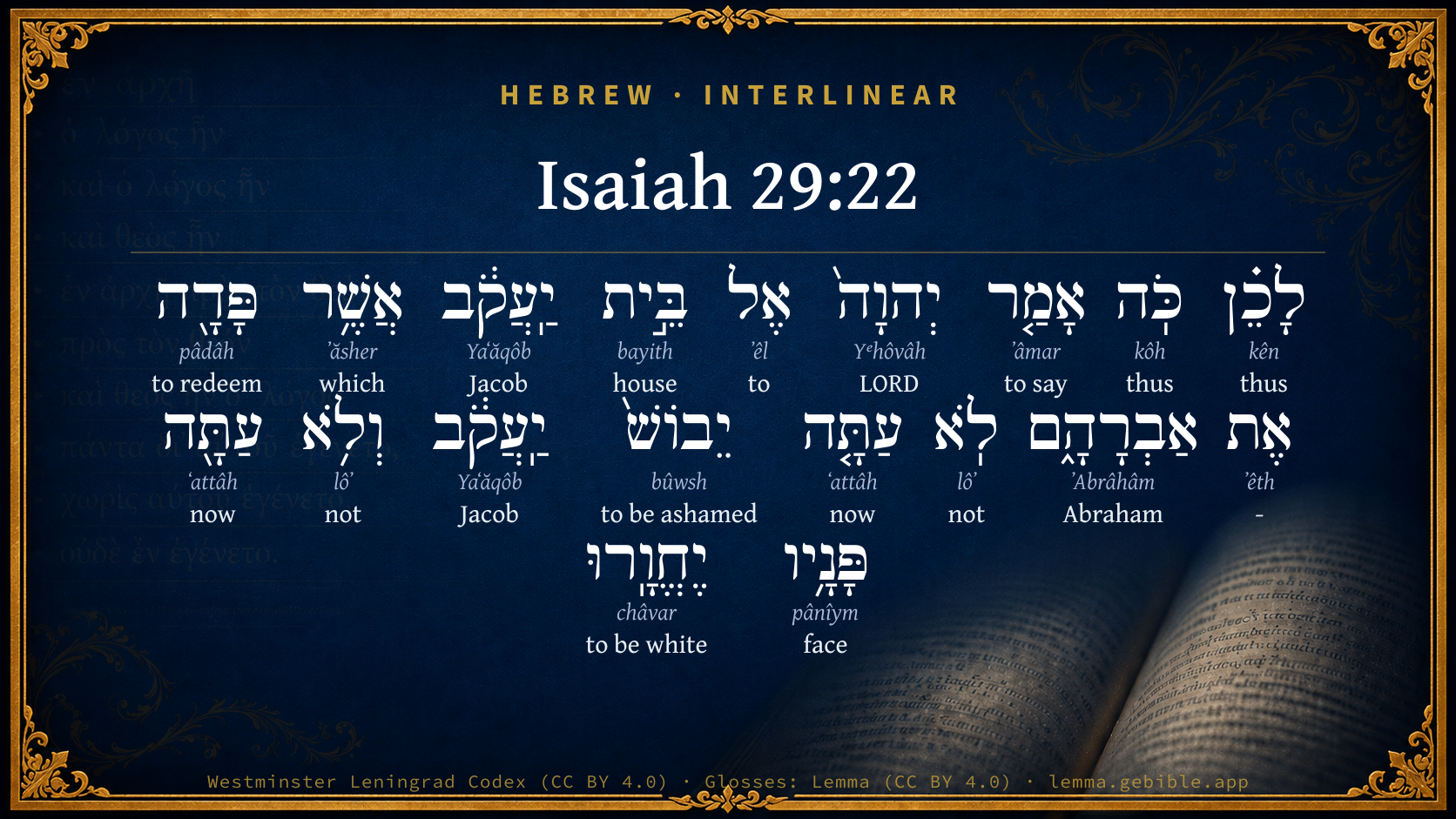
Hebrew (Westminster Leningrad Codex) Isaiah 29:22 appears in the Hebrew Old Testament. The text above is from the Westminster Leningrad Codex. Each word links to its Strong’s number, a concise gloss, and parsing drawn from the Open Scriptures Hebrew Bible morphology. Click any word for its full Brown-Driver-Briggs (BDB) entry.
Download image
Cite this verse

Isaiah 29:22 (World English Bible). Public Domain. Lemma interlinear Bible study tool, https://lemma.gebible.app/v/isaiah/29/22.

Show BibTeX & RIS
BibTeX
RIS
English Translation
Therefore thus says Yahweh, who redeemed Abraham, concerning the house of Jacob: Jacob shall not now be ashamed, neither shall his face now wax pale.
World English Bible · Public Domain
Highlights
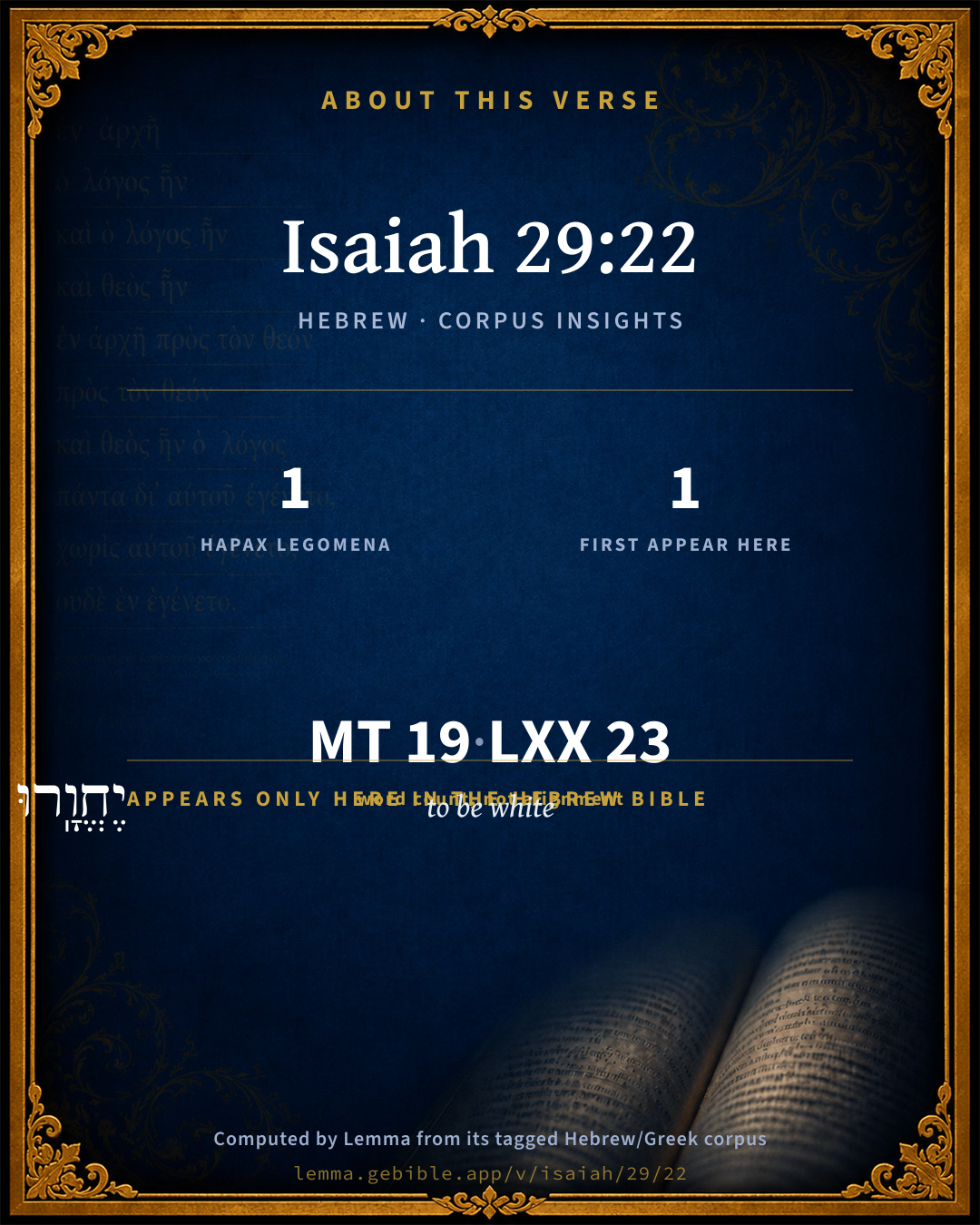
  • 1 hapax legomenon — only here in the Hebrew Bible
  • 1 first appearance in the Hebrew Bible
Full analysis ↓
Download a study sheet

One document with this verse’s original text, its word-by-word gloss line, the meaning frame, cross-references with their text, attributed commentary, and full source and license credits — printable, and it pastes into notes with its structure intact.

This verse Autodidact and up

Study sheet (.html) Plain text (.txt)

A passage Seminary Student

Up to 50 verses in one chapter. A passage sheet keeps up to 6 commentary sources and 12 cross-references per verse, in the order this page ranks them, and says so on the sheet whenever that leaves anything out. Ask for a single verse and you get the Autodidact verse sheet above.

Everything on this page stays free to read, with no account — the sheet is a download of what is already on screen, not access to it.

Want to remove ads? Support Godless Engineer
Compare translations 3

The same verse in 3 English versions, stacked beneath the original-language interlinear above. Click any original word for its lexicon entry.

Each is an independent rendering of the whole verse — the interlinear is not word-aligned to these translations.

Highlighted words mark where these versions differ — a whole-verse word diff, not a word-by-word alignment.

  • World English Bible Public Domain
    Therefore thus says Yahweh, who redeemed Abraham, concerning the house of Jacob: Jacob shall not now be ashamed, neither shall his face now wax pale.
  • King James Version Public Domain
    Therefore thus saith the LORD, who redeemed Abraham, concerning the house of Jacob, Jacob shall not now be ashamed, neither shall his face now wax pale.
  • unfoldingWord Literal Text CC BY-SA 4.0
    Therefore, thus says Yahweh, who redeemed Abraham, to the house of Jacob: “Now let Jacob not have shame, and now let not his face become pale.

unfoldingWord Literal Text — © unfoldingWord, licensed CC BY-SA 4.0. Word-aligned USFM3 via Door43 (git.door43.org/unfoldingWord/en_ult).

Versions to compare (up to 4)

3 of 4 selected

Show all 18 translations

Every available English version of this verse, each an independent rendering of the whole verse.

  • World English Bible Public Domain
    Therefore thus says Yahweh, who redeemed Abraham, concerning the house of Jacob: Jacob shall not now be ashamed, neither shall his face now wax pale.
  • Berean Standard Bible Public Domain
    Therefore the LORD who redeemed Abraham says of the house of Jacob: “No longer will Jacob be ashamed and no more will his face grow pale.
  • Majority Standard Bible Public Domain
    Therefore the LORD who redeemed Abraham says of the house of Jacob: “No longer will Jacob be ashamed and no more will his face grow pale.
  • King James Version Public Domain
    Therefore thus saith the LORD, who redeemed Abraham, concerning the house of Jacob, Jacob shall not now be ashamed, neither shall his face now wax pale.
  • American Standard Version (1901) Public Domain
    Therefore thus saith Jehovah, who redeemed Abraham, concerning the house of Jacob: Jacob shall not now be ashamed, neither shall his face now wax pale.
  • Revised Version (1885) Public Domain
    Therefore thus saith the LORD, who redeemed Abraham, concerning the house of Jacob: Jacob shall not now be ashamed, neither shall his face now wax pale.
  • Geneva Bible (1599) Public Domain
    Therefore thus sayth the Lord vnto the house of Iaakob, euen hee that redeemed Abraham, Iaakob shall not now be confounded, neither now shall his face be pale.
  • Douay-Rheims (1899) Public Domain
    Therefore thus saith the Lord to the house of Jacob, he that redeemed Abraham: Jacob shall not now be confounded, neither shall his countenance now be ashamed:
  • Young's Literal Translation Public Domain
    Therefore, thus said Jehovah, Who ransomed Abraham, Concerning the house of Jacob: `Not now ashamed is Jacob, Nor now doth his face become pale,
  • Literal Standard Version CC BY-SA 4.0
    Therefore, thus said YHWH, || Who ransomed Abraham, || Concerning the house of Jacob: “Jacob is not ashamed now, || Nor does his face now become pale,
  • Unlocked Literal Bible CC BY-SA 4.0
    Therefore this is what Yahweh says concerning the house of Jacob—Yahweh, who redeemed Abraham, “Jacob will no longer be ashamed, nor will his face be pale.
  • unfoldingWord Literal Text CC BY-SA 4.0
    Therefore, thus says Yahweh, who redeemed Abraham, to the house of Jacob: “Now let Jacob not have shame, and now let not his face become pale.
  • Darby Bible Public Domain
    Therefore thus saith Jehovah who redeemed Abraham, concerning the house of Jacob: Jacob shall not now be ashamed, neither shall his face now be pale;
  • World Messianic Bible Public Domain
    Therefore the LORD, who redeemed Abraham, says concerning the house of Jacob: “Jacob shall no longer be ashamed, neither shall his face grow pale.
  • Webster's Bible Public Domain
    Therefore thus saith the LORD, who redeemed Abraham, concerning the house of Jacob, Jacob shall not now be ashamed, neither shall his face now become pale.
  • Free Bible Version CC BY-SA 4.0
    So this is what the Lord, who redeemed Abraham, says to the descendants of Jacob: “You don't need to be ashamed anymore; your faces won't grow pale with fright any longer.
  • Bible in Basic English Public Domain
    For this reason the Lord, the saviour of Abraham, says about the family of Jacob, Jacob will not now be put to shame, or his face be clouded with fear.
  • JPS Tanakh (1917) Public Domain
    Therefore thus saith the LORD, who redeemed Abraham, concerning the house of Jacob: Jacob shall not now be ashamed, neither shall his face now wax pale;

Literal Standard Version (2020), Covenant Press — licensed CC BY-SA 4.0. Text via the HelloAO Bible API (eBible.org). Unlocked Literal Bible (unfoldingWord) — licensed CC BY-SA 4.0. Text via the HelloAO Bible API (eBible.org). unfoldingWord Literal Text — © unfoldingWord, licensed CC BY-SA 4.0. Word-aligned USFM3 via Door43 (git.door43.org/unfoldingWord/en_ult). Free Bible Version, Dr. Jonathan Gallagher — licensed CC BY-SA 4.0. Text via the HelloAO Bible API (eBible.org).

Word by word

More ways to search: Search by grammar → Find every occurrence → Compare this word →

Practice this passage: Drill this verse → Learn its vocabulary →

יֶחֱוָֽרוּ
châvar
H2357
“to be white”
Verb, Qal, Imperfect, 3rd Person, Masculine, Plural
Part of Speech
Verb
Stem
Qal
Form
Imperfect
Person
3rd Person
Gender
Masculine
Number
Plural
Full BDB Definition

Origin: a primitive root

TWOT: 630

(Qal) to be white, grow white, grow pale
  1. לָכֵ֗ן kên H3651 “to/for · thus” Preposition + Adverb
  2. כֹּֽה kôh H3541 “thus” Adverb
  3. אָמַ֤ר ʼâmar H559 “to say” Verb, Qal, Perfect, 3rd Person, Masculine, Singular
  4. יְהוָה֙ Yᵉhôvâh H3068 “LORD” Noun, Proper
  5. אֶל ʼêl H413 “to” Preposition
  6. בֵּ֣ית bayith H1004 “house of” Noun, Common, Masculine, Singular, Construct
  7. יַֽעֲקֹ֔ב Yaʻăqôb H3290 “Jacob” Noun, Proper
  8. אֲשֶׁ֥ר ʼăsher H834 “which” Particle, Relative
  9. פָּדָ֖ה pâdâh H6299 “to redeem” Verb, Qal, Perfect, 3rd Person, Masculine, Singular
  10. אֶת ʼêth H853 “-” Particle, Direct Object
  11. אַבְרָהָ֑ם ʼAbrâhâm H85 “Abraham” Noun, Proper
  12. לֹֽא lôʼ H3808 “not” Particle, Negative
  13. עַתָּ֤ה ʻattâh H6258 “now” Adverb
  14. יֵבוֹשׁ֙ bûwsh H954 “to be ashamed” Verb, Qal, Imperfect, 3rd Person, Masculine, Singular
  15. יַֽעֲקֹ֔ב Yaʻăqôb H3290 “Jacob” Noun, Proper
  16. וְלֹ֥א lôʼ H3808 “and · not” Conjunction + Particle, Negative
  17. עַתָּ֖ה ʻattâh H6258 “now” Adverb
  18. פָּנָ֥יו pânîym H6440 “face(s) · his” Noun, Common, Both, Plural, Construct + Suffix, Personal, 3rd Person, Masculine, Singular

About this verse

These counts appear in no published source. They are computed here, from the morphology-tagged text and Lemma’s own curated glosses. What Lemma adds →

19
words
16
distinct lemmas
Prophets
section

Notable vocabulary

1 hapax legomenon — a word that appears only here in the entire Hebrew Bible:

  • יֶחֱוָֽרוּ to be white H2357

First appearance in Scripture

This word makes its first canonical appearance in the Hebrew Bible here:

  • יֶחֱוָֽרוּ to be white H2357

Shared distinctive vocabulary

פָּדָ֖ה to redeem H6299 occurs in 48 verses of the Hebrew Bible. Also found in:

Grammatical profile

  • 4 verbs
  • 6 nouns
  • 1 preposition
  • 4 adverbs
  • 4 particles

Verb forms

  • אָמַ֤ר Qal · Perfect
  • פָּדָ֖ה Qal · Perfect
  • יֵבוֹשׁ֙ Qal · Imperfect
  • יֶחֱוָֽרוּ Qal · Imperfect

Repetition

Words recur within this verse — often emphatic in Hebrew:

  • יַֽעֲקֹ֔ב Jacob H3290 ×2
  • עַתָּ֤ה now H6258 ×2
  • לֹֽא not H3808 ×2

Hebrew & Septuagint length

In English translation the verse runs 25 words from the Hebrew and 28 from the Septuagint (LXX English) — closely comparable.

A rough comparison of the two English renderings, which tokenize alike — not a word-level alignment.

Word counts can differ between the Hebrew and the Greek without any difference in meaning — e.g. the Hebrew direct-object marker אֵת has no separate Greek word, and Greek often adds the article ὁ.

In the original languages it is 19 Hebrew tokens and 23 Greek tokens — but the two are counted differently (Hebrew bundles its prefixes and suffixes into one token; the Greek is in lemma form), so that isn’t a like-for-like length.

Cross-references

28

Topical passages linked to Isaiah 29:22 in the Treasury of Scripture Knowledge — connected by theme and wording, ordered by reader-vote popularity; previews shown in the World English Bible.

  • Isaiah 45:17 [But] Israel shall be saved by Yahweh with an everlasting salvation: you shall not be disappointed nor confounded world without end.
  • Isaiah 51:2 Look to Abraham your father, and to Sarah who bore you; for when he was but one I called him, and I blessed him, and made him many.
  • Jeremiah 30:10 Therefore don't you be afraid, O Jacob my servant, says Yahweh; neither be dismayed, Israel: for, behold, I will save you from afar, and your seed from the land of their captivity; and Jacob shall return, and shall be quiet and at ease, and none shall make him afraid.
  • Isaiah 54:4 Don't be afraid; for you shall not be ashamed: neither be confounded; for you shall not be disappointed: for you shall forget the shame of your youth; and the reproach of your widowhood shall you remember no more.
  • Joel 2:27 You will know that I am in the midst of Israel, And that I am Yahweh, your God, and there is no one else; And my people will never again be disappointed.
  • 1 Peter 1:18–19 knowing that you were redeemed, not with corruptible things, with silver or gold, from the useless way of life handed down from your fathers,
  • Luke 1:68 "Blessed be the Lord, the God of Israel, For he has visited and worked redemption for his people;
  • Genesis 48:16 the angel who has redeemed me from all evil, bless the lads, and let my name be named on them, and the name of my fathers Abraham and Isaac. Let them grow into a multitude in the midst of the earth."
  • Joshua 24:2–5 Joshua said to all the people, Thus says Yahweh, the God of Israel, Your fathers lived of old time beyond the River, even Terah, the father of Abraham, and the father of Nahor: and they served other gods.
  • Nehemiah 9:7–8 You are Yahweh the God, who did choose Abram, and brought him forth out of Ur of the Chaldees, and gave him the name of Abraham,
  • Isaiah 41:8–9 But you, Israel, my servant, Jacob whom I have chosen, the seed of Abraham my friend,
  • Isaiah 41:14 Don't be afraid, you worm Jacob, and you men of Israel; I will help you, says Yahweh, and your Redeemer is the Holy One of Israel.
  • Isaiah 44:21–26 Remember these things, Jacob, and Israel; for you are my servant: I have formed you; you are my servant: Israel, you shall not be forgotten by me.
  • Isaiah 45:25 In Yahweh shall all the seed of Israel be justified, and shall glory.
  • Isaiah 46:3–4 Listen to me, house of Jacob, and all the remnant of the house of Israel, that have been borne [by me] from their birth, that have been carried from the womb;
  • Isaiah 49:7–26 Thus says Yahweh, the Redeemer of Israel, [and] his Holy One, to him whom man despises, to him whom the nation abhors, to a servant of rulers: Kings shall see and arise; princes, and they shall worship; because of Yahweh who is faithful, [even] the Holy One of Israel, who has chosen you.
  • Isaiah 51:11 The ransomed of Yahweh shall return, and come with singing to Zion; and everlasting joy shall be on their heads: they shall obtain gladness and joy; [and] sorrow and sighing shall flee away.
  • Isaiah 60:1–9 Arise, shine; for your light is come, and the glory of Yahweh is risen on you.
  • Isaiah 61:7–11 Instead of your shame [you shall have] double; and instead of dishonor they shall rejoice in their portion: therefore in their land they shall possess double; everlasting joy shall be to them.
  • Isaiah 63:16 For you are our Father, though Abraham doesn't know us, and Israel does not acknowledge us: you, Yahweh, are our Father; our Redeemer from everlasting is your name.
  • Jeremiah 30:5–7 For thus says Yahweh: We have heard a voice of trembling, of fear, and not of peace.
  • Jeremiah 31:10–12 Hear the word of Yahweh, you nations, and declare it in the isles afar off; and say, He who scattered Israel will gather him, and keep him, as shepherd does his flock.
  • Jeremiah 33:24–26 Don't you consider what this people has spoken, saying, The two families which Yahweh did choose, he has cast them off? thus do they despise my people, that they should be no more a nation before them.
  • Ezekiel 37:24 My servant David shall be king over them; and they all shall have one shepherd: they shall also walk in my ordinances, and observe my statutes, and do them.
  • Ezekiel 37:28 The nations shall know that I am Yahweh who sanctifies Israel, when my sanctuary shall be in the midst of them forevermore.
  • Ezekiel 39:25–40:48 Therefore thus says the Lord Yahweh: Now will I bring back the captivity of Jacob, and have mercy on the whole house of Israel; and I will be jealous for my holy name.
  • Romans 11:11–24 I ask then, did they stumble that they might fall? May it never be! But by their fall salvation has come to the Gentiles, to provoke them to jealousy.
  • Revelation 5:9 They sang a new song, saying, "You are worthy to take the book, And to open its seals: For you were killed, And bought us for God with your blood, Out of every tribe, language, people, and nation,

Cross-references courtesy of OpenBible.info (CC BY 4.0).

Hebrew and Greek witnesses Masoretic Hebrew ↔ Greek Septuagint

The same verse in the two great witnesses to the Old Testament, shown verse-for-verse.

These are two independent witnesses, not word-aligned to each other, and the Septuagint is shown in lemma (dictionary) form.

Hebrew Isaiah 29:22 Masoretic · Westminster Leningrad Codex

לָכֵ֗ן כֹּֽה אָמַ֤ר יְהוָה֙ אֶל בֵּ֣ית יַֽעֲקֹ֔ב אֲשֶׁ֥ר פָּדָ֖ה אֶת אַבְרָהָ֑ם לֹֽא עַתָּ֤ה יֵבוֹשׁ֙ יַֽעֲקֹ֔ב וְלֹ֥א עַתָּ֖ה פָּנָ֥יו יֶחֱוָֽרוּ

Therefore thus says Yahweh, who redeemed Abraham, concerning the house of Jacob: Jacob shall not now be ashamed, neither shall his face now wax pale.

World English Bible · Public Domain

Greek LXX Isaiah 29:22 Septuagint · lemma form

διά οὗτος ὅδε λέγω κύριος ἐπί ὁ οἶκος ἰακώβ ὅς ἀποὁρίζω ἐκ ἀβραάμ οὐ νῦν αἰσχύνω ἰακώβ οὐδέ νῦν ὁ πρόσωπον μεταβάλλω ἰσραήλ

Therefore thus says the Lord concerning the house of Jacob, whom he set apart from Abraam, Jacob shall not now be ashamed, neither shall he now change countenance.

LXX2012 (modern English Septuagint) · Public Domain

Hebrew: Westminster Leningrad Codex (CC BY 4.0). Greek: Septuagint (public domain); English from LXX2012 (modern English Septuagint) (Public Domain). How the Septuagint differs from the Hebrew →

Targum (Aramaic paraphrase)

1

The Targum is the ancient Jewish Aramaic paraphrase of the Hebrew Scriptures — an interpretive translation, not the Hebrew text itself. Onkelos (literal) and Pseudo-Jonathan (expansive) render the Torah, and Jonathan the Prophets. Coverage is partial: where no permissively-licensed English translation exists for a verse, only the Aramaic is shown. This is verse-level text, not a word-by-word alignment to the Hebrew.

  1. Targum Jonathan Prophets (Joshua–Malachi)
    בְּכֵן כִּדְנַן אֲמַר יְיָ עַל בֵּית יַעֲקֹב דִפְרִיק יַת אַבְרָהָם לָא מִכְּעַן יִבַּהֲתוּן דְבֵית יַעֲקֹב וְלָא מִכְּעַן אֲפֵּיהוֹן יִשְׁתַּנוֹן:

    Therefore thus hath the Lord said, who hath redeemed Abraham, concerning the house of Jacob: They of the house of Jacob shall not henceforth be confounded, neither shall their faces henceforth look dismayed.

    Targum Jonathan — Aramaic: “Mikraot Gedolot” (public domain). English: “Sefaria Community Translation” (CC0 1.0 (public-domain dedication)); “London "Chaldee Paraphrase," 1871” (public domain). Text via Sefaria.

Commentary

Notes on Isaiah 29:22 from classic Christian and Jewish commentators (each source and its license shown beneath its notes). The classic Christian expositions comment on the surrounding passage and are grouped to its opening verse, so a note may address several verses; the Jewish commentaries on the Tanakh (Rashi and others) are per-verse, so they appear only where the commentator wrote on this verse.

Lemma curates 59 commentaries, every one of them public domain or Creative Commons licensed, each selected and text-cleaned for this edition rather than reprinted as found. About our sources →

Trapp's Complete Commentary

John Trapp

Isa 29:22 Therefore thus saith the LORD, who redeemed Abraham, concerning the house of Jacob, Jacob shall not now be ashamed, neither shall his face now wax pale.

Ver. 22. Who redeemed Abraham., ] sc., Out of his idolatry, that pulled him as a brand out of Ur of the Chaldees. {Jos 24:2-3} The Rabbis say that his father Terah was a maker and seller of images.

Concerning the house of Jacob,] i.e., The calling of the Jews. Compare Rom 11:2-5.

John Trapp, A Commentary or Exposition upon All the Books of the Old and New Testament (1647–1656) — public domain. Text from a community e-Sword module.

Joseph Benson's Commentary

Isa 29:22-24. Therefore thus saith the Lord — These verses contain the third consequence of turning Lebanon into a fruitful field; “a wonderful increase of the true seed of Abraham and Jacob disseminated through the whole world, in whom those patriarchs, according to the promises given them by God, might be able to recognise their true image.” Who redeemed Abraham — From manifold dangers, and especially from idolatry, in which his family and ancestors were generally involved; Jacob shall not now be ashamed — The posterity of Jacob, who had great cause to be ashamed for their continued infidelity, for their persecutions of God’s prophets and righteous servants, and for their rejection of their own Messiah, shall, at last, be brought back unto the God of their fathers, and to their own Messiah. Neither shall his face now wax pale — Through fear of their enemies, who from time to time had molested them, for now they shall be delivered from them all, and shall serve God without fear, Luk 1:74. But when he seeth his children — When the believing seed of Jacob shall see those children whom they have begotten to God, by the gospel, even the Gentiles; the work of my hands — The children, not of the flesh, but of the promise, whom I, by my almighty grace, have regenerated; in the midst of him — Incorporated with the Jews, into one and the same body; they shall sanctify my name, &c. — Instead of despising and hating the Gentiles, and envying them the grace of God, they shall praise and glorify God with them, and for them. They also that erred — Those Gentiles who had erred from God’s truth, being led aside by a lying spirit to idolatry, and all manner of impiety; shall come to understanding — Shall come to the knowledge of the truth; and they that murmured, &c. — They that would not receive the doctrine of God, but murmured at his faithful teachers who delivered it; shall learn doctrine — Shall receive God’s truth in the love of it.

Joseph Benson's Commentary on the Old and New Testaments (1811–1818) — public domain. Text from a community e-Sword module.

Tyndale Open Study Notes

Tyndale Open Resources

29:22-24 The prophecy of woe, which began at 29:15, now ends with a prophecy of salvation.

29:22 Abraham was the father of all Israel (see Gen 12:1-3; see also Gal 3:29). • Rescued from human abuse and God’s judgment, the people would no longer be ashamed; their disgrace resulted from the apparent failure of what they had trusted (see Ps 71:1; 1 Pet 2:6).

Tyndale Open Study Notes — © Tyndale Open Resources, licensed CC BY-SA 4.0. Text via the HelloAO Bible API.

Jamieson, Fausset & Brown

Robert Jamieson, A. R. Fausset & David Brown

Join "saith . . . concerning the house of Jacob."

redeemed--out of Ur, a land of idolaters (Jos 24:3).

not now--After the moral revolution described (Isa 29:17), the children of Jacob shall no longer give cause to their forefathers to blush for them.

wax pale--with shame and disappointment at the wicked degeneracy of his posterity, and fear as to their punishment.

Jamieson, Fausset & Brown — Commentary Critical and Explanatory on the Whole Bible (1871) — public domain (CC PDM 1.0). Text via the HelloAO Bible API.

Adam Clarke's Commentary

Verse 22. Who redeemed Abraham] As God redeemed Abraham from among idolaters and workers of iniquity, so will he redeem those who hear the words of the Book, and are humbled before him, Isa 29:18-19.

Concerning the house of Jacob - "The God of the house of Jacob"] I read אל El as a noun, not a preposition: the parallel line favours this sense; and there is no address to the house of Jacob to justify the other.

Neither shall his face now wax pale - "His face shall no more be covered with confusion."] "יחורו yechoro, Chald. ut ὁ μεταβαλει, Theod. εντραπησεται, Syr. נחפרו necaphro, videtur legendum יחפרו yechepheru: hic enim solum legitur verbum, חור chavar, nec in linguis affinibus habet pudoris significationem." - SECKER. "Here alone is the verb חור chavar read; nor has it in the cognate languages the signification of shame."

Adam Clarke's Commentary on the Bible (1810–1826) — public domain. Text from a community e-Sword/MySword module.

Ellicott's Commentary for English Readers

(22) Thus saith the Lord, who redeemed Abraham.—The words gain in vividness if we think of them as referring to the Jewish tradition that Abraham had been accused by his kinsmen before Nimrod for not worshipping the host of heaven. That history was for the prophet the assurance that Jehovah would not abandon him to his accusers.

Jacob shall not now be ashamed . . .—The patriarch appears, as Rachel does in Jer_31:15, as if watching over the fortunes of his descendants with varying emotions. Those emotions had been of shame and terror; now there was the dawning of a brighter day.

A Bible Commentary for English Readers, edited by Charles John Ellicott (1878–1897) — public domain. Text from a community e-Sword module.

The Cambridge Bible for Schools and Colleges

gen. ed. J. J. S. Perowne

22. who redeemed Abraham] The clause is suspicious both from its position in the original, and from its contents. There is no incident in the biblical history of Abraham to which the expression “redeem” is specially appropriate; there is, however, a late Jewish legend about his being delivered from a fiery death prepared for him by his heathen relations (Book of Jubilees, ch. 12). The words may be a late interpolation.

not now] spoken from the standpoint of the ideal future.

The Cambridge Bible for Schools and Colleges (gen. ed. J. J. S. Perowne; Cambridge University Press, 1878–1918) — public domain. Text from a community e-Sword module.

John Gill's Exposition

Therefore thus saith the Lord, who redeemed Abraham,.... That brought him from Ur of the Chaldees; that freed him from idolatry, and from a vain conversation before conversion, and delivered him from many evils and dangers afterwards; and saved him with an everlasting salvation, through the Messiah, the great Redeemer, that sprung from him, and took on him the nature of the seed of Abraham:

concerning the house of Jacob; his family and posterity, the whole body of the Jewish people; or rather the church of God in Gospel times, consisting of the posterity of Jacob; that trod in his steps, plain hearted Christians, Israelites indeed, praying souls, wrestling Jacobs, and prevailing Israels; of whom the Lord speaks the following things:

Jacob shall not now be ashamed, neither shall his face now wax pale; as formerly, when those that descended from Jacob rejected the Messiah, traduced his character, as if he was the worst of men; blasphemed his person, doctrines, and miracles; spit upon him, buffeted, scourged, and crucified him; which filled those of the same descent and nation, that believed in him, with shame and confusion, so that their faces blushed, or turned pale or white; but now this should be no longer their case, because of the conversion and salvation of that people in the latter day, which is predicted in the next verse Isa 29:23, with which this is connected.

John Gill's Exposition of the Whole Bible (1746–1763) — public domain (CC PDM 1.0). Text via the HelloAO Bible API.

Albert Barnes' Notes on the Bible

Therefore - In consequence of the happy change which shall take place in the nation when the oppressor shall be removed Isa 29:20-21, and when the poor and the meek shall rejoice Isa 29:19, and the ignorant shall be instructed Isa 29:18, Jacob shall not be ashamed of his descendants as he was before, nor have cause to blush in regard to his posterity.

Who redeemed Abraham - That is, who brought him out of a land of idolaters, and rescued him from the abominations of idolatry. The word ‘redeem,’ here (פדה pâdâh), properly denotes “to ransom, that is, to redeem a captive, or a prisoner with a price paid Exo 13:13; Exo 34:20. But it is also used as meaning to deliver in general, without reference to a price, to free in any manner, to recover 2Sa 4:9; 1Ki 1:29; Job 5:20; Psa 71:23. It is used in this general sense here; and means that Yahweh had rescued Abraham from the evils of idolatry, and made him his friend. The connection, also, would seem to imply that there was a reference to the promise which was made to Abraham that he should have a numerous posterity (see Isa 29:23).

Jacob shall not now be ashamed - This is a poetical introduction of Jacob as the ancestor of the Jewish people, as if the venerable patriarch were looking upon his children. Their deportment had been such as would suffuse a father’s cheeks with shame; henceforward in the reformation that would occur he would “not” be ashamed of them, but would look on them with approbation.

Neither shall his face wax pale - The face usually becomes pale with fear: but this may also occur from any strong emotion. Disappointment may produce paleness as well as fear; and perhaps the idea may be that the face of Jacob should no more become pallid as “if” he had been disappointed in regard to the hopes which he had cherished of his sons.

Albert Barnes' Notes on the Bible (1834–1885) — public domain. Text from a community e-Sword/MySword module.

Matthew Poole's English Annotations

Who redeemed Abraham from manifold dangers, and especially from that idolatry in which his family and ancestors were generally involved, Jos 24:2,3.

Jacob; the Israelites or posterity of Jacob, who are oft called Jacob in Scripture, who had great cause to be ashamed, for their continued infidelity, and for their persecutions of God’s prophets and righteous servants, and for their rejection of their own Messiah; but shall at last be brought back unto the God of their fathers, and to their Messiah.

Neither shall his face now wax pale, through fear of their enemies, who, from time to time, have molested them; but now they shall be delivered from them all, and shall serve God without fear, as is said, Luk 1:74.

Matthew Poole's English Annotations on the Holy Bible (1683–1685) — public domain. Text from a community e-Sword/MySword module.

Whedon's Commentary on the Bible

Daniel D. Whedon

22-24. Jehovah, who called Abraham out of heathendom, says, that in consequence of this happy change, which shall take place in the nation when the oppressor shall be removed, and the poor and meek shall rejoice, and the ignorant shall be properly instructed, the holy ancestry of Israel shall no more blush in shame nor wax pale as aforetime on account of the base life of their descendants. But they shall look out of heaven upon the whole body of purified Israel sanctifying the name of Jehovah, who hath wrought in them this great change. They shall see those of formerly erring spirit now learning true wisdom, and the hardened ones accepting sound instruction.

From the foregoing we may fairly infer that the prophet sees just before him in the future, during the improved times of Hezekiah, the beginning of this happy change; and that, with prophetic ken, he leaps on to the better days beyond the captivity, and thence to the glorious period of the Messiah. At least, in other prophetic pieces, such appears to be the law under which the soul of Isaiah was wrought upon.

Daniel D. Whedon (gen. ed.), Commentary on the Old and New Testaments (1874–1909) — public domain. Text from a community e-Sword module.

The Pulpit Commentary

The Lord, who redeemed Abraham; rather, who delivered Abraham, as the verb used is often rendered. (see Job_33:28 Psa_51:18 Psa_69:18 Psa_78:42, etc.) God"s directions to Abraham to remove from a land of idolaters (Jos_24:2, 3 Act_7:2, Act_7:3) were practically a "deliverance." The work thus commenced could not be suffered to remain incomplete. Israel the true Israelwould not be ashamed, or wax pale through fear any more; they would be God"s children, his true worshippers, and would have no need to experience either fear or shame.

The Pulpit Commentary (1880–1919), ed. H.D.M. Spence-Jones & Joseph S. Exell — public domain. Text from a community e-Sword module.

John Wesley's Explanatory Notes

Redeemed - From manifold dangers, and especially from idolatry. Jacob - The Israelites or posterity of Jacob, who had great cause to be ashamed, for their continued infidelity, shall at last be brought back to the God of their fathers, and to their Messiah. Pale - Through fear of their enemies.

John Wesley, Explanatory Notes Upon the Whole Bible (1754–1765) — public domain. Text via the GEBible commentary corpus.

Keil & Delitzsch

C. F. Keil & F. Delitzsch

Everything that was incorrigible would be given up to destruction; and therefore the people of God, when it came out of the judgment, would have nothing of the same kind to look for again. "Therefore thus saith Jehovah of the house of Jacob, He who redeemed Abraham: Jacob shall not henceforth be ashamed, nor shall his face turn pale any more. For when he, when his children see the work of my hands in the midst of him, they will sanctify my name, and sanctify the Holy One of Jacob, and shudder before the God of Israel. And those who were of an erring spirit discern understanding, and murmurers accept instruction." With אל (for which Luzzatto, following Lowth, reads אל sda, "the God of the house of Jacob") the theme is introduced to which the following utterance refers. The end of Israel will correspond to the holy root of its origin. Just as Abraham was separated from the human race that was sunk in heathenism, to become the ancestor of a nation of Jehovah, so would a remnant be separated from the great mass of Israel that was sunk in apostasy from Jehovah; and this remnant would be the foundation of a holy community well pleasing to God. And this would never be confounded or become pale with shame again (on bōsh, see at Isa 1:29; châvar is a poetical Aramaism); for both sins and sinners that called forth the punishments of God, which had put them to shame, would have been swept away (cf., Zep 3:11). In the presence of this decisive work of punishment (ma‛ăseh as in Isa 28:21; Isa 10:12; Isa 5:12, Isa 5:19), which Jehovah would perform in the heart of Israel, Israel itself would undergo a thorough change. ילדיו is in apposition to the subject in בּראתו, "when he, namely his children" (comp. Job 29:3); and the expression "his children" is intentionally chosen instead of "his sons" (bânı̄m), to indicate that there would be a new generation, which would become, in the face of the judicial self-manifestation of Jehovah, a holy church, sanctifying Him, the Holy One of Israel. Yaqdı̄shū is continued in vehiqdı̄shū: the prophet intentionally repeats this most significant word, and he‛ĕrı̄ts is the parallel word to it, as in Isa 8:12-13. The new church would indeed not be a sinless one, or thoroughly perfect; but, according to Isa 29:24, the previous self-hardening in error would have been exchanged for a willing and living appropriation of right understanding, and the former murmuring resistance to the admonitions of Jehovah would have given place to a joyful and receptive thirst for instruction. There is the same interchange of Jacob and Israel here which we so frequently met with in chapters 40ff. And, in fact, throughout this undisputedly genuine prophecy of Isaiah, we can detect the language of chapters 40-66. Through the whole of the first part, indeed, we may trace the gradual development of the thoughts and forms which predominate there.

Keil & Delitzsch — Biblical Commentary on the Old Testament (1861–1891) — public domain (CC PDM 1.0). Text via the HelloAO Bible API. (Old Testament only.)

J. A. Alexander on Isaiah

Joseph Addison Alexander

“Therefore thus saith Jehovah to the house of Jacob, he who redeemed Abraham, Not now shall Jacob be ashamed, and not now shall his face turn pale.” The Hebrew phrase ‘not now’ does not imply that it shall be so hereafter, but on the contrary that it shall be so no more. The phrase ‘redeemed Abraham’ may be naturally understood, either as signifying deliverance from danger and the divine protection generally, or in a higher sense as signifying Abraham’s conversion and salvation. Shame and fear are here combined as strong and painful emotions from which Jacob should be henceforth free. Some understand by Jacob here the patriarch himself, poetically represented as beholding and sympathizing with the fortunes of his own descendants. Most interpreters suppose the name to be employed like Israel in direct application to the race itself.

Joseph Addison Alexander, The Prophecies of Isaiah (1846–1847; New York: Scribner, 1870–1878) — public domain. Text from a community e-Sword module.

Scofield Reference Notes

C. I. Scofield

redeemed

(See Scofield "Isa 59:20") See Scofield "Exo 14:30".

The Scofield Reference Bible (1917 edition), notes by C. I. Scofield — public domain. Text from a community e-Sword module.

unfoldingWord translationNotes

Door43 World Missions Community

the house of Jacob

Here "house" represents a family. AT: "the descendants of Jacob" (See: Metonymy)

who redeemed Abraham

This possibly refers to when Yahweh called Abraham from his home country and sent him to the promised land. (See: Assumed Knowledge and Implicit Information)

Jacob will no longer ... his face ... he sees his children

Here "Jacob" represents his descendants. AT: "Jacob's descendants will no longer ... their faces ... they see their children" (See: Metonymy)

nor will his face be pale

This is an idiom that means they will no longer be afraid. AT: "nor will they be afraid" (See: Idiom)

But when he sees his children, the work of my hands

Here "hands" represents Yahweh's power and action. AT: "When they see all the children I have given them and all that I have done" (See: Metonymy)

they will make my name holy

Here "name" represents Yahweh. AT: "they will honor me" (See: Metonymy)

They will make holy the name of the Holy One of Jacob

Here "name" represents Yahweh. Yahweh refers to himself as "the Holy One of Jacob." AT: "They will honor me, the Holy One of Jacob" (See: Metonymy and First, Second, or Third Person)

of the God of Israel

Yahweh refers to himself as "the God of Israel." AT: "of me, the God of Israel" (See: First, Second, or Third Person)

Those who err in spirit

Here "spirit" represents a person's inner being. AT: "Those who are wrong in what they think" or "Those who are wrong in their attitude" (See: Metonymy)

will gain understanding

This can be made more explicit to explain what they will understand. AT: "will begin to understand Yahweh and his laws" (See: Assumed Knowledge and Implicit Information)

complainers will learn knowledge

This can be made more explicit to explain what knowledge they will learn. AT: "those who complain will begin to know that what Yahweh teaches them is true" (See: Assumed Knowledge and Implicit Information)

translationWords

Yahweh

house

Jacob

redeem

Abraham

shame

children

hand

honor

name

Holy One

awe

Israel

spirit

know

unfoldingWord translationNotes — © Distant Shores Media and the Door43 World Missions Community, licensed CC BY-SA 4.0. Source: git.door43.org/Door43/en_tn.

Rashi

Rabbi Shlomo Yitzchaki (Rashi)

Who redeemed Abraham from Ur of the Chaldees.

Now Jacob shall not be ashamed of his father.

and now his face shall not pale because of his father’s father, for no imperfection has been found in his bed, and his bed is perfect.

Rashi on the Tanakh — English translations: “The Judaica Press complete Tanach with Rashi, translated by A. J. Rosenberg” (CC BY 4.0); “Pentateuch with Rashi's commentary by M. Rosenbaum and A.M. Silbermann, 1929-1934” (public domain); “The Metsudah Tanach series, Lakewood, N.J” (CC BY 4.0); and “The Book of Joshua, Metsudah Publications, 1997” (CC BY 4.0). Text via Sefaria.

Ibn Ezra

Rabbi Abraham ibn Ezra

Who redeemed Abraham, by taking him away from amongst the wicked.

יחורו Shall wax pale. The root חור to be white is frequent in Chaldee.

Ibn Ezra on the Tanakh — English translations: “Sefaria Community Translation” (CC0 1.0 (public-domain dedication)); “Yalkut, Sifsei Chachomim Chumash, Metsudah Publications, 2009” (CC BY 4.0); and “Commentary of Ibn Ezra on Isaiah - trans. by M. Friedlander, 1873” (public domain). Text via Sefaria.

Lesson kit

Teaching starters — assembled from the data on this page, not authored interpretation. Every prompt links to the verse data it draws on. Edit before teaching.

Isaiah, in the Prophets, opens this verse with 19 words (16 distinct Hebrew lemmas). Its most distinctive word is châvar (“to be white”). A historical commentator’s framing appears above. Read the whole chapter for the surrounding context.

Discussion questions

  1. How does “to be white” (châvar) shape what this verse is saying?
  2. This verse holds 1 word here found nowhere else in the Hebrew Bible. What might the rare word draw attention to?
  3. The word “to be white” first appears here in Scripture. What is being introduced at this debut?
  4. Exodus 13:13 shares the word «to redeem» with this verse. How do the two illuminate each other?
  5. “Jacob” occurs 2× in this one verse. What is the effect of the repetition?
  6. These translations render this verse differently. What is at stake in choosing one wording over another?
  7. The verb «אָמַ֤ר» is Qal Perfect. How does its form color the action?
  8. Reading how Trapp's Complete Commentary and Joseph Benson's Commentary read this verse, where do the two commentators agree and where do they part?

Things to notice

  • 1 word in this verse appears nowhere else in the Hebrew Bible.
  • 1 word makes its first canonical appearance in Scripture here.
  • This verse counts 19 Hebrew ↔ 23 Greek words.
  • These translations choose different wording for 12 words in this verse.
  • “Jacob” occurs 2× in this single verse.

Reading settings

Reading text

Shown beneath each verse's original-language words.

Old Testament
Old Testament edition

Read the OT as the Masoretic Hebrew (MT) or the Greek Septuagint (LXX).

English shown for the Greek Septuagint (in the Hebrew ↔ Greek comparison).

Comparing translations? Open the Compare panel on any verse page to stack up to four side by side.