
Isaiah 59:21

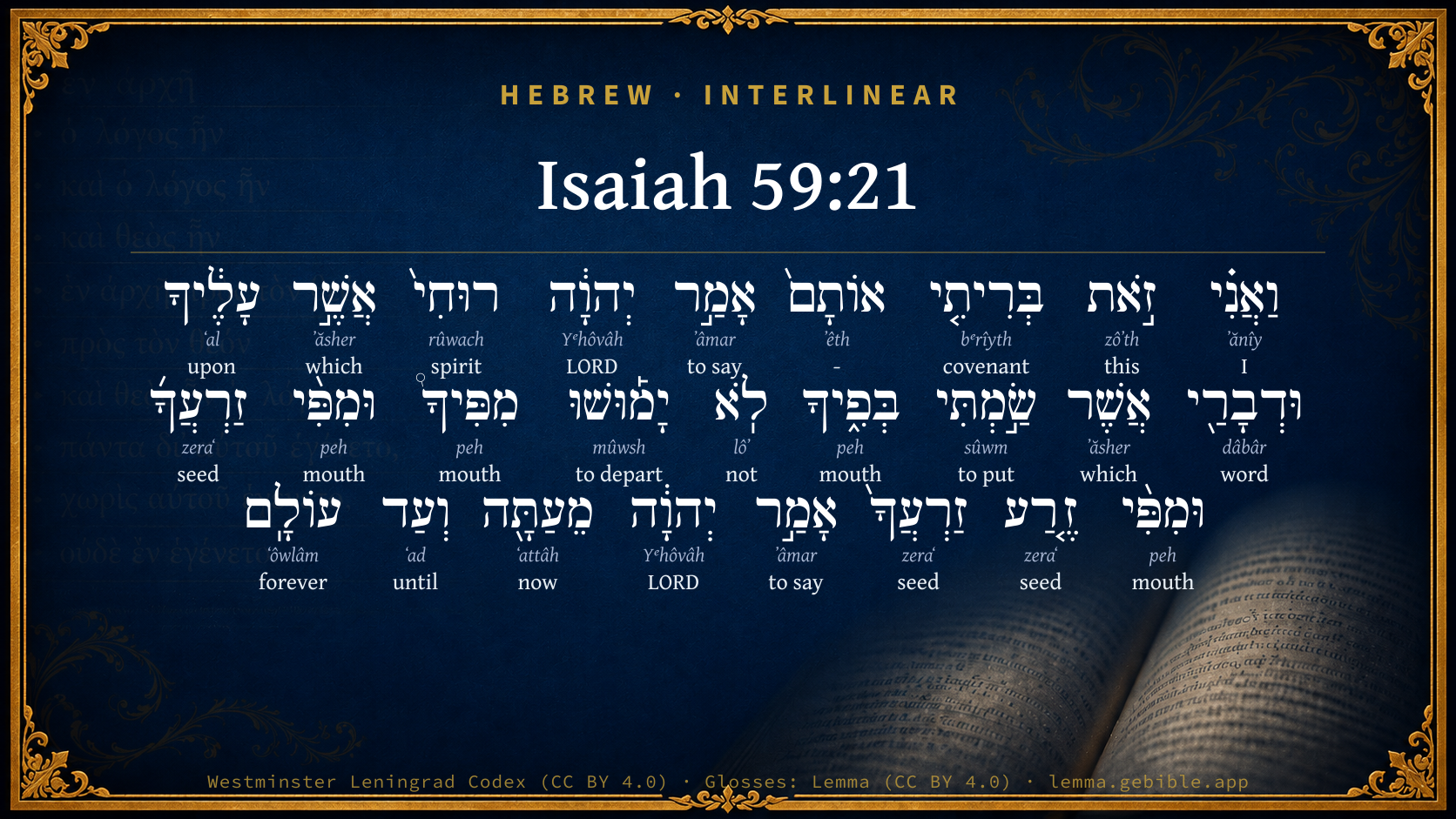
Hebrew (Westminster Leningrad Codex) Isaiah 59:21 appears in the Hebrew Old Testament. The text above is from the Westminster Leningrad Codex. Each word links to its Strong’s number, a concise gloss, and parsing drawn from the Open Scriptures Hebrew Bible morphology. Click any word for its full Brown-Driver-Briggs (BDB) entry.
Download image
Cite this verse

Isaiah 59:21 (World English Bible). Public Domain. Lemma interlinear Bible study tool, https://lemma.gebible.app/v/isaiah/59/21.

Show BibTeX & RIS
BibTeX
RIS
English Translation
As for me, this is my covenant with them, says Yahweh: my Spirit who is on you, and my words which I have put in your mouth, shall not depart out of your mouth, nor out of the mouth of your seed, nor out of the mouth of your seed's seed, says Yahweh, from henceforth and forever.
World English Bible · Public Domain
Download a study sheet

One document with this verse’s original text, its word-by-word gloss line, the meaning frame, cross-references with their text, attributed commentary, and full source and license credits — printable, and it pastes into notes with its structure intact.

This verse Autodidact and up

Study sheet (.html) Plain text (.txt)

A passage Seminary Student

Up to 50 verses in one chapter. A passage sheet keeps up to 6 commentary sources and 12 cross-references per verse, in the order this page ranks them, and says so on the sheet whenever that leaves anything out. Ask for a single verse and you get the Autodidact verse sheet above.

Everything on this page stays free to read, with no account — the sheet is a download of what is already on screen, not access to it.

Want to remove ads? Support Godless Engineer
Compare translations 3

The same verse in 3 English versions, stacked beneath the original-language interlinear above. Click any original word for its lexicon entry.

Each is an independent rendering of the whole verse — the interlinear is not word-aligned to these translations.

Highlighted words mark where these versions differ — a whole-verse word diff, not a word-by-word alignment.

  • World English Bible Public Domain
    As for me, this is my covenant with them, says Yahweh: my Spirit who is on you, and my words which I have put in your mouth, shall not depart out of your mouth, nor out of the mouth of your seed, nor out of the mouth of your seed's seed, says Yahweh, from henceforth and forever.
  • King James Version Public Domain
    As for me, this is my covenant with them, saith the LORD; My spirit that is upon thee, and my words which I have put in thy mouth, shall not depart out of thy mouth, nor out of the mouth of thy seed, nor out of the mouth of thy seed's seed, saith the LORD, from henceforth and for ever.
  • unfoldingWord Literal Text CC BY-SA 4.0
    “And me, this my covenant with them,” says Yahweh. “My Spirit, who upon you, and my words, which I have put in your mouth, will not depart from your mouth or from the mouth of your seed or from the mouth of the seed of your seed,” says Yahweh, “from now and to eternity.”

unfoldingWord Literal Text — © unfoldingWord, licensed CC BY-SA 4.0. Word-aligned USFM3 via Door43 (git.door43.org/unfoldingWord/en_ult).

Versions to compare (up to 4)

3 of 4 selected

Show all 18 translations

Every available English version of this verse, each an independent rendering of the whole verse.

  • World English Bible Public Domain
    As for me, this is my covenant with them, says Yahweh: my Spirit who is on you, and my words which I have put in your mouth, shall not depart out of your mouth, nor out of the mouth of your seed, nor out of the mouth of your seed's seed, says Yahweh, from henceforth and forever.
  • Berean Standard Bible Public Domain
    “As for Me, this is My covenant with them,” says the LORD. “My Spirit will not depart from you, and My words that I have put in your mouth will not depart from your mouth or from the mouths of your children and grandchildren, from now on and forevermore,” says the LORD.
  • Majority Standard Bible Public Domain
    “As for Me, this is My covenant with them,” says the LORD. “My Spirit will not depart from you, and My words that I have put in your mouth will not depart from your mouth or from the mouths of your children and grandchildren, from now on and forevermore,” says the LORD.
  • King James Version Public Domain
    As for me, this is my covenant with them, saith the LORD; My spirit that is upon thee, and my words which I have put in thy mouth, shall not depart out of thy mouth, nor out of the mouth of thy seed, nor out of the mouth of thy seed's seed, saith the LORD, from henceforth and for ever.
  • American Standard Version (1901) Public Domain
    And as for me, this is my covenant with them, saith Jehovah: my Spirit that is upon thee, and my words which I have put in thy mouth, shall not depart out of thy mouth, nor out of the mouth of thy seed, nor out of the mouth of thy seed's seed, saith Jehovah, from henceforth and for ever.
  • Revised Version (1885) Public Domain
    And as for me, this is my covenant with them, saith the LORD: my spirit that is upon thee, and my words which I have put in thy mouth, shall not depart out of thy mouth, nor out of the mouth of thy seed, nor out of the mouth of thy seed’s seed, saith the LORD, from henceforth and for ever.
  • Geneva Bible (1599) Public Domain
    And I will make this my couenant with them, saith the Lord. My Spirit that is vpon thee, and my wordes, which I haue put in thy mouth, shall not depart out of thy mouth, nor out of the mouth of thy seede, nor out of the mouth of the seede of thy seede, saith the Lord, from hencefoorth euen for euer.
  • Douay-Rheims (1899) Public Domain
    This is my covenant with them, saith the Lord: My spirit that is in thee, and my words that I have put in thy mouth, shall not depart out of thy mouth, nor out of the mouth of thy seed, nor out of the mouth of thy seed's seed, saith the Lord, from henceforth and for ever.
  • Young's Literal Translation Public Domain
    And I -- this `is' My covenant with them, said Jehovah, My Spirit that `is' on thee, And My words that I have put in thy mouth, Depart not from thy mouth, And from the mouth of thy seed, And from the mouth of thy seed's seed, said Jehovah, From henceforth unto the age!
  • Literal Standard Version CC BY-SA 4.0
    “And I—this [is] My covenant with them,” said YHWH, “My Spirit that [is] on you, || And My words that I have put in your mouth, || Do not depart from your mouth, || And from the mouth of your seed, || And from the mouth of your seed’s seed,” said YHWH, “From now on, even for all time!”
  • Unlocked Literal Bible CC BY-SA 4.0
    As for me, this is my covenant with them—says Yahweh—my spirit who is upon you, and my words which I have put in your mouth, will not leave your mouth, or go out of the mouth of your children, or go out of the mouth of your children's children—says Yahweh—from this time and forever.”
  • unfoldingWord Literal Text CC BY-SA 4.0
    “And me, this my covenant with them,” says Yahweh. “My Spirit, who upon you, and my words, which I have put in your mouth, will not depart from your mouth or from the mouth of your seed or from the mouth of the seed of your seed,” says Yahweh, “from now and to eternity.”
  • Darby Bible Public Domain
    And as for me, this is my covenant with them, saith Jehovah: My spirit that is upon thee, and my words which I have put in thy mouth, shall not depart out of thy mouth, nor out of the mouth of thy seed, nor out of the mouth of thy seed's seed, saith Jehovah, from henceforth and for ever.
  • World Messianic Bible Public Domain
    “As for me, this is my covenant with them,” says the LORD. “My Spirit who is on you, and my words which I have put in your mouth shall not depart out of your mouth, nor out of the mouth of your offspring, nor out of the mouth of your offspring’s offspring,” says the LORD, “from now on and forever.”
  • Webster's Bible Public Domain
    As for me, this is my covenant with them, saith the LORD; My spirit that is upon thee, and my words which I have put in thy mouth, shall not depart out of thy mouth, nor out of the mouth of thy seed, nor out of the mouth of thy seed's seed, saith the LORD, from henceforth and for ever.
  • Free Bible Version CC BY-SA 4.0
    This is my agreement with them, says the Lord. My Spirit, who is upon you, won't leave you, and my words that I have given you to speak will always be on your lips, on the lips of your children, and on the lips of your descendants, from now until forever, says the Lord.
  • Bible in Basic English Public Domain
    And as for me, this is my agreement with them, says the Lord: my spirit which is on you, and my words which I have put in your mouth, will not go away from your mouth, or from the mouth of your seed, or from the mouth of your seed's seed, says the Lord, from now and for ever.
  • JPS Tanakh (1917) Public Domain
    And as for Me, this is My covenant with them, saith the LORD; My spirit that is upon thee, and My words which I have put in thy mouth, shall not depart out of thy mouth, nor out of the mouth of thy seed, nor out of the mouth of thy seed's seed, saith the LORD, from henceforth and for ever.

Literal Standard Version (2020), Covenant Press — licensed CC BY-SA 4.0. Text via the HelloAO Bible API (eBible.org). Unlocked Literal Bible (unfoldingWord) — licensed CC BY-SA 4.0. Text via the HelloAO Bible API (eBible.org). unfoldingWord Literal Text — © unfoldingWord, licensed CC BY-SA 4.0. Word-aligned USFM3 via Door43 (git.door43.org/unfoldingWord/en_ult). Free Bible Version, Dr. Jonathan Gallagher — licensed CC BY-SA 4.0. Text via the HelloAO Bible API (eBible.org).

Word by word

More ways to search: Search by grammar → Find every occurrence → Compare this word →

Practice this passage: Drill this verse → Learn its vocabulary →

יָמ֡וּשׁוּ
mûwsh
H4185
“to depart”
Verb, Qal, Imperfect, 3rd Person, Masculine, Plural
Part of Speech
Verb
Stem
Qal
Form
Imperfect
Person
3rd Person
Gender
Masculine
Number
Plural
Full BDB Definition

Origin: a primitive root [perhaps rather the same as H4184 through the idea of receding by contact]

TWOT: 1167

to depart, remove - (Qal) - to depart - to remove - to be removed (of inanimate objects) - (Hiphil) to remove, depart
  1. וַאֲנִ֗י ʼănîy H589 “and · I” Conjunction + Pronoun, Personal, 1st Person, Common, Singular
  2. זֹ֣את zôʼth H2063 “this” Pronoun, Demonstrative, Feminine, Singular
  3. בְּרִיתִ֤י bᵉrîyth H1285 “covenant · my” Noun, Common, Feminine, Singular, Construct + Suffix, Personal, 1st Person, Common, Singular
  4. אוֹתָם֙ ʼêth H853 “- · them” Particle, Direct Object + Suffix, Personal, 3rd Person, Masculine, Plural
  5. אָמַ֣ר ʼâmar H559 “to say” Verb, Qal, Perfect, 3rd Person, Masculine, Singular
  6. יְהוָ֔ה Yᵉhôvâh H3068 “LORD” Noun, Proper
  7. רוּחִי֙ rûwach H7307 “spirit · my” Noun, Common, Both, Singular, Construct + Suffix, Personal, 1st Person, Common, Singular
  8. אֲשֶׁ֣ר ʼăsher H834 “which” Particle, Relative
  9. עָלֶ֔יךָ ʻal H5921 “upon · you” Preposition + Suffix, Personal, 2nd Person, Masculine, Singular
  10. וּדְבָרַ֖י dâbâr H1697 “and · words · my” Conjunction + Noun, Common, Masculine, Plural, Construct + Suffix, Personal, 1st Person, Common, Singular
  11. אֲשֶׁר ʼăsher H834 “which” Particle, Relative
  12. שַׂ֣מְתִּי sûwm H7760 “to put” Verb, Qal, Perfect, 1st Person, Common, Singular
  13. בְּפִ֑יךָ peh H6310 “in/at · mouth · your” Preposition + Noun, Common, Masculine, Singular, Construct + Suffix, Personal, 2nd Person, Masculine, Singular
  14. לֹֽא lôʼ H3808 “not” Particle, Negative
  15. מִפִּיךָ֩ peh H6310 “from · mouth · your” Preposition + Noun, Common, Masculine, Singular, Construct + Suffix, Personal, 2nd Person, Masculine, Singular
  16. וּמִפִּ֨י peh H6310 “and · from · mouth of” Conjunction + Preposition + Noun, Common, Masculine, Singular, Construct
  17. זַרְעֲךָ֜ zeraʻ H2233 “seed · your” Noun, Common, Masculine, Singular, Construct + Suffix, Personal, 2nd Person, Masculine, Singular
  18. וּמִפִּ֨י peh H6310 “and · from · mouth of” Conjunction + Preposition + Noun, Common, Masculine, Singular, Construct
  19. זֶ֤רַע zeraʻ H2233 “seed of” Noun, Common, Masculine, Singular, Construct
  20. זַרְעֲךָ֙ zeraʻ H2233 “seed · your” Noun, Common, Masculine, Singular, Construct + Suffix, Personal, 2nd Person, Masculine, Singular
  21. אָמַ֣ר ʼâmar H559 “to say” Verb, Qal, Perfect, 3rd Person, Masculine, Singular
  22. יְהוָ֔ה Yᵉhôvâh H3068 “LORD” Noun, Proper
  23. מֵעַתָּ֖ה ʻattâh H6258 “from · now” Preposition + Adverb
  24. וְעַד ʻad H5704 “and · until” Conjunction + Preposition
  25. עוֹלָֽם ʻôwlâm H5769 “forever” Noun, Common, Masculine, Singular, Absolute

About this verse

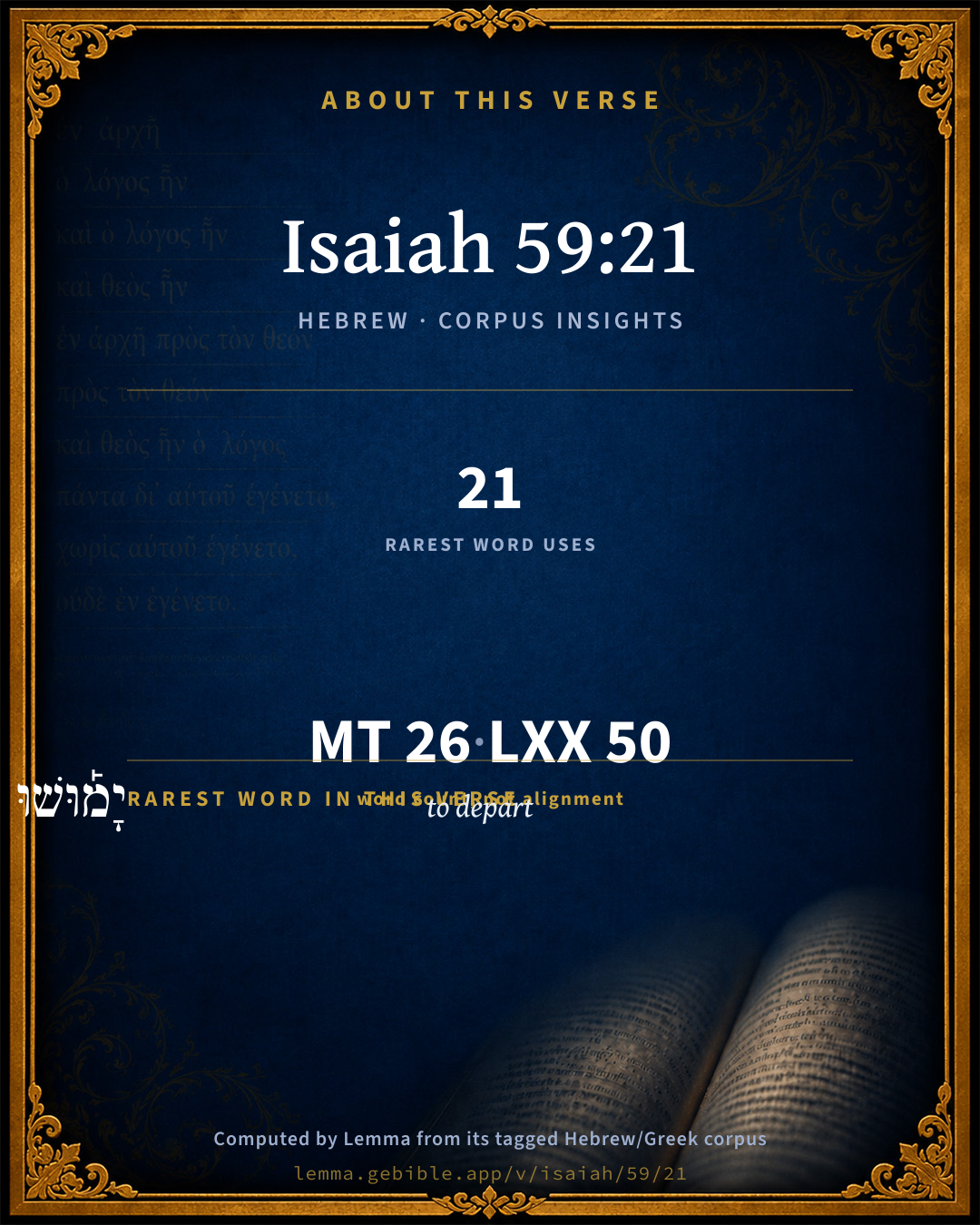
These counts appear in no published source. They are computed here, from the morphology-tagged text and Lemma’s own curated glosses. What Lemma adds →

26
words
18
distinct lemmas
Prophets
section

Notable vocabulary

The rarest word here is יָמ֡וּשׁוּ to depart H4185 — appearing just 21 times in the whole Hebrew Bible.

Shared distinctive vocabulary

יָמ֡וּשׁוּ to depart H4185 occurs in 19 verses of the Hebrew Bible. Also found in:

Grammatical profile

  • 4 verbs
  • 13 nouns
  • 2 pronouns
  • 2 prepositions
  • 1 adverb
  • 4 particles

Verb forms

  • אָמַ֣ר Qal · Perfect
  • שַׂ֣מְתִּי Qal · Perfect
  • יָמ֡וּשׁוּ Qal · Imperfect
  • אָמַ֣ר Qal · Perfect

Repetition

Words recur within this verse — often emphatic in Hebrew:

  • בְּפִ֑יךָ mouth H6310 ×4
  • זַרְעֲךָ֜ seed H2233 ×3
  • אָמַ֣ר to say H559 ×2
  • יְהוָ֔ה LORD H3068 ×2
  • אֲשֶׁ֣ר which H834 ×2

Hebrew & Septuagint length

In English translation the verse runs 57 words from the Hebrew and 50 from the Septuagint (LXX English) — closely comparable.

A rough comparison of the two English renderings, which tokenize alike — not a word-level alignment.

Word counts can differ between the Hebrew and the Greek without any difference in meaning — e.g. the Hebrew direct-object marker אֵת has no separate Greek word, and Greek often adds the article ὁ.

In the original languages it is 26 Hebrew tokens and 50 Greek tokens — but the two are counted differently (Hebrew bundles its prefixes and suffixes into one token; the Greek is in lemma form), so that isn’t a like-for-like length.

Cross-references

24

Topical passages linked to Isaiah 59:21 in the Treasury of Scripture Knowledge — connected by theme and wording, ordered by reader-vote popularity; previews shown in the World English Bible.

  • Jeremiah 31:31–34 Behold, the days come, says Yahweh, that I will make a new covenant with the house of Israel, and with the house of Judah:
  • Hebrews 10:16 "This is the covenant that I will make with them: 'After those days,' says the Lord, 'I will put my laws on their heart, I will also write them on their mind;'" then he says,
  • Ezekiel 36:25–27 I will sprinkle clean water on you, and you shall be clean: from all your filthiness, and from all your idols, will I cleanse you.
  • Jeremiah 32:38–41 and they shall be my people, and I will be their God:
  • Hebrews 8:6–13 But now he has obtained a more excellent ministry, by so much as he is also the mediator of a better covenant, which has been enacted on better promises.
  • 2 Corinthians 3:17–18 Now the Lord is the Spirit and where the Spirit of the Lord is, there is liberty.
  • Isaiah 51:16 I have put my words in your mouth, and have covered you in the shadow of my hand, that I may plant the heavens, and lay the foundations of the earth, and tell Zion, You are my people.
  • Isaiah 44:3 For I will pour water on him who is thirsty, and streams on the dry ground; I will pour my Spirit on your seed, and my blessing on your offspring:
  • Isaiah 61:1–3 The Spirit of the Lord Yahweh is on me; because Yahweh has anointed me to preach good news to the humble; he has sent me to bind up the broken-hearted, to proclaim liberty to the captives, and the opening [of the prison] to those who are bound;
  • John 4:14 but whoever drinks of the water that I will give him will never thirst again; but the water that I will give him will become in him a well of water springing up to eternal life."
  • Isaiah 55:3 Turn your ear, and come to me; hear, and your soul shall live: and I will make an everlasting covenant with you, even the sure mercies of David.
  • Romans 8:9 But you are not in the flesh but in the Spirit, if it is so that the Spirit of God dwells in you. But if any man doesn't have the Spirit of Christ, he is not his.
  • John 7:16–17 Jesus therefore answered them, "My teaching is not mine, but his who sent me.
  • John 3:34 For he whom God has sent speaks the words of God; for God gives the Spirit without measure.
  • John 7:39 But he said this about the Spirit, which those believing in him were to receive. For the Holy Spirit was not yet given, because Jesus wasn't yet glorified.
  • Isaiah 11:1–3 There shall come forth a shoot out of the stock of Jesse, and a branch out of his roots shall bear fruit.
  • Isaiah 49:8 Thus says Yahweh, In an acceptable time have I answered you, and in a day of salvation have I helped you; and I will preserve you, and give you for a covenant of the people, to raise up the land, to make them inherit the desolate heritage:
  • Ezekiel 37:25–27 They shall dwell in the land that I have given to Jacob my servant, in which your fathers lived; and they shall dwell therein, they, and their children, and their children's children, forever: and David my servant shall be their prince for ever.
  • Ezekiel 39:25–29 Therefore thus says the Lord Yahweh: Now will I bring back the captivity of Jacob, and have mercy on the whole house of Israel; and I will be jealous for my holy name.
  • 1 Corinthians 15:3–58 For I delivered to you first of all that which I also received: that Christ died for our sins according to the Scriptures,
  • 2 Corinthians 3:8 won't service of the Spirit be with much more glory?
  • John 1:33 I didn't recognize him, but he who sent me to baptize in water, he said to me, 'On whomever you will see the Spirit descending, and remaining on him, the same is he who baptizes in the Holy Spirit.'
  • John 17:8 for the words which you have given me I have given to them, and they received them, and knew for sure that I came forth from you, and they have believed that you sent me.
  • John 8:38 I say the things which I have seen with my Father; and you also do the things which you have seen with your father."

Cross-references courtesy of OpenBible.info (CC BY 4.0).

Hebrew and Greek witnesses Masoretic Hebrew ↔ Greek Septuagint

The same verse in the two great witnesses to the Old Testament, shown verse-for-verse.

These are two independent witnesses, not word-aligned to each other, and the Septuagint is shown in lemma (dictionary) form.

Hebrew Isaiah 59:21 Masoretic · Westminster Leningrad Codex

וַאֲנִ֗י זֹ֣את בְּרִיתִ֤י אוֹתָם֙ אָמַ֣ר יְהוָ֔ה רוּחִי֙ אֲשֶׁ֣ר עָלֶ֔יךָ וּדְבָרַ֖י אֲשֶׁר שַׂ֣מְתִּי בְּפִ֑יךָ לֹֽא יָמ֡וּשׁוּ מִפִּיךָ֩ וּמִפִּ֨י זַרְעֲךָ֜ וּמִפִּ֨י זֶ֤רַע זַרְעֲךָ֙ אָמַ֣ר יְהוָ֔ה מֵעַתָּ֖ה וְעַד עוֹלָֽם

As for me, this is my covenant with them, says Yahweh: my Spirit who is on you, and my words which I have put in your mouth, shall not depart out of your mouth, nor out of the mouth of your seed, nor out of the mouth of your seed's seed, says Yahweh, from henceforth and forever.

World English Bible · Public Domain

Greek LXX Isaiah 59:21 Septuagint · lemma form

καί οὗτος αὐτός ὁ παρά ἐγώ διαθήκη εἶπον κύριος ὁ πνεῦμα ὁ ἐμός ὅς εἰμί ἐπί σύ καί ὁ ῥῆμα ὅς δίδωμι εἰς ὁ στόμα σύ οὐ μή ἐκλείπω ἐκ ὁ στόμα σύ καί ἐκ ὁ στόμα ὁ σπέρμα σύ εἶπον γάρ κύριος ἀπό ὁ νῦν καί εἰς ὁ αἰών

And this shall be my covenant with them, said the Lord; My Spirit which is upon you, and the words which I have put in your mouth, shall never fail from your mouth, nor from the mouth of your seed, for the Lord has spoken it, henceforth and for ever.

LXX2012 (modern English Septuagint) · Public Domain

Hebrew: Westminster Leningrad Codex (CC BY 4.0). Greek: Septuagint (public domain); English from LXX2012 (modern English Septuagint) (Public Domain). How the Septuagint differs from the Hebrew →

Targum (Aramaic paraphrase)

1

The Targum is the ancient Jewish Aramaic paraphrase of the Hebrew Scriptures — an interpretive translation, not the Hebrew text itself. Onkelos (literal) and Pseudo-Jonathan (expansive) render the Torah, and Jonathan the Prophets. Coverage is partial: where no permissively-licensed English translation exists for a verse, only the Aramaic is shown. This is verse-level text, not a word-by-word alignment to the Hebrew.

  1. Targum Jonathan Prophets (Joshua–Malachi)
    וַאֲנָא דֵין קְיָמִי עִמְהוֹן אֲמַר יְיָ רוּחַ קוּדְשִׁי דַעֲלָךְ וּפִתְגָמֵי נְבוּאָתִי דְשַׁוֵתִי בְּפוּמָךְ לָא יֶעְדוּן מִפּוּמָךְ וּמִפּוּם בְּנָךְ וּמִפּוּם בְּנֵי בְנָךְ אֲמַר יְיָ מִכְּעַן וְעַד עַלְמָא:

    And as for me, this shall be my covenant with them, saith the Lord; My Holy Spirit that is upon thee, and the words of my prophecy which I have put in thy mouth, shall not depart out of thy mouth, nor out of the mouth of thy children, nor out of the mouth of thy children's children, saith the Lord, from henceforth and for ever.

    Targum Jonathan — Aramaic: “Mikraot Gedolot” (public domain). English: “Sefaria Community Translation” (CC0 1.0 (public-domain dedication)); “London "Chaldee Paraphrase," 1871” (public domain). Text via Sefaria.

Commentary

Notes on Isaiah 59:21 from classic Christian and Jewish commentators (each source and its license shown beneath its notes). The classic Christian expositions comment on the surrounding passage and are grouped to its opening verse, so a note may address several verses; the Jewish commentaries on the Tanakh (Rashi and others) are per-verse, so they appear only where the commentator wrote on this verse.

Lemma curates 59 commentaries, every one of them public domain or Creative Commons licensed, each selected and text-cleaned for this edition rather than reprinted as found. About our sources →

Trapp's Complete Commentary

John Trapp

Isa 59:21 As for me, this [is] my covenant with them, saith the LORD; My spirit that [is] upon thee, and my words which I have put in thy mouth, shall not depart out of thy mouth, nor out of the mouth of thy seed, nor out of the mouth of thy seed’s seed, saith the LORD, from henceforth and for ever.

Ver. 21. My Spirit which is upon thee, and my words.] The efficacy of the Word is by the Spirit, the expression of the Spirit by the Word; both are here promised to the Church as her true goods. {Isa 30:20-21 Job 14:16-17} It is with the Word and Spirit as with the veins and arteries in the body; as the veins carry the blood, so the arteries carry the spirits to quicken the blood.

John Trapp, A Commentary or Exposition upon All the Books of the Old and New Testament (1647–1656) — public domain. Text from a community e-Sword module.

Tyndale Open Study Notes

Tyndale Open Resources

59:21 The members of the new community have the Spirit, and they know and practice God’s word (see also Ezek 36:24-28). The Lord promises to regenerate the children by his Spirit and bring them into the covenant of obedience and love for the Lord (Joel 2:28; Acts 2:39).

Tyndale Open Study Notes — © Tyndale Open Resources, licensed CC BY-SA 4.0. Text via the HelloAO Bible API.

Geneva Bible (1599)

Geneva Bible translators

Because the doctrine is made profitable by the virtue of the Spirit, he joineth the one with the other, and promiseth to give them both to his Church forever.

Geneva Bible (1599) marginal notes — public domain. Text via Bolls.life.

Jamieson, Fausset & Brown

Robert Jamieson, A. R. Fausset & David Brown

covenant with them . . . thee--The covenant is with Christ, and with them only as united to Him (Heb 2:13). Jehovah addresses Messiah the representative and ideal Israel. The literal and spiritual Israel are His seed, to whom the promise is to be fulfilled (Psa 22:30).

spirit . . . not depart . . . for ever-- (Jer 31:31-37; Mat 28:20).

An ode of congratulation to Zion on her restoration at the Lord's second advent to her true position as the mother church from which the Gospel is to be diffused to the whole Gentile world; the first promulgation of the Gospel among the Gentiles, beginning at Jerusalem [Luk 24:47], is an earnest of this. The language is too glorious to apply to anything that as yet has happened.

Next: Isaiah Chapter 60

Jamieson, Fausset & Brown — Commentary Critical and Explanatory on the Whole Bible (1871) — public domain (CC PDM 1.0). Text via the HelloAO Bible API.

Adam Clarke's Commentary

Verse 21. This is my covenant with them - "This is the covenant which I make with them"] For אותם otham, them, twenty-four MSS., (four ancient,) and nine editions have אתם ittam, with them.

My Spirit that is upon thee] This seems to be an address to the Messiah; Kimchi says it is to the prophet, informing him that the spirit of prophecy should be given to all Israelites in the days of the Messiah, as it was then given to him, i.e., to the prophet.

And my words which I have put in thy mouth] Whatsoever Jesus spoke was the word and mind of God himself; and must, as such, be implicitly received.

Nor out of the mouth of thy seed] The same doctrines which Jesus preached, all his faithful ministers preach; and his seed - genuine Christians, who are all born of God, believe; and they shall continue, and the doctrines remain in the seed's seed through all generations - for ever and ever. This is God's covenant, ordered in all things and sure.

Adam Clarke's Commentary on the Bible (1810–1826) — public domain. Text from a community e-Sword/MySword module.

Ellicott's Commentary for English Readers

(21) As for me, this is my covenant . . .—The words are, as to their form, an echo of Gen_17:4; as to their meaning, the germ of Jer_31:31; Heb_8:10; Heb_10:16. The new covenant is to involve the gift of the Spirit, that writes the law of God inwardly in the heart, as distinct from the Law, which is thought of as outside the conscience, doing its work as an accuser and a judge.

A Bible Commentary for English Readers, edited by Charles John Ellicott (1878–1897) — public domain. Text from a community e-Sword module.

The Cambridge Bible for Schools and Colleges

gen. ed. J. J. S. Perowne

21. Confirmation of the covenant to the true Israel. The verse, on account of its apparent want of connexion with what precedes, and its change of person and number, is regarded by some as an insertion.

My spirit that is upon thee] The change of pronouns (with them … upon thee) presents little difficulty here. It is caused by the transition from indirect to direct address; what follows being the substance of an oracle that was already gone forth. Comp. the similar promise in ch. Isa_44:3. The person addressed is the spiritual Israel, which is even now endowed with the divine spirit and word. Whether Israel is conceived as “the bearer of the idea of the Servant of Jehovah” (Dillmann) is doubtful in view of the possible post-exilic origin of the prophecy. Against the view that the prophet himself is addressed, Dillmann pertinently remarks that the O.T. knows nothing of a hereditary transmission of the prophetic gift.

The Cambridge Bible for Schools and Colleges (gen. ed. J. J. S. Perowne; Cambridge University Press, 1878–1918) — public domain. Text from a community e-Sword module.

John Gill's Exposition

As for me, this is my covenant with them, saith the Lord,.... Which shall be manifested and made good to them that repent of their sins, and, believe in Christ; and to whom the particular blessing of it shall be applied, the forgiveness of their sins; see Rom 11:27,

my Spirit which is upon thee, and my words which I have put in thy mouth; the Spirit of God, with his gifts and graces, which were upon Christ the Redeemer without measure; and the doctrines he received from his divine Father to teach others, and which he gave to his apostles; the same Spirit which in measure was put upon them, and the same truths which were delivered to them:

shall not depart out of thy mouth, nor out of the mouth of thy seed, nor out of the mouth of thy seed's seed, saith the Lord, from henceforth and for ever; that is, shall always continue with the church and her spiritual seed, such as are born in her, and brought up by her, throughout all successive ages, and to the end of time; and it may be observed, that after the conversion of the Jews, to which this prophecy has a special regard, they shall no more apostatize; the Spirit of the Lord shall not depart from them; and the Gospel shall always be professed by them: and it may be further observed, that the Spirit and the word go together; and that the latter is only effectual as accompanied will, the former, and is a proof of the perseverance of the church of God, and of all such who have the Spirit and grace of God, Christ will always have a church, and that church a seed, in which the Spirit and word will always remain. The grace of the Spirit, in the hearts of God's people, never removes from them; nor his Gospel from such, in whose hearts it works effectually. The Targum interprets this of the words of prophecy; and the Talmud (o) of the law not departing from the disciples of wise men; but it is best to understand it of the Gospel not departing from the disciples of Christ, and the seed of the church.

(o) T. Bab. Bava Metzia, fol. 85. 1.

Next: Isaiah Chapter 60

John Gill's Exposition of the Whole Bible (1746–1763) — public domain (CC PDM 1.0). Text via the HelloAO Bible API.

Albert Barnes' Notes on the Bible

As for me - In the previous part of the chapter, the prophet has spoken. Here Yahweh is introduced as speaking himself, and as declaring the nature of the covenant which he would establish. In the verse previous, it had been stated that the qualifications on the part of people for their partaking of the benefits of the Redeemer’s work, were, that they should turn from transgression. In this verse, Yahweh states what he would do in regard to the covenant which was to be established with his people. ‘So far as I am concerned, I will enter into a covenant with them and with their children.’

This is my covenant with them - (Compare the notes at Isa 42:6; Isa 49:8; Isa 54:10). The covenant here referred to, is that made with people under the Messiah. In important respects it differed from that made with the Jewish people under Moses. The word, ‘covenant’ here is evidently equivalent, as it is commonly, when applied to a transaction between God and human beings, to a most solemn promise on his part; and the expression is a most solemn declaration that, under the Messiah, God would impart his Spirit to those who should turn from transgression, and would abundantly bless them and their offspring with the knowledge of his truth. When it is said, ‘this is my covenant,’ the import evidently is, ‘this is the nature or the tenure of my covenant, or of my solemn promises to my people under the Messiah. It shall certainly occur that my Spirit will be continually imparted to thy seed, and that my words will abide with thee and them forever.’

My Spirit that is upon thee - The word ‘thee’ here does not refer, as Jerome and others suppose, to the prophet, but to the pious Hebrew people. The covenant under the Messiah, was not made especially with the prophet or his posterity, but is a promise made to the church, and here evidently refers to the true people of God: and the idea is, that the Spirit of God would be continually imparted to his people, and to their descendants forever. It is a covenant made with true believers and with their children.

And my words - The Chaldee understands this of prophecy. But it seems rather to refer to the truth of God in general which he had revealed for the guidance and instruction of his church.

Shall not depart out of thy mouth - This phrase probably means, that the truth of God would be the subject of perpetual meditation and conversation. The covenant would be deemed so precious that it would constantly dwell on the tongues of those who were interested in it.

Thy seed’s seed - Thy descendants; thy posterity.

From henceforth and for ever - This is in accordance with the promises which everywhere occur in the Scriptures, that God would bless the posterity of his people, and that the children of the pious should partake of his favor. See Exo 20:6 : ‘Showing mercy unto thousands (that is, thousands of generations) of them that love me and keep my commandments.’ Compare Deu 4:37; Deu 5:29; Deu 7:9; Psa 89:24, Psa 89:36; Jer 32:39-40. There is no promise of the Bible that is more full of consolation to the pious, or that has been more strikingly fulfilled than this. And though it is true that not all the children of holy parents become truly pious; though there are instances where they are signally wicked and abandoned, yet it is also true that rich spiritual blessings are imparted to the posterity of those who serve God and who keep his commandments. The following facts are well known to all who have ever made any observation on this subject:

1. The great majority of those who become religious are the descendants of those who were themselves the friends of God. Those who now compose the Christian churches, are not those generally who have been taken from the ways of open vice and profligacy; from the ranks of infidelity; or from the immediate descendants of scoffers, drunkards, and blasphemers. Such people usually tread, for a few generations at least, in the footsteps of their fathers. The church is composed mainly of the descendants of those who have been true Christians, and who trained their children to walk in the ways of pure religion.

2. It is a fact that comparatively a large proportion of the descendants of the pious themselves for many generations become true Christians. I know that it is often thought to be otherwise, and especially that it is often said that the children of clergymen are less virtuous and religious than others. But it should be remembered that such cases are more prominent than others, and especially that the profane and the wicked have a malicious pleasure in making them the subject of remark. The son of a drunkard will be intemperate without attracting notice - for such a result is expected; the son of an infidel will be an infidel; the son of a scoffer will be a scoffer; of a thief a thief; of a licentious man licentious, without being the subject of special observation. But when the son of an eminent Christian treads the path of open profligacy, it at once excites remark, because such is not the usual course, and is not usually expected; and because a wicked world has pleasure in marking the case, and calumniating religion through such a prominent instance of imperfection and sin.

But such is not the common result of religious training. Some of the most devotedly pious people of this land are the descendants of the Huguenots who were expelled from France. A very large proportion of all the piety in this country has been derived from the ‘Pilgrims,’ who landed on the rock of Plymouth, and God has blessed their descendants in New England and elsewhere with numerous revivals of religion. I am acquainted with the descendants of John Rogers, the first martyr in Queen Mary’s reign, of the tenth and eleventh generations. With a single exception, the oldest son in the family has been a clergymen - some of them eminently distinguished for learning and piety; and there are few families now in this land a greater proportion of whom are pious than of that. The following statistical account made of a limited section of the country, not more favored or more distinguished for piety than many others, accords undoubtedly with similar facts which are constantly occurring in the families of those who are the friends of religion. The Secretary of the Massachusetts Sabbath School Society made a limited investigation, in the year 1838, for the purpose of ascertaining the facts about the religious character of the families of ministers and deacons with reference to the charge so often urged that the ‘sons and daughters of ministers and deacons were worse than common children.’ The following is the result.

In 268 families which he canvassed, he found 1290 children over fifteen years of age. Of these children 884, almost three-fourths, are hopefully pious; 794 have united with the churches; sixty-one entered the ministry; only seventeen are dissipated, and about half only of these became so while with their parents. In eleven of these families there are 123 children, and all but seven pious. In fifty-six of these families there are 249 children over fifteen, and all hopefully pious. When and where can any such result be found in the families of infidels, of the vicious, or of irreligious people? Indeed, it is the great law by which religion and virtue are perpetuated in the world. that God is faithful to this covenant, and that he blesses the efforts of his friends to train up generations for his service.

3. All pious parents should repose on this promise of a faithful God. They may and should believe that it is his design to perpetuate religion in the families of those who truly serve and obey him. They should be faithful in imparting religious truth; faithful in prayer, and in a meek, holy, pure, and benevolent example; they should so live that their children may safely tread in their footsteps; they should look to God for his blessing on their efforts, and their efforts will not be in vain. They shall see their children walk in the ways of virtue; and when they die, they may leave the world with unwavering confidence that God will not suffer his faithfulness to fail; that he will not break his covenant, nor alter the thing that is gone out of his lips Psa 89:33-34.

Albert Barnes' Notes on the Bible (1834–1885) — public domain. Text from a community e-Sword/MySword module.

Haydock's Catholic Bible Commentary

Covenant. Note here a clear promise of perpetual orthodoxy to the Church of Christ. (Challoner) --- She hath still the spirit of truth. (Worthington) (Matthew xxviii. 20.) --- None will apply this to the synagogue, which is visibly in the dark, and abandoned. (Calmet)

George Leo Haydock (1774–1849), Haydock's Catholic Family Bible and Commentary, 1859 edition — public domain. Excludes Psalms (Douay-Rheims chapter numbering differs from Protestant) and Deuterocanonical books (Catholic canon only).

Matthew Poole's English Annotations

This is my covenant, or what I have promised, and so am engaged to see fulfilled, viz. to them that turn from their iniquity; or rather, the promise of his word and Spirit to abide in his church, upon which account it is also that the Spirit is promised in the next words, by which is understood either the gift of prophecy, or the prophecy itself, given here to Isaiah, and so to the church: and being here, as in the foregoing verse, explicative, not copulative; unless it note that in an ordinary way the Spirit and the word go together wherever either of them are effectual, the Spirit impressing what the word expresses, Joh 14:16-18; and it is the spirit of Satan that is different from the word.

My Spirit that is upon thee. See Poole "Num 11:17", See Poole "Num 11:25", &c.; See Poole "2Ki 2:15".

Which I have put in thy mouth; which thou hast uttered by virtue of my Spirit, it being the church’s great treasure and happiness to have God present with his word. Shall not depart out of thy mouth, &iowa.; the sense is either, these words, and the fulfilling of them, shall be always talked of, wherever the mention of this deliverance shall come, as is said of Mary’s ointment, Mat 26:13. Or rather, he seems to promise the perpetual presence of his word and Spirit with the prophets, apostles, and ministers, and teachers of the church to all succeeding ages thereof, and may have a special reference to the gospel, or new covenant in Christ.

For ever, i.e. for a long, though yet a definitive, space of time, as it is often used.

Matthew Poole's English Annotations on the Holy Bible (1683–1685) — public domain. Text from a community e-Sword/MySword module.

Whedon's Commentary on the Bible

Daniel D. Whedon

21. As for me… saith the Lord — Of late the prophet has been, but now Jehovah reappears as, the speaker; probably because he personates the “Redeemer” of the preceding verse.

This is my covenant — Namely, the covenant of the Gospel, with all its spiritual benefits, which is to run on till the world ends.

My Spirit… upon thee — First, on Messiah without measure; (Joh_3:36;) then, on his people, the devoted ones of Israel, the true Israel, they of the “west” and they of regions where is “the rising of the sun.” From these, that is, the true Israel, (Isa_49:3,)

“righteousness will now overflow to the whole people.” They will be raised to their high calling as God’s royal priesthood; and the oath to Abraham and the truth to Jacob will be fulfilled through successive generations, as it had been sworn to the fathers from the days of old. (Birks.)

Daniel D. Whedon (gen. ed.), Commentary on the Old and New Testaments (1874–1909) — public domain. Text from a community e-Sword module.

The Pulpit Commentary

As for me; literally, and I The prophet begins with one construction, and then checks himself, and introduces another. This is my covenant. (comp. Jer_31:31-34; and see the comment on Isa_53:3) The new covenant involved the giving of God"s Spirit to his people; (Joe_2:28) and this Spirit, it is here promised, shall not depart from God"s people while time endures. The Spirit will be accompanied with certain "words" which will be put into the Church"s mouth; and these words will remain unchanged and pass on from mouth to mouth, age after age, for ever. The "words" intended are probably those of the entire Bible God"s revelations" (Cheyne) which the Church will maintain as inspired truth through all ages. Upon thee; i.e. upon Israel. The change of number and person ("with them... upon thee") is not unusual in Isaiah. (Isa_1:29 Isa_33:2 Isa_49:5 Isa_62:11, Isa_62:12, etc.)

The hope of the rued.

Wherein shall we find the true hope of the human race? It would be but a sorry prospect if man had nothing better to build upon than the results of physical science, or political economy, or mental and moral philosophy. These are helpful handmaids, but they have shown themselves inefficient regenerators of mankind. We build our hope ultimately on

I THE FULFILMENT OF THE DIVINE PROMISE. God has "covenanted" or promised to do great things for us. Our hope is in him: it was in his Divine pity, unpledged, unexpressed. It is in his promise to be friend, to illumine, to renew. The world went utterly wrong, and in the greatness of his compassion he interposed with a marvellous redemption.

The Church became utterly corrupt, and in the fulness of his faithfulness he did not desert it, but cleansed and raised it.

II THE PLANTING OF DIVINE TRUTH. We may have a good hope for mankind if "God"s words are in the mouth" of men. Not enactments on the statute-book, nor institutions in society, nor the sword in the magistrate"s hand, but God"s truth in the mind, is the source of strength, the criterion of advancement, and the condition of security. When God"s thoughts are precious, (Psa_139:17) and God"s words are loved, the people are in the way of wisdom and of life.

III THE OUTPOURING OF HIS SPIRIT. "My Spirit is upon thee." The indwelling, illuminating, transforming Spirit will make all holy truth effectual and mighty.

IV THE TRANSMISSION OF GODLINESS FROM GENERATION TO GENERATION. "Nor out of the mouth of thy seed," etc. The "promise is to us and to our children." Far more than to evangelistic efforts or missionary labours do we look to the upgrowing in godly homes of a devout and holy generation. The future of the world is in the hands of Christian fathers and mothers! Let them be what they should be, and their sons and daughters will strengthen the cause of God and fulfil the hope of mankind. C.

The gospel-covenant.

The recipient of this covenant is the spiritual Israel. The old Jewish covenant is to provide figures that may help us to understand the spiritual covenant which we make with God and God makes with us, through Jesus Christ, the covenant-Negotiator. Here God"s side of covenant-pledge is that he will always be the inner life and inspiration of his people. And it is assumed that his people"s covenant-pledge is that they hold themselves as fully consecrated unto him, and in all holy and earnest activities seek to serve him.

I THE NEW COVENANT ON GOD"S SIDE. Compare the pledge in the older Jewish covenant preservation of bodily life, with all that this might demand of providing, guiding, and preserving everything needed for the life that now is. In the new covenant the pledge is of preservation of that Divine life, spiritual life, which in us has been divinely quickened, with all that this higher life may demand of sustenance, guidance, protection, and inspiration. God will be sure to supply all the needs of our soul-life, and put his Spirit in us and keep his Spirit with us, to be the life of our life, our security, our guarantee, our sanctification. Cramer says, "Does the Spirit of God remain? then also does his Word; does the Word remain? then preachers also remain; do preachers remain? then also hearers do; do hearers remain? then also remain believers; and therefore the Christian Church remains also." Too seldom do we take the comforting and strengthening assurance that our God is actually under pledge to us to carry on to its completion the work of grace in us which he has begun. "Though we believe not, yet he abideth faithful: he cannot deny himself." Matthew Henry says, "In the Redeemer there was a new covenant made with us, a covenant of promises; and this is the great and comprehensive promise of that covenant, that God will give and continue his Word and Spirit to his Church and people throughout all generations." Dean Plumptre says, "The new covenant is to involve the gift of the Spirit, that writes the law of God inwardly in the heart, as distinct from the Law, which is thought of as outside the conscience, doing its work as an accuser and a judge.

II THE NEW COVENANT ON MAN"S SIDE. Find what is the spiritual counterpart of the old Jewish covenant-conditions on man"s side. Then he pledged loyalty to Jehovah, strict and prompt obedience to the will of Jehovah. The answering spiritual pledge may be found in Rom_12:1, "I beseech you therefore, brethren, by the mercies of God, that ye present your bodies a living sacrifice, holy, acceptable to God, which is your reasonable service. R.T.

The Pulpit Commentary (1880–1919), ed. H.D.M. Spence-Jones & Joseph S. Exell — public domain. Text from a community e-Sword module.

John Wesley's Explanatory Notes

My covenant - What I have promised, to them that turn from their iniquity. My words - Which thou hast uttered by virtue of my spirit. Of thy seed - A promise of the perpetual presence of his word and spirit with the prophets, apostles, and teachers of the church to all ages.

John Wesley, Explanatory Notes Upon the Whole Bible (1754–1765) — public domain. Text via the GEBible commentary corpus.

Keil & Delitzsch

C. F. Keil & F. Delitzsch

Jehovah, having thus come as a Redeemer to His people, who have hitherto been lying under the curse, makes an everlasting covenant with them. "And I, this is my covenant with them, saith Jehovah: My Spirit which is upon thee, and my word which I have put in thy mouth, shall not depart out of thy mouth, and out of the mouth of thy seed, and out of the mouth of thy seed's seed, saith Jehovah, from henceforth and for ever." In the words, "And I, this is my covenant with them," we have a renewal of the words of God to Abram in Gen 17:4, "As for me, behold, my covenant is with thee." Instead of אתּם we have in the same sense אתם (not אותם, as in Isa 54:15); we find this very frequently in Jeremiah. The following prophecy is addressed to Israel, the "servant of Jehovah," which has been hitherto partially faithful and partially unfaithful, but which has now returned to fidelity, viz., the "remnant of Israel," which has been rescued through the medium of a general judgment upon the nations, and to which the great body of all who fear God from east to west attach themselves. This church of the new covenant has the Spirit of God over it, for it comes down upon it from above; and the comforting saving words of God are not only the blessed treasure of its heart, but the confession of its mouth which spreads salvation all around. The words intended are those which prove, according to Isa 51:16, the seeds of the new heaven and the new earth. The church of the last days, endowed with the Spirit of God, and never again forsaking its calling, carries them as the evangelist of God in her apostolic mouth. The subject of the following prophecy is the new Jerusalem, the glorious centre of this holy church.

Keil & Delitzsch — Biblical Commentary on the Old Testament (1861–1891) — public domain (CC PDM 1.0). Text via the HelloAO Bible API. (Old Testament only.)

J. A. Alexander on Isaiah

Joseph Addison Alexander

“And I (or as for me), this (is) my covenant with them, saith Jehovah. My Spirit which is on thee, and my words which I have placed in thy mouth, shall not depart out of thy mouth, nor out of the mouth of thy seed, nor out of the mouth of thy seed’s seed, saith Jehovah, from henceforth and forever (or from now and to eternity).” The absolute pronoun at the beginning is not merely emphatic, but intended to intimate a change of person, God himself re-appearing as the speaker. There may also be allusion to the similar use of the pronoun in the promise to Noah (Gen 9:9) which was ever present to the mind of Jewish readers as the great standing type and model of God’s covenants and promises. The only natural antecedent of the pronoun ‘them’ is the converts of apostasy in Jacob, to whom the promise in v. 20 is limited. These are then suddenly addressed, or rather the discourse is turned to Israel himself, as the progenitor or as the ideal representative of his descendants, not considered merely as a nation but as a church, and therefore including proselytes as well as natives, Gentiles as well as Jews, nay believing Gentiles to the exclusion of the unbelieving Jews, This is not a mere incidental application of Old Testament expressions to another subject, but a protracted and repeated exposition of the mutual relations of the old and new economy and of the natural and spiritual Israel. To this great body, considered as the Israel of God, the promise now before us is addressed, a promise of continued spiritual influence exerted through the word and giving effect. The phrase ‘upon thee’ here as elsewhere implies influence from above and has respect to the figure of the Spirit’s descending and abiding on the object. The particular mention of the mouth cannot be explained as having reference merely to the reception of the word, in which case the ear would have been more appropriate. The true explanation seems to be that Israel is here, as in many other parts of this great prophecy, regarded not merely as a receiver but as a dispenser of the truth, an office with which as we have seen the Body is invested in connection with the Head, and in perpetual subordination to Him. Israel, as well as the Messiah, and in due dependence on Him, was to be the light of the Gentiles, the reclaimer of apostate nations, and in this high’ mission and vocation was to be sustained and prospered by the never-failing presence of the Holy Spirit, as the author and the finisher of all revelation. (See above, Isa 42:1-7; Isa 44:1-3; Isa 49:1-9; Isa 51:16; Isa 54:3; Isa 56:6-8; Isa 58:12, and compare Jer 31:31; Joe 2:28; Eze 36:27; Eze 39:29).

Joseph Addison Alexander, The Prophecies of Isaiah (1846–1847; New York: Scribner, 1870–1878) — public domain. Text from a community e-Sword module.

unfoldingWord translationNotes

Door43 World Missions Community

my words which I have put in your mouth

"the message I have given you to speak"

translationWords

covenant

Yahweh

Holy Spirit

word

children

eternity

unfoldingWord translationNotes — © Distant Shores Media and the Door43 World Missions Community, licensed CC BY-SA 4.0. Source: git.door43.org/Door43/en_tn.

Rashi

Rabbi Shlomo Yitzchaki (Rashi)

As for Me, this is My covenant with them In this matter, I made a covenant with them, and I will fulfill it, for even in their exile, My Torah shall not be forgotten from them.

Rashi on the Tanakh — English translations: “The Judaica Press complete Tanach with Rashi, translated by A. J. Rosenberg” (CC BY 4.0); “Pentateuch with Rashi's commentary by M. Rosenbaum and A.M. Silbermann, 1929-1934” (public domain); “The Metsudah Tanach series, Lakewood, N.J” (CC BY 4.0); and “The Book of Joshua, Metsudah Publications, 1997” (CC BY 4.0). Text via Sefaria.

Ibn Ezra

Rabbi Abraham ibn Ezra

As for me, this is my covenant. I shall make a covenant with them, namely, that my spirit which is upon thee, etc. Upon thee. Israel is addressed. My spirit. My prophecy; comp. And it shall come to pass afterward, that I will pour out my spirit upon all flesh, etc. (Joel 3:1).

And my words which I have put in thy mouth. Repetition of the same idea. God has revealed Himself to His people through prophets, whose divine words shall never depart from the hearts of the Israelites.

Ibn Ezra on the Tanakh — English translations: “Sefaria Community Translation” (CC0 1.0 (public-domain dedication)); “Yalkut, Sifsei Chachomim Chumash, Metsudah Publications, 2009” (CC BY 4.0); and “Commentary of Ibn Ezra on Isaiah - trans. by M. Friedlander, 1873” (public domain). Text via Sefaria.

Lesson kit

Teaching starters — assembled from the data on this page, not authored interpretation. Every prompt links to the verse data it draws on. Edit before teaching.

Isaiah, in the Prophets, opens this verse with 26 words (18 distinct Hebrew lemmas). Its most distinctive word is mûwsh (“to depart”). A historical commentator’s framing appears above. Read the whole chapter for the surrounding context.

Discussion questions

  1. The word mûwsh carries the sense “to depart.” How does it shape the verse?
  2. Exodus 13:22 shares the word «to depart» with this verse. How do the two illuminate each other?
  3. “mouth” occurs 4× in this one verse. What is the effect of the repetition?
  4. These translations render this verse differently. What is at stake in choosing one wording over another?
  5. The verb «אָמַ֣ר» is Qal Perfect. How does its form color the action?
  6. Reading how Trapp's Complete Commentary and Tyndale Open Study Notes read this verse, where do the two commentators agree and where do they part?

Things to notice

Reading settings

Reading text

Shown beneath each verse's original-language words.

Old Testament
Old Testament edition

Read the OT as the Masoretic Hebrew (MT) or the Greek Septuagint (LXX).

English shown for the Greek Septuagint (in the Hebrew ↔ Greek comparison).

Comparing translations? Open the Compare panel on any verse page to stack up to four side by side.