

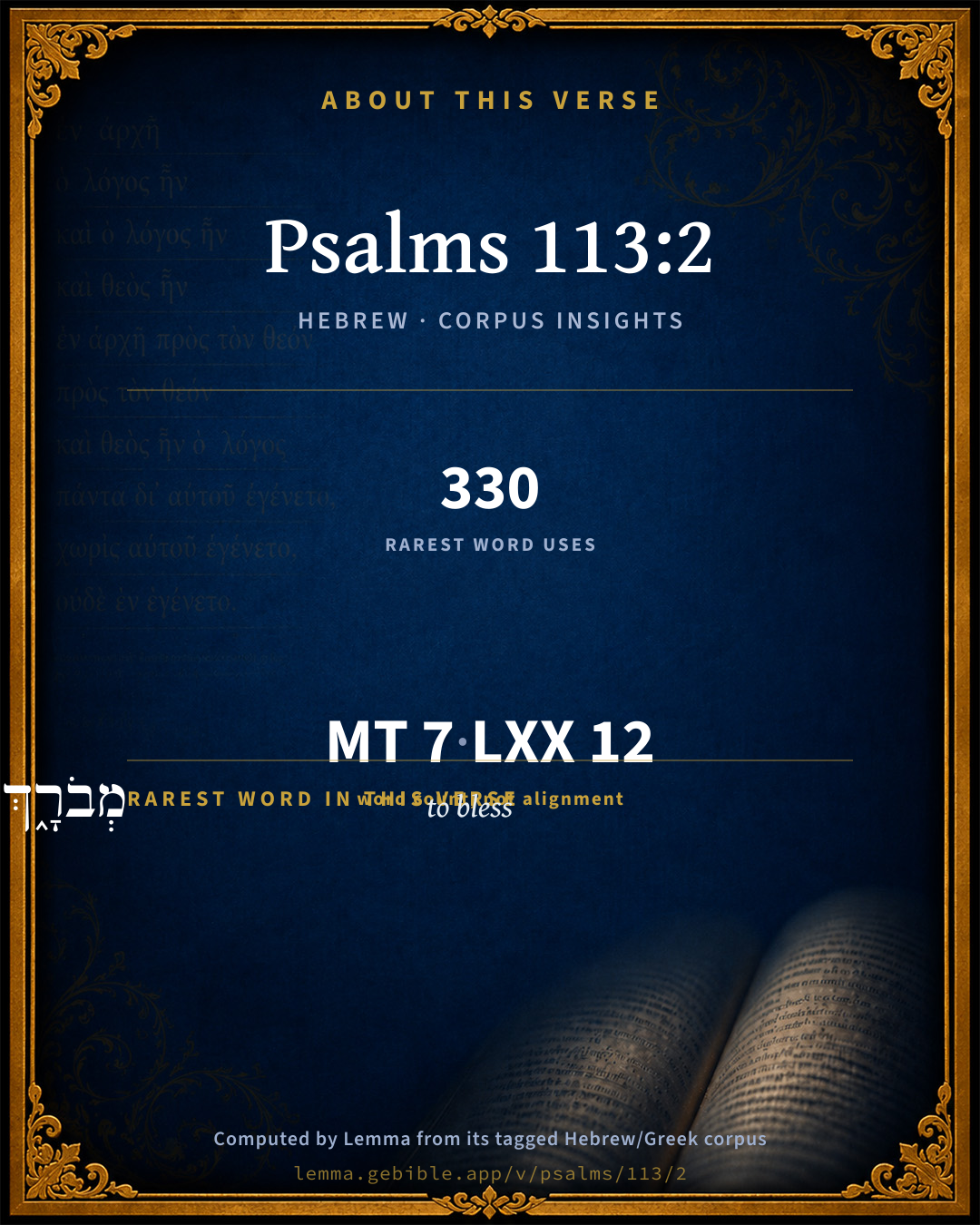
Psalms 113:2

Hebrew (Westminster Leningrad Codex) Psalms 113:2 appears in the Hebrew Old Testament. The text above is from the Westminster Leningrad Codex. Each word links to its Strong’s number, a concise gloss, and parsing drawn from the Open Scriptures Hebrew Bible morphology. Click any word for its full Brown-Driver-Briggs (BDB) entry.
Download image
Cite this verse

Psalms 113:2 (World English Bible). Public Domain. Lemma interlinear Bible study tool, https://lemma.gebible.app/v/psalms/113/2.

Show BibTeX & RIS
BibTeX
RIS
English Translation
Blessed be the name of Yahweh, From this time forth and forevermore.
World English Bible · Public Domain
Download a study sheet

One document with this verse’s original text, its word-by-word gloss line, the meaning frame, cross-references with their text, attributed commentary, and full source and license credits — printable, and it pastes into notes with its structure intact.

This verse Autodidact and up

Study sheet (.html) Plain text (.txt)

A passage Seminary Student

Up to 50 verses in one chapter. A passage sheet keeps up to 6 commentary sources and 12 cross-references per verse, in the order this page ranks them, and says so on the sheet whenever that leaves anything out. Ask for a single verse and you get the Autodidact verse sheet above.

Everything on this page stays free to read, with no account — the sheet is a download of what is already on screen, not access to it.

Want to remove ads? Support Godless Engineer
Compare translations 3

The same verse in 3 English versions, stacked beneath the original-language interlinear above. Click any original word for its lexicon entry.

Each is an independent rendering of the whole verse — the interlinear is not word-aligned to these translations.

Highlighted words mark where these versions differ — a whole-verse word diff, not a word-by-word alignment.

  • World English Bible Public Domain
    Blessed be the name of Yahweh, From this time forth and forevermore.
  • King James Version Public Domain
    Blessed be the name of the LORD from this time forth and for evermore.
  • unfoldingWord Literal Text CC BY-SA 4.0
    Blessed be the name of Yahweh, from now and to forever.

unfoldingWord Literal Text — © unfoldingWord, licensed CC BY-SA 4.0. Word-aligned USFM3 via Door43 (git.door43.org/unfoldingWord/en_ult).

Versions to compare (up to 4)

3 of 4 selected

Show all 18 translations

Every available English version of this verse, each an independent rendering of the whole verse.

  • World English Bible Public Domain
    Blessed be the name of Yahweh, From this time forth and forevermore.
  • Berean Standard Bible Public Domain
    Blessed be the name of the LORD both now and forevermore.
  • Majority Standard Bible Public Domain
    Blessed be the name of the LORD both now and forevermore.
  • King James Version Public Domain
    Blessed be the name of the LORD from this time forth and for evermore.
  • American Standard Version (1901) Public Domain
    Blessed be the name of Jehovah From this time forth and for evermore.
  • Revised Version (1885) Public Domain
    Blessed be the name of the LORD from this time forth and for evermore.
  • Geneva Bible (1599) Public Domain
    Blessed be the Name of the Lord from hencefoorth and for euer.
  • Douay-Rheims (1899) Public Domain
    Blessed be the name of the Lord, from henceforth now and for ever.
  • Young's Literal Translation Public Domain
    The name of Jehovah is blessed, From henceforth, and unto the age.
  • Literal Standard Version CC BY-SA 4.0
    The Name of YHWH is blessed, || From now on, and for all time.
  • Unlocked Literal Bible CC BY-SA 4.0
    Blessed be the name of Yahweh, both now and forevermore.
  • unfoldingWord Literal Text CC BY-SA 4.0
    Blessed be the name of Yahweh, from now and to forever.
  • Darby Bible Public Domain
    Blessed be the name of Jehovah, from this time forth and for evermore!
  • World Messianic Bible Public Domain
    Blessed be the LORD’s name, from this time forward and forever more.
  • Webster's Bible Public Domain
    Blessed be the name of the LORD from this time forth and for evermore.
  • Free Bible Version CC BY-SA 4.0
    Let the Lord's nature be praised, now and forever.
  • Bible in Basic English Public Domain
    Let blessing be on the name of the Lord, from this time and for ever.
  • JPS Tanakh (1917) Public Domain
    Blessed be the name of the LORD from this time forth and for ever.

Literal Standard Version (2020), Covenant Press — licensed CC BY-SA 4.0. Text via the HelloAO Bible API (eBible.org). Unlocked Literal Bible (unfoldingWord) — licensed CC BY-SA 4.0. Text via the HelloAO Bible API (eBible.org). unfoldingWord Literal Text — © unfoldingWord, licensed CC BY-SA 4.0. Word-aligned USFM3 via Door43 (git.door43.org/unfoldingWord/en_ult). Free Bible Version, Dr. Jonathan Gallagher — licensed CC BY-SA 4.0. Text via the HelloAO Bible API (eBible.org).

Word by word

More ways to search: Search by grammar → Find every occurrence → Compare this word →

Practice this passage: Drill this verse → Learn its vocabulary →

About this verse

These counts appear in no published source. They are computed here, from the morphology-tagged text and Lemma’s own curated glosses. What Lemma adds →

7
words
7
distinct lemmas
Wisdom
section

Grammatical profile

  • 2 verbs
  • 3 nouns
  • 1 preposition
  • 1 adverb

Verb forms

  • יְהִ֤י Qal · Imperfect
  • מְבֹרָ֑ךְ Pual · Participle Passive

Hebrew & Septuagint length

In English translation the verse runs 12 words from the Hebrew and 15 from the Septuagint (LXX English) — closely comparable.

A rough comparison of the two English renderings, which tokenize alike — not a word-level alignment.

Word counts can differ between the Hebrew and the Greek without any difference in meaning — e.g. the Hebrew direct-object marker אֵת has no separate Greek word, and Greek often adds the article ὁ.

In the original languages it is 7 Hebrew tokens and 12 Greek tokens — but the two are counted differently (Hebrew bundles its prefixes and suffixes into one token; the Greek is in lemma form), so that isn’t a like-for-like length.

Cross-references

7

Topical passages linked to Psalms 113:2 in the Treasury of Scripture Knowledge — connected by theme and wording, ordered by reader-vote popularity; previews shown in the World English Bible.

  • Daniel 2:20 Daniel answered, Blessed be the name of God forever and ever; for wisdom and might are his.
  • 1 Chronicles 16:36 Blessed be Yahweh, the God of Israel, From everlasting even to everlasting. All the people said, Amen, and praised Yahweh.
  • Psalms 41:13 Blessed be Yahweh, the God of Israel, From everlasting and to everlasting! Amen and amen.
  • Revelation 5:13 I heard every created thing which is in heaven, on the earth, under the earth, on the sea, and everything in them, saying, "To him who sits on the throne, and to the Lamb be the blessing, the honor, the glory, and the dominion, forever and ever! Amen!"
  • 1 Chronicles 29:10–13 Therefore David blessed Yahweh before all the assembly; and David said, You are blessed, Yahweh, the God of Israel our father, forever and ever.
  • Psalms 106:48 Blessed be Yahweh, the God of Israel, From everlasting even to everlasting! Let all the people say, "Amen." Praise Yah!
  • Ephesians 3:21 to him be the glory in the assembly and in Christ Jesus to all generations forever and ever. Amen.

Cross-references courtesy of OpenBible.info (CC BY 4.0).

Hebrew and Greek witnesses Masoretic Hebrew ↔ Greek Septuagint

The same verse in the two great witnesses to the Old Testament, shown verse-for-verse.

You’re reading Greek Psalm 112 (Hebrew Psalm 113). The Septuagint counts the superscription, so verse numbers can differ from the Hebrew — chapter-level alignment, not verse-by-verse. Numbering follows Rahlfs.

These are two independent witnesses, not word-aligned to each other, and the Septuagint is shown in lemma (dictionary) form.

Hebrew Psalms 113:2 Masoretic · Westminster Leningrad Codex

יְהִ֤י שֵׁ֣ם יְהוָ֣ה מְבֹרָ֑ךְ מֵֽ֝עַתָּ֗ה וְעַד עוֹלָֽם

Blessed be the name of Yahweh, From this time forth and forevermore.

World English Bible · Public Domain

Greek LXX Greek Psalm 112:2 Septuagint · lemma form

εἰμί ὁ ὄνομα κύριος εὐλογέω ἀπό ὁ νῦν καί ἕως ὁ αἰών

Let the name of the Lord be blessed, from this present time and for ever.

LXX2012 (modern English Septuagint) · Public Domain

Hebrew: Westminster Leningrad Codex (CC BY 4.0). Greek: Septuagint (public domain); English from LXX2012 (modern English Septuagint) (Public Domain). How the Septuagint differs from the Hebrew →

Commentary

Notes on Psalms 113:2 from classic Christian and Jewish commentators (each source and its license shown beneath its notes). The classic Christian expositions comment on the surrounding passage and are grouped to its opening verse, so a note may address several verses; the Jewish commentaries on the Tanakh (Rashi and others) are per-verse, so they appear only where the commentator wrote on this verse.

Lemma curates 59 commentaries, every one of them public domain or Creative Commons licensed, each selected and text-cleaned for this edition rather than reprinted as found. About our sources →

Trapp's Complete Commentary

John Trapp

Psa 113:2 Blessed be the name of the LORD from this time forth and for evermore.

Ver. 2. Blessed be the name of the Lord] Praise him with utmost intention and extension of spirit and of speech. God is therefore called, by an appellative proper, The Blessed One, Baruc-hu, Mar 14:61 Luk 1:68.

From this time, &c.] A nunc et usque.

John Trapp, A Commentary or Exposition upon All the Books of the Old and New Testament (1647–1656) — public domain. Text from a community e-Sword module.

J. A. Alexander on Psalms

Joseph Addison Alexander

2. (Psa 113:2) Be the name of Jehovah blessed, from now and even to eternity. In this as well as the preceding verse, the name of Jehovah involves the usual allusion to the manifestation of his nature in his former acts. See above, on Psa 5:11. The wish expressed in this verse implies a perpetual continuation or renewal of the evidence already furnished.

Joseph Addison Alexander, The Psalms Translated and Explained (1850) — public domain. Text from a community e-Sword module.

John Calvin's Commentaries

2 Blessed be the name of Jehovah The prophet confirms what I stated above, that the praises of God must be continued throughout the whole course of our life. If his name is to be continually praised, it ought, at least, to be our earnest endeavor, during our brief pilgrimage here, that the remembrance of it may flourish after we are dead. In the next verse, he extends the glory of God’s name to all parts of the earth; wherefore our apathy will be totally inexcusable, if we do not make its praises resound among ourselves. Under the law, God could not be praised aright, excepting in Judea by his own people, to whom the knowledge of him was confined. His works, however, which are visible to all nations, are worthy of the admiration of the whole world. To the same effect is the following clause respecting the loftiness of God’s glory; for can there be any thing more base, than for us to magnify it but seldom and tardily, considering it ought to fill our thoughts with enrapturing admiration? In extolling the name of God so highly, the prophet intends to show us that there is no ground for indifference; that silence would savor of impiety were we not to exert ourselves to the utmost of our ability to celebrate his praises, in order that our affections may, as it were, rise above the heavens. When he adds, that God is high above all nations, there is an implied reproach, by which he fastens upon the chosen people the charge of apathy in the exercise of praise. For can there be any thing more preposterous, than for those who are eye-witnesses of God’s glory, which shines forth even among the blind, to refrain from making it the theme of their praises? At the very time when God conferred upon the Jews the exclusive honor of being the depositaries of the knowledge of his heavenly doctrine, he was nevertheless, according to Paul, not without a witness, (Acts 14:17; Romans 1:20) After the promulgation of the Gospel, his exaltation above the nations was more evident, for then the whole world was placed under his sway.

John Calvin's Commentaries (1540-1563) — public domain. Text from the Calvin Translation Society English edition (1840s-50s) via the Christian Classics Ethereal Library (ccel.org). Calvin's coverage is partial (roughly two-thirds of the Bible); uncommented books and verses are honest gaps, never fabricated. The 19th-century editor's footnotes and remarks are omitted so the notes are faithfully Calvin's own voice.

John Gill's Exposition

Blessed be the name of the Lord,.... Some prefix the word "saying", as directing to the matter and manner of praising the Lord, and to express themselves thus; "let the name of the Lord be blessed"; honoured, glorified, spoken well of.

From this time forth and for evermore; from the beginning of time, or as soon as time began, the Lord's name was to be praised, and was praised by the holy angels, who were present at laying the foundation of the earth, Job 38:4, and all the works of the Lord, in their way, have praised him ever since. Here it may respect the time of penning this psalm, or the time when the persons called upon commenced the servants of the Lord, the time of their conversion; a time of love, life, light, and deliverance, and therefore a time to begin to praise the Lord: or the whole time of the Gospel dispensation, to which this psalm refers; the accepted time and day of salvation, and of the Gentiles glorifying God for his mercy; in which the Lord is to be and is praised, as he will be to all eternity, by angels and glorified saints.

John Gill's Exposition of the Whole Bible (1746–1763) — public domain (CC PDM 1.0). Text via the HelloAO Bible API.

Albert Barnes' Notes on the Bible

Blessed be the name of the Lord - Blessed be the Lord; or; Let the name of the Lord be blessed.

From this time forth and for evermore - Now and forever. He is worthy of praise now, and he ever will be. What he is now, he will always continue to be; and as praise is proper now, it will be forever and ever. An eternal God has claims to eternal praise.

Albert Barnes' Notes on the Bible (1834–1885) — public domain. Text from a community e-Sword/MySword module.

The Treasury of David

Charles H. Spurgeon

Ver. 2. Blessed be the name of the LORD. While praising him aloud, the people were also to bless him in the silence of their hearts, wishing glory to his name, success to his cause, and triumph to his truth. By mentioning the name, the Psalmist would teach us to bless each of the attributes of the Most High, which are as it were the letters of his name; not quarrelling with his justice or his severity, nor servilely dreading his power, but accepting him as we find him revealed in the inspired word and by his own acts, and loving him and praising him as such. We must not give the Lord a new name nor invent a new nature, for that would be the setting up of a false god. Every time we think of the God of Scripture we should bless him, and his august name should never be pronounced without joyful reverence.

From this time forth. If we have never praised him before, let us begin now. As the Passover stood at the beginning of the year it was well to commence the new year with blessing him who wrought deliverance for his people. Every solemn feast had its own happy associations, and might be regarded as a fresh starting place for adoration. Are there not reasons why the reader should make the present day the opening of a year of praise? When the Lord says, "From this time will I bless you, "we ought to reply, "Blessed be the name of the Lord from this time forth."

And for evermore: eternally. The Psalmist could not have intended that the divine praise should cease at a future date however remote. "For evermore" in reference to the praise of God must signify endless duration: are we wrong in believing that it bears the same meaning when it refers to gloomier themes? Can our hearts ever cease to praise the name of the Lord? Can we imagine a period in which the praises of Israel shall no more surround the throne of the Divine Majesty? Impossible. For ever, and more than "for ever, "if more can be, let him be magnified.

Ver. 2. Blessed be the name of the LORD. Let then, O man, thy labouring soul strive to conceive (for 'tis impossible to express) what an immense debt of gratitude thou owest to him, who by his creating goodness called thee out of nothing to make thee a partaker of reason and even a sharer of immortality with himself; who by his preserving goodness designs to conduct thee safe through the various stages of thy eternal existence; and who by his redeeming goodness hath prepared for thee a happiness too big for the comprehension of a human understanding. Canst thou receive such endearments of love to thee and all mankind with insensibility and coldness? ...In the whole compass of language what word is expressive enough to paint the black ingratitude of that man who is unaffected by, and entirely regardless of, the goodness of God his Creator and the mercies of Christ? Jeremiah Seed, 1747.

Ver. 2. Blessed be the name of the LORD, etc. No doubt the disciples that sat at that paschal table would repeat with mingled feelings of thanksgiving and sadness that ascription of praise. Blessed be the name of the LORD from this time forth and for evermore. But what Israelite in all the paschal chambers at Jerusalem on that night, as he sang the hallel or hymn, or which of the disciples at the sorrowing board of Jesus, could have understood or entered into the full meaning of the expression, "from this time forth?" From what time? I think St. John gives us a clue to the very hour and moment of which the Psalmist, perhaps unconsciously, spake. He tells us, that when the traitor Judas had received the sop, he immediately went out; and that when he was gone out to clench as it were and ratify his treacherous purpose, Jesus said, "Now is the Son of man glorified, and God is glorified in Him." From that time forth, when by the determinate counsel and foreknowledge of God, the Son of man was about to be delivered into the hands of wicked men, and crucified and slain, as Jesus looked at those around him, as sorrow had indeed filled their hearts, and as with all seeing, prescient eye he looked onwards and beheld all those that should hereafter believe on him through their word, with what significance and emphasis of meaning may we imagine the blessed Jesus on that night of anguish to have uttered these words of the hymn, "Blessed be the name of the LORD from this time forth and for evermore"! "A few more hours and the covenant will be sealed in my own blood; the compact ratified, when I hang upon the cross." And with what calm and confident assurance of triumph does he look upon that cross of shame; with what overflowing love does he point to it and say, "And I, if I be lifted up, will draw all men unto me"! It is the very same here in this Paschal Psalm; and how must the Saviour's heart have rejoiced even in the contemplation of those sufferings that awaited him, as he uttered this prediction, "From the rising of the sun unto the going down of the same the LORD'S name is to be praised"! "That which thou sowest is not quickened except it die:" and thus from that hour to the present the Lord hath added daily to the church those whom in every age and in every clime he hath chosen unto salvation, till, in his own appointed fulness of time, from the east and from the west, from the north and from the south, all nations shall do him service, and the "earth be filled with the knowledge of the Lord as the waters cover the sea." Barton Bouchier.

Ver. 2. From this time forth and for evermore. The servants of the Lord are to sing his praises in this life to the world's end; and in the next life, world without end. John Boys.

Ver. 2.

1. The work of heaven begun on earth: to praise the name of the Lord.

2. The work of earth continued in heaven: "and for evermore." If the praise begun on earth be continued in heaven, we must be in heaven to continue the praise. G. R.

Ver. 2.

1. It is time to begin to praise: "from this time." Is there not special reason, from long arrears, from present duty, etc.?

2. There is no time for leaving off praise: "and for evermore." None supposable or excusable.

Psalms 113:3*

Charles H. Spurgeon's The Treasury of David (1869–1885) — public domain. Psalms only. Text from a community e-Sword/MySword module.

Whedon's Commentary on the Bible

Daniel D. Whedon

2. From this time forth—From now unto eternity. The from now supposes an urgent cause for a new form and measure of praise, as if it should mark a new date of national piety and experience, and well accords with the state of the newly returned exiles. See Psa_115:18; Psa_121:8; Psa_131:3

Daniel D. Whedon (gen. ed.), Commentary on the Old and New Testaments (1874–1909) — public domain. Text from a community e-Sword module.

The Pulpit Commentary

Blessed be the Name of the Lord from this time forth and for evermore. The prayer here is that God may be praised through all time, as in the next verse it is that he may be praised through all space. In connection with the praise of God, limits of time and place are unsuitable. (comp. Psa_115:18 Psa_121:8 Psa_131:3 Isa_59:21 Mic_4:7)

The Pulpit Commentary (1880–1919), ed. H.D.M. Spence-Jones & Joseph S. Exell — public domain. Text from a community e-Sword module.

Lesson kit

Teaching starters — assembled from the data on this page, not authored interpretation. Every prompt links to the verse data it draws on. Edit before teaching.

Psalms, in the Wisdom, opens this verse with 7 words (7 distinct Hebrew lemmas). Its most distinctive word is bârak (“to bless”). A historical commentator’s framing appears above. Read the whole chapter for the surrounding context.

Discussion questions

  1. The word bârak carries the sense “to bless.” How does it shape the verse?
  2. How does Daniel 2:20, which shares this passage’s theme, read alongside this verse?
  3. These translations render this verse differently. What is at stake in choosing one wording over another?
  4. «יְהִ֤י» is a Qal Imperfect verb. How does that grammatical form shape the action described?
  5. Compare how Trapp's Complete Commentary and J. A. Alexander on Psalms read this verse. Where do they agree or differ?

Things to notice

Reading settings

Reading text

Shown beneath each verse's original-language words.

Old Testament
Old Testament edition

Read the OT as the Masoretic Hebrew (MT) or the Greek Septuagint (LXX).

English shown for the Greek Septuagint (in the Hebrew ↔ Greek comparison).

Comparing translations? Open the Compare panel on any verse page to stack up to four side by side.