
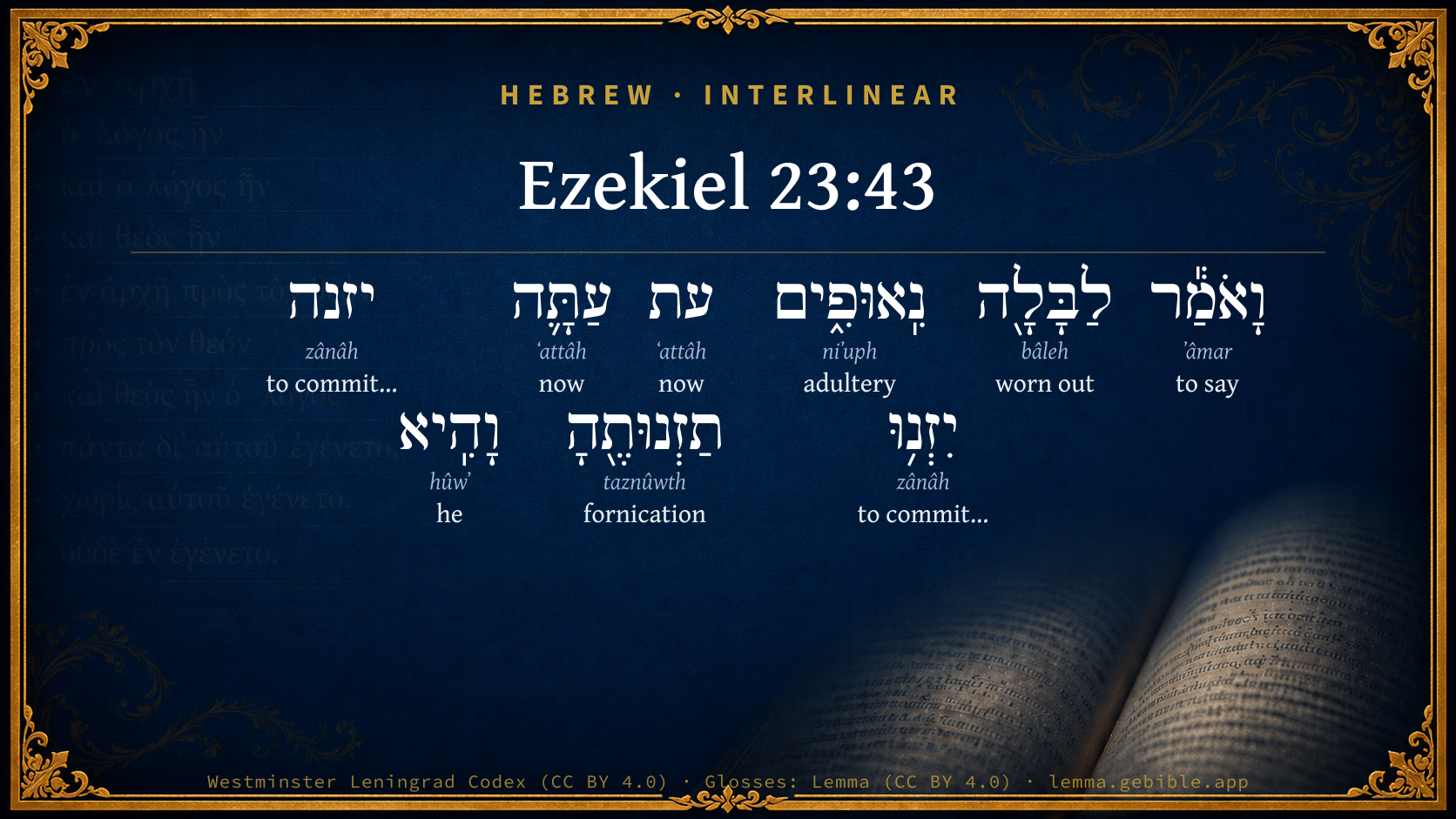
Ezekiel 23:43

Hebrew (Westminster Leningrad Codex) Ezekiel 23:43 appears in the Hebrew Old Testament. The text above is from the Westminster Leningrad Codex. Each word links to its Strong’s number, a concise gloss, and parsing drawn from the Open Scriptures Hebrew Bible morphology. Click any word for its full Brown-Driver-Briggs (BDB) entry.
Download image
Cite this verse

Ezekiel 23:43 (World English Bible). Public Domain. Lemma interlinear Bible study tool, https://lemma.gebible.app/v/ezekiel/23/43.

Show BibTeX & RIS
BibTeX
RIS
English Translation
Then said I of her who was old in adulteries, Now will they play the prostitute with her, and she [with them].
World English Bible · Public Domain
Download a study sheet

One document with this verse’s original text, its word-by-word gloss line, the meaning frame, cross-references with their text, attributed commentary, and full source and license credits — printable, and it pastes into notes with its structure intact.

This verse Autodidact and up

Study sheet (.html) Plain text (.txt)

A passage Seminary Student

Up to 50 verses in one chapter. A passage sheet keeps up to 6 commentary sources and 12 cross-references per verse, in the order this page ranks them, and says so on the sheet whenever that leaves anything out. Ask for a single verse and you get the Autodidact verse sheet above.

Everything on this page stays free to read, with no account — the sheet is a download of what is already on screen, not access to it.

Want to remove ads? Support Godless Engineer
Compare translations 3

The same verse in 3 English versions, stacked beneath the original-language interlinear above. Click any original word for its lexicon entry.

Each is an independent rendering of the whole verse — the interlinear is not word-aligned to these translations.

Highlighted words mark where these versions differ — a whole-verse word diff, not a word-by-word alignment.

  • World English Bible Public Domain
    Then said I of her who was old in adulteries, Now will they play the prostitute with her, and she [with them].
  • King James Version Public Domain
    Then said I unto her that was old in adulteries, Will they now commit whoredoms with her, and she with them?
  • unfoldingWord Literal Text CC BY-SA 4.0
    Then I said of her who was worn out by adultery, ‘Now they will be sexually immoral with her, and she with them.’

unfoldingWord Literal Text — © unfoldingWord, licensed CC BY-SA 4.0. Word-aligned USFM3 via Door43 (git.door43.org/unfoldingWord/en_ult).

Versions to compare (up to 4)

3 of 4 selected

Show all 18 translations

Every available English version of this verse, each an independent rendering of the whole verse.

  • World English Bible Public Domain
    Then said I of her who was old in adulteries, Now will they play the prostitute with her, and she [with them].
  • Berean Standard Bible Public Domain
    Then I said of her who had grown old in adulteries: ‘Now let them use her as a prostitute, for that is all she is!’
  • Majority Standard Bible Public Domain
    Then I said of her who had grown old in adulteries: ‘Now let them use her as a prostitute, for that is all she is!’
  • King James Version Public Domain
    Then said I unto her that was old in adulteries, Will they now commit whoredoms with her, and she with them?
  • American Standard Version (1901) Public Domain
    Then said I of her that was old in adulteries, Now will they play the harlot with her, and she `with them'.
  • Revised Version (1885) Public Domain
    Then said I of her that was old in adulteries, Now will they commit whoredoms with her, and she with them.
  • Geneva Bible (1599) Public Domain
    Then I sayd vnto her, that was olde in adulteries, Now shall she and her fornications come to an end.
  • Douay-Rheims (1899) Public Domain
    And I said to her that was worn out in her adulteries: Now will this woman still continue in her fornication.
  • Young's Literal Translation Public Domain
    And I say of the worn-out one in adulteries, Now they commit her whoredoms -- she also!
  • Literal Standard Version CC BY-SA 4.0
    And I say of the worn-out one in adulteries, || Now they commit her whoredoms—she also!
  • Unlocked Literal Bible CC BY-SA 4.0
    Then I said of her who was worn out by adultery, 'Now they will be sexually immoral with her, and she with them.'
  • unfoldingWord Literal Text CC BY-SA 4.0
    Then I said of her who was worn out by adultery, ‘Now they will be sexually immoral with her, and she with them.’
  • Darby Bible Public Domain
    And I said of her that was old in adulteries, Will she now commit her fornications, even she.
  • World Messianic Bible Public Domain
    Then I said of her who was old in adulteries, ‘Now they will play the prostitute with her, and she with them.’
  • Webster's Bible Public Domain
    Then said I to her that was old in adulteries, Will they now commit lewd deeds with her, and she with them?
  • Free Bible Version CC BY-SA 4.0
    Then I said about the old worn-out woman, ‘Now they can have her as a prostitute because that's what she is!’
  • Bible in Basic English Public Domain
    Then I said... now she will go on with her loose ways.
  • JPS Tanakh (1917) Public Domain
    Then said I of her that was worn out by adulteries: Still they commit harlotries with her, even her.

Literal Standard Version (2020), Covenant Press — licensed CC BY-SA 4.0. Text via the HelloAO Bible API (eBible.org). Unlocked Literal Bible (unfoldingWord) — licensed CC BY-SA 4.0. Text via the HelloAO Bible API (eBible.org). unfoldingWord Literal Text — © unfoldingWord, licensed CC BY-SA 4.0. Word-aligned USFM3 via Door43 (git.door43.org/unfoldingWord/en_ult). Free Bible Version, Dr. Jonathan Gallagher — licensed CC BY-SA 4.0. Text via the HelloAO Bible API (eBible.org).

Word by word

More ways to search: Search by grammar → Find every occurrence → Compare this word →

Practice this passage: Drill this verse → Learn its vocabulary →

About this verse

These counts appear in no published source. They are computed here, from the morphology-tagged text and Lemma’s own curated glosses. What Lemma adds →

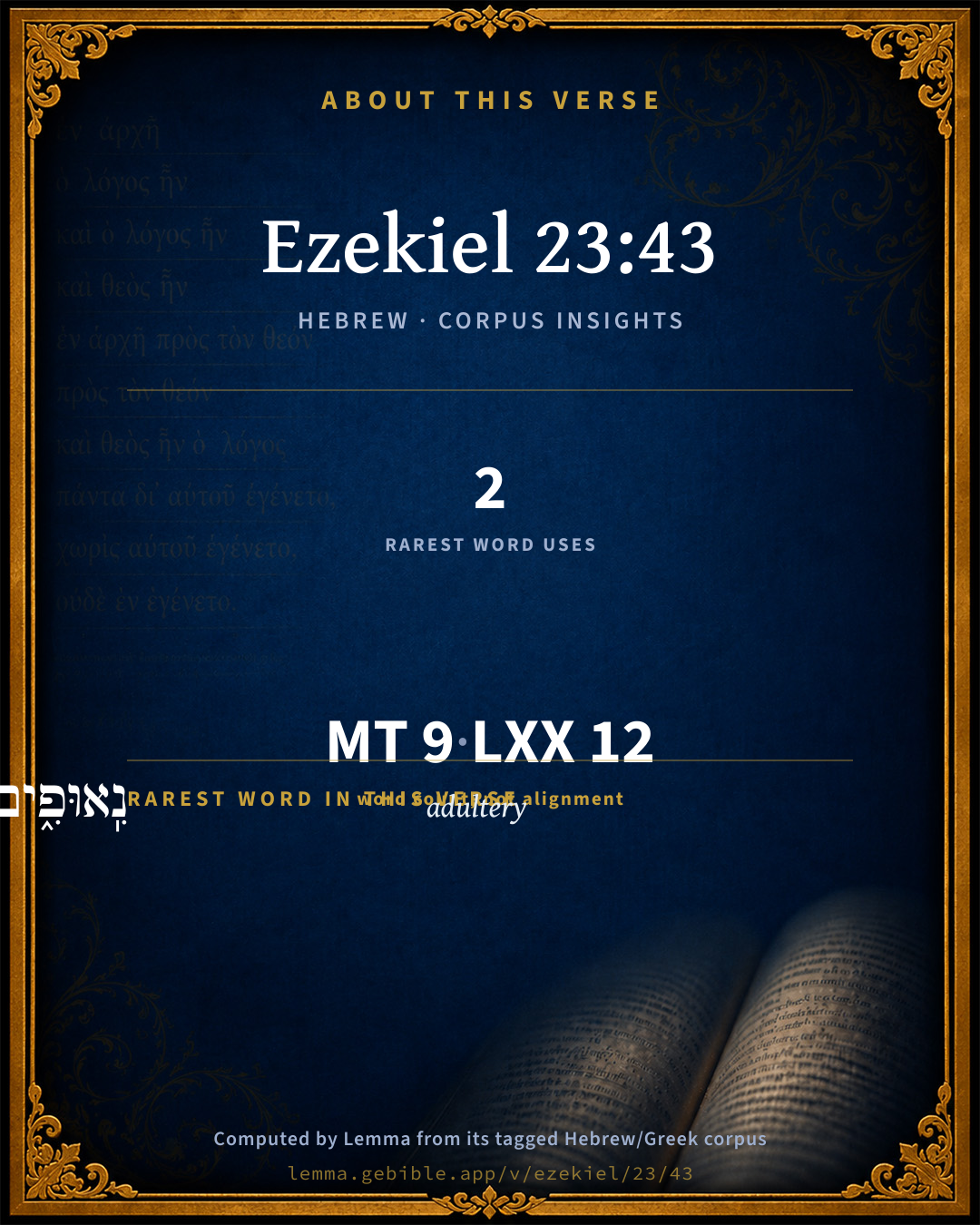
9
words
7
distinct lemmas
Prophets
section

Notable vocabulary

The rarest word here is נִֽאוּפִ֑ים adultery H5004 — appearing just 2 times in the whole Hebrew Bible.

Shared distinctive vocabulary

נִֽאוּפִ֑ים adultery H5004 occurs in 2 verses of the Hebrew Bible. Also found in:

Grammatical profile

  • 3 verbs
  • 2 nouns
  • 1 adjective
  • 1 pronoun
  • 2 adverbs

Verb forms

  • וָאֹמַ֕ר Qal · Sequential Imperfect
  • יזנה Qal · Imperfect
  • יִזְנ֥וּ Qal · Imperfect

Repetition

Words recur within this verse — often emphatic in Hebrew:

  • עת now H6258 ×2
  • יזנה to commit fornication H2181 ×2

Hebrew & Septuagint length

In English translation the verse runs 22 words from the Hebrew and 22 from the Septuagint (LXX English) — the same length.

A rough comparison of the two English renderings, which tokenize alike — not a word-level alignment.

Word counts can differ between the Hebrew and the Greek without any difference in meaning — e.g. the Hebrew direct-object marker אֵת has no separate Greek word, and Greek often adds the article ὁ.

In the original languages it is 9 Hebrew tokens and 12 Greek tokens — but the two are counted differently (Hebrew bundles its prefixes and suffixes into one token; the Greek is in lemma form), so that isn’t a like-for-like length.

Cross-references

5

Topical passages linked to Ezekiel 23:43 in the Treasury of Scripture Knowledge — connected by theme and wording, ordered by reader-vote popularity; previews shown in the World English Bible.

  • Ezra 9:7 Since the days of our fathers we have been exceeding guilty to this day; and for our iniquities have we, our kings, and our priests, been delivered into the hand of the kings of the lands, to the sword, to captivity, and to plunder, and to confusion of face, as it is this day.
  • Psalms 106:6 We have sinned with our fathers. We have committed iniquity. We have done wickedly.
  • Jeremiah 13:23 Can the Ethiopian change his skin, or the leopard his spots? then may you also do good, who are accustomed to do evil.
  • Ezekiel 23:3 and they played the prostitute in Egypt; they played the prostitute in their youth; there were their breasts pressed, and there was handled the bosom of their virginity.
  • Daniel 9:16 Lord, according to all your righteousness, let your anger and please let your wrath be turned away from your city Jerusalem, your holy mountain; because for our sins, and for the iniquities of our fathers, Jerusalem and your people are become a reproach to all who are round about us.

Cross-references courtesy of OpenBible.info (CC BY 4.0).

Hebrew and Greek witnesses Masoretic Hebrew ↔ Greek Septuagint

The same verse in the two great witnesses to the Old Testament, shown verse-for-verse.

These are two independent witnesses, not word-aligned to each other, and the Septuagint is shown in lemma (dictionary) form.

Hebrew Ezekiel 23:43 Masoretic · Westminster Leningrad Codex

וָאֹמַ֕ר לַבָּלָ֖ה נִֽאוּפִ֑ים עת עַתָּ֛ה יזנה יִזְנ֥וּ תַזְנוּתֶ֖הָ וָהִֽיא

Then said I of her who was old in adulteries, Now will they play the prostitute with her, and she [with them].

World English Bible · Public Domain

Greek LXX Ezekiel 23:43 Septuagint · lemma form

καί εἶπον οὐ ἐν οὗτος μοιχεύω καί ἔργον πόρνη καί αὐτός ἐκπορνεύω

Therefore I said, Do they not commit adultery with these? and has she also gone a-whoring after the manner of a harlot?

LXX2012 (modern English Septuagint) · Public Domain

On this verse, The Cambridge Bible for Schools and Colleges discusses the Septuagint’s reading. Read the note in Commentary ↓

Hebrew: Westminster Leningrad Codex (CC BY 4.0). Greek: Septuagint (public domain); English from LXX2012 (modern English Septuagint) (Public Domain). How the Septuagint differs from the Hebrew →

Targum (Aramaic paraphrase)

1

The Targum is the ancient Jewish Aramaic paraphrase of the Hebrew Scriptures — an interpretive translation, not the Hebrew text itself. Onkelos (literal) and Pseudo-Jonathan (expansive) render the Torah, and Jonathan the Prophets. Coverage is partial: where no permissively-licensed English translation exists for a verse, only the Aramaic is shown. This is verse-level text, not a word-by-word alignment to the Hebrew.

  1. Targum Jonathan Prophets (Joshua–Malachi)
    וַאֲמָרֵית לִכְנִשְׁתָּא דְיִשְׂרָאֵל דִבְלִיעַת עַמָה בְּחוֹבִין כְּעַן תִּשְׁבוֹק מִטַעֲוָתָהּ וּתְתוּב לְפוּלְחָנִי וְלָא תָבָת:

    (no public-domain English translation for this verse)

    Targum Jonathan — Aramaic: “Mikraot Gedolot” (public domain). English: “Sefaria Community Translation” (CC0 1.0 (public-domain dedication)); “London "Chaldee Paraphrase," 1871” (public domain). Text via Sefaria.

Commentary

Notes on Ezekiel 23:43 from classic Christian and Jewish commentators (each source and its license shown beneath its notes). The classic Christian expositions comment on the surrounding passage and are grouped to its opening verse, so a note may address several verses; the Jewish commentaries on the Tanakh (Rashi and others) are per-verse, so they appear only where the commentator wrote on this verse.

Lemma curates 59 commentaries, every one of them public domain or Creative Commons licensed, each selected and text-cleaned for this edition rather than reprinted as found. About our sources →

Trapp's Complete Commentary

John Trapp

Eze 23:43 Then said I unto [her that was] old in adulteries, Will they now commit whoredoms with her, and she [with them]?

Ver. 43. To her that was old in adulteries.] Inveteratae et detritae, withered and overworn.

And she with them?] Is she - as Helen was παλαι γυνη - the same still, no changeling yet?

John Trapp, A Commentary or Exposition upon All the Books of the Old and New Testament (1647–1656) — public domain. Text from a community e-Sword module.

Joseph Benson's Commentary

Eze 23:43-44. Then I said unto her that was grown old in adulteries — Aholibah, who had been long idolatrous. The words import that experience might, before this time, have sufficiently convinced her of the folly of her ways. Will they now commit whoredoms with her? — God is here represented as waiting to see whether that mutability, which is natural to the human race, would not occasion a difference between the Jewish people and their idolatrous allies, and make them grow weary of one another. Yet they went in unto her, &c. — Both Samaria and Jerusalem continued to defile themselves with the idolatries of all the heathen round about them: compare Eze 23:7; Eze 23:17.

Joseph Benson's Commentary on the Old and New Testaments (1811–1818) — public domain. Text from a community e-Sword module.

Jamieson, Fausset & Brown

Robert Jamieson, A. R. Fausset & David Brown

Will they, &c.--Is it possible that paramours will desire any longer to commit whoredoms with so worn-out an old adulteress?

Jamieson, Fausset & Brown — Commentary Critical and Explanatory on the Whole Bible (1871) — public domain (CC PDM 1.0). Text via the HelloAO Bible API.

Ellicott's Commentary for English Readers

(43) Will they now commit?—This should not be made a question, nor should the opening of Eze_23:44 be made adversative. The thought is that, after all means of reclamation had failed, God gave her up to her sins. Translate, Now shall her whoredom be committed, even this. And they went in, &c.

A Bible Commentary for English Readers, edited by Charles John Ellicott (1878–1897) — public domain. Text from a community e-Sword module.

The Cambridge Bible for Schools and Colleges

gen. ed. J. J. S. Perowne

43. unto her … old in adulteries] Old is worn out, e.g. of clothes, Jos_9:4-5, and the verb of the body, in the decay of nature (Gen_18:12, of Sarah). The construction of A.V. is unusual; the words might be read as an exclamation: She that is aged committeth adulteries! or, With her that is aged shall they commit adulteries! Ew., reading “aged” as a noun, To perdition with adulteries! None of these senses is very natural. LXX., as in some other places, appears to assume a contraction, which it expands, Do they not commit adultery with these?

The meaning put by A.V., R.V. upon the rest of the verse can hardly be drawn from the words, which are extremely obscure. The natural sense is: “now shall her whoredom commit whoredom even itself” (Hitz.); but the idea that what the faded harlot can no more do herself her vicious propensity continues to do, though true in itself, is scarcely to be expected here. LXX., which had nearly our present text before it, disposes the letters differently: And she too has gone a whoring after the manner (with the doings) of a harlot. So Syr., And according to the doings of harlots have they committed whoredom.

The Cambridge Bible for Schools and Colleges (gen. ed. J. J. S. Perowne; Cambridge University Press, 1878–1918) — public domain. Text from a community e-Sword module.

John Gill's Exposition

Then said I unto her that was old in adulteries,.... That had been an old adulterer or idolater; meaning either Aholah the ten tribes, who from Jeroboam's time had been guilty of idolatry; or Aholibah the two tribes, who had remained longer in their own country, and had been long given to idolatry; or both of them, as some think, the whole body of the people of Israel, who had been addicted to idolatry ever since they came out of Egypt, and so was like an old harlot indeed: now the Lord said "unto her", or "concerning her" (l); in his own mind, after the manner of men. So the Targum,

"I said concerning the congregation of Israel, whose people are old in sins:''

will they now commit whoredoms with her, and she with them? will they commit adultery with such an old harlot? are they not weary of her? and will they not rather loath and despise her? as it is common when such prostitutes grow old; and what pleasure can she take, thus advanced in years, in such impurities? suggesting that alliances and confederacies between the Jews and the nations of the world could not be agreeable on either side, especially to the former; but so it was, and so were their idolatries likewise. The Targum is,

"now she will leave her idols, and return to thy worship; but she returned not.''

(l) "de inveterata illa", Vatablus.

John Gill's Exposition of the Whole Bible (1746–1763) — public domain (CC PDM 1.0). Text via the HelloAO Bible API.

Albert Barnes' Notes on the Bible

Will they now commit ... - Rather, Now shall there be committed her whoredom, even this; i. e., when Israel and Judah had courted these alliances God said in wrath, “This sin too shall be committed, and so (not “yet) they went in;” the alliances were made according to their desires, and then followed the consequent punishment.

Albert Barnes' Notes on the Bible (1834–1885) — public domain. Text from a community e-Sword/MySword module.

Matthew Poole's English Annotations

Then said I; after the manner of man God seems to stand musing, or saying to himself, or it may be supposed that God speaks to the prophet, asking him.

Unto her; or rather, of her, concerning her.

Old in adulteries, such usually are out of request with adulterers; and now Samaria and Jerusalem had been long spiritual adulteresses, and one would think her lovers would be weary of her, if she were not weary of them.

Matthew Poole's English Annotations on the Holy Bible (1683–1685) — public domain. Text from a community e-Sword/MySword module.

Whedon's Commentary on the Bible

Daniel D. Whedon

43. Mosheh Ben Shesheth renders: “As I looked I thought: Can it be that a woman who is old and decrepit will commit adultery? Or is it not enough that she has grown old in whoredoms? No; therefore even these have come to commit them with her?(or, Will they not take away all her gains and herself as well?).” This shows how uncertain the Hebrew text is. The picture seems to be that of a woman worn out in sin, yet still attempting to carry on her old life. It of course refers to Jerusalem coqueting with foreign alliances and foreign idolatries.

Daniel D. Whedon (gen. ed.), Commentary on the Old and New Testaments (1874–1909) — public domain. Text from a community e-Sword module.

The Pulpit Commentary

The whole verse is obscure, and has been very differently rendered.

(1) The Authorized Version may be paraphrased, "Then said I to her that was worn out with her whoredoms, passed her prime and enfeebled, Will they (the foreign nations) commit whoredoms (enter into alliances) with her? sc. What is there to attract now? And yet the habit is inveterate. She has grown old in her vice, and cannot cease from it.

(2) The Revised Version takes it not as a question, but as a statement: Now said I of her that was old in adulteries, Now will they commit, etc. So, in the main, Keil. The text is probably corrupt, and resists conjectural emendation. In any ease the general meaning is clear. The sin is of too long standing to be cured.

The Pulpit Commentary (1880–1919), ed. H.D.M. Spence-Jones & Joseph S. Exell — public domain. Text from a community e-Sword module.

unfoldingWord translationNotes

Door43 World Missions Community

General Information:

Yahweh continues to refer to the cities of Jerusalem and Samaria as if they were two prostitutes. (See: Metaphor)

her who was worn out ... with her, and she with them

This refers to one of the sisters but the situation is probably the same for both sisters. If one sister must be specified in your language, refer to Oholibah here.

They went in to her and slept with her as men go in to be with a prostitute

This compares the way men slept with her to the way men sleep with a prostitute. AT: "They slept with her in the same way that men sleep with a prostitute" (See: Euphemism)

They went in to her

"They went in to where she was" or "They went to her"

In this way they slept with Oholah and Oholibah

"This is how they slept with Oholah and Oholibah"

pass judgment

This is an idiom. AT: "condemn" (See: Idiom)

who shed blood ... blood is on their hands

This is an idiom. AT: "who murder people ... murderers" (See: Idiom)

translationWords

adultery

sexual immorality

guilt

righteous

condemn

punish

blood

hand

unfoldingWord translationNotes — © Distant Shores Media and the Door43 World Missions Community, licensed CC BY-SA 4.0. Source: git.door43.org/Door43/en_tn.

Rashi

Rabbi Shlomo Yitzchaki (Rashi)

And I said of the one who had aged [in] adulteries, “Now her harlotries will end,” etc. I said to Myself about this one who had become worn out and aged in her adulteries, “From now on, since she has aged, her harlotries will leave her, and the desires for her harlotry will leave her heart, and she will repent,” but she is still in her harlotries as in the beginning.

will end [Heb. יִזְנוּ] will leave. Every “harlot” (זוֹנָה) is translated into Aramaic as נֳפְקֲת בְּרָא, one who goes out. So did I hear, and so did Jonathan render.

of the one who had aged [in] adulteries like: [lit. to the one who had aged adulteries,] the one who had aged in adulteries, as you say (Gen. 38:11): “and she remained her father’s house,” is like “in her father’s house”; (Exod. 30:20), “they shall wash water,” is like “they shall wash with water.” [Likewise,] (ibid.): “And he shall go out freedom;” [and] (Num. 30:11): “But if she made a vow [in] her father’s house.” So did Dunash (p. 17) explain [this]. However, Menachem connected it (p. 45) to (Lev 20:12): “they committed a disgraceful act (תֶּבֶל),” but his words are impossible.

Rashi on the Tanakh — English translations: “The Judaica Press complete Tanach with Rashi, translated by A. J. Rosenberg” (CC BY 4.0); “Pentateuch with Rashi's commentary by M. Rosenbaum and A.M. Silbermann, 1929-1934” (public domain); “The Metsudah Tanach series, Lakewood, N.J” (CC BY 4.0); and “The Book of Joshua, Metsudah Publications, 1997” (CC BY 4.0). Text via Sefaria.

Lesson kit

Teaching starters — assembled from the data on this page, not authored interpretation. Every prompt links to the verse data it draws on. Edit before teaching.

Ezekiel, in the Prophets, opens this verse with 9 words (7 distinct Hebrew lemmas). Its most distinctive word is niʼuph (“adultery”). A historical commentator’s framing appears above. Read the whole chapter for the surrounding context.

Discussion questions

  1. How does “adultery” (niʼuph) shape what this verse is saying?
  2. How does Jeremiah 13:27, which shares the word «adultery», read alongside this verse?
  3. What does the repetition of “now” (2× in this one verse) do in this verse?
  4. These translations render this verse differently. What is at stake in choosing one wording over another?
  5. «וָאֹמַ֕ר» is a Qal Sequential Imperfect verb. How does that grammatical form shape the action described?
  6. Compare how Trapp's Complete Commentary and Joseph Benson's Commentary read this verse. Where do they agree or differ?

Things to notice

Reading settings

Reading text

Shown beneath each verse's original-language words.

Old Testament
Old Testament edition

Read the OT as the Masoretic Hebrew (MT) or the Greek Septuagint (LXX).

English shown for the Greek Septuagint (in the Hebrew ↔ Greek comparison).

Comparing translations? Open the Compare panel on any verse page to stack up to four side by side.