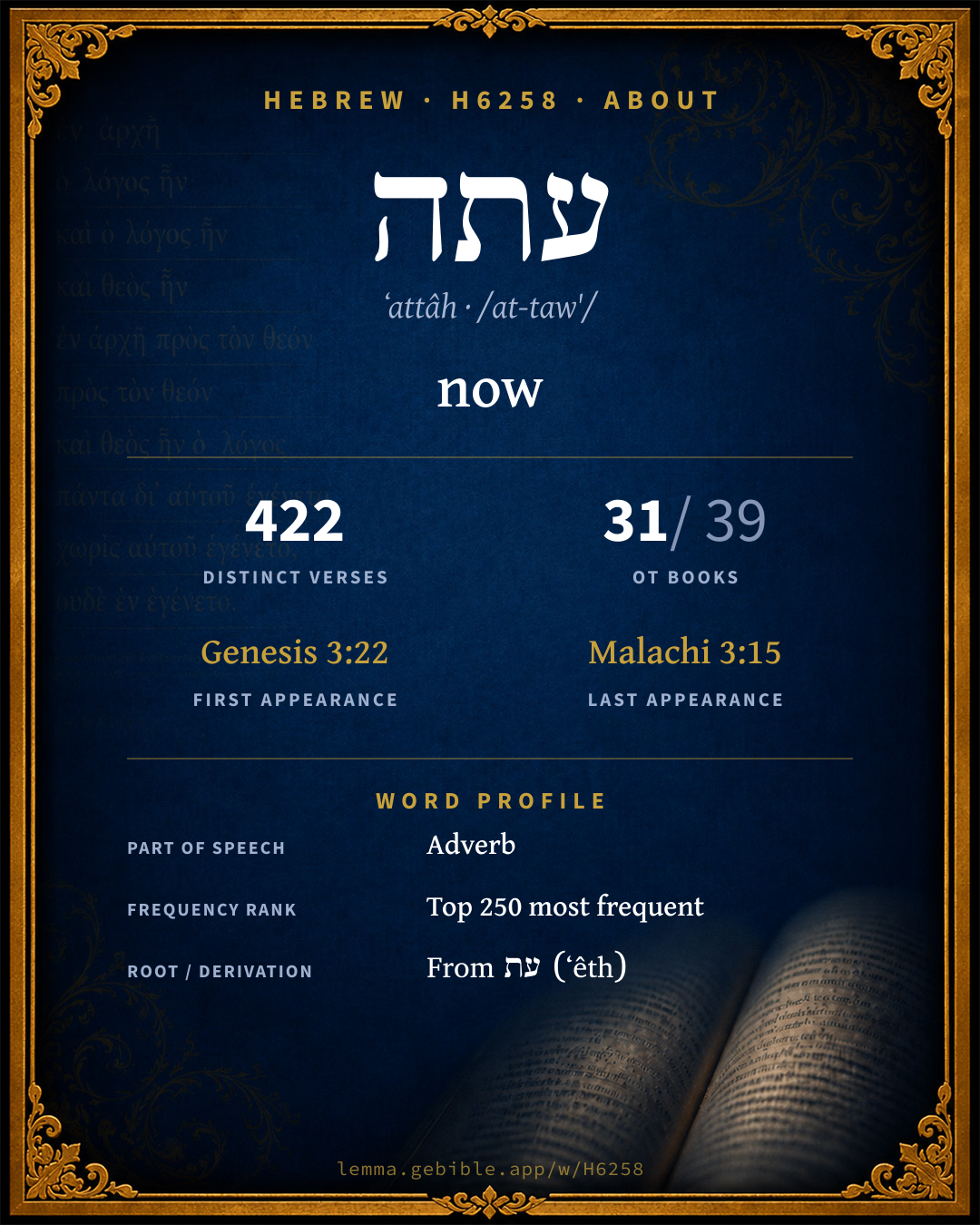
עַתָּ֫ה
now
‘now’ is one of 2 main senses fuller range ↓
Full lexicon entry — Brown-Driver-Briggs (BDB)
From Brown-Driver-Briggs (BDB)
Where this word appears
Grammar key — what these labels mean
Part of speech
- Adverb
- A word that modifies a verb, adjective, or other adverb.
Every verse where H6258 appears in the Book of 2 Kings — 22 distinct verses. Click any verse to open its interlinear word-by-word view. Verse text shown in the World English Bible for context — . Each verse’s Hebrew form is shown with its reference; the English is not keyword-highlighted, since the data carries no word-level English alignment. Use “Compare translations” on any verse to read it across multiple English versions. This concordance covers the Hebrew Bible; Septuagint (Greek Old Testament) occurrences are not indexed here.
2 Kings
- 2 Kings 1:14 וְ/עַתָּ֕ה conj + adv Behold, fire came down from the sky, and consumed the two former captains of fifty with their fifties; but now let my life be precious in your sight.
- 2 Kings 3:15 וְ/עַתָּ֖ה conj + adv But now bring me a minstrel. It happened, when the minstrel played, that the hand of Yahweh came on him.
- 2 Kings 3:23 וְ/עַתָּ֥ה conj + adv and they said, This is blood; the kings are surely destroyed, and they have struck each man his fellow: now therefore, Moab, to the spoil.
- 2 Kings 4:26 עַתָּה֮ adv please run now to meet her, and ask her, Is it well with you? is it well with your husband? is it well with the child? She answered, It is well.
- 2 Kings 5:6 וְ/עַתָּ֗ה conj + adv He brought the letter to the king of Israel, saying, Now when this letter is come to you, behold, I have sent Naaman my servant to you, that you may recover him of his leprosy.
- 2 Kings 5:15 וְ/עַתָּ֛ה conj + adv He returned to the man of God, he and all his company, and came, and stood before him; and he said, See now, I know that there is no God in all the earth, but in Israel: now therefore, please take a present from your servant.
- 2 Kings 5:22 עַתָּ֡ה adv He said, All is well. My master has sent me, saying, Behold, even now there are come to me from the hill-country of Ephraim two young men of the sons of the prophets; please give them a talent of silver, and two changes of clothing.
- 2 Kings 7:4 וְ/עַתָּ֗ה conj + adv If we say, We will enter into the city, then the famine is in the city, and we shall die there; and if we sit still here, we die also. Now therefore come, and let us fall to the host of the Syrians: if they save us alive, we shall live; and if they kill us, we shall but die.
- 2 Kings 7:9 וְ/עַתָּה֙ conj + adv Then they said one to another, We aren't doing right. This day is a day of good news, and we hold our peace: if we wait until the morning light, punishment will overtake us; now therefore come, let us go and tell the king's household.
- 2 Kings 8:6 עָֽתָּה adv When the king asked the woman, she told him. So the king appointed to her a certain officer, saying, Restore all that was hers, and all the fruits of the field since the day that she left the land, even until now.
- 2 Kings 9:26 וְ/עַתָּ֗ה conj + adv Surely I have seen yesterday the blood of Naboth, and the blood of his sons, says Yahweh; and I will requite you in this plat, says Yahweh. Now therefore take and cast him into the plat [of ground], according to the word of Yahweh.
- 2 Kings 10:2 וְ/עַתָּ֗ה conj + adv Now as soon as this letter comes to you, seeing your master's sons are with you, and there are with you chariots and horses, a fortified city also, and armor;
- 2 Kings 10:19 וְ/עַתָּ֣ה conj + adv Now therefore call to me all the prophets of Baal, all his worshippers, and all his priests; let none be wanting: for I have a great sacrifice [to do] to Baal; whoever shall be wanting, he shall not live. But Jehu did it in subtlety, to the intent that he might destroy the worshippers of Baal.
- 2 Kings 12:7 וְ/עַתָּ֗ה conj + adv Then king Jehoash called for Jehoiada the priest, and for the [other] priests, and said to them, Why don't you repair the breaches of the house? now therefore take no [more] money from your acquaintance, but deliver it for the breaches of the house.
- 2 Kings 13:19 וְ/עַתָּ֕ה conj + adv The man of God was angry with him, and said, You should have struck five or six times: then had you struck Syria until you had consumed it, whereas now you shall strike Syria but thrice.
- 2 Kings 13:23 עָֽתָּה adv But Yahweh was gracious to them, and had compassion on them, and had respect to them, because of his covenant with Abraham, Isaac, and Jacob, and would not destroy them, neither cast he them from his presence as yet.
- 2 Kings 18:20 עַתָּה֙ adv You say (but they are but vain words), [There is] counsel and strength for the war. Now on whom do you trust, that you have rebelled against me?
- 2 Kings 18:21 עַתָּ֡ה adv Now, behold, you trust on the staff of this bruised reed, even on Egypt; whereon if a man lean, it will go into his hand, and pierce it: so is Pharaoh king of Egypt to all who trust on him.
- 2 Kings 18:23 וְ/עַתָּה֙ conj + adv Now therefore, Please give pledges to my master the king of Assyria, and I will give you two thousand horses, if you are able on your part to set riders on them.
- 2 Kings 18:25 עַתָּה֙ adv Am I now come up without Yahweh against this place to destroy it? Yahweh said to me, Go up against this land, and destroy it.
- 2 Kings 19:19 וְ/עַתָּה֙ conj + adv Now therefore, Yahweh our God, save you us, I beg you, out of his hand, that all the kingdoms of the earth may know that you Yahweh are God alone.
- 2 Kings 19:25 עַתָּ֣ה adv Haven't you heard how I have done it long ago, and formed it of ancient times? now have I brought it to pass, that it should be yours to lay waste fortified cities into ruinous heaps.
About this entry
At a glance — auto-summarized from this page’s data, not written by a person. Every figure links to its source below. This summary describes the numbers; it doesn’t interpret them.
At its core, עתה (ʻattâh) means “now.” Scripture first uses it in Genesis 3:22. With 422 verses in 31 books, it is a common word in the Hebrew Bible. Not a single-sense word: explore its full sense range. Sharing its root, it stands alongside עת, עתי and עת קצין. Each statement above links to its evidence; the full detail follows below.
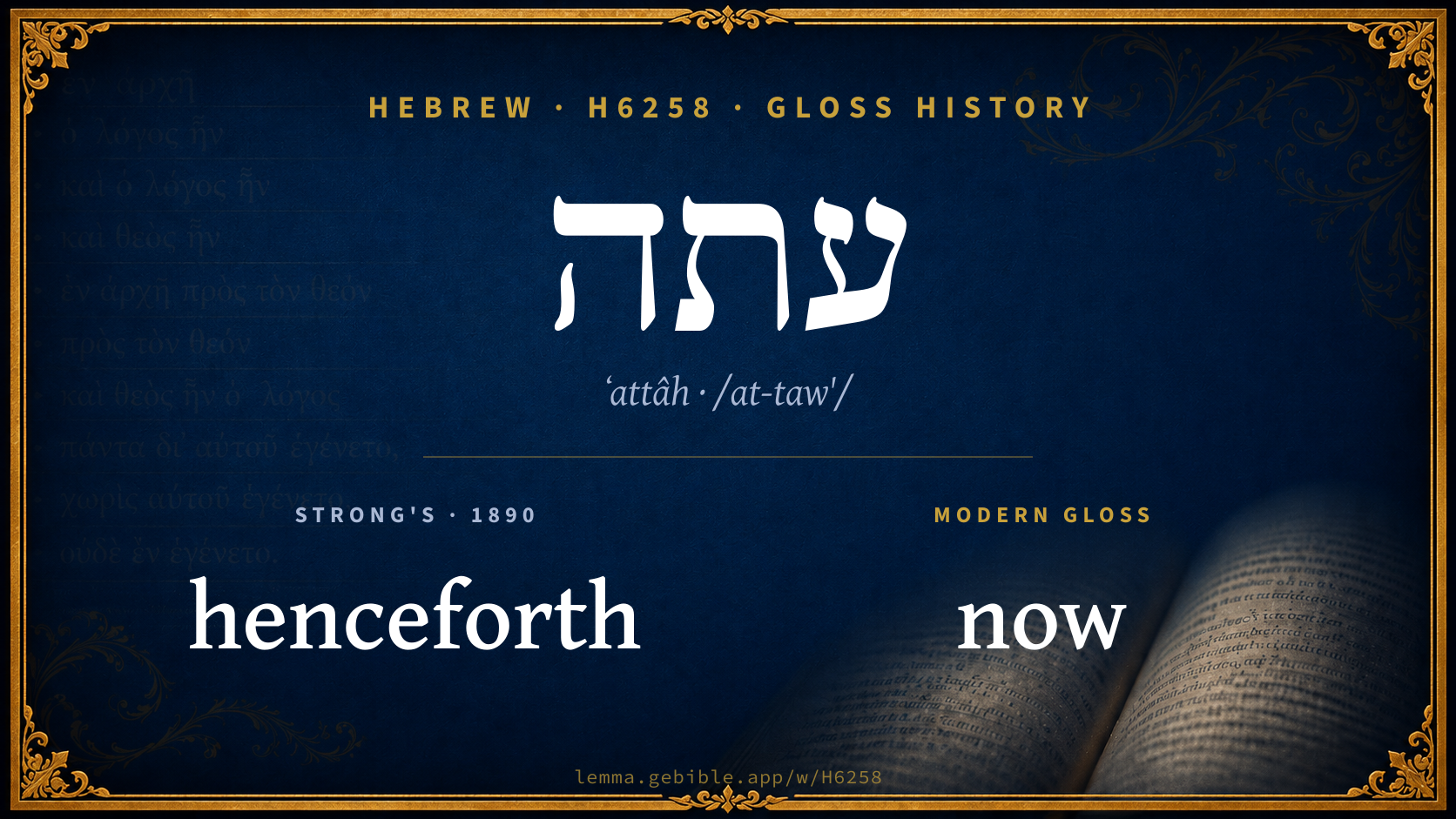
Gloss history
Strong's 1890 vs modern scholarship
About this word
Strong's H6258 catalogs a Hebrew word from the Hebrew Old Testament.
These counts are not copied from any lexicon or concordance. They are computed here, from the morphology-tagged Hebrew Old Testament. What Lemma adds →
- 422
- distinct verses
- The word appears in 422 distinct verses.
- 31 / 39
- OT books
- The word appears in 31 of 39 Old Testament books.
- #112
- by frequency
- Top 250 most frequent Hebrew words (rank 112 of 8,640 Hebrew words by occurrence).
View all 422 occurrences in the concordance →
Most concentrated in
- 1 Samuel 44 verses 10%
- Genesis 40 verses 9%
- 2 Chronicles 29 verses 7%
By section of the Old Testament
By traditional corpus
Conventional, traditional groupings — biblical authorship is debated, so this is a traditional corpus grouping, not an authorship claim. Each share is this word’s portion of its verses in that division of the Hebrew canon. Each figure is a share of the word’s 422 distinct verses.
- Prophets (Nevi'im) 241 verses · 57%
- Writings (Ketuvim) 97 verses · 23%
- Torah (Pentateuch) 84 verses · 20%
How translations render this word
Counts come from each version’s own published word-to-Strong’s tagging or interlinear alignment — an approximate guide to how each version renders this word, not a word-level alignment the data otherwise carries. Because each total is that version’s own tagged count, the per-version totals vary from one another and need not match the appearance or distinct-verse counts above. These counts may also differ from a printed concordance because Lemma counts each distinctly tagged rendering and does not collapse phrase taggings into a single head-word total. This is a fixed set of word-tagged versions (KJV, ASV, BSB, ULT) and does not change with the reading translation you choose elsewhere. Each version’s license is shown beside its name below (and on Sources).
BDB lists this Strong’s number as 2 distinct words (homographs). Each count above pools all of them and is not split by sense — see the Senses section below. A low-frequency rendering may belong to a different one of those words, not the primary meaning.
- King James Version†: Now 2×
- American Standard Version†: Herein thou hast done foolishly for from henceforth 1×, Him 1×, Me 1×
- Berean Standard Bible†: Now 266×, Now therefore 38×, So 11×
- unfoldingWord Literal Text†: Now 416×, Then 2×
King James Version Public Domain
Renders H6258 across 9† tagged occurrences — most commonly:
Plus 7 renderings that appear only once — usually multi-word phrases or single function words the recovered tagging swept in, not distinct renderings.
American Standard Version Public Domain
Renders H6258 across 9† tagged occurrences — most commonly:
Berean Standard Bible Public Domain
Renders H6258 across 409† tagged occurrences — most commonly:
Plus other, less common renderings. Plus 36 renderings that appear only once — usually multi-word phrases or single function words the recovered tagging swept in, not distinct renderings. Not rendered by a distinct English word in 21 further occurrences.
unfoldingWord Literal Text CC BY-SA 4.0
Renders H6258 across 425† tagged occurrences — most commonly:
Plus 7 renderings that appear only once — usually multi-word phrases or single function words the recovered tagging swept in, not distinct renderings.
14 senses and sub-senses in the full BDB
What do BDB’s symbols mean?
BDB uses these scholarly abbreviations:
| Symbol | Meaning |
|---|---|
| 𝔊 | the Septuagint (the ancient Greek translation, LXX) |
| 𝔙 | the Vulgate (the Latin translation) |
| 𝔖 | the Syriac version (the Peshitta) |
| 𝔗 | the Targum (the Aramaic translation) |
| ψ | the Psalms |
| √ | root (the underlying root or stem) |
| ‖ | parallel passage (a synonymous or contrasted parallel) |
| † | the dagger: every passage where the word occurs is cited |
The 14 senses and sub-senses the full Brown-Driver-Briggs lexicon distinguishes for this word, in lexicon order (not ranked by frequency), with BDB’s own verbatim wording and sub-sense lettering. Shown in Hebrew script with BDB’s own scholarly abbreviations. The condensed entry is in the Lexicon Entry tab. See also the Forms in the corpus table below.
- 1.
- a. Gn 12:19 ועתה הנה אשׁתך and now, behold thy wife, 22:12 כי עתה ידעתי now I know (so Ex 18:11; Ju 17:13; 1 K 17:24 [עַתָּה זֶה], ψ 20:7), 26:22, 29; 27:36; 31:13, 28, etc., Ex 5:5 הן רבים עתה עם הארץ; whether in opp. to past time, as Gn 32:11; Jos 14:11 כְּכֹחִי אָז וּכְכֹחִי עָ֑תָּה, Ju 11:8; 1 K 12:4; Is 1:21 ועתה מרצהים, 16:14 Ho 2:9 כִּי טוֹב לִי אָז מֵעָ֑תָּה, 13:2; Jb 30:1 +, or to future, as Nu 24:17 אֶרְאֶנּוּ ולא עתה, Ju 8:6 הֲכַף זֶבַח וצ׳ עַתָּה־בְּיָדֶ֑ךָ, 1 S 2:16 כִּי עַתָּה תִּתֵּן; = after all Nu 22:38; Ju 8:2; = now at last 2 S 24:16; 1 K 19:4; 2 K 19:25; Ho 7:2; Je 4:12; and in the phr. מעתה ועד עולם †Is 9:6; 59:21; Mi 4:7 (v. infr.), ψ 113:2; 115:18; 121:8; 125:2; 131:3. e.g. Genesis 12:19
- b. of the imminent or impending future: Gn 19:9 עַתָּה נָרַע לְךָ מֵהֶם, 29:32 כי עתה יאהבני אישׁי, v 34 Ex 6:1 עתה תראה, Nu 11:23; 22:4; 2 S 20:6; Is 33:10 (ψ 12:6), 43:19; 49:19; Am 6:7 לכן עתה יִגְלוּ, Is 49:19; Mi 7:4, 10; Dn 10:20; and especially ἀσυνδέτως in Hos, introducing a punishment, Ho 4:16 עתה יִרְעֵם י׳ וגו׳ 5:7; 8:8, 13 (Je 14:10), 10:2. e.g. Genesis 19:9
- c. of a time ideally present (= then, from our point of view): Is 29:22 לא עתה יבושׁ יעקב, v b Ho 10:3; Mi 4:9, 10, 11, 14; 5:3. e.g. Isaiah 29:22
- d. describing a present state = as things are: 1 S 8:5 thou art old, etc., עתה שִׂימָה לנו מלך, 9:6; 13:12; 14:30; 25:7b; 27:1 now I shall be swept away one day, etc., 2 K 18:20, 25; Jb 6:21; 14:16; 16:7. e.g. 1 Samuel 8:5
- e. with an Imv., as an encouragement, implying that the time has come for the exhortation or advice to be followed, Gn 31:13 עתה קום צא, Ex 18:19 עתה שְׁמַע בקולי, Nu 22:11 Dt 2:13 Is 30:8. e.g. Genesis 31:13
- 2. Phrases:
- a. עַתָּה זֶה (זֶה 4 h) †1 K 17:24 2 K 5:22. e.g. 1 Kings 17:24
- b. ועתה and, now, or now, therefore (וְ 4), drawing a conclusion, especially (cf. 1 e) a practical one, from what has been stated: Gn 3:22 and now (since man has once been disobedinet), lest he put forth his hand, etc., 20:7; 21:23 וְעַתָּה הִשָּֽׁבְעָה לִי הֵ֫נָּה, 27:3, 8 ועתה בני שְׁמַע בקולי, 30:30; 31:16, 44; 37:20 + often, Is 5:3, 5; 36:8 ψ 2:10; Gn 11:6 ועתה לֹא־יִבָּצֵר מֵהֶם וגו׳, 31:30; 45:8; 2 S 19:11 ψ 39:8 ועתה מַה־קִּוִּיתִי אֲדֹנָי, Is 52:5. e.g. Genesis 3:22
- c. וְעַתָּה הִנֵּה stating the ground on which some conclusion or action is to be based, Ex 3:9 Jo 14:10(×2) 1 S 12:2; 24:21; 1 K 1:18; Je 40:4 (with ועתה usually repeated after the הנה-clause). e.g. Exodus 3:9
- d. גם עתה Gn 44:10; 1 S 12:16; 1 K 14:14; Jo 2:12; Jb 16:19. e.g. Genesis 44:10
- e. מֵעַתָּה from now, henceforth, Je 3:4; Is 48:6; Dn 10:17 (according to some, here = from just now), 2 Ch 16:9; מעתה ועד עולם, v. supr. 1 a end. e.g. Jeremiah 3:4
- f. עַד־עַתָּה until now, Gn 32:5 וָאֵחַר עד־ע׳, Dt 12:9 לא באתם עד ע׳ אל הנחלה (opp. to the fut.), 2 K 13:23; especially after clause with מִן, 46:34 מִנְּעוּרֵינוּ וְעַד־ע׳ (2 S 19:8 Ez 4:14), Ex 9:18; 2 K 8:6; Ru 2:7. e.g. Genesis 32:5
- g. כִּי עַתָּה for in this case, in our idiom, for then (עתה pointing to a condition assumed as a possible contingency; cf. Dr§ 141, 142); †(a) Ex 9:15 כי עתה שׁלחתי וגו׳ for then (if the intention expressed in v 14 had not existed) I should have put forth my hand, etc., Nu 22:29 כי עתה הֲרַגְתִּיךְ, 1 S 13:13; Jb 3:13; sq. impf. Jb 6:3 for then (if it were weighed, v 2) it would be heavier, etc., 13:19 for then would I be silent and die; (b) after a protasis, surely then Gn 31:42 + (see כִּי 1 d b, p. 472).— e.g. Exodus 9:15
- Read כְּמוֹ עַתָּ (𝔊 𝔙) as now, for כְּמוֹ עֵת Ez 16:57, עַתָּ נִשְׁבַּרְתְּ (𝔊 𝔖 𝔙) now art thou broken! for עֵת נִשְׁבֶּרֶת Ez 27:34, and prob. עַתָּ בָּא (Hi We Kö Now, cf. 𝔊 𝔖) for עֶת־בֹּא Hg 1:2; also עַתָּה for אַתָּה 1 K 1:20, and אַתָּה for עַתָּה v 18b; 2 S 18:3. e.g. Ezekiel 16:57
Senses from the full Brown-Driver-Briggs lexicon (Brown, Driver, Briggs; Oxford 1906 — public domain), digitized via Sefaria, supplemented by the OpenScriptures HebrewLexicon (CC BY 4.0). Full attribution on Sources.
Word origin
(also Ez 23:43 ψ 74:6 עת Kt, Qr עַתָּה), עָ֑֫תָּה Gn 32:5 +, adv. of time, now (proposes acc. of [’int], עֵת (Köii. 260), at the time, in partic. of the present time, i.e. now; cf. Germ. zur Zeit, Arabic اَلْآنَ at the time, i.e. now);—now:
— Brown-Driver-Briggs (Oxford 1906, public domain), digitized via Sefaria, supplemented by the OpenScriptures HebrewLexicon (CC BY 4.0). See Sources.
Derived from עת (ʻêth) (H6256) — time.
Jastrow Dictionary
A second Hebrew/Aramaic lexicon for comparison, covering Aramaic and post-biblical (Talmudic, Targumic, Midrashic) usage that the biblical-Hebrew BDB does not. Matched by lemma rather than by Strong’s number, so a lemma may carry more than one Jastrow headword (shown separately below), and the entries cover usage well beyond the Bible.
עַתָּה
- v. עֵת) now, this time. Ber. 46ᵃ מע׳ ועד עולם from now and forever. Tanḥ. Mishp. 18 וע׳ באתי and now I have come again; a. fr. [In Talm. mostly עכשיו.]—As a dialectic term: מֵעַ׳ from now, i.e. as a consequence; if this were so, then.—Y. Ab. Zar. I, 39ᵈ bot. מע׳ חטין אל ימכור וכ׳ according to this he ought not to sell him wheat &c.; a. fr.—Mostly: אֶלָּא מע׳. Succ. 2ᵃ א׳ מ׳ העושה סוכתו וכ׳ but according to this, if a man put up his Succah in Ashteroth Karnayim (v. עַשְׁתָּרוֹת), would you also say that it is no legitimate Succah? B. Kam. 17ᵇ; a. fr.—אֱמוֹר מע׳ say from now, i.e. learn from this, therefore. Tosef. Kel. B. Mets. V, 2. Sifré Deut. 334; a. fr.
A Dictionary of the Targumim, the Talmud Babli and Yerushalmi, and the Midrashic Literature (Marcus Jastrow; London, Luzac, 1903) — Public Domain. Digitized via Sefaria. Digitized via Sefaria. Full attribution on Sources.
Forms in the corpus
The 45 distinct written forms H6258 takes in the Hebrew Bible, most frequent first — each parse links to that state’s occurrences in the concordance. Hebrew forms include their vowel points and cantillation, so a single lemma takes many written forms.
| Form | Parsing | Example | Uses |
|---|---|---|---|
| וְ/עַתָּ֗ה | Adverb | Deuteronomy 10:22 | 80 |
| וְ/עַתָּה֙ | Adverb | Deuteronomy 5:25 | 39 |
| וְ/עַתָּ֣ה | Adverb | Daniel 9:15 | 36 |
| וְ/עַתָּ֕ה | Adverb | Daniel 11:2 | 26 |
| עַתָּה֙ | Adverb | Exodus 9:15 | 26 |
| וְ/עַתָּ֖ה | Adverb | Amos 7:16 | 21 |
| עַתָּ֖ה | Adverb | Daniel 10:11 | 19 |
| עַתָּ֣ה | Adverb | Exodus 6:1 | 19 |
| עַתָּ֗ה | Adverb | Deuteronomy 2:13 | 18 |
| וְ/עַתָּ֡ה | Adverb | Exodus 33:13 | 15 |
| וְ/עַתָּ֛ה | Adverb | Ezra 9:10 | 12 |
| וְ/עַתָּ֞ה | Adverb | Exodus 32:34 | 11 |
| וְ֠/עַתָּה | Adverb | Ezra 9:12 | 10 |
| עַתָּ֥ה | Adverb | Amos 6:7 | 10 |
| וְ/עַתָּ֥ה | Adverb | Genesis 27:8 | 8 |
| עַתָּ֛ה | Adverb | Ezekiel 23:43 | 8 |
| עַתָּ֕ה | Adverb | Genesis 19:9 | 7 |
| עַ֭תָּה | Adverb | Job 3:13 | 6 |
| עַתָּ֤ה | Adverb | Genesis 29:34 | 6 |
| עָֽתָּה | Adverb | Exodus 9:18 | 6 |
| עַ֔תָּה | Adverb | Ezekiel 4:14 | 5 |
| עַתָּ֞ה | Adverb | Exodus 18:19 | 5 |
| וְ/עַתָּ֤ה | Adverb | 1 Samuel 2:30 | 4 |
| וְ֭/עַתָּה | Adverb | Job 6:28 | 4 |
| וְ/עַתָּה֩ | Adverb | 1 Samuel 26:8 | 3 |
| מֵ/עַ֔תָּה | Adverb | 2 Chronicles 16:9 | 3 |
| מֵֽ֝/עַתָּ֗ה | Adverb | Psalms 113:2 | 3 |
| עָ֑תָּה | Adverb | Deuteronomy 12:9 | 3 |
| וְ֝/עַתָּ֗ה | Adverb | Job 42:5 | 2 |
| מֵ/עַתָּ֖ה | Adverb | Isaiah 59:21 | 2 |
| עַתָּ֡ה | Adverb | 2 Kings 5:22 | 2 |
| עַתָּ֨ה | Adverb | 2 Chronicles 29:31 | 2 |
| עַתָּה֩ | Adverb | 1 Samuel 15:3 | 2 |
| ו/עת | Adverb | Psalms 74:6 | 1 |
| וְ/עַתָּ֨ה | Adverb | Psalms 27:6 | 1 |
| מֵ/עַ֨תָּה֙ | Adverb | Daniel 10:17 | 1 |
| מֵ/עַתָּה֙ | Adverb | Isaiah 9:7 | 1 |
| מֵ/עָֽתָּה | Adverb | Hosea 2:7 | 1 |
| מֵ֝/עַתָּ֗ה | Adverb | Psalms 125:2 | 1 |
| מֵֽ/עַתָּ֥ה | Adverb | Psalms 115:18 | 1 |
| עַ֠תָּה | Adverb | 1 Samuel 13:12 | 1 |
| עַתָּ֔ה | Adverb | Numbers 24:17 | 1 |
| עַתָּ֜ה | Adverb | 2 Samuel 16:11 | 1 |
| עַתָּה֮ | Adverb | 2 Kings 4:26 | 1 |
| עת | Adverb | Ezekiel 23:43 | 1 |
Same root — word family
Other BDB entries built from the same root as H6258, grouped by Strong’s listed origin. These share a root / origin per the lexicon — not necessarily a shared meaning. Each links to that word’s own entry.
Derives from
Shares the same root
Proper names from this root
People and places named from this root — a name, not an additional meaning of the word.
Compare all same-root words → 1 of the same-root words is a proper name (a person or place). They share a root, not necessarily a meaning.
Septuagint verse parallels
This word appears in 410 verses that also exist in the Greek Old Testament (Septuagint), out of the 422 Hebrew verses it occurs in. You can read those verses in Greek by switching the Old Testament edition to the Septuagint.
Read these verses in the Septuagint
- Genesis 3:22
- Exodus 3:9
- Numbers 11:6
- Deuteronomy 2:13
- Joshua 1:2
- Judges 6:13
- Ruth 2:7
- 1 Samuel 2:16
- 2 Samuel 2:6
- 1 Kings 1:12
- 2 Kings 1:14
- 1 Chronicles 17:7
This is a verse-level parallel only — the same verses exist in both the Hebrew and Greek Old Testaments. No word-level Hebrew↔Greek correspondence is claimed: the data carries no such alignment, so no Greek word is shown as this Hebrew word’s translation. Coverage is not total — the Septuagint omits the deuterocanon and renumbers the Psalms, so some Hebrew verses have no direct Greek parallel.