
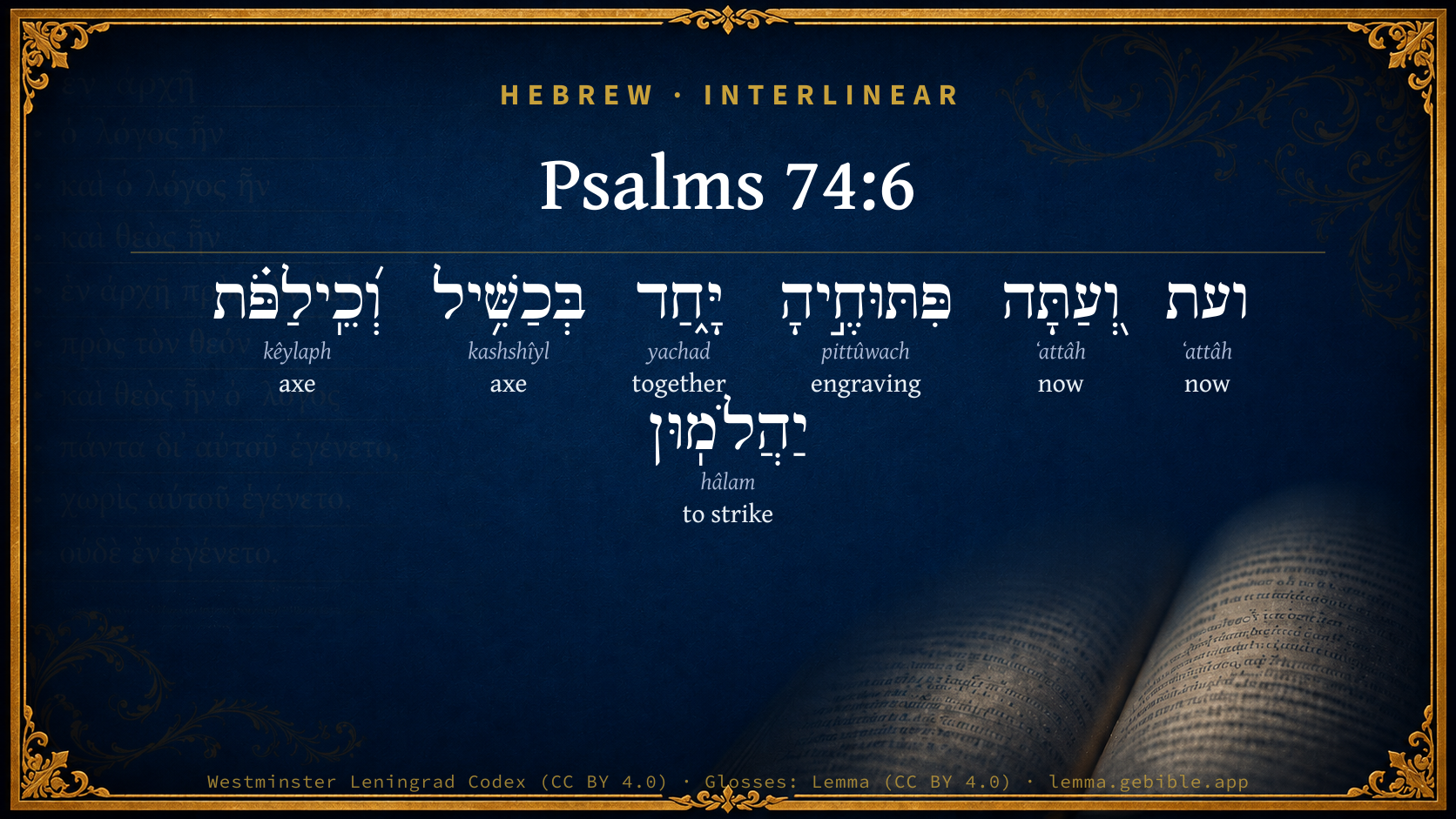
Psalms 74:6

Hebrew (Westminster Leningrad Codex) Psalms 74:6 appears in the Hebrew Old Testament. The text above is from the Westminster Leningrad Codex. Each word links to its Strong’s number, a concise gloss, and parsing drawn from the Open Scriptures Hebrew Bible morphology. Click any word for its full Brown-Driver-Briggs (BDB) entry.
Download image
Cite this verse

Psalms 74:6 (World English Bible). Public Domain. Lemma interlinear Bible study tool, https://lemma.gebible.app/v/psalms/74/6.

Show BibTeX & RIS
BibTeX
RIS
English Translation
Now all its carved work They break down with hatchet and hammers.
World English Bible · Public Domain
Highlights
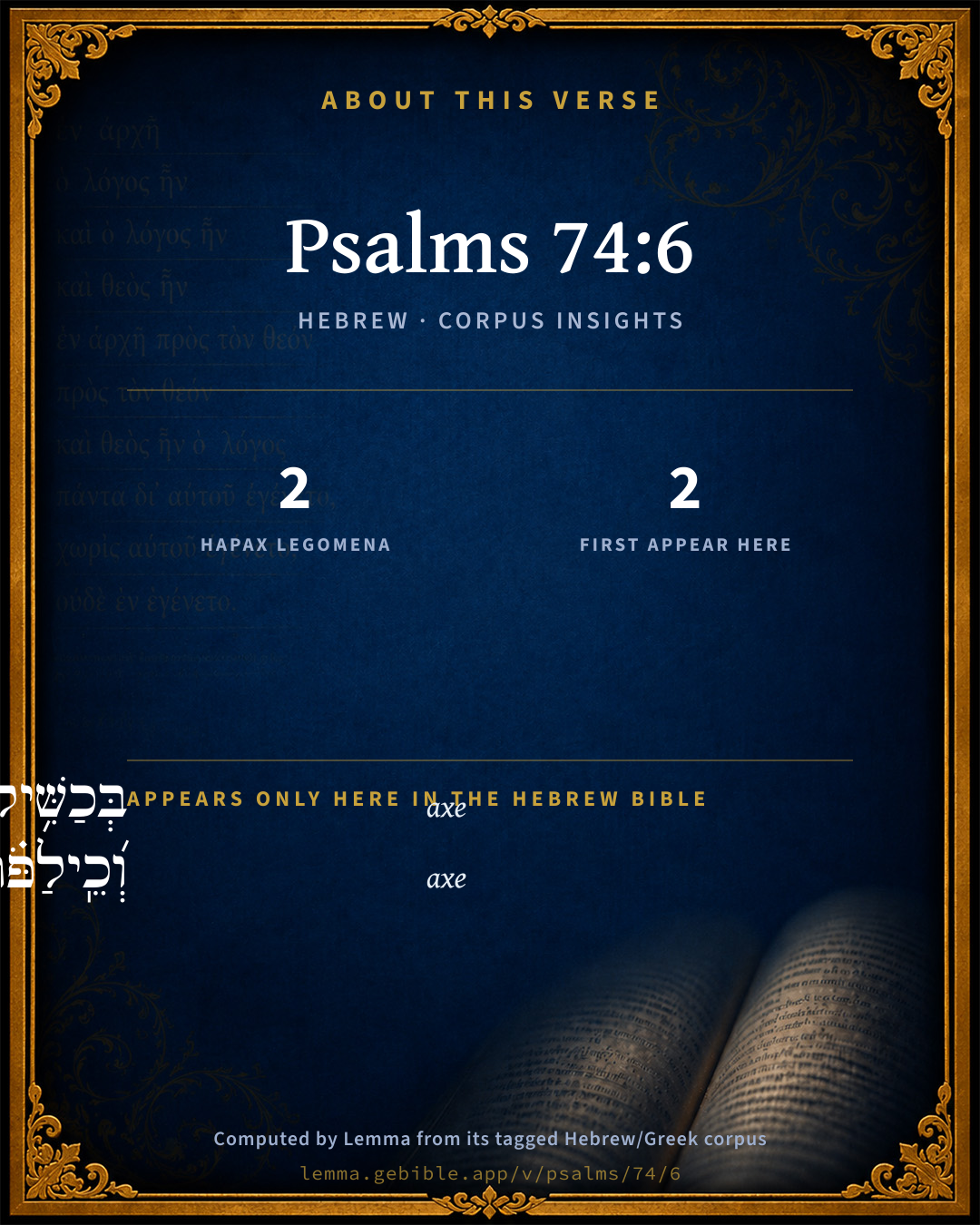
  • 2 hapax legomena — only here in the Hebrew Bible
  • 2 first appearances in the Hebrew Bible
Full analysis ↓
Download a study sheet

One document with this verse’s original text, its word-by-word gloss line, the meaning frame, cross-references with their text, attributed commentary, and full source and license credits — printable, and it pastes into notes with its structure intact.

This verse Autodidact and up

Study sheet (.html) Plain text (.txt)

A passage Seminary Student

Up to 50 verses in one chapter. A passage sheet keeps up to 6 commentary sources and 12 cross-references per verse, in the order this page ranks them, and says so on the sheet whenever that leaves anything out. Ask for a single verse and you get the Autodidact verse sheet above.

Everything on this page stays free to read, with no account — the sheet is a download of what is already on screen, not access to it.

Want to remove ads? Support Godless Engineer
Compare translations 3

The same verse in 3 English versions, stacked beneath the original-language interlinear above. Click any original word for its lexicon entry.

Each is an independent rendering of the whole verse — the interlinear is not word-aligned to these translations.

Highlighted words mark where these versions differ — a whole-verse word diff, not a word-by-word alignment.

  • World English Bible Public Domain
    Now all its carved work They break down with hatchet and hammers.
  • King James Version Public Domain
    But now they break down the carved work thereof at once with axes and hammers.
  • unfoldingWord Literal Text CC BY-SA 4.0
    And now with hatchet and hammers they have broken down its carvings altogether.

unfoldingWord Literal Text — © unfoldingWord, licensed CC BY-SA 4.0. Word-aligned USFM3 via Door43 (git.door43.org/unfoldingWord/en_ult).

Versions to compare (up to 4)

3 of 4 selected

Show all 18 translations

Every available English version of this verse, each an independent rendering of the whole verse.

  • World English Bible Public Domain
    Now all its carved work They break down with hatchet and hammers.
  • Berean Standard Bible Public Domain
    and smashing all the carvings with hatchets and picks.
  • Majority Standard Bible Public Domain
    and smashing all the carvings with hatchets and picks.
  • King James Version Public Domain
    But now they break down the carved work thereof at once with axes and hammers.
  • American Standard Version (1901) Public Domain
    And now all the carved work thereof They break down with hatchet and hammers.
  • Revised Version (1885) Public Domain
    And now all the carved work thereof together they break down with hatchet and hammers.
  • Geneva Bible (1599) Public Domain
    But nowe they breake downe the carued worke thereof with axes and hammers.
  • Douay-Rheims (1899) Public Domain
    they have cut down at once the gates thereof, with axe and hatchet they have brought it down.
  • Young's Literal Translation Public Domain
    And now, its carvings together With axe and hatchet they break down,
  • Literal Standard Version CC BY-SA 4.0
    And now they break down its engravings, || Together, with axe and hatchet,
  • Unlocked Literal Bible CC BY-SA 4.0
    They smashed and broke down all the engravings; they broke them with axes and hammers.
  • unfoldingWord Literal Text CC BY-SA 4.0
    And now with hatchet and hammers they have broken down its carvings altogether.
  • Darby Bible Public Domain
    And now they break down its carved work altogether, with hatchets and hammers.
  • World Messianic Bible Public Domain
    Now they break all its carved work down with hatchet and hammers.
  • Webster's Bible Public Domain
    But now they break down the carved work of it at once with axes and hammers.
  • Free Bible Version CC BY-SA 4.0
    With axes and hammers they smashed in the carved wooden panels.
  • Bible in Basic English Public Domain
    Your doors are broken down with hammers and iron blades.
  • JPS Tanakh (1917) Public Domain
    And now all the carved work thereof together they strike down with hatchet and hammers.

Literal Standard Version (2020), Covenant Press — licensed CC BY-SA 4.0. Text via the HelloAO Bible API (eBible.org). Unlocked Literal Bible (unfoldingWord) — licensed CC BY-SA 4.0. Text via the HelloAO Bible API (eBible.org). unfoldingWord Literal Text — © unfoldingWord, licensed CC BY-SA 4.0. Word-aligned USFM3 via Door43 (git.door43.org/unfoldingWord/en_ult). Free Bible Version, Dr. Jonathan Gallagher — licensed CC BY-SA 4.0. Text via the HelloAO Bible API (eBible.org).

Word by word

More ways to search: Search by grammar → Find every occurrence → Compare this word →

Practice this passage: Drill this verse → Learn its vocabulary →

About this verse

These counts appear in no published source. They are computed here, from the morphology-tagged text and Lemma’s own curated glosses. What Lemma adds →

7
words
6
distinct lemmas
Wisdom
section

Notable vocabulary

2 hapax legomena — words that appear only here in the entire Hebrew Bible:

  • בְּכַשִּׁ֥יל axe H3781
  • וְ֝כֵֽילַפֹּ֗ת axe H3597

First appearance in Scripture

These words make their first canonical appearance in the Hebrew Bible here:

  • בְּכַשִּׁ֥יל axe H3781
  • וְ֝כֵֽילַפֹּ֗ת axe H3597

Shared distinctive vocabulary

יַהֲלֹמֽוּן to strike H1986 occurs in 9 verses of the Hebrew Bible. Also found in:

Grammatical profile

  • 1 verb
  • 3 nouns
  • 3 adverbs

Verb forms

  • יַהֲלֹמֽוּן Qal · Imperfect

Repetition

A word recurs within this verse — often emphatic in Hebrew:

Hebrew & Septuagint length

In English translation the verse runs 12 words from the Hebrew and 25 from the Septuagint (LXX English) — closely comparable.

A rough comparison of the two English renderings, which tokenize alike — not a word-level alignment.

Word counts can differ between the Hebrew and the Greek without any difference in meaning — e.g. the Hebrew direct-object marker אֵת has no separate Greek word, and Greek often adds the article ὁ.

Cross-references

4

Topical passages linked to Psalms 74:6 in the Treasury of Scripture Knowledge — connected by theme and wording, ordered by reader-vote popularity; previews shown in the World English Bible.

  • 1 Kings 6:18 There was cedar on the house within, carved with buds and open flowers: all was cedar; there was no stone seen.
  • 1 Kings 6:29 He carved all the walls of the house round about with carved figures of cherubim and palm trees and open flowers, inside and outside.
  • 1 Kings 6:32 So [he made] two doors of olive-wood; and he carved on them carvings of cherubim and palm trees and open flowers, and overlaid them with gold; and he spread the gold on the cherubim, and on the palm trees.
  • 1 Kings 6:35 He carved [thereon] cherubim and palm trees and open flowers; and he overlaid them with gold fitted on the engraved work.

Cross-references courtesy of OpenBible.info (CC BY 4.0).

Hebrew and Greek witnesses Masoretic Hebrew ↔ Greek Septuagint

The same verse in the two great witnesses to the Old Testament, shown verse-for-verse.

You’re reading Greek Psalm 73 (Hebrew Psalm 74). The Septuagint counts the superscription, so verse numbers can differ from the Hebrew — chapter-level alignment, not verse-by-verse. Numbering follows Rahlfs.

These are two independent witnesses, not word-aligned to each other, and the Septuagint is shown in lemma (dictionary) form.

Hebrew Psalms 74:6 Masoretic · Westminster Leningrad Codex

ועת וְ֭עַתָּה פִּתּוּחֶ֣יהָ יָּ֑חַד בְּכַשִּׁ֥יל וְ֝כֵֽילַפֹּ֗ת יַהֲלֹמֽוּן

Now all its carved work They break down with hatchet and hammers.

World English Bible · Public Domain

Greek LXX Greek Psalm 73:6 Septuagint · lemma form

ὡς ἐν δρυμός ξύλον ἀξίνη ἐκκόπτω ὁ θύρα αὐτός ἐπί ὁ αὐτός ἐν πέλεκυς καί λαξευτήριον καταῥάσσω αὐτός

they cut down its doors at once with axes as in a wood of trees; they have broken it down with hatchet and stone cutter.

LXX2012 (modern English Septuagint) · Public Domain

Hebrew: Westminster Leningrad Codex (CC BY 4.0). Greek: Septuagint (public domain); English from LXX2012 (modern English Septuagint) (Public Domain). How the Septuagint differs from the Hebrew →

Commentary

Notes on Psalms 74:6 from classic Christian and Jewish commentators (each source and its license shown beneath its notes). The classic Christian expositions comment on the surrounding passage and are grouped to its opening verse, so a note may address several verses; the Jewish commentaries on the Tanakh (Rashi and others) are per-verse, so they appear only where the commentator wrote on this verse.

Lemma curates 59 commentaries, every one of them public domain or Creative Commons licensed, each selected and text-cleaned for this edition rather than reprinted as found. About our sources →

Trapp's Complete Commentary

John Trapp

Psa 74:6 But now they break down the carved work thereof at once with axes and hammers.

Ver. 6. But now they break down the carved work thereof] The Chaldeans did with military violence, and afterwards the Romans under Titus, who could not preserve it from the soldiers’ fury, though he desired so to have done, as some historians have told us. Now, if the enemies’ rage were so great as is here described against the outward marks of religion, how much more should our zeal kindle against the most costly or curious monuments of idolatry and superstition? Zisca, the valiant Bohemian, overthrew three hundred monasteries with their idols, and among the rest the famous monastery called the king’s court, a mile from Prague, in the walls whereof the whole Bible was most exquisitely written in letters of gold.

John Trapp, A Commentary or Exposition upon All the Books of the Old and New Testament (1647–1656) — public domain. Text from a community e-Sword module.

J. A. Alexander on Psalms

Joseph Addison Alexander

Psa 74:6. And now the carvings thereof together (or at once) with sledge and hammers they beat (down). This completes the comparison begun in the preceding verse, with which the one before us is connected by the phrase and now, i.e. in this case. As in the case supposed the woodman deals with trees and thickets, so in the real ease the spoiler deals with the costly fruits of art and skill. The word translated carvings is expressly used in the description of the temple. See 1Ki 6:29, and compare Exo 28:11; Exo 39:6. The suffix (thereof) has no grammatical antecedent in the sentence; the form was probably determined by a word not expressed, though present to the writer's mind. At once does not mean quickly, suddenly, without delay, but all together, indiscriminately, in confusion.

Joseph Addison Alexander, The Psalms Translated and Explained (1850) — public domain. Text from a community e-Sword module.

John Gill's Exposition

But now they break down the carved work thereof at once with axes and hammers. Formerly it was an honour to be employed in cutting down a tree for the building of the temple; but now so little regard was paid to it, that all its fine carved work, which Solomon made, Kg1 6:18, was demolished at once in a rude and furious manner with axes and hammers; which was done either by the Chaldeans in Nebuchadnezzar's time, or by the Syrians in the times of Antiochus, or by the Romans in the times of Vespasian; the first seems intended; see Jer 46:22.

.

Psalms 74:7

psa 74:7

psa 74:7

psa 74:7They have cast fire into thy sanctuary,.... Or, "thy sanctuary into the fire" (o); which denotes the utter destruction of it by fire, which was done both by the Chaldean and Roman armies; see Kg2 25:9,

they have defiled, by casting down the dwelling place of thy name to the ground, or "to the earth they have defiled the habitation of thy name" (p); that is, to the last and lowest degree; this Antiochus did when he set up an idol in the temple, and Titus when he laid it level with the ground, not leaving one stone upon another, as our Lord predicted, Mat 24:1 the aggravation of which was, that it was the place where the Lord had put his name, where his name was called upon, and where was the symbol of his presence.

(o) "in ignem sanctuaria tua", Pagninus, Vatablus; so Cocceius, Gejerus, Michaelis. (p) "ad terram usque prophanarunt tabernaculum, vel habitationem nominis tui", Musculus, Gejerus, Michaelis; so Cocceius.

John Gill's Exposition of the Whole Bible (1746–1763) — public domain (CC PDM 1.0). Text via the HelloAO Bible API.

Albert Barnes' Notes on the Bible

But now they break down the carved work thereof ... - literally, “But now the carvings of it together, at once, with sledge and hammers they beat down.” The carved work refers evidently to the ornaments of the temple. The word used here - פתוח pittûach - is rendered engraving, carved work, or carving; Exo 28:11, Exo 28:21, Exo 28:36; Exo 39:6, Exo 39:14, Exo 39:30; Zec 3:9; 2Ch 2:14. It is the very word which in 1Ki 6:29 is applied to the ornaments around the walls of the temple - the “carved figures of cherubim, and palm trees, and open flowers,” and there can be no doubt that the allusion here is to those ornaments. These were rudely cut down, or knocked off, with axes and hammers, as a man lays low the trees of the wood. The phrase “at once” means that they drove forward the work with all despatch. They spared none of them. They treated them all alike as an axeman does the trees of a forest when his object is to clear the land.

Albert Barnes' Notes on the Bible (1834–1885) — public domain. Text from a community e-Sword/MySword module.

Matthew Poole's English Annotations

See Poole "Psa 74:5".

Axes and hammers: it hath been ingeniously observed that these two words are not Hebrew, but Chaldee or Syriac words, to point out the time when this was done, even when the Chaldeans brought in their language together with their arms among the Israelites.

Matthew Poole's English Annotations on the Holy Bible (1683–1685) — public domain. Text from a community e-Sword/MySword module.

The Treasury of David

Charles H. Spurgeon

Ver. 6. But now they break down the carved work thereof at once with axes and hammers. The invaders were as industrious to destroy as the ancient builders had been to construct. Such fair carving it was barbarous to hew in pieces, but the Vandals had no mercy and broke down all, with any weapon which came to hand. In these days men are using axes and sledgehammers against the gospel and the church. Glorious truths, far more exquisite than the goodliest carving, are cavilled over and smashed by the blows of modern criticism. Truths which have upheld the afflicted and cheered the dying are smitten by pretentious Goths, who would be accounted learned, but know not the first principals of the truth. With sharp ridicule, and heavy blows of sophistry, they break the faith of some: and would, if it were possible, destroy the confidence of the elect themselves. Assyrians, Babylonians, and Romans are but types of spiritual foes who labour to crush the truth and the people of God.

Ver. 6. The carved work thereof. Even barbarian invaders are wont to spare the more splendid buildings for art's sake. Demetrius, when he had taken a picture painted by Protogenes in the suburbs of Rhodes, was besought by the Rhodians to be lenient towards art, lest he should destroy the painting. He replied that he would sooner burn the statues of his father than so great a work of art. The ferocity of these enemies, therefore, outdoes the barbarity of others, for they ruthlessly cast down an edifice sculptured and polished with the greatest skill. Mollerus.

Ver. 6. The carved work. Mywtb Pittuchim: used in 1Ki 6:29, of the "carved figures of cherubim, and palm trees, and open flowers, "which were on the Temple walls. William Kay.

Ver. 6. With axes and hammers. It is noted by a learned interpreter, that the words in the original rendered in our translation, with axes and hammers, are not properly Hebrew, but Syriac words, purposely to hint thereby the time when and the persons by whom this was done. Arthur Jackson.

Ver. 6. Vandal work against the truth of God.

Ver. 6-7. Things feared by a church.

I. Injury to her doctrines or ordinances: carved work.

II. The fire of strife, division, etc.

III. The defilement of sin. Either of these three will

throw a church down; let her guard and pray against

them.

Psalms 74:7*

Ver. 6-7. Things feared by a church.

I. Injury to her doctrines or ordinances: carved work.

II. The fire of strife, division, etc.

III. The defilement of sin. Either of these three will

throw a church down; let her guard and pray against

them.

Psalms 74:8*

Charles H. Spurgeon's The Treasury of David (1869–1885) — public domain. Psalms only. Text from a community e-Sword/MySword module.

The Pulpit Commentary

But now they break down the carved work thereof at once with axes and hammers. The "carved work" (pittuchim) of the temple consisted of the cherubim and palm trees and open flowers which formed the decoration of the temple walls. (see 1Ki_6:29, where the same word, pittuchim, is used) This superficial carved work may have been broken down for the sake of the gold with which it was overlaid. (1Ki_6:22, 1Ki_6:32, 1Ki_6:35)

The Pulpit Commentary (1880–1919), ed. H.D.M. Spence-Jones & Joseph S. Exell — public domain. Text from a community e-Sword module.

John Wesley's Explanatory Notes

Axes and hammers - These words are not Hebrew, but Chaldee or Syriack, to point out the time when this was done, even when the Chaldeans brought in their language, together with their arms, among the Israelites.

John Wesley, Explanatory Notes Upon the Whole Bible (1754–1765) — public domain. Text via the GEBible commentary corpus.

Rashi

Rabbi Shlomo Yitzchaki (Rashi)

And now although he saw that this troubled the Holy One, blessed be He, he did not refrain from striking all its entrances and all its gates together.

with hatchets and hammers They are tools of destruction used by carpenters (Jer. 46:22): “and will come against her with axes (ובקרדמות).” Jonathan renders: בּכשיליא. כֵּילַפּוֹת is Arabic. This is how Dunash (p. 34) explained it, and it is one of the carpenters’ tools.

they strike The enemies [strike].

Rashi on the Tanakh — English translations: “The Judaica Press complete Tanach with Rashi, translated by A. J. Rosenberg” (CC BY 4.0); “Pentateuch with Rashi's commentary by M. Rosenbaum and A.M. Silbermann, 1929-1934” (public domain); “The Metsudah Tanach series, Lakewood, N.J” (CC BY 4.0); and “The Book of Joshua, Metsudah Publications, 1997” (CC BY 4.0). Text via Sefaria.

Lesson kit

Teaching starters — assembled from the data on this page, not authored interpretation. Every prompt links to the verse data it draws on. Edit before teaching.

Psalms, in the Wisdom, opens this verse with 7 words (6 distinct Hebrew lemmas). Its most distinctive word is kashshîyl (“axe”). A historical commentator’s framing appears above. Read the whole chapter for the surrounding context.

Discussion questions

  1. How does “axe” (kashshîyl) shape what this verse is saying?
  2. 2 words here appear nowhere else in the Hebrew Bible. Why might the author reach for such rare wording?
  3. 2 words make their first appearance in Scripture here. What does this debut establish?
  4. How does Judges 5:22, which shares the word «to strike», read alongside this verse?
  5. What does the repetition of “now” (2× in this one verse) do in this verse?
  6. These translations render this verse differently; the difference is in the English rendering, not the original. What questions does that raise?
  7. «יַהֲלֹמֽוּן» is a Qal Imperfect verb. How does that grammatical form shape the action described?
  8. Compare how Trapp's Complete Commentary and J. A. Alexander on Psalms read this verse. Where do they agree or differ?

Things to notice

  • 2 words in this verse appear nowhere else in the Hebrew Bible.
  • 2 words make their first canonical appearance in Scripture here.
  • These translations choose different wording for 12 words in this verse.
  • “now” occurs 2× in this single verse.
  • 6 distinct Hebrew lemmas span 7 words in this verse.

Reading settings

Reading text

Shown beneath each verse's original-language words.

Old Testament
Old Testament edition

Read the OT as the Masoretic Hebrew (MT) or the Greek Septuagint (LXX).

English shown for the Greek Septuagint (in the Hebrew ↔ Greek comparison).

Comparing translations? Open the Compare panel on any verse page to stack up to four side by side.