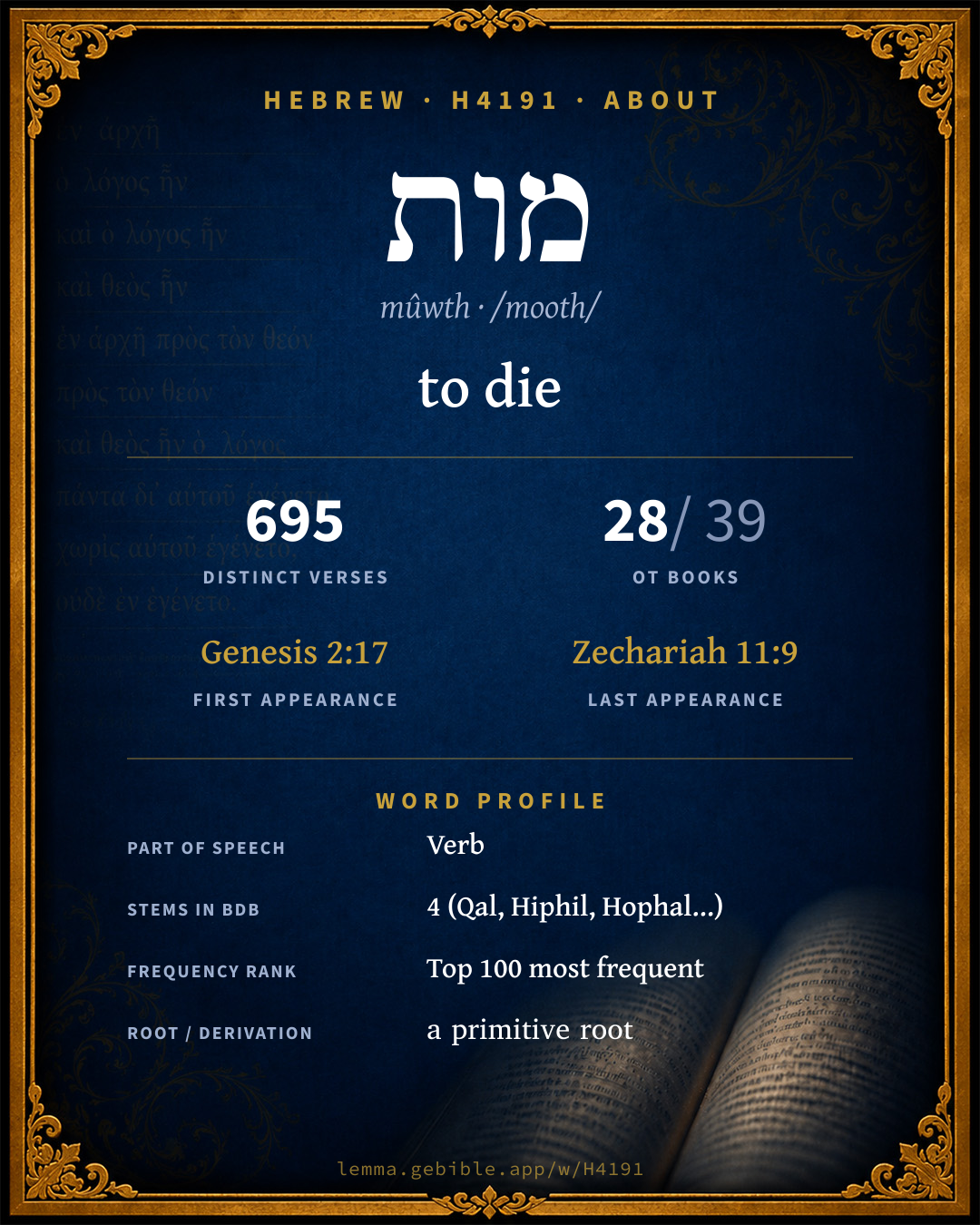
מוּת
to die
also: kill, have one executed fuller range ↓
Full lexicon entry — Brown-Driver-Briggs (BDB)
From Brown-Driver-Briggs (BDB)
Where this word appears
See every Qal verb in the Hebrew Bible →
Grammar key — what these labels mean
Part of speech
- Verb
- An action or state-of-being word.
- Noun
- A naming word — a person, place, thing, or idea.
Noun type
- Common
- A common noun — a general class of person, place, or thing (“king,” “city,” “water”), not a specific name.
Stem
- Qal
- The basic, simple active stem — the plain form of the verb (“he wrote”). Here: ‘die’
- Hophal
- The passive counterpart of the Hiphil (“he was caused to…”). Here: ‘by conspiracy 2 K 11’
- Hiphil
- The causative active stem (“he caused / brought about”). Here: ‘of killing men in personal combat’
- Polel
- A stem of hollow/geminate roots functioning like the Piel — intensive active.
Form
- Sequential Imperfect
- An imperfect with prefixed waw — the standard past-narrative form (waw-consecutive imperfect).
- Imperfect
- An incomplete, ongoing, or future action (“he will / would write”).
- Infinitive Absolute
- An unbound verbal noun, often intensifying or standing in for a finite verb.
- Perfect
- A completed action or state — Hebrew marks aspect (completeness) more than strict tense (“he wrote”).
- Sequential Perfect
- A perfect with prefixed waw continuing a preceding imperfect or command (waw-consecutive perfect).
- Infinitive Construct
- A bound verbal noun, frequently with prepositions (“to write / in writing”).
- Participle Active
- A verbal adjective expressing ongoing or characteristic action (“writing / one who writes”).
- Imperative
- A direct command (“write!”).
- Jussive
- A third- or second-person volitional form expressing wish or command (“let him write”).
- Participle Passive
- A verbal adjective expressing action received (“written”).
- Cohortative
- A first-person volitional form expressing wish or resolve (“let me / let us write”).
State
- Absolute
- The independent form of a noun, not bound to a following word.
- Construct
- A noun bound to a following noun in a possessive / “of” relationship (the construct chain).
Person
- 3rd Person
- The one spoken about (“he / she / it / they”).
- 2nd Person
- The one addressed (“you”).
- 1st Person
- The speaker (“I / we”).
Gender
- Masculine
- Grammatically masculine.
- Common
- Either gender — not distinguished for this form.
- Feminine
- Grammatically feminine.
Number
- Singular
- One.
- Plural
- More than one (in Hebrew, generally three or more).
15 verses where H4191 appears in the Hiphil stem in the Book of 1 Kings. Filtered view — show all forms. Click any verse to open its interlinear word-by-word view. Verse text shown in the World English Bible for context — . Each verse’s Hebrew form is shown with its reference; the English is not keyword-highlighted, since the data carries no word-level English alignment. Use “Compare translations” on any verse to read it across multiple English versions. This concordance covers the Hebrew Bible; Septuagint (Greek Old Testament) occurrences are not indexed here.
1 Kings
- 1 Kings 1:51 יָמִ֥ית Hiphil impf 3ms It was told Solomon, saying, Behold, Adonijah fears king Solomon; for, behold, he has laid hold on the horns of the altar, saying, Let king Solomon swear to me first that he will not kill his servant with the sword.
- 1 Kings 2:8 אֲמִֽיתְ/ךָ֖ Hiphil impf 1cs + sfx pers 2ms Behold, there is with you Shimei the son of Gera, the Benjamite, of Bahurim, who cursed me with a grievous curse in the day when I went to Mahanaim; but he came down to meet me at the Jordan, and I swore to him by Yahweh, saying, I will not put you to death with the sword.
- 1 Kings 2:26 אֲמִיתֶ֗/ךָ Hiphil impf 1cs + sfx pers 2ms To Abiathar the priest said the king, Get you to Anathoth, to your own fields; for you are worthy of death: but I will not at this time put you to death, because you bear the ark of the Lord Yahweh before David my father, and because you were afflicted in all in which my father was afflicted.
- 1 Kings 2:34 וַ/יְמִתֵ֑/הוּ conj + Hiphil wimpf 3ms + sfx pers 3ms Then Benaiah the son of Jehoiada went up, and fell on him, and killed him; and he was buried in his own house in the wilderness.
- 1 Kings 3:26 וְ/הָמֵ֖ת תְּמִיתֻ֑/הוּ conj + Hiphil inf.abs Hiphil juss 2mp + sfx pers 3ms Then spoke the woman whose the living child was to the king, for her heart yearned over her son, and she said, Oh, my lord, give her the living child, and in no way kill it. But the other said, It shall be neither mine nor yours; divide it.
- 1 Kings 3:27 וְ/הָמֵ֖ת תְמִיתֻ֑/הוּ conj + Hiphil inf.abs Hiphil impf 2mp + sfx pers 3ms Then the king answered, Give her the living child, and in no way kill it: she is the mother of it.
- 1 Kings 11:40 לְ/הָמִ֣ית prep + Hiphil inf.cs Solomon sought therefore to kill Jeroboam; but Jeroboam arose, and fled into Egypt, to Shishak king of Egypt, and was in Egypt until the death of Solomon.
- 1 Kings 13:24 וַ/יְמִיתֵ֑/הוּ conj + Hiphil wimpf 3ms + sfx pers 3ms When he was gone, a lion met him by the way, and killed him: and his body was cast in the way, and the donkey stood by it; the lion also stood by the body.
- 1 Kings 13:26 וַ/יְמִתֵ֔/הוּ conj + Hiphil wimpf 3ms + sfx pers 3ms When the prophet who brought him back from the way heard of it, he said, It is the man of God, who was disobedient to the mouth of Yahweh: therefore Yahweh has delivered him to the lion, which has torn him, and slain him, according to the word of Yahweh, which he spoke to him.
- 1 Kings 15:28 וַ/יְמִתֵ֣/הוּ conj + Hiphil wimpf 3ms + sfx pers 3ms Even in the third year of Asa king of Judah did Baasha kill him, and reigned in his place.
- 1 Kings 16:10 וַ/יְמִיתֵ֔/הוּ conj + Hiphil wimpf 3ms + sfx pers 3ms and Zimri went in and struck him, and killed him, in the twenty-seventh year of Asa king of Judah, and reigned in his place.
- 1 Kings 17:18 וּ/לְ/הָמִ֥ית conj + prep + Hiphil inf.cs She said to Elijah, What have I to do with you, you man of God? You have come to me to bring my sin to memory, and to kill my son!
- 1 Kings 17:20 לְ/הָמִ֥ית prep + Hiphil inf.cs He cried to Yahweh, and said, Yahweh my God, have you also brought evil on the widow with whom I sojourn, by killing her son?
- 1 Kings 18:9 לַ/הֲמִיתֵֽ/נִי prep + Hiphil inf.cs + sfx pers 1cs He said, Wherein have I sinned, that you would deliver your servant into the hand of Ahab, to kill me?
- 1 Kings 19:17 יָמִ֣ית יָמִ֥ית Hiphil impf 3ms Hiphil impf 3ms It shall happen, that he who escapes from the sword of Hazael shall Jehu kill; and he who escapes from the sword of Jehu shall Elisha kill.
About this entry
At a glance — auto-summarized from this page’s data, not written by a person. Every figure links to its source below. This summary describes the numbers; it doesn’t interpret them.
The Hebrew verb מות centers on the idea of “to die.” Where the King James Version keeps “slay,” modern versions use “died” — see the renderings breakdown. It appears 695 verses across 28 books of the Hebrew Bible, among its most common vocabulary. Its earliest occurrence is Genesis 2:17. Different stems carry different senses — BDB groups them under 4 stems, among them Qal and Hiphil. For the data behind this summary, explore the sense tree and the renderings breakdown below.
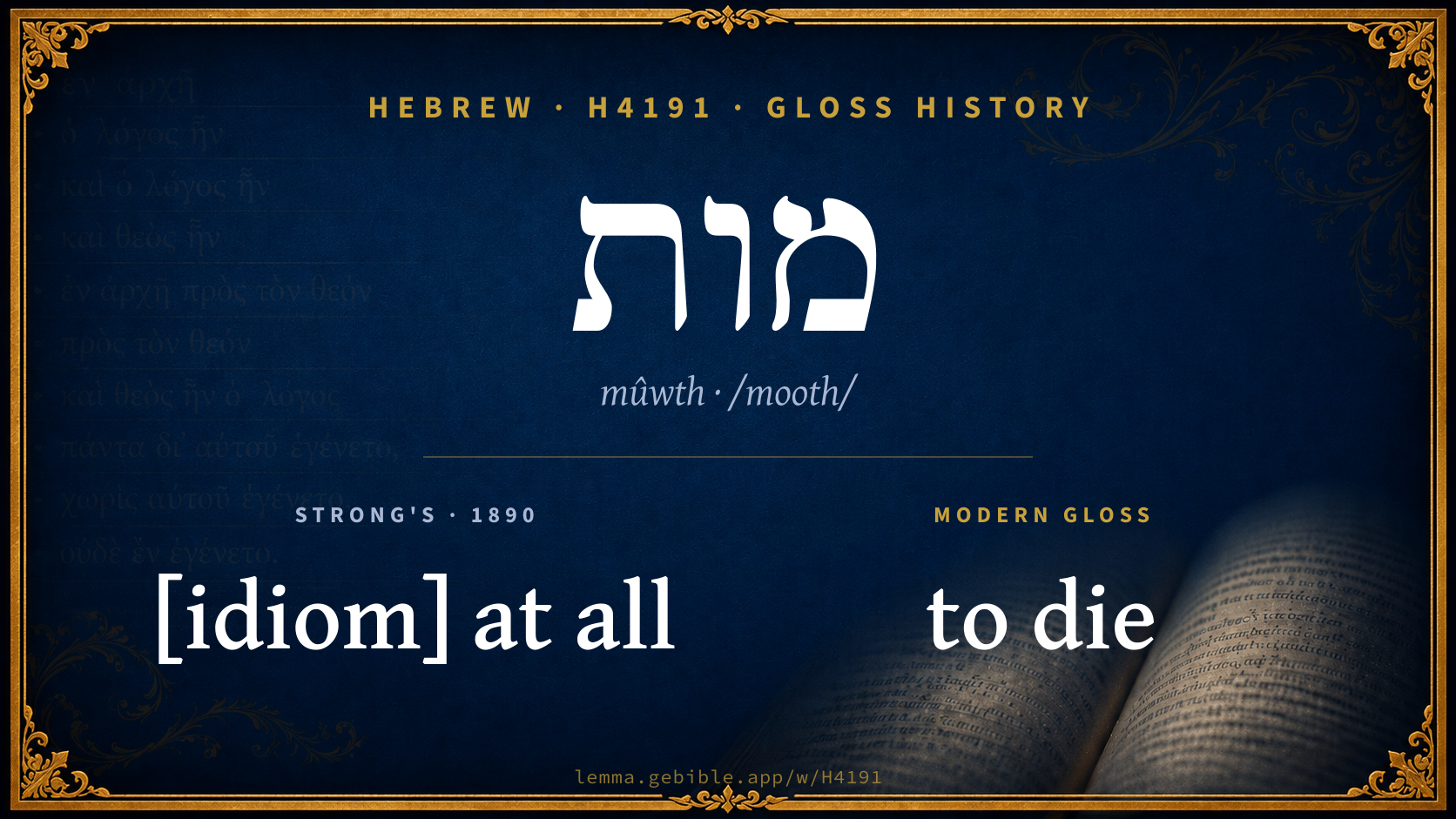
Gloss history
Strong's 1890 vs modern scholarship
About this word
Strong's H4191 catalogs a Hebrew word from the Hebrew Old Testament.
These counts are not copied from any lexicon or concordance. They are computed here, from the morphology-tagged Hebrew Old Testament. What Lemma adds →
- 695
- distinct verses
- The word appears in 695 distinct verses.
- 28 / 39
- OT books
- The word appears in 28 of 39 Old Testament books.
- #54
- by frequency
- Top 100 most frequent Hebrew words (rank 54 of 8,640 Hebrew words by occurrence).
View all 695 occurrences in the concordance →
By section of the Old Testament
By traditional corpus
Conventional, traditional groupings — biblical authorship is debated, so this is a traditional corpus grouping, not an authorship claim. Each share is this word’s portion of its verses in that division of the Hebrew canon. Each figure is a share of the word’s 695 distinct verses.
- Prophets (Nevi'im) 353 verses · 51%
- Torah (Pentateuch) 242 verses · 35%
- Writings (Ketuvim) 100 verses · 14%
How translations render this word
Counts come from each version’s own published word-to-Strong’s tagging or interlinear alignment — an approximate guide to how each version renders this word, not a word-level alignment the data otherwise carries. Because each total is that version’s own tagged count, the per-version totals vary from one another and need not match the appearance or distinct-verse counts above. These counts may also differ from a printed concordance because Lemma counts each distinctly tagged rendering and does not collapse phrase taggings into a single head-word total. This is a fixed set of word-tagged versions (KJV, ASV, BSB, ULT) and does not change with the reading translation you choose elsewhere. Each version’s license is shown beside its name below (and on Sources).
- King James Version: Died 97×, Die 57×, Dead 49×
- American Standard Version: Died 97×, Die 48×, Dead 37×
- Berean Standard Bible: Died 98×, Die 65×, Dead 44×
- unfoldingWord Literal Text: Died 97×, Die 85×, He died 57×
King James Version Public Domain
Renders H4191 across 833 tagged occurrences — most commonly:
Plus other, less common renderings. Plus 174 renderings that appear only once — usually multi-word phrases or single function words the recovered tagging swept in, not distinct renderings. Not rendered by a distinct English word in 2 further occurrences.
American Standard Version Public Domain
Renders H4191 across 831 tagged occurrences — most commonly:
Plus other, less common renderings. Plus 227 renderings that appear only once — usually multi-word phrases or single function words the recovered tagging swept in, not distinct renderings.
Berean Standard Bible Public Domain
Renders H4191 across 771 tagged occurrences — most commonly:
Plus other, less common renderings. Plus 141 renderings that appear only once — usually multi-word phrases or single function words the recovered tagging swept in, not distinct renderings. Not rendered by a distinct English word in 69 further occurrences.
unfoldingWord Literal Text CC BY-SA 4.0
Renders H4191 across 995 tagged occurrences — most commonly:
Plus other, less common renderings. Plus 112 renderings that appear only once — usually multi-word phrases or single function words the recovered tagging swept in, not distinct renderings.
25 senses and sub-senses in the full BDB
Hebrew verbs can shift meaning by stem (binyan): Qal is the basic action, Niphal is often passive or reflexive, Piel often intensifies or makes it factitive, and Hiphil is typically causative. The senses below are grouped under the stem BDB assigns to each. This entry also uses Hophal (the passive of Hiphil) and one or more reduplicated stems (the Pōlēl/Pilpēl type), which for hollow or geminate roots behave much like Piel — often intensive or iterative.
What do BDB’s symbols mean?
BDB uses these scholarly abbreviations:
| Symbol | Meaning |
|---|---|
| 𝔊 | the Septuagint (the ancient Greek translation, LXX) |
| 𝔙 | the Vulgate (the Latin translation) |
| 𝔖 | the Syriac version (the Peshitta) |
| 𝔗 | the Targum (the Aramaic translation) |
| ψ | the Psalms |
| √ | root (the underlying root or stem) |
| ‖ | parallel passage (a synonymous or contrasted parallel) |
| † | the dagger: every passage where the word occurs is cited |
The 25 senses and sub-senses the full Brown-Driver-Briggs lexicon distinguishes for this word, in lexicon order (not ranked by frequency), with BDB’s own verbatim wording and sub-sense lettering. Shown in Hebrew script with BDB’s own scholarly abbreviations. The condensed entry is in the Lexicon Entry tab. See also the Forms in the corpus table below.
Qal
- Pf. 3 ms. מֵת Gn 42:38 +; 3 fs. מֵ֫תָה Gn 35:18 +; 2 ms. מַתָּה Ez 28:8; 1 s. וָמַ֑תִּי Gn 19:19; 3 mpl. מֵ֫תוּ Gn 7:22 +; 1 pl. מַתְנוּ Nu 14:2 2 K 7:4; מָ֑תְנוּ Nu 14:9 +; Impf. יָמוּת Gn 38:11 +; יָמֹ֑ת Dt 33:6 +; וַיָּ֫מָת Gn 11:28 +; 1 s. אָמוּת Gn 26:9 +; אָמֻת 2 S 19:38; אָמוּ֫תָה Gn 46:30; 3 mpl. יָמ֫וּתוּ 1 S 2:23 +; יְמֻתוּן Nu 16:29; 3 fpl. תְּמוּתֶ֫נָה Ez 13:19 (Ges§ 72, 5) +; Imv. מֻת Dt 32:50 Jb 2:9; Inf. abs. מוֹת Gn 2:17 +; cstr. מוּת Gn 25:32 +; sf. מוּתִי 2 S 19:1; מֻתָן 2 S 20:3, etc.; Pt. מֵת Gn 20:3 +; sf. מֵתִי Gn 23:4 +; fs. מֵתָה Gn 30:1 Zc 11:9; pl. מֵתִים Ex 12:33 +; cstr. מֵתֵי Is 22:2 +; sf. מֵתֶיךָ Is 26:19;— e.g. Genesis 42:38
- 1. die, of natural or other causes:
- a. (1) of man, †וַיִּגְוַע וַיָּמָת and he expired and died Gn 25:8 (+ בְּשֵׂיבָה טוֹבָה, v. infr.), v 17 35:29 (P); †וַיָּמָת וַיִּקָּבֵר Ju 10:2, 5; 8:32; 12:7, 10, 12, 15 2 S 17:23; †וימת וימלך תַּחְתָּיו and he died and—reigned in his stead Gn 36:33, 34, 35, 36, 37, 38, 39 (P), 2 S 10:1 = 1 Ch 19:1, 2 K 1:17; 8:15; 13:24 1 Ch 1:44, 45, 46, 47, 48, 49, 50; וימת בְּשֵׂיבָה טוֹבָה and he died in a good old age 1 Ch 29:28 (+ Gn 25:8, v. supr.); as the result of smiting הכה Ex 21:18, 20, 22 (E); + במלחמה Dt 20:5, 6, 7 2 S 19:11; בַּחֶרֶב Je 11:22; ברעב v 22; מפני הרעב 38:9; בְּדֶבֶר 21:6; באבן Nu 35:17, 23 (P); †בַּמַּגֵּפָה Nu 14:37; 17:14; 25:9 (P). (2) fig. of wisdom, עִמָּכֶם תָּמוּת חָכְמָה Jb 12:2; of courage, וַיָּמָת לִבּוֹ בְּקִרְבּוֹ and his heart died within him 1 S 25:37.—2 S 2:31 del. מֵ֑תוּ We Dr Kit Bu, cf. 𝔊. e.g. Genesis 25:8
- b. of animals Lv 11:39; cattle Gn 33:13 (J), fish Ex 7:18 (E), frogs Ex 8:9 (J), lion Ec 9:4, worm Is 66:24; כֶּלֶב מֵת, dead dog (in proverb) 1 S 24:15 2 S 9:8; 16:9. e.g. Leviticus 11:39
- c. a tree Jb 14:8. e.g. Job 14:8
- d. זִבְחֵי מֵתִים ψ 106:28 sacrifices to the dead (idols). e.g. Psalms 106:28
- 2. die as a penalty = be put to death:
- a. by human authority Gn 42:20 Ex 10:28; 21:14 (E), Gn 44:9 Jos 2:14 (J), Lv 20:20 (H), Nu 35:12, 30(×2) (P), especially D, Dt 17:5, 6; 18:20; 19:12; 22:22, 25; 24:7 Ju 6:30 1 S 14:43, 45(×2); 2 Sa 19:24 Je 38:24; מות יָמוּת, die = be put to a violent death (> AV RV surely die), 1 S 14:39, 44; 22:16; 1 K 2:37, 42 (all Judaic), Je 26:8, all of capital punishment; 2 K 8:10 (Ephr.) of assassination; מוֹת יוּמַת be put to a violent death, in the codes of Ex 21:12, 15, 16, 17; 22:18 (E), Lv 20:2, 9, 10, 11, 12, 13, 15, 16, 27; 24:16, 17 (H), Ex 31:14, 15 Nu 15:35; 35:16, 17, 18, 21, 31 Lv 27:29 (P; never in D; D uses verb, either Qal or Hiph., without inf. abs.); it is used in narratives Gn 26:11(J), Ex 19:12 (E), Ju 21:5. מ׳ is preceded by רגם Nu 15:36 (P), Dt 21:21 1 K 12:18 = 2 Ch 10:18, 1 K 21:13; סקל Dt 13:11 17:5; 22:21, 24 1 K 21:10, 13, 14, 15; פגע 1 K 2:25, 46; רמס 2 K 7:17, 20; בְּיַד גֹּאֵל Jos 20:9 (P). e.g. Genesis 42:20
- b. inflicted by God, Gn 20:3, 7; Jos 10:11 (E), Gn 3:3; 38:11; Ex 11:5; 12:33 (J), 28:35; 30:20(×2) Lv 8:35; 10:2, 6, 7, 9; 16:1, 2, 13 Nu 3:4; 4:19, 20; 14:35; 17:14, 25, 28; 18:3, 32; 26:11, 61 (P), Dt 5:22(×2); 18:16 Ju 6:23 1 S 5:12; 12:19; 25:17, 38, 39; 2 S 6:7; 12:13; 1 K 19:4; 2 K 14:6 = 2 Ch 25:4, 1 Ch 24:2; 2 Ch 13:20; 2 K 19:35 = Is 37:36, Ez 3:20; 18:4, 20, 21, 28; 33:15; מוֹת יָמוּת Gn 2:17; 3:4 (J), 20:7 (E), Ju 13:21, 22; 2 S 12:14; 14:14; 2 K 1:4, 6, 16 (all Judaic), Nu 26:65 (P), Ez 3:18; 33:8, 14; מוֹת יוּמַת 18:13, ביד יהוה Ex 16:3 (P); בחטא Lv 22:9 (H), Nu 27:3 (P), 2 K 14:6 = 2 Ch 25:4; לשׂאת חטא למות Nu 18:22 (P); בחטאת Ez 3:20; 18:24; בטמאה Lv 15:21 (P); בעון Je 31:30; Ez 3:18, 19; 18:17, 18; 33:8, 9; לא ישׂאו עון ומתו Ex 28:43 Nu 4:15 (P); בעול Ez 18:26; 33:13, 18; על עול 18:26; במעל 1 Ch 10:13. e.g. Genesis 20:3
- c. die, perish, of a nation by divine judgment, Moab Am 2:2, Ephraim Ho 13:1; בית ישׂראל Ez 18:31; 33:1. e.g. Amos 2:2
- d. die prematurely, by neglect of wise moral conduct Pr 5:23; 10:21; 15:10; 19:16; 23:13; Ec 7:17.— e.g. Proverbs 5:23
- On (לַבֵּן) עַל־מוּת ψ 9:1; 48:15 v. עַלְמָה sub II. עלם. e.g. Psalms 9:1
Poʿlel
- Pf. ms. sf. מוֹתְתַנִי Je 20:17; 1 s. מֹתַתִּי 2 S 1:16; Impf. 3 ms. sf. יְמֹתְתֵהוּ 1 S 17:51; 3 fs. תְּמוֹתֵת ψ 34:22; 1 s. sf. אֲמֹתְתֵהוּ 2 S 1:10; Imv. sf. מוֹתְתֵנִי Ju 9:54; מֹתְתֵנִי 2 S 1:9; inf. מוֹתֵת ψ 109:16; Pt. מְמוֹתֵת 1 S 14:13;—kill, put to death, despatch (intens.), abs. 1 S 14:13, elsewhere c. acc. Ju 9:54; 1 S 17:51; 2 S 1:9, 10, 16; Je 20:17; ψ 34:22; 109:16. e.g. Jeremiah 20:17
Hiphil
- Pf. 3 ms. הֵמִית Ju 16:30 +; sf. וֶהֱמִתָ֑נִי 2 S 14:32; הֱמִיתָם Je 41:8; 3 fs. sf. הֱמִיתָ֑תְהוּ 2 Ch 22:11; 2 ms. הֵמַתָּה Nu 14:15; 1 s. sf. הֲמִיתִּיו (read הֲמִתִּיו) 1 S 17:35; 3 mpl. הֵמִיתוּ 1 S 30:2 +, etc.; Impf. יָמִית Nu 35:19 +; וַיָּ֫מֶת Gn 38:10 +; sf. יְמִיתֵהוּ 1 K 13:24 +; יְמִתֶנּוּ Nu 35:19 +; Imv. sf. הֲמִיתֵנִי 1 S 20:8; pl. הָמִיתוּ 1 S 22:17; Inf. abs. הָמֵת 2 K 11:15 +; cstr. הָמִית Lv 20:4 +; Pt. מֵמִית 1 S 2:6; pl. מְמִיתִים 2 K 17:26; מְמִתִים Je 26:15 Jb 33:22;—kill, put to death: e.g. Judges 16:30
- 1. abs. Jb 9:23, elsewhere c. acc., subj. man, e.g. Job 9:23
- a. of killing men in personal combat, or in war, often preceded by הכּה smite Jos 10:26; 11:17; 17:50 +; of destroying a city 2 S 20:19 (‖ השׁחית v 20). e.g. Joshua 10:26
- b. by authority, espec. in capital punishment Ex 1:16 (E), Lv 20:4 (H), Nu 35:19(×2), 21 (P), Dt 13:10; 17:7 Ju 20:13 1 S 11:12; 28:9 2 S 14:7, 32; 21:4 1 K 2:26, 34; 11:40; 19:17(×2) 2 K 14:6 = 2 Ch 25:4; Is 11:4; Je 26:15, 21, 24; 38:15, 16, 25; Est 4:11; בַּחֶרֶב 1 K 1:51; 2:8; 2 K 11:20 = 2 Ch 23:21; הָמֵת יָמִית Ju 15:13 1 K 3:26, 27; Je 26:19; 38:15. e.g. Exodus 1:16
- 2. subj. God, by inflicting penalty, abs. Dt 32:39; 1 S 2:6; 2 K 5:7, elsewhere c. acc. Gn 18:25; 38:7, 10; Ex 4:24; Nu 14:15 (J), Dt 9:28; Ju 13:23; 1 S 2:25; 5:10, 11; 1 Ch 2:3; 10:14; Is 65:15; Ho 9:16; ברעב Is 14:30; בצמא Ho 2:5; of killing fish ψ 105:29; מְמִיתִים Jb 33:22 executioners, angels of death. e.g. Deuteronomy 32:39
- 3. of animals killing men, e.g. ox Ex 21:29 (E), lion 1 K 13:24, 26; 2 K 17:26. e.g. Exodus 21:29
- 4. bring to a premature death Pr 19:18; 21:25. e.g. Proverbs 19:18
Hophal
- Pf. הוּמָ֑ת 2 K 11:2 +; 3 mpl. הֻמְתוּ 2 S 21:9; Impf. יוּמַת Lv 20:10 +; יוּמָ֑ת Gn 26:11 +; Pt. מוּמָת 1 S 19:11, pl. מוּמָתִים 2 K 11:2 (Qr), 2 Ch 22:11;—be killed, put to death: e.g. 2 Kings 11:2
- 1. by conspiracy 2 K 11:2, 2 = 2 Ch 22:11, 2 K 11:8, 15, 16 2 Ch 23:7, 14. e.g. 2 Kings 11:2
- 2. by capital punishment Ex 21:29 (E), 35:2 Nu 1:51; 3;10, 38; 18:7 (P), Lv 19:20; 24:16, 21 (H), Dt 13:6; 17:6(×2); 21:22; 24:16(×3) = 2 K 14:6(×3), Jos 1:18 (all D) Ju 6:31; 1 S 11:13; 19:6, 11; 20:32; 2 S 19:22, 23; 21:9; 1 K 2:24; 2 Ch 15:13; Je 38:4, and the phrase מוֹת יוּמת (see Qal 2 a). e.g. Exodus 21:29
- 3. by divine infliction, in the phrase מות יוּמת (see Qal 2 b).
- 4. die prematurely Pr 19:16. e.g. Proverbs 19:16
Senses from the full Brown-Driver-Briggs lexicon (Brown, Driver, Briggs; Oxford 1906 — public domain), digitized via Sefaria, supplemented by the OpenScriptures HebrewLexicon (CC BY 4.0). Full attribution on Sources.
Word origin
vb. die (NH id. (rare); Assyrian mâtu DlHWB 395, Arabic مَاتَ, Ethiopic ሞተ, Aramaic מוּת, מִית, ܡܺܝܬ; Nab. מות EutNab 14, 6; Zinj. מת DHMSendsch.Gloss.);—
— Brown-Driver-Briggs (Oxford 1906, public domain), digitized via Sefaria, supplemented by the OpenScriptures HebrewLexicon (CC BY 4.0). See Sources.
Origin: a primitive root
Jastrow Dictionary
A second Hebrew/Aramaic lexicon for comparison, covering Aramaic and post-biblical (Talmudic, Targumic, Midrashic) usage that the biblical-Hebrew BDB does not. Matched by lemma rather than by Strong’s number, so a lemma may carry more than one Jastrow headword (shown separately below), and the entries cover usage well beyond the Bible.
מוֹת
- (b. h.) to die. Gitt. VII, 3, a. fr. אם מַתִּי if I should die. Gen. R. s. 9 (play on מְאֹד, Gen. I, 31) והנה טזב מוֹת behold, it is good to die.—Kidd. 72ᵇ כשמֵת ר׳ וכ׳ when R … died. M. Kat. 28ᵃ מת פתאום if one dies suddenly. Sabb. 55ᵇ בחטאם מֵתוּ died for their sin. Tam. 32ᵃ (in Chald. dict.) מה יעביד אינש ויָמוֹת וכ׳ what must man do in order to die? Let him feed himself, v. הָיָה. Shebu. 18ᵃ, v. וָטוּב; a. v. fr.—V. מֵת. e.g. Genesis 1:31
- to put to death; to cause death. Snh. 53ᵃ אם אי אתה יכול לַהֲמִיתוֹ … שאתה מֵמִיתוֹ וכ׳ that if you cannot put him to death in the manner legally prescribed, you must execute judgment by whatever means you can. Ib. 56ᵇ דברים … מְמִיתִין עליהן acts on which a Jewish court passes a sentence of death. Tam. l. c. (in Chald. dict.) מה יעבד אינש … יָמִית עצמו what must man do in order to live?… Let him starve himself (his appetites). Ber. 63ᵇ אין ד"ת … שממית עצמו עליה the words of the Law remain only with him who kills himself (denies himself all enjoyments) for its sake (with play on Num. XIX, 14); a. v. fr. e.g. Numbers 19:14
- to be put to death. Keth. 37ᵇ מוּמָתִין בסייף those put to death by the sword. Snh. 55ᵇ מומתין על ידה are put to death on her account; a. fr.
מוּת
- v. מִית
מָוֶת
- preced.) death. Ab. II, 4 אל … עד יום מוֹתְךָ do not trust thyself (that thou wilt not sin) until thy dying day; Ber. 29ᵃ. Ib. 17ᵃ סוף אדם לַמָּ׳ man’s final destiny in death; a. v. fr.—מלאך המ׳ (abbrev. מה"מ) the angel of death. Ab. Zar. 5ᵃ. Gen. R. s. 9 והנה טוב מאד זה מה"מ ‘and behold, it was very good’ (Gen. I, 31) this refers to the angel of death; a. fr. e.g. Genesis 1:31
מוֹת ²
- Targ. Ex. X, 17. Targ. Jer. XI, 19 סמא דמ׳ poison; a. fr.—Targ. Y. Gen. XXXV, 18 fem.—Sabb. 88ᵇ סמא דמ׳, v. supra; Yoma 72ᵇ.—Yeb. 63ᵃ מידי דקשי ממ׳ something harder than death. M. Kat. 28ᵇ, v. חֲבוּלְיָא; a. fr.
A Dictionary of the Targumim, the Talmud Babli and Yerushalmi, and the Midrashic Literature (Marcus Jastrow; London, Luzac, 1903) — Public Domain. Digitized via Sefaria. Digitized via Sefaria. Full attribution on Sources.
Forms in the corpus
The 372 distinct written forms H4191 takes in the Hebrew Bible, most frequent first — each parse links to that stem’s occurrences in the concordance. Hebrew forms include their vowel points and cantillation, so a single lemma takes many written forms.
The 60 most common forms are shown; 312 rarer forms follow in the full concordance.
Same root — word family
Other BDB entries built from the same root as H4191, grouped by Strong’s listed origin. These share a root / origin per the lexicon — not necessarily a shared meaning. Each links to that word’s own entry.
Derived from this word
Compare all same-root words → Showing 4 of 5 — not the complete family. They share a root, not necessarily a meaning.
Septuagint verse parallels
This word appears in 672 verses that also exist in the Greek Old Testament (Septuagint), out of the 695 Hebrew verses it occurs in. You can read those verses in Greek by switching the Old Testament edition to the Septuagint.
Read these verses in the Septuagint
- Genesis 2:17
- Exodus 1:6
- Leviticus 8:35
- Numbers 1:51
- Deuteronomy 2:16
- Joshua 1:2
- Judges 1:7
- Ruth 1:3
- 1 Samuel 2:6
- 2 Samuel 1:4
- 1 Kings 1:51
- 2 Kings 1:4
This is a verse-level parallel only — the same verses exist in both the Hebrew and Greek Old Testaments. No word-level Hebrew↔Greek correspondence is claimed: the data carries no such alignment, so no Greek word is shown as this Hebrew word’s translation. Coverage is not total — the Septuagint omits the deuterocanon and renumbers the Psalms, so some Hebrew verses have no direct Greek parallel.