1 Kings 3:27

Hebrew (Westminster Leningrad Codex) 1 Kings 3:27 appears in the Hebrew Old Testament. The text above is from the Westminster Leningrad Codex. Each word links to its Strong’s number, a concise gloss, and parsing drawn from the Open Scriptures Hebrew Bible morphology. Click any word for its full Brown-Driver-Briggs (BDB) entry.
Download image
Cite this verse

1 Kings 3:27 (World English Bible). Public Domain. Lemma interlinear Bible study tool, https://lemma.gebible.app/v/1-kings/3/27.

Show BibTeX & RIS
BibTeX
RIS
English Translation
Then the king answered, Give her the living child, and in no way kill it: she is the mother of it.
World English Bible · Public Domain
Download a study sheet

One document with this verse’s original text, its word-by-word gloss line, the meaning frame, cross-references with their text, attributed commentary, and full source and license credits — printable, and it pastes into notes with its structure intact.

This verse Autodidact and up

Study sheet (.html) Plain text (.txt)

A passage Seminary Student

Up to 50 verses in one chapter. A passage sheet keeps up to 6 commentary sources and 12 cross-references per verse, in the order this page ranks them, and says so on the sheet whenever that leaves anything out. Ask for a single verse and you get the Autodidact verse sheet above.

Everything on this page stays free to read, with no account — the sheet is a download of what is already on screen, not access to it.

Want to remove ads? Support Godless Engineer
Compare translations 3

The same verse in 3 English versions, stacked beneath the original-language interlinear above. Click any original word for its lexicon entry.

Each is an independent rendering of the whole verse — the interlinear is not word-aligned to these translations.

Highlighted words mark where these versions differ — a whole-verse word diff, not a word-by-word alignment.

  • World English Bible Public Domain
    Then the king answered, Give her the living child, and in no way kill it: she is the mother of it.
  • King James Version Public Domain
    Then the king answered and said, Give her the living child, and in no wise slay it: she is the mother thereof.
  • unfoldingWord Literal Text CC BY-SA 4.0
    And the king answered and said, “Give the living child to her, and killing, you shall not kill him. She is his mother.”

unfoldingWord Literal Text — © unfoldingWord, licensed CC BY-SA 4.0. Word-aligned USFM3 via Door43 (git.door43.org/unfoldingWord/en_ult).

Versions to compare (up to 4)

3 of 4 selected

Show all 18 translations

Every available English version of this verse, each an independent rendering of the whole verse.

  • World English Bible Public Domain
    Then the king answered, Give her the living child, and in no way kill it: she is the mother of it.
  • Berean Standard Bible Public Domain
    Then the king gave his ruling: “Give the living baby to the first woman. By no means should you kill him; she is his mother.”
  • Majority Standard Bible Public Domain
    Then the king gave his ruling: “Give the living baby to the first woman. By no means should you kill him; she is his mother.”
  • King James Version Public Domain
    Then the king answered and said, Give her the living child, and in no wise slay it: she is the mother thereof.
  • American Standard Version (1901) Public Domain
    Then the king answered and said, Give her the living child, and in no wise slay it: she is the mother thereof.
  • Revised Version (1885) Public Domain
    Then the king answered and said, Give her the living child, and in no wise slay it: she is the mother thereof.
  • Geneva Bible (1599) Public Domain
    Then the King answered, and sayde, Giue her the liuing childe, and slay him not: this is his mother.
  • Douay-Rheims (1899) Public Domain
    The king answered, and said: Give the living child to this woman, and let it not be killed, for she is the mother thereof.
  • Young's Literal Translation Public Domain
    And the king answereth and saith, `Give ye to her the living child, and put it not at all to death; she `is' its mother.'
  • Literal Standard Version CC BY-SA 4.0
    And the king answers and says, “Give the living child to her [who wants him], and do not put him to death at all; she [is] his mother.”
  • Unlocked Literal Bible CC BY-SA 4.0
    Then the king answered and said, “Give the first woman the living child, and by no means kill him. She is his mother.”
  • unfoldingWord Literal Text CC BY-SA 4.0
    And the king answered and said, “Give the living child to her, and killing, you shall not kill him. She is his mother.”
  • Darby Bible Public Domain
    And the king answered and said, Give this one the living child, and in no wise put it to death: she is its mother.
  • World Messianic Bible Public Domain
    Then the king answered, “Give the first woman the living child, and definitely do not kill him. She is his mother.”
  • Webster's Bible Public Domain
    Then the king answered and said, Give her the living child, and in no wise slay it: she is the mother of it.
  • Free Bible Version CC BY-SA 4.0
    The king gave his verdict. “Give the child that's alive to the first woman,” he ordered. “On no account kill him, for she is his real mother.”
  • Bible in Basic English Public Domain
    Then the king made answer and said, Give her the child, and do not put it to death; she is the mother of it.
  • JPS Tanakh (1917) Public Domain
    Then the king answered and said: 'Give her the living child, and in no wise slay it: she is the mother thereof.'

Literal Standard Version (2020), Covenant Press — licensed CC BY-SA 4.0. Text via the HelloAO Bible API (eBible.org). Unlocked Literal Bible (unfoldingWord) — licensed CC BY-SA 4.0. Text via the HelloAO Bible API (eBible.org). unfoldingWord Literal Text — © unfoldingWord, licensed CC BY-SA 4.0. Word-aligned USFM3 via Door43 (git.door43.org/unfoldingWord/en_ult). Free Bible Version, Dr. Jonathan Gallagher — licensed CC BY-SA 4.0. Text via the HelloAO Bible API (eBible.org).

Word by word

More ways to search: Search by grammar → Find every occurrence → Compare this word →

Practice this passage: Drill this verse → Learn its vocabulary →

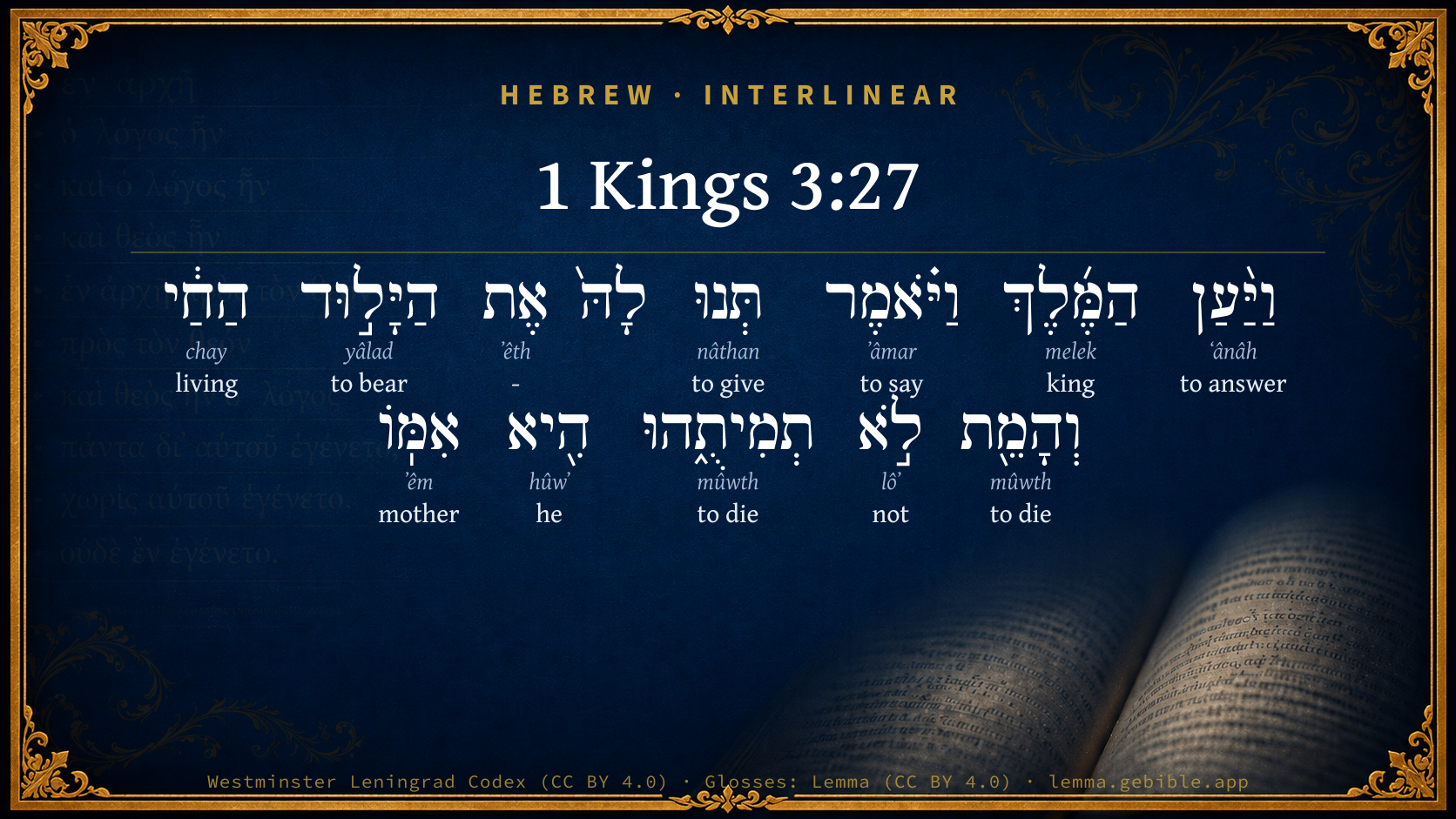
אִמּֽוֹ
ʼêm
H517
“mother · his”
Noun, Common, Feminine, Singular, Construct + Suffix, Personal, 3rd Person, Masculine, Singular
Part of Speech
Noun
Type
Common
Gender
Feminine
Number
Singular
State
Construct
Full BDB Definition

Origin: a primitive word

TWOT: 115a

mother - of humans - of Deborah's relationship to the people (figuratively) - of animals - point of departure or division
  1. וַיַּ֨עַן ʻânâh H6030 “and · to answer” Conjunction + Verb, Qal, Sequential Imperfect, 3rd Person, Masculine, Singular
  2. הַמֶּ֜לֶךְ melek H4428 “the · king” Particle, Definite Article + Noun, Common, Masculine, Singular, Absolute
  3. וַיֹּ֗אמֶר ʼâmar H559 “and · to say” Conjunction + Verb, Qal, Sequential Imperfect, 3rd Person, Masculine, Singular
  4. תְּנוּ nâthan H5414 “give” Verb, Qal, Imperative, 2nd Person, Masculine, Plural
  5. אֶת ʼêth H853 “-” Particle, Direct Object
  6. הַיָּל֣וּד yâlad H3205 “the · borne” Particle, Definite Article + Verb, Qal, Participle Passive, Masculine, Singular, Absolute
  7. הַחַ֔י chay H2416 “the · living” Particle, Definite Article + Adjective, Adjective, Masculine, Singular, Absolute
  8. וְהָמֵ֖ת mûwth H4191 “and · to die” Conjunction + Verb, Hiphil, Infinitive Absolute
  9. לֹ֣א lôʼ H3808 “not” Particle, Negative
  10. תְמִיתֻ֑הוּ mûwth H4191 “to die · him” Verb, Hiphil, Imperfect, 2nd Person, Masculine, Plural + Suffix, Personal, 3rd Person, Masculine, Singular
  11. הִ֖יא hûwʼ H1931 “he” Pronoun, Personal, 3rd Person, Feminine, Singular

About this verse

These counts appear in no published source. They are computed here, from the morphology-tagged text and Lemma’s own curated glosses. What Lemma adds →

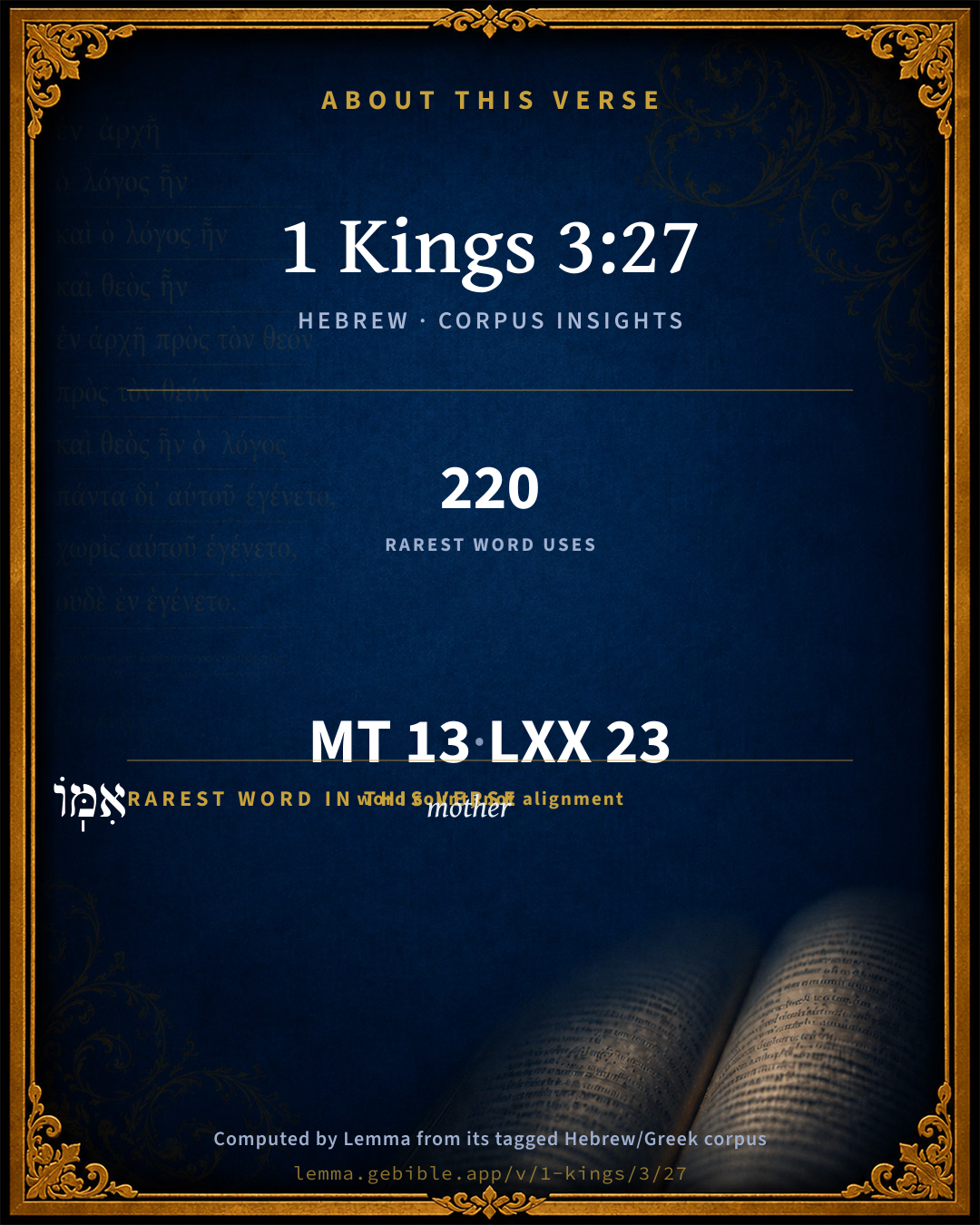
13
words
11
distinct lemmas
Historical
section

Grammatical profile

  • 6 verbs
  • 2 nouns
  • 1 adjective
  • 1 pronoun
  • 1 preposition
  • 2 particles

Verb forms

  • וַיַּ֨עַן Qal · Sequential Imperfect
  • וַיֹּ֗אמֶר Qal · Sequential Imperfect
  • תְּנוּ Qal · Imperative
  • הַיָּל֣וּד Qal · Participle Passive
  • וְהָמֵ֖ת Hiphil · Infinitive Absolute
  • תְמִיתֻ֑הוּ Hiphil · Imperfect

Repetition

A word recurs within this verse — often emphatic in Hebrew:

  • וְהָמֵ֖ת to die H4191 ×2

Hebrew & Septuagint length

In English translation the verse runs 21 words from the Hebrew and 27 from the Septuagint (LXX English) — closely comparable.

A rough comparison of the two English renderings, which tokenize alike — not a word-level alignment.

Word counts can differ between the Hebrew and the Greek without any difference in meaning — e.g. the Hebrew direct-object marker אֵת has no separate Greek word, and Greek often adds the article ὁ.

In the original languages it is 13 Hebrew tokens and 23 Greek tokens — but the two are counted differently (Hebrew bundles its prefixes and suffixes into one token; the Greek is in lemma form), so that isn’t a like-for-like length.

Hebrew and Greek witnesses Masoretic Hebrew ↔ Greek Septuagint

The same verse in the two great witnesses to the Old Testament, shown verse-for-verse.

These are two independent witnesses, not word-aligned to each other, and the Septuagint is shown in lemma (dictionary) form.

Hebrew 1 Kings 3:27 Masoretic · Westminster Leningrad Codex

וַיַּ֨עַן הַמֶּ֜לֶךְ וַיֹּ֗אמֶר תְּנוּ לָהּ֙ אֶת הַיָּל֣וּד הַחַ֔י וְהָמֵ֖ת לֹ֣א תְמִיתֻ֑הוּ הִ֖יא אִמּֽוֹ

Then the king answered, Give her the living child, and in no way kill it: she is the mother of it.

World English Bible · Public Domain

Greek LXX 1 Kings 3:27 Septuagint · lemma form

καί ἀποκρίνω ὁ βασιλεύς καί εἶπον δίδωμι ὁ παιδίον ὁ εἶπον δίδωμι αὐτός αὐτός καί θάνατος μή θανατόω αὐτός αὐτός ὁ μήτηρ αὐτός

Then the king answered and said, Give the child to her that said, 'Give it to her, and by no means kill it:' she is its mother.

LXX2012 (modern English Septuagint) · Public Domain

On this verse, The Pulpit Commentary discusses the Septuagint’s reading. Read the note in Commentary ↓

Hebrew: Westminster Leningrad Codex (CC BY 4.0). Greek: Septuagint (public domain); English from LXX2012 (modern English Septuagint) (Public Domain). How the Septuagint differs from the Hebrew →

Targum (Aramaic paraphrase)

1

The Targum is the ancient Jewish Aramaic paraphrase of the Hebrew Scriptures — an interpretive translation, not the Hebrew text itself. Onkelos (literal) and Pseudo-Jonathan (expansive) render the Torah, and Jonathan the Prophets. Coverage is partial: where no permissively-licensed English translation exists for a verse, only the Aramaic is shown. This is verse-level text, not a word-by-word alignment to the Hebrew.

  1. Targum Jonathan Prophets (Joshua–Malachi)
    וַאֲתֵיב מַלְכָּא וַאֲמַר הָבוּ לָהּ יַת רַבְיָא חַיָא וּמִקְטַל לָא תִקְטְלוּנֵיהּ הִיא אִמֵיהּ:

    (no public-domain English translation for this verse)

    Targum Jonathan — Aramaic: “Mikraot Gedolot” (public domain). English: “Sefaria Community Translation” (CC0 1.0 (public-domain dedication)); “London "Chaldee Paraphrase," 1871” (public domain). Text via Sefaria.

Commentary

Notes on 1 Kings 3:27 from classic Christian and Jewish commentators (each source and its license shown beneath its notes). The classic Christian expositions comment on the surrounding passage and are grouped to its opening verse, so a note may address several verses; the Jewish commentaries on the Tanakh (Rashi and others) are per-verse, so they appear only where the commentator wrote on this verse.

Lemma curates 59 commentaries, every one of them public domain or Creative Commons licensed, each selected and text-cleaned for this edition rather than reprinted as found. About our sources →

Trapp's Complete Commentary

John Trapp

1Ki 3:27 Then the king answered and said, Give her the living child, and in no wise slay it: she [is] the mother thereof.

Ver. 27. She is the mother thereof.] As appeareth by her natural affection. Ownness maketh love. Prolem quisque amat non quia pulchram, sed quia suam.

John Trapp, A Commentary or Exposition upon All the Books of the Old and New Testament (1647–1656) — public domain. Text from a community e-Sword module.

Joseph Benson's Commentary

1Ki 3:27-28. She is the mother — As is evident from her natural affection to the child, which she had rather have given away from her than destroyed. Wisdom of God — Divine wisdom, with which God had inspired him for the government of his people.

Joseph Benson's Commentary on the Old and New Testaments (1811–1818) — public domain. Text from a community e-Sword module.

The Cambridge Bible for Schools and Colleges

gen. ed. J. J. S. Perowne

27. Give her the living child] Not referring to the woman who had last spoken as the sequence of the clauses might lead us to expect. The king no doubt pointed to the mother who was desirous at all cost to keep the child alive.

The late Dr Bernard had a most ingenious explanation of the construction of this passage. The king, he said, was pondering the words of the two women. At last he broke forth in the language of the mother who had said ‘Give her the living child and in no wise slay it.’ And to that sentence, taken as representative of the person who had spoken it, he adds his own decision, ‘She is the mother thereof.’

The Cambridge Bible for Schools and Colleges (gen. ed. J. J. S. Perowne; Cambridge University Press, 1878–1918) — public domain. Text from a community e-Sword module.

John Gill's Exposition

And all Israel heard of the judgment which the king had judged,.... In the above case; the decision of it was divulged throughout the land, and the fame of it was spread everywhere:

and they feared the king; reverenced him as a wise, judicious, and faithful king, and feared to do anything of a criminal nature, as perceiving that he was so sagacious and penetrating, that he would discover it quickly, and bring them to shame and punishment:

for they saw that the wisdom of God was in him to do judgment; that God had put more than ordinary wisdom into him, to make a right judgment in causes that came before him, and finish them in the most just and equitable manner.

Next: 1 Kings Chapter 4

John Gill's Exposition of the Whole Bible (1746–1763) — public domain (CC PDM 1.0). Text via the HelloAO Bible API.

Matthew Poole's English Annotations

As is evident from her natural and motherly affection to the child, which she had rather have alienated and given away from her than destroyed.

Matthew Poole's English Annotations on the Holy Bible (1683–1685) — public domain. Text from a community e-Sword/MySword module.

The Pulpit Commentary

Then the king answered and said (He simply echoes the exact words of the mother. This is clear from the fact that the word dWlynatus, "the one born," here and in ver. 26 rendered child," is a very unusual one), Give her the living child, and in no wise slay it (The LXX, which reads "Give the child to her who said, Give it to her," etc., obscures the evidently designed repetition) she is the mother thereof (Heb. she, his mother).

The Pulpit Commentary (1880–1919), ed. H.D.M. Spence-Jones & Joseph S. Exell — public domain. Text from a community e-Sword module.

John Wesley's Explanatory Notes

She is the mother - As is evident from her natural affection to the child, which she had rather have given away from her, than destroyed.

John Wesley, Explanatory Notes Upon the Whole Bible (1754–1765) — public domain. Text via the GEBible commentary corpus.

Keil & Delitzsch

C. F. Keil & F. Delitzsch

Solomon saw from this which was the mother of the living child, and handed it over to her.

(Note: Grotius observes on this: "The ἀγχίνοια of Solomon was shown by this to be very great. There is a certain similarity in the account of Ariopharnis, king of the Thracians, who, when three persons claimed to be the sons of the king of the Cimmerii, decided that he was the son who would not obey the command to cast javelins at his father's corpse. The account is given by Diodorus Siculus.")

Keil & Delitzsch — Biblical Commentary on the Old Testament (1861–1891) — public domain (CC PDM 1.0). Text via the HelloAO Bible API. (Old Testament only.)

Rashi

Rabbi Shlomo Yitzchaki (Rashi)

She is his mother. A Divine voice appeared and said, “She is his mother.”

Rashi on the Tanakh — English translations: “The Judaica Press complete Tanach with Rashi, translated by A. J. Rosenberg” (CC BY 4.0); “Pentateuch with Rashi's commentary by M. Rosenbaum and A.M. Silbermann, 1929-1934” (public domain); “The Metsudah Tanach series, Lakewood, N.J” (CC BY 4.0); and “The Book of Joshua, Metsudah Publications, 1997” (CC BY 4.0). Text via Sefaria.

Lesson kit

Teaching starters — assembled from the data on this page, not authored interpretation. Every prompt links to the verse data it draws on. Edit before teaching.

1 Kings, in the Historical, opens this verse with 13 words (11 distinct Hebrew lemmas). Its most distinctive word is ʼêm (“mother”). A historical commentator’s framing appears above. Read the whole chapter for the surrounding context.

Discussion questions

  1. How does “mother” (ʼêm) shape what this verse is saying?
  2. What does the repetition of “to die” (2× in this one verse) do in this verse?
  3. These translations render this verse differently; the difference is in the English rendering, not the original. What questions does that raise?
  4. «וַיַּ֨עַן» is a Qal Sequential Imperfect verb. How does that grammatical form shape the action described?
  5. Compare how Trapp's Complete Commentary and Joseph Benson's Commentary read this verse. Where do they agree or differ?

Things to notice

Reading settings

Reading text

Shown beneath each verse's original-language words.

Old Testament
Old Testament edition

Read the OT as the Masoretic Hebrew (MT) or the Greek Septuagint (LXX).

English shown for the Greek Septuagint (in the Hebrew ↔ Greek comparison).

Comparing translations? Open the Compare panel on any verse page to stack up to four side by side.