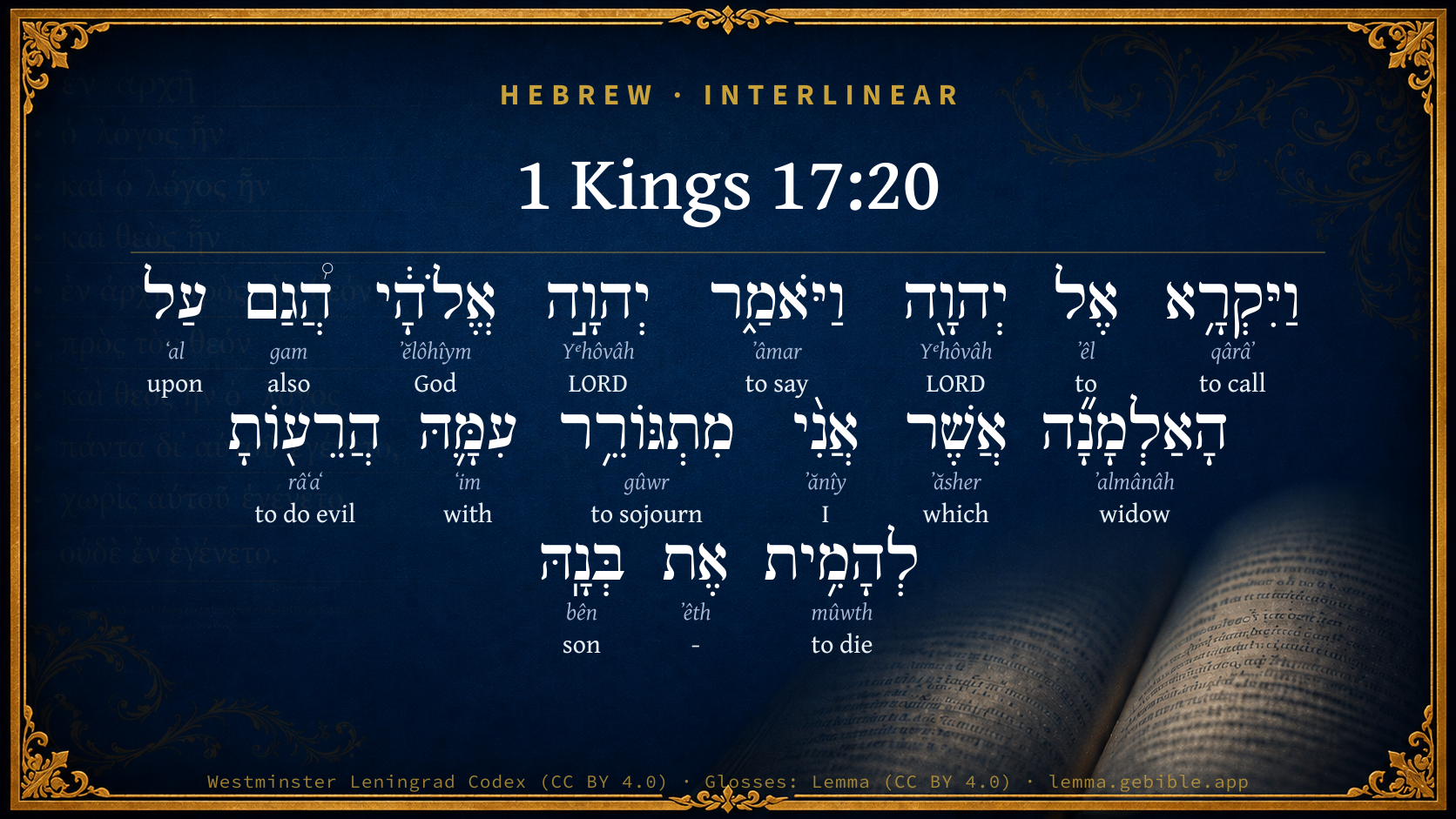
1 Kings 17:20

Hebrew (Westminster Leningrad Codex) 1 Kings 17:20 appears in the Hebrew Old Testament. The text above is from the Westminster Leningrad Codex. Each word links to its Strong’s number, a concise gloss, and parsing drawn from the Open Scriptures Hebrew Bible morphology. Click any word for its full Brown-Driver-Briggs (BDB) entry.
Download image
Cite this verse

1 Kings 17:20 (World English Bible). Public Domain. Lemma interlinear Bible study tool, https://lemma.gebible.app/v/1-kings/17/20.

Show BibTeX & RIS
BibTeX
RIS
English Translation
He cried to Yahweh, and said, Yahweh my God, have you also brought evil on the widow with whom I sojourn, by killing her son?
World English Bible · Public Domain
Download a study sheet

One document with this verse’s original text, its word-by-word gloss line, the meaning frame, cross-references with their text, attributed commentary, and full source and license credits — printable, and it pastes into notes with its structure intact.

This verse Autodidact and up

Study sheet (.html) Plain text (.txt)

A passage Seminary Student

Up to 50 verses in one chapter. A passage sheet keeps up to 6 commentary sources and 12 cross-references per verse, in the order this page ranks them, and says so on the sheet whenever that leaves anything out. Ask for a single verse and you get the Autodidact verse sheet above.

Everything on this page stays free to read, with no account — the sheet is a download of what is already on screen, not access to it.

Want to remove ads? Support Godless Engineer
Compare translations 3

The same verse in 3 English versions, stacked beneath the original-language interlinear above. Click any original word for its lexicon entry.

Each is an independent rendering of the whole verse — the interlinear is not word-aligned to these translations.

Highlighted words mark where these versions differ — a whole-verse word diff, not a word-by-word alignment.

  • World English Bible Public Domain
    He cried to Yahweh, and said, Yahweh my God, have you also brought evil on the widow with whom I sojourn, by killing her son?
  • King James Version Public Domain
    And he cried unto the LORD, and said, O LORD my God, hast thou also brought evil upon the widow with whom I sojourn, by slaying her son?
  • unfoldingWord Literal Text CC BY-SA 4.0
    And he cried out to Yahweh and said, “Yahweh my God, have you even brought harm upon the widow with whom I am sojourning, by killing her son?”

unfoldingWord Literal Text — © unfoldingWord, licensed CC BY-SA 4.0. Word-aligned USFM3 via Door43 (git.door43.org/unfoldingWord/en_ult).

Versions to compare (up to 4)

3 of 4 selected

Show all 18 translations

Every available English version of this verse, each an independent rendering of the whole verse.

  • World English Bible Public Domain
    He cried to Yahweh, and said, Yahweh my God, have you also brought evil on the widow with whom I sojourn, by killing her son?
  • Berean Standard Bible Public Domain
    Then he cried out to the LORD, “O LORD my God, have You also brought tragedy on this widow who has opened her home to me, by causing her son to die?”
  • Majority Standard Bible Public Domain
    Then he cried out to the LORD, “O LORD my God, have You also brought tragedy on this widow who has opened her home to me, by causing her son to die?”
  • King James Version Public Domain
    And he cried unto the LORD, and said, O LORD my God, hast thou also brought evil upon the widow with whom I sojourn, by slaying her son?
  • American Standard Version (1901) Public Domain
    And he cried unto Jehovah, and said, O Jehovah my God, hast thou also brought evil upon the widow with whom I sojourn, by slaying her son?
  • Revised Version (1885) Public Domain
    And he cried unto the LORD, and said, O LORD my God, hast thou also brought evil upon the widow with whom I sojourn, by slaying her son?
  • Geneva Bible (1599) Public Domain
    Then he called vnto the Lord, and sayde, O Lord my God, hast thou punished also this widowe, with whome I soiourne, by killing her sonne?
  • Douay-Rheims (1899) Public Domain
    And he cried to the Lord, and said: O Lord my God, hast thou afflicted also the widow, with whom I am after a so maintained, so as to kill her son?
  • Young's Literal Translation Public Domain
    and crieth unto Jehovah, and saith, `Jehovah my God, also on the widow with whom I am sojourning hast Thou done evil -- to put her son to death?'
  • Literal Standard Version CC BY-SA 4.0
    and cries to YHWH and says, “My God YHWH, have You also brought calamity on the widow with whom I am sojourning, to put her son to death?”
  • Unlocked Literal Bible CC BY-SA 4.0
    He cried to Yahweh and said, “Yahweh my God, have you also brought disaster on the widow with whom I am staying, by killing her son?”
  • unfoldingWord Literal Text CC BY-SA 4.0
    And he cried out to Yahweh and said, “Yahweh my God, have you even brought harm upon the widow with whom I am sojourning, by killing her son?”
  • Darby Bible Public Domain
    And he cried to Jehovah and said, Jehovah, my God, hast thou also brought evil upon the widow with whom I sojourn, by slaying her son?
  • World Messianic Bible Public Domain
    He cried to the LORD and said, “LORD my God, have you also brought evil on the widow with whom I am staying, by killing her son?”
  • Webster's Bible Public Domain
    And he cried to the LORD, and said, O LORD my God, hast thou also brought evil upon the widow with whom I sojourn, by slaying her son?
  • Free Bible Version CC BY-SA 4.0
    Then he cried out to the Lord, saying, “Lord my God, why have you allowed this to happen to this widow who has opened her home to me, this terrible tragedy of causing her son to die?”
  • Bible in Basic English Public Domain
    And crying to the Lord he said, O Lord my God, have you sent evil even on the widow whose guest I am, by causing her son's death?
  • JPS Tanakh (1917) Public Domain
    And he cried unto the LORD, and said: 'O LORD my God, hast Thou also brought evil upon the widow with whom I sojourn, by slaying her son?'

Literal Standard Version (2020), Covenant Press — licensed CC BY-SA 4.0. Text via the HelloAO Bible API (eBible.org). Unlocked Literal Bible (unfoldingWord) — licensed CC BY-SA 4.0. Text via the HelloAO Bible API (eBible.org). unfoldingWord Literal Text — © unfoldingWord, licensed CC BY-SA 4.0. Word-aligned USFM3 via Door43 (git.door43.org/unfoldingWord/en_ult). Free Bible Version, Dr. Jonathan Gallagher — licensed CC BY-SA 4.0. Text via the HelloAO Bible API (eBible.org).

Word by word

More ways to search: Search by grammar → Find every occurrence → Compare this word →

Practice this passage: Drill this verse → Learn its vocabulary →

הָאַלְמָנָ֞ה
ʼalmânâh
H490
“the · widow”
Particle, Definite Article + Noun, Common, Feminine, Singular, Absolute
Part of Speech
Particle + Noun
Type
Common
Gender
Feminine
Number
Singular
State
Absolute
Full BDB Definition

Origin: from H488 ; a widow

TWOT: 105

widow
  1. וַיִּקְרָ֥א qârâʼ H7121 “and · to call” Conjunction + Verb, Qal, Sequential Imperfect, 3rd Person, Masculine, Singular
  2. אֶל ʼêl H413 “to” Preposition
  3. יְהוָ֖ה Yᵉhôvâh H3068 “LORD” Noun, Proper
  4. וַיֹּאמַ֑ר ʼâmar H559 “and · to say” Conjunction + Verb, Qal, Sequential Imperfect, 3rd Person, Masculine, Singular
  5. יְהוָ֣ה Yᵉhôvâh H3068 “LORD” Noun, Proper
  6. אֱלֹהָ֔י ʼĕlôhîym H430 “God(s) · my” Noun, Common, Masculine, Plural, Construct + Suffix, Personal, 1st Person, Common, Singular
  7. הֲ֠גַם gam H1571 “also” Particle, Interrogative + Adverb
  8. עַל ʻal H5921 “upon” Preposition
  9. אֲשֶׁר ʼăsher H834 “which” Particle, Relative
  10. אֲנִ֨י ʼănîy H589 “I” Pronoun, Personal, 1st Person, Common, Singular
  11. מִתְגּוֹרֵ֥ר gûwr H1481 “sojourning” Verb, Hithpolel, Participle Active, Masculine, Singular, Absolute
  12. עִמָּ֛הּ ʻim H5973 “with · her” Preposition + Suffix, Personal, 3rd Person, Feminine, Singular
  13. הֲרֵע֖וֹתָ râʻaʻ H7489 “to do evil” Verb, Hiphil, Perfect, 2nd Person, Masculine, Singular
  14. לְהָמִ֥ית mûwth H4191 “to die” Preposition + Verb, Hiphil, Infinitive Construct
  15. אֶת ʼêth H853 “-” Particle, Direct Object
  16. בְּנָֽהּ bên H1121 “son · her” Noun, Common, Masculine, Singular, Construct + Suffix, Personal, 3rd Person, Feminine, Singular

About this verse

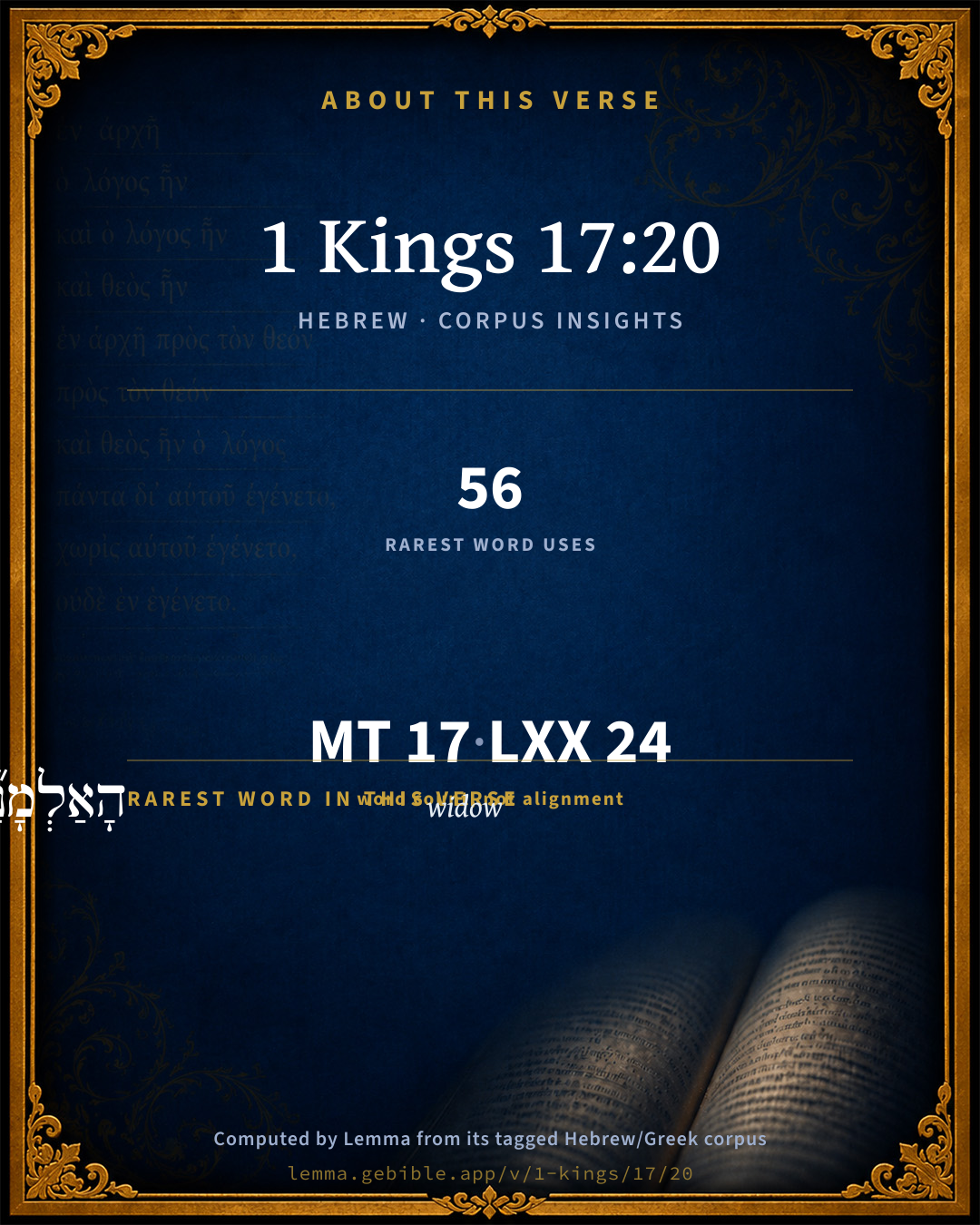
These counts appear in no published source. They are computed here, from the morphology-tagged text and Lemma’s own curated glosses. What Lemma adds →

17
words
16
distinct lemmas
Historical
section

Shared distinctive vocabulary

הָאַלְמָנָ֞ה widow H490 occurs in 54 verses of the Hebrew Bible. Also found in:

Grammatical profile

  • 5 verbs
  • 5 nouns
  • 1 pronoun
  • 3 prepositions
  • 1 adverb
  • 2 particles

Verb forms

  • וַיִּקְרָ֥א Qal · Sequential Imperfect
  • וַיֹּאמַ֑ר Qal · Sequential Imperfect
  • מִתְגּוֹרֵ֥ר Hithpolel · Participle Active
  • הֲרֵע֖וֹתָ Hiphil · Perfect
  • לְהָמִ֥ית Hiphil · Infinitive Construct

Repetition

A word recurs within this verse — often emphatic in Hebrew:

  • יְהוָ֖ה LORD H3068 ×2

Hebrew & Septuagint length

In English translation the verse runs 25 words from the Hebrew and 28 from the Septuagint (LXX English) — closely comparable.

A rough comparison of the two English renderings, which tokenize alike — not a word-level alignment.

Word counts can differ between the Hebrew and the Greek without any difference in meaning — e.g. the Hebrew direct-object marker אֵת has no separate Greek word, and Greek often adds the article ὁ.

In the original languages it is 17 Hebrew tokens and 24 Greek tokens — but the two are counted differently (Hebrew bundles its prefixes and suffixes into one token; the Greek is in lemma form), so that isn’t a like-for-like length.

Cross-references

12

Topical passages linked to 1 Kings 17:20 in the Treasury of Scripture Knowledge — connected by theme and wording, ordered by reader-vote popularity; previews shown in the World English Bible.

  • Matthew 21:22 All things, whatever you ask in prayer, believing, you will receive."
  • James 5:15–18 and the prayer of faith will heal him who is sick, and the Lord will raise him up. If he has committed sins, he will be forgiven.
  • Genesis 18:23–25 Abraham drew near, and said, "Will you consume the righteous with the wicked?
  • Exodus 17:4 Moses cried to Yahweh, saying, "What shall I do with these people? They are almost ready to stone me."
  • Joshua 7:8–9 Oh, Lord, what shall I say, after that Israel has turned their backs before their enemies!
  • 1 Samuel 7:8–9 The children of Israel said to Samuel, "Don't cease to cry to Yahweh our God for us, that he will save us out of the hand of the Philistines."
  • 1 Kings 18:36–37 It happened at the time of the offering of the [evening] offering, that Elijah the prophet came near, and said, Yahweh, the God of Abraham, of Isaac, and of Israel, let it be known this day that you are God in Israel, and that I am your servant, and that I have done all these things at your word.
  • 2 Kings 19:15 Hezekiah prayed before Yahweh, and said, Yahweh, the God of Israel, who sit [above] the cherubim, you are the God, even you alone, of all the kingdoms of the earth; you have made heaven and earth.
  • Psalms 99:6 Moses and Aaron were among his priests, Samuel among those who call on his name; They called on Yahweh, and he answered them.
  • 2 Kings 19:4 It may be Yahweh your God will hear all the words of Rabshakeh, whom the king of Assyria his master has sent to defy the living God, and will rebuke the words which Yahweh your God has heard. Therefore lift up your prayer for the remnant that is left.
  • Psalms 73:13–14 Surely in vain I have cleansed my heart, And washed my hands in innocence,
  • Jeremiah 12:1 Righteous are you, Yahweh, when I contend with you; yet would I reason the cause with you: why does the way of the wicked prosper? why are all they at ease who deal very treacherously?

Cross-references courtesy of OpenBible.info (CC BY 4.0).

Hebrew and Greek witnesses Masoretic Hebrew ↔ Greek Septuagint

The same verse in the two great witnesses to the Old Testament, shown verse-for-verse.

These are two independent witnesses, not word-aligned to each other, and the Septuagint is shown in lemma (dictionary) form.

Hebrew 1 Kings 17:20 Masoretic · Westminster Leningrad Codex

וַיִּקְרָ֥א אֶל יְהוָ֖ה וַיֹּאמַ֑ר יְהוָ֣ה אֱלֹהָ֔י הֲ֠גַם עַל הָאַלְמָנָ֞ה אֲשֶׁר אֲנִ֨י מִתְגּוֹרֵ֥ר עִמָּ֛הּ הֲרֵע֖וֹתָ לְהָמִ֥ית אֶת בְּנָֽהּ

He cried to Yahweh, and said, Yahweh my God, have you also brought evil on the widow with whom I sojourn, by killing her son?

World English Bible · Public Domain

Greek LXX 1 Kings 17:20 Septuagint · lemma form

καί ἀναβοάω ηλιου καί εἶπον οἴμμοι κύριος ὁ μάρτυς ὁ χήρα μετά ὅς ἐγώ καταοἰκέω μετά αὐτός σύ κακόω ὁ θανατόω ὁ υἱός αὐτός

And Eliu cried aloud, and said, Alas, O Lord, the witness of the widow with whom I sojourn, you have wrought evil for her in slaying her son.

LXX2012 (modern English Septuagint) · Public Domain

On this verse, The Cambridge Bible for Schools and Colleges discusses the Septuagint’s reading. Read the note in Commentary ↓

Hebrew: Westminster Leningrad Codex (CC BY 4.0). Greek: Septuagint (public domain); English from LXX2012 (modern English Septuagint) (Public Domain). How the Septuagint differs from the Hebrew →

Targum (Aramaic paraphrase)

1

The Targum is the ancient Jewish Aramaic paraphrase of the Hebrew Scriptures — an interpretive translation, not the Hebrew text itself. Onkelos (literal) and Pseudo-Jonathan (expansive) render the Torah, and Jonathan the Prophets. Coverage is partial: where no permissively-licensed English translation exists for a verse, only the Aramaic is shown. This is verse-level text, not a word-by-word alignment to the Hebrew.

  1. Targum Jonathan Prophets (Joshua–Malachi)
    וְצַלֵי קֳדָם יְיָ וַאֲמַר יְיָ אֱלָהִי בְּרַם עַל אַרְמַלְתָּא דִי אֲנָא דָר עִמָהּ לָא יִתְבָּאֵשׁ לָהּ וְלָא יְמוּת בְּרָהּ:

    (no public-domain English translation for this verse)

    Targum Jonathan — Aramaic: “Mikraot Gedolot” (public domain). English: “Sefaria Community Translation” (CC0 1.0 (public-domain dedication)); “London "Chaldee Paraphrase," 1871” (public domain). Text via Sefaria.

Commentary

Notes on 1 Kings 17:20 from classic Christian and Jewish commentators (each source and its license shown beneath its notes). The classic Christian expositions comment on the surrounding passage and are grouped to its opening verse, so a note may address several verses; the Jewish commentaries on the Tanakh (Rashi and others) are per-verse, so they appear only where the commentator wrote on this verse.

Lemma curates 59 commentaries, every one of them public domain or Creative Commons licensed, each selected and text-cleaned for this edition rather than reprinted as found. About our sources →

Trapp's Complete Commentary

John Trapp

1Ki 17:20 And he cried unto the LORD, and said, O LORD my God, hast thou also brought evil upon the widow with whom I sojourn, by slaying her son?

Ver. 20. Hast thou also brought evil?] Words of wonder, and all full of weight. Quot verba, tot argumenta: this humble expostulation flowed from faith, as appeareth in 1Ki 17:21.

John Trapp, A Commentary or Exposition upon All the Books of the Old and New Testament (1647–1656) — public domain. Text from a community e-Sword module.

Tyndale Open Study Notes

Tyndale Open Resources

17:20 why have you brought tragedy: Elijah plaintively expressed to God the fear that his presence caused the child’s death.

Tyndale Open Study Notes — © Tyndale Open Resources, licensed CC BY-SA 4.0. Text via the HelloAO Bible API.

Geneva Bible (1599)

Geneva Bible translators

He was afraid lest God’s name should have been blasphemed and his ministers contemned, except he should have continued his mercies as he had begun them, specially while he there remained.

Geneva Bible (1599) marginal notes — public domain. Text via Bolls.life.

Ellicott's Commentary for English Readers

(20) Hast thou also brought evil.—Elijah’s complaint is characteristic of the half-presumptuous impatience seen more fully in 1 Kings 19. He apparently implies that his own lot, as a hunted fugitive not protected by God’s Almighty power, is so hard, that it must be his presence which has brought trouble even on the home that sheltered him.

A Bible Commentary for English Readers, edited by Charles John Ellicott (1878–1897) — public domain. Text from a community e-Sword module.

The Cambridge Bible for Schools and Colleges

gen. ed. J. J. S. Perowne

20. O Lord my God, hast thou also brought evil upon the widow] The LXX. omits ‘my God.’ In ‘also’ the prophet refers to the other evil which was brought on Israel and Phœnicia too by the drought. The widow had shewn such faith and obedience that we may regard the prophet’s question as of the nature of a petition ‘Let not this evil fall upon her.’

The Cambridge Bible for Schools and Colleges (gen. ed. J. J. S. Perowne; Cambridge University Press, 1878–1918) — public domain. Text from a community e-Sword module.

John Gill's Exposition

And he stretched himself upon the child three times,.... Or "measured himself" (i) on it, or put himself into a posture in some respects equal to the child; putting his mouth on its mouth, his eyes on its eyes, his hands on its hands, as Elisha afterwards did in a like case, perhaps in imitation of him, Kg2 4:34, thereby showing his great affection to the child, and in order to increase it the more, and to make him the more fervent and importunate in his prayers for its life; and hereby signifying also that he would if he could infuse his breath and life into it, and warm it with his own heat:

and cried unto the Lord, and said, O Lord my God, I pray thee, let this child's soul come into him again: which shows that the child was really dead; and a proof this that the soul dies not with the body, but exists in a separate state without it.

(i) "et mensus est se", Pagninus, Montanus; "admensus se", Junius & Tremellius, Piscator.

John Gill's Exposition of the Whole Bible (1746–1763) — public domain (CC PDM 1.0). Text via the HelloAO Bible API.

Haydock's Catholic Bible Commentary

Her son. He speaks in the most earnest and familiar manner, shewing his confidence in God. (Salien)

George Leo Haydock (1774–1849), Haydock's Catholic Family Bible and Commentary, 1859 edition — public domain. Excludes Psalms (Douay-Rheims chapter numbering differs from Protestant) and Deuterocanonical books (Catholic canon only).

Matthew Poole's English Annotations

A prayer full of powerful arguments. Thou art the Lord, that canst revive the child; and my God, and therefore wilt not, do not, deny me. She is a widow; add not affliction to the afflicted; deprive her not of the great support and staff of her age. She hath given me kind entertainment; let her not fare the worse for her kindness to a prophet, whereby wicked men will take occasion to reproach both her and religion.

Matthew Poole's English Annotations on the Holy Bible (1683–1685) — public domain. Text from a community e-Sword/MySword module.

Whedon's Commentary on the Bible

Daniel D. Whedon

20. Hast thou also brought evil — Not the language of reproach or complaint, but the emotional expression of profoundest sympathy with the widow’s affliction, and of the earnestness of Elijah’s faith and prayer.

Daniel D. Whedon (gen. ed.), Commentary on the Old and New Testaments (1874–1909) — public domain. Text from a community e-Sword module.

The Pulpit Commentary

And he cried unto the Lord, and said, O Lord my God, hast Thou also i.e. in addition to the misery and suffering brought through me upon my country brought evil upon the widow with whom I sojourn, by slaying Heb. to slay. Words. worth partly bases his conclusion that the child was dead on the inexact translation of the A.V her son?

The Pulpit Commentary (1880–1919), ed. H.D.M. Spence-Jones & Joseph S. Exell — public domain. Text from a community e-Sword module.

John Wesley's Explanatory Notes

He cried - A prayer full of powerful arguments. Thou art the Lord, that canst revive the child: and my God; and therefore wilt not, deny me. She is a widow, add not affliction to the afflicted; deprive her not of the support and staff of her age: she hath given me kind entertainment: let her not fare the worse for her kindness to a prophet, whereby wicked men will take occasion to reproach both her, and religion.

John Wesley, Explanatory Notes Upon the Whole Bible (1754–1765) — public domain. Text via the GEBible commentary corpus.

Lesson kit

Teaching starters — assembled from the data on this page, not authored interpretation. Every prompt links to the verse data it draws on. Edit before teaching.

1 Kings, in the Historical, opens this verse with 17 words (16 distinct Hebrew lemmas). Its most distinctive word is ʼalmânâh (“widow”). A historical commentator’s framing appears above. Read the whole chapter for the surrounding context.

Discussion questions

  1. How does “widow” (ʼalmânâh) shape what this verse is saying?
  2. How does Genesis 38:11, which shares the word «widow», read alongside this verse?
  3. What does the repetition of “LORD” (2× in this one verse) do in this verse?
  4. These translations render this verse differently; the difference is in the English rendering, not the original. What questions does that raise?
  5. «וַיִּקְרָ֥א» is a Qal Sequential Imperfect verb. How does that grammatical form shape the action described?
  6. Compare how Trapp's Complete Commentary and Tyndale Open Study Notes read this verse. Where do they agree or differ?

Things to notice

Reading settings

Reading text

Shown beneath each verse's original-language words.

Old Testament
Old Testament edition

Read the OT as the Masoretic Hebrew (MT) or the Greek Septuagint (LXX).

English shown for the Greek Septuagint (in the Hebrew ↔ Greek comparison).

Comparing translations? Open the Compare panel on any verse page to stack up to four side by side.