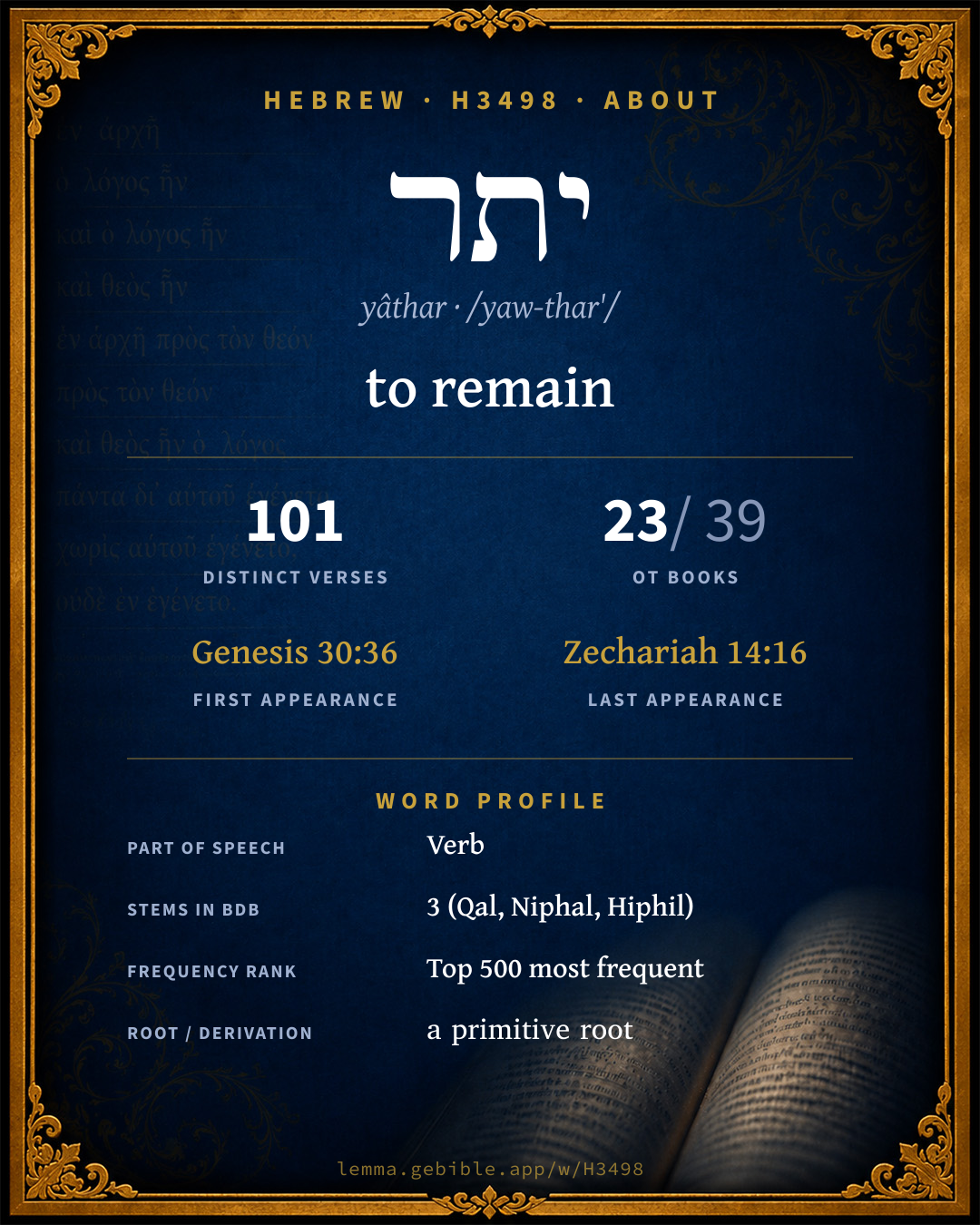
יָתַר
to remain
‘to remain’ is one of 3 main senses fuller range ↓
Full lexicon entry — Brown-Driver-Briggs (BDB)
From Brown-Driver-Briggs (BDB)
Where this word appears
See every Niphal verb in the Hebrew Bible →
Grammar key — what these labels mean
Part of speech
- Verb
- An action or state-of-being word.
Noun type
- Common
- A common noun — a general class of person, place, or thing (“king,” “city,” “water”), not a specific name.
Stem
- Niphal
- Usually the simple passive or reflexive of the Qal (“he was written”). Here: ‘be left over’
- Hiphil
- The causative active stem (“he caused / brought about”). Here: ‘leave over’
Form
- Participle Active
- A verbal adjective expressing ongoing or characteristic action (“writing / one who writes”).
- Perfect
- A completed action or state — Hebrew marks aspect (completeness) more than strict tense (“he wrote”).
- Imperfect
- An incomplete, ongoing, or future action (“he will / would write”).
- Sequential Imperfect
- An imperfect with prefixed waw — the standard past-narrative form (waw-consecutive imperfect).
- Infinitive Absolute
- An unbound verbal noun, often intensifying or standing in for a finite verb.
- Sequential Perfect
- A perfect with prefixed waw continuing a preceding imperfect or command (waw-consecutive perfect).
- Participle Passive
- A verbal adjective expressing action received (“written”).
- Infinitive Construct
- A bound verbal noun, frequently with prepositions (“to write / in writing”).
- Jussive
- A third- or second-person volitional form expressing wish or command (“let him write”).
- Imperative
- A direct command (“write!”).
State
- Absolute
- The independent form of a noun, not bound to a following word.
Person
- 3rd Person
- The one spoken about (“he / she / it / they”).
- 2nd Person
- The one addressed (“you”).
- 1st Person
- The speaker (“I / we”).
Gender
- Masculine
- Grammatically masculine.
- Feminine
- Grammatically feminine.
- Common
- Either gender — not distinguished for this form.
Number
- Plural
- More than one (in Hebrew, generally three or more).
- Singular
- One.
Grammatical forms 31 distinct
- Verb, Niphal, Participle Active, Masculine, Plural, Absolute 24 times (22%)
- Verb, Niphal, Participle Active, Masculine, Singular, Absolute 19 times (18%)
- Verb, Niphal, Perfect, 3rd Person, Masculine, Singular 10 times (9%)
- Verb, Niphal, Imperfect, 3rd Person, Masculine, Singular 4 times (4%)
- Verb, Niphal, Participle Active, Feminine, Singular, Absolute 4 times (4%)
- Verb, Niphal, Sequential Imperfect, 3rd Person, Masculine, Singular 3 times (3%)
- Verb, Hiphil, Infinitive Absolute 3 times (3%)
- Verb, Niphal, Participle Active, Feminine, Plural, Absolute 3 times (3%)
+23 more forms (37 occurrences)
Parsed forms decoded from the imported morphology (morphhb / Westminster Leningrad Codex — WLC text public domain, morphhb tagging CC BY 4.0), counted across 107 parsed occurrences — not distinct verses.
Every verse where H3498 appears — 101 distinct verses across 23 books. Click any verse to open its interlinear word-by-word view. Verse text shown in the World English Bible for context — . Each verse’s Hebrew form is shown with its reference; the English is not keyword-highlighted, since the data carries no word-level English alignment. Use “Compare translations” on any verse to read it across multiple English versions. This concordance covers the Hebrew Bible; Septuagint (Greek Old Testament) occurrences are not indexed here.
Genesis 4 verses
- Genesis 30:36 הַ/נּוֹתָרֹֽת ptcl def.art + Niphal ptcp.act fp He set three days' journey between himself and Jacob, and Jacob fed the rest of Laban's flocks.
- Genesis 32:24 וַ/יִּוָּתֵ֥ר conj + Niphal wimpf 3ms Jacob was left alone, and wrestled with a man there until the breaking of the day.
- Genesis 44:20 וַ/יִּוָּתֵ֨ר conj + Niphal wimpf 3ms We said to my lord, 'We have a father, an old man, and a child of his old age, a little one; and his brother is dead, and he alone is left of his mother; and his father loves him.'
- Genesis 49:4 תּוֹתַ֔ר Hiphil juss 2ms Boiling over as water, you shall not have the pre-eminence; Because you went up to your father's bed; Then defiled it. He went up to my couch.
Exodus 7 verses
- Exodus 10:15 הוֹתִ֖יר נוֹתַ֨ר Hiphil pf 3ms Niphal pf 3ms For they covered the surface of the whole earth, so that the land was darkened, and they ate every herb of the land, and all the fruit of the trees which the hail had left. There remained nothing green, either tree or herb of the field, through all the land of Egypt.
- Exodus 12:10 תוֹתִ֥ירוּ וְ/הַ/נֹּתָ֥ר Hiphil impf 2mp conj + ptcl def.art + Niphal ptcp.act ms You shall let nothing of it remain until the morning; but that which remains of it until the morning you shall burn with fire.
- Exodus 16:19 יוֹתֵ֥ר Hiphil juss 3ms Moses said to them, "Let no one leave of it until the morning."
- Exodus 16:20 וַ/יּוֹתִ֨רוּ conj + Hiphil wimpf 3mp Notwithstanding they didn't listen to Moses, but some of them left of it until the morning, and it bred worms, and became foul: and Moses was angry with them.
- Exodus 28:10 הַ/נּוֹתָרִ֛ים ptcl def.art + Niphal ptcp.act mp six of their names on the one stone, and the names of the six that remain on the other stone, in the order of their birth.
- Exodus 29:34 יִוָּתֵ֞ר הַ/נּוֹתָר֙ Niphal impf 3ms ptcl def.art + Niphal ptcp.act ms If anything of the flesh of the consecration, or of the bread, remains to the morning, then you shall burn the remainder with fire: it shall not be eaten, because it is holy.
- Exodus 36:7 וְ/הוֹתֵֽר conj + Hiphil inf.abs For the stuff they had was sufficient for all the work to make it, and too much.
Leviticus 13 verses
- Leviticus 2:3 וְ/הַ/נּוֹתֶ֨רֶת֙ conj + ptcl def.art + Niphal ptcp.act fs That which is left of the meal offering shall be Aaron's and his sons'. It is a most holy thing of the offerings of Yahweh made by fire.
- Leviticus 2:10 וְ/הַ/נּוֹתֶ֨רֶת֙ conj + ptcl def.art + Niphal ptcp.act fs That which is left of the meal offering shall be Aaron's and his sons'. It is a thing most holy of the offerings of Yahweh made by fire.
- Leviticus 6:16 וְ/הַ/נּוֹתֶ֣רֶת conj + ptcl def.art + Niphal ptcp.act fs That which is left of it Aaron and his sons shall eat. It shall be eaten without yeast in a holy place. They shall eat it in the court of the Tent of Meeting
- Leviticus 7:16 וְ/הַ/נּוֹתָ֥ר conj + ptcl def.art + Niphal ptcp.act ms "'But if the sacrifice of his offering is a vow, or a freewill offering, it shall be eaten on the day that he offers his sacrifice; and on the next day what remains of it shall be eaten:
- Leviticus 7:17 וְ/הַ/נּוֹתָ֖ר conj + ptcl def.art + Niphal ptcp.act ms but what remains of the flesh of the sacrifice on the third day shall be burned with fire.
- Leviticus 8:32 וְ/הַ/נּוֹתָ֥ר conj + ptcl def.art + Niphal ptcp.act ms What remains of the flesh and of the bread you shall burn with fire.
- Leviticus 10:12 הַ/נּֽוֹתָרִים֒ הַ/נּוֹתֶ֨רֶת֙ ptcl def.art + Niphal ptcp.act mp ptcl def.art + Niphal ptcp.act fs Moses spoke to Aaron, and to Eleazar and to Ithamar, his sons who were left, "Take the meal offering that remains of the offerings of Yahweh made by fire, and eat it without yeast beside the altar; for it is most holy;
- Leviticus 10:16 הַ/נּוֹתָרִ֖ם ptcl def.art + Niphal ptcp.act mp Moses diligently inquired about the goat of the sin offering, and, behold, it was burned: and he was angry with Eleazar and with Ithamar, the sons of Aaron who were left, saying,
- Leviticus 14:18 וְ/הַ/נּוֹתָ֗ר conj + ptcl def.art + Niphal ptcp.act ms The rest of the oil that is in the priest's hand he shall put on the head of him who is to be cleansed, and the priest shall make atonement for him before Yahweh.
- Leviticus 14:29 וְ/הַ/נּוֹתָ֗ר conj + ptcl def.art + Niphal ptcp.act ms The rest of the oil that is in the priest's hand he shall put on the head of him who is to be cleansed, to make atonement for him before Yahweh.
- Leviticus 19:6 וְ/הַ/נּוֹתָר֙ conj + ptcl def.art + Niphal ptcp.act ms It shall be eaten the same day you offer it, and on the next day: and if anything remains until the third day, it shall be burned with fire.
- Leviticus 22:30 תוֹתִ֥ירוּ Hiphil impf 2mp It shall be eaten on the same day; you shall leave none of it until the morning. I am Yahweh.
- Leviticus 27:18 הַ/נּ֣וֹתָרֹ֔ת ptcl def.art + Niphal ptcp.act fp But if he dedicates his field after the Jubilee, then the priest shall reckon to him the money according to the years that remain to the Year of Jubilee; and an abatement shall be made from your valuation.
Numbers 2 verses
- Numbers 26:65 נוֹתַ֤ר Niphal pf 3ms For Yahweh had said of them, They shall surely die in the wilderness. There was not left a man of them, save Caleb the son of Jephunneh, and Joshua the son of Nun.
- Numbers 33:55 תּוֹתִ֣ירוּ Hiphil impf 2mp But if you will not drive out the inhabitants of the land from before you, then shall those who you let remain of them be as pricks in your eyes, and as thorns in your sides, and they shall vex you in the land in which you dwell.
Deuteronomy 3 verses
- Deuteronomy 28:11 וְ/הוֹתִֽרְ/ךָ֤ conj + Hiphil wpf 3ms + sfx pers 2ms Yahweh will make you plenteous for good, in the fruit of your body, and in the fruit of your cattle, and in the fruit of your ground, in the land which Yahweh swore to your fathers to give you.
- Deuteronomy 28:54 יוֹתִֽיר Hiphil impf 3ms The man who is tender among you, and very delicate, his eye shall be evil toward his brother, and toward the wife of his bosom, and toward the remnant of his children whom he has remaining;
- Deuteronomy 30:9 וְ/הוֹתִֽירְ/ךָ֩ conj + Hiphil wpf 3ms + sfx pers 2ms Yahweh your God will make you plenteous in all the work of your hand, in the fruit of your body, and in the fruit of your cattle, and in the fruit of your ground, for good: for Yahweh will again rejoice over you for good, as he rejoiced over your fathers;
Joshua 10 verses
- Joshua 11:11 נוֹתַ֖ר Niphal pf 3ms They struck all the souls who were therein with the edge of the sword, utterly destroying them; there was none left who breathed: and he burnt Hazor with fire.
- Joshua 11:22 נוֹתַ֣ר Niphal pf 3ms There was none of the Anakim left in the land of the children of Israel: only in Gaza, in Gath, and in Ashdod, did some remain.
- Joshua 17:2 הַ/נּוֹתָרִים֮ ptcl def.art + Niphal ptcp.act mp So [the lot] was for the rest of the children of Manasseh according to their families: for the children of Abiezer, and for the children of Helek, and for the children of Asriel, and for the children of Shechem, and for the children of Hepher, and for the children of Shemida: these were the male children of Manasseh the son of Joseph according to their families.
- Joshua 17:6 הַ/נּֽוֹתָרִֽים ptcl def.art + Niphal ptcp.act mp because the daughters of Manasseh had an inheritance among his sons. The land of Gilead belonged to the rest of the sons of Manasseh.
- Joshua 18:2 וַ/יִּוָּֽתְרוּ֙ conj + Niphal wimpf 3mp There remained among the children of Israel seven tribes, which had not yet divided their inheritance.
- Joshua 21:5 הַ/נּוֹתָרִ֗ים ptcl def.art + Niphal ptcp.act mp The rest of the children of Kohath had by lot out of the families of the tribe of Ephraim, and out of the tribe of Dan, and out of the half-tribe of Manasseh, ten cities.
- Joshua 21:20 הַ/נּוֹתָרִ֖ים ptcl def.art + Niphal ptcp.act mp The families of the children of Kohath, the Levites, even the rest of the children of Kohath, they had the cities of their lot out of the tribe of Ephraim.
- Joshua 21:26 הַ/נּוֹתָרִֽים ptcl def.art + Niphal ptcp.act mp All the cities of the families of the rest of the children of Kohath were ten with their suburbs.
- Joshua 21:34 הַ/נּוֹתָרִים֒ ptcl def.art + Niphal ptcp.act mp To the families of the children of Merari, the rest of the Levites, out of the tribe of Zebulun, Jokneam with its suburbs, and Kartah with its suburbs,
- Joshua 21:40 הַ/נּוֹתָרִ֖ים ptcl def.art + Niphal ptcp.act mp All [these were] the cities of the children of Merari according to their families, even the rest of the families of the Levites; and their lot was twelve cities.
Judges 4 verses
- Judges 8:10 הַ/נּ֣וֹתָרִ֔ים ptcl def.art + Niphal ptcp.act mp Now Zebah and Zalmunna were in Karkor, and their hosts with them, about fifteen thousand men, all who were left of all the host of the children of the east; for there fell one hundred twenty thousand men who drew sword.
- Judges 9:5 וַ/יִּוָּתֵ֞ר conj + Niphal wimpf 3ms He went to his father's house at Ophrah, and killed his brothers the sons of Jerubbaal, being seventy persons, on one stone: but Jotham the youngest son of Jerubbaal was left; for he hid himself.
- Judges 21:7 לַ/נּוֹתָרִ֖ים prep det + Niphal ptcp.pass mp How shall we do for wives for those who remain, seeing we have sworn by Yahweh that we will not give them of our daughters to wives?
- Judges 21:16 לַ/נּוֹתָרִ֖ים prep det + Niphal ptcp.pass mp Then the elders of the congregation said, How shall we do for wives for those who remain, seeing the women are destroyed out of Benjamin?
Ruth 2 verses
- Ruth 2:14 וַ/תֹּתַֽר conj + Hiphil wimpf 3fs At meal-time Boaz said to her, Come here, and eat of the bread, and dip your morsel in the vinegar. She sat beside the reapers, and they reached her parched grain, and she ate, and was sufficed, and left of it.
- Ruth 2:18 הוֹתִ֖רָה Hiphil pf 3fs She took it up, and went into the city; and her mother-in-law saw what she had gleaned: and she brought forth and gave to her that which she had left after she was sufficed.
1 Samuel 4 verses
- 1 Samuel 2:36 הַ/נּוֹתָר֙ ptcl def.art + Niphal ptcp.act ms It shall happen, that everyone who is left in your house shall come and bow down to him for a piece of silver and a loaf of bread, and shall say, Please put me into one of the priests' offices, that I may eat a morsel of bread.
- 1 Samuel 15:15 הַ/יּוֹתֵ֖ר ptcl def.art + n c ms Saul said, They have brought them from the Amalekites: for the people spared the best of the sheep and of the oxen, to sacrifice to Yahweh your God; and the rest we have utterly destroyed.
- 1 Samuel 25:34 נוֹתַ֧ר Niphal pf 3ms For in very deed, as Yahweh, the God of Israel, lives, who has withheld me from hurting you, except you had hurried and come to meet me, surely there wouldn't have been left to Nabal by the morning light so much as one man-child.
- 1 Samuel 30:9 וְ/הַ/נּֽוֹתָרִ֖ים conj + ptcl def.art + Niphal ptcp.act mp So David went, he and the six hundred men who were with him, and came to the brook Besor, where those who were left behind stayed.
2 Samuel 4 verses
- 2 Samuel 8:4 וַ/יּוֹתֵ֥ר conj + Hiphil wimpf 3ms David took from him one thousand seven hundred horsemen, and twenty thousand footmen: and David hamstrung all the chariot horses, but reserved of them for one hundred chariots.
- 2 Samuel 9:1 נוֹתַ֖ר Niphal pf 3ms David said, Is there yet any who is left of the house of Saul, that I may show him kindness for Jonathan's sake?
- 2 Samuel 13:30 נוֹתַ֥ר Niphal pf 3ms It happened, while they were in the way, that the news came to David, saying, Absalom has slain all the king's sons, and there is not one of them left.
- 2 Samuel 17:12 נ֥וֹתַר Niphal pf 3ms So shall we come on him in some place where he shall be found, and we will light on him as the dew falls on the ground; and of him and of all the men who are with him we will not leave so much as one.
1 Kings 8 verses
- 1 Kings 9:20 הַ/נּוֹתָ֨ר ptcl def.art + Niphal ptcp.act ms As for all the people who were left of the Amorites, the Hittites, the Perizzites, the Hivites, and the Jebusites, who were not of the children of Israel;
- 1 Kings 9:21 נֹתְר֤וּ Niphal pf 3cp their children who were left after them in the land, whom the children of Israel were not able utterly to destroy, of them did Solomon raise a levy of bondservants to this day.
- 1 Kings 15:18 הַֽ/נּוֹתָרִ֣ים ptcl def.art + Niphal ptcp.act mp Then Asa took all the silver and the gold that were left in the treasures of the house of Yahweh, and the treasures of the king's house, and delivered them into the hand of his servants; and king Asa sent them to Ben Hadad, the son of Tabrimmon, the son of Hezion, king of Syria, who lived at Damascus, saying,
- 1 Kings 17:17 נֽוֹתְרָה Niphal pf 3fs It happened after these things, that the son of the woman, the mistress of the house, fell sick; and his sickness was so sore, that there was no breath left in him.
- 1 Kings 18:22 נוֹתַ֧רְתִּי Niphal pf 1cs Then Elijah said to the people, "I, even I only, am left a prophet of Yahweh; but Baal's prophets are four hundred fifty men.
- 1 Kings 19:10 וָֽ/אִוָּתֵ֤ר conj + Niphal wimpf 1cs He said, I have been very jealous for Yahweh, the God of hosts; for the children of Israel have forsaken your covenant, thrown down your altars, and slain your prophets with the sword: and I, even I only, am left; and they seek my life, to take it away.
- 1 Kings 19:14 וָ/אִוָּתֵ֤ר conj + Niphal wimpf 1cs He said, I have been very jealous for Yahweh, the God of hosts; for the children of Israel have forsaken your covenant, thrown down your altars, and slain your prophets with the sword; and I, even I only, am left; and they seek my life, to take it away.
- 1 Kings 20:30 הַ/נּוֹתָרִ֥ים הַ/נּוֹתָרִ֑ים ptcl def.art + Niphal ptcp.act mp ptcl def.art + Niphal ptcp.act mp But the rest fled to Aphek, into the city; and the wall fell on twenty-seven thousand men who were left. Ben Hadad fled, and came into the city, into an inner chamber.
2 Kings 4 verses
- 2 Kings 4:7 בַּ/נּוֹתָֽר prep det + Niphal ptcp.act ms Then she came and told the man of God. He said, Go, sell the oil, and pay your debt, and live you and your sons of the rest.
- 2 Kings 4:43 וְ/הוֹתֵֽר conj + Hiphil inf.abs His servant said, What, should I set this before a hundred men? But he said, Give the people, that they may eat; for thus says Yahweh, They shall eat, and shall leave of it.
- 2 Kings 4:44 וַ/יּוֹתִ֖רוּ conj + Hiphil wimpf 3mp So he set it before them, and they ate, and left of it, according to the word of Yahweh.
- 2 Kings 20:17 יִוָּתֵ֥ר Niphal impf 3ms Behold, the days come, that all that is in your house, and that which your fathers have laid up in store to this day, shall be carried to Babylon: nothing shall be left, says Yahweh.
1 Chronicles 5 verses
- 1 Chronicles 6:61 הַ/נּוֹתָרִ֗ים ptcl def.art + Niphal ptcp.act mp To the rest of the sons of Kohath [were given] by lot, out of the family of the tribe, out of the half-tribe, the half of Manasseh, ten cities.
- 1 Chronicles 6:70 הַ/נּוֹתָרִֽים ptcl def.art + Niphal ptcp.act mp and out of the half-tribe of Manasseh, Aner with its suburbs, and Bileam with its suburbs, for the rest of the family of the sons of Kohath.
- 1 Chronicles 6:77 הַ/נּוֹתָרִים֒ ptcl def.art + Niphal ptcp.act mp To the rest of [the Levites], the sons of Merari, [were given], out of the tribe of Zebulun, Rimmono with its suburbs, Tabor with its suburbs;
- 1 Chronicles 18:4 וַ/יּוֹתֵ֥ר conj + Hiphil wimpf 3ms David took from him one thousand chariots, and seven thousand horsemen, and twenty thousand footmen; and David hamstrung all the chariot horses, but reserved of them for one hundred chariots.
- 1 Chronicles 24:20 הַ/נּוֹתָרִ֑ים ptcl def.art + Niphal ptcp.act mp Of the rest of the sons of Levi: of the sons of Amram, Shubael; of the sons of Shubael, Jehdeiah.
2 Chronicles 3 verses
- 2 Chronicles 8:7 הַ/נּוֹתָ֨ר ptcl def.art + Niphal ptcp.act ms As for all the people who were left of the Hittites, and the Amorites, and the Perizzites, and the Hivites, and the Jebusites, who were not of Israel;
- 2 Chronicles 8:8 נוֹתְר֤וּ Niphal pf 3cp of their children who were left after them in the land, whom the children of Israel didn't consume, of them did Solomon raise a levy [of bondservants] to this day.
- 2 Chronicles 31:10 וְ/הוֹתֵר֙ וְ/הַ/נּוֹתָ֖ר conj + Hiphil inf.abs conj + ptcl def.art + Niphal ptcp.act ms Azariah the chief priest, of the house of Zadok, answered him and said, Since [the people] began to bring the offerings into the house of Yahweh, we have eaten and had enough, and have left plenty: for Yahweh has blessed his people; and that which is left is this great store.
Nehemiah 1 verse
Psalms 2 verses
Proverbs 1 verse
Isaiah 6 verses
- Isaiah 1:8 וְ/נוֹתְרָ֥ה conj + Niphal pf 3fs The daughter of Zion is left like a shelter in a vineyard, Like a hut in a field of melons, Like a besieged city.
- Isaiah 1:9 הוֹתִ֥יר Hiphil pf 3ms Unless Yahweh of hosts had left to us a very small remnant, We would have been as Sodom; We would have been like Gomorrah.
- Isaiah 4:3 וְ/הַ/נּוֹתָר֙ conj + ptcl def.art + Niphal ptcp.act ms It will happen, that he who is left in Zion, and he who remains in Jerusalem, shall be called holy, even everyone who is written among the living in Jerusalem;
- Isaiah 7:22 הַ/נּוֹתָ֖ר ptcl def.art + Niphal ptcp.act ms and it shall happen, that because of the abundance of milk which they shall give he shall eat butter: for everyone will eat butter and honey that is left in the midst of the land.
- Isaiah 30:17 נוֹתַרְתֶּ֗ם Niphal pf 2mp One thousand [shall flee] at the threat of one; at the threat of five shall you flee: until you be left as a beacon on the top of a mountain, and as an ensign on a hill.
- Isaiah 39:6 יִוָּתֵ֥ר Niphal impf 3ms Behold, the days are coming, when all that is in your house, and that which your fathers have laid up in store until this day, shall be carried to Babylon: nothing shall be left, says Yahweh.
Jeremiah 5 verses
- Jeremiah 27:18 הַ/נּוֹתָרִ֣ים ptcl def.art + Niphal ptcp.act mp But if they be prophets, and if the word of Yahweh be with them, let them now make intercession to Yahweh of Hosts, that the vessels which are left in the house of Yahweh, and in the house of the king of Judah, and at Jerusalem, don't go to Babylon.
- Jeremiah 27:19 הַ/נּוֹתָרִ֖ים ptcl def.art + Niphal ptcp.act mp For thus says Yahweh of Hosts concerning the pillars, and concerning the sea, and concerning the bases, and concerning the residue of the vessels that are left in this city,
- Jeremiah 27:21 הַ/נּֽוֹתָרִים֙ ptcl def.art + Niphal ptcp.act mp yes, thus says Yahweh of Hosts, the God of Israel, concerning the vessels that are left in the house of Yahweh, and in the house of the king of Judah, and at Jerusalem:
- Jeremiah 34:7 הַ/נּֽוֹתָר֑וֹת ptcl def.art + Niphal ptcp.act fp when the king of Babylon's army was fighting against Jerusalem, and against all the cities of Judah that were left, against Lachish and against Azekah; for these [alone] remained of the cities of Judah [as] fortified cities.
- Jeremiah 44:7 הוֹתִ֥יר Hiphil inf.cs Therefore now thus says Yahweh, the God of hosts, the God of Israel: Why commit you [this] great evil against your own souls, to cut off from you man and woman, infant and suckling, out of the midst of Judah, to leave you none remaining;
Ezekiel 9 verses
- Ezekiel 6:8 וְ/הוֹתַרְתִּ֗י conj + Hiphil wpf 1cs Yet will I leave a remnant, in that you shall have some that escape the sword among the nations, when you shall be scattered through the countries.
- Ezekiel 12:16 וְ/הוֹתַרְתִּ֤י conj + Hiphil wpf 1cs But I will leave a few men of them from the sword, from the famine, and from the pestilence; that they may declare all their abominations among the nations where they come; and they shall know that I am Yahweh.
- Ezekiel 14:22 נֽוֹתְרָה Niphal pf 3fs Yet, behold, therein shall be left a remnant that shall be carried forth, both sons and daughters: behold, they shall come forth to you, and you shall see their way and their doings; and you shall be comforted concerning the evil that I have brought on Jerusalem, even concerning all that I have brought on it.
- Ezekiel 34:18 הַ/נּ֣וֹתָרִ֔ים ptcl def.art + Niphal ptcp.act mp Seems it a small thing to you to have fed on the good pasture, but you must tread down with your feet the residue of your pasture? and to have drunk of the clear waters, but you must foul the residue with your feet?
- Ezekiel 39:14 הַ/נּוֹתָרִ֛ים ptcl def.art + Niphal ptcp.act mp They shall set apart men of continual employment, who shall pass through the land, and, with those who pass through, those who bury those who remain on the surface of the land, to cleanse it: after the end of seven months shall they search.
- Ezekiel 39:28 אוֹתִ֥יר Hiphil impf 1cs They shall know that I am Yahweh their God, in that I caused them to go into captivity among the nations, and have gathered them to their own land; and I will leave none of them any more there;
- Ezekiel 48:15 הַ/נּוֹתָ֣ר ptcl def.art + Niphal ptcp.act ms The five thousand that are left in the breadth, in front of the twenty-five thousand, shall be for common use, for the city, for dwelling and for suburbs; and the city shall be in the midst of it.
- Ezekiel 48:18 וְ/הַ/נּוֹתָ֨ר conj + ptcl def.art + Niphal ptcp.act ms The remainder in the length, answerable to the holy offering, shall be ten thousand eastward, and ten thousand westward; and it shall be answerable to the holy offering; and the increase of it shall be for food to those who labor in the city.
- Ezekiel 48:21 וְ/הַ/נּוֹתָ֣ר conj + ptcl def.art + Niphal ptcp.act ms The residue shall be for the prince, on the one side and on the other of the holy offering and of the possession of the city; in front of the twenty-five thousand of the offering toward the east border, and westward in front of the twenty-five thousand toward the west border, answerable to the portions, it shall be for the prince: and the holy offering and the sanctuary of the house shall be in the midst of it.
Daniel 1 verse
Amos 1 verse
Zechariah 2 verses
- Zechariah 13:8 יִוָּ֥תֶר Niphal impf 3ms It shall happen that in all the land," says Yahweh, Two parts in it will be cut off and die; But the third will be left in it.
- Zechariah 14:16 הַ/נּוֹתָר֙ ptcl def.art + Niphal ptcp.act ms It will happen that everyone who is left of all the nations that came against Jerusalem will go up from year to year to worship the King, Yahweh of Hosts, and to keep the feast of tents.
About this entry
At a glance — auto-summarized from this page’s data, not written by a person. Every figure links to its source below. This summary describes the numbers; it doesn’t interpret them.
At its core, יתר (yâthar) means “to remain.” The King James Version usually renders it “rest,” while modern versions prefer “remaining” (Berean Standard Bible) — see the renderings breakdown. Spanning 101 verses in 23 books, it ranks among the common words of the Hebrew Bible. Scripture first uses it in Genesis 30:36. Read the stem: it spans 3 stems, including Qal and Niphal. Dig into 101-verse concordance and the renderings breakdown below.
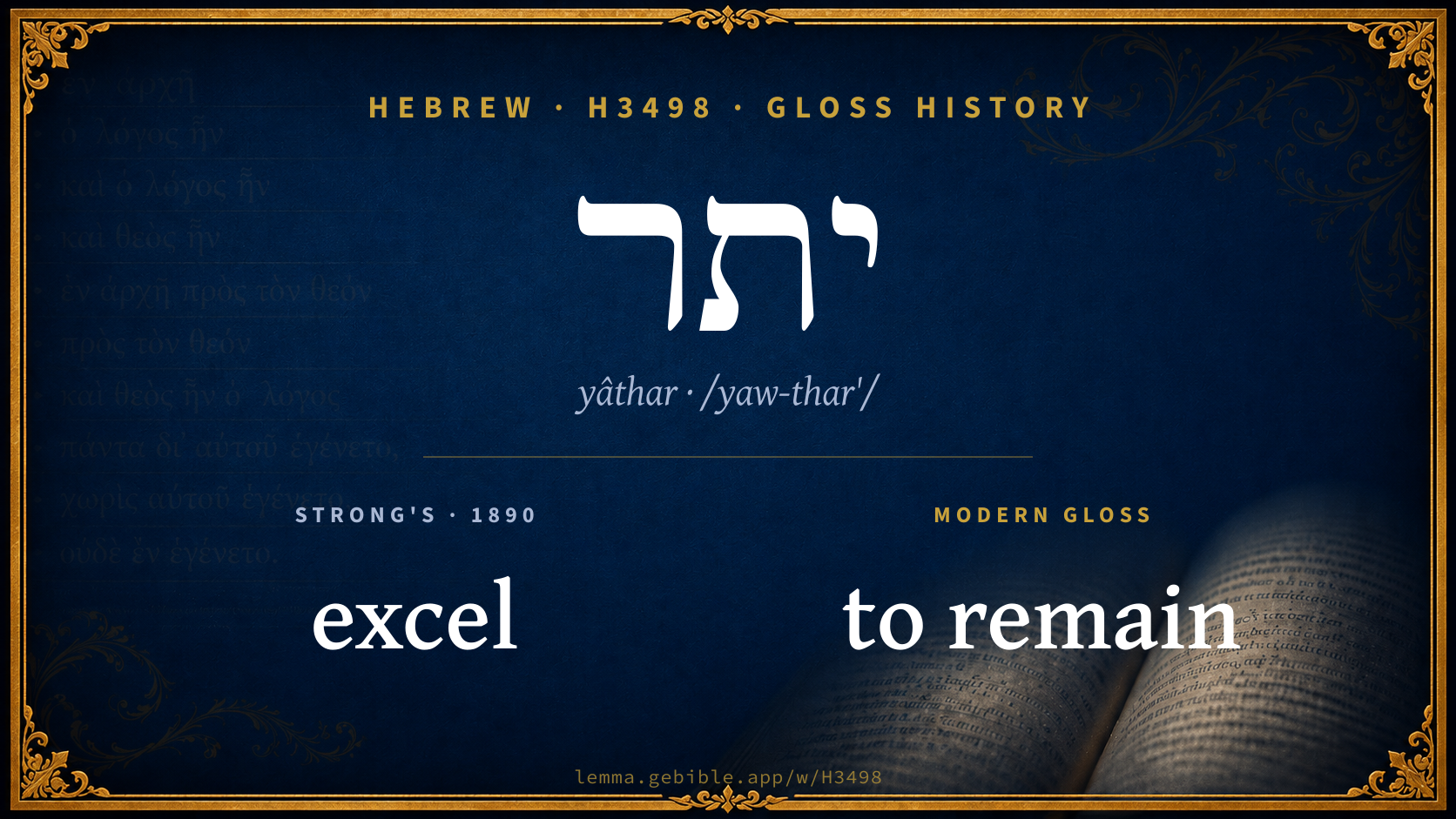
Gloss history
Strong's 1890 vs modern scholarship
About this word
Strong's H3498 catalogs a Hebrew word from the Hebrew Old Testament.
These counts are not copied from any lexicon or concordance. They are computed here, from the morphology-tagged Hebrew Old Testament. What Lemma adds →
- 101
- distinct verses
- The word appears in 101 distinct verses.
- 23 / 39
- OT books
- The word appears in 23 of 39 Old Testament books.
- #405
- by frequency
- Top 500 most frequent Hebrew words (rank 405 of 8,640 Hebrew words by occurrence).
View all 101 occurrences in the concordance →
By section of the Old Testament
By traditional corpus
Conventional, traditional groupings — biblical authorship is debated, so this is a traditional corpus grouping, not an authorship claim. Each share is this word’s portion of its verses in that division of the Hebrew canon. Each figure is a share of the word’s 101 distinct verses.
- Prophets (Nevi'im) 57 verses · 56%
- Torah (Pentateuch) 29 verses · 29%
- Writings (Ketuvim) 15 verses · 15%
How translations render this word
Counts come from each version’s own published word-to-Strong’s tagging or interlinear alignment — an approximate guide to how each version renders this word, not a word-level alignment the data otherwise carries. Because each total is that version’s own tagged count, the per-version totals vary from one another and need not match the appearance or distinct-verse counts above. These counts may also differ from a printed concordance because Lemma counts each distinctly tagged rendering and does not collapse phrase taggings into a single head-word total. This is a fixed set of word-tagged versions (KJV, ASV, BSB, ULT) and does not change with the reading translation you choose elsewhere. Each version’s license is shown beside its name below (and on Sources).
- King James Version: Rest 11×, Were left 10×, Left 8×
- American Standard Version: Rest 14×, Were left 9×, Is left 6×
- Berean Standard Bible: Remaining 11×, Rest 9×, Remainder 8×
- unfoldingWord Literal Text: Remaining 19×, Remainder 11×, And 7×
King James Version Public Domain
Renders H3498 across 107 tagged occurrences — most commonly:
Plus other, less common renderings. Plus 31 renderings that appear only once — usually multi-word phrases or single function words the recovered tagging swept in, not distinct renderings.
American Standard Version Public Domain
Renders H3498 across 108 tagged occurrences — most commonly:
Plus other, less common renderings. Plus 36 renderings that appear only once — usually multi-word phrases or single function words the recovered tagging swept in, not distinct renderings.
Berean Standard Bible Public Domain
Renders H3498 across 106 tagged occurrences — most commonly:
Plus other, less common renderings. Plus 35 renderings that appear only once — usually multi-word phrases or single function words the recovered tagging swept in, not distinct renderings.
unfoldingWord Literal Text CC BY-SA 4.0
Renders H3498 across 128 tagged occurrences — most commonly:
Plus other, less common renderings. Plus 38 renderings that appear only once — usually multi-word phrases or single function words the recovered tagging swept in, not distinct renderings.
8 senses and sub-senses in the full BDB
Hebrew verbs can shift meaning by stem (binyan): Qal is the basic action, Niphal is often passive or reflexive, Piel often intensifies or makes it factitive, and Hiphil is typically causative. The senses below are grouped under the stem BDB assigns to each.
What do BDB’s symbols mean?
BDB uses these scholarly abbreviations:
| Symbol | Meaning |
|---|---|
| 𝔊 | the Septuagint (the ancient Greek translation, LXX) |
| 𝔙 | the Vulgate (the Latin translation) |
| 𝔖 | the Syriac version (the Peshitta) |
| 𝔗 | the Targum (the Aramaic translation) |
| ψ | the Psalms |
| √ | root (the underlying root or stem) |
| ‖ | parallel passage (a synonymous or contrasted parallel) |
| † | the dagger: every passage where the word occurs is cited |
The 8 senses and sub-senses the full Brown-Driver-Briggs lexicon distinguishes for this word, in lexicon order (not ranked by frequency), with BDB’s own verbatim wording and sub-sense lettering. Shown in Hebrew script with BDB’s own scholarly abbreviations. The condensed entry is in the Lexicon Entry tab. See also the Forms in the corpus table below.
Qal
- Pt. הַיּוֹתֵר 1 S 15:15 the remainder†. e.g. 1 Samuel 15:15
Niphal
- be left over, remain over; Pf. נוֹתַר Ex 10:15 + 8 times, etc.; Impf. יִוָּתֵר 2 K 20:17 + 2 times; יִוָּתֶ֥ר בָּ֑הּ Zc 13:8; וַיִּוָּתֵר Gn 32:25 + 2 times; וָאִוָּתֵר 1 K 19:10, 14, etc.; Pt. נוֹתָר 1 S 2:26 + 17 times, נֹתָר Ex 12:10; fs. נוֹתֶ֫רֶת Lv 2:3 + 3 times; mpl. נוֹתָרִים Ju 8:10 + 24 times, etc.;—be left over, remain (over), abs. Ex 10:15 (J), Jos 11:11, 22 (D), Ju 9:5 Is 1:8; 30:17 1 K 18:22 2 K 20:17 = Is 39:6; sq. לְבַדּוֹ be left alone Gn 32:25 (J), so 1 K 19:10, 14; sq. מִן be left from (= of) 2 S 13:30 Ex 29:34 Nu 26:65 (both P), ψ 106:11; pt. sq. מִן Ju 8:10 + 10 times P, 1 K 9:20 = 2 Ch 8:7, Zc 14:16 1 Ch 6:46; sq. לְ, be left (surviving) to, 1 S 25:34 2 S 9:1, of those belonging to Gn 44:20 (J; לְבַדּוֹ לְאִמּוֹ); sq. בְּ be left in (= of) 2 S 17:12 Jos 18:2 (JE), also pt. Lv 8:32; 14:18 (P), Ez 48:15, 18; often sq. בְּ loc. &Am 6:9 + 11 times; sq. בֵּית in the house of Je 27:21; sq. על־פני הארץ Ez 39:14 (pt.); sq. אַחֲרֵי = be left behind (of sons) 1 K 9:21 = 2 Ch 8:8; sq. שָׁם + אֵצֶל Dn 10:13 I was left over there beside the kings (i.e. I had nothing more to do; cf. VB); elsewhere pt. abs., as adj. Gn 30:36 (J), Jos 17:2, 6 (JE), Lv 10:12, 16; 27:18 Jos 21:5, 26, 34 (all P), Je 34:7 1 Ch 6:55, 62; 24:20; as subst. Ju 21:7, 16 1 S 30:9 Ex 28:10; 29:34 Lv 19:6 (all P), 1 K 20:30(×2) 2 K 4:7 Ez 34:18; 48:21 2 Ch 31:10. e.g. Exodus 10:15
Hiphil
- Pf. הוֹתִיר Ex 10:15 Is 1:9, etc.; Impf. יוֹתִיר Dt 28:54; juss. יוֹתֵר Ex 16:19; וַיּוֹתֵר 2 S 8:4 2 Ch 18:4; 3 fs. וַתֹּתַ֑ר Ru 2:14; 2 ms. juss. תּוֹתַר Gn 49:4; 1 s. אוֹתִיר Ez 39:28; 3 mpl. וַיּוֹתִרוּ Ex 16:20 2 K 4:44; 2 mpl. תּוֹתִירוּ Ex 12:10 + 2 times; Imv. הוֹתֵר ψ 79:11; Inf. abs. הוֹתֵר 2 K 4:43 + 2 times; cstr. הוֹתִיר Je 44:7;— e.g. Exodus 10:15
- 1.
- a. leave over, leave Ex 10:15 (J), Ru 2:14 (obj.om.), v 18 2 K 4:43 (אָכוֹל וְהוֹתֵר, v. infr.), v 44 (obj.om. in both), 2 Ch 31:10; יֶתֶר בָּנָיו אֲשֶׁר יוֹתִיר Dt 28:54; sq. obj. שָׂרִיד + ל pers. Is 1:9; obj. שְׁאֵרִית + ל pers. Je 44:7; sq. מִן from (= of), 2 S 8:4 = 1 Ch 18:4, Nu 33:55 (P), Ez 12:16; + עַד temp. Ex 12:10; 16:19, 20 (all P), Lv 22:30 (H); + שָׁם loc. Ez 39:28. e.g. Exodus 10:15
- b. abs. leave a remnant Ez 6:8 (denom. from יֶתֶר? e.g. Ezekiel 6:8
- c. save over ψ 79:11 הַתֵּר release (We 𝔙 𝔗). e.g. Psalms 79:11
- 2. excel, shew pre-eminence Gn 49:4 (Poem in J). e.g. Genesis 49:4
- 3. shew excess = have more than enough Ex 36:7 (P; vid. also 2 K 4:43 2 Ch 31:10 supr.); make abundant Dt 28:11; 30:9 (sq. sf. pers. + ב rei.). e.g. Exodus 36:7
Senses from the full Brown-Driver-Briggs lexicon (Brown, Driver, Briggs; Oxford 1906 — public domain), digitized via Sefaria, supplemented by the OpenScriptures HebrewLexicon (CC BY 4.0). Full attribution on Sources.
Word origin
vb. remain over (NH id.; Aramaic יְתַר, ܝܺܬܰܪ id.; Zinj. יתר n. rest, remainder; Ethiopic ወተረ Assyrian [atâru], remain over, in der. conj., DlHWB; in Sab. ותר CIS iv, 15, 46, p. 77; especially n. ותר as epithet of king = noble one, and as n.pr. ותרם MordtZMG, 1876, 37, 292 DHMZMG, 1883, 15 CISiv, 10; Arabic وَتَرَ is make single, make to be one, or an odd number)—
— Brown-Driver-Briggs (Oxford 1906, public domain), digitized via Sefaria, supplemented by the OpenScriptures HebrewLexicon (CC BY 4.0). See Sources.
Origin: a primitive root
Jastrow Dictionary
A second Hebrew/Aramaic lexicon for comparison, covering Aramaic and post-biblical (Talmudic, Targumic, Midrashic) usage that the biblical-Hebrew BDB does not. Matched by lemma rather than by Strong’s number, so a lemma may carry more than one Jastrow headword (shown separately below), and the entries cover usage well beyond the Bible.
יָתַר
- [to be strong; denom. יֶתֶר cord, v. יִתְרָא I,] to be rich, plentiful.
- to be left over.—Part. נוֹתָר m. portions of sacrifices left over beyond the legal time and bound to be burnt. Kerith. III, 4 והיה נ׳ מן וכ׳ and it was an overdue remnant of sacrifices. Ib. I, 1 דם נ׳ blood of overdue sacrifices. Meïl. I, 3, a. fr. משום נ׳ as coming under the law of nothar; a. v. fr.—Pl. נוֹתָרִים, נוֹתָרוֹת. Sifré Aḥăré Par. 5, ch. VII.—Cant. R. to V, 14 כמה נ׳ how many laws about nothar. Num. R. s. 11 שלא לפסול … בנ׳ not to unfit any of the sacrifices by allowing them to become overdue.
- to leave over; to go beyond; to be more. Mekh. Bo s. 6 אם ה׳ if he left a part of the Passover lamb over until morning. Sifra Tsav, Par. 7, ch. XII אם ה׳ ה׳ if he has left over, he has left over (and it may be eaten). Ib. אם הוֹתִירוּ כולו if they left the whole of it over (for the second day); a. fr.—Ber. 34ᵇ לא חסרתם ולא הוֹתַרְתֶּם you stated the time neither too early nor too late. B. Bath. VII, 2 ה׳ כל שהוא if it was somewhat more (than the stated measure).—b) הִתִּיר (cmp. הִצִּיק fr. יָצַק), v. infra.
- (denom. of יָתֵר) to add; to do too much. Erub. 13ᵃ שמא אתה … מְיַיתֵּר for if thou omit one letter or write one too many; Sot. 20ᵃ תַּתִּיר Hif. (v. supra). Ex. R. s. 27; Tanḥ. Yithro 4 his name was Jether (Jethro) שֶׁיִּ׳ פרשה וכ׳ because he gave rise to an additional chapter (about judges) in the Law; Mekh. ib., Amalek, s. 1 שהוֹתִיר.—Ib. שיי׳ במעשים טובים because he did more (than ordinary men, was liberal in) good deeds. [Y. Keth. IV, end, 29ᵇ וייתר, v. יָתַר.]—Part. pass. מְיוּתָּר, pl. מְיוּתָּרִין added, superfluous. Koh. R. to V, 8 (ref. to ויתרון, ib.) דברים שתראה (ש)הן מי׳ לתורה (not בתורה) things which thou wouldst regard as additions to the Law. Ib. אפי׳ דברים … מי׳ בעולם even things in nature which thou wouldst believe to be superfluous (useless); Ex. R. s. 10; (Gen. R. s. 10 יְתֵירָה); a. e.
- to be left over. Yoma 46ᵃ איברי עולה שנִתּוֹתְרוּ parts of a burnt-offering which remained over (failed to be entirely burnt). Pes. 59ᵇ כשנִיתּוֹתְרוּ when they were left over (unoffered).
יְתַר
- [Targ. Ruth II, 16, a. e. מיתר, v. נְתַר.]
- 1. to leave over. Targ. II Kings IV, 43; a. e.—Y. Peah VII, 20ᵃ bot. ואַיְיתְרוּן.
- 2. to bless with plenty. Targ. O. Deut. XXVIII, 11; XXX, 9.
- , as preced. Pi.—Part. pass. מְיַיתַּר, f. מְיַיתְּרָא larger. Meg. 19ᵃ מחסרא או מיי׳ smaller in size or larger.
- 1. to be left over; (in legal interpret.) to be superfluous in the Bible text and therefore available for interpretation. Targ. O. Ex. XXXVI, 7 וִיתָּרַת (= ואִיתָּ׳, ed. Berl. וְיִתַּרַת, corr. acc.).—Ber. 35ᵃ, v. הִילּוּל. Men. 93ᵃ אִיַּיתְּרוּ ליה תרי קראי two verses remain for interpretation; Arakh. 2ᵇ אייתרי להו תרי (v. Rabb. D. S. to Men. l. c. note).—
- *2. to be added, included. Sabb. 64ᵃ אִיַּיתּוּר ליה (some ed. אייתר) they are now included (Ms. M. אייתי they include it, v. אֲתָא).
יָתֵר
- (preced. wds.)
- 1. additional, a person having an additional limb. Bekh. VII, 6 י׳ בידיו וכ׳ if one has an additional finger (or toe) on each of his hands and feet. Ib. 45ᵇ.—Ib. 40ᵃ חסר וי׳ ביד having one toe less or one too many on the forefoot. Ib. כל יתיר כנטול דמי every addition is considered equal to the entire absence of the respective limb; Ḥull. 58ᵇ כל יתר וכ׳. B. Bath. VII, 2, sq. הן י׳ (יתיר a. יתר interchanging), v. הֵן; a. fr.—Fem. יְתֵרָה, יְתֵירָה; (as noun also) יְתֶרֶת, יְתֶירֶת. Bekh. VII, 6 (45ᵃ) היתה (בה) בו יתרת וכ׳ (Rashi יתירה; Ib. יתירת) if there has been an additional limb and he had it cut off. Ib. 40ᵃ י׳ על של משה וכ׳ (a cubit measure) larger than the Mosaic by &c. Ḥull. III, 6 (as a sign of clean birds) כל שיש לו אצבע י׳ that which has an additional toe (on top of those in a line). Keth. 76ᵃ יתירת a woman having an additional limb. Erub. 83ᵃ י׳ על מדברית וכ׳ one sixth larger than &c.; a. fr. [V. יְתֵירָה.]—Pl. יְתֵרִים, יְתֵרִין, יְתֵי׳; f. יְתֵירוֹת. Macc. 23ᵃ יְתֵירֵי מדע men of more than ordinary knowledge; י׳ כח of more than common physical strength.—[Gen. R. s. 98 הניחו יתירות left remants of the conquered nations, prob. to be read: יְתֵידוֹת, v. יָתֵד.]—Esp. יְתֶרֶת an additional lobe of the lungs. Ḥull. 47ᵃ (not יות׳).
- 2. a word written plene, with vowel letters.—Pl. יְתֵירוֹת. Erub. 13ᵃ, a. e., v. חָסֵר II.
יֶתֶר I
- v. יָתַר)
- 1. cord, bow-string. Lev. R. s. 5 (ref. to Ps. XI, 2), v. מִתְחָא.—2) = יוֹתֵר addition, (adv.) more. Bekh. VII, 1 (43ᵃ) וי עליהן וכ׳ Bab. ed. (Mish. יותר עליהן באדם וכ׳) to these must be added, with reference to blemishes of human beings, the wedge-shaped head &c. Erub. 83ᵇ י׳על כן more than that. Gitt. III, 1 י׳מכן nay, even more; a. fr. e.g. Psalms 11:2
יֶתֶר II
- (b. h.) pr. n. m. Jether, v. יִתְרוֹ a. יִתְרָא II.
A Dictionary of the Targumim, the Talmud Babli and Yerushalmi, and the Midrashic Literature (Marcus Jastrow; London, Luzac, 1903) — Public Domain. Digitized via Sefaria. Digitized via Sefaria. Full attribution on Sources.
Forms in the corpus
The 82 distinct written forms H3498 takes in the Hebrew Bible, most frequent first — each parse links to that stem’s occurrences in the concordance. Hebrew forms include their vowel points and cantillation, so a single lemma takes many written forms.
The 60 most common forms are shown; 22 rarer forms follow in the full concordance.
Same root — word family
Other BDB entries built from the same root as H3498, grouped by Strong’s listed origin. These share a root / origin per the lexicon — not necessarily a shared meaning. Each links to that word’s own entry.
Derived from this word
- יותר yôwthêr H3148 advantage
- יתור yâthûwr H3491 to remain
- יתר yether H3499 remainder
- יתרון yithrôwn H3504 profit
- יתרת yôthereth H3508 appendage
- מותר môwthâr H4195 abundance
- מיתר mêythâr H4340 cord
Proper names from this root
People and places named from this root — a name, not an additional meaning of the word.
Compare all same-root words → Showing 4 of 11 — not the complete family. 3 of the same-root words are proper names (people or places). They share a root, not necessarily a meaning.
Septuagint verse parallels
This word appears in 94 verses that also exist in the Greek Old Testament (Septuagint), out of the 101 Hebrew verses it occurs in. You can read those verses in Greek by switching the Old Testament edition to the Septuagint.
Read these verses in the Septuagint
- Genesis 30:36
- Exodus 10:15
- Leviticus 2:3
- Numbers 26:65
- Deuteronomy 28:11
- Joshua 11:11
- Judges 8:10
- Ruth 2:14
- 1 Samuel 2:36
- 2 Samuel 8:4
- 1 Kings 15:18
- 2 Kings 4:7
This is a verse-level parallel only — the same verses exist in both the Hebrew and Greek Old Testaments. No word-level Hebrew↔Greek correspondence is claimed: the data carries no such alignment, so no Greek word is shown as this Hebrew word’s translation. Coverage is not total — the Septuagint omits the deuterocanon and renumbers the Psalms, so some Hebrew verses have no direct Greek parallel.