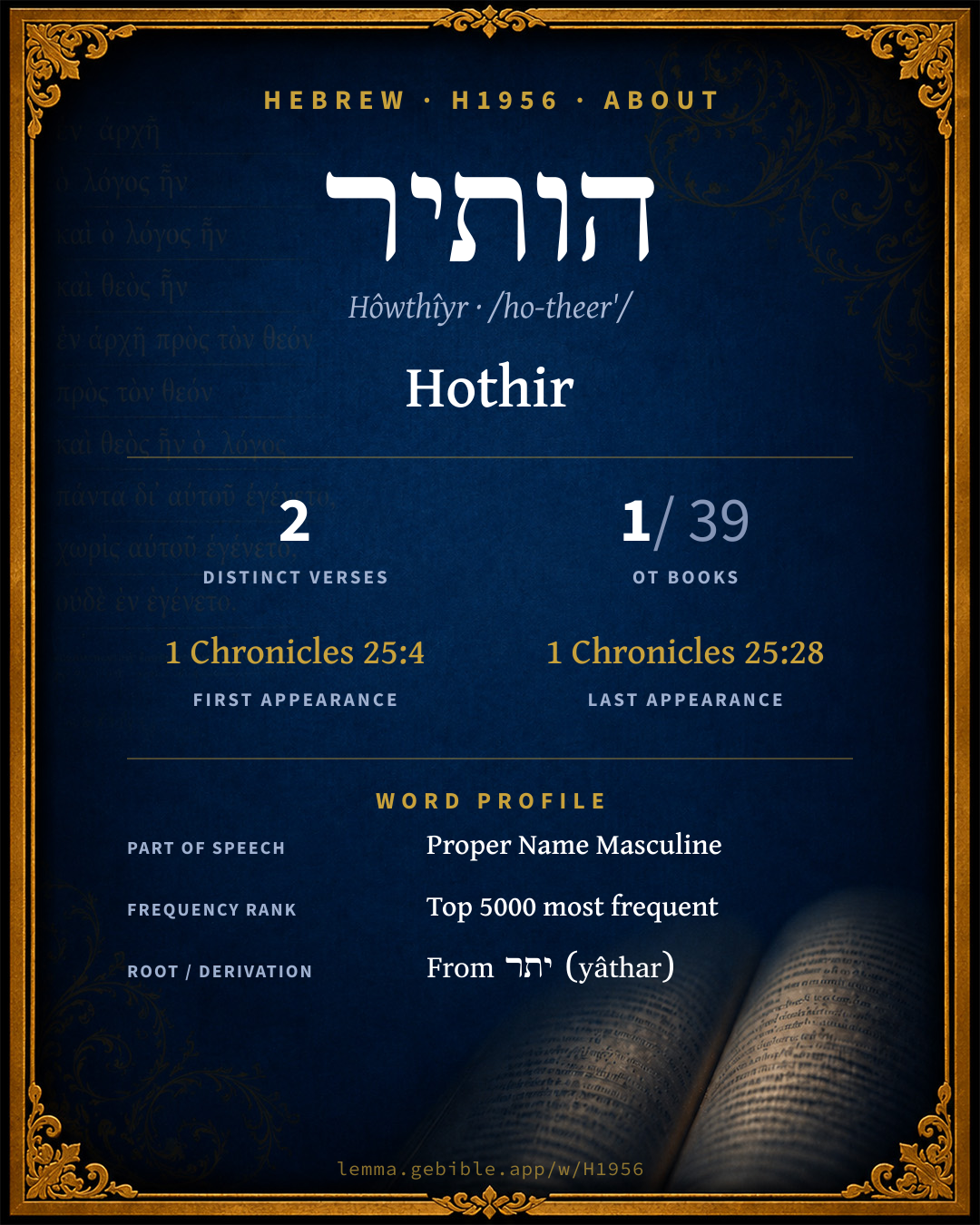
הוֹתִיר
Hothir
BDB lists 2 entries for ‘Hothir’ fuller range ↓
Full lexicon entry — Brown-Driver-Briggs (BDB)
From Brown-Driver-Briggs (BDB)
Where this word appears
Grammar key — what these labels mean
Part of speech
- Noun
- A naming word — a person, place, thing, or idea.
Noun type
- Proper
- A name of a specific person, place, or people (e.g. Abraham, Zion, Israel).
Every verse where H1956 appears — 2 distinct verses across 1 book. Click any verse to open its interlinear word-by-word view. Verse text shown in the World English Bible for context — . Each verse’s Hebrew form is shown with its reference; the English is not keyword-highlighted, since the data carries no word-level English alignment. Use “Compare translations” on any verse to read it across multiple English versions. This concordance covers the Hebrew Bible; Septuagint (Greek Old Testament) occurrences are not indexed here.
1 Chronicles 2 verses
- 1 Chronicles 25:4 הוֹתִ֖יר n Proper Of Heman; the sons of Heman: Bukkiah, Mattaniah, Uzziel, Shebuel, and Jerimoth, Hananiah, Hanani, Eliathah, Giddalti, and Romamti-ezer, Joshbekashah, Mallothi, Hothir, Mahazioth.
- 1 Chronicles 25:28 לְ/הוֹתִ֔יר prep + n Proper for the one and twentieth to Hothir, his sons and his brothers, twelve:
About this entry
At a glance — auto-summarized from this page’s data, not written by a person. Every figure links to its source below. This summary describes the numbers; it doesn’t interpret them.
הותיר — transliterated Hôwthîyr — is a Hebrew name carrying the sense “Hothir.” It occurs a mere 2 verses across Scripture. More than three-quarters of its appearances fall in 1 Chronicles. Debuting at 1 Chronicles 25:4, it then recurs through the corpus. See 2-verse concordance and the renderings breakdown below.
Gloss history
Strong's 1890 vs modern scholarship
About this word
Strong's H1956 catalogs a Hebrew word from the Hebrew Old Testament.
These counts are not copied from any lexicon or concordance. They are computed here, from the morphology-tagged Hebrew Old Testament. What Lemma adds →
- 2
- distinct verses
- The word appears in 2 distinct verses.
- 1 / 39
- OT books
- The word appears in 1 of 39 Old Testament books.
- #4,807
- by frequency
- Top 5000 most frequent Hebrew words (rank 4,807 of 8,640 Hebrew words by occurrence).
View all 2 occurrences in the concordance →
Most concentrated in
- 1 Chronicles 2 verses 100%
By section of the Old Testament
By traditional corpus
Conventional, traditional groupings — biblical authorship is debated, so this is a traditional corpus grouping, not an authorship claim. Each share is this word’s portion of its verses in that division of the Hebrew canon. Each figure is a share of the word’s 2 distinct verses.
- Writings (Ketuvim) 2 verses · 100%
How translations render this word
Counts come from each version’s own published word-to-Strong’s tagging or interlinear alignment — an approximate guide to how each version renders this word, not a word-level alignment the data otherwise carries. Because each total is that version’s own tagged count, the per-version totals vary from one another and need not match the appearance or distinct-verse counts above. These counts may also differ from a printed concordance because Lemma counts each distinctly tagged rendering and does not collapse phrase taggings into a single head-word total. This is a fixed set of word-tagged versions (KJV, ASV, BSB, ULT) and does not change with the reading translation you choose elsewhere. Each version’s license is shown beside its name below (and on Sources).
BDB lists this Strong’s number as 2 distinct words (homographs). Each count above pools all of them and is not split by sense — see the Senses section below. A low-frequency rendering may belong to a different one of those words, not the primary meaning.
- King James Version†: Hothir 2×
- American Standard Version†: Hothir 2×
- Berean Standard Bible†: Hothir 2×
- unfoldingWord Literal Text†: Hothir 2×
King James Version Public Domain
Renders H1956 across 2† tagged occurrences — most commonly:
American Standard Version Public Domain
Renders H1956 across 2† tagged occurrences — most commonly:
Berean Standard Bible Public Domain
Renders H1956 across 2† tagged occurrences — most commonly:
unfoldingWord Literal Text CC BY-SA 4.0
Renders H1956 across 2† tagged occurrences — most commonly:
Senses in BDB
The 2 senses BDB distinguishes for this word, in lexicon order (not ranked by frequency or importance). The full entry — with sub-senses — is in the Lexicon Entry tab.
- Hothir = "abundance"
- the 13th son of Heman and a Kohathite Levite
Word origin
n.pr.m. (abundance, superabundance)—a son of Heman, according to 1 Ch 25:4, 28 (but on the ostensible list of names v. Ew§ 274 b WeProl.229; Hist. Isr. 219 RSOTJC 224; 2nd ed. 143).
— Brown-Driver-Briggs (Oxford 1906, public domain), digitized via Sefaria, supplemented by the OpenScriptures HebrewLexicon (CC BY 4.0). See Sources.
Derived from יתר (yâthar) (H3498) — to remain.
Jastrow Dictionary
A second Hebrew/Aramaic lexicon for comparison, covering Aramaic and post-biblical (Talmudic, Targumic, Midrashic) usage that the biblical-Hebrew BDB does not. Matched by lemma rather than by Strong’s number, so a lemma may carry more than one Jastrow headword (shown separately below), and the entries cover usage well beyond the Bible.
יָתַר
- [to be strong; denom. יֶתֶר cord, v. יִתְרָא I,] to be rich, plentiful.
- to be left over.—Part. נוֹתָר m. portions of sacrifices left over beyond the legal time and bound to be burnt. Kerith. III, 4 והיה נ׳ מן וכ׳ and it was an overdue remnant of sacrifices. Ib. I, 1 דם נ׳ blood of overdue sacrifices. Meïl. I, 3, a. fr. משום נ׳ as coming under the law of nothar; a. v. fr.—Pl. נוֹתָרִים, נוֹתָרוֹת. Sifré Aḥăré Par. 5, ch. VII.—Cant. R. to V, 14 כמה נ׳ how many laws about nothar. Num. R. s. 11 שלא לפסול … בנ׳ not to unfit any of the sacrifices by allowing them to become overdue.
- to leave over; to go beyond; to be more. Mekh. Bo s. 6 אם ה׳ if he left a part of the Passover lamb over until morning. Sifra Tsav, Par. 7, ch. XII אם ה׳ ה׳ if he has left over, he has left over (and it may be eaten). Ib. אם הוֹתִירוּ כולו if they left the whole of it over (for the second day); a. fr.—Ber. 34ᵇ לא חסרתם ולא הוֹתַרְתֶּם you stated the time neither too early nor too late. B. Bath. VII, 2 ה׳ כל שהוא if it was somewhat more (than the stated measure).—b) הִתִּיר (cmp. הִצִּיק fr. יָצַק), v. infra.
- (denom. of יָתֵר) to add; to do too much. Erub. 13ᵃ שמא אתה … מְיַיתֵּר for if thou omit one letter or write one too many; Sot. 20ᵃ תַּתִּיר Hif. (v. supra). Ex. R. s. 27; Tanḥ. Yithro 4 his name was Jether (Jethro) שֶׁיִּ׳ פרשה וכ׳ because he gave rise to an additional chapter (about judges) in the Law; Mekh. ib., Amalek, s. 1 שהוֹתִיר.—Ib. שיי׳ במעשים טובים because he did more (than ordinary men, was liberal in) good deeds. [Y. Keth. IV, end, 29ᵇ וייתר, v. יָתַר.]—Part. pass. מְיוּתָּר, pl. מְיוּתָּרִין added, superfluous. Koh. R. to V, 8 (ref. to ויתרון, ib.) דברים שתראה (ש)הן מי׳ לתורה (not בתורה) things which thou wouldst regard as additions to the Law. Ib. אפי׳ דברים … מי׳ בעולם even things in nature which thou wouldst believe to be superfluous (useless); Ex. R. s. 10; (Gen. R. s. 10 יְתֵירָה); a. e.
- to be left over. Yoma 46ᵃ איברי עולה שנִתּוֹתְרוּ parts of a burnt-offering which remained over (failed to be entirely burnt). Pes. 59ᵇ כשנִיתּוֹתְרוּ when they were left over (unoffered).
A Dictionary of the Targumim, the Talmud Babli and Yerushalmi, and the Midrashic Literature (Marcus Jastrow; London, Luzac, 1903) — Public Domain. Digitized via Sefaria. Digitized via Sefaria. Full attribution on Sources.
Forms in the corpus
The 2 distinct written forms H1956 takes in the Hebrew Bible, most frequent first — each parse links to that state’s occurrences in the concordance. Hebrew forms include their vowel points and cantillation, so a single lemma takes many written forms.
| Form | Parsing | Example | Uses |
|---|---|---|---|
| הוֹתִ֖יר | Noun, Proper | 1 Chronicles 25:4 | 1 |
| לְ/הוֹתִ֔יר | Noun, Proper | 1 Chronicles 25:28 | 1 |
Same root — word family
Other BDB entries built from the same root as H1956, grouped by Strong’s listed origin. These share a root / origin per the lexicon — not necessarily a shared meaning. Each links to that word’s own entry.
Derives from
Shares the same root
- יותר yôwthêr H3148 advantage
- יתור yâthûwr H3491 to remain
- יתר yether H3499 remainder
- יתרון yithrôwn H3504 profit
- יתרת yôthereth H3508 appendage
- מותר môwthâr H4195 abundance
- מיתר mêythâr H4340 cord
Proper names from this root
People and places named from this root — a name, not an additional meaning of the word.
Compare all same-root words → Showing 4 of 11 — not the complete family. 2 of the same-root words are proper names (people or places). They share a root, not necessarily a meaning.
Bible dictionary
Public-domain dictionary articles matched to this entry by name (Hothir). A biblical name can be shared by more than one person or place, so an article may treat several.
Smith's Bible Dictionary · William Smith, 1863
(fullness), the thirteenth son of Heman, "the king's seer," (1 Chronicles 25:4,28) and therefore a Kohathite Levite. (B.C. 1014.)
Hitchcock's Bible Names Dictionary · Roswell D. Hitchcock, 1869
excelling; remaining
Classic public-domain reference works; full attribution on Sources.
Septuagint verse parallels
This word appears in 2 verses that also exist in the Greek Old Testament (Septuagint), out of the 2 Hebrew verses it occurs in. You can read those verses in Greek by switching the Old Testament edition to the Septuagint.
Read these verses in the Septuagint
This is a verse-level parallel only — the same verses exist in both the Hebrew and Greek Old Testaments. No word-level Hebrew↔Greek correspondence is claimed: the data carries no such alignment, so no Greek word is shown as this Hebrew word’s translation. Coverage is not total — the Septuagint omits the deuterocanon and renumbers the Psalms, so some Hebrew verses have no direct Greek parallel.