
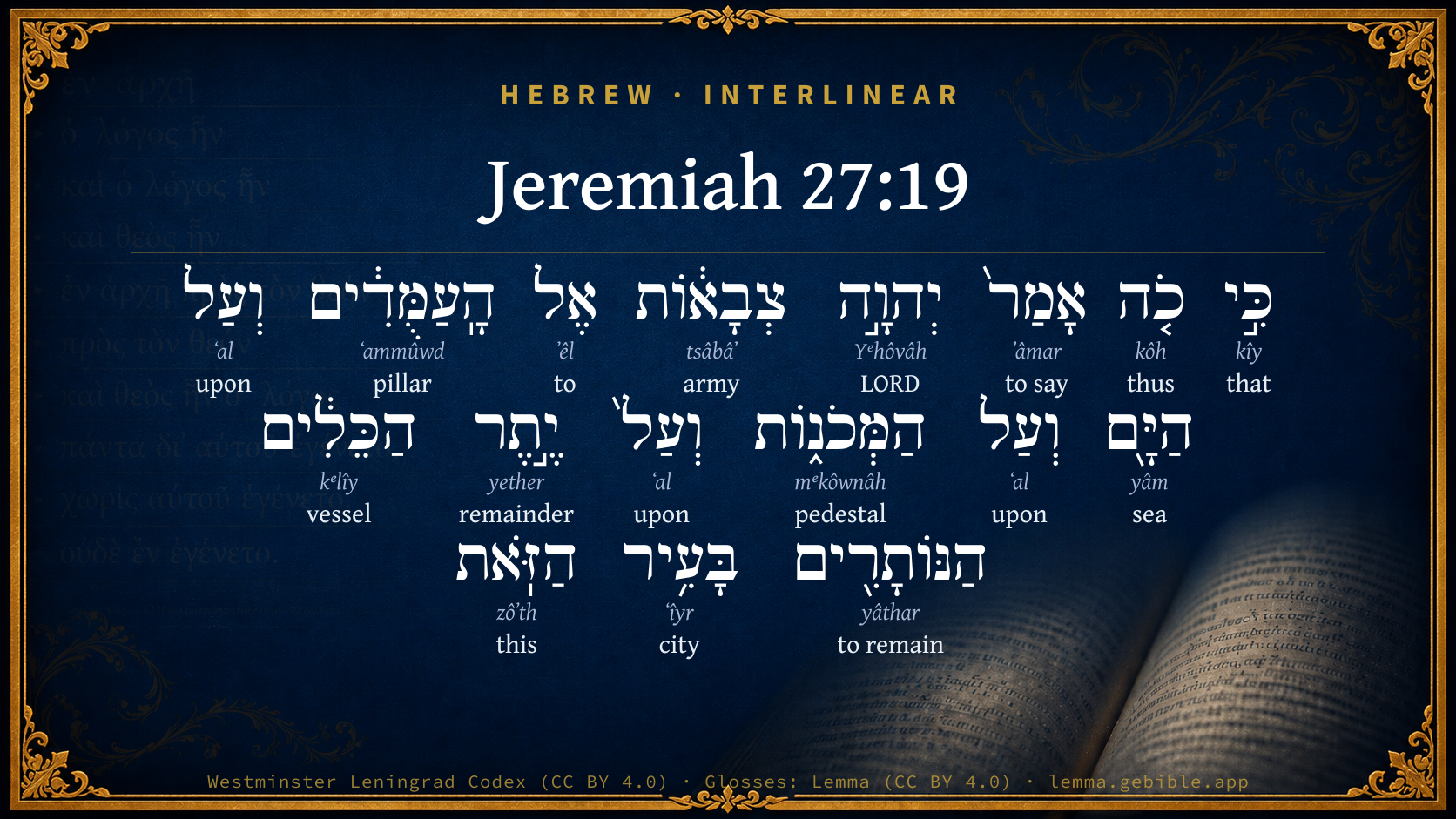
Jeremiah 27:19

Hebrew (Westminster Leningrad Codex) Jeremiah 27:19 appears in the Hebrew Old Testament. The text above is from the Westminster Leningrad Codex. Each word links to its Strong’s number, a concise gloss, and parsing drawn from the Open Scriptures Hebrew Bible morphology. Click any word for its full Brown-Driver-Briggs (BDB) entry.
Download image
Cite this verse

Jeremiah 27:19 (World English Bible). Public Domain. Lemma interlinear Bible study tool, https://lemma.gebible.app/v/jeremiah/27/19.

Show BibTeX & RIS
BibTeX
RIS
English Translation
For thus says Yahweh of Hosts concerning the pillars, and concerning the sea, and concerning the bases, and concerning the residue of the vessels that are left in this city,
World English Bible · Public Domain
Download a study sheet

One document with this verse’s original text, its word-by-word gloss line, the meaning frame, cross-references with their text, attributed commentary, and full source and license credits — printable, and it pastes into notes with its structure intact.

This verse Autodidact and up

Study sheet (.html) Plain text (.txt)

A passage Seminary Student

Up to 50 verses in one chapter. A passage sheet keeps up to 6 commentary sources and 12 cross-references per verse, in the order this page ranks them, and says so on the sheet whenever that leaves anything out. Ask for a single verse and you get the Autodidact verse sheet above.

Everything on this page stays free to read, with no account — the sheet is a download of what is already on screen, not access to it.

Want to remove ads? Support Godless Engineer
Compare translations 3

The same verse in 3 English versions, stacked beneath the original-language interlinear above. Click any original word for its lexicon entry.

Each is an independent rendering of the whole verse — the interlinear is not word-aligned to these translations.

Highlighted words mark where these versions differ — a whole-verse word diff, not a word-by-word alignment.

  • World English Bible Public Domain
    For thus says Yahweh of Hosts concerning the pillars, and concerning the sea, and concerning the bases, and concerning the residue of the vessels that are left in this city,
  • King James Version Public Domain
    For thus saith the LORD of hosts concerning the pillars, and concerning the sea, and concerning the bases, and concerning the residue of the vessels that remain in this city.
  • unfoldingWord Literal Text CC BY-SA 4.0
    For thus says Yahweh of Armies concerning the pillars, and concerning the Sea, and concerning the stands, and concerning the rest of the vessels remaining in this city,

unfoldingWord Literal Text — © unfoldingWord, licensed CC BY-SA 4.0. Word-aligned USFM3 via Door43 (git.door43.org/unfoldingWord/en_ult).

Versions to compare (up to 4)

3 of 4 selected

Show all 18 translations

Every available English version of this verse, each an independent rendering of the whole verse.

  • World English Bible Public Domain
    For thus says Yahweh of Hosts concerning the pillars, and concerning the sea, and concerning the bases, and concerning the residue of the vessels that are left in this city,
  • Berean Standard Bible Public Domain
    For this is what the LORD of Hosts says about the pillars, the sea, the bases, and the rest of the articles that remain in this city,
  • Majority Standard Bible Public Domain
    For this is what the LORD of Hosts says about the pillars, the sea, the bases, and the rest of the articles that remain in this city,
  • King James Version Public Domain
    For thus saith the LORD of hosts concerning the pillars, and concerning the sea, and concerning the bases, and concerning the residue of the vessels that remain in this city.
  • American Standard Version (1901) Public Domain
    For thus saith Jehovah of hosts concerning the pillars, and concerning the sea, and concerning the bases, and concerning the residue of the vessels that are left in this city,
  • Revised Version (1885) Public Domain
    For thus saith the LORD of hosts concerning the pillars, and concerning the sea, and concerning the bases, and concerning the residue of the vessels, that are left in this city,
  • Geneva Bible (1599) Public Domain
    For thus saith the Lord of hostes, concerning the pillars, and concerning the sea, and concerning the bases, and concerning the residue of the vessels that remaine in this citie,
  • Douay-Rheims (1899) Public Domain
    For thus saith the Lord of hosts d to the pillars, and to the sea, and to the bases, and to the rest of the vessels that remain in this city:
  • Young's Literal Translation Public Domain
    For thus said Jehovah of Hosts concerning the pillars, and concerning the sea, and concerning the bases, and concerning the rest of the vessels that are left in this city,
  • Literal Standard Version CC BY-SA 4.0
    For thus said YHWH of Hosts concerning the pillars, and concerning the sea, and concerning the bases, and concerning the rest of the vessels that are left in this city,
  • Unlocked Literal Bible CC BY-SA 4.0
    Yahweh of hosts says this about the pillars, the large basin known as “The Sea” and its base, and the rest of the objects that remain in this city—
  • unfoldingWord Literal Text CC BY-SA 4.0
    For thus says Yahweh of Armies concerning the pillars, and concerning the Sea, and concerning the stands, and concerning the rest of the vessels remaining in this city,
  • Darby Bible Public Domain
    For thus saith Jehovah of hosts concerning the pillars, and concerning the sea, and concerning the bases, and concerning the rest of the vessels that are left in this city,
  • World Messianic Bible Public Domain
    For the LORD of Hosts says concerning the pillars, concerning the sea, concerning the bases, and concerning the rest of the vessels that are left in this city,
  • Webster's Bible Public Domain
    For thus saith the LORD of hosts concerning the pillars, and concerning the sea, and concerning the bases, and concerning the residue of the vessels that remain in this city,
  • Free Bible Version CC BY-SA 4.0
    This what the Lord Almighty says about the pillars, the bronze sea, the bases, and the rest of the objects that are left in Jerusalem—
  • Bible in Basic English Public Domain
    For this is what the Lord has said about the rest of the vessels which are still in this town,
  • JPS Tanakh (1917) Public Domain
    For thus saith the LORD of hosts concerning the pillars, and concerning the sea, and concerning the bases, and concerning the residue of the vessels that remain in this city,

Literal Standard Version (2020), Covenant Press — licensed CC BY-SA 4.0. Text via the HelloAO Bible API (eBible.org). Unlocked Literal Bible (unfoldingWord) — licensed CC BY-SA 4.0. Text via the HelloAO Bible API (eBible.org). unfoldingWord Literal Text — © unfoldingWord, licensed CC BY-SA 4.0. Word-aligned USFM3 via Door43 (git.door43.org/unfoldingWord/en_ult). Free Bible Version, Dr. Jonathan Gallagher — licensed CC BY-SA 4.0. Text via the HelloAO Bible API (eBible.org).

Word by word

More ways to search: Search by grammar → Find every occurrence → Compare this word →

Practice this passage: Drill this verse → Learn its vocabulary →

הַמְּכֹנ֑וֹת
mᵉkôwnâh
H4350
“the · pedestals”
Particle, Definite Article + Noun, Common, Feminine, Plural, Absolute
Part of Speech
Particle + Noun
Type
Common
Gender
Feminine
Number
Plural
State
Absolute
Full BDB Definition

Origin: from H4349

TWOT: 964d

fixed resting place, base, pedestal
  1. כִּ֣י kîy H3588 “that” Conjunction
  2. כֹ֤ה kôh H3541 “thus” Adverb
  3. אָמַר֙ ʼâmar H559 “to say” Verb, Qal, Perfect, 3rd Person, Masculine, Singular
  4. יְהוָ֣ה Yᵉhôvâh H3068 “LORD” Noun, Proper
  5. צְבָא֔וֹת tsâbâʼ H6635 “armies” Noun, Common, Both, Plural, Absolute
  6. אֶל ʼêl H413 “to” Preposition
  7. הָֽעַמֻּדִ֔ים ʻammûwd H5982 “the · pillars” Particle, Definite Article + Noun, Common, Masculine, Plural, Absolute
  8. וְעַל ʻal H5921 “and · upon” Conjunction + Preposition
  9. הַיָּ֖ם yâm H3220 “the · sea” Particle, Definite Article + Noun, Common, Masculine, Singular, Absolute
  10. וְעַל ʻal H5921 “and · upon” Conjunction + Preposition
  11. וְעַל֙ ʻal H5921 “and · upon” Conjunction + Preposition
  12. יֶ֣תֶר yether H3499 “remainder of” Noun, Common, Masculine, Singular, Construct
  13. הַכֵּלִ֔ים kᵉlîy H3627 “the · vessels” Particle, Definite Article + Noun, Common, Masculine, Plural, Absolute
  14. הַנּוֹתָרִ֖ים yâthar H3498 “the · remaining” Particle, Definite Article + Verb, Niphal, Participle Active, Masculine, Plural, Absolute
  15. בָּעִ֥יר ʻîyr H5892 “in/at the · city” Preposition, Determined + Noun, Common, Feminine, Singular, Absolute
  16. הַזֹּֽאת zôʼth H2063 “the · this” Particle, Definite Article + Pronoun, Demonstrative, Feminine, Singular

About this verse

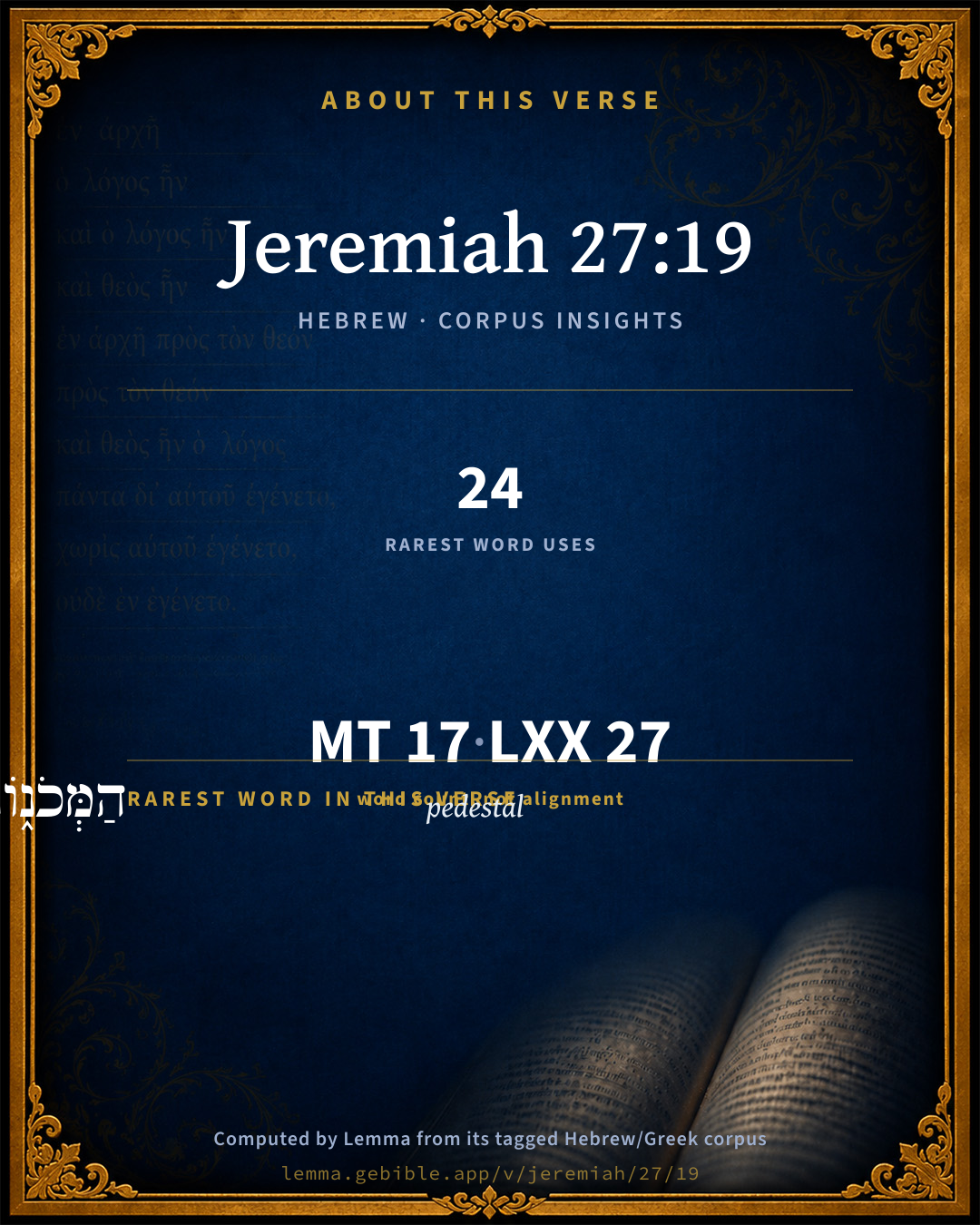
These counts appear in no published source. They are computed here, from the morphology-tagged text and Lemma’s own curated glosses. What Lemma adds →

17
words
15
distinct lemmas
Prophets
section

Notable vocabulary

The rarest word here is הַמְּכֹנ֑וֹת pedestal H4350 — appearing just 24 times in the whole Hebrew Bible.

Shared distinctive vocabulary

הַמְּכֹנ֑וֹת pedestal H4350 occurs in 18 verses of the Hebrew Bible. Also found in:

Grammatical profile

  • 2 verbs
  • 8 nouns
  • 1 pronoun
  • 4 prepositions
  • 1 conjunction
  • 1 adverb

Verb forms

  • אָמַר֙ Qal · Perfect
  • הַנּוֹתָרִ֖ים Niphal · Participle Active

Repetition

A word recurs within this verse — often emphatic in Hebrew:

  • וְעַל upon H5921 ×3

Hebrew & Septuagint length

In the original languages it is 17 Hebrew tokens and 27 Greek tokens — but the two are counted differently (Hebrew bundles its prefixes and suffixes into one token; the Greek is in lemma form), so that isn’t a like-for-like length.

Cross-references

5

Topical passages linked to Jeremiah 27:19 in the Treasury of Scripture Knowledge — connected by theme and wording, ordered by reader-vote popularity; previews shown in the World English Bible.

  • 2 Kings 25:13 The pillars of brass that were in the house of Yahweh, and the bases and the brazen sea that were in the house of Yahweh, did the Chaldeans break in pieces, and carried the brass of them to Babylon.
  • Jeremiah 52:17–23 The pillars of brass that were in the house of Yahweh, and the bases and the brazen sea that were in the house of Yahweh, did the Chaldeans break in pieces, and carried all the brass of them to Babylon.
  • 2 Kings 25:17 The height of the one pillar was eighteen cubits, and a capital of brass was on it; and the height of the capital was three cubits, with network and pomegranates on the capital round about, all of brass: and like to these had the second pillar with network.
  • 1 Kings 7:15–22 For he fashioned the two pillars of brass, eighteen cubits high apiece: and a line of twelve cubits compassed either of them about.
  • 2 Chronicles 4:2–16 Also he made the molten sea of ten cubits from brim to brim, round in compass; and the height of it was five cubits; and a line of thirty cubits compassed it round about.

Cross-references courtesy of OpenBible.info (CC BY 4.0).

Hebrew and Greek witnesses Masoretic Hebrew ↔ Greek Septuagint

The same verse in the two great witnesses to the Old Testament, shown verse-for-verse.

These are two independent witnesses, not word-aligned to each other, and the Septuagint is shown in lemma (dictionary) form.

Hebrew Jeremiah 27:19 Masoretic · Westminster Leningrad Codex

כִּ֣י כֹ֤ה אָמַר֙ יְהוָ֣ה צְבָא֔וֹת אֶל הָֽעַמֻּדִ֔ים וְעַל הַיָּ֖ם וְעַל הַמְּכֹנ֑וֹת וְעַל֙ יֶ֣תֶר הַכֵּלִ֔ים הַנּוֹתָרִ֖ים בָּעִ֥יר הַזֹּֽאת

For thus says Yahweh of Hosts concerning the pillars, and concerning the sea, and concerning the bases, and concerning the residue of the vessels that are left in this city,

World English Bible · Public Domain

Greek LXX Structure differs

In the Septuagint, Jeremiah is about an eighth shorter than the Hebrew and arranges its material differently — the Oracles Against the Nations (Hebrew chapters 46–51) appear in the middle of the Greek book, after 25:13. Because the chapter and verse boundaries do not line up, a verse-for-verse comparison with the Hebrew is not shown.

A verse-for-verse comparison isn’t shown here because the chapters and verses don’t line up. Switch to the LXX edition with the MT / LXX toggle above to read the Greek directly.

On this verse, Ellicott's Commentary for English Readers discusses the Septuagint’s reading. Read the note in Commentary ↓

Hebrew: Westminster Leningrad Codex (CC BY 4.0). Greek: Septuagint (public domain); English from a public-domain English Septuagint. How the Septuagint differs from the Hebrew →

Targum (Aramaic paraphrase)

1

The Targum is the ancient Jewish Aramaic paraphrase of the Hebrew Scriptures — an interpretive translation, not the Hebrew text itself. Onkelos (literal) and Pseudo-Jonathan (expansive) render the Torah, and Jonathan the Prophets. Coverage is partial: where no permissively-licensed English translation exists for a verse, only the Aramaic is shown. This is verse-level text, not a word-by-word alignment to the Hebrew.

  1. Targum Jonathan Prophets (Joshua–Malachi)
    אֲרֵי כִדְנַן אֲמַר יְיָ צְבָאוֹת עַל עַמוּדַיָא וְעַל יַמָא וְעַל בְּסִיסַיָא וְעַל שְׁאַר מָנַיָא דְאִשְׁתָּאֲרוּ בְּקַרְתָּא הָדָא:

    (no public-domain English translation for this verse)

    Targum Jonathan — Aramaic: “Mikraot Gedolot” (public domain). English: “Sefaria Community Translation” (CC0 1.0 (public-domain dedication)); “London "Chaldee Paraphrase," 1871” (public domain). Text via Sefaria.

Commentary

Notes on Jeremiah 27:19 from classic Christian and Jewish commentators (each source and its license shown beneath its notes). The classic Christian expositions comment on the surrounding passage and are grouped to its opening verse, so a note may address several verses; the Jewish commentaries on the Tanakh (Rashi and others) are per-verse, so they appear only where the commentator wrote on this verse.

Lemma curates 59 commentaries, every one of them public domain or Creative Commons licensed, each selected and text-cleaned for this edition rather than reprinted as found. About our sources →

Trapp's Complete Commentary

John Trapp

Jer 27:19 For thus saith the LORD of hosts concerning the pillars, and concerning the sea, and concerning the bases, and concerning the residue of the vessels that remain in this city,

Ver. 19. Concerning the sea, and concerning the pillars, &c.] Of these, see 1Ki 7:15; 1Ki 7:23; 1Ki 7:27.

And concerning the residue of the vessels.] All the goodly plate, whether sacred or profane, that the moderation of the conqueror had left in the city. {a}

{a} Diod.

John Trapp, A Commentary or Exposition upon All the Books of the Old and New Testament (1647–1656) — public domain. Text from a community e-Sword module.

Joseph Benson's Commentary

Jer 27:19-22. Thus saith the Lord concerning the pillars, &c. — These were all parts of the temple, or vessels used in it: see 1 Kings 7. And all the nobles, &c. — Concerning the persons and things which the king of Babylon carried away, see 2Ki 24:13-15. Yea, thus saith the Lord — The prophet enlarges the divine threatening, and represents it as extending to all other vessels of value in the houses of the king, the nobles, or more wealthy citizens. They shall be carried to Babylon, and there shall they be — See an historical account of the fulfilment of this prophecy, 2Ki 25:13-16; and 2Ch 36:18; and that they abode in Babylon till the end of the captivity, appears from Dan 5:2, where we read of Belshazzar’s sending for them, to drink wine in at his fatal feast; until the day that I visit them — That is, until the expiration of the time of the Jewish captivity, which was seventy years. Then will I restore them to this place — Of the fulfilling of which part of the prophecy we have an account Ezr 1:7-9. So punctually was Jeremiah’s prophecy in this place fulfilled, and so exactly does one part of holy writ agree with another, which are irrefragable proofs of the divine authority of the sacred Scriptures.

Joseph Benson's Commentary on the Old and New Testaments (1811–1818) — public domain. Text from a community e-Sword module.

Jamieson, Fausset & Brown

Robert Jamieson, A. R. Fausset & David Brown

(Jer 52:17, Jer 52:20-21).

Jamieson, Fausset & Brown — Commentary Critical and Explanatory on the Whole Bible (1871) — public domain (CC PDM 1.0). Text via the HelloAO Bible API.

Adam Clarke's Commentary

Verse 19. Concerning the pillars] Two brazen columns placed by Solomon in the pronaos or portico of the temple, eighteen cubits high, and twelve in circumference, 1Kg 7:16-22; Jer 52:11.

The sea] The brazen sea, ten cubits in diameter, and thirty in circumference. It contained water for different washings in the Divine worship, and was supported on twelve brazen oxen. Perhaps these are what are called the bases here. See the parallel places in the margin, and the notes on them (2Kg 25:13; Jer 52:17; Jer 52:20-21).

Adam Clarke's Commentary on the Bible (1810–1826) — public domain. Text from a community e-Sword/MySword module.

John Calvin's Commentaries

Jeremiah said, in the passage we considered yesterday, that it was more to be desired that God should keep what remained at Jerusalem, than that what had been taken away should be restored, for the time of punishment had not yet passed away; and thus he condemned the false teachers, because they had presumptuously and boldly promised a quick return as to the king as well as to those who had been led with him into exile, he now confirms the same thing, and says that what remained as yet at Jerusalem was already destined for their enemies the Babylonians, and would become their prey. Nebuchadnezzar had in part spared the Temple and the city; he had taken away chiefly the precious vessels, but had not entirely spoiled the Temple of its ornaments. As, then, some splendor was still to be seen there, the Jews ought to have learned that he had acted kindly towards them. He now says, that the Temple and the city would be destroyed; and this may be gathered from his words when he says, that there would be nothing remaining.

Thus saith Jehovah concerning the pillars, etc. There is no doubt but that Solomon spent much money on the pillars, as the Scripture commends the work. He adds, concerning the sea, which was a very large vessel, for from it the priests took water to wash themselves whenever they entered the Temple to perform their sacred duties. And though it was made of brass, it was yet of no small value on account of its largeness; and for this reason it was called sea. He mentions, in the third place, the bases Jerome reads, “To the bases,” for the preposition is אל, but it means often of, or concerning, as it is well known. He then declares what God had determined as to the pillars as well as the sea and the bases. There were, indeed, other vessels besides; but he specified these in order that the king, and also the people, might know that nothing would be left remaining in the Temple.

John Calvin's Commentaries (1540-1563) — public domain. Text from the Calvin Translation Society English edition (1840s-50s) via the Christian Classics Ethereal Library (ccel.org). Calvin's coverage is partial (roughly two-thirds of the Bible); uncommented books and verses are honest gaps, never fabricated. The 19th-century editor's footnotes and remarks are omitted so the notes are faithfully Calvin's own voice.

Ellicott's Commentary for English Readers

(19) For thus saith the Lord of hosts concerning the pillars . . .—The “pillars” referred to were probably the two bronze columns known as Jachin and Boaz, on each side of the porch of the Temple (1Ki_7:21). The molten “sea,” standing on twelve oxen as its supporters, is described in 1Ki_7:23-26. The ten “bases” for the ten lavers, with their engraved work of cherubim, lions, and palm-trees, are described in 1Ki_7:27-37. The work of plunder was apparently confined, in the first instance, to the more portable vessels—cups, flagons, and the like. The absence of the specific list of the vessels in the LXX. version has led some critics to the conclusion that it was a later addition to the Hebrew text.

A Bible Commentary for English Readers, edited by Charles John Ellicott (1878–1897) — public domain. Text from a community e-Sword module.

The Cambridge Bible for Schools and Colleges

gen. ed. J. J. S. Perowne

19. The pillars, the sea (1Ki_7:23 ff.), and the bases (1Ki_7:27 ff.; 2Ch_4:6) were broken up by the Chaldaeans at Jerusalem (Jer_52:17), and thus could not in any case be restored. Various other treasures were restored by Cyrus (Ezr_1:7 ff.). Bar_6:8, however, speaks of “silver vessels which Sedekias the son of Josias king of Judah had made” as sent back in the lifetime of Jehoiachin.

The Cambridge Bible for Schools and Colleges (gen. ed. J. J. S. Perowne; Cambridge University Press, 1878–1918) — public domain. Text from a community e-Sword module.

John Gill's Exposition

For thus saith the Lord of hosts concerning the pillars,.... The pillars of brass that stood in the temple; the one called Boaz, and the other Jachin, Kg1 7:15;

and concerning the sea; the sea of molten brass, which stood upon twelve oxen, Kg1 7:23;

and concerning the bases: the ten bases, which also were made of brass, Kg1 7:27;

and concerning the residue of the vessels that remain in this city; in the king's palace, and in the houses of the noblemen, and of the rich and wealthy inhabitants of Jerusalem.

John Gill's Exposition of the Whole Bible (1746–1763) — public domain (CC PDM 1.0). Text via the HelloAO Bible API.

Haydock's Catholic Bible Commentary

To thee. Hebrew also, "concerning," as [in] ver. 21., (Haydock) though (Calmet) inanimate things are often spoken to. (St. Jerome)

George Leo Haydock (1774–1849), Haydock's Catholic Family Bible and Commentary, 1859 edition — public domain. Excludes Psalms (Douay-Rheims chapter numbering differs from Protestant) and Deuterocanonical books (Catholic canon only).

Matthew Poole's English Annotations

These were all parts of the temple, or vessels used in it. See 1Ki 7.

Matthew Poole's English Annotations on the Holy Bible (1683–1685) — public domain. Text from a community e-Sword/MySword module.

Whedon's Commentary on the Bible

Daniel D. Whedon

19. The pillars — Jachin and Boaz. 1Ki_7:21.

The sea — That is, the brazen sea. 1Ki_7:23.

The bases — The frames or pedestals which supported the basins for washing the sacrificial flesh. 1Ki_7:27.

Daniel D. Whedon (gen. ed.), Commentary on the Old and New Testaments (1874–1909) — public domain. Text from a community e-Sword module.

The Pulpit Commentary

This and the two following verses are thus given in the Septuagint: "For thus saith the Lord... and the rest of the vessels which the king of Babylon took not, when he carried Jeconiah captive from Jerusalem; they shall come to Babylon, saith the Lord." This shortened form throws a light on the fact of the absence of "now shortly" in ver. 16 (see note). The pillars, etc.; i.e. the two bronze pillars called Jachin and 1Ki_7:21. The sea; i.e. the molten "sea," or basin. (1Ki_7:23) The bases. (1Ki_7:27)

The Pulpit Commentary (1880–1919), ed. H.D.M. Spence-Jones & Joseph S. Exell — public domain. Text from a community e-Sword module.

unfoldingWord translationNotes

Door43 World Missions Community

General Information:

Jeremiah continues to bring the message of Yahweh.

Yahweh of hosts says this

Jeremiah often uses these words to introduce an important message from Yahweh. See how you translated this in Jeremiah 6:6.

the pillars, the large basin known as "The Sea" and its base

These were objects that were in the temple. "The Sea" was a large bronze bowl.

Jehoiachin

The Hebrew text has "Jeconiah," which is a variation of the name "Jehoiachin." Many modern versions have "Jehoiachin" in order to make it clear that the same king is being referred to.

translationWords

preach

column

Nebuchadnezzar

king

Babylon

Jehoiachin

Jehoiakim

kingdom of Judah

captive

noble

unfoldingWord translationNotes — © Distant Shores Media and the Door43 World Missions Community, licensed CC BY-SA 4.0. Source: git.door43.org/Door43/en_tn.

Rashi

Rabbi Shlomo Yitzchaki (Rashi)

the bases Jonathan renders: בְּסִיסַיָּא Cf. “the washbasin and its stand” (Exodus 35:16).

Rashi on the Tanakh — English translations: “The Judaica Press complete Tanach with Rashi, translated by A. J. Rosenberg” (CC BY 4.0); “Pentateuch with Rashi's commentary by M. Rosenbaum and A.M. Silbermann, 1929-1934” (public domain); “The Metsudah Tanach series, Lakewood, N.J” (CC BY 4.0); and “The Book of Joshua, Metsudah Publications, 1997” (CC BY 4.0). Text via Sefaria.

Lesson kit

Teaching starters — assembled from the data on this page, not authored interpretation. Every prompt links to the verse data it draws on. Edit before teaching.

Jeremiah, in the Prophets, opens this verse with 17 words (15 distinct Hebrew lemmas). Its most distinctive word is mᵉkôwnâh (“pedestal”). A historical commentator’s framing appears above. Read the whole chapter for the surrounding context.

Discussion questions

  1. The word mᵉkôwnâh carries the sense “pedestal.” How does it shape the verse?
  2. 1 Kings 7:27 shares the word «pedestal» with this verse. How do the two illuminate each other?
  3. “upon” occurs 3× in this one verse. What is the effect of the repetition?
  4. These translations render this verse differently. What is at stake in choosing one wording over another?
  5. The verb «אָמַר֙» is Qal Perfect. How does its form color the action?
  6. Reading how Trapp's Complete Commentary and Joseph Benson's Commentary read this verse, where do the two commentators agree and where do they part?

Things to notice

Reading settings

Reading text

Shown beneath each verse's original-language words.

Old Testament
Old Testament edition

Read the OT as the Masoretic Hebrew (MT) or the Greek Septuagint (LXX).

English shown for the Greek Septuagint (in the Hebrew ↔ Greek comparison).

Comparing translations? Open the Compare panel on any verse page to stack up to four side by side.