
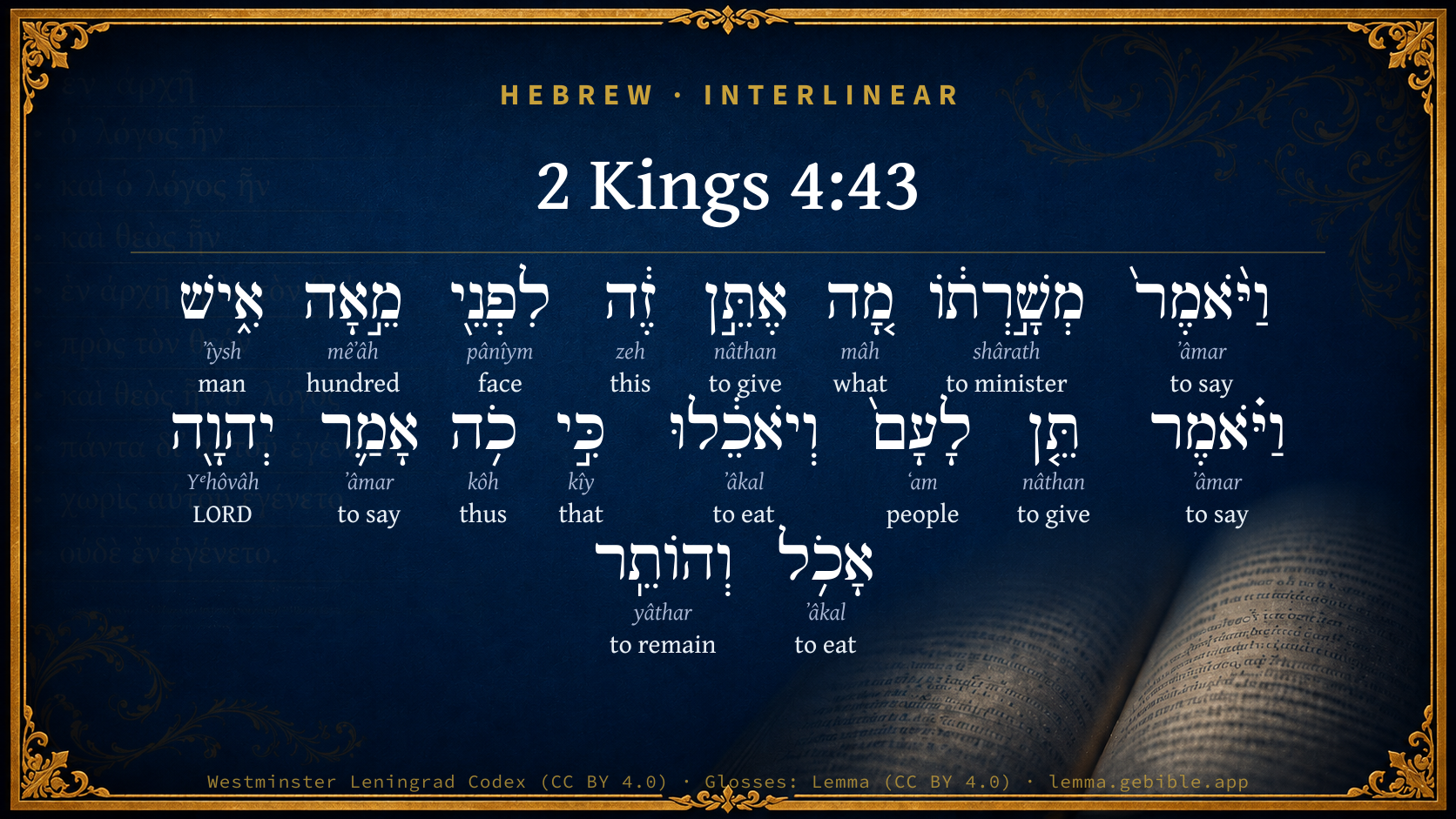
2 Kings 4:43

Hebrew (Westminster Leningrad Codex) 2 Kings 4:43 appears in the Hebrew Old Testament. The text above is from the Westminster Leningrad Codex. Each word links to its Strong’s number, a concise gloss, and parsing drawn from the Open Scriptures Hebrew Bible morphology. Click any word for its full Brown-Driver-Briggs (BDB) entry.
Download image
Cite this verse

2 Kings 4:43 (World English Bible). Public Domain. Lemma interlinear Bible study tool, https://lemma.gebible.app/v/2-kings/4/43.

Show BibTeX & RIS
BibTeX
RIS
English Translation
His servant said, What, should I set this before a hundred men? But he said, Give the people, that they may eat; for thus says Yahweh, They shall eat, and shall leave of it.
World English Bible · Public Domain
Download a study sheet

One document with this verse’s original text, its word-by-word gloss line, the meaning frame, cross-references with their text, attributed commentary, and full source and license credits — printable, and it pastes into notes with its structure intact.

This verse Autodidact and up

Study sheet (.html) Plain text (.txt)

A passage Seminary Student

Up to 50 verses in one chapter. A passage sheet keeps up to 6 commentary sources and 12 cross-references per verse, in the order this page ranks them, and says so on the sheet whenever that leaves anything out. Ask for a single verse and you get the Autodidact verse sheet above.

Everything on this page stays free to read, with no account — the sheet is a download of what is already on screen, not access to it.

Want to remove ads? Support Godless Engineer
Compare translations 3

The same verse in 3 English versions, stacked beneath the original-language interlinear above. Click any original word for its lexicon entry.

Each is an independent rendering of the whole verse — the interlinear is not word-aligned to these translations.

Highlighted words mark where these versions differ — a whole-verse word diff, not a word-by-word alignment.

  • World English Bible Public Domain
    His servant said, What, should I set this before a hundred men? But he said, Give the people, that they may eat; for thus says Yahweh, They shall eat, and shall leave of it.
  • King James Version Public Domain
    And his servitor said, What, should I set this before an hundred men? He said again, Give the people, that they may eat: for thus saith the LORD, They shall eat, and shall leave thereof.
  • unfoldingWord Literal Text CC BY-SA 4.0
    And the one serving him said, “How shall I set this to the face of a hundred men?” And he said, “Give to the people that they may eat, for thus says Yahweh, ‘Eating and leaving over.’”

unfoldingWord Literal Text — © unfoldingWord, licensed CC BY-SA 4.0. Word-aligned USFM3 via Door43 (git.door43.org/unfoldingWord/en_ult).

Versions to compare (up to 4)

3 of 4 selected

Show all 18 translations

Every available English version of this verse, each an independent rendering of the whole verse.

  • World English Bible Public Domain
    His servant said, What, should I set this before a hundred men? But he said, Give the people, that they may eat; for thus says Yahweh, They shall eat, and shall leave of it.
  • Berean Standard Bible Public Domain
    But his servant asked, “How am I to set twenty loaves before a hundred men?” “Give it to the people to eat,” said Elisha, “for this is what the LORD says: ‘They will eat and have some left over.’”
  • Majority Standard Bible Public Domain
    But his servant asked, “How am I to set twenty loaves before a hundred men?” “Give it to the people to eat,” said Elisha, “for this is what the LORD says: ‘They will eat and have some left over.’”
  • King James Version Public Domain
    And his servitor said, What, should I set this before an hundred men? He said again, Give the people, that they may eat: for thus saith the LORD, They shall eat, and shall leave thereof.
  • American Standard Version (1901) Public Domain
    And his servant said, What, should I set this before a hundred men? But he said, Give the people, that they may eat; for thus saith Jehovah, They shall eat, and shall leave thereof.
  • Revised Version (1885) Public Domain
    And his servant said, What, should I set this before an hundred men? But he said, Give the people, that they may eat; for thus saith the LORD, They shall eat, and shall leave thereof.
  • Geneva Bible (1599) Public Domain
    And his seruant answered, How shoulde I set this before an hundreth men? He sayd againe, Giue it vnto the people, that they may eate: for thus sayth the Lord, They shall eate, and there shall remaine.
  • Douay-Rheims (1899) Public Domain
    And his servant answered him: How much is this, that I should set it before a hundred men? He said again: Give to the people, that they may eat: for thus saith the Lord: They shall eat, and there shall be left.
  • Young's Literal Translation Public Domain
    And his minister saith, `What -- do I give this before a hundred men?' and he saith, `Give to the people, and they eat, for thus said Jehovah, Eat and leave;'
  • Literal Standard Version CC BY-SA 4.0
    And his minister says, “How do I give this before one hundred men?” And he says, “Give to the people, and they eat, for thus said YHWH: Eat and leave”;
  • Unlocked Literal Bible CC BY-SA 4.0
    His servant said, “What, should I set this before a hundred men?” But Elisha said, “Give this to the people, so they can eat, because Yahweh says, 'They will eat and will have some left.'”
  • unfoldingWord Literal Text CC BY-SA 4.0
    And the one serving him said, “How shall I set this to the face of a hundred men?” And he said, “Give to the people that they may eat, for thus says Yahweh, ‘Eating and leaving over.’”
  • Darby Bible Public Domain
    And his attendant said, How shall I set this before a hundred men? And he said, Give the people that they may eat; for thus saith Jehovah: They shall eat, and shall have to spare.
  • World Messianic Bible Public Domain
    His servant said, “What, should I set this before a hundred men?” But he said, “Give it to the people, that they may eat; for the LORD says, ‘They will eat, and will have some left over.’”
  • Webster's Bible Public Domain
    And his servitor said, What, should I set this before a hundred men? He said again, Give the people, that they may eat: for thus saith the LORD, They shall eat, and shall leave of it.
  • Free Bible Version CC BY-SA 4.0
    “How can I serve just twenty loaves to a hundred men?” his servant asked. “Give it to the people to eat,” said Elisha, “for this is what the Lord says: ‘They will eat and there will still be some left over.’”
  • Bible in Basic English Public Domain
    But his servant said, How am I to put this before a hundred men? But he said, Give it to the people for food; for the Lord says, There will be food for them and some over.
  • JPS Tanakh (1917) Public Domain
    And his servant said: 'How should I set this before a hundred men?' But he said: 'Give the people, that they may eat; for thus saith the LORD: They shall eat, and shall leave thereof.'

Literal Standard Version (2020), Covenant Press — licensed CC BY-SA 4.0. Text via the HelloAO Bible API (eBible.org). Unlocked Literal Bible (unfoldingWord) — licensed CC BY-SA 4.0. Text via the HelloAO Bible API (eBible.org). unfoldingWord Literal Text — © unfoldingWord, licensed CC BY-SA 4.0. Word-aligned USFM3 via Door43 (git.door43.org/unfoldingWord/en_ult). Free Bible Version, Dr. Jonathan Gallagher — licensed CC BY-SA 4.0. Text via the HelloAO Bible API (eBible.org).

Word by word

More ways to search: Search by grammar → Find every occurrence → Compare this word →

Practice this passage: Drill this verse → Learn its vocabulary →

מְשָׁ֣רְת֔וֹ
shârath
H8334
“ministering · him”
Verb, Piel, Participle Active, Masculine, Singular, Construct + Suffix, Personal, 3rd Person, Masculine, Singular
Part of Speech
Verb
Stem
Piel
Form
Participle Active
Gender
Masculine
Number
Singular
State
Construct
Full BDB Definition

Origin: a primitive root

TWOT: 2472

(Piel) to minister, serve, minister to
  1. וַיֹּ֨אמֶר֙ ʼâmar H559 “and · to say” Conjunction + Verb, Qal, Sequential Imperfect, 3rd Person, Masculine, Singular
  2. מָ֚ה mâh H4100 “what” Particle, Interrogative
  3. אֶתֵּ֣ן nâthan H5414 “to give” Verb, Qal, Imperfect, 1st Person, Common, Singular
  4. זֶ֔ה zeh H2088 “this” Pronoun, Demonstrative, Masculine, Singular
  5. לִפְנֵ֖י pânîym H6440 “to/for · face(s) of” Preposition + Noun, Common, Both, Plural, Construct
  6. מֵ֣אָה mêʼâh H3967 “hundred” Adjective, Cardinal number, Both, Singular, Absolute
  7. אִ֑ישׁ ʼîysh H376 “man” Noun, Common, Masculine, Singular, Absolute
  8. וַיֹּ֗אמֶר ʼâmar H559 “and · to say” Conjunction + Verb, Qal, Sequential Imperfect, 3rd Person, Masculine, Singular
  9. תֵּ֤ן nâthan H5414 “give” Verb, Qal, Imperative, 2nd Person, Masculine, Singular
  10. לָעָם֙ ʻam H5971 “to/for the · people” Preposition, Determined + Noun, Common, Masculine, Singular, Absolute
  11. וְיֹאכֵ֔לוּ ʼâkal H398 “and · to eat” Conjunction + Verb, Qal, Jussive, 3rd Person, Masculine, Plural
  12. כִּ֣י kîy H3588 “that” Conjunction
  13. כֹ֥ה kôh H3541 “thus” Adverb
  14. אָמַ֛ר ʼâmar H559 “to say” Verb, Qal, Perfect, 3rd Person, Masculine, Singular
  15. יְהוָ֖ה Yᵉhôvâh H3068 “LORD” Noun, Proper
  16. אָכֹ֥ל ʼâkal H398 “to eat” Verb, Qal, Infinitive Absolute
  17. וְהוֹתֵֽר yâthar H3498 “and · to remain” Conjunction + Verb, Hiphil, Infinitive Absolute

About this verse

These counts appear in no published source. They are computed here, from the morphology-tagged text and Lemma’s own curated glosses. What Lemma adds →

18
words
14
distinct lemmas
Historical
section

Grammatical profile

  • 9 verbs
  • 4 nouns
  • 1 adjective
  • 1 pronoun
  • 1 conjunction
  • 1 adverb
  • 1 particle

Verb forms

  • וַיֹּ֨אמֶר֙ Qal · Sequential Imperfect
  • מְשָׁ֣רְת֔וֹ Piel · Participle Active
  • אֶתֵּ֣ן Qal · Imperfect
  • וַיֹּ֗אמֶר Qal · Sequential Imperfect
  • תֵּ֤ן Qal · Imperative
  • וְיֹאכֵ֔לוּ Qal · Jussive
  • אָמַ֛ר Qal · Perfect
  • אָכֹ֥ל Qal · Infinitive Absolute
  • וְהוֹתֵֽר Hiphil · Infinitive Absolute

Repetition

Words recur within this verse — often emphatic in Hebrew:

  • וַיֹּ֨אמֶר֙ to say H559 ×3
  • אֶתֵּ֣ן to give H5414 ×2
  • וְיֹאכֵ֔לוּ to eat H398 ×2

Hebrew & Septuagint length

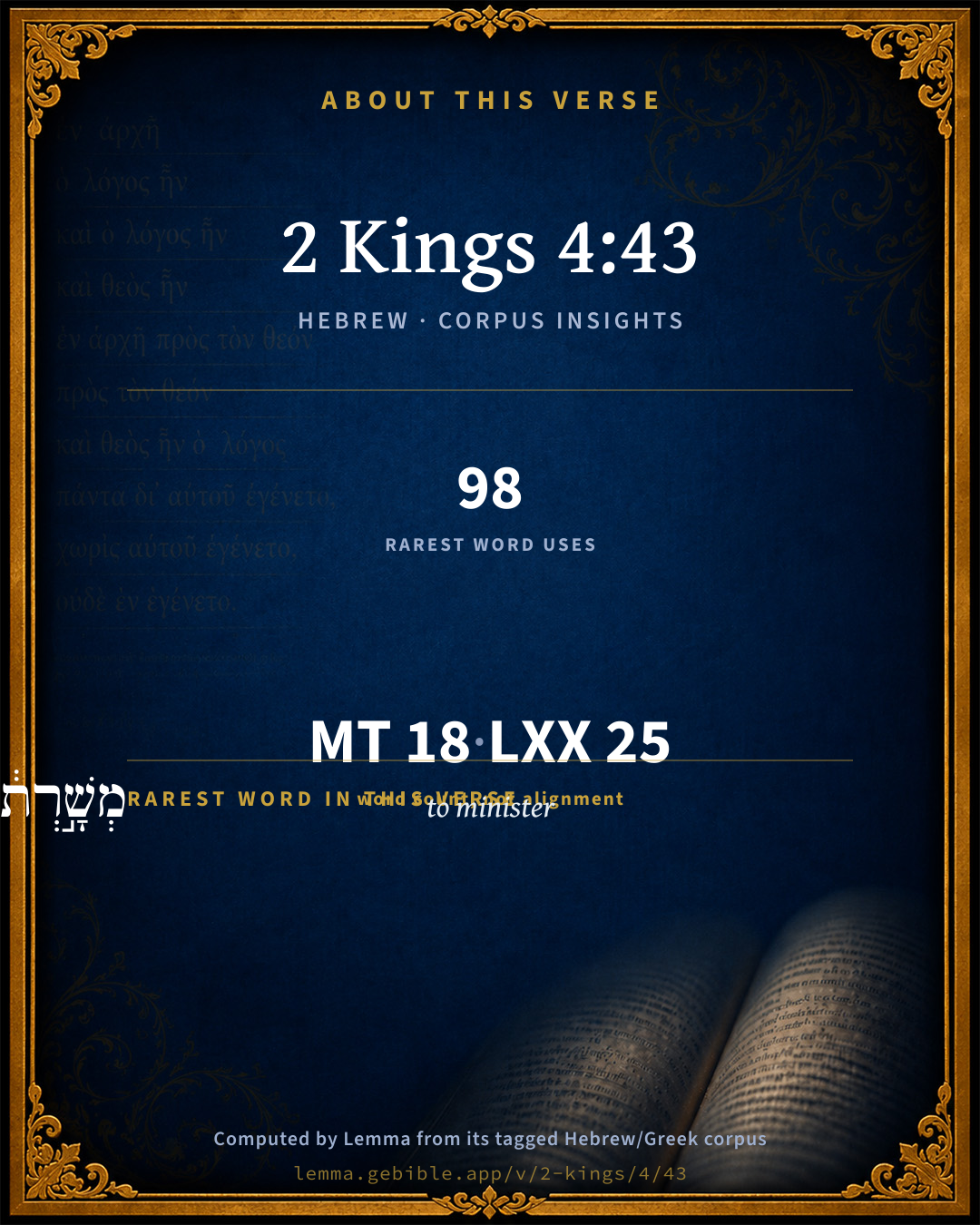
In English translation the verse runs 34 words from the Hebrew and 34 from the Septuagint (LXX English) — the same length.

A rough comparison of the two English renderings, which tokenize alike — not a word-level alignment.

Word counts can differ between the Hebrew and the Greek without any difference in meaning — e.g. the Hebrew direct-object marker אֵת has no separate Greek word, and Greek often adds the article ὁ.

In the original languages it is 18 Hebrew tokens and 25 Greek tokens — but the two are counted differently (Hebrew bundles its prefixes and suffixes into one token; the Greek is in lemma form), so that isn’t a like-for-like length.

Cross-references

13

Topical passages linked to 2 Kings 4:43 in the Treasury of Scripture Knowledge — connected by theme and wording, ordered by reader-vote popularity; previews shown in the World English Bible.

  • Luke 9:13 But he said to them, "You give them something to eat." They said, "We have no more than five loaves and two fish, unless we should go and buy food for all these people."
  • Matthew 14:20 They all ate, and were filled. They took up twelve baskets full of that which remained left over from the broken pieces.
  • John 6:9 "There is a boy here who has five barley loaves and two fish, but what are these among so many?"
  • Matthew 16:8–10 Jesus, perceiving it, said, "Why do you reason among yourselves, you of little faith, 'because you have brought no bread?'
  • John 6:11–13 Jesus took the loaves; and having given thanks, he distributed to the disciples, and the disciples to those who were sitting down; likewise also of the fish as much as they desired.
  • Matthew 14:16–17 But Jesus said to them, "They don't need to go away. You give them something to eat."
  • Matthew 15:33–34 The disciples said to him, "Where should we get so many loaves in a deserted place as to satisfy so great a multitude?"
  • Matthew 15:37 They all ate, and were filled. They took up seven baskets full of the broken pieces that were left over.
  • Mark 6:37–39 But he answered them, "You give them something to eat." They asked him, "Shall we go and buy two hundred denarii worth of bread, and give them something to eat?"
  • Luke 9:17 They ate, and were all filled. They gathered up twelve baskets of broken pieces that were left over.
  • Mark 6:42–43 They all ate, and were filled.
  • Mark 8:4 His disciples answered him, "From where could one satisfy these people with bread here in a deserted place?"
  • Mark 8:20 "When the seven loaves fed the four thousand, how many baskets full of broken pieces did you take up?" They told him, "Seven."

Cross-references courtesy of OpenBible.info (CC BY 4.0).

Hebrew and Greek witnesses Masoretic Hebrew ↔ Greek Septuagint

The same verse in the two great witnesses to the Old Testament, shown verse-for-verse.

These are two independent witnesses, not word-aligned to each other, and the Septuagint is shown in lemma (dictionary) form.

Hebrew 2 Kings 4:43 Masoretic · Westminster Leningrad Codex

וַיֹּ֨אמֶר֙ מְשָׁ֣רְת֔וֹ מָ֚ה אֶתֵּ֣ן זֶ֔ה לִפְנֵ֖י מֵ֣אָה אִ֑ישׁ וַיֹּ֗אמֶר תֵּ֤ן לָעָם֙ וְיֹאכֵ֔לוּ כִּ֣י כֹ֥ה אָמַ֛ר יְהוָ֖ה אָכֹ֥ל וְהוֹתֵֽר

His servant said, What, should I set this before a hundred men? But he said, Give the people, that they may eat; for thus says Yahweh, They shall eat, and shall leave of it.

World English Bible · Public Domain

Greek LXX 2 Kings 4:43 Septuagint · lemma form

καί εἶπον ὁ λειτουργός αὐτός τίς δίδωμι οὗτος ἐνώπιον ἑκατόν ἀνήρ καί εἶπον δίδωμι ὁ λαός καί ἐσθίω ὅτι ὅδε λέγω κύριος ἐσθίω καί καταλείπω

And his servant said, Why should I set this before one hundred men? and he said, Give to the people, and let them eat; for thus says the Lord, They shall eat and leave.

LXX2012 (modern English Septuagint) · Public Domain

Hebrew: Westminster Leningrad Codex (CC BY 4.0). Greek: Septuagint (public domain); English from LXX2012 (modern English Septuagint) (Public Domain). How the Septuagint differs from the Hebrew →

Targum (Aramaic paraphrase)

1

The Targum is the ancient Jewish Aramaic paraphrase of the Hebrew Scriptures — an interpretive translation, not the Hebrew text itself. Onkelos (literal) and Pseudo-Jonathan (expansive) render the Torah, and Jonathan the Prophets. Coverage is partial: where no permissively-licensed English translation exists for a verse, only the Aramaic is shown. This is verse-level text, not a word-by-word alignment to the Hebrew.

  1. Targum Jonathan Prophets (Joshua–Malachi)
    וַאֲמַר מְשׁוּמְשָׁנֵיהּ מָא אֶתֵּן דֵין קֳדָם מְאָה גַבְרָא וַאֲמַר הַב לְעַמָא וְיֵיכְלוּן אֲרֵי כִדְנַן אֲמַר יְיָ יֵיכְלוּן וְיוֹתְרוֹן:

    (no public-domain English translation for this verse)

    Targum Jonathan — Aramaic: “Mikraot Gedolot” (public domain). English: “Sefaria Community Translation” (CC0 1.0 (public-domain dedication)); “London "Chaldee Paraphrase," 1871” (public domain). Text via Sefaria.

Commentary

Notes on 2 Kings 4:43 from classic Christian and Jewish commentators (each source and its license shown beneath its notes). The classic Christian expositions comment on the surrounding passage and are grouped to its opening verse, so a note may address several verses; the Jewish commentaries on the Tanakh (Rashi and others) are per-verse, so they appear only where the commentator wrote on this verse.

Lemma curates 59 commentaries, every one of them public domain or Creative Commons licensed, each selected and text-cleaned for this edition rather than reprinted as found. About our sources →

Trapp's Complete Commentary

John Trapp

2Ki 4:43 And his servitor said, What, should I set this before an hundred men? He said again, Give the people, that they may eat: for thus saith the LORD, They shall eat, and shall leave [thereof].

Ver. 43. And his servitor.] Gehazi, who was no stranger to his master’s miracles, but continued a Pettifidian, or small faith.

John Trapp, A Commentary or Exposition upon All the Books of the Old and New Testament (1647–1656) — public domain. Text from a community e-Sword module.

Joseph Benson's Commentary

2Ki 4:43. What! should I set this before a hundred men? — Just as the apostles said to the Lord Jesus, when he intended to feed a far greater number with less food. He said again, Give unto the people, &c. — Do as I order you, and make no objections. For thus saith the Lord, They shall eat, and shall leave thereof — As the multitude left of the loaves and fishes which Christ caused to be set before them. The similitude between several of the miracles of Elijah and Elisha, and those of the Lord Jesus, is very striking, and may be considered as a proof that they all acted by the power of one and the same Spirit. The miracles of the Son of God, however, were both far more in number, and far greater, than those which were performed by these his servants.

Joseph Benson's Commentary on the Old and New Testaments (1811–1818) — public domain. Text from a community e-Sword module.

Geneva Bible (1599)

Geneva Bible translators

It is not the quantity of bread that satisfieth, but the blessing that God giveth.

Geneva Bible (1599) marginal notes — public domain. Text via Bolls.life.

Jamieson, Fausset & Brown

Robert Jamieson, A. R. Fausset & David Brown

SATISFIES A HUNDRED MEN WITH TWENTY LOAVES. (Kg2 4:42-44)

They shall eat, and shall leave thereof--This was not a miracle of Elisha, but only a prediction of one by the word of the Lord. Thus it differed widely from those of Christ (Mat 15:37; Mar 8:8; Luk 9:17; Joh 6:12).

Next: 2 Kings Chapter 5

Jamieson, Fausset & Brown — Commentary Critical and Explanatory on the Whole Bible (1871) — public domain (CC PDM 1.0). Text via the HelloAO Bible API.

Adam Clarke's Commentary

Verse 43. Thus saith the Lord, They shall eat, and shall leave thereof.] It was God, not the prophet, who fed one hundred men with these twenty loaves, &c. This is something like our Lord's feeding the multitude miraculously. Indeed, there are many things in this chapter similar to facts in our Lord's history: and this prophet might be more aptly considered a type of our Lord, than most of the other persons in the Scriptures who have been thus honoured.

Adam Clarke's Commentary on the Bible (1810–1826) — public domain. Text from a community e-Sword/MySword module.

Ellicott's Commentary for English Readers

(43) Servitor.—Minister, or attendant.

What, should I set this before an hundred men?—Or, How am I to set? &c. (Comp. Mat_14:33.)

He said again.—And he said.

They shall eat, and shall leave thereof.—Heb., eating and leaving! an exclamatory mode of speech, natural in hurried and vehement utterance.

A Bible Commentary for English Readers, edited by Charles John Ellicott (1878–1897) — public domain. Text from a community e-Sword module.

The Cambridge Bible for Schools and Colleges

gen. ed. J. J. S. Perowne

43. And his servitor [R.V. servant] said] The word is not the usual one for ‘servant’ which has occurred above in this chapter; but it is rendered elsewhere by ‘minister’ or ‘servant’ (see Exo_24:13; Exo_33:11), and nowhere but here ‘servitor’. As the word is used, in the passages referred to, of Joshua, the minister of Moses, it seems likely that Gehazi, the special attendant on Elisha, is here meant.

before an hundred men] Probably the number of the prophetic college at Gilgal. We have seen above (2Ki_2:7) that these communities had many members, not all perhaps resident regularly, but likely to gather in full force when Elisha was visiting their society.

He said again] R.V. But he said. There is nothing in the text to warrant the ‘again’.

The Cambridge Bible for Schools and Colleges (gen. ed. J. J. S. Perowne; Cambridge University Press, 1878–1918) — public domain. Text from a community e-Sword module.

John Gill's Exposition

And his servitor said,.... His servant Gehazi very probably:

what, should I set this before one hundred men? for so many, it seems, the sons of the prophets were in this place; and these loaves being very small, no more, it is thought by some, than one man could eat, and the ears of corn but few, the servant suggests they would be nothing comparatively to such a company of men:

he said again, give the people, that they may eat; he insisted upon it that his orders should be obeyed:

for thus saith the Lord, they shall eat, and shall leave thereof; it was suggested to him by a spirit of prophecy, there would be enough for them, and to spare.

John Gill's Exposition of the Whole Bible (1746–1763) — public domain (CC PDM 1.0). Text via the HelloAO Bible API.

Albert Barnes' Notes on the Bible

This miracle was a faint foreshadowing of our Lord’s far more marvelous feeding of thousands with even scantier materials. The resemblance is not only in the broad fact, but in various minute particulars, such as the distribution through the hands of others; the material, bread; the surprised question of the servant; and the evidence of superfluity in the fragments that were left (see the marginal references). As Elijah was a type of the Baptist, so Elisha was in many respects a type of our Blessed Lord. In his peaceful, non-ascetic life, in his mild and gentle character, in his constant circuits, in his many miracles of mercy, in the healing virtue which abode in his bodily frame 2Ki 13:21, he resembled, more than any other prophet, the Messiah, of whom all prophets were more or less shadows and figures.

Albert Barnes' Notes on the Bible (1834–1885) — public domain. Text from a community e-Sword/MySword module.

Haydock's Catholic Bible Commentary

Men. The disciples of Christ found the like difficulty, John vi. 9. (Menochius) --- God multiplied the provisions for these 100 men, (Calmet) living in the community at Galgal. (Haydock)

George Leo Haydock (1774–1849), Haydock's Catholic Family Bible and Commentary, 1859 edition — public domain. Excludes Psalms (Douay-Rheims chapter numbering differs from Protestant) and Deuterocanonical books (Catholic canon only).

Whedon's Commentary on the Bible

Daniel D. Whedon

43. His servitor — His minister; attendant. Probably Gehazi.

This before a hundred men — Do you expect me to feed a hundred with these few loaves, which are barely sufficient for us? Compare Luk_9:13; Joh_6:9. Here was not only an expression of surprise, but it was prompted by a Judas-like feeling of covetousness on the part of Gehazi, who would keep all for himself.

They shall eat, and shall leave — This word of the Lord shows that the miracle was not wrought by the prophet, but by a Divine power far beyond him and above him. But by this miracle God honoured him, and strengthened the faith of the people. Here, says Wordsworth, “is a specimen of the work of Christ in apostolic Churches, receiving the alms of the faithful at God’s altar, and seeking for true riches by bestowing those offerings, blessed by God with increase, to the benefit of his people.”

Daniel D. Whedon (gen. ed.), Commentary on the Old and New Testaments (1874–1909) — public domain. Text from a community e-Sword module.

The Pulpit Commentary

And his servitor said, What, should I set this before an hundred men? The servant felt that the quantity was quite insufficient, and thought it absurd to invite a hundred men to sit down to a meal, which would not satisfy a fifth of the number; but Elisha repeated his command. He said again, Give the people, that they may eat. This time, however, he added an explanation of the proceeding: for thus saith the Lord, They shall eat, and shall leave thereof. God had supernaturally intimated to him that the quantity of food would prove ample for the hundred men; they would show that they had had enough by leaving some of it. And the result was as predicted.

The Pulpit Commentary (1880–1919), ed. H.D.M. Spence-Jones & Joseph S. Exell — public domain. Text from a community e-Sword module.

Rashi

Rabbi Shlomo Yitzchaki (Rashi)

“How will I present this.” Each bread.

Rashi on the Tanakh — English translations: “The Judaica Press complete Tanach with Rashi, translated by A. J. Rosenberg” (CC BY 4.0); “Pentateuch with Rashi's commentary by M. Rosenbaum and A.M. Silbermann, 1929-1934” (public domain); “The Metsudah Tanach series, Lakewood, N.J” (CC BY 4.0); and “The Book of Joshua, Metsudah Publications, 1997” (CC BY 4.0). Text via Sefaria.

Lesson kit

Teaching starters — assembled from the data on this page, not authored interpretation. Every prompt links to the verse data it draws on. Edit before teaching.

2 Kings, in the Historical, opens this verse with 18 words (14 distinct Hebrew lemmas). Its most distinctive word is shârath (“to minister”). A historical commentator’s framing appears above. Read the whole chapter for the surrounding context.

Discussion questions

  1. The word shârath carries the sense “to minister.” How does it shape the verse?
  2. How does Luke 9:13, which shares this passage’s theme, read alongside this verse?
  3. What does the repetition of “to say” (3× in this one verse) do in this verse?
  4. The translations on this page render this verse differently — a whole-verse word diff, not a word-by-word alignment. What might account for the different wordings?
  5. «וַיֹּ֨אמֶר֙» is a Qal Sequential Imperfect verb. How does that grammatical form shape the action described?
  6. Compare how Trapp's Complete Commentary and Joseph Benson's Commentary read this verse. Where do they agree or differ?

Things to notice

Reading settings

Reading text

Shown beneath each verse's original-language words.

Old Testament
Old Testament edition

Read the OT as the Masoretic Hebrew (MT) or the Greek Septuagint (LXX).

English shown for the Greek Septuagint (in the Hebrew ↔ Greek comparison).

Comparing translations? Open the Compare panel on any verse page to stack up to four side by side.