
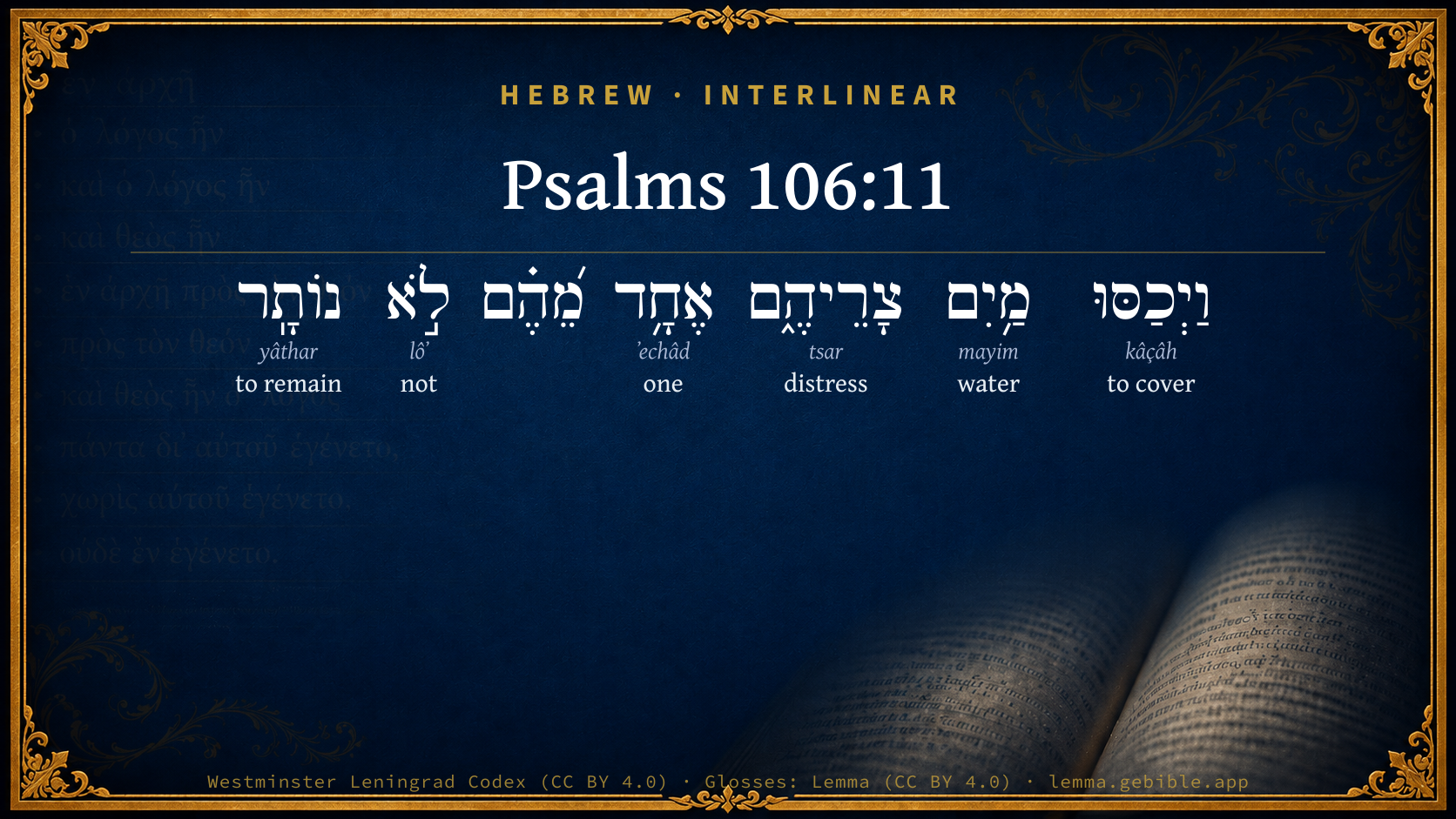
Psalms 106:11

Hebrew (Westminster Leningrad Codex) Psalms 106:11 appears in the Hebrew Old Testament. The text above is from the Westminster Leningrad Codex. Each word links to its Strong’s number, a concise gloss, and parsing drawn from the Open Scriptures Hebrew Bible morphology. Click any word for its full Brown-Driver-Briggs (BDB) entry.
Download image
Cite this verse

Psalms 106:11 (World English Bible). Public Domain. Lemma interlinear Bible study tool, https://lemma.gebible.app/v/psalms/106/11.

Show BibTeX & RIS
BibTeX
RIS
English Translation
The waters covered their adversaries. There was not one of them left.
World English Bible · Public Domain
Download a study sheet

One document with this verse’s original text, its word-by-word gloss line, the meaning frame, cross-references with their text, attributed commentary, and full source and license credits — printable, and it pastes into notes with its structure intact.

This verse Autodidact and up

Study sheet (.html) Plain text (.txt)

A passage Seminary Student

Up to 50 verses in one chapter. A passage sheet keeps up to 6 commentary sources and 12 cross-references per verse, in the order this page ranks them, and says so on the sheet whenever that leaves anything out. Ask for a single verse and you get the Autodidact verse sheet above.

Everything on this page stays free to read, with no account — the sheet is a download of what is already on screen, not access to it.

Want to remove ads? Support Godless Engineer
Compare translations 3

The same verse in 3 English versions, stacked beneath the original-language interlinear above. Click any original word for its lexicon entry.

Each is an independent rendering of the whole verse — the interlinear is not word-aligned to these translations.

Highlighted words mark where these versions differ — a whole-verse word diff, not a word-by-word alignment.

  • World English Bible Public Domain
    The waters covered their adversaries. There was not one of them left.
  • King James Version Public Domain
    And the waters covered their enemies: there was not one of them left.
  • unfoldingWord Literal Text CC BY-SA 4.0
    Then the waters covered their adversaries; one of them was not left.

unfoldingWord Literal Text — © unfoldingWord, licensed CC BY-SA 4.0. Word-aligned USFM3 via Door43 (git.door43.org/unfoldingWord/en_ult).

Versions to compare (up to 4)

3 of 4 selected

Show all 18 translations

Every available English version of this verse, each an independent rendering of the whole verse.

  • World English Bible Public Domain
    The waters covered their adversaries. There was not one of them left.
  • Berean Standard Bible Public Domain
    The waters covered their foes; not one of them remained.
  • Majority Standard Bible Public Domain
    The waters covered their foes; not one of them remained.
  • King James Version Public Domain
    And the waters covered their enemies: there was not one of them left.
  • American Standard Version (1901) Public Domain
    And the waters covered their adversaries; There was not one of them left.
  • Revised Version (1885) Public Domain
    And the waters covered their adversaries: there was not one of them left.
  • Geneva Bible (1599) Public Domain
    And the waters couered their oppressours: not one of them was left.
  • Douay-Rheims (1899) Public Domain
    And the water covered them that afflicted them: there was not one of them left.
  • Young's Literal Translation Public Domain
    And waters cover their adversaries, One of them hath not been left.
  • Literal Standard Version CC BY-SA 4.0
    And waters cover their adversaries, || One of them has not been left.
  • Unlocked Literal Bible CC BY-SA 4.0
    But the waters covered their adversaries; not one of them survived.
  • unfoldingWord Literal Text CC BY-SA 4.0
    Then the waters covered their adversaries; one of them was not left.
  • Darby Bible Public Domain
    And the waters covered their oppressors: there was not one of them left.
  • World Messianic Bible Public Domain
    The waters covered their adversaries. There was not one of them left.
  • Webster's Bible Public Domain
    And the waters covered their enemies: there was not one of them left.
  • Free Bible Version CC BY-SA 4.0
    The water drowned their enemies—none of them survived,
  • Bible in Basic English Public Domain
    And the waters went over their haters; all of them came to an end.
  • JPS Tanakh (1917) Public Domain
    And the waters covered their adversaries; there was not one of them left.

Literal Standard Version (2020), Covenant Press — licensed CC BY-SA 4.0. Text via the HelloAO Bible API (eBible.org). Unlocked Literal Bible (unfoldingWord) — licensed CC BY-SA 4.0. Text via the HelloAO Bible API (eBible.org). unfoldingWord Literal Text — © unfoldingWord, licensed CC BY-SA 4.0. Word-aligned USFM3 via Door43 (git.door43.org/unfoldingWord/en_ult). Free Bible Version, Dr. Jonathan Gallagher — licensed CC BY-SA 4.0. Text via the HelloAO Bible API (eBible.org).

Word by word

More ways to search: Search by grammar → Find every occurrence → Compare this word →

Practice this passage: Drill this verse → Learn its vocabulary →

נוֹתָֽר
yâthar
H3498
“to remain”
Verb, Niphal, Perfect, 3rd Person, Masculine, Singular
Part of Speech
Verb
Stem
Niphal
Form
Perfect
Person
3rd Person
Gender
Masculine
Number
Singular
Full BDB Definition

Origin: a primitive root

TWOT: 936

to be left over, remain, remain over, leave - (Qal) remainder (participle) - (Niphal) to be left over, remain over, be left behind - (Hiphil) - to leave over, leave - to save over, preserve alive - to excel, show pre-eminence - to show excess, have more than enough, have an excess
  1. וַיְכַסּוּ kâçâh H3680 “and · to cover” Conjunction + Verb, Piel, Sequential Imperfect, 3rd Person, Masculine, Plural
  2. מַ֥יִם mayim H4325 “water(s)” Noun, Common, Masculine, Plural, Absolute
  3. צָרֵיהֶ֑ם tsar H6862 “distresses · their” Noun, Common, Masculine, Plural, Construct + Suffix, Personal, 3rd Person, Masculine, Plural
  4. אֶחָ֥ד ʼechâd H259 “one” Adjective, Cardinal number, Masculine, Singular, Absolute
  5. לֹ֣א lôʼ H3808 “not” Particle, Negative

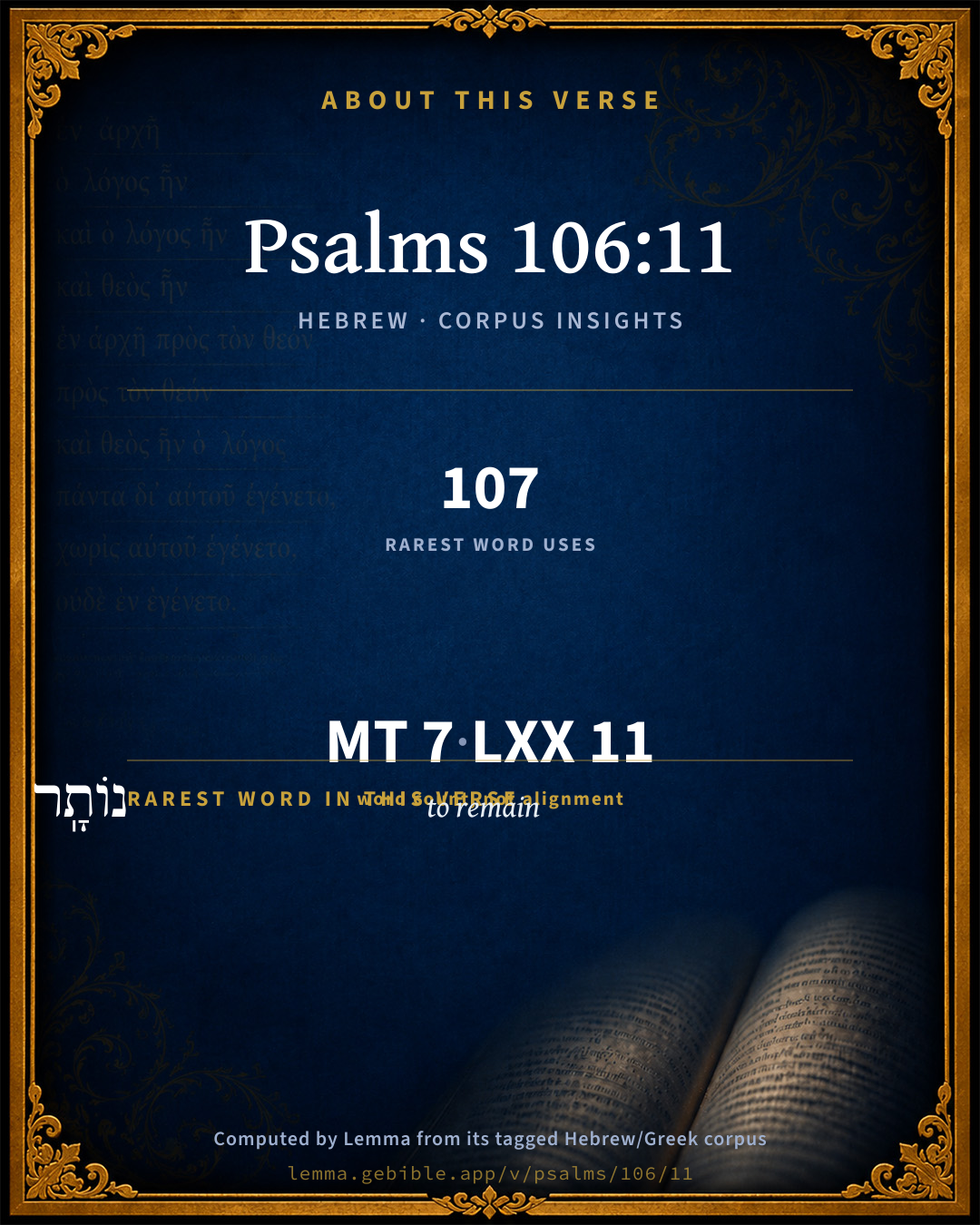
About this verse

These counts appear in no published source. They are computed here, from the morphology-tagged text and Lemma’s own curated glosses. What Lemma adds →

7
words
6
distinct lemmas
Wisdom
section

Grammatical profile

  • 2 verbs
  • 2 nouns
  • 1 adjective
  • 1 preposition
  • 1 particle

Verb forms

  • וַיְכַסּוּ Piel · Sequential Imperfect
  • נוֹתָֽר Niphal · Perfect

Hebrew & Septuagint length

In English translation the verse runs 12 words from the Hebrew and 14 from the Septuagint (LXX English) — closely comparable.

A rough comparison of the two English renderings, which tokenize alike — not a word-level alignment.

Word counts can differ between the Hebrew and the Greek without any difference in meaning — e.g. the Hebrew direct-object marker אֵת has no separate Greek word, and Greek often adds the article ὁ.

In the original languages it is 7 Hebrew tokens and 11 Greek tokens — but the two are counted differently (Hebrew bundles its prefixes and suffixes into one token; the Greek is in lemma form), so that isn’t a like-for-like length.

Cross-references

6

Topical passages linked to Psalms 106:11 in the Treasury of Scripture Knowledge — connected by theme and wording, ordered by reader-vote popularity; previews shown in the World English Bible.

  • Exodus 15:5 The deeps cover them. They went down into the depths like a stone.
  • Exodus 14:13 Moses said to the people, "Don't be afraid. Stand still, and see the salvation of Yahweh, which he will work for you today: for the Egyptians whom you have seen today, you shall never see them again.
  • Exodus 14:27–28 Moses stretched out his hand over the sea, and the sea returned to its strength when the morning appeared; and the Egyptians fled against it. Yahweh overthrew the Egyptians in the midst of the sea.
  • Psalms 78:53 He led them safely, so that they weren't afraid, But the sea overwhelmed their enemies.
  • Exodus 15:10 You blew with your wind. The sea covered them. They sank like lead in the mighty waters.
  • Exodus 15:19 For the horses of Pharaoh went in with his chariots and with his horsemen into the sea, and Yahweh brought back the waters of the sea on them; but the children of Israel walked on dry land in the midst of the sea.

Cross-references courtesy of OpenBible.info (CC BY 4.0).

Hebrew and Greek witnesses Masoretic Hebrew ↔ Greek Septuagint

The same verse in the two great witnesses to the Old Testament, shown verse-for-verse.

You’re reading Greek Psalm 105 (Hebrew Psalm 106). The Septuagint counts the superscription, so verse numbers can differ from the Hebrew — chapter-level alignment, not verse-by-verse. Numbering follows Rahlfs.

These are two independent witnesses, not word-aligned to each other, and the Septuagint is shown in lemma (dictionary) form.

Hebrew Psalms 106:11 Masoretic · Westminster Leningrad Codex

וַיְכַסּוּ מַ֥יִם צָרֵיהֶ֑ם אֶחָ֥ד מֵ֝הֶ֗ם לֹ֣א נוֹתָֽר

The waters covered their adversaries. There was not one of them left.

World English Bible · Public Domain

Greek LXX Greek Psalm 105:11 Septuagint · lemma form

καί καλύπτω ὕδωρ ὁ θλίβω αὐτός εἷς ἐκ αὐτός οὐ ὑπολείπω

The water covered those that oppressed them: there was not one of them left.

LXX2012 (modern English Septuagint) · Public Domain

Hebrew: Westminster Leningrad Codex (CC BY 4.0). Greek: Septuagint (public domain); English from LXX2012 (modern English Septuagint) (Public Domain). How the Septuagint differs from the Hebrew →

Commentary

Notes on Psalms 106:11 from classic Christian and Jewish commentators (each source and its license shown beneath its notes). The classic Christian expositions comment on the surrounding passage and are grouped to its opening verse, so a note may address several verses; the Jewish commentaries on the Tanakh (Rashi and others) are per-verse, so they appear only where the commentator wrote on this verse.

Lemma curates 59 commentaries, every one of them public domain or Creative Commons licensed, each selected and text-cleaned for this edition rather than reprinted as found. About our sources →

Trapp's Complete Commentary

John Trapp

Psa 106:11 And the waters covered their enemies: there was not one of them left.

Ver. 11. And the waters covered their enemies] The preservation of the Church is ever accompanied with the destruction of its enemies, that the mercy may appear the greater.

Not one of them left] Left alive to carry the news.

John Trapp, A Commentary or Exposition upon All the Books of the Old and New Testament (1647–1656) — public domain. Text from a community e-Sword module.

J. A. Alexander on Psalms

Joseph Addison Alexander

11. (Psa 106:11) And the waters covered their adversaries; not one of them was left. The Psalmist dwells upon the completeness of the overthrow and destruction experienced by Pharaoh and his host, in order to aggravate the previous and subsequent ingratitude of Israel, as well as to enhance the free grace of Jehovah, and the fidelity with which he executed his engagements, even to the faithless.

Joseph Addison Alexander, The Psalms Translated and Explained (1850) — public domain. Text from a community e-Sword module.

The Cambridge Bible for Schools and Colleges

gen. ed. J. J. S. Perowne

11. See Exo_14:28. enemies] R.V. adversaries.

The Cambridge Bible for Schools and Colleges (gen. ed. J. J. S. Perowne; Cambridge University Press, 1878–1918) — public domain. Text from a community e-Sword module.

John Gill's Exposition

And the waters covered their enemies,.... They pursuing the Israelites into the sea, the waters returned, and covered Pharaoh and all his host, and drowned them, so that they sunk as a stone, and as lead into the bottom of the sea, Exo 14:28.

There was not one of them left; to return back to Egypt, and give an account of what became of the army, Exo 14:28, an emblem this of the utter destruction of all our spiritual enemies by Christ; who has not only saved us from them, but has entirely destroyed them; he has made an end of sin, even of all the sins of his people; he has spoiled Satan and his principalities and powers; he has abolished death, the last enemy, and made his saints more than conquerors over all. Likewise it may be a representation of the destruction of the wicked at the last day, who will be all burnt up at the general conflagration, root and branch, not one will be left; see Mal 4:1.

John Gill's Exposition of the Whole Bible (1746–1763) — public domain (CC PDM 1.0). Text via the HelloAO Bible API.

Albert Barnes' Notes on the Bible

And the waters covered their enemies ... - Exo 14:27-28; Exo 15:5.

Albert Barnes' Notes on the Bible (1834–1885) — public domain. Text from a community e-Sword/MySword module.

The Treasury of David

Charles H. Spurgeon

Ver. 11. And the waters covered their enemies: there was not one of them left. The Lord does nothing by halves. What he begins he carries through to the end. This, again, made Israel's sin the greater, because they saw the thoroughness of the divine justice, and the perfection of the divine faithfulness. In the covering of their enemies we have a type of the pardon of our sins; they are sunk as in the sea, never to rise again; and, blessed be the Lord, there is "not one of them left." Not one sin of thought, or word, or deed, the blood of Jesus has covered all. "I will cast their iniquities into the depths of the sea."

Ver. 11. There was not one of them left. An emblem this of the utter destruction of all our spiritual enemies by Christ, who has not only saved us from them, but has entirely destroyed them; he has made an end of sin, even of all the sins of his people; he has spoiled Satan, and his principalities and powers; he has abolished death, the last enemy, and made his saints more than conquerors over all. Likewise it may be a representation of the destruction of the wicked at the last day, who will all be burnt up at the general conflagration, root and branch, not one will be left. See Mal 4:1. John Gill.

Ver. 11. (second clause). Song over sins forgiven.

Psalms 106:12*

Charles H. Spurgeon's The Treasury of David (1869–1885) — public domain. Psalms only. Text from a community e-Sword/MySword module.

The Pulpit Commentary

And the waters covered their enemies. (see Exo_14:28-30 Exo_15:10) There was not one of them left. The words of Exo_14:28 (last clause) are almost exactly followed. (On the true meaning of the expression, see the "Pulpit Commentary" on Exodus 14, p. 314)

The Pulpit Commentary (1880–1919), ed. H.D.M. Spence-Jones & Joseph S. Exell — public domain. Text from a community e-Sword module.

Lesson kit

Teaching starters — assembled from the data on this page, not authored interpretation. Every prompt links to the verse data it draws on. Edit before teaching.

Psalms, in the Wisdom, opens this verse with 7 words (6 distinct Hebrew lemmas). Its most distinctive word is yâthar (“to remain”). A historical commentator’s framing appears above. Read the whole chapter for the surrounding context.

Discussion questions

  1. What does “to remain” (yâthar) contribute to the verse as a whole?
  2. How does Exodus 15:5, which shares this passage’s theme, read alongside this verse?
  3. These translations render this verse differently; the difference is in the English rendering, not the original. What questions does that raise?
  4. «וַיְכַסּוּ» is a Piel Sequential Imperfect verb. How does that grammatical form shape the action described?
  5. Compare how Trapp's Complete Commentary and J. A. Alexander on Psalms read this verse. Where do they agree or differ?

Things to notice

Reading settings

Reading text

Shown beneath each verse's original-language words.

Old Testament
Old Testament edition

Read the OT as the Masoretic Hebrew (MT) or the Greek Septuagint (LXX).

English shown for the Greek Septuagint (in the Hebrew ↔ Greek comparison).

Comparing translations? Open the Compare panel on any verse page to stack up to four side by side.