
Numbers 33:55

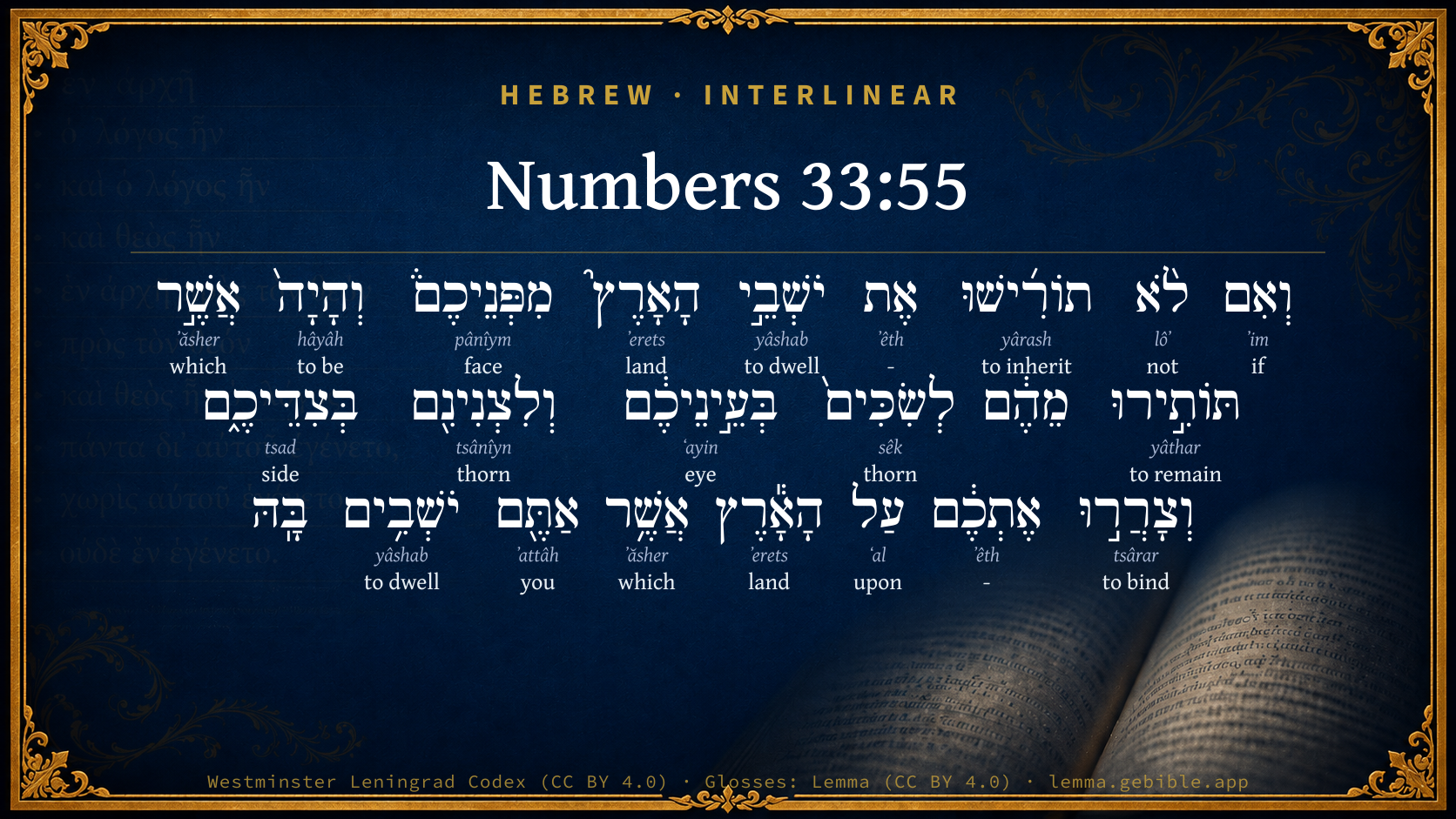
Hebrew (Westminster Leningrad Codex) Numbers 33:55 appears in the Hebrew Old Testament. The text above is from the Westminster Leningrad Codex. Each word links to its Strong’s number, a concise gloss, and parsing drawn from the Open Scriptures Hebrew Bible morphology. Click any word for its full Brown-Driver-Briggs (BDB) entry.
Download image
Cite this verse

Numbers 33:55 (World English Bible). Public Domain. Lemma interlinear Bible study tool, https://lemma.gebible.app/v/numbers/33/55.

Show BibTeX & RIS
BibTeX
RIS
English Translation
But if you will not drive out the inhabitants of the land from before you, then shall those who you let remain of them be as pricks in your eyes, and as thorns in your sides, and they shall vex you in the land in which you dwell.
World English Bible · Public Domain
Highlights
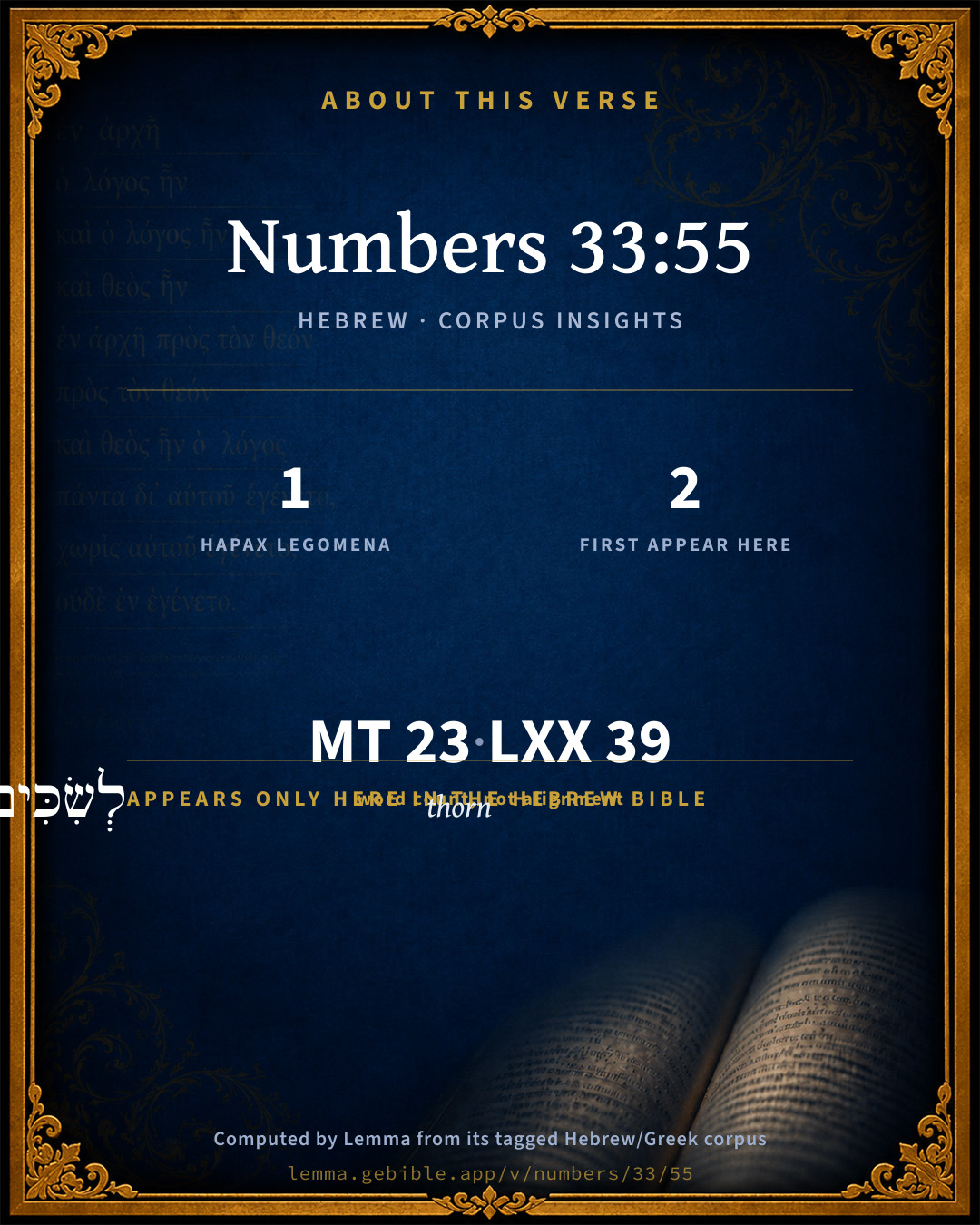
  • 1 hapax legomenon — only here in the Hebrew Bible
  • 2 first appearances in the Hebrew Bible
Full analysis ↓
Download a study sheet

One document with this verse’s original text, its word-by-word gloss line, the meaning frame, cross-references with their text, attributed commentary, and full source and license credits — printable, and it pastes into notes with its structure intact.

This verse Autodidact and up

Study sheet (.html) Plain text (.txt)

A passage Seminary Student

Up to 50 verses in one chapter. A passage sheet keeps up to 6 commentary sources and 12 cross-references per verse, in the order this page ranks them, and says so on the sheet whenever that leaves anything out. Ask for a single verse and you get the Autodidact verse sheet above.

Everything on this page stays free to read, with no account — the sheet is a download of what is already on screen, not access to it.

Want to remove ads? Support Godless Engineer
Compare translations 3

The same verse in 3 English versions, stacked beneath the original-language interlinear above. Click any original word for its lexicon entry.

Each is an independent rendering of the whole verse — the interlinear is not word-aligned to these translations.

Highlighted words mark where these versions differ — a whole-verse word diff, not a word-by-word alignment.

  • World English Bible Public Domain
    But if you will not drive out the inhabitants of the land from before you, then shall those who you let remain of them be as pricks in your eyes, and as thorns in your sides, and they shall vex you in the land in which you dwell.
  • King James Version Public Domain
    But if ye will not drive out the inhabitants of the land from before you; then it shall come to pass, that those which ye let remain of them shall be pricks in your eyes, and thorns in your sides, and shall vex you in the land wherein ye dwell.
  • unfoldingWord Literal Text CC BY-SA 4.0
    And if you do not dispossess those who dwell in the land from your face, then whom you leave from them will be as thorns in your eyes and as pricks in your sides, and they shall vex you on the land that you are about to dwell in.

unfoldingWord Literal Text — © unfoldingWord, licensed CC BY-SA 4.0. Word-aligned USFM3 via Door43 (git.door43.org/unfoldingWord/en_ult).

Versions to compare (up to 4)

3 of 4 selected

Show all 18 translations

Every available English version of this verse, each an independent rendering of the whole verse.

  • World English Bible Public Domain
    But if you will not drive out the inhabitants of the land from before you, then shall those who you let remain of them be as pricks in your eyes, and as thorns in your sides, and they shall vex you in the land in which you dwell.
  • Berean Standard Bible Public Domain
    But if you do not drive out the inhabitants of the land before you, those you allow to remain will become barbs in your eyes and thorns in your sides; they will harass you in the land where you settle.
  • Majority Standard Bible Public Domain
    But if you do not drive out the inhabitants of the land before you, those you allow to remain will become barbs in your eyes and thorns in your sides; they will harass you in the land where you settle.
  • King James Version Public Domain
    But if ye will not drive out the inhabitants of the land from before you; then it shall come to pass, that those which ye let remain of them shall be pricks in your eyes, and thorns in your sides, and shall vex you in the land wherein ye dwell.
  • American Standard Version (1901) Public Domain
    But if ye will not drive out the inhabitants of the land from before you, then shall those that ye let remain of them be as pricks in your eyes, and as thorns in your sides, and they shall vex you in the land wherein ye dwell.
  • Revised Version (1885) Public Domain
    But if ye will not drive out the inhabitants of the land from before you; then shall those which ye let remain of them be as pricks in your eyes, and as thorns in your sides, and they shall vex you in the land wherein ye dwell.
  • Geneva Bible (1599) Public Domain
    But if ye will not driue out the inhabitants of the land before you, then those which yee let ramaine of them, shalbe prickes in your eyes, and thornes in your sides, and shall vexe you in the land wherein ye dwell.
  • Douay-Rheims (1899) Public Domain
    But if you will not kill the inhabitants of the land: they that remain, shall be unto you as nails in your eyes, and spears in your sides, and they shall be your adversaries in the land of your habitation.
  • Young's Literal Translation Public Domain
    `And if ye do not dispossess the inhabitants of the land from before you, then it hath been, those whom ye let remain of them, `are' for pricks in your eyes, and for thorns in your sides, and they have distressed you on the land in which ye are dwelling,
  • Literal Standard Version CC BY-SA 4.0
    And if you do not dispossess the inhabitants of the land from before you, then it has been [that] those whom you let remain of them [are] for pricks in your eyes and for thorns in your sides, and they have distressed you on the land in which you are dwelling,
  • Unlocked Literal Bible CC BY-SA 4.0
    But if you do not drive out the land's inhabitants before you, then the people you allow to stay will become like objects in your eyes and thorns in your sides. They will make your lives difficult in the land where you settle.
  • unfoldingWord Literal Text CC BY-SA 4.0
    And if you do not dispossess those who dwell in the land from your face, then whom you leave from them will be as thorns in your eyes and as pricks in your sides, and they shall vex you on the land that you are about to dwell in.
  • Darby Bible Public Domain
    But if ye will not dispossess the inhabitants of the land from before you, those that ye let remain of them shall be thorns in your eyes, and pricks in your sides, and they shall harass you in the land wherein ye dwell.
  • World Messianic Bible Public Domain
    “But if you do not drive out the inhabitants of the land from before you, then those you let remain of them will be like pricks in your eyes and thorns in your sides. They will harass you in the land in which you dwell.
  • Webster's Bible Public Domain
    But if ye will not drive out the inhabitants of the land from before you; then it shall come to pass, that those which ye let remain of them shall be prickles in your eyes, and thorns in your sides, and shall harass you in the land in which ye dwell.
  • Free Bible Version CC BY-SA 4.0
    But if you don't drive out everyone living in the land, the people you allow to remain will be like grit in your eyes and thorns in your sides. They will cause you trouble where you settle in the country.
  • Bible in Basic English Public Domain
    But if you are slow in driving out the people of the land, then those of them who are still there will be like pin-points in your eyes and like thorns in your sides, troubling you in the land where you are living.
  • JPS Tanakh (1917) Public Domain
    But if ye will not drive out the inhabitants of the land from before you, then shall those that ye let remain of them be as thorns in your eyes, and as pricks in your sides, and they shall harass you in the land wherein ye dwell.

Literal Standard Version (2020), Covenant Press — licensed CC BY-SA 4.0. Text via the HelloAO Bible API (eBible.org). Unlocked Literal Bible (unfoldingWord) — licensed CC BY-SA 4.0. Text via the HelloAO Bible API (eBible.org). unfoldingWord Literal Text — © unfoldingWord, licensed CC BY-SA 4.0. Word-aligned USFM3 via Door43 (git.door43.org/unfoldingWord/en_ult). Free Bible Version, Dr. Jonathan Gallagher — licensed CC BY-SA 4.0. Text via the HelloAO Bible API (eBible.org).

Word by word

More ways to search: Search by grammar → Find every occurrence → Compare this word →

Practice this passage: Drill this verse → Learn its vocabulary →

לְשִׂכִּים֙
sêk
H7899
“to/for · thorns”
Preposition + Noun, Common, Masculine, Plural, Absolute
Part of Speech
Preposition + Noun
Type
Common
Gender
Masculine
Number
Plural
State
Absolute
Full BDB Definition

Origin: from H5526 in the sense of H7753

TWOT: 2262a

thorn
  1. וְאִם ʼim H518 “and · if” Conjunction + Conjunction
  2. לֹ֨א lôʼ H3808 “not” Particle, Negative
  3. תוֹרִ֜ישׁוּ yârash H3423 “to inherit” Verb, Hiphil, Imperfect, 2nd Person, Masculine, Plural
  4. אֶת ʼêth H853 “-” Particle, Direct Object
  5. יֹשְׁבֵ֣י yâshab H3427 “dwelling” Verb, Qal, Participle Active, Masculine, Plural, Construct
  6. הָאָרֶץ֮ ʼerets H776 “the · land” Particle, Definite Article + Noun, Common, Both, Singular, Absolute
  7. מִפְּנֵיכֶם֒ pânîym H6440 “from · face(s) · your” Preposition + Noun, Common, Both, Plural, Construct + Suffix, Personal, 2nd Person, Masculine, Plural
  8. וְהָיָה֙ hâyâh H1961 “and · to be” Conjunction + Verb, Qal, Sequential Perfect, 3rd Person, Masculine, Singular
  9. אֲשֶׁ֣ר ʼăsher H834 “which” Particle, Relative
  10. תּוֹתִ֣ירוּ yâthar H3498 “to remain” Verb, Hiphil, Imperfect, 2nd Person, Masculine, Plural
  11. בְּעֵ֣ינֵיכֶ֔ם ʻayin H5869 “in/at · eyes · your” Preposition + Noun, Common, Both, Dual, Construct + Suffix, Personal, 2nd Person, Masculine, Plural
  12. וְלִצְנִינִ֖ם tsânîyn H6796 “and · to/for · thorns” Conjunction + Preposition + Noun, Common, Masculine, Plural, Absolute
  13. בְּצִדֵּיכֶ֑ם tsad H6654 “in/at · sides · your” Preposition + Noun, Common, Masculine, Plural, Construct + Suffix, Personal, 2nd Person, Masculine, Plural
  14. וְצָרֲר֣וּ tsârar H6887 “and · to bind” Conjunction + Verb, Qal, Sequential Perfect, 3rd Person, Common, Plural
  15. אֶתְכֶ֔ם ʼêth H853 “- · you” Particle, Direct Object + Suffix, Personal, 2nd Person, Masculine, Plural
  16. עַל ʻal H5921 “upon” Preposition
  17. הָאָ֕רֶץ ʼerets H776 “the · land” Particle, Definite Article + Noun, Common, Both, Singular, Absolute
  18. אֲשֶׁ֥ר ʼăsher H834 “which” Particle, Relative
  19. אַתֶּ֖ם ʼattâh H859 “you” Pronoun, Personal, 2nd Person, Masculine, Plural
  20. יֹשְׁבִ֥ים yâshab H3427 “dwelling” Verb, Qal, Participle Active, Masculine, Plural, Absolute

About this verse

These counts appear in no published source. They are computed here, from the morphology-tagged text and Lemma’s own curated glosses. What Lemma adds →

23
words
17
distinct lemmas
Pentateuch
section

Notable vocabulary

1 hapax legomenon — a word that appears only here in the entire Hebrew Bible:

  • לְשִׂכִּים֙ thorn H7899

First appearance in Scripture

These words make their first canonical appearance in the Hebrew Bible here:

  • לְשִׂכִּים֙ thorn H7899
  • וְלִצְנִינִ֖ם thorn H6796

Shared distinctive vocabulary

וְלִצְנִינִ֖ם thorn H6796 occurs in 2 verses of the Hebrew Bible. Also found in:

Grammatical profile

  • 6 verbs
  • 7 nouns
  • 1 pronoun
  • 3 prepositions
  • 1 conjunction
  • 5 particles

Verb forms

  • תוֹרִ֜ישׁוּ Hiphil · Imperfect
  • יֹשְׁבֵ֣י Qal · Participle Active
  • וְהָיָה֙ Qal · Sequential Perfect
  • תּוֹתִ֣ירוּ Hiphil · Imperfect
  • וְצָרֲר֣וּ Qal · Sequential Perfect
  • יֹשְׁבִ֥ים Qal · Participle Active

Repetition

Words recur within this verse — often emphatic in Hebrew:

  • יֹשְׁבֵ֣י to dwell H3427 ×2
  • הָאָרֶץ֮ land H776 ×2
  • אֲשֶׁ֣ר which H834 ×2

Hebrew & Septuagint length

In English translation the verse runs 48 words from the Hebrew and 53 from the Septuagint (LXX English) — closely comparable.

A rough comparison of the two English renderings, which tokenize alike — not a word-level alignment.

Word counts can differ between the Hebrew and the Greek without any difference in meaning — e.g. the Hebrew direct-object marker אֵת has no separate Greek word, and Greek often adds the article ὁ.

In the original languages it is 23 Hebrew tokens and 39 Greek tokens — but the two are counted differently (Hebrew bundles its prefixes and suffixes into one token; the Greek is in lemma form), so that isn’t a like-for-like length.

Cross-references

8

Topical passages linked to Numbers 33:55 in the Treasury of Scripture Knowledge — connected by theme and wording, ordered by reader-vote popularity; previews shown in the World English Bible.

  • Judges 2:3 Therefore I also said, I will not drive them out from before you; but they shall be [as thorns] in your sides, and their gods shall be a snare to you.
  • Psalms 106:34–36 They didn't destroy the peoples, As Yahweh commanded them,
  • Deuteronomy 7:16 You shall consume all the peoples who Yahweh your God shall deliver to you; your eye shall not pity them: neither shall you serve their gods; for that will be a snare to you.
  • Joshua 23:12–13 Else if you do at all go back, and cleave to the remnant of these nations, even these who remain among you, and make marriages with them, and go in to them, and they to you;
  • Exodus 23:33 They shall not dwell in your land, lest they make you sin against me, for if you serve their gods, it will surely be a snare to you."
  • Deuteronomy 7:4 For he will turn away your son from following me, that they may serve other gods: so will the anger of Yahweh be kindled against you, and he will destroy you quickly.
  • Judges 1:21–36 The children of Benjamin did not drive out the Jebusites who inhabited Jerusalem; but the Jebusites dwell with the children of Benjamin in Jerusalem to this day.
  • Ezekiel 28:24 There shall be no more a pricking brier to the house of Israel, nor a hurting thorn of any that are round about them, that did despite to them; and they shall know that I am the Lord Yahweh.

Cross-references courtesy of OpenBible.info (CC BY 4.0).

Hebrew and Greek witnesses Masoretic Hebrew ↔ Greek Septuagint

The same verse in the two great witnesses to the Old Testament, shown verse-for-verse.

These are two independent witnesses, not word-aligned to each other, and the Septuagint is shown in lemma (dictionary) form.

Hebrew Numbers 33:55 Masoretic · Westminster Leningrad Codex

וְאִם לֹ֨א תוֹרִ֜ישׁוּ אֶת יֹשְׁבֵ֣י הָאָרֶץ֮ מִפְּנֵיכֶם֒ וְהָיָה֙ אֲשֶׁ֣ר תּוֹתִ֣ירוּ מֵהֶ֔ם לְשִׂכִּים֙ בְּעֵ֣ינֵיכֶ֔ם וְלִצְנִינִ֖ם בְּצִדֵּיכֶ֑ם וְצָרֲר֣וּ אֶתְכֶ֔ם עַל הָאָ֕רֶץ אֲשֶׁ֥ר אַתֶּ֖ם יֹשְׁבִ֥ים בָּֽהּ

But if you will not drive out the inhabitants of the land from before you, then shall those who you let remain of them be as pricks in your eyes, and as thorns in your sides, and they shall vex you in the land in which you dwell.

World English Bible · Public Domain

Greek LXX Numbers 33:55 Septuagint · lemma form

ἐάν δέ μή ἀποὀλλύω ὁ καταοἰκέω ἐπί ὁ γῆ ἀπό πρόσωπον σύ καί εἰμί ὅς ἐάν καταλείπω ἐκ αὐτός σκόλοψ ἐν ὁ ὀφθαλμός σύ καί βολίς ἐν ὁ πλευρά σύ καί ἐχθρεύω ἐπί ὁ γῆ ἐπί ὅς σύ καταοἰκέω

But if you⌃ will not destroy the dwellers in the land from before you, then it shall come to pass that whoever of them you⌃ shall leave shall be thorns in your eyes, and darts in your sides, and they shall be enemies to you on the land on which you⌃ shall dwell;

LXX2012 (modern English Septuagint) · Public Domain

On this verse, Haydock's Catholic Bible Commentary discusses the Septuagint’s reading. Read the note in Commentary ↓

Hebrew: Westminster Leningrad Codex (CC BY 4.0). Greek: Septuagint (public domain); English from LXX2012 (modern English Septuagint) (Public Domain). How the Septuagint differs from the Hebrew →

Targum (Aramaic paraphrase)

2

The Targum is the ancient Jewish Aramaic paraphrase of the Hebrew Scriptures — an interpretive translation, not the Hebrew text itself. Onkelos (literal) and Pseudo-Jonathan (expansive) render the Torah, and Jonathan the Prophets. Coverage is partial: where no permissively-licensed English translation exists for a verse, only the Aramaic is shown. This is verse-level text, not a word-by-word alignment to the Hebrew.

  1. Targum Onkelos Torah (Genesis–Deuteronomy)
    וְאִם לָא תְתָרְכוּן יָת יָתְבֵי אַרְעָא מִן קֳדָמֵיכוֹן וִיהֵי דִי תַשְׁאֲרוּן מִנְהוֹן לְסִיעַן נַטְלַן זְיַן לְקִבְלֵיכוֹן וּלְמַשִׁרְיַן מַקְפַּנְכוֹן וִיעִיקוּן לְכוֹן עַל אַרְעָא דִי אַתּוּן יָתְבִין בָּהּ

    (no public-domain English translation for this verse)

    Targum Onkelos — Aramaic: “Onkelos Genesis” (public domain); “Onkelos Exodus” (public domain); “Onkelos Leviticus” (public domain); “Onkelos Numbers” (public domain); “Onkelos Deuteronomy” (public domain). English: “Sefaria Community Translation” (CC0 1.0 (public-domain dedication)); “J.W. Etheridge. The Targums of Onkelos and Jonathan Ben Uzziel on the Pentateuch. London: Longmans, Green, 1862” (public domain). Text via Sefaria.

  2. Targum Pseudo-Jonathan Torah (Genesis–Deuteronomy)
    וְאִין לָא תְּתַרְכוּן יַת כָּל יַתְבֵי אַרְעָא מִן קֳדָמֵיכוֹן וִיהֵי מַה דִתְשַׁיְירוּן מִנְהוֹן לְסָכְיַין בְּעֵינָא בִּישָׁא בְּכוֹן וּמַקִיפִין לְכוֹן כִּתְרֵיסִין בְּסִיטְרֵיכוֹן וְיַתְעִיקִין יַתְכוֹן עַל אַרְעָא דְאַתּוּן יַתְבִין בָּהּ

    But if you will not drive out the inhabitants of the land from before you, it will be that the residue whom you have spared looking at you with an evil eye will surround you as shields (terisin) on your sides, and afflict you in the land wherein you dwell;

    Targum Pseudo-Jonathan — Aramaic: “Targum Jonathan on Genesis” (public domain); “Targum Jonathan on Exodus” (public domain); “Targum Jonathan on Leviticus” (public domain); “Targum Jonathan on Numbers” (public domain); “Targum Jonathan on Deuteronomy” (public domain). English: “The Targum of Jonathan ben Uzziel, trans. J. W. Etheridge, London, 1862” (public domain). Text via Sefaria.

Commentary

Notes on Numbers 33:55 from classic Christian and Jewish commentators (each source and its license shown beneath its notes). The classic Christian expositions comment on the surrounding passage and are grouped to its opening verse, so a note may address several verses; the Jewish commentaries on the Tanakh (Rashi and others) are per-verse, so they appear only where the commentator wrote on this verse.

Lemma curates 59 commentaries, every one of them public domain or Creative Commons licensed, each selected and text-cleaned for this edition rather than reprinted as found. About our sources →

Trapp's Complete Commentary

John Trapp

Num 33:55 But if ye will not drive out the inhabitants of the land from before you; then it shall come to pass, that those which ye let remain of them [shall be] pricks in your eyes, and thorns in your sides, and shall vex you in the land wherein ye dwell.

Ver. 55. Shall be pricks in your eyes.] The eye is the tenderest part, and soon vexed with the least mote that falls into it. These Jebusites preserved, should be notorious mischiefs to them; as the Jesuits at this day are to those Christian states that harbour them. Shall we suffer those vipers to lodge in our bosoms till they eat out our hearts? Sic notus Ulysses? Jesuits, like bells, will never be well tuned till well hanged. Among much change of houses in foreign parts, they have in France two famous for the accordance of their names, the one called the Bow at Nola, the other the Arrow, la Fleche, given them by Henry IV, whom afterwards they villanously stabbed to death. Their apostate Ferrier played upon them in this distitch: -

“ Arcum Nola dedit, dedit illis alma sagttram

Gallia; quis funem, quem meruere, dabit! ”

“Nola the bow, and France the shaft did bring;

But who shall help them to a hempen string?”

John Trapp, A Commentary or Exposition upon All the Books of the Old and New Testament (1647–1656) — public domain. Text from a community e-Sword module.

Joseph Benson's Commentary

Num 33:55. If ye will not drive out the inhabitants — Those of them whom ye suffer to remain in the land through your cowardice, slothfulness, or friendship toward them, shall be a great plague to you, and bring sore calamities upon you; see Eze 28:24. Joshua intimates the same to them before he died, Num 23:13. Of this also an angel puts them in mind, Jdg 2:3. And so it came to pass, as we read there, (Num 33:14,) and throughout that whole book. Shall be pricks in your eyes, and thorns in your sides — Both vexatious and pernicious. Whosoever, by neglecting, through the Spirit, (to be sought by prayer,) to mortify the deeds of the body, and to crucify the flesh, with its sinful lusts, shall permit sinful tempers and desires to remain in his heart, will one day find by experience that these evil dispositions will be to his soul what the ancient inhabitants of Canaan were to the Israelites; they will be as pricks in his eyes, and thorns in his flesh — A continual source of trouble and vexation, depriving him of true peace and comfort. But is it our privilege to be delivered from these corrupt passions and inclinations? Certainly it is, as much as it was the privilege of the Israelites to be delivered from the Canaanites. For Christ gave himself for us, that he might redeem us from all iniquity, (Tit 2:14,) might sanctify and cleanse his church, and render it without spot or wrinkle, or any such thing, Eph 5:26-27. And God promises, by Ezekiel, (Eze 36:25,) From all your filthiness and idols will I cleanse you. And faithful is he that hath promised, who also will do it for all those that earnestly call upon, firmly confide in, and perseveringly seek him in the way he has appointed.

Joseph Benson's Commentary on the Old and New Testaments (1811–1818) — public domain. Text from a community e-Sword module.

Tyndale Open Study Notes

Tyndale Open Resources

33:55-56 Israel failed to carry out God’s instructions (33:51-53) and suffered the consequences predicted here (see Judg 1:1–2:5; 2:11–3:6). Israel’s enemies in the period of the judges were like splinters and thorns (Num 33:55), harassing them militarily and spiritually (cp. 2 Cor 12:7).

Tyndale Open Study Notes — © Tyndale Open Resources, licensed CC BY-SA 4.0. Text via the HelloAO Bible API.

Geneva Bible (1599)

Geneva Bible translators

Or, knives.

Geneva Bible (1599) marginal notes — public domain. Text via Bolls.life.

Jamieson, Fausset & Brown

Robert Jamieson, A. R. Fausset & David Brown

But if ye will not drive out the inhabitants of the land from before you--No associations were to be formed with the inhabitants; otherwise, "if ye let remain, they will be pricks in your eyes, and thorns in your sides"--that is, they would prove troublesome and dangerous neighbors, enticing to idolatry, and consequently depriving you of the divine favor and blessing. The neglect of the counsel against union with the idolatrous inhabitants became fatal to them. This earnest admonition given to the Israelites in their peculiar circumstances conveys a salutary lesson to us to allow no lurking habits of sin to remain in us. That spiritual enemy must be eradicated from our nature; otherwise it will be ruinous to our present peace and future salvation.

Next: Numbers Chapter 34

Jamieson, Fausset & Brown — Commentary Critical and Explanatory on the Whole Bible (1871) — public domain (CC PDM 1.0). Text via the HelloAO Bible API.

Adam Clarke's Commentary

Verse 55. Shall be pricks in your eyes] Under these metaphors, the continual mischief that should be done to them, both in soul and body, by these idolaters, is set forth in a very expressive manner. What can be more vexatious than a continual goading of each side, so that the attempt to avoid the one throws the body more forcibly on the other? And what can be more distressing than a continual pricking in the eye, harassing the mind, tormenting the body, and extinguishing the sight?

1. IT has been usual among pious men to consider these Canaanites remaining in the land, as emblems of indwelling sin; and it must be granted that what those remaining Canaanites were to the people of Israel, who were disobedient to God, such is indwelling sin to all those who will not have the blood of the covenant to cleanse them from all unrighteousness. For a time, while conscience is tender, such persons feel themselves straitened in all their goings, hindered in all their religious services, and distressed beyond measure because of the law-the authority and power of sin, which they find warring in their members: by and by the eye of their mind becomes obscured by the constant piercings of sin, till at last, fatally persuaded that sin must dwell in them as long as they live, they accommodate their minds to their situation, their consciences cease to be tender, and they content themselves with expecting redemption where and when it has never been promised, viz., beyond the grave! On the subject of the journeyings of the Israelites, the following observations from old Mr. Ainsworth cannot fail to interest the reader.

2. "The TRAVELS of Israel through that great and terrible wilderness, wherein were fiery serpents, and scorpions, and drought, where there was no water, De 8:15, which was a land of deserts, and of pits, a land of drought, and of the shadow of death, a land that no man passed through, and where no man dwelt, Jer 2:6, signified the many troubles and afflictions through which we must enter into the kingdom of God, Ac 14:22. The helps, comforts, and deliverances which God gave unto his people in their distresses, are examples of his love and mercy towards his followers; for he comforts them in all their tribulation, that as the sufferings of Christ abound in them, so their consolation also abounds in Christ, 2Co 1:5. The punishments which God inflicted upon the disobedient, who perished in the wilderness for their sins, happened unto them for ensamples, and they are written for our admonition, upon whom the ends of the world are come, 1Co 10:1-11; Heb 3:17-19; Heb 4:1-2. By the names of their encamping places, and histories adjoined, it appears how Israel came sometimes into straits and troublesome ways, as at Pihahiroth, Ex 14:2-3; Ex 14:10, c. and at Zalmonah, Nu 2:1; Nu 2:4, c. sometimes into large and ample room, as at the plains of Moab; sometimes to places of hunger and thirst, as at Rephidim and Kadesh, Ex 16:1-3; Ex 17:1-3; Nu 20:2-5; sometimes to places of refreshing, as at Elim and Beer, Ex 15:27; Nu 21:16; sometimes where they had wars, as at Rephidim, Kadesh, Edrei, Ex 17:8; Nu 21:1; Nu 21:33; sometimes where they had rest, as at Mount Sinai: sometimes they went right forward, as from Sinai to Kadesh-barnea; sometimes they turned backward, as from Kadesh-barnea to the Red Sea: sometimes they came to mountains, as Sinai, Shapher, Hor-Gidgad; sometimes to valleys, as Tahath, c. sometimes to places of bitterness, as Marah; sometimes, of sweetness, as Mithcah.

3. "The SINS which they committed in the wilderness were many and great; as open IDOLATRY by the calf, at Horeb, Num 32:3; Num 32:4, and with Baal-peor, Nu 25:16-18. UNBELIEF, at Kadesh, Nu 14:11; and afterwards PRESUMPTUOUS BOLDNESS in the same place; MURMURING against God sundry times, with tempting of Christ, (as the apostle speaks, 1Co 10:9) CONTENTION and REBELLION against their governors often; lusting for flesh to fill their appetites, and loathing manna, the heavenly food; WHOREDOM with the daughters of Moab, and many other provocations; so that this complaint is after made of them, How oft did they provoke him in the wilderness, and grieve him in the desert! Ps 78:40. All sorts of persons sinned against God; the multitude of people very often; the mixed multitude of strangers among them, Nu 11:4-6. The princes, as the ten spies, Dathan, Abiram, c. The Levites, as Korah and his company Miriam the prophetess, Nu 12:1-2; Aaron the priest with her, besides his sin at Horeb, Ex 32:1-4; and at the water of Meribah, Nu 20:24. Moses also himself at the same place, for which he was excluded from the land of Canaan.

4. "The PUNISHMENTS laid on them by the Lord for their disobedience were many. They died by the sword of the enemy, as of the Amalekites, Ex 17:9-11, and of the Canaanites, Nu 14:45; and some by the sword of their brethren, Ex 32:25-29 Some were burned with fire, Nu 11:1; Nu 16:35; some died with surfeit, Nu 11:34; some were swallowed up alive in the earth, Nu 16:31-34; some were killed with serpents, Nu 21:6; many died of the pestilence, Nu 16:46, and Nu 5:25; and generally all that generation which were first mustered, after their coming out of Egypt, perished, Nu 26:64-65. God consumed their days in vanity, and their years in terror, Ps 78:33.

5. "Nevertheless, for his name's sake, he magnified his MERCIES unto them and their posterity. He had divided the sea, and led them through on dry land, drowning their enemies, Ex 14:27-28. He led them with a cloud by day, and a pillar of fire by night, continually. He gave them manna from heaven daily. He clave the rock, and gave them water for their thirst. He fed them with quails, when they longed for flesh. He sweetened the bitter waters. He saved them from the sword of their enemies. He delivered them from the fiery serpents and scorpions. Their raiment waxed not old upon them, neither did their foot swell for forty years, De 8:4. He delivered them from the intended curse of Balaam, and turned it into a blessing, because he loved them, Nu 22:13; Nu 22:38; De 23:5. He came down from Mount Sinai, and spake with them from heaven, and gave them right judgments and true laws, good statutes and commandments, and gave also his good Spirit to instruct them, Neh 9:13; Neh 9:20. In the times of his wrath he remembered mercy; his eye spared them from destroying them, neither did he make an end of them in the wilderness, Eze 20:17; Eze 20:22. He gave them kingdoms and nations, and they possessed the lands of their enemies; and he multiplied their children as the stars of heaven, and brought them into the land promised unto their forefathers. Neh 9:22-9:23. Now whatsoever things were written aforetime were written for our learning, that we, through patience and comfort of the Scriptures, might have hope, Ro 15:4." Let him that readeth understand."

Adam Clarke's Commentary on the Bible (1810–1826) — public domain. Text from a community e-Sword/MySword module.

The Cambridge Bible for Schools and Colleges

gen. ed. J. J. S. Perowne

55. as pricks in your eyes, and as thorns in your sides] Cf. Jos_23:13, Eze_28:24, and perhaps Jdg_2:3.

The Cambridge Bible for Schools and Colleges (gen. ed. J. J. S. Perowne; Cambridge University Press, 1878–1918) — public domain. Text from a community e-Sword module.

Haydock's Catholic Bible Commentary

Nails. Septuagint, "goads," &c., by which they will force you in a manner to gratify your curiosity, by an imitation of their idol worship; and thus will prove to you more dangerous, than if you had nails piercing your eyes. See Josue xxiii. 13., and Ezechiel xxviii. 24. These abandoned nations must not be spared through a false pity, Deuteronomy xx. 16. (Calmet) --- The Israelites, however, proved negligent, and God made use of the remains of these nations to scourge his people, and to train them for war. (Du Hamel)

George Leo Haydock (1774–1849), Haydock's Catholic Family Bible and Commentary, 1859 edition — public domain. Excludes Psalms (Douay-Rheims chapter numbering differs from Protestant) and Deuterocanonical books (Catholic canon only).

Matthew Poole's English Annotations

Pricks in your eyes, i.e. both vexatious and pernicious, for the eye is a tender part, and a wound there is very mischievous.

Matthew Poole's English Annotations on the Holy Bible (1683–1685) — public domain. Text from a community e-Sword/MySword module.

Whedon's Commentary on the Bible

Daniel D. Whedon

55. If ye will not drive out, etc. — If Israel should be perversely disobedient, Jehovah threatens to withdraw from them his help. Exo_23:22-23.

Pricks in your eyes — Joshua, (Num_23:13,) in repeating this, says, “scourges in your sides and thorns in your eyes,” and adds, “they shall be snares and traps unto you.” These strong metaphors portray the infliction of the most painful injuries by the un-exterminated Canaanites.

Daniel D. Whedon (gen. ed.), Commentary on the Old and New Testaments (1874–1909) — public domain. Text from a community e-Sword module.

The Pulpit Commentary

If ye will not drive out the inhabitants. As was in fact the case. (Jud_1:1) The warning is here given for the first time, because the danger was now near at hand, and had indeed already shown itself in the matter of the Midianitish women and children. Pricks in your eyes, and thorns in your sides. Natural symbols of dangerous annoyances. Possibly the thickets which fringe the Jordan supplied them with present examples. In Jos_23:13 we have "scourges in your sides, and thorns in your eyes," which sounds somewhat more artificial. In Jud_1:2:3, where this warning is quoted, the figure is not expressed at all: "they shall be in your sides."

The Pulpit Commentary (1880–1919), ed. H.D.M. Spence-Jones & Joseph S. Exell — public domain. Text from a community e-Sword module.

unfoldingWord translationNotes

Door43 World Missions Community

General Information:

Yahweh continues telling Moses what the people must do.

like objects in your eyes and thorns in your sides

Just like a small object in a person's eye or a small thorn that sticks into a person skin can cause great irritation, so even a small portion of the Canaanites, if left in the land, would cause great trouble for the Israelites. (See: Simile)

translationWords

cast out

people group

thorn

unfoldingWord translationNotes — © Distant Shores Media and the Door43 World Missions Community, licensed CC BY-SA 4.0. Source: git.door43.org/Door43/en_tn.

Rashi

Rabbi Shlomo Yitzchaki (Rashi)

והיה אשר תותירו מהם THEN IT SHALL COME TO PASS THAT THOSE WHOM YE LEAVE OF THEM shall be a misfortune for you.

לשכים AS שכים IN YOUR EYES — as pins which prick out your eyes: the Targum translation of יתדות pins or pegs, is שיכיא (cf. e. g., Exodus 27:19).

ולצנינים — The lexicographers explain it in the sense of a hedge of thorns (צנינים is another form of צנים) so that the meaning here is: they will become as something which hedges you in, enclosing and imprisoning you in order that none can go forth nor come in (cf. Rashi on Joshua 23:13) (The meaning is they will hedge you in on all sides בצדיכם.

וצררו אתכם — Understand this as the Targum does: (“and they will distress you”).

Rashi on the Tanakh — English translations: “The Judaica Press complete Tanach with Rashi, translated by A. J. Rosenberg” (CC BY 4.0); “Pentateuch with Rashi's commentary by M. Rosenbaum and A.M. Silbermann, 1929-1934” (public domain); “The Metsudah Tanach series, Lakewood, N.J” (CC BY 4.0); and “The Book of Joshua, Metsudah Publications, 1997” (CC BY 4.0). Text via Sefaria.

Ramban (Nachmanides)

Rabbi Moshe ben Nachman (Ramban / Nachmanides)

L’SIKIM’ IN YOUR EYES — “‘like pins’ which prick out your eyes. The [Aramaic] Targum [Onkelos] of the Hebrew word yetheidoth (pins) is sikim. ‘V’LITZNINIM.’ Translators have interpreted this [word] in the sense of [the phrase] mesuchath (hedged by) thorns encircling you so that they enclose and imprison you and you cannot go out or come in.” This is Rashi’s language.Now it is [indeed] clear that sikim means “sharp thorns,” and is related to [the expression]: I will take away ‘mesukatho’ (the hedge thereof); I will ‘sach’ (hedge up) thy way with thorns; Hast Thou not ‘sachta’ (made a hedge) about him?; and put ‘sakin’ to thy throat — [all these phrases referring to] something sharp, made from a thorn or from iron. V’litzninim is likewise [a term for] a piercing thorn related to the expression: and taketh it even ‘mitzinim’ out of the thorns); ‘tzinim’ (thorns) and snares are in the way of the crooked, and [the word tzinim in these two verses] lacks the double letter [‘nun,’ since the full word is tzninim, as in the verse before us]. But the intention of [the expression here] ‘l’sikim’ in your eyes is: “to mislead you so that you will not see nor understand,” just as in [the expression], for the bribe ‘blindeth’ the open-eyed, and as, nor put a stumbling-block before ‘the blind,’ according to the opinion of our Rabbis. Thus the verse is saying that they [the inhabitants of the Land] will “prick out” your eyes by misleading you, because you will not perceive nor understand [the danger], and they will teach you [to do] all their abominations and to worship their gods, just as He said, They shall not dwell in thy Land, lest they make thee sin against Me, for thou wilt serve their gods. After being thorns in your eyes and misleading you to turn away from Me, they will be pricks in your sides, causing you suffering and pain, by plundering and despoiling you. And after that they shall harass you, meaning that they will fight against you and bring you under siege, and I will then send you into exile, a whole captivity, in their place. For as I thought to do unto them because of you, that is, to send all of them into exile from the Land, so that you should leave none of them any more there, but you have not hearkened to My voice, therefore so will I do unto you and I will leave not a single one of you in the Land.In a similar way Joshua said: And they shall be a snare and a trap unto you, and scourge in your sides, and pricks in your eyes, until ye perish from off this good Land. Joshua said a snare and a trap referring to the errors into which they will lead you, as in [the expression], for thou wilt serve their gods — for they will be ‘a snare’ unto thee; and a scourge in your sides which means that they will chastise you with shotim (whips) [in Joshua 23:13, which is usually translated: as a scourge], is understood here by Ramban as coming from the noun shot (a whip). so that they may plunder, despoil and cause you great suffering; and pricks in your eyes, this refers to blinding of the perception of the heart, so as to further mislead you after their gods; until ye perish from off this good Land, similar to that which it is said, lest they, seeing with their eyes, and hearing with their ears, and understanding with their heart, return and be healed.

Ramban (Nachmanides) on the Tanakh — English translation: “Commentary on the Torah by Ramban (Nachmanides). Translated and annotated by Charles B. Chavel. New York, Shilo Pub. House, 1971-1976” (CC BY 4.0). Text via Sefaria.

Lesson kit

Teaching starters — assembled from the data on this page, not authored interpretation. Every prompt links to the verse data it draws on. Edit before teaching.

Numbers, in the Pentateuch, opens this verse with 23 words (17 distinct Hebrew lemmas). Its most distinctive word is sêk (“thorn”). A historical commentator’s framing appears above. Read the whole chapter for the surrounding context.

Discussion questions

  1. The word sêk carries the sense “thorn.” How does it shape the verse?
  2. This verse holds 1 word here found nowhere else in the Hebrew Bible. What might the rare word draw attention to?
  3. 2 words here appear for the first time in Scripture. What is being introduced at this debut?
  4. Joshua 23:13 shares the word «thorn» with this verse. How do the two illuminate each other?
  5. “to dwell” occurs 2× in this one verse. What is the effect of the repetition?
  6. The translations on this page render this verse differently — a whole-verse word diff, not a word-by-word alignment. What might account for the different wordings?
  7. The verb «תוֹרִ֜ישׁוּ» is Hiphil Imperfect. How does its form color the action?
  8. Reading how Trapp's Complete Commentary and Joseph Benson's Commentary read this verse, where do the two commentators agree and where do they part?

Things to notice

  • 1 word in this verse appears nowhere else in the Hebrew Bible.
  • 2 words make their first canonical appearance in Scripture here.
  • This verse counts 23 Hebrew ↔ 39 Greek words.
  • These translations choose different wording for 17 words in this verse.
  • “to dwell” occurs 2× in this single verse.

Reading settings

Reading text

Shown beneath each verse's original-language words.

Old Testament
Old Testament edition

Read the OT as the Masoretic Hebrew (MT) or the Greek Septuagint (LXX).

English shown for the Greek Septuagint (in the Hebrew ↔ Greek comparison).

Comparing translations? Open the Compare panel on any verse page to stack up to four side by side.