

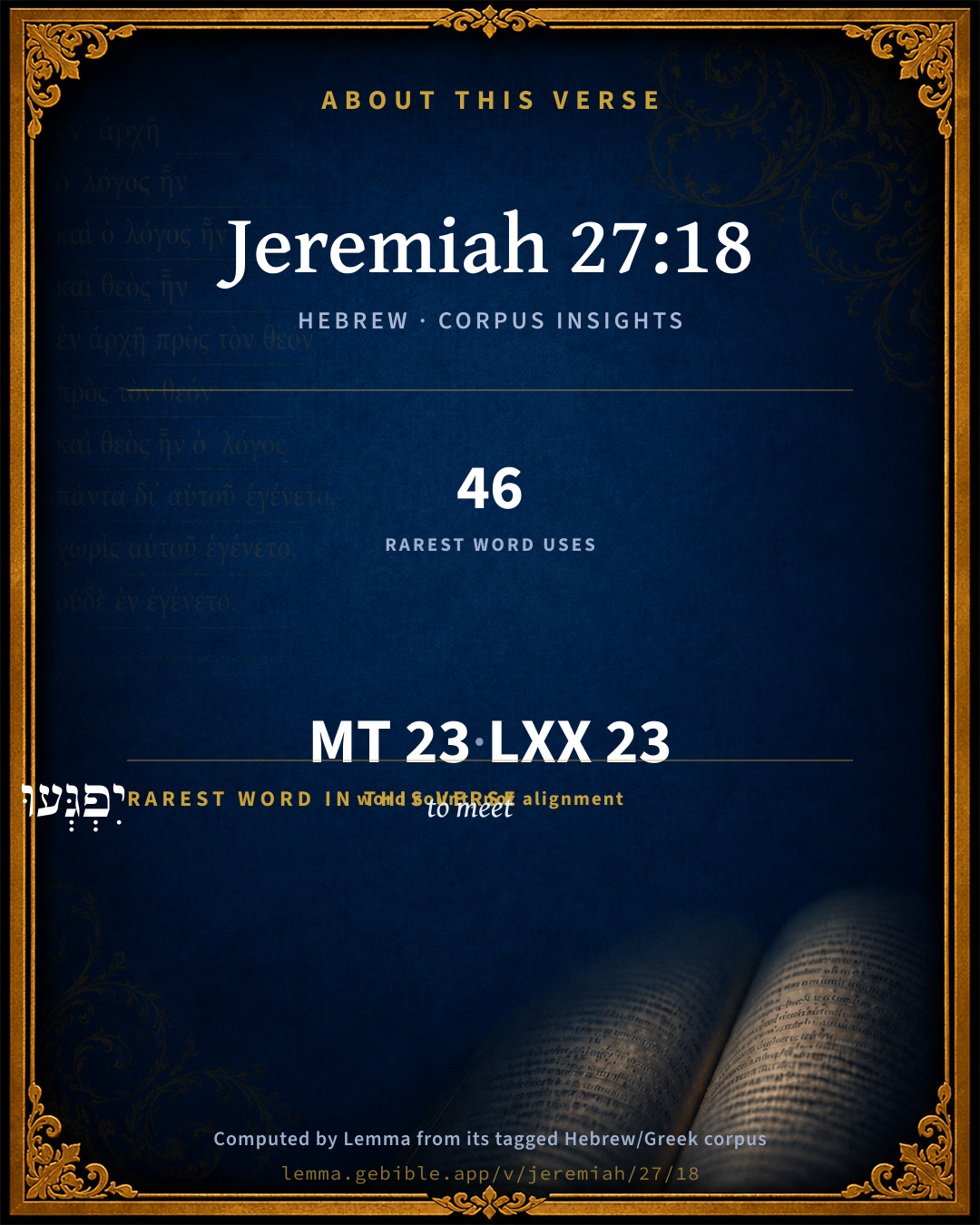
Jeremiah 27:18

Hebrew (Westminster Leningrad Codex) Jeremiah 27:18 appears in the Hebrew Old Testament. The text above is from the Westminster Leningrad Codex. Each word links to its Strong’s number, a concise gloss, and parsing drawn from the Open Scriptures Hebrew Bible morphology. Click any word for its full Brown-Driver-Briggs (BDB) entry.
Download image
Cite this verse

Jeremiah 27:18 (World English Bible). Public Domain. Lemma interlinear Bible study tool, https://lemma.gebible.app/v/jeremiah/27/18.

Show BibTeX & RIS
BibTeX
RIS
English Translation
But if they be prophets, and if the word of Yahweh be with them, let them now make intercession to Yahweh of Hosts, that the vessels which are left in the house of Yahweh, and in the house of the king of Judah, and at Jerusalem, don't go to Babylon.
World English Bible · Public Domain
Download a study sheet

One document with this verse’s original text, its word-by-word gloss line, the meaning frame, cross-references with their text, attributed commentary, and full source and license credits — printable, and it pastes into notes with its structure intact.

This verse Autodidact and up

Study sheet (.html) Plain text (.txt)

A passage Seminary Student

Up to 50 verses in one chapter. A passage sheet keeps up to 6 commentary sources and 12 cross-references per verse, in the order this page ranks them, and says so on the sheet whenever that leaves anything out. Ask for a single verse and you get the Autodidact verse sheet above.

Everything on this page stays free to read, with no account — the sheet is a download of what is already on screen, not access to it.

Want to remove ads? Support Godless Engineer
Compare translations 3

The same verse in 3 English versions, stacked beneath the original-language interlinear above. Click any original word for its lexicon entry.

Each is an independent rendering of the whole verse — the interlinear is not word-aligned to these translations.

Highlighted words mark where these versions differ — a whole-verse word diff, not a word-by-word alignment.

  • World English Bible Public Domain
    But if they be prophets, and if the word of Yahweh be with them, let them now make intercession to Yahweh of Hosts, that the vessels which are left in the house of Yahweh, and in the house of the king of Judah, and at Jerusalem, don't go to Babylon.
  • King James Version Public Domain
    But if they be prophets, and if the word of the LORD be with them, let them now make intercession to the LORD of hosts, that the vessels which are left in the house of the LORD, and in the house of the king of Judah, and at Jerusalem, go not to Babylon.
  • unfoldingWord Literal Text CC BY-SA 4.0
    And if they prophets, and if the word of Yahweh is with them, let them please intercede with Yahweh of Armies, that the vessels remaining in the house of Yahweh and the house of the king of Judah and in Jerusalem not go to Babylon.”

unfoldingWord Literal Text — © unfoldingWord, licensed CC BY-SA 4.0. Word-aligned USFM3 via Door43 (git.door43.org/unfoldingWord/en_ult).

Versions to compare (up to 4)

3 of 4 selected

Show all 18 translations

Every available English version of this verse, each an independent rendering of the whole verse.

  • World English Bible Public Domain
    But if they be prophets, and if the word of Yahweh be with them, let them now make intercession to Yahweh of Hosts, that the vessels which are left in the house of Yahweh, and in the house of the king of Judah, and at Jerusalem, don't go to Babylon.
  • Berean Standard Bible Public Domain
    If they are indeed prophets and the word of the LORD is with them, let them now plead with the LORD of Hosts that the articles remaining in the house of the LORD, in the palace of the king of Judah, and in Jerusalem, not be taken to Babylon.
  • Majority Standard Bible Public Domain
    If they are indeed prophets and the word of the LORD is with them, let them now plead with the LORD of Hosts that the articles remaining in the house of the LORD, in the palace of the king of Judah, and in Jerusalem, not be taken to Babylon.
  • King James Version Public Domain
    But if they be prophets, and if the word of the LORD be with them, let them now make intercession to the LORD of hosts, that the vessels which are left in the house of the LORD, and in the house of the king of Judah, and at Jerusalem, go not to Babylon.
  • American Standard Version (1901) Public Domain
    But if they be prophets, and if the word of Jehovah be with them, let them now make intercession to Jehovah of hosts, that the vessels which are left in the house of Jehovah, and in the house of the king of Judah, and at Jerusalem, go not to Babylon.
  • Revised Version (1885) Public Domain
    But if they be prophets, and if the word of the LORD be with them, let them now make intercession to the LORD of hosts, that the vessels which are left in the house of the LORD, and in the house of the king of Judah, and at Jerusalem, go not to Babylon.
  • Geneva Bible (1599) Public Domain
    But if they be Prophets, and if the word of the Lord be with them, let them intreate the Lord of hostes, that the vessels, which are left in the House of the Lord, and in the house of the King of Iudah, and at Ierusalem, go not to Babel.
  • Douay-Rheims (1899) Public Domain
    But if they be prophets, and the word of the Lord be in them: let them interpose themselves before the Lord of hosts, that the vessels which were left in the house of the Lord, and in the house of the king of Juda, and in Jerusalem, may not go to Babylon.
  • Young's Literal Translation Public Domain
    `And, if they be prophets, and if a word of Jehovah be with them, let them intercede, I pray you, with Jehovah of Hosts, so that the vessels that are left in the house of Jehovah, and `in' the house of the king of Judah, and in Jerusalem, have not gone into Babylon.
  • Literal Standard Version CC BY-SA 4.0
    And if they are prophets, and if a word of YHWH is with them, let them now intercede with YHWH of Hosts, so that the vessels that are left in the house of YHWH, and [in] the house of the king of Judah, and in Jerusalem, have not gone into Babylon.
  • Unlocked Literal Bible CC BY-SA 4.0
    If they are prophets, and if the word of Yahweh has truly come to them, let them beg Yahweh of hosts not to send to Babylon the objects that remain in his house, the house of the king of Judah, and Jerusalem.
  • unfoldingWord Literal Text CC BY-SA 4.0
    And if they prophets, and if the word of Yahweh is with them, let them please intercede with Yahweh of Armies, that the vessels remaining in the house of Yahweh and the house of the king of Judah and in Jerusalem not go to Babylon.”
  • Darby Bible Public Domain
    But if they be prophets, and if the word of Jehovah be with them, let them now make intercession to Jehovah of hosts, that the vessels which are left in the house of Jehovah, and in the house of the king of Judah, and at Jerusalem, go not to Babylon.
  • World Messianic Bible Public Domain
    But if they are prophets, and if the LORD’s word is with them, let them now make intercession to the LORD of Hosts, that the vessels which are left in the LORD’s house, in the house of the king of Judah, and at Jerusalem, don’t go to Babylon.
  • Webster's Bible Public Domain
    But if they are prophets, and if the word of the LORD is with them, let them now make intercession to the LORD of hosts, that the vessels which are left in the house of the LORD, and in the house of the king of Judah, and at Jerusalem, go not to Babylon.
  • Free Bible Version CC BY-SA 4.0
    If they are truly prophets and really have the word of the Lord with them, they should be pleading now with the Lord Almighty that what's left in the Lord's Temple, in the palace of the king of Judah, and in Jerusalem, isn't taken to Babylon.
  • Bible in Basic English Public Domain
    But if they are prophets, and if the word of the Lord is with them, let them now make request to the Lord of armies that the vessels which are still in the house of the Lord and in the house of the king of Judah and at Jerusalem, may not go to Babylon.
  • JPS Tanakh (1917) Public Domain
    But if they be prophets, and if the word of the LORD be with them, let them now make intercession to the LORD of hosts, that the vessels which are left in the house of the LORD, and in the house of the king of Judah, and at Jerusalem, go not to Babylon.

Literal Standard Version (2020), Covenant Press — licensed CC BY-SA 4.0. Text via the HelloAO Bible API (eBible.org). Unlocked Literal Bible (unfoldingWord) — licensed CC BY-SA 4.0. Text via the HelloAO Bible API (eBible.org). unfoldingWord Literal Text — © unfoldingWord, licensed CC BY-SA 4.0. Word-aligned USFM3 via Door43 (git.door43.org/unfoldingWord/en_ult). Free Bible Version, Dr. Jonathan Gallagher — licensed CC BY-SA 4.0. Text via the HelloAO Bible API (eBible.org).

Word by word

More ways to search: Search by grammar → Find every occurrence → Compare this word →

Practice this passage: Drill this verse → Learn its vocabulary →

יִפְגְּעוּ
pâgaʻ
H6293
“to meet”
Verb, Qal, Jussive, 3rd Person, Masculine, Plural
Part of Speech
Verb
Stem
Qal
Form
Jussive
Person
3rd Person
Gender
Masculine
Number
Plural
Full BDB Definition

Origin: a primitive root

TWOT: 1731

to encounter, meet, reach, entreat, make intercession - (Qal) - to meet, light upon, join - to meet (of kindness) - to encounter, fall upon (of hostility) - to encounter, entreat (of request) - to strike, touch (of boundary) - (Hiphil) - to cause to light upon - to cause to entreat - to make entreaty, interpose - to make attack - to reach the mark
  1. וְאִם ʼim H518 “and · if” Conjunction + Conjunction
  2. נְבִאִ֣ים nâbîyʼ H5030 “prophets” Noun, Common, Masculine, Plural, Absolute
  3. הֵ֔ם hêm H1992 “they” Pronoun, Personal, 3rd Person, Masculine, Plural
  4. וְאִם ʼim H518 “and · if” Conjunction + Conjunction
  5. יֵ֥שׁ yêsh H3426 “there is” Particle, Demonstrative
  6. דְּבַר dâbâr H1697 “word of” Noun, Common, Masculine, Singular, Construct
  7. יְהוָ֖ה Yᵉhôvâh H3068 “LORD” Noun, Proper
  8. אִתָּ֑ם ʼêth H854 “with · them” Preposition + Suffix, Personal, 3rd Person, Masculine, Plural
  9. נָא֙ nâʼ H4994 “please” Particle, Exhortation
  10. בַּֽיהוָ֣ה Yᵉhôvâh H3068 “in/at · LORD” Preposition + Noun, Proper
  11. צְבָא֔וֹת tsâbâʼ H6635 “armies” Noun, Common, Both, Plural, Absolute
  12. לְבִלְתִּי biltîy H1115 “to/for · except” Preposition + Conjunction
  13. בֹ֜אוּ bôwʼ H935 “enter” Verb, Qal, Imperative, 2nd Person, Masculine, Plural
  14. הַכֵּלִ֣ים kᵉlîy H3627 “the · vessels” Particle, Definite Article + Noun, Common, Masculine, Plural, Absolute
  15. הַנּוֹתָרִ֣ים yâthar H3498 “the · remaining” Particle, Definite Article + Verb, Niphal, Participle Active, Masculine, Plural, Absolute
  16. בְּבֵית bayith H1004 “in/at · house of” Preposition + Noun, Common, Masculine, Singular, Construct
  17. יְהוָ֗ה Yᵉhôvâh H3068 “LORD” Noun, Proper
  18. וּבֵ֨ית bayith H1004 “and · house of” Conjunction + Noun, Common, Masculine, Singular, Construct
  19. מֶ֧לֶךְ melek H4428 “king of” Noun, Common, Masculine, Singular, Construct
  20. יְהוּדָ֛ה Yᵉhûwdâh H3063 “Judah” Noun, Proper
  21. וּבִירוּשָׁלִַ֖ם Yᵉrûwshâlaim H3389 “and · in/at · Jerusalem” Conjunction + Preposition + Noun, Proper
  22. בָּבֶֽלָה Bâbel H894 “Babylon · toward” Noun, Proper + Suffix, Demonstrative

About this verse

These counts appear in no published source. They are computed here, from the morphology-tagged text and Lemma’s own curated glosses. What Lemma adds →

23
words
19
distinct lemmas
Prophets
section

Shared distinctive vocabulary

יִפְגְּעוּ to meet H6293 occurs in 43 verses of the Hebrew Bible. Also found in:

Grammatical profile

  • 3 verbs
  • 13 nouns
  • 1 pronoun
  • 1 preposition
  • 3 conjunctions
  • 2 particles

Verb forms

  • יִפְגְּעוּ Qal · Jussive
  • בֹ֜אוּ Qal · Imperative
  • הַנּוֹתָרִ֣ים Niphal · Participle Active

Repetition

Words recur within this verse — often emphatic in Hebrew:

  • יְהוָ֖ה LORD H3068 ×3
  • בְּבֵית house H1004 ×2
  • וְאִם if H518 ×2

Hebrew & Septuagint length

In the original languages it is 23 Hebrew tokens and 23 Greek tokens — but the two are counted differently (Hebrew bundles its prefixes and suffixes into one token; the Greek is in lemma form), so that isn’t a like-for-like length.

Cross-references

18

Topical passages linked to Jeremiah 27:18 in the Treasury of Scripture Knowledge — connected by theme and wording, ordered by reader-vote popularity; previews shown in the World English Bible.

  • 1 Samuel 7:8 The children of Israel said to Samuel, "Don't cease to cry to Yahweh our God for us, that he will save us out of the hand of the Philistines."
  • 1 Samuel 12:19 All the people said to Samuel, Pray for your servants to Yahweh your God, that we not die; for we have added to all our sins [this] evil, to ask us a king.
  • 1 Samuel 12:23 Moreover as for me, far be it from me that I should sin against Yahweh in ceasing to pray for you: but I will instruct you in the good and the right way.
  • 1 Kings 18:24 You call on the name of your god, and I will call on the name of Yahweh; and the God who answers by fire, let him be God." All the people answered, "It is well said."
  • Jeremiah 18:20 Shall evil be recompensed for good? for they have dug a pit for my soul. Remember how I stood before you to speak good for them, to turn away your wrath from them.
  • Genesis 18:24–33 What if there are fifty righteous within the city? Will you consume and not spare the place for the fifty righteous who are therein?
  • Genesis 20:17 Abraham prayed to God. God healed Abimelech, and his wife, and his maid-servants, and they bore children.
  • 1 Kings 18:26 They took the bull which was given them, and they dressed it, and called on the name of Baal from morning even until noon, saying, Baal, hear us. But there was no voice, nor any who answered. They leaped about the altar which was made.
  • 2 Chronicles 32:20 Hezekiah the king, and Isaiah the prophet the son of Amoz, prayed because of this, and cried to heaven.
  • Job 42:8–9 Now therefore, take to yourselves seven bulls and seven rams, and go to my servant Job, and offer up for yourselves a burnt offering; and my servant Job shall pray for you, for I will accept him, that I not deal with you according to your folly. For you have not spoken of me the thing that is right, as my servant Job has."
  • Jeremiah 7:16 Therefore don't you pray for this people, neither lift up a cry nor prayer for them, neither make intercession to me; for I will not hear you.
  • Jeremiah 15:1 Then said Yahweh to me, Though Moses and Samuel stood before me, yet my mind would not be toward this people: cast them out of my sight, and let them go forth.
  • Jeremiah 42:2 and said to Jeremiah the prophet, Let, we pray you, our supplication be presented before you, and pray for us to Yahweh your God, even for all this remnant; for we are left but a few of many, as your eyes do see us:
  • Ezekiel 14:14 though these three men, Noah, Daniel, and Job, were in it, they should deliver but their own souls by their righteousness, says the Lord Yahweh.
  • Ezekiel 14:18–20 though these three men were in it, as I live, says the Lord Yahweh, they should deliver neither sons nor daughters, but they only should be delivered themselves.
  • Ezekiel 22:30 I sought for a man among them, who should build up the wall, and stand in the gap before me for the land, that I should not destroy it; but I found none.
  • Malachi 1:9 "Now, please entreat the favor of God, that he may be gracious to us. With this, will he accept any of you?" says Yahweh of Hosts.
  • James 5:16–18 Confess your offenses to one another, and pray one for another, that you may be healed. The effective, earnest prayer of a righteous man is powerfully effective.

Cross-references courtesy of OpenBible.info (CC BY 4.0).

Hebrew and Greek witnesses Masoretic Hebrew ↔ Greek Septuagint

The same verse in the two great witnesses to the Old Testament, shown verse-for-verse.

These are two independent witnesses, not word-aligned to each other, and the Septuagint is shown in lemma (dictionary) form.

Hebrew Jeremiah 27:18 Masoretic · Westminster Leningrad Codex

וְאִם נְבִאִ֣ים הֵ֔ם וְאִם יֵ֥שׁ דְּבַר יְהוָ֖ה אִתָּ֑ם יִפְגְּעוּ נָא֙ בַּֽיהוָ֣ה צְבָא֔וֹת לְבִלְתִּי בֹ֜אוּ הַכֵּלִ֣ים הַנּוֹתָרִ֣ים בְּבֵית יְהוָ֗ה וּבֵ֨ית מֶ֧לֶךְ יְהוּדָ֛ה וּבִירוּשָׁלִַ֖ם בָּבֶֽלָה

But if they be prophets, and if the word of Yahweh be with them, let them now make intercession to Yahweh of Hosts, that the vessels which are left in the house of Yahweh, and in the house of the king of Judah, and at Jerusalem, don't go to Babylon.

World English Bible · Public Domain

Greek LXX Structure differs

In the Septuagint, Jeremiah is about an eighth shorter than the Hebrew and arranges its material differently — the Oracles Against the Nations (Hebrew chapters 46–51) appear in the middle of the Greek book, after 25:13. Because the chapter and verse boundaries do not line up, a verse-for-verse comparison with the Hebrew is not shown.

A verse-for-verse comparison isn’t shown here because the chapters and verses don’t line up. Switch to the LXX edition with the MT / LXX toggle above to read the Greek directly.

On this verse, The Cambridge Bible for Schools and Colleges discusses the Septuagint’s reading. Read the note in Commentary ↓

Hebrew: Westminster Leningrad Codex (CC BY 4.0). Greek: Septuagint (public domain); English from a public-domain English Septuagint. How the Septuagint differs from the Hebrew →

Targum (Aramaic paraphrase)

1

The Targum is the ancient Jewish Aramaic paraphrase of the Hebrew Scriptures — an interpretive translation, not the Hebrew text itself. Onkelos (literal) and Pseudo-Jonathan (expansive) render the Torah, and Jonathan the Prophets. Coverage is partial: where no permissively-licensed English translation exists for a verse, only the Aramaic is shown. This is verse-level text, not a word-by-word alignment to the Hebrew.

  1. Targum Jonathan Prophets (Joshua–Malachi)
    וְאִם מִתְנַבָּן אִינוּן וְאִם אִית פִּתְגְמָא דַייָ עִמְהוֹן יִבְעוֹן כְּעַן בְּמֵימְרָא דַייָ צְבָאוֹת בְּדִיל דְלָא יִתּוֹבְלוּן מָנַיָא דְאִשְׁתְּאָרוּ בְּבֵית מַקְדְשָׁא דַייָ וּבֵית מְלַךְ שִׁבְטָא דְבֵית יְהוּדָה וּבִירוּשְׁלֵם לְבָבֶל:

    (no public-domain English translation for this verse)

    Targum Jonathan — Aramaic: “Mikraot Gedolot” (public domain). English: “Sefaria Community Translation” (CC0 1.0 (public-domain dedication)); “London "Chaldee Paraphrase," 1871” (public domain). Text via Sefaria.

Commentary

Notes on Jeremiah 27:18 from classic Christian and Jewish commentators (each source and its license shown beneath its notes). The classic Christian expositions comment on the surrounding passage and are grouped to its opening verse, so a note may address several verses; the Jewish commentaries on the Tanakh (Rashi and others) are per-verse, so they appear only where the commentator wrote on this verse.

Lemma curates 59 commentaries, every one of them public domain or Creative Commons licensed, each selected and text-cleaned for this edition rather than reprinted as found. About our sources →

Trapp's Complete Commentary

John Trapp

Jer 27:18 But if they [be] prophets, and if the word of the LORD be with them, let them now make intercession to the LORD of hosts, that the vessels which are left in the house of the LORD, and [in] the house of the king of Judah, and at Jerusalem, go not to Babylon.

Ver. 18. Let them make intercession to the Lord of hosts.] Let them pray in the Holy Ghost, by whom they pretend to be inspired. Let us see what answer. So Elias called upon the Baalites to call aloud unto their god; and forasmuch as he heard them not, the people were satisfied that they were false prophets. God will fulfil what he hath foretold; but then he looketh that his servants should make intercession. Elias had foretold Ahab that there should be store of rain after a long drought; but then he went up into Mount Carmel to pray for that rain. I came for thy prayer, said the angel to Daniel. God’s prophets are his favourites, and may have anything of him.

John Trapp, A Commentary or Exposition upon All the Books of the Old and New Testament (1647–1656) — public domain. Text from a community e-Sword module.

Tyndale Open Study Notes

Tyndale Open Resources

27:18-19 Even the false prophets were called upon to repent and pray to the Lord.

Tyndale Open Study Notes — © Tyndale Open Resources, licensed CC BY-SA 4.0. Text via the HelloAO Bible API.

Geneva Bible (1599)

Geneva Bible translators

For it was not only the Prophet’s office to show the word of God, but also to pray for the sins of the people, Gen. 20:7, which these could not do because they had no express word: for God had pronounced the contrary.

Geneva Bible (1599) marginal notes — public domain. Text via Bolls.life.

Jamieson, Fausset & Brown

Robert Jamieson, A. R. Fausset & David Brown

at Jerusalem--that is, in other houses containing such vessels, besides the house of God and the king's palace. Nebuzara-dan, captain of the guard under Nebuchadnezzar, carried all away (Kg2 25:13-17; Ch2 36:18). The more costly vessels had been previously removed in the reigns of Jehoiakim and Jeconiah.

Jamieson, Fausset & Brown — Commentary Critical and Explanatory on the Whole Bible (1871) — public domain (CC PDM 1.0). Text via the HelloAO Bible API.

John Calvin's Commentaries

Here the Prophet laughs to scorn the foolish confidence with which the false prophets were swollen, when they promised all happiness in time to come. He hence says, that they were not to be believed as to the prosperity of which they prophesied, but that on the contrary they ought to have dreaded a most grievous punishment.

He then says, If they are prophets, let them intercede with Jehovah, that what still remains may not be taken away from Jerusalem. They promised the return of the vessels, which had been already carried away to Babylon; and yet what still remained in the Temple and in the palace of the king and in the whole city, was to be removed to Babylon. We now perceive the Prophet’s design; he compares the future with the past, and shews that these impostors foolishly promised some better state of things, even when God’s heavy judgment was impending over them; for the city and the Temple were doomed to entire ruin. The verb פגע, pego, means to meet, to go to meet, and is taken metaphorically in the sense of interceding; for he who meets one as an intercessor, in a manner restrains the opponent; and the Scripture uses this word, when it speaks of the saints as supplicating God; the proper word is interceding.

From this passage we learn that these two things are united — teaching and praying. Then God would have him whom he has set a teacher in his Church, to be assiduous in prayer. And so the Apostles said, when they spoke of appointing deacons, that they could not attend to tables; for they said that they were sufficiently engaged in teaching, and they mentioned also prayers. (Acts 6:2-4.) The same also we learn from this place, where Jeremiah ascribes the office of interceding to God’s true and faithful servants who conscientiously discharged the office of teaching; If they be prophets, he says, let them intercede with Jehovah, that the remaining vessels be not taken away. Let us at the same time notice the definition he gives; for by this he also shews who are to be counted true prophets, even those who have the word of God, as we have found elsewhere,

“The Prophet who has a dream, and who has my true word, let him speak my word.” (Jeremiah 23:28)

We said by these words of the Prophet it may be determined who they are who deserve to be called prophets, even those who have the word of God. Jeremiah confirms the same here when he says, If they are prophets, and if the word of Jehovah is with them These two clauses ought to be read together, for the latter is exegetic, or explanatory of the former. But I cannot now finish the whole, I must therefore defer the rest till to-morrow.

John Calvin's Commentaries (1540-1563) — public domain. Text from the Calvin Translation Society English edition (1840s-50s) via the Christian Classics Ethereal Library (ccel.org). Calvin's coverage is partial (roughly two-thirds of the Bible); uncommented books and verses are honest gaps, never fabricated. The 19th-century editor's footnotes and remarks are omitted so the notes are faithfully Calvin's own voice.

Ellicott's Commentary for English Readers

(18) But if they be prophets . . .—The rivals of Jeremiah had, as has been said, staked their credit upon the return of the vessels that had already been taken. He stakes his On the prediction that what had been spared in the first invasion should be taken on the second. They had better use their gift of the Spirit, if they had any, in interceding for their preservation.

A Bible Commentary for English Readers, edited by Charles John Ellicott (1878–1897) — public domain. Text from a community e-Sword module.

The Cambridge Bible for Schools and Colleges

gen. ed. J. J. S. Perowne

18. that the vessels … Babylon] omitted in LXX, and thus omitting any actual mention of a subject for their prayer. This harshness would naturally lead to such an addition as that in MT. For the idea of prophets as intercessors cp. Gen_20:7.

19–22 are much briefer in LXX, viz.: “For thus saith the Lord, And of the rest of the vessels, which the king of Babylon took not, when he carried away Jechonias from Jerusalem, they shall go to Babylon, saith the Lord.”

The Cambridge Bible for Schools and Colleges (gen. ed. J. J. S. Perowne; Cambridge University Press, 1878–1918) — public domain. Text from a community e-Sword module.

John Gill's Exposition

But if they be prophets, and if the word of the Lord be with them,.... The true prophets of the Lord are sent by him, and have his word put into them:

let them now make intercession to the Lord of hosts: use their interest with him, as they must have one, if they are true prophets; let them pray unto him, who doubtless will hear them; and this will be acting in character, for prophets ought to be praying persons; and this will turn to some good account:

that the vessels which are left in the house of the Lord, and in the house of the king of Judah, and at Jerusalem, go not to Babylon; instead of prophesying about the return of what are gone, let them pray for the preservation and continuance of what are left, that they do not go also; of which there was great danger, yea, certainty, in case of non-submission to, and rebellion against, the king of Babylon; there were some vessels of the sanctuary which yet remained, as well as others in the king's palace, and in the houses of the noble and rich men in Jerusalem; for the keeping of which they would do well to show a proper concern, and make use of proper means; and nothing more effectual than prayer to God; and, next to that, submission to the Chaldean yoke.

John Gill's Exposition of the Whole Bible (1746–1763) — public domain (CC PDM 1.0). Text via the HelloAO Bible API.

Haydock's Catholic Bible Commentary

Hosts. If they prevail, account me a false prophet. (Calmet) --- The things taken shall not be soon restored; but more shall be conveyed away. (Worthington)

George Leo Haydock (1774–1849), Haydock's Catholic Family Bible and Commentary, 1859 edition — public domain. Excludes Psalms (Douay-Rheims chapter numbering differs from Protestant) and Deuterocanonical books (Catholic canon only).

Matthew Poole's English Annotations

If they be true prophets, End have any communion with God, instead of foretelling the bringing back of the vessels carried away, let them apply themselves to hinder the carrying away of what vessels yet remain, and that either in the house of the Lord, or the king’s house, or in Jerusalem; which is to be done no other way than by pleading with God to turn away his wrath, and not to bring those sore judgments which he is most certainly bringing upon you.

Matthew Poole's English Annotations on the Holy Bible (1683–1685) — public domain. Text from a community e-Sword/MySword module.

Whedon's Commentary on the Bible

Daniel D. Whedon

18. Vessels… left — Only the more costly vessels, and those most readily accessible, were at first removed. Those remaining were not only in the temple, but sacred utensils were probably kept in other places also.

Daniel D. Whedon (gen. ed.), Commentary on the Old and New Testaments (1874–1909) — public domain. Text from a community e-Sword module.

The Pulpit Commentary

But if they be prophets, etc. The "false prophets," so Jeremiah declares, have neglected one of the principal functions of a prophet, viz. intercessory prayer. (comp. on Jer_7:16) Seeing that a part of the sacred vessels had been carried to Babylon, ell true prophets ought to intercede with Jehovah that those still left might be spared. The end was that the remaining vessels were carried off on the capture of Jerusalem. (2Ki_25:13)

Prophets tested by prayer.

I BY THIS THEIR DISPOSITION WAS DISCOVERED. Prayer is one of the most vital indications of the presence of spiritual life. It is only by constant devotion and spiritual intercourse with God that any one can be truly acquainted with him or know his will. The taunt of the prophet is to the effect that they are not over addicted to this practice, but prefer to indulge in political trifling and bombast. They had no pleasure in the exercises of true piety; and it might be were even afraid directly to invoke Jehovah. It was the neglect of the latter by themselves and their idolatrous followers which had entailed the present evils upon Judah. The prophet points out, therefore, the true method of discovering the will of God, and of restoring, not only the vessels to the temple, but the exiles to their land.

II THEIR PRETENSIONS WOULD BE TESTED BY THE EFFICACY OF THEIR INTERCESSION. This is the most disinterested form of prayer. By betaking themselves to it, instead of prophesying lies, they would do real service to the nation. Because he who can effectually intercede:

1. Is a source of blessing to all who are about him. He has true sympathy and insight, and can bring down forgiveness even upon the undeserving. The grandest promises of Holy Scripture are encouragements to this practice.

2. Is thereby acknowledged and accepted by God. As Elijah provoked with a similar challenge the prophets of Baal, so Jeremiah taunts his enemies with their spiritual impotency. The restoration of the vessels under the circumstances would be nothing short of a miracle, and supernatural aid would be required. He alone is truly great who can prevail with God. And the greatest of the prophets is he who makes intercession for mankind according to the Divine will. M.

The Pulpit Commentary (1880–1919), ed. H.D.M. Spence-Jones & Joseph S. Exell — public domain. Text from a community e-Sword module.

Lesson kit

Teaching starters — assembled from the data on this page, not authored interpretation. Every prompt links to the verse data it draws on. Edit before teaching.

Jeremiah, in the Prophets, opens this verse with 23 words (19 distinct Hebrew lemmas). Its most distinctive word is pâgaʻ (“to meet”). A historical commentator’s framing appears above. Read the whole chapter for the surrounding context.

Discussion questions

  1. How does “to meet” (pâgaʻ) shape what this verse is saying?
  2. How does Genesis 23:8, which shares the word «to meet», read alongside this verse?
  3. What does the repetition of “LORD” (3× in this one verse) do in this verse?
  4. These translations render this verse differently; the difference is in the English rendering, not the original. What questions does that raise?
  5. «יִפְגְּעוּ» is a Qal Jussive verb. How does that grammatical form shape the action described?
  6. Compare how Trapp's Complete Commentary and Tyndale Open Study Notes read this verse. Where do they agree or differ?

Things to notice

Reading settings

Reading text

Shown beneath each verse's original-language words.

Old Testament
Old Testament edition

Read the OT as the Masoretic Hebrew (MT) or the Greek Septuagint (LXX).

English shown for the Greek Septuagint (in the Hebrew ↔ Greek comparison).

Comparing translations? Open the Compare panel on any verse page to stack up to four side by side.