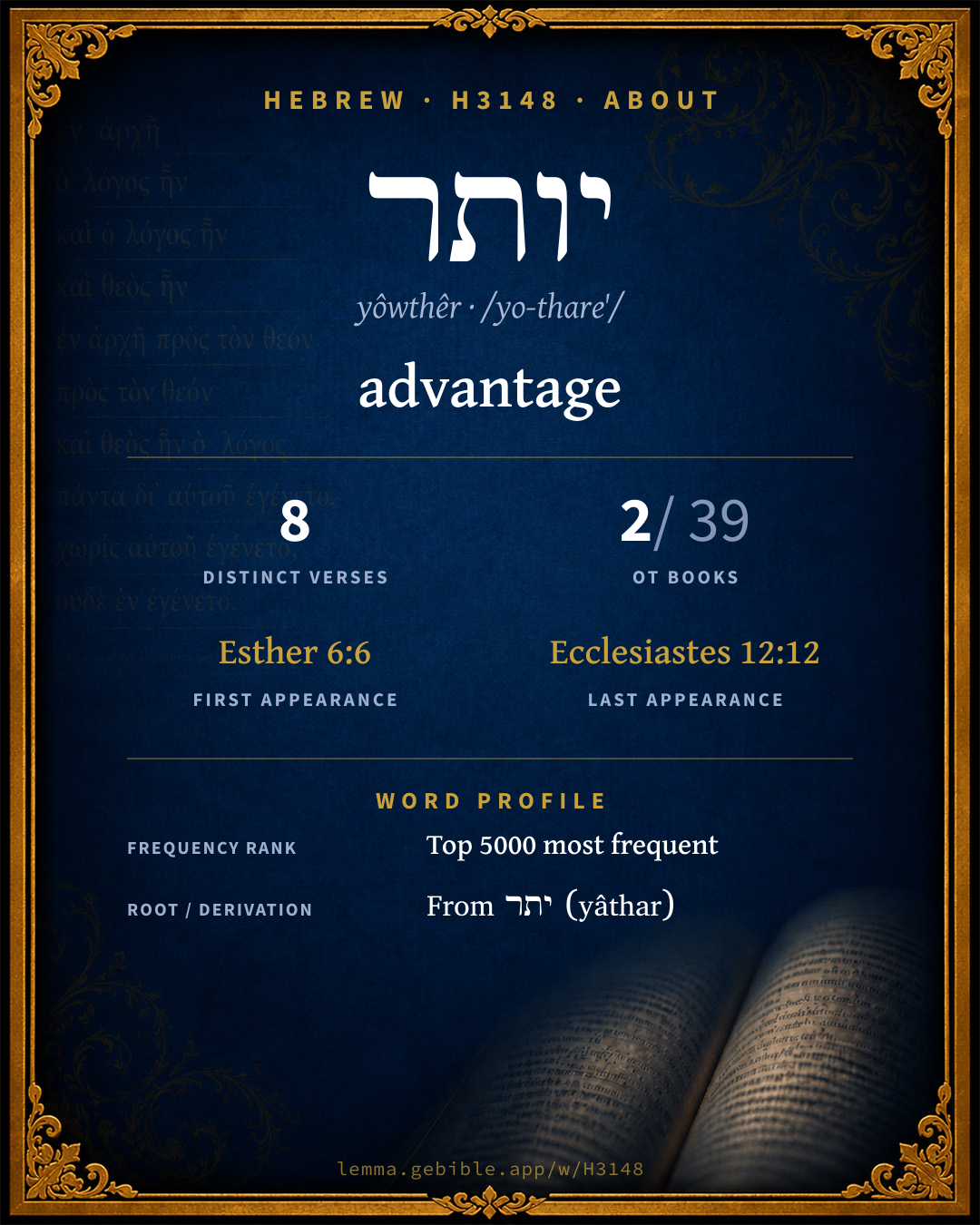
יוֹתֵר
advantage
also: superiority, excess fuller range ↓
Full lexicon entry — Brown-Driver-Briggs (BDB)
From Brown-Driver-Briggs (BDB)
Where this word appears
Grammar key — what these labels mean
Part of speech
- Noun
- A naming word — a person, place, thing, or idea.
Noun type
- Common
- A common noun — a general class of person, place, or thing (“king,” “city,” “water”), not a specific name.
State
- Absolute
- The independent form of a noun, not bound to a following word.
Gender
- Masculine
- Grammatically masculine.
Number
- Singular
- One.
Every verse where H3148 appears — 8 distinct verses across 2 books. Click any verse to open its interlinear word-by-word view. Verse text shown in the World English Bible for context — . Each verse’s Hebrew form is shown with its reference; the English is not keyword-highlighted, since the data carries no word-level English alignment. Use “Compare translations” on any verse to read it across multiple English versions. This concordance covers the Hebrew Bible; Septuagint (Greek Old Testament) occurrences are not indexed here.
Esther 1 verse
Ecclesiastes 7 verses
- Ecclesiastes 2:15 יוֹתֵ֑ר n c ms Then said I in my heart, "As it happens to the fool, so will it happen even to me; and why was I then more wise?" Then said I in my heart that this also is vanity.
- Ecclesiastes 6:8 יּוֹתֵ֥ר n c ms For what advantage has the wise more than the fool? What has the poor man, that knows how to walk before the living?
- Ecclesiastes 6:11 יֹּתֵ֖ר n c ms For there are many words that create vanity. What does that profit man?
- Ecclesiastes 7:11 וְ/יֹתֵ֖ר conj + n c ms Wisdom is as good as an inheritance. Yes, it is more excellent for those who see the sun.
- Ecclesiastes 7:16 יוֹתֵ֑ר n c ms Don't be overly righteous, neither make yourself overly wise. Why should you destroy yourself?
- Ecclesiastes 12:9 וְ/יֹתֵ֕ר conj + n c ms Further, because the Preacher was wise, he still taught the people knowledge. Yes, he pondered, sought out, and set in order many proverbs.
- Ecclesiastes 12:12 וְ/יֹתֵ֥ר conj + n c ms Furthermore, my son, be admonished: of making many books there is no end; and much study is a weariness of the flesh.
About this entry
At a glance — auto-summarized from this page’s data, not written by a person. Every figure links to its source below. This summary describes the numbers; it doesn’t interpret them.
יותר — transliterated yôwthêr — is a Hebrew word carrying the sense “advantage.” Its uses cluster heavily in Ecclesiastes (88% of all occurrences). Spanning 8 verses in 2 books, it ranks among the uncommon words of the Hebrew Bible. Debuting at Esther 6:6, it then recurs through the corpus. The lexical range runs to 3 senses — “advantage” plus “superiority” and “excess”. See the sense tree, 8-verse concordance, and the renderings breakdown below.
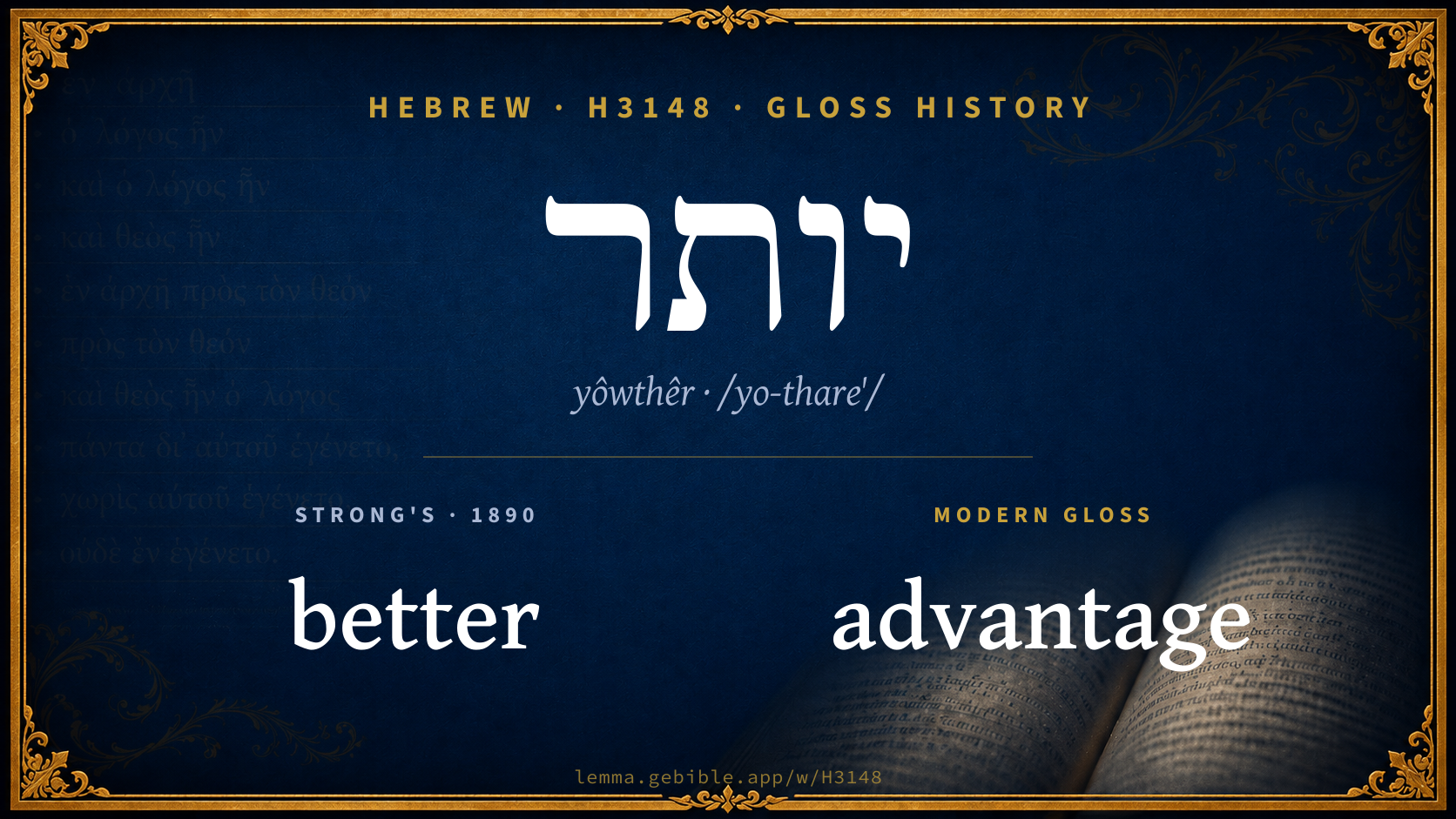
Gloss history
Strong's 1890 vs modern scholarship
About this word
Strong's H3148 catalogs a Hebrew word from the Hebrew Old Testament.
These counts are not copied from any lexicon or concordance. They are computed here, from the morphology-tagged Hebrew Old Testament. What Lemma adds →
- 8
- distinct verses
- The word appears in 8 distinct verses.
- 2 / 39
- OT books
- The word appears in 2 of 39 Old Testament books.
- #2,625
- by frequency
- Top 5000 most frequent Hebrew words (rank 2,625 of 8,640 Hebrew words by occurrence).
View all 8 occurrences in the concordance →
Most concentrated in
- Ecclesiastes 7 verses 88%
- Esther 1 verse 13%
By section of the Old Testament
By traditional corpus
Conventional, traditional groupings — biblical authorship is debated, so this is a traditional corpus grouping, not an authorship claim. Each share is this word’s portion of its verses in that division of the Hebrew canon. Each figure is a share of the word’s 8 distinct verses.
- Writings (Ketuvim) 8 verses · 100%
How translations render this word
Counts come from each version’s own published word-to-Strong’s tagging or interlinear alignment — an approximate guide to how each version renders this word, not a word-level alignment the data otherwise carries. Because each total is that version’s own tagged count, the per-version totals vary from one another and need not match the appearance or distinct-verse counts above. These counts may also differ from a printed concordance because Lemma counts each distinctly tagged rendering and does not collapse phrase taggings into a single head-word total. This is a fixed set of word-tagged versions (KJV, ASV, BSB, ULT) and does not change with the reading translation you choose elsewhere. Each version’s license is shown beside its name below (and on Sources).
- King James Version: More 2×
- American Standard Version: Better 1×, Further 1×, Furthermore 1×
- Berean Standard Bible: Advantage 1×, Be further 1×, Benefits 1×
- unfoldingWord Literal Text: Advantage 3×, More 3×
King James Version Public Domain
Renders H3148 across 8 tagged occurrences — most commonly:
Plus 6 renderings that appear only once — usually multi-word phrases or single function words the recovered tagging swept in, not distinct renderings.
American Standard Version Public Domain
Renders H3148 across 8 tagged occurrences — most commonly:
Berean Standard Bible Public Domain
Renders H3148 across 9 tagged occurrences — most commonly:
unfoldingWord Literal Text CC BY-SA 4.0
Renders H3148 across 9 tagged occurrences — most commonly:
Plus 3 renderings that appear only once — usually multi-word phrases or single function words the recovered tagging swept in, not distinct renderings.
Senses in BDB
The 3 senses BDB distinguishes for this word, in lexicon order (not ranked by frequency or importance). The full entry — with sub-senses — is in the Lexicon Entry tab.
- superiority, advantage, excess (noun masculine)
- excess, better (adverb)
- besides, moreover, more (conjuntion)
Word origin
n.m. superiority, advantage, excess (late) (proposes Qal pt. of יתר)—abs. יוֹתֵר Ec 7:16 + 2 times; יֹתֵר Ec 2:15 + 4 times;—superiority, advantage מַה־יּוֹתֵר לֶחָכָם מִן־הַכְּסִיל Ec 6:8 what advantage hath the wise over the fool? prob. also יֹתֵר מֵהֵמָּה 12:12 (as to) what is more than these (see VB); abs. מַה־יֹּתֵר לָאָדָם 6:11; יֹתֵר לְרֹאֵי הַשָּׁ֑מֶשׁ Ec 7:11; elsewhere adv. to excess, overmuch Ec 2:15; 7:16; sq. מִן (as often in NH), יוֹתֵר מִמֶּנִּי Est 6:6 more than me; יֹתֵר שֶׁ׳ = besides that Ec 12:9.
— Brown-Driver-Briggs (Oxford 1906, public domain), digitized via Sefaria, supplemented by the OpenScriptures HebrewLexicon (CC BY 4.0). See Sources.
Derived from יתר (yâthar) (H3498) — to remain.
Jastrow Dictionary
A second Hebrew/Aramaic lexicon for comparison, covering Aramaic and post-biblical (Talmudic, Targumic, Midrashic) usage that the biblical-Hebrew BDB does not. Matched by lemma rather than by Strong’s number, so a lemma may carry more than one Jastrow headword (shown separately below), and the entries cover usage well beyond the Bible.
יוֹתֵר
- much; (followed by מ־, or מ־ implied) more. Y. Ber. IV, 7ᵈ top בן תורה י׳ ממני a greater scholar than I am. Keth. 86ᵃ, a. e. י׳ ממה שהאיש וכ׳ more than man desires to marry, does woman desire to be married. Pes. 112ᵃ י׳ ממה שהעגל וכ׳ more auxious than the calf is to suck, is the cow to nurse, i.e. the teacher is more anxious to teach than the pupil to learn. M. Kat. 27ᵇ י׳ מדאי more than enough, י׳ מכשיעור more than the proper measure, too much; a. v. fr.—בי׳ a) in a higher degree, especially. Sifré Deut. 31 עלינו הוחל שמו בי׳ upon us especially has His name been made to rest. Lev. R. s. 14 ובי׳ אם היה זכר and especially so when it is a male; a. e.—b) for a higher price, above market value. Ned. III, 11; a. e.—V. יֶתֶר.
יוֹתִר
- Targ. Ruth I, 13. Ib. III, 12 (ed. Lag. יָתֵר).
A Dictionary of the Targumim, the Talmud Babli and Yerushalmi, and the Midrashic Literature (Marcus Jastrow; London, Luzac, 1903) — Public Domain. Digitized via Sefaria. Digitized via Sefaria. Full attribution on Sources.
Forms in the corpus
The 7 distinct written forms H3148 takes in the Hebrew Bible, most frequent first — each parse links to that state’s occurrences in the concordance. Hebrew forms include their vowel points and cantillation, so a single lemma takes many written forms.
| Form | Parsing | Example | Uses |
|---|---|---|---|
| יוֹתֵ֑ר | Noun, Common, Masculine, Singular, Absolute | Ecclesiastes 2:15 | 2 |
| וְ/יֹתֵ֕ר | Noun, Common, Masculine, Singular, Absolute | Ecclesiastes 12:9 | 1 |
| וְ/יֹתֵ֖ר | Noun, Common, Masculine, Singular, Absolute | Ecclesiastes 7:11 | 1 |
| וְ/יֹתֵ֥ר | Noun, Common, Masculine, Singular, Absolute | Ecclesiastes 12:12 | 1 |
| יֹּתֵ֖ר | Noun, Common, Masculine, Singular, Absolute | Ecclesiastes 6:11 | 1 |
| יּוֹתֵ֥ר | Noun, Common, Masculine, Singular, Absolute | Ecclesiastes 6:8 | 1 |
| יוֹתֵ֥ר | Noun, Common, Masculine, Singular, Absolute | Esther 6:6 | 1 |
Same root — word family
Other BDB entries built from the same root as H3148, grouped by Strong’s listed origin. These share a root / origin per the lexicon — not necessarily a shared meaning. Each links to that word’s own entry.
Derives from
Shares the same root
- יתור yâthûwr H3491 to remain
- יתר yether H3499 remainder
- יתרון yithrôwn H3504 profit
- יתרת yôthereth H3508 appendage
- מותר môwthâr H4195 abundance
- מיתר mêythâr H4340 cord
Proper names from this root
People and places named from this root — a name, not an additional meaning of the word.
Compare all same-root words → Showing 4 of 11 — not the complete family. 3 of the same-root words are proper names (people or places). They share a root, not necessarily a meaning.
Septuagint verse parallels
This word appears in 8 verses that also exist in the Greek Old Testament (Septuagint), out of the 8 Hebrew verses it occurs in. You can read those verses in Greek by switching the Old Testament edition to the Septuagint.
Read these verses in the Septuagint
This is a verse-level parallel only — the same verses exist in both the Hebrew and Greek Old Testaments. No word-level Hebrew↔Greek correspondence is claimed: the data carries no such alignment, so no Greek word is shown as this Hebrew word’s translation. Coverage is not total — the Septuagint omits the deuterocanon and renumbers the Psalms, so some Hebrew verses have no direct Greek parallel.