Psalms 79:11

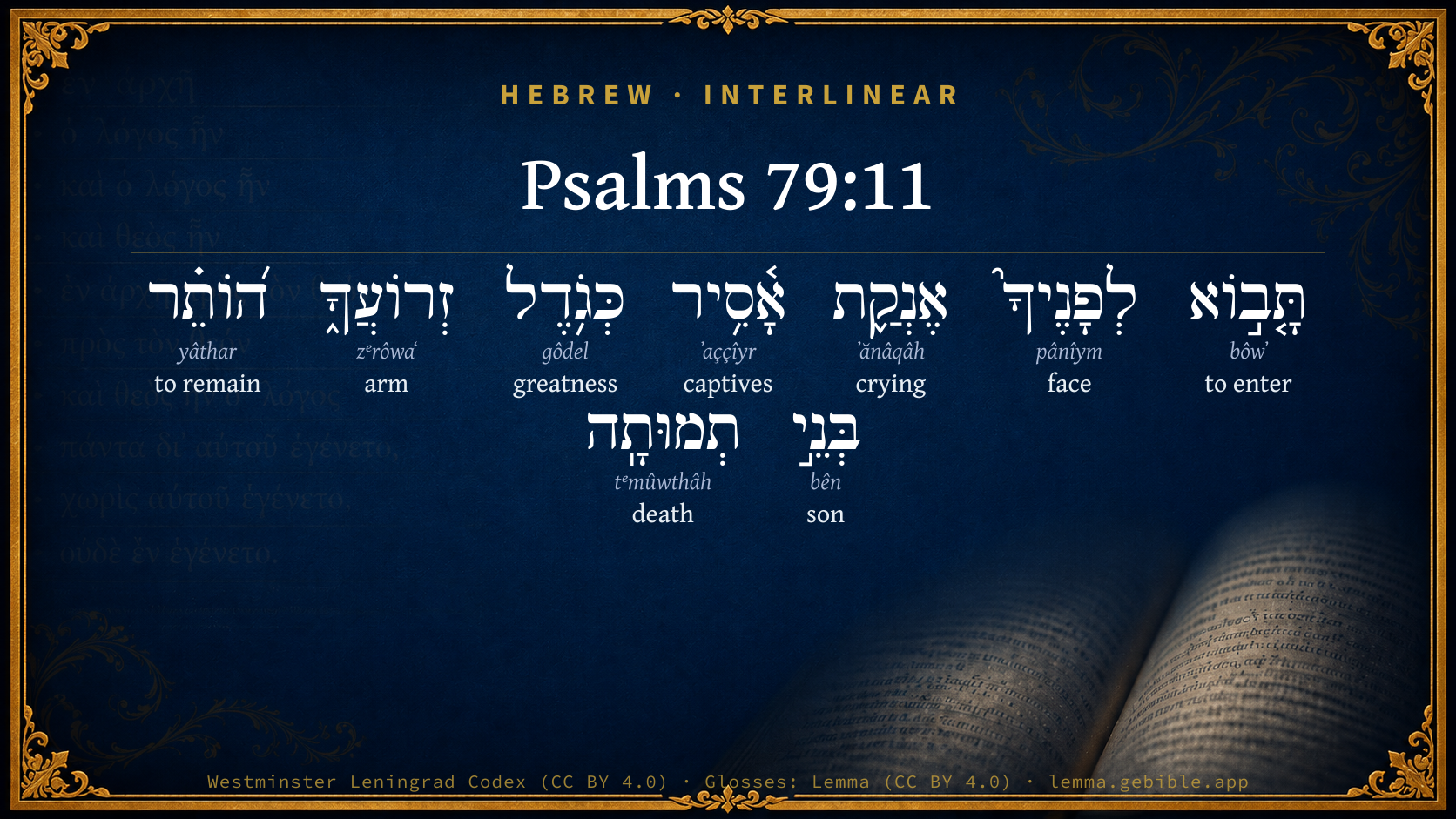
Hebrew (Westminster Leningrad Codex) Psalms 79:11 appears in the Hebrew Old Testament. The text above is from the Westminster Leningrad Codex. Each word links to its Strong’s number, a concise gloss, and parsing drawn from the Open Scriptures Hebrew Bible morphology. Click any word for its full Brown-Driver-Briggs (BDB) entry.
Download image
Cite this verse

Psalms 79:11 (World English Bible). Public Domain. Lemma interlinear Bible study tool, https://lemma.gebible.app/v/psalms/79/11.

Show BibTeX & RIS
BibTeX
RIS
English Translation
Let the sighing of the prisoner come before you. According to the greatness of your power, preserve those who are sentenced to death;
World English Bible · Public Domain
Highlights
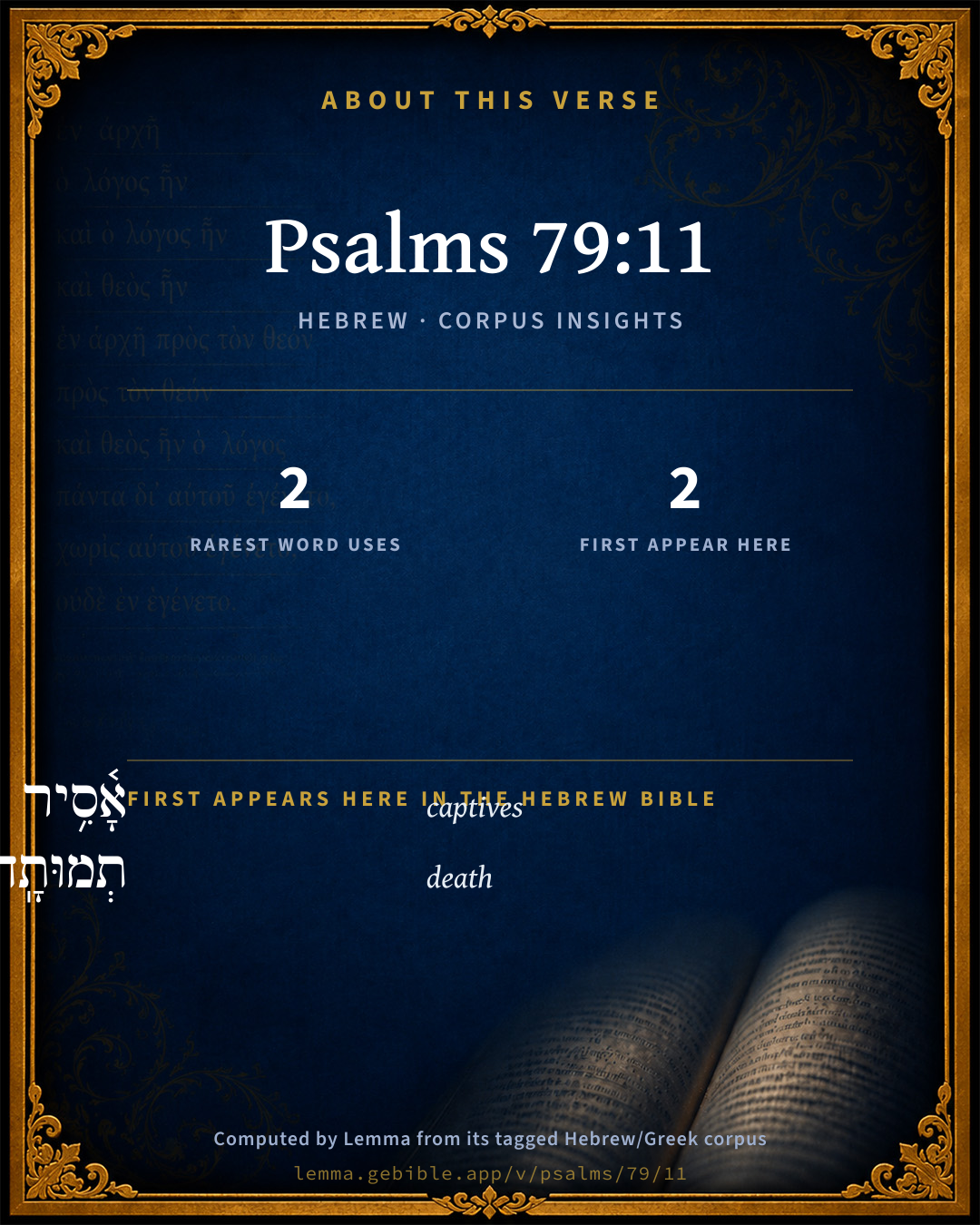
  • 2 first appearances in the Hebrew Bible
Full analysis ↓
Download a study sheet

One document with this verse’s original text, its word-by-word gloss line, the meaning frame, cross-references with their text, attributed commentary, and full source and license credits — printable, and it pastes into notes with its structure intact.

This verse Autodidact and up

Study sheet (.html) Plain text (.txt)

A passage Seminary Student

Up to 50 verses in one chapter. A passage sheet keeps up to 6 commentary sources and 12 cross-references per verse, in the order this page ranks them, and says so on the sheet whenever that leaves anything out. Ask for a single verse and you get the Autodidact verse sheet above.

Everything on this page stays free to read, with no account — the sheet is a download of what is already on screen, not access to it.

Want to remove ads? Support Godless Engineer
Compare translations 3

The same verse in 3 English versions, stacked beneath the original-language interlinear above. Click any original word for its lexicon entry.

Each is an independent rendering of the whole verse — the interlinear is not word-aligned to these translations.

Highlighted words mark where these versions differ — a whole-verse word diff, not a word-by-word alignment.

  • World English Bible Public Domain
    Let the sighing of the prisoner come before you. According to the greatness of your power, preserve those who are sentenced to death;
  • King James Version Public Domain
    Let the sighing of the prisoner come before thee; according to the greatness of thy power preserve thou those that are appointed to die;
  • unfoldingWord Literal Text CC BY-SA 4.0
    Let the groaning of the prisoner come to your face; according to the greatness of your arm, preserve the sons of death.

unfoldingWord Literal Text — © unfoldingWord, licensed CC BY-SA 4.0. Word-aligned USFM3 via Door43 (git.door43.org/unfoldingWord/en_ult).

Versions to compare (up to 4)

3 of 4 selected

Show all 18 translations

Every available English version of this verse, each an independent rendering of the whole verse.

  • World English Bible Public Domain
    Let the sighing of the prisoner come before you. According to the greatness of your power, preserve those who are sentenced to death;
  • Berean Standard Bible Public Domain
    May the groans of the captives reach You; by the strength of Your arm preserve those condemned to death.
  • Majority Standard Bible Public Domain
    May the groans of the captives reach You; by the strength of Your arm preserve those condemned to death.
  • King James Version Public Domain
    Let the sighing of the prisoner come before thee; according to the greatness of thy power preserve thou those that are appointed to die;
  • American Standard Version (1901) Public Domain
    Let the sighing of the prisoner come before thee: According to the greatness of thy power preserve thou those that are appointed to death;
  • Revised Version (1885) Public Domain
    Let the sighing of the prisoner come before thee; according to the greatness of thy power preserve thou those that are appointed to death;
  • Geneva Bible (1599) Public Domain
    Let the sighing of the prisoners come before thee: according to thy mightie arme preserue the children of death,
  • Douay-Rheims (1899) Public Domain
    let the sighing of the prisoners come in before thee. According to the greatness of thy arm, take possession of the children of them that have been put to death.
  • Young's Literal Translation Public Domain
    Let the groaning of the prisoner come in before Thee, According to the greatness of Thine arm, Leave Thou the sons of death.
  • Literal Standard Version CC BY-SA 4.0
    Let the groaning of the prisoner come in before You, || According to the greatness of Your arm, || Leave the sons of death.
  • Unlocked Literal Bible CC BY-SA 4.0
    May the groans of the prisoners come before you; with the greatness of your power keep the children of death alive.
  • unfoldingWord Literal Text CC BY-SA 4.0
    Let the groaning of the prisoner come to your face; according to the greatness of your arm, preserve the sons of death.
  • Darby Bible Public Domain
    Let the groaning of the prisoner come before thee; according to the greatness of thine arm, preserve those that are appointed to die;
  • World Messianic Bible Public Domain
    Let the sighing of the prisoner come before you. According to the greatness of your power, preserve those who are sentenced to death.
  • Webster's Bible Public Domain
    Let the sighing of the prisoner come before thee; according to the greatness of thy power preserve thou those that are appointed to die;
  • Free Bible Version CC BY-SA 4.0
    Listen to the groans of the prisoners; with your great power save those condemned to die.
  • Bible in Basic English Public Domain
    Let the cry of the prisoner come before you; with your strong arm make free the children of death;
  • JPS Tanakh (1917) Public Domain
    Let the groaning of the prisoner come before Thee; according to the greatness of Thy power set free those that are appointed to death;

Literal Standard Version (2020), Covenant Press — licensed CC BY-SA 4.0. Text via the HelloAO Bible API (eBible.org). Unlocked Literal Bible (unfoldingWord) — licensed CC BY-SA 4.0. Text via the HelloAO Bible API (eBible.org). unfoldingWord Literal Text — © unfoldingWord, licensed CC BY-SA 4.0. Word-aligned USFM3 via Door43 (git.door43.org/unfoldingWord/en_ult). Free Bible Version, Dr. Jonathan Gallagher — licensed CC BY-SA 4.0. Text via the HelloAO Bible API (eBible.org).

Word by word

More ways to search: Search by grammar → Find every occurrence → Compare this word →

Practice this passage: Drill this verse → Learn its vocabulary →

About this verse

These counts appear in no published source. They are computed here, from the morphology-tagged text and Lemma’s own curated glosses. What Lemma adds →

9
words
9
distinct lemmas
Wisdom
section

Notable vocabulary

The rarest word here is תְמוּתָֽה death H8546 — appearing just 2 times in the whole Hebrew Bible.

First appearance in Scripture

These words make their first canonical appearance in the Hebrew Bible here:

  • אָ֫סִ֥יר captives H616
  • תְמוּתָֽה death H8546

Shared distinctive vocabulary

תְמוּתָֽה death H8546 occurs in 2 verses of the Hebrew Bible. Also found in:

Grammatical profile

  • 2 verbs
  • 7 nouns

Verb forms

  • תָּ֤ב֣וֹא Qal · Imperfect
  • ה֝וֹתֵ֗ר Hiphil · Imperative

Hebrew & Septuagint length

In English translation the verse runs 23 words from the Hebrew and 24 from the Septuagint (LXX English) — closely comparable.

A rough comparison of the two English renderings, which tokenize alike — not a word-level alignment.

Word counts can differ between the Hebrew and the Greek without any difference in meaning — e.g. the Hebrew direct-object marker אֵת has no separate Greek word, and Greek often adds the article ὁ.

Cross-references

10

Topical passages linked to Psalms 79:11 in the Treasury of Scripture Knowledge — connected by theme and wording, ordered by reader-vote popularity; previews shown in the World English Bible.

  • Psalms 102:20 To hear the groans of the prisoner; To free those who are condemned to death;
  • Psalms 146:6–7 Who made heaven and earth, The sea, and all that is in them; Who keeps truth forever;
  • Isaiah 33:2 Yahweh, be gracious to us; we have waited for you: be our arm every morning, our salvation also in the time of trouble.
  • Isaiah 42:7 to open the blind eyes, to bring out the prisoners from the dungeon, and those who sit in darkness out of the prison-house.
  • Exodus 2:23–24 It happened in the course of those many days, that the king of Egypt died, and the children of Israel sighed because of the bondage, and they cried, and their cry came up to God because of the bondage.
  • Psalms 12:5 "Because of the oppression of the weak and because of the groaning of the needy, I will now arise," says Yahweh; "I will set him in safety from those who malign him."
  • Psalms 69:33 For Yahweh hears the needy, And doesn't despise his captive people.
  • Ephesians 3:20 Now to him who is able to do exceedingly abundantly above all that we ask or think, according to the power that works in us,
  • Numbers 14:17–19 Now please let the power of the Lord be great, according as you have spoken, saying,
  • Matthew 6:13 Bring us not into temptation, but deliver us from the evil one. For yours is the Kingdom, the power, and the glory forever. Amen.'

Cross-references courtesy of OpenBible.info (CC BY 4.0).

Hebrew and Greek witnesses Masoretic Hebrew ↔ Greek Septuagint

The same verse in the two great witnesses to the Old Testament, shown verse-for-verse.

You’re reading Greek Psalm 78 (Hebrew Psalm 79). The Septuagint counts the superscription, so verse numbers can differ from the Hebrew — chapter-level alignment, not verse-by-verse. Numbering follows Rahlfs.

These are two independent witnesses, not word-aligned to each other, and the Septuagint is shown in lemma (dictionary) form.

Hebrew Psalms 79:11 Masoretic · Westminster Leningrad Codex

תָּ֤ב֣וֹא לְפָנֶיךָ֮ אֶנְקַ֪ת אָ֫סִ֥יר כְּגֹ֥דֶל זְרוֹעֲךָ֑ ה֝וֹתֵ֗ר בְּנֵ֣י תְמוּתָֽה

Let the sighing of the prisoner come before you. According to the greatness of your power, preserve those who are sentenced to death;

World English Bible · Public Domain

Greek LXX Greek Psalm 78:11 Septuagint · lemma form

εἰςἔρχομαι ἐνώπιον σύ ὁ στεναγμός ὁ πεδάω κατά ὁ μεγαλωσύνη ὁ βραχίων σύ περιποιέω ὁ υἱός ὁ θανατόω

Let the groaning of the prisoners come in before you; according to the greatness of your arm preserve the sons of the slain ones.

LXX2012 (modern English Septuagint) · Public Domain

Hebrew: Westminster Leningrad Codex (CC BY 4.0). Greek: Septuagint (public domain); English from LXX2012 (modern English Septuagint) (Public Domain). How the Septuagint differs from the Hebrew →

Commentary

Notes on Psalms 79:11 from classic Christian and Jewish commentators (each source and its license shown beneath its notes). The classic Christian expositions comment on the surrounding passage and are grouped to its opening verse, so a note may address several verses; the Jewish commentaries on the Tanakh (Rashi and others) are per-verse, so they appear only where the commentator wrote on this verse.

Lemma curates 59 commentaries, every one of them public domain or Creative Commons licensed, each selected and text-cleaned for this edition rather than reprinted as found. About our sources →

Trapp's Complete Commentary

John Trapp

Psa 79:11 Let the sighing of the prisoner come before thee; according to the greatness of thy power preserve thou those that are appointed to die;

Ver. 11. Let the sighing of the prisoner, &c.] It was lately in many places of this land a like difficult thing to find a wicked man in the enemy’s prisons or a godly man out of them. The sighs of such were shrill in God’s ears.

Preserve thou those that are appointed to die] Heb. The children of death, those that being destined to destruction, seem to be as much in death’s power as children are in their parents’. The Arabic rendereth it, Redime filios occisorum, Redeem the children of those who are slain, lest the name of their parents be blotted out.

John Trapp, A Commentary or Exposition upon All the Books of the Old and New Testament (1647–1656) — public domain. Text from a community e-Sword module.

The Biblical Illustrator

Joseph S. Exell

Psa_79:11

Let the sighing of the prisoner come before Thee.

The prisoners sigh

How difficult is it in earthly courts for the poor and sick to get access to the monarchs earl There is a fearful contrast between the king thus surrounded with magnificence and pomp, and the prisoner alone in his sad dungeon, the prey of hunger, of nakedness, and cold--the music of the monarchs court, the silence of the captives cell, the monarchs prospects of power and glory for to-morrow, and the prisoners that the morrow will be even as wretched as to-day. But what we cannot contemplate in things temporal is oftentimes plainly shown in things spiritual. The court of the Most High is unlike all others, for there the poor, the wretched, and the sad have entrance when they will.

I. The prisoner.

1. There is the prisoner under forced bondage to sin, who is held in degrading thraldom against his will, perhaps by some peculiar effort of the devil, perhaps by some evil habit which he has allowed to become ascendant in his heart. Be encouraged, we say to such an one, with all your sins you are not shut out from life and hope, your state is dangerous but it is not desperate, provided that you make Gods throne the destination of these sighs.

2. The prisoner under the bondage of conviction. Whilst you are sighing in your captivity, our message is to sustain you, not to do away with your convictions, or bid you cease to sigh, but to make your convictions lead you to the Cross, and to tell you that your sighs are surely heard.

3. The prisoner in the dungeon of despair. We approach such an one and say, How earnest thou in hither? Who has denied the entrance of hope into thy cell, and fast bound thy soul in iron? Why shouldest thou at one time rage, and at another time be sullen? Hast thou ever petitioned for thy relief? We tell this man of Christ, and of the free love of God, and of mercy shown to such sinners as David and myriads more, and exalting the power of the Cross; we show how Jesus is able to save even to the very uttermost all that, come unto God by Him; but what the immediate effect of this might be none can tell. At the sound of this Gospels trump, the walls of some mens dungeons will immediately fall fiat, as Jerichos fell prostrate at the sounding of the priests. Then the captive of despair, seeing that there is salvation in Christ, will be set free by the Son, and so be free indeed.

II. The prisoners application for relief.

1. A sigh is an unexpected declaration. Although we do not speak, still we can tell a long tale of sorrow with a sigh.

2. An unexpressed with for deliverance. A sigh indicates a condition of the mind: it tells us that there is sorrow there. Do you indeed feel this? If you do, is it possible that you can thus express your sadness without Gods being well acquainted with it all? Surely not; and if God knows this, is His heart hardened that He will not feel; is His hand shortened that it cannot save?

III. The source from which this prisoner looked for help. According to the greatness of Thy power. This preservation shall be vouchsafed to every one of you who sigh for it to God. He Will deliver you from the place where you are confined with a sentence of death upon you, and will altogether reverse the sentence itself. It were of no use to escape from the prison-house with our sentence still impending over us; we might be apprehended again, and lose our life at last. Deliverance, however, and remission, shall both be yours; and the greatness of the power you have invoked shall be seen in each. And who will come forth, and bring you from your captivity, but Jesus Christ Himself? (P. B. Power, M. A.)

The condemned prisoner

I. Our sad and gloomy condition as fallen creatures. There are many sorts of prisoners; some are so from debt, some by being taken captive in battle, some for criminal offences. The sinner is all these. He is, as the word may be rendered, a son of death; a criminal, respited, but not pardoned. He is as one waiting for execution. His doom is delayed, but not averted.

II. What are the obstacles to deliverance? In the King who can reprieve he sees the adversary whom he has wronged, and the Judge who has appointed him to die. Omnipotent power, injured dignity, and immutable justice are leagued against him. What can the prisoner do?

III. That there is a way of escape. In the face of every obstacle, deliverance is attainable. In proof of this we may notice--

1. The infinite knowledge of God. Let the sighing of the prisoner come before thee. From whatever depth of guilt and misery you breathe the prayer of a broken and contrite heart, that prayer is heard by a gracious God.

2. The Almighty power on which the plea is founded--According to the greatness of Thy power. This must be exercised. (Anon.)

The Biblical Illustrator, edited by Joseph S. Exell (c. 1880s–1900s) — public domain. Text from a community e-Sword module.

Joseph Benson's Commentary

Psa 79:11-12. Let the sighing of the prisoner — Of thy poor people now in prison, or, at least, in captivity; come before thee — Be taken cognizance of by thee, and be as prevalent with thee as these prayers; according to the greatness of thy power — Hebrew, זרועךְ, zerognacha, of thine arm; with which no creature can contend; preserve thou those that are appointed to die — Hebrew, בני תמותה, benee temutha, the children of death, that is, which were either designed for death, or were in manifest danger of it, as being wholly in the power of their cruel and barbarous enemies. Thus, “next to those who had been slain, the case of such as groaned in captivity, lying bound in chains and fetters, under sentence of death, to be inflicted at the will of their cruel and insulting conquerors, is recommended to God.” And render unto our neighbours sevenfold — That is, either, 1st, Abundantly, as this phrase signifies, Isa 65:6-7; Jer 32:18; Luk 6:38. Or, 2d, Sensibly, so that it may come home to them, and fall heavily upon them in their own persons. The reproach wherewith they have reproached thee — As impotent, or unfaithful, or unmerciful to thy people. As if he had said, “As they have reproached thee with weakness, so manifest to others their weakness, who are but sinful dust and ashes; as they have endeavoured to make thee contemptible, so let the world have just cause to despise them, who have thus presumptuously offended; according as it is written, Them that honour me, I will honour, and they that despise me shall be lightly esteemed,”

1Sa 2:30. And be assured, reader, however different the appearance of things may now be, this will certainly be found true in every instance at the last day.

Joseph Benson's Commentary on the Old and New Testaments (1811–1818) — public domain. Text from a community e-Sword module.

J. A. Alexander on Psalms

Joseph Addison Alexander

11. (Psa 79:11) Let the sighing of the prisoner come before thee, according to the greatness of thine arm, suffer to survive the sons of death (or of mortality). The nation is here viewed as an individual captive, not without reference to the literal captivity and exile occasioned by the Babylonian conquest, and with evident historical allusion to the bondage of Israel in Egypt, from the account of which (Exodus 23-25) some of the expressions here are borrowed. Come before thee, reach thee, and attract thy notice. Compare the opposite expression in Isa.i. 23. The arm, as usual, is the symbol of exerted strength. See above, on Psa 10:15; Psa 37:17; Psa 44:3. The whole phrase is a Mosaic one. See Exo 15:16, and compare Num 14:19, Deu 3:24. The last verb in the sentence means to leave behind or over, to cause or suffer to remain. See Exo 10:15; Exo 12:10, Isa 1:9. The last noun in Hebrew occurs only here, but is an obvious derivative from (tUm) death, bearing perhaps the same relation to it that mortalitas sustains to mors. According to a well-known oriental idiom, the whole phrase denotes dying men, or those about to die, or more specifically, those condemned or doomed to death.

Joseph Addison Alexander, The Psalms Translated and Explained (1850) — public domain. Text from a community e-Sword module.

Geneva Bible (1599)

Geneva Bible translators

Which were captives among their enemies, and could look for nothing but death.

Who though in respect of God they were justly punished for their sins: yet in consideration of their cause were unjustly murdered.

Geneva Bible (1599) marginal notes — public domain. Text via Bolls.life.

Adam Clarke's Commentary

Verse 11. The sighing of the prisoner] The poor captive Israelites in Babylon, who sigh and cry because of their bondage.

Those that are appointed to die] בני תמותה beney themuthah, "sons of death." Either those who were condemned to death because of their crimes, or condemned to be destroyed by their oppressors. Both these senses apply to the Israelites: they were sons of death, i.e., worthy of death because of their sins against God; they were condemned to death or utter destruction, by their Babylonish enemies.

Adam Clarke's Commentary on the Bible (1810–1826) — public domain. Text from a community e-Sword/MySword module.

John Calvin's Commentaries

11. Let the sighing of the prisoner come before thee. The people of God, I have no doubt, were in captivity when the Holy Spirit endited this prayer; and, therefore, the name of prisoners is applied to them all in general, because they were so shut up within the bounds of Assyria and Chaldea, that had they stirred one foot thence, they would have incurred the penalty of death. They are called the children of death; by which is meant, that they were appointed or condemned to death in respect of their captivity. This sentence, however, may not improperly be restricted to a small number who were shut up in prison under closer restraint. By this expression, it is intimated that those proud spirits who had before vaunted themselves against God, were now broken and effectually humbled. The greatness of God’s arm, that is to say, the greatness of his power, is implored; for without a signal and extraordinary interposition on his part, no hope could be entertained of the restoration of the Church.

John Calvin's Commentaries (1540-1563) — public domain. Text from the Calvin Translation Society English edition (1840s-50s) via the Christian Classics Ethereal Library (ccel.org). Calvin's coverage is partial (roughly two-thirds of the Bible); uncommented books and verses are honest gaps, never fabricated. The 19th-century editor's footnotes and remarks are omitted so the notes are faithfully Calvin's own voice.

Ellicott's Commentary for English Readers

(11) Appointed to die.—See margin. This expression, as well as the “sighing of the prisoners,” occurs, Psa_102:20, of the sufferers in the Captivity.

A Bible Commentary for English Readers, edited by Charles John Ellicott (1878–1897) — public domain. Text from a community e-Sword module.

The Cambridge Bible for Schools and Colleges

gen. ed. J. J. S. Perowne

11. The same phrases recur in Psa_102:20.

thy power] Lit. thine arm, a word which recalls the memories of a glorious past (Exo_15:16; Psa_44:3).

those that are appointed to die] Lit., the sons of death. It is not necessary to understand these expressions literally of prisoners sentenced to execution: more probably they denote the prison and the living death of exile (Isa_42:7; Isa_49:9; Isa_61:1).

The Cambridge Bible for Schools and Colleges (gen. ed. J. J. S. Perowne; Cambridge University Press, 1878–1918) — public domain. Text from a community e-Sword module.

John Gill's Exposition

Let the sighing of the prisoner come before thee,.... Such as were so in a literal or spiritual sense; and the sighs and groans of such are not hid from the Lord; they come up into his ears as did the sighing and groaning of the children of Israel when in Egypt, Exo 2:23,

according to the greatness of thy power, preserve thou those that are appointed to die; not by the Lord, as all men are, but by men; who are under a sentence of condemnation, who are ready to die, being appointed to destruction, Pro 31:6, or are in danger of death, as Jarchi observes; the phrase is used in Talmudic writings; whose lives are exposed to danger, who are killed all the day long, and are accounted as sheep for the slaughter, Psa 44:22, these it is desired the Lord would keep from dying, or cause them to remain in life; or not suffer their lives to be taken away from them, which he was able to do through "the greatness of his power"; though these words according to the accents belong to the preceding clause. The Targum, and so Jarchi, and other Jewish writers, render the words, "loose thou those", &c. mention being made before of prisoners, or of persons bound.

John Gill's Exposition of the Whole Bible (1746–1763) — public domain (CC PDM 1.0). Text via the HelloAO Bible API.

Albert Barnes' Notes on the Bible

Let the sighing of the prisoner come before thee - The sighing of him who is bound. The allusion here is, doubtless, to those among the Hebrews who had been taken captives, and who “sighed” not only on account of the sufferings which they endured in their bondage, but because they had been taken from their country and home. The meaning is, “Hear those sighs, and come for the deliverance of those who are thus held in captivity.”

According to the greatness of thy power - Margin, as in Hebrew, thine arm. The arm is the symbol of power. It is implied here that great power was needful to deliver those who were held in captivity, power such as God only could exert - power which could be wielded only by an Omnipotent Being. It was the power of God only which could rescue them, as it is only by the power of God that sinners can be saved.

Preserve thou those that are appointed to die - Margin, Reserve the children of death. The literal meaning is, “Let remain the sons of death;” that is, Preserve those who are in such circumstances that death is impending, and who may be called the sons of death. This might apply to those who were condemned to death; or, to those who were sick and in danger of death; or to those who were prisoners and captives, and who were, by their sufferings, exposed to death. The prayer is that such might be suffered to remain on the earth; that is, that they might be kept alive.

Albert Barnes' Notes on the Bible (1834–1885) — public domain. Text from a community e-Sword/MySword module.

Matthew Poole's English Annotations

Of the prisoner; of thy poor people now in prison, or, at least, in captivity.

Those that are appointed to die, Heb. the children of death, i.e. which were either designed to death, or in manifest danger of it, as being wholly in the power of their cruel and barbarous enemies.

Matthew Poole's English Annotations on the Holy Bible (1683–1685) — public domain. Text from a community e-Sword/MySword module.

Whedon's Commentary on the Bible

Daniel D. Whedon

11. Let the sighing of the prisoner come before thee—The psalmist had urged the honour and attributes of God, the covenant relation of his people, the equity of the case as between Israel and his enemies, and now carries his appeal directly to the divine pity and compassion: how can he fail here? If we accept the verbs in this and the former verse in the future, as they stand in the original, we have an expression of confidence as well as petition: “He [God] shall be known among the heathen.” “The sighing of the prisoner shall come before thee.”

Preserve thou those that are appointed to die—Hebrew, the sons of death; those of the captives who are under death-sentence, or those who, by the hardships of the long march and exile, must soon succumb to death. The most literal sense, here, is the most probable. The captives, especially those of them who had distinguished themselves by resistance of the besieging army, were treated with great rigour.

Daniel D. Whedon (gen. ed.), Commentary on the Old and New Testaments (1874–1909) — public domain. Text from a community e-Sword module.

The Pulpit Commentary

Let the sighing of the prisoner come before thee; or, the groaning, as in Exo_2:24. The Babylonians treated their Jewish captives variously. Some, like Daniel and the "Three Children," were favoured, and exalted to high places. But the bulk of them were afflicted and oppressed. (see Lam_1:3-5 Lam_5:18, etc.) But, whether well or ill treated, all sighed to return. (comp. Psa_137:1-6) According to the greatness of thy power preserve thou those that are appointed to die; literally, that are children of death, which may have the meaning assigned to it in our version, or may simply signify, "those whose death is imminent who cannot live long now that they are torn from their country. The phrase recurs in Psa_102:20.

The cry of the prisoner.

"The sighing of the prisoner." The prisoner here is not the man under the penalty of his crime. It is the captive placed under wearying limitations, not for personal faults, but as sharing the national disabilities. The case of such may be treated from three points of view. We have the sigh of the captive, the exile, and the oppressed.

I THE SIGH OF THE CAPTIVE. The restraint of personal liberty is a most grievous distress. Man loves his freedom, and cannot endure bondage. There is the captivity of the body, but there is also a captivity of opinion, and a captivity of habits. When men are awakened, they begin to sigh under these bondages. "He is the free man whom the truth makes free, and all are slaves besides." Illustrate by the condition of captive Israel in Babylon. One psalmist pictures their distress in a very touching way, (Psa_137:1, Psa_137:2) "By the rivers of Babylon, there we sat down, yea, we wept, when we remembered Zion. We hanged our harps upon the willows in the midst thereof." Not captives in the bodily or in the national sense, we may be captives to sin; then what is the sigh we breathe, and the cry we make, and into whose ears will our cry enter? There is One whose work concerns the "freeing of them that are bound." There is a trumpet voice which proclaims for all who sigh and cry in the prison house"The year of jubilee is come, Return, ye ransomed sinners, home.

II THE SIGH OF THE EXILE. Where patriot feeling is strong, it is an inconceivable distress to be away from one"s own land. At least it is to be compelled to be away. We may leave home pleasantly at our own will; we never leave home pleasantly against our will. Illustrate by the passionate yearning of the Babylonian exiles for Jerusalem. "If I forget thee, O Jerusalem, let my right hand forget her cunning." See Daniel, the exile, praying with his window open toward Jerusalem. And yet here is a most strange and unnatural thing so many souls are exiled by the compulsions of sin and self-will from their true home in God, and yet they neither sigh nor cry for their return. For all who do sigh there is a Divine Zerubbabel, ever ready to lead them back.

III THE SIGH OF THE OPPRESSED. For the captive life in Babylon was a life of stern trials and hardships. There were even some "appointed to die," placed in peril of life. To whom should they cry in their time of sore need, save to the God of their fathers? Like Samson, blind and oppressed, they could find a way to God. And sin is an oppression and humiliation. They who live in sin find it, as the prodigal son did, a hard lot; and presently they cry for home and father and God, even as he did. R.T.

The Pulpit Commentary (1880–1919), ed. H.D.M. Spence-Jones & Joseph S. Exell — public domain. Text from a community e-Sword module.

John Wesley's Explanatory Notes

The prisoner - Of thy poor people now in captivity.

John Wesley, Explanatory Notes Upon the Whole Bible (1754–1765) — public domain. Text via the GEBible commentary corpus.

Rashi

Rabbi Shlomo Yitzchaki (Rashi)

set free Heb. הותר, release the prisoners from their prison, as (below 105:20): “A king sent and released him (ויתירהו)”; (146:7), “sets loose (מתיר) the bound.”

the children of the mother who died The children of her who was killed because of You; enmorinede in Old French, doomed to die. There is an example in the Sages’ language: “It is better that Jews eat the flesh of slaughtered dying beasts rather than eat the flesh of the carcasses of dying animals.” That means the flesh of a dying animal that was slaughtered, in tractate Kiddushin (21b).

Rashi on the Tanakh — English translations: “The Judaica Press complete Tanach with Rashi, translated by A. J. Rosenberg” (CC BY 4.0); “Pentateuch with Rashi's commentary by M. Rosenbaum and A.M. Silbermann, 1929-1934” (public domain); “The Metsudah Tanach series, Lakewood, N.J” (CC BY 4.0); and “The Book of Joshua, Metsudah Publications, 1997” (CC BY 4.0). Text via Sefaria.

Lesson kit

Teaching starters — assembled from the data on this page, not authored interpretation. Every prompt links to the verse data it draws on. Edit before teaching.

Psalms, in the Wisdom, opens this verse with 9 words (9 distinct Hebrew lemmas). Its most distinctive word is tᵉmûwthâh (“death”). A historical commentator’s framing appears above. Read the whole chapter for the surrounding context.

Discussion questions

  1. What does “death” (tᵉmûwthâh) contribute to the verse as a whole?
  2. 2 words here appear for the first time in Scripture. What is being introduced at this debut?
  3. Psalms 102:20 shares the word «death» with this verse. How do the two illuminate each other?
  4. The translations on this page render this verse differently — a whole-verse word diff, not a word-by-word alignment. What might account for the different wordings?
  5. The verb «תָּ֤ב֣וֹא» is Qal Imperfect. How does its form color the action?
  6. Reading how Trapp's Complete Commentary and The Biblical Illustrator read this verse, where do the two commentators agree and where do they part?

Things to notice

Reading settings

Reading text

Shown beneath each verse's original-language words.

Old Testament
Old Testament edition

Read the OT as the Masoretic Hebrew (MT) or the Greek Septuagint (LXX).

English shown for the Greek Septuagint (in the Hebrew ↔ Greek comparison).

Comparing translations? Open the Compare panel on any verse page to stack up to four side by side.