Isaiah 1:9

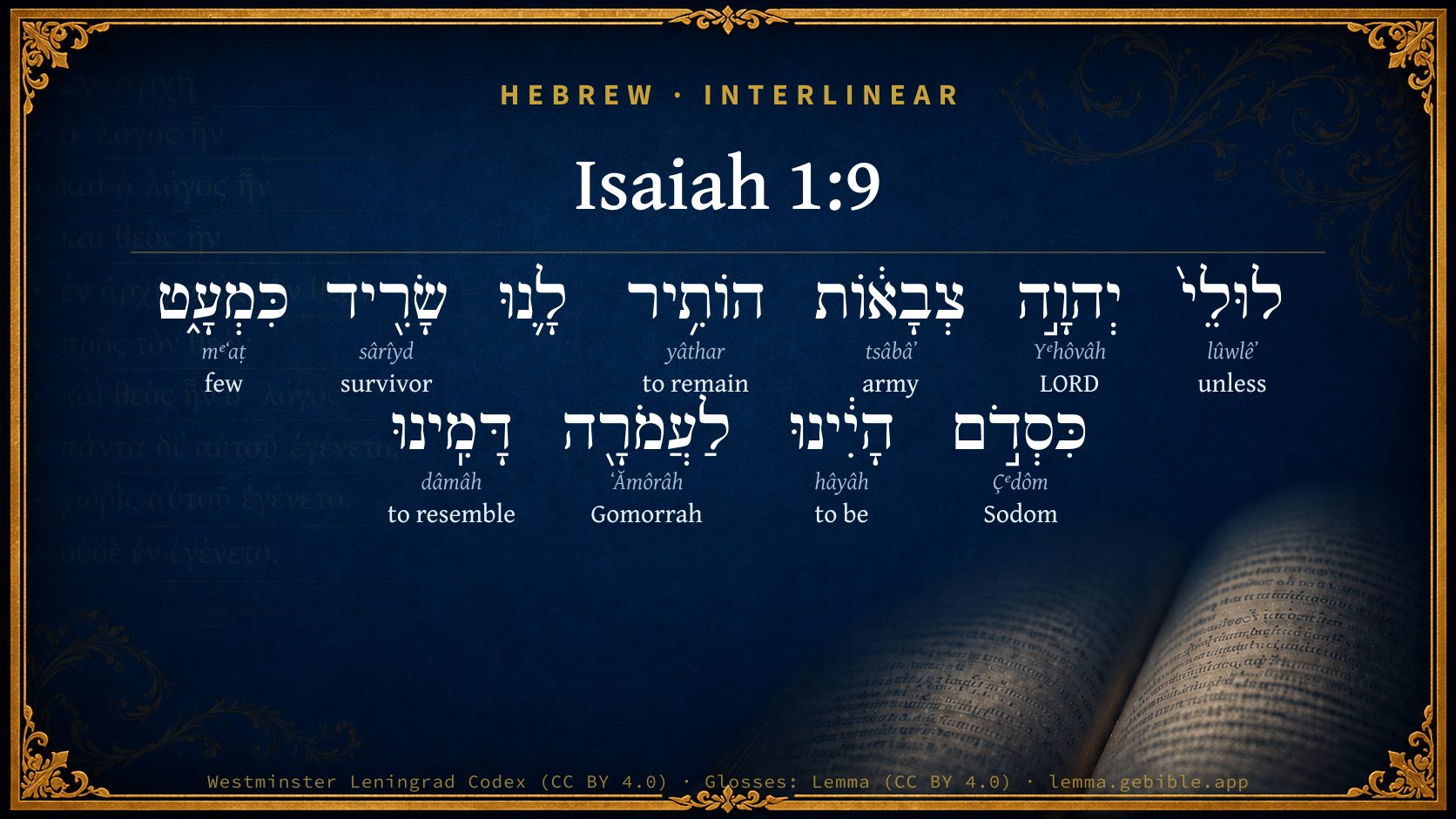
Hebrew (Westminster Leningrad Codex) Isaiah 1:9 appears in the Hebrew Old Testament. The text above is from the Westminster Leningrad Codex. Each word links to its Strong’s number, a concise gloss, and parsing drawn from the Open Scriptures Hebrew Bible morphology. Click any word for its full Brown-Driver-Briggs (BDB) entry.
Download image
Cite this verse

Isaiah 1:9 (World English Bible). Public Domain. Lemma interlinear Bible study tool, https://lemma.gebible.app/v/isaiah/1/9.

Show BibTeX & RIS
BibTeX
RIS
English Translation
Unless Yahweh of hosts had left to us a very small remnant, We would have been as Sodom; We would have been like Gomorrah.
World English Bible · Public Domain
Download a study sheet

One document with this verse’s original text, its word-by-word gloss line, the meaning frame, cross-references with their text, attributed commentary, and full source and license credits — printable, and it pastes into notes with its structure intact.

This verse Autodidact and up

Study sheet (.html) Plain text (.txt)

A passage Seminary Student

Up to 50 verses in one chapter. A passage sheet keeps up to 6 commentary sources and 12 cross-references per verse, in the order this page ranks them, and says so on the sheet whenever that leaves anything out. Ask for a single verse and you get the Autodidact verse sheet above.

Everything on this page stays free to read, with no account — the sheet is a download of what is already on screen, not access to it.

Want to remove ads? Support Godless Engineer
Compare translations 3

The same verse in 3 English versions, stacked beneath the original-language interlinear above. Click any original word for its lexicon entry.

Each is an independent rendering of the whole verse — the interlinear is not word-aligned to these translations.

Highlighted words mark where these versions differ — a whole-verse word diff, not a word-by-word alignment.

  • World English Bible Public Domain
    Unless Yahweh of hosts had left to us a very small remnant, We would have been as Sodom; We would have been like Gomorrah.
  • King James Version Public Domain
    Except the LORD of hosts had left unto us a very small remnant, we should have been as Sodom, and we should have been like unto Gomorrah.
  • unfoldingWord Literal Text CC BY-SA 4.0
    If Yahweh of Armies had not left a remnant to us according to a few, we would have been like Sodom, we would have compared to Gomorrah. q1

unfoldingWord Literal Text — © unfoldingWord, licensed CC BY-SA 4.0. Word-aligned USFM3 via Door43 (git.door43.org/unfoldingWord/en_ult).

Versions to compare (up to 4)

3 of 4 selected

Show all 18 translations

Every available English version of this verse, each an independent rendering of the whole verse.

  • World English Bible Public Domain
    Unless Yahweh of hosts had left to us a very small remnant, We would have been as Sodom; We would have been like Gomorrah.
  • Berean Standard Bible Public Domain
    Unless the LORD of Hosts had left us a few survivors, we would have become like Sodom, we would have resembled Gomorrah.
  • Majority Standard Bible Public Domain
    Unless the LORD of Hosts had left us a few survivors, we would have become like Sodom, we would have resembled Gomorrah.
  • King James Version Public Domain
    Except the LORD of hosts had left unto us a very small remnant, we should have been as Sodom, and we should have been like unto Gomorrah.
  • American Standard Version (1901) Public Domain
    Except Jehovah of hosts had left unto us a very small remnant, we should have been as Sodom, we should have been like unto Gomorrah.
  • Revised Version (1885) Public Domain
    Except the LORD of hosts had left unto us a very small remnant, we should have been as Sodom, we should have been like unto Gomorrah.
  • Geneva Bible (1599) Public Domain
    Except the Lord of hostes had reserued vnto vs, euen a small remnant: we should haue bene as Sodom, and should haue bene like vnto Gomorah.
  • Douay-Rheims (1899) Public Domain
    Except the Lord of hosts had left us seed, we had been as Sodom, and we should have been like to Gomorrha.
  • Young's Literal Translation Public Domain
    Unless Jehovah of Hosts had left to us a remnant, Shortly -- as Sodom we had been, To Gomorrah we had been like!
  • Literal Standard Version CC BY-SA 4.0
    Unless YHWH of Hosts had left a remnant to us, || Shortly—we had been as Sodom, || We had been like to Gomorrah!
  • Unlocked Literal Bible CC BY-SA 4.0
    If Yahweh of hosts had not left for us a small remnant, we would have been like Sodom, we would have been like Gomorrah.
  • unfoldingWord Literal Text CC BY-SA 4.0
    If Yahweh of Armies had not left a remnant to us according to a few, we would have been like Sodom, we would have compared to Gomorrah. q1
  • Darby Bible Public Domain
    Unless Jehovah of hosts had left us a very small residue, we should have been as Sodom, we should have been like unto Gomorrah.
  • World Messianic Bible Public Domain
    Unless the LORD of Hosts had left to us a very small remnant, we would have been as Sodom. We would have been like Gomorrah.
  • Webster's Bible Public Domain
    Except the LORD of hosts had left to us a very small remnant, we should have been as Sodom; we should have been like Gomorrah.
  • Free Bible Version CC BY-SA 4.0
    If the Lord Almighty hadn't let a few of us survive, we would have become like Sodom and Gomorrah.
  • Bible in Basic English Public Domain
    If the Lord of armies had not kept some at least of us safe, we would have been like Sodom, and the fate of Gomorrah would have been ours.
  • JPS Tanakh (1917) Public Domain
    Except the LORD of hosts had left unto us a very small remnant, we should have been as Sodom, we should have been like unto Gomorrah.

Literal Standard Version (2020), Covenant Press — licensed CC BY-SA 4.0. Text via the HelloAO Bible API (eBible.org). Unlocked Literal Bible (unfoldingWord) — licensed CC BY-SA 4.0. Text via the HelloAO Bible API (eBible.org). unfoldingWord Literal Text — © unfoldingWord, licensed CC BY-SA 4.0. Word-aligned USFM3 via Door43 (git.door43.org/unfoldingWord/en_ult). Free Bible Version, Dr. Jonathan Gallagher — licensed CC BY-SA 4.0. Text via the HelloAO Bible API (eBible.org).

Word by word

More ways to search: Search by grammar → Find every occurrence → Compare this word →

Practice this passage: Drill this verse → Learn its vocabulary →

About this verse

These counts appear in no published source. They are computed here, from the morphology-tagged text and Lemma’s own curated glosses. What Lemma adds →

11
words
10
distinct lemmas
Prophets
section

Notable vocabulary

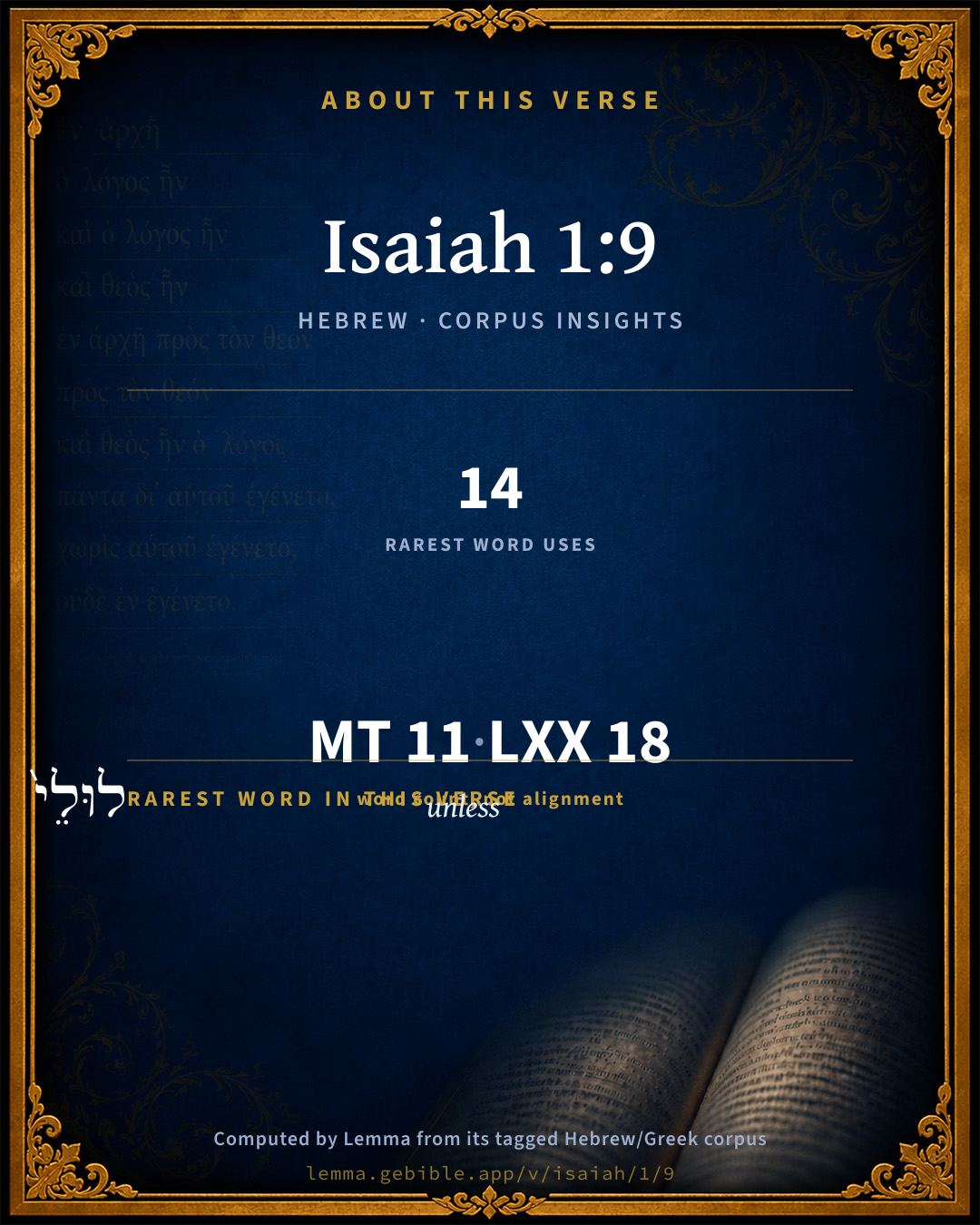
The rarest word here is לוּלֵי֙ unless H3884 — appearing just 14 times in the whole Hebrew Bible.

Shared distinctive vocabulary

לוּלֵי֙ unless H3884 occurs in 14 verses of the Hebrew Bible. Also found in:

Grammatical profile

  • 3 verbs
  • 6 nouns
  • 1 preposition
  • 1 conjunction

Verb forms

  • הוֹתִ֥יר Hiphil · Perfect
  • הָיִ֔ינוּ Qal · Perfect
  • דָּמִֽינוּ Qal · Perfect

Hebrew & Septuagint length

In English translation the verse runs 24 words from the Hebrew and 26 from the Septuagint (LXX English) — closely comparable.

A rough comparison of the two English renderings, which tokenize alike — not a word-level alignment.

Word counts can differ between the Hebrew and the Greek without any difference in meaning — e.g. the Hebrew direct-object marker אֵת has no separate Greek word, and Greek often adds the article ὁ.

In the original languages it is 11 Hebrew tokens and 18 Greek tokens — but the two are counted differently (Hebrew bundles its prefixes and suffixes into one token; the Greek is in lemma form), so that isn’t a like-for-like length.

Cross-references

26

Topical passages linked to Isaiah 1:9 in the Treasury of Scripture Knowledge — connected by theme and wording, ordered by reader-vote popularity; previews shown in the World English Bible.

  • Romans 9:29 As Isaiah has said before, "Unless the Lord of Hosts had left us a seed, We would have become like Sodom, And would have been made like Gomorrah."
  • Isaiah 37:31–32 The remnant that is escaped of the house of Judah shall again take root downward, and bear fruit upward.
  • Genesis 19:24 Then Yahweh rained on Sodom and on Gomorrah sulfur and fire from Yahweh out of the sky.
  • Lamentations 3:22 [It is of] Yahweh's loving kindnesses that we are not consumed, because his compassion doesn't fail.
  • Amos 4:11 "I have overthrown some of you, As when God overthrew Sodom and Gomorrah, And you were like a burning stick plucked out of the fire; Yet you haven't returned to me," says Yahweh.
  • Romans 11:4–6 But how does God answer him? "I have reserved for myself seven thousand men, who have not bowed the knee to Baal."
  • Genesis 18:32 He said, "Oh don't let the Lord be angry, and I will speak yet but this once. What if ten are found there?" He said, "I will not destroy it for the ten's sake."
  • Isaiah 6:13 If there are yet a tenth in it, It also shall in turn be eaten up: As a terebinth, and as an oak, whose stock remains, when they are felled; So the holy seed is its stock."
  • Isaiah 10:20–22 It shall come to pass in that day, that the remnant of Israel, and those who are escaped of the house of Jacob, shall no more again lean on him who struck them, but shall lean on Yahweh, the Holy One of Israel, in truth.
  • Isaiah 17:6 Yet there shall be left therein gleanings, as the shaking of an olive tree, two or three berries in the top of the uppermost bough, four or five in the outmost branches of a fruitful tree, says Yahweh, the God of Israel.
  • Isaiah 24:13 For thus shall it be in the midst of the earth among the peoples, as the shaking of an olive tree, as the gleanings when the vintage is done.
  • Isaiah 37:4 It may be Yahweh your God will hear the words of Rabshakeh, whom the king of Assyria his master has sent to defy the living God, and will rebuke the words which Yahweh your God has heard. Therefore lift up your prayer for the remnant that is left.
  • Deuteronomy 29:23 [and that] the whole land of it is sulfur, and salt, [and] a burning, [that] it is not sown, nor bears, nor any grass grows therein, like the overthrow of Sodom and Gomorrah, Admah and Zeboiim, which Yahweh overthrew in his anger, and in his wrath:
  • 1 Kings 19:18 Yet will I leave [me] seven thousand in Israel, all the knees which have not bowed to Baal, and every mouth which has not kissed him.
  • Lamentations 4:6 For the iniquity of the daughter of my people is greater than the sin of Sodom, That was overthrown as in a moment, and no hands were laid on her.
  • Ezekiel 6:8 Yet will I leave a remnant, in that you shall have some that escape the sword among the nations, when you shall be scattered through the countries.
  • Habakkuk 3:2 Yahweh, I have heard of your fame. I stand in awe of your deeds, Yahweh. Renew your work in the midst of the years. In the midst of the years make it known. In wrath, you remember mercy.
  • Zephaniah 2:9 Therefore as I live, says Yahweh of Hosts, the God of Israel, surely Moab will be as Sodom, and the children of Ammon as Gomorrah, a possession of nettles, and salt pits, and a perpetual desolation. The remnant of my people will plunder them, and the survivors of my nation will inherit them.
  • Zechariah 13:8–9 It shall happen that in all the land," says Yahweh, Two parts in it will be cut off and die; But the third will be left in it.
  • Matthew 7:14 How narrow is the gate, and restricted is the way that leads to life! Few are those who find it.
  • Luke 17:29–30 but in the day that Lot went out from Sodom, it rained fire and sulfur from the sky, and destroyed them all.
  • Romans 9:27 Isaiah cries concerning Israel, "If the number of the children of Israel are as the sand of the sea, It is the remnant who will be saved;
  • Genesis 18:26 Yahweh said, "If I find in Sodom fifty righteous within the city, then I will spare all the place for their sake."
  • Ezekiel 14:22 Yet, behold, therein shall be left a remnant that shall be carried forth, both sons and daughters: behold, they shall come forth to you, and you shall see their way and their doings; and you shall be comforted concerning the evil that I have brought on Jerusalem, even concerning all that I have brought on it.
  • Joel 2:32 It will happen that whoever will call on the name of Yahweh shall be saved; For in Mount Zion and in Jerusalem there will be those who escape, As Yahweh has said, And among the remnant, those whom Yahweh calls.
  • 2 Peter 2:6 and turning the cities of Sodom and Gomorrah into ashes, condemned them to destruction, having made them an example to those who would live ungodly;

Cross-references courtesy of OpenBible.info (CC BY 4.0).

Hebrew and Greek witnesses Masoretic Hebrew ↔ Greek Septuagint

The same verse in the two great witnesses to the Old Testament, shown verse-for-verse.

These are two independent witnesses, not word-aligned to each other, and the Septuagint is shown in lemma (dictionary) form.

Hebrew Isaiah 1:9 Masoretic · Westminster Leningrad Codex

לוּלֵי֙ יְהוָ֣ה צְבָא֔וֹת הוֹתִ֥יר לָ֛נוּ שָׂרִ֖יד כִּמְעָ֑ט כִּסְדֹ֣ם הָיִ֔ינוּ לַעֲמֹרָ֖ה דָּמִֽינוּ

Unless Yahweh of hosts had left to us a very small remnant, We would have been as Sodom; We would have been like Gomorrah.

World English Bible · Public Domain

Greek LXX Isaiah 1:9 Septuagint · lemma form

καί εἰ μή κύριος σαβαωθ ἐν καταλείπω ἐγώ σπέρμα ὡς σοδομα ἄν γίγνομαι καί ὡς γομορρα ἄν ὁμοιόω

And if the Lord of Sabaoth had not left us a seed, we should have been as Sodom, and we should have been made like Gomorrha.

LXX2012 (modern English Septuagint) · Public Domain

On this verse, Trapp's Complete Commentary discusses the Septuagint’s reading. Read the note in Commentary ↓

Hebrew: Westminster Leningrad Codex (CC BY 4.0). Greek: Septuagint (public domain); English from LXX2012 (modern English Septuagint) (Public Domain). How the Septuagint differs from the Hebrew →

Targum (Aramaic paraphrase)

1

The Targum is the ancient Jewish Aramaic paraphrase of the Hebrew Scriptures — an interpretive translation, not the Hebrew text itself. Onkelos (literal) and Pseudo-Jonathan (expansive) render the Torah, and Jonathan the Prophets. Coverage is partial: where no permissively-licensed English translation exists for a verse, only the Aramaic is shown. This is verse-level text, not a word-by-word alignment to the Hebrew.

  1. Targum Jonathan Prophets (Joshua–Malachi)
    אִלוּלָפוֹן מוֹתָר טוּבֵיהּ דַייָ צְבָאוֹת אַשְׁאַר לָנָא שֵׁיזְבָא בְּרַחֲמוֹהִי אִית עִמָנָא חוֹבִין דְכֶאֱנָשׁ סְדוֹם פּוֹן אֲבַדְנָא וּכְיָתְבֵי עֲמוֹרָה אִשְׁתֵּיצָנָא:

    Except the exceeding goodness of the Lord of hosts had caused to remain unto us in His mercy a deliverance, we had sins, on account of which we certainly had perished as the men of Sodom, and as the inhabitants of Gomorrah we would have been consumed.

    Targum Jonathan — Aramaic: “Mikraot Gedolot” (public domain). English: “Sefaria Community Translation” (CC0 1.0 (public-domain dedication)); “London "Chaldee Paraphrase," 1871” (public domain). Text via Sefaria.

Commentary

Notes on Isaiah 1:9 from classic Christian and Jewish commentators (each source and its license shown beneath its notes). The classic Christian expositions comment on the surrounding passage and are grouped to its opening verse, so a note may address several verses; the Jewish commentaries on the Tanakh (Rashi and others) are per-verse, so they appear only where the commentator wrote on this verse.

Lemma curates 59 commentaries, every one of them public domain or Creative Commons licensed, each selected and text-cleaned for this edition rather than reprinted as found. About our sources →

Trapp's Complete Commentary

John Trapp

Isa 1:9 Except the LORD of hosts had left unto us a very small remnant, we should have been as Sodom, [and] we should have been like unto Gomorrah.

Ver. 9. Except the Lord.] Jehovah, the Essentiator et Induperator, the Maker and Monarch of the universe.

Had left unto us a very small remnant.] Which he reserved for royal use; pulling them as "a brand out of the fire," {Zec 3:2} or as "two legs or a piece of an ear taken by the shepherd out of the mouth of a lion." {Amo 3:12} The apostle, after the Septuagint, rendereth it "a seed," {Rom 9:29} in allusion to store seed kept by the husbandman; and there hence inferreth that the elect Jews shall by faith in Christ be freed from the tyranny of Satan and terror of hell. And this is here alleged for an allay to those foregoing dreadful declarations of bygone and direful menaces of future desolations; so loath is the Sun of righteousness to set in a cloud; surely in the midst of judgment he remembereth mercy -

“ Quamvis cecidere trecenti,

Non omnes Fabios abstulit una dies. ” - Ovid.

We should have been as Sodom.] Those five cities of the plain are thrown forth for an example. {Jdg 1:7} Lot was no sooner taken out of Sodom but Sodom was taken out of the world and turned into a sea of salt. {Deu 29:23} So Meroz, {Jdg 5:23} some city likely near the place where that battle was fought, hath the very name and memorial of it utterly extinct.

John Trapp, A Commentary or Exposition upon All the Books of the Old and New Testament (1647–1656) — public domain. Text from a community e-Sword module.

The Biblical Illustrator

Joseph S. Exell

Isa_1:9

Except the Lord of hosts had left unto us a very mall remnant.

The influence of good men

1. Gods greatness in the universe. The Lord of hosts, or Jehovah of hosts. Who are His hosts? Angels. Who shall count the number of these troops? He is their Creator and Sustainer.

2. Gods authority over good men. He is here represented as having left a very small remnant. whilst an existences are absolutely His, He has a special interest in the good. He keeps good men here as long as He thinks fit. He removes them at His pleasure.

I. THEIR INFLUENCE IS HIGHLY BENEFICENT. From what evil did this remnant deliver the country? The answer will come out with potency by replying to two other questions.

1. What was the moral condition of Sodom and Gomorrah? Their sin was very grievous (Gen_18:20).

2. What was their doom? (Gen_19:24-25.) Now, it was from this moral corruption and terrible doom these good people, it is said in our text, delivered others. Ye are the salt of the earth, History abounds with examples of moral declination, and all hearts are conscious of this gravitating force, What is the counteractive? The life of Christ in man. That life flashes a light upon the corrupt heart of society, and makes it blush. But few will dare to sin in the presence of living holiness. Vice cowers under the radiant eye of virtue.

II. Their influence is highly beneficent, HOWEVER FEW THEIR NUMBER. A very small remnant. A little goodness on this earth goes a great way. Even one man like Moses, Elijah, Paul, Luther, Whitefield, Wesley, may stop the flow of depravity and turn the destinies of an age. Conclusion--

1. The criminal ignorance of nations in relation to their true benefactors

2. The supreme value of Christianity. (D. Thomas, D. D.)

Beneficial influence of goodness

On a hot summers day, some years ago, I was sailing with a friend in a tiny boat on a miniature lake enclosed like a cup within a circle of steep, bare Scottish hills. On the shoulder of the brown sunburnt mountain, and full in sight, was a well with a crystal stream trickling over its lip, and making its way down towards the lake. Around the wells month and along the course of the rivulet a belt of green stood out in strong contrast with the iron surface of the rocks all around. We soon agreed as to what should be made of it. There it was, a legend clearly printed by the finger of God on the side of these silent hills, teaching the passer-by how needful a good man is, and how useful he may be in a desert world. (W. Arnot, D. D.)

The, Lord of hosts

Jehovah of hosts, or of armies, is a favourite expression of the Hebrew writers, and especially of Isaiah, Jeremiah, Zechariah and Malachi, by which they recognise Him as the universal governor of heaven and earth, who has ordained and constituted the services of men and angels in a wonderful order, and who employs His kingly and almighty power to rule the nations in righteousness, and, as now, both to punish and to save His chosen people. (Sir E. Strachey, Bart.)

The Biblical Illustrator, edited by Joseph S. Exell (c. 1880s–1900s) — public domain. Text from a community e-Sword module.

Joseph Benson's Commentary

Isa 1:9. Except the Lord had left us a remnant — If God, by his infinite power and goodness, had not restrained our enemies, and reserved some of us, we should have been as Sodom — The whole nation of us had been utterly cut off, as the people of Sodom and Gomorrah were. So great was the rage and power of our enemies, and so utterly unable were we to deliver ourselves. This remnant was “a type of those few converts among the Jews, who, embracing the gospel, escaped both the temporal and eternal judgments which came upon the rest of the nation for rejecting Christ and his messengers,” Rom 9:2; Rom 11:5. — Lowth.

Joseph Benson's Commentary on the Old and New Testaments (1811–1818) — public domain. Text from a community e-Sword module.

The Preacher's Complete Homiletical Commentary

Joseph S. Exell (gen. ed.)

GOD’S RELUCTANCE TO PUNISH

Isa_1:9. Except the Lord of hosts had left us a very small remnant, we should have been as Sodom, and we should have been like unto Gomorrah.

God had humbled His people because of their transgressions, but He had not utterly destroyed them, as He might have done in strict justice. This reminds us—

1. That the punishments that befall wicked men in this world frequently fall short of their deserts.

2. That this disproportion between guilt and chastisement occurs because God is not so much concerned to punish sin as to reclaim sinners. God chastises, in the first instance, that He may correct, and it is with reluctance that He increases the severity of His strokes [234]

[234] See note (α), page 18.

These facts should lead us—

1. To adore the divine benignity. How worthy of our love and worship is this God who is no mere vindictive avenger of broken law, but a loving Father who chastens us, not for His pleasure, but for our profit!

2. To gratefully acknowledge the mercy that has mingled with the judgments which our sins have drawn down upon us (Lam_3:10) [237]

3. To shrink with abhorrence from any abuse of the divine long-suffering. The fact that God is so reluctant to punish, instead of encouraging us in rebellion, should incite us to prompt and loving obedience. Nothing can be more base than to “turn the grace of God into lasciviousness;” and nothing could be more dangerous [240] (Pro_29:1).

[237] If in an affliction we would pour forth to God such acceptable prayers as may obtain comfort in our crosses and deliverance from all our calamities, we must confess our sins, and humbly acknowledge that we deserve to be overwhelmed with much more heavy plagues and punishments. And so the Lord will excuse us when we accuse ourselves, remit our sins when we remember them, and absolve us from punishment when in all humility we acknowledge that we have justly deserved the fearfullest of His plagues. For if we, who have but a little of the milk of mercy, are moved with compassion when either our sons or our servants acknowledge their faults, and offer themselves of their own accord to Buffer that punishment which they have deserved, how can we doubt that God, whose love and mercy towards us are infinite and incomprehensible, will be pitiful and ready to forgive us when He sees us thus humbled?—Downame, 1644.

[240] Take heed of abusing this mercy of God. Suck not poison out of the sweet flower of God’s mercy: do not think that because God is merciful you may go on in sin; this is to make mercy your enemy. None might touch the Ark but the priests, who by their office were more holy: none may touch this ark of God’s mercy but such as are resolved to be holy. He that sins because of mercy shall have judgment without mercy. Mercy abused turns to fury (Deu_29:19-20). “The mercy of the Lord is upon them that fear Him.” Mercy is not for them that sin and fear not, but for them that fear and sin not God’s mercy is a holy mercy; where it pardons, it heals.—Watson, 1696.

The Preacher's Complete Homiletical Commentary (gen. ed. Joseph S. Exell; Funk & Wagnalls, c. 1892) — public domain (pre-1929). A full-Bible homiletical/sermon-outline anthology covering 65 of 66 books (2 John is absent from the source module). Text from a community e-Sword module.

Tyndale Open Study Notes

Tyndale Open Resources

1:9 The Lord of Heaven’s Armies refers to the millions of angels that are at the Lord’s command (see 2 Kgs 6:16-17; Matt 26:53). At the Exodus, Moses described God as a warrior fighting for his people (Exod 15:1-21). Ironically, in Isaiah’s day, God fought against Judah because of their wickedness (Isa 1:24; 3:1-5).

Tyndale Open Study Notes — © Tyndale Open Resources, licensed CC BY-SA 4.0. Text via the HelloAO Bible API.

Geneva Bible (1599)

Geneva Bible translators

Because that he will ever have a Church to call upon his Name.

That is, all destroyed.

Geneva Bible (1599) marginal notes — public domain. Text via Bolls.life.

Jamieson, Fausset & Brown

Robert Jamieson, A. R. Fausset & David Brown

Jehovah of Sabaoth, that is, God of the angelic and starry hosts (Psa 59:5; Psa 147:4; Psa 148:2). The latter were objects of idolatry, called hence Sabaism (Kg2 17:16). God is above even them (Ch1 16:26). "The groves" were symbols of these starry hosts; it was their worship of Sabaoth instead of the Lord of Sabaoth, which had caused the present desolation (Ch2 24:18). It needed no less a power than His, to preserve even a "remnant." Condescending grace for the elect's sake, since He has no need of us, seeing that He has countless hosts to serve Him.

Jamieson, Fausset & Brown — Commentary Critical and Explanatory on the Whole Bible (1871) — public domain (CC PDM 1.0). Text via the HelloAO Bible API.

Adam Clarke's Commentary

Verse 9. The Lord of hosts - "JEHOVAH God of hosts"] As this title of God, יהוה צבאות Yehovah tsebaoth, "JEHOVAH of hosts, occurs here for the first time, I think it proper to note, that I translate it always, as in this place, "JEHOVAH God of hosts;" taking it as an elliptical expression for יהוה אלהי צבאות Yehovah Elohey tsebaoth. This title imports that JEHOVAH is the God or Lord of hosts or armies; as he is the Creator and Supreme Governor of all beings in heaven and earth, and disposeth and ruleth them all in their several orders and stations; the almighty, universal Lord.

We should have been as Sodom] As completely and finally ruined as that and the cities of the plain were, no vestige of which remains at this day.

Adam Clarke's Commentary on the Bible (1810–1826) — public domain. Text from a community e-Sword/MySword module.

Ellicott's Commentary for English Readers

(9) Except the Lord of hosts . . .—This name also had been stamped on the prophet’s mind at the time of his call (Isa_6:3). The God of the hosts (or armies) of heaven (sun, moon and stars, angels and archangels) and of earth had not been unmindful of the people. The idea of the “remnant” left when the rest of the people perished is closely connected with the leading thought of Isa_6:12-13. It had, perhaps, been impressed on the prophet’s mind by the “remnant” of Israel that had escaped from Tiglath-pileser or Sargon (2Ch_30:6; comp. Mic_5:7).

We should have been as Sodom . . .—Here the prophet, continuing perhaps the thought of Isa_1:7, speaks of the destruction, in the next verse of the guilt, of the cities of the plain. Both had passed into a proverb. So Ezekiel (Eze_16:46-56) works out the parallelism; so our Lord speaks of the guilt of Sodom as being lighter than that of Capernaum (Mat_11:23); so the tradition has condensed itself in the Arabic proverb, quoted by Cheyne, “More unjust than a kadi of Sodom.” (Comp. Isa_3:9; Deu_32:32.)

A Bible Commentary for English Readers, edited by Charles John Ellicott (1878–1897) — public domain. Text from a community e-Sword module.

The Cambridge Bible for Schools and Colleges

gen. ed. J. J. S. Perowne

9. the Lord of hosts] In Hebr. Yahveh Tsĕbâôth, a peculiarly solemn title of the God of Israel, specially common in the prophetic writings. On the different theories as to the origin of the expression, see the Note in Cheyne, Comm. i. pp. 11 ff. The simplest explanation of its origin is that which regards it as equivalent to “Jehovah (the God) of the armies of Israel” (1Sa_17:45; cf. Exo_7:4). It is true that this cannot be the precise sense in which the phrase is used by the prophets, since it is a fundamental conception with them that Jehovah is no longer on the side of the hosts of Israel. But just as Amos took the phrase “day of Jehovah” from the lips of the people (see below on Isa_2:12), and gave it an interpretation diametrically opposed to the popular one, so he may have done also with this expression. If this be the correct view, “God of battles” may approximately reproduce the sense in which it is used by the prophets: Jehovah is still the Lord of Hosts, although He has disowned those of Israel. Or, if a vaguer idea be preferred, we may adopt the Κύριος παντοκράτωρ (All-sovereign Lord) of the LXX. as sufficiently expressive.

a very small remnant] The adverbial phrase “very small” might (disregarding the accents) be taken with the following clause, which, would then read “we might readily have been as Sodom, &c.” (as in Gen_26:10; Psa_94:17; Psa_119:87). The word for remnant (sarîd) is only here used by Isaiah. He perhaps purposely avoids shì’âr, which he would have used in speaking of the ideal remnant that inherits the hope of the future.

The Cambridge Bible for Schools and Colleges (gen. ed. J. J. S. Perowne; Cambridge University Press, 1878–1918) — public domain. Text from a community e-Sword module.

John Gill's Exposition

Except the Lord of hosts had left unto us a very small remnant,.... This is an instance of the super abounding goodness of the Lord of hosts, as the Targum expresses it; that he should, in those very wicked and calamitous times, leave and reserve a few from being defiled with the sins of the age, and from being involved in the general calamity of it; which was true of the Christian Jews at the time of Jerusalem's destruction; for that this prophecy belongs to these times is clear from the application of it by the Apostle Paul, Rom 9:29 and which confirms the sense given of the above passages: "the very small remnant" are the remnant according to the election of grace, the little flock, the few that entered in at the strait gate and are saved, or the few that believed in Christ, and so were saved from that untoward generation; these were "left", reserved, distinguished, and secured in the grace of election, being a remnant according to it, in the hands of Christ to whom they were given, and in whom they were preserved; in redemption by him, that they might be a peculiar people; in providence till called, in which the Lord watched over them to do them good, and waited to be gracious to them, and saved them to be called; and in effectual calling, in which he separated them from the rest of the world, and kept them by his power through faith unto salvation. And this was done "unto us"; for the sake of his church, that that might continue, and he might have a seed to serve him: and by "the Lord of hosts", of the hosts of heaven, the sun, and moon, and stars, and of the angels there, and of the inhabitants of the earth; which shows great condescension in him to regard this remnant, and great grace to them; since he could not stand in need of them, having the host of heaven on his right hand and on his left; nor was there any thing in them that could deserve this of him; but it was, as Jarchi observes, in his mercy, and not for their righteousness: to which may be added, that since he is the Lord of hosts, he was able to protect and preserve this remnant, notwithstanding all the opposition of men and devils, as he did; and had he not taken such a method as this,

we should have been as Sodom, and we should have been like unto Gomorrah: cities that were infamous for their sins, and notorious for the punishment of them, being consumed by fire from heaven, Gen 13:13 and not only the Jews, but any and every nation, even the whole world, would have been like these cities, both for sin and punishment, had it not been for the distinguishing grace of God, in leaving and reserving a few for his glory, and the support of his interest. All the holiness that ever was, is, or will be in the world, is owing to electing, redeeming, and efficacious grace: there had not been a holy man nor a holy woman in the world, in any age, if God had not taken such methods of grace; and it is owing to, and for the sake of, this small remnant, that temporal judgments are often averted from a nation and people, and that the conflagration of the world is not yet; this is kept back till they are gathered in; and were it not for this distinguishing grace, every individual of mankind would have been cast into hell, and must have suffered the vengeance of eternal fire, which the punishment of Sodom and Gomorrah, was an example of.

John Gill's Exposition of the Whole Bible (1746–1763) — public domain (CC PDM 1.0). Text via the HelloAO Bible API.

Albert Barnes' Notes on the Bible

Except ... - It is owing entirely to the mercy of God, that we are not like Sodom. The prophet traces this not to the goodness of the nation, not to any power or merit of theirs, but solely to the mercy of God. This passage the apostle Paul has used in an argument to establish the doctrine of divine sovereignty in the salvation of people; see the note at Rom 9:29.

The Lord - Hebrew Yahweh. Note Isa 1:2.

Of hosts - צבאות tsebâ'ôth - the word sometimes translated “Sabaoth”; Rom 9:29; Jam 5:4. The word means literally armies or military hosts. It is applied, however, to the angels which surround the throne of God; 1Ki 22:19; 2Ch 18:18; Psa 103:21; and to the stars or constellations that appear to be marshalled in the sky; Jer 33:22; Isa 40:26. This host, or the “host of heaven,” was frequently an object of idolatrous worship; Deu 4:19; Deu 17:3; 2Ki 17:16. God is called Yahweh of hosts because he is at the head of all these armies, as their leader and commander; he marshals and directs them - as a general does the army under his command. ‘This,’ says Gesenius, ‘is the most common name of God in Isaiah, and in Jeremiah, Zechariah, and Malachi. It represents him as the ruler of the hosts of heaven, that is, the angels and the stars. Sometimes, but less frequently, we meet with the appellation Yahweh, God of hosts. Hence, some suppose the expression Yahweh of hosts to be elliptical. But it is not a correct assertion that Yahweh, as a proper name, admits of no genitive. But such relations and adjuncts as depend upon the genitive, often depend upon proper names. So in Arabic, one is called Rebiah of the poor in reference to his liability.’ The name is given here, because to save any portion of a nation so wicked implied the exercise of the same power as that by which he controlled the hosts of heaven.

Remnant - A small part - that which is left. It means here, that God had spared a portion of the nation, so that they were not entirely overthrown.

We should have been as Sodom ... - This does not refer to the character of the people, but to their destiny. If God had not interposed to save them they would have been overwhelmed entirely as Sodom was; compare Gen 19:24-25.

Albert Barnes' Notes on the Bible (1834–1885) — public domain. Text from a community e-Sword/MySword module.

Matthew Poole's English Annotations

If God, by his infinite power and goodness, had not restrained our enemies, and reserved some of us, the whole nation and race of us had been utterly cut off, as the people of Sodom and Gomorrah were; so great was the rage and power of our enemies, and so utterly unable we were to deliver ourselves.

Matthew Poole's English Annotations on the Holy Bible (1683–1685) — public domain. Text from a community e-Sword/MySword module.

Whedon's Commentary on the Bible

Daniel D. Whedon

9. Lord of hosts — Of the angelic hosts, and starry heavens. Worship of the latter was very early observed by the Assyrians, Phoenicians, Canaanites, etc., but the Lord of Israel is above all, and so is called “Lord” or Master “of hosts.”

Very small remnant — That which is left of the people after the ravages of invasive war. With Isaiah, as often elsewhere, the word “remnant” means the righteous, in distinction from the multitude of the ungodly. Rom_9:29.

We — After having reproved the sinful nation, the prophet now identifies himself with the people.

As Sodom — Not in character, probably, but in destiny; that is, cut off entirely.

Gomorrah — The same idea, repeated for preserving poetic parallelism.

The prophets — eminently Isaiah — frequently gave their instructions in symbolic terms, and in sentences metrical as well as poetical.

Daniel D. Whedon (gen. ed.), Commentary on the Old and New Testaments (1874–1909) — public domain. Text from a community e-Sword module.

The Pulpit Commentary

Except the Lord of hosts had left unto us a very small remnant, we should have been as Sodom. Lowth and Cheyne prefer to divide the two clauses differently, and to translate, "Except the Lord of hosts had left us a remnant, within a little we should have been like Sodom." The "remnant" is that of the few godly men who still inhabit Jerusalem. The comparison of Jerusalem with Sodom is made again in Isa_3:9, and is carried out at some length by Ezekiel. (Eze_16:44-57) It implies a condition of extreme depravity.

The faithful remnant.

Except the Lord of hosts had left unto us a very small remnant, we should have been as Sodom, and we should have been like unto Gomorrah." This is as music of hope amid a strain of grief. And it is the first note of an evangelic prophecy, which is to merge into the "Comfort ye, comfort ye my people," of a later chapter. Where there is life there is hope in national calamity as well as in personal sickness. A cottage in a vineyard" is a cottage that speaks of home (ver. 8), "a lodge in a garden of cucumbers" is a center of care and toil; and a very small remnant may be a branch of healing to save a nation.

I THE SMALL REMNANT BELONGS TO THE LORD OF HOSTS. Therefore power is on their side. What a contrast! and "remnant." Even so. God can multiply the loaves and fishes. God can put such power into the remnant that they may be able to say, "Greater is he that is for us than all that can be against us." We must not judge by numbers or statistics, nor by quantity, but by quality. Whose are these? Decide that; and then "This is the victory that overcometh the world, even our faith, "for that faith centers in God.

II THE SMALL REMNANT IS ANTISEPTIC. It can arrest disease. It can heal. Take a few grains of some chemical substance, and they will color and cleanse an entire stream. "We should have been as Sodom is." Yes; God"s judgments on a nation, as in our own at the time when profligate plays had undermined the moral life, have saved the nation. For when men laugh at sin, well-nigh the deepest depth has been reached; but godly souls are then used as leaven to purify the body politic. Judah and Jerusalem were almost gone, but the Lord had mercy on them.

III THE SMALL REMNANT IS TO SPREAD THE WORD OF THE LORD. The next verse says, "Hear ye the Word of the Lord." It is a Divine revelation that is to save them. And the prophet who speaks is called Isaiah, or Iesahiaha, signifying "the salvation of the Lord; "so that though the prophet speaks stern words of rebuke, his very name contains the glorious issue of his work. His work was laborious and long he prophesied in the days of Uzziah, Jotham, Ahaz, and Hezekiah. Terribly profane were those days, for in the days of Ahaz "the doors of the house of the Lord were shut up, and idolatrous altars were erected in every corner of Jerusalem." But God sent his Word and healed them; and that is the true regenerator in every age. W.M.S.

The Pulpit Commentary (1880–1919), ed. H.D.M. Spence-Jones & Joseph S. Exell — public domain. Text from a community e-Sword module.

Keil & Delitzsch

C. F. Keil & F. Delitzsch

For the present, however, Jerusalem was saved from this extremity. The omnipotence of God had mercifully preserved it: "Unless Jehovah of hosts had left us a little of what had escaped, we had become like Sodom, we were like Gomorrah." Sarid (which is rendered inaccurately σπέρμα in the Sept.; cf., Rom 9:29) was used, even in the early Mosaic usage of the language, to signify that which escaped the general destruction (Deu 2:34, etc.); and כּמעט (which might very well be connected with the verbs which follow: "we were very nearly within a little like Sodom," etc.) is to be taken in connection with sarid, as the pausal form clearly shows: "a remnant which was but a mere trifle" (on this use of the word, see Isa 16:14; Ch2 12:7; Pro 10:20; Psa 105:12). Jehovah Zebaoth stands first, for the sake of emphasis. It would have been all over with Israel long ago, if it had not been for the compassion of God (vid., Hos 11:8). And because it was the omnipotence of God, which set the will of His compassion in motion, He is called Jehovah Zebaoth, Jehovah (the God) of the heavenly hosts - an expression in which Zebaoth is a dependent genitive, and not, as Luzzatto supposes, an independent name of God as the Absolute, embracing within itself all the powers of nature. The prophet says "us" and "we." He himself was an inhabitant of Jerusalem; and even if he had not been so, he was nevertheless an Israelite. He therefore associates himself with his people, like Jeremiah in Lam 3:22. He had had to experience the anger of God along with the rest; and so, on the other hand, he also celebrates the mighty compassion of God, which he had experienced in common with them. But for this compassion, the people of God would have become like Sodom, from which only four human beings escaped: it would have resembled Gomorrah, which was absolutely annihilated. (On the prefects in the protasis and apodosis, see Ges. 126, 5.)

Keil & Delitzsch — Biblical Commentary on the Old Testament (1861–1891) — public domain (CC PDM 1.0). Text via the HelloAO Bible API. (Old Testament only.)

J. A. Alexander on Isaiah

Joseph Addison Alexander

The idea of a desolation almost total is expressed in other words, and with an intimation that the narrow escape was owing to God’s favor for the remnant according to the election of grace, who still existed in the Jewish church. “Except Jehovah of Hosts had left unto us” (or caused to remain over, to survive, for us) “a very small remnant, we should have been like Sodom, we should have resembled Gomorrah,” (i.e., we should have been totally and justly destroyed). That the verse has reference to quality as well as quantity, is evident from Rom 9:29, where Paul makes use of it, not as an illustration, but as an argument to show that mere connection with the church could not save men from the wrath of God. The citation would have been irrelevant if this phrase denoted merely a small number of survivors, and not a minority of true believers in the midst of the prevailing unbelief. Jehovah of Hosts means the Sovereign Ruler of "heaven and earth and all the hosts of them," (i.e., all their inhabitants). (Gen 2:1).

Joseph Addison Alexander, The Prophecies of Isaiah (1846–1847; New York: Scribner, 1870–1878) — public domain. Text from a community e-Sword module.

Scofield Reference Notes

C. I. Scofield

remnant Remnant. See, Isa 10:20; Rom 11:5 (See Scofield "Rom 11:5")

The Scofield Reference Bible (1917 edition), notes by C. I. Scofield — public domain. Text from a community e-Sword module.

unfoldingWord translationNotes

Door43 World Missions Community

General Information:

Isaiah speaks to the people of Judah in the form of a poem. (See: Parallelism)

If Yahweh

This describes something that could have happened in the past but did not. (See: Hypothetical Situations)

a small remnant

"a few survivors"

us ... we

Here these words refer to Isaiah and includes all the people of Judah and Jerusalem. (See: Inclusive "We")

we would have been like Sodom, we would have been like Gomorrah

How Judah would have been like Sodom and Gomorrah can be made explicit. AT: "God would have destroyed us, like he destroyed the cities of Sodom and Gomorrah" (See: Assumed Knowledge and Implicit Information and Simile)

translationWords

Yahweh of hosts

remnant

Sodom

Gomorrah

unfoldingWord translationNotes — © Distant Shores Media and the Door43 World Missions Community, licensed CC BY-SA 4.0. Source: git.door43.org/Door43/en_tn.

Rashi

Rabbi Shlomo Yitzchaki (Rashi)

Had not the Lord of Hosts left us a remnant by His own volition and with His mercy, not because of our merits.

we would soon be like Sodom All of us would be destroyed.

Rashi on the Tanakh — English translations: “The Judaica Press complete Tanach with Rashi, translated by A. J. Rosenberg” (CC BY 4.0); “Pentateuch with Rashi's commentary by M. Rosenbaum and A.M. Silbermann, 1929-1934” (public domain); “The Metsudah Tanach series, Lakewood, N.J” (CC BY 4.0); and “The Book of Joshua, Metsudah Publications, 1997” (CC BY 4.0). Text via Sefaria.

Ibn Ezra

Rabbi Abraham ibn Ezra

Except the Lord of hosts, etc. These are the words of the Israelites, whom the prophet introduces now speaking.

כמעָט֑ Very small. Join with שׂריד ‘remnant,’ because of its disjunctive accent; for it is an important rule, that the most careful notice should be taken of the accents. the son of Amoz.

Ibn Ezra on the Tanakh — English translations: “Sefaria Community Translation” (CC0 1.0 (public-domain dedication)); “Yalkut, Sifsei Chachomim Chumash, Metsudah Publications, 2009” (CC BY 4.0); and “Commentary of Ibn Ezra on Isaiah - trans. by M. Friedlander, 1873” (public domain). Text via Sefaria.

Lesson kit

Teaching starters — assembled from the data on this page, not authored interpretation. Every prompt links to the verse data it draws on. Edit before teaching.

Isaiah, in the Prophets, opens this verse with 11 words (10 distinct Hebrew lemmas). Its most distinctive word is lûwlêʼ (“unless”). A historical commentator’s framing appears above. Read the whole chapter for the surrounding context.

Discussion questions

  1. What does “unless” (lûwlêʼ) contribute to the verse as a whole?
  2. How does Genesis 31:42, which shares the word «unless», read alongside this verse?
  3. These translations render this verse differently; the difference is in the English rendering, not the original. What questions does that raise?
  4. «הוֹתִ֥יר» is a Hiphil Perfect verb. How does that grammatical form shape the action described?
  5. Compare how Trapp's Complete Commentary and The Biblical Illustrator read this verse. Where do they agree or differ?

Things to notice

Reading settings

Reading text

Shown beneath each verse's original-language words.

Old Testament
Old Testament edition

Read the OT as the Masoretic Hebrew (MT) or the Greek Septuagint (LXX).

English shown for the Greek Septuagint (in the Hebrew ↔ Greek comparison).

Comparing translations? Open the Compare panel on any verse page to stack up to four side by side.