
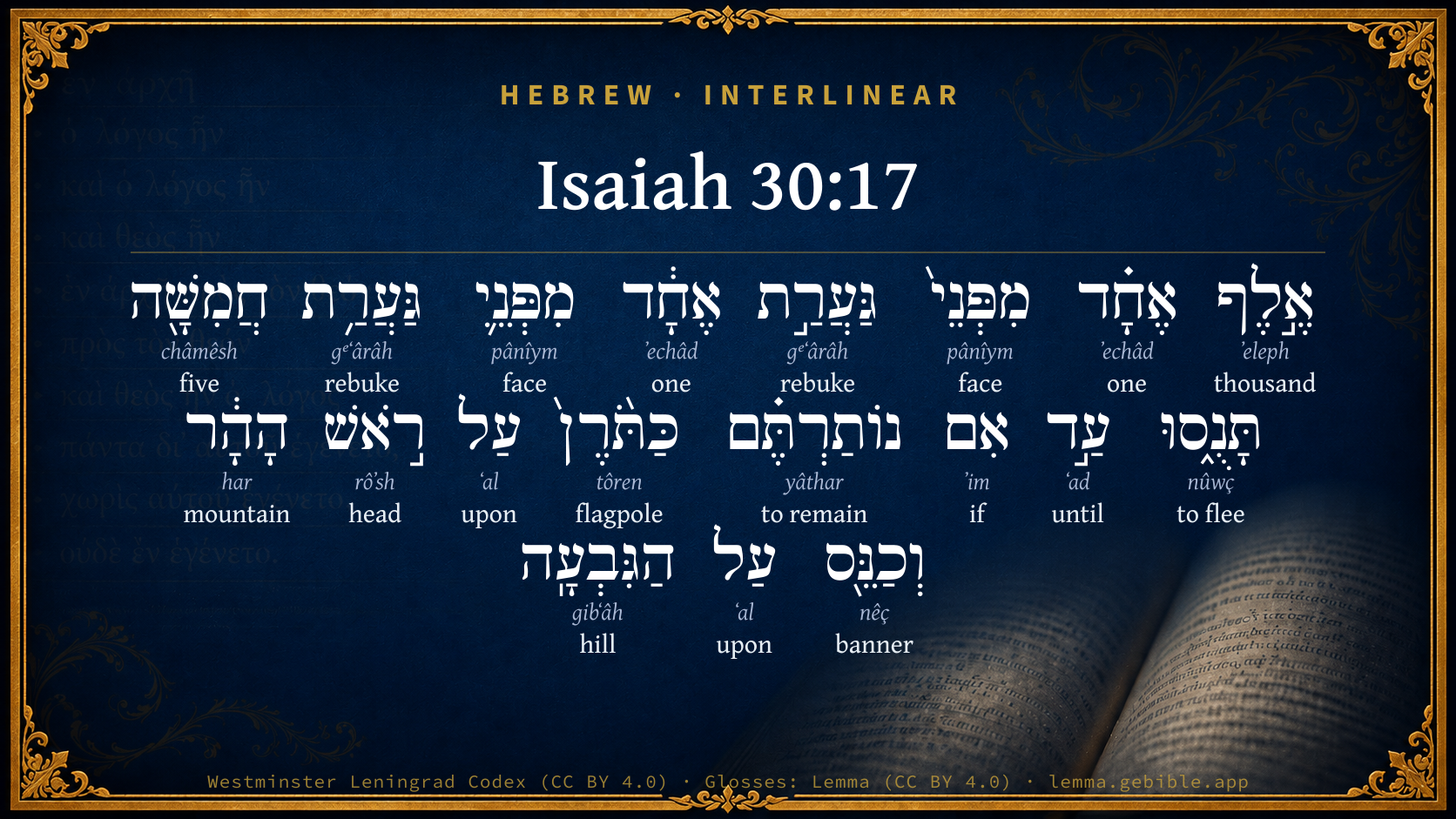
Isaiah 30:17

Hebrew (Westminster Leningrad Codex) Isaiah 30:17 appears in the Hebrew Old Testament. The text above is from the Westminster Leningrad Codex. Each word links to its Strong’s number, a concise gloss, and parsing drawn from the Open Scriptures Hebrew Bible morphology. Click any word for its full Brown-Driver-Briggs (BDB) entry.
Download image
Cite this verse

Isaiah 30:17 (World English Bible). Public Domain. Lemma interlinear Bible study tool, https://lemma.gebible.app/v/isaiah/30/17.

Show BibTeX & RIS
BibTeX
RIS
English Translation
One thousand [shall flee] at the threat of one; at the threat of five shall you flee: until you be left as a beacon on the top of a mountain, and as an ensign on a hill.
World English Bible · Public Domain
Highlights
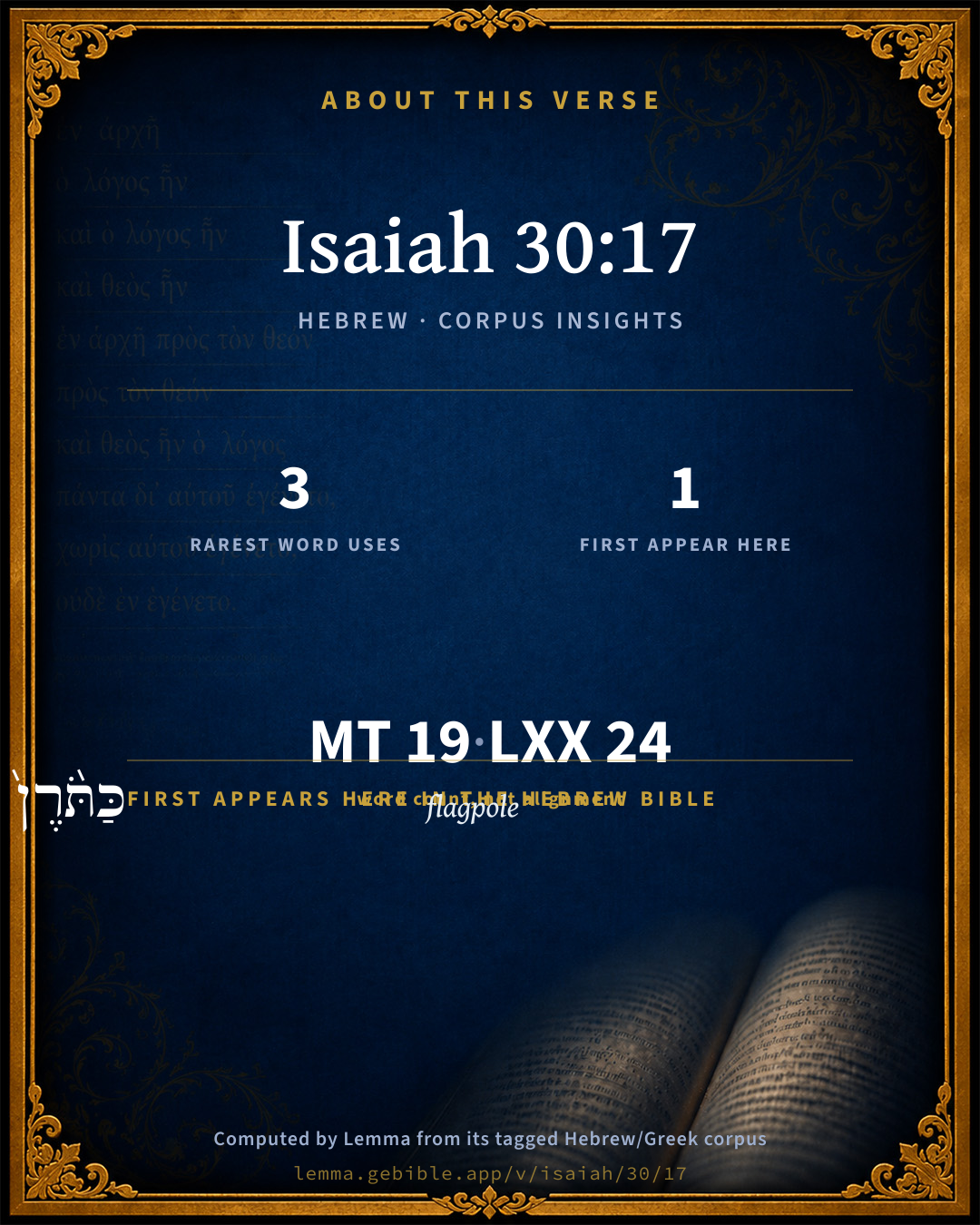
  • 1 first appearance in the Hebrew Bible
Full analysis ↓
Download a study sheet

One document with this verse’s original text, its word-by-word gloss line, the meaning frame, cross-references with their text, attributed commentary, and full source and license credits — printable, and it pastes into notes with its structure intact.

This verse Autodidact and up

Study sheet (.html) Plain text (.txt)

A passage Seminary Student

Up to 50 verses in one chapter. A passage sheet keeps up to 6 commentary sources and 12 cross-references per verse, in the order this page ranks them, and says so on the sheet whenever that leaves anything out. Ask for a single verse and you get the Autodidact verse sheet above.

Everything on this page stays free to read, with no account — the sheet is a download of what is already on screen, not access to it.

Want to remove ads? Support Godless Engineer
Compare translations 3

The same verse in 3 English versions, stacked beneath the original-language interlinear above. Click any original word for its lexicon entry.

Each is an independent rendering of the whole verse — the interlinear is not word-aligned to these translations.

Highlighted words mark where these versions differ — a whole-verse word diff, not a word-by-word alignment.

  • World English Bible Public Domain
    One thousand [shall flee] at the threat of one; at the threat of five shall you flee: until you be left as a beacon on the top of a mountain, and as an ensign on a hill.
  • King James Version Public Domain
    One thousand shall flee at the rebuke of one; at the rebuke of five shall ye flee: till ye be left as a beacon upon the top of a mountain, and as an ensign on an hill.
  • unfoldingWord Literal Text CC BY-SA 4.0
    One thousand, from the face of the rebuke of one; from the face of the rebuke of five, you will flee, until that you are left like a flagpole on the head of a mountain and like a banner on a hill. q1

unfoldingWord Literal Text — © unfoldingWord, licensed CC BY-SA 4.0. Word-aligned USFM3 via Door43 (git.door43.org/unfoldingWord/en_ult).

Versions to compare (up to 4)

3 of 4 selected

Show all 18 translations

Every available English version of this verse, each an independent rendering of the whole verse.

  • World English Bible Public Domain
    One thousand [shall flee] at the threat of one; at the threat of five shall you flee: until you be left as a beacon on the top of a mountain, and as an ensign on a hill.
  • Berean Standard Bible Public Domain
    A thousand will flee at the threat of one; at the threat of five you will all flee, until you are left alone like a pole on a mountaintop, like a banner on a hill.
  • Majority Standard Bible Public Domain
    A thousand will flee at the threat of one; at the threat of five you will all flee, until you are left alone like a pole on a mountaintop, like a banner on a hill.
  • King James Version Public Domain
    One thousand shall flee at the rebuke of one; at the rebuke of five shall ye flee: till ye be left as a beacon upon the top of a mountain, and as an ensign on an hill.
  • American Standard Version (1901) Public Domain
    One thousand `shall flee' at the threat of one; at the threat of five shall ye flee: till ye be left as a beacon upon the top of a mountain, and as an ensign on a hill.
  • Revised Version (1885) Public Domain
    One thousand shall flee at the rebuke of one; at the rebuke of five shall ye flee: till ye be left as a beacon upon the top of a mountain, and as an ensign on an hill.
  • Geneva Bible (1599) Public Domain
    A thousand as one shall flee at the rebuke of one: at the rebuke of fiue shall ye flee, till ye be left as a ship maste vpon the top of a mountaine, and as a beaken vpon an hill.
  • Douay-Rheims (1899) Public Domain
    A thousand men shall flee for fear of one: and for fear of five shall you flee, till you be left as the mast of a ship on the top of a mountain, and as an ensign upon a hill.
  • Young's Literal Translation Public Domain
    One thousand because of the rebuke of one, Because of the rebuke of five ye flee, Till ye have been surely left as a pole On the top of the mountain, And as an ensign on the height.
  • Literal Standard Version CC BY-SA 4.0
    One thousand [flee] because of the rebuke of one, || Because of the rebuke of five you flee, || Until you have surely been left as a pole || On the top of the mountain, || And as an ensign on the height.
  • Unlocked Literal Bible CC BY-SA 4.0
    One thousand will flee at the threat of one; at the threat of five you will flee until your remnant will be like a flagstaff on the top of a mountain, or like a flag on a hill.”
  • unfoldingWord Literal Text CC BY-SA 4.0
    One thousand, from the face of the rebuke of one; from the face of the rebuke of five, you will flee, until that you are left like a flagpole on the head of a mountain and like a banner on a hill. q1
  • Darby Bible Public Domain
    One thousand [shall flee] at the rebuke of one; at the rebuke of five shall ye flee: till ye be left as a beacon upon the top of a mountain, and as a banner on a hill.
  • World Messianic Bible Public Domain
    One thousand will flee at the threat of one. At the threat of five, you will flee until you are left like a beacon on the top of a mountain, and like a banner on a hill.
  • Webster's Bible Public Domain
    One thousand shall flee at the rebuke of one; at the rebuke of five shall ye flee: till ye be left as a beacon upon the top of a mountain, and as an ensign on a hill.
  • Free Bible Version CC BY-SA 4.0
    Just one of them will chase after a thousand of you. Just five of them will make you all run away. All that will be left of you will look like a flag fluttering on the top of a mountain, a banner waving on a hill.
  • Bible in Basic English Public Domain
    A thousand will go in fear before one; even before five you will go in flight: till you are like a pillar by itself on the top of a mountain, and like a flag on a hill.
  • JPS Tanakh (1917) Public Domain
    One thousand shall flee at the rebuke of one, at the rebuke of five shall ye flee; till ye be left as a beacon upon the top of a mountain, and as an ensign on a hill.

Literal Standard Version (2020), Covenant Press — licensed CC BY-SA 4.0. Text via the HelloAO Bible API (eBible.org). Unlocked Literal Bible (unfoldingWord) — licensed CC BY-SA 4.0. Text via the HelloAO Bible API (eBible.org). unfoldingWord Literal Text — © unfoldingWord, licensed CC BY-SA 4.0. Word-aligned USFM3 via Door43 (git.door43.org/unfoldingWord/en_ult). Free Bible Version, Dr. Jonathan Gallagher — licensed CC BY-SA 4.0. Text via the HelloAO Bible API (eBible.org).

Word by word

More ways to search: Search by grammar → Find every occurrence → Compare this word →

Practice this passage: Drill this verse → Learn its vocabulary →

כַּתֹּ֨רֶן֙
tôren
H8650
“like/as the · flagpole”
Preposition, Determined + Noun, Common, Masculine, Singular, Absolute
Part of Speech
Preposition + Noun
Type
Common
Gender
Masculine
Number
Singular
State
Absolute
Full BDB Definition

Origin: probably for H766

TWOT: 2544

beacon, mast, flagpole
  1. אֶ֣לֶף ʼeleph H505 “thousand” Adjective, Cardinal number, Both, Singular, Absolute
  2. אֶחָ֗ד ʼechâd H259 “one” Adjective, Cardinal number, Masculine, Singular, Absolute
  3. מִפְּנֵי֙ pânîym H6440 “from · face(s) of” Preposition + Noun, Common, Both, Plural, Construct
  4. גַּעֲרַ֣ת gᵉʻârâh H1606 “rebuke of” Noun, Common, Feminine, Singular, Construct
  5. אֶחָ֔ד ʼechâd H259 “one” Adjective, Cardinal number, Masculine, Singular, Absolute
  6. מִפְּנֵ֛י pânîym H6440 “from · face(s) of” Preposition + Noun, Common, Both, Plural, Construct
  7. גַּעֲרַ֥ת gᵉʻârâh H1606 “rebuke of” Noun, Common, Feminine, Singular, Construct
  8. חֲמִשָּׁ֖ה châmêsh H2568 “five” Adjective, Cardinal number, Masculine, Singular, Absolute
  9. תָּנֻ֑סוּ nûwç H5127 “to flee” Verb, Qal, Imperfect, 2nd Person, Masculine, Plural
  10. עַ֣ד ʻad H5704 “until” Preposition
  11. אִם ʼim H518 “if” Conjunction
  12. נוֹתַרְתֶּ֗ם yâthar H3498 “to remain” Verb, Niphal, Perfect, 2nd Person, Masculine, Plural
  13. עַל ʻal H5921 “upon” Preposition
  14. רֹ֣אשׁ rôʼsh H7218 “head of” Noun, Common, Masculine, Singular, Construct
  15. הָהָ֔ר har H2022 “the · mountain” Particle, Definite Article + Noun, Common, Masculine, Singular, Absolute
  16. וְכַנֵּ֖ס nêç H5251 “and · like/as the · banner” Conjunction + Preposition, Determined + Noun, Common, Masculine, Singular, Absolute
  17. עַל ʻal H5921 “upon” Preposition
  18. הַגִּבְעָֽה gibʻâh H1389 “the · hill” Particle, Definite Article + Noun, Common, Feminine, Singular, Absolute

About this verse

These counts appear in no published source. They are computed here, from the morphology-tagged text and Lemma’s own curated glosses. What Lemma adds →

19
words
15
distinct lemmas
Prophets
section

Notable vocabulary

The rarest word here is כַּתֹּ֨רֶן֙ flagpole H8650 — appearing just 3 times in the whole Hebrew Bible.

First appearance in Scripture

This word makes its first canonical appearance in the Hebrew Bible here:

  • כַּתֹּ֨רֶן֙ flagpole H8650

Shared distinctive vocabulary

כַּתֹּ֨רֶן֙ flagpole H8650 occurs in 3 verses of the Hebrew Bible. Also found in:

Grammatical profile

  • 2 verbs
  • 9 nouns
  • 4 adjectives
  • 3 prepositions
  • 1 conjunction

Verb forms

  • תָּנֻ֑סוּ Qal · Imperfect
  • נוֹתַרְתֶּ֗ם Niphal · Perfect

Repetition

Words recur within this verse — often emphatic in Hebrew:

  • אֶחָ֗ד one H259 ×2
  • מִפְּנֵי֙ face H6440 ×2
  • גַּעֲרַ֣ת rebuke H1606 ×2
  • עַל upon H5921 ×2

Hebrew & Septuagint length

In English translation the verse runs 37 words from the Hebrew and 40 from the Septuagint (LXX English) — closely comparable.

A rough comparison of the two English renderings, which tokenize alike — not a word-level alignment.

Word counts can differ between the Hebrew and the Greek without any difference in meaning — e.g. the Hebrew direct-object marker אֵת has no separate Greek word, and Greek often adds the article ὁ.

In the original languages it is 19 Hebrew tokens and 24 Greek tokens — but the two are counted differently (Hebrew bundles its prefixes and suffixes into one token; the Greek is in lemma form), so that isn’t a like-for-like length.

Cross-references

17

Topical passages linked to Isaiah 30:17 in the Treasury of Scripture Knowledge — connected by theme and wording, ordered by reader-vote popularity; previews shown in the World English Bible.

  • Deuteronomy 28:25 Yahweh will cause you to be struck before your enemies; you shall go out one way against them, and shall flee seven ways before them: and you shall be tossed back and forth among all the kingdoms of the earth.
  • Leviticus 26:36 "'As for those of you who are left, I will send a faintness into their hearts in the lands of their enemies: and the sound of a driven leaf will put them to flight; and they shall flee, as one flees from the sword; and they will fall when no one pursues.
  • Deuteronomy 32:30 How should one chase a thousand, Two put ten thousand to flight, Except their Rock had sold them, Yahweh had delivered them up?
  • Joshua 23:10 One man of you shall chase a thousand; for Yahweh your God, he it is who fights for you, as he spoke to you.
  • Leviticus 26:8 Five of you shall chase a hundred, and a hundred of you shall chase ten thousand; and your enemies shall fall before you by the sword.
  • Proverbs 28:1 The wicked flee when no one pursues; But the righteous are as bold as a lion.
  • John 15:2–6 Every branch in me that doesn't bear fruit, he takes away. Every branch that bears fruit, he prunes, that it may bear more fruit.
  • Romans 11:17 But if some of the branches were broken off, and you, being a wild olive, were grafted in among them, and became partaker with them of the root and of the richness of the olive tree;
  • Nehemiah 1:2–3 that Hanani, one of my brothers, came, he and certain men out of Judah; and I asked them concerning the Jews who had escaped, who were left of the captivity, and concerning Jerusalem.
  • Isaiah 1:7–8 Your country is desolate. Your cities are burned with fire. Strangers devour your land in your presence, And it is desolate, As overthrown by strangers.
  • Isaiah 6:13 If there are yet a tenth in it, It also shall in turn be eaten up: As a terebinth, and as an oak, whose stock remains, when they are felled; So the holy seed is its stock."
  • Isaiah 27:11 When the boughs of it are withered, they shall be broken off; the women shall come, and set them on fire; for it is a people of no understanding: therefore he who made them will not have compassion on them, and he who formed them will show them no favor.
  • Isaiah 37:3–4 They said to him, Thus says Hezekiah, This day is a day of trouble, and of rebuke, and of rejection; for the children have come to the birth, and there is no strength to bring forth.
  • Jeremiah 37:10 For though you had struck the whole army of the Chaldeans who fight against you, and there remained but wounded men among them, yes would they rise up every man in his tent, and burn this city with fire.
  • Zephaniah 3:12 But I will leave in the midst of you an afflicted and poor people, and they will take refuge in the name of Yahweh.
  • Zechariah 13:8–9 It shall happen that in all the land," says Yahweh, Two parts in it will be cut off and die; But the third will be left in it.
  • Matthew 24:21–22 for then there will be great oppression, such as has not been from the beginning of the world until now, no, nor ever will be.

Cross-references courtesy of OpenBible.info (CC BY 4.0).

Hebrew and Greek witnesses Masoretic Hebrew ↔ Greek Septuagint

The same verse in the two great witnesses to the Old Testament, shown verse-for-verse.

These are two independent witnesses, not word-aligned to each other, and the Septuagint is shown in lemma (dictionary) form.

Hebrew Isaiah 30:17 Masoretic · Westminster Leningrad Codex

אֶ֣לֶף אֶחָ֗ד מִפְּנֵי֙ גַּעֲרַ֣ת אֶחָ֔ד מִפְּנֵ֛י גַּעֲרַ֥ת חֲמִשָּׁ֖ה תָּנֻ֑סוּ עַ֣ד אִם נוֹתַרְתֶּ֗ם כַּתֹּ֨רֶן֙ עַל רֹ֣אשׁ הָהָ֔ר וְכַנֵּ֖ס עַל הַגִּבְעָֽה

One thousand [shall flee] at the threat of one; at the threat of five shall you flee: until you be left as a beacon on the top of a mountain, and as an ensign on a hill.

World English Bible · Public Domain

Greek LXX Isaiah 30:17 Septuagint · lemma form

διά φωνή εἷς φεύγω χίλιοι καί διά φωνή πέντε φεύγω πολύς ἕως ἄν καταλείπω ὡς ἱστός ἐπί ὄρος καί ὡς σημαία φέρω ἐπί βουνός

A thousand shall flee because of the voice of one, and many shall flee on account of the voice of five; until you⌃ be left as a signal-post upon a mountain, and as one bearing an ensign upon a hill.

LXX2012 (modern English Septuagint) · Public Domain

On this verse, Adam Clarke's Commentary discusses the Septuagint’s reading. Read the note in Commentary ↓

Hebrew: Westminster Leningrad Codex (CC BY 4.0). Greek: Septuagint (public domain); English from LXX2012 (modern English Septuagint) (Public Domain). How the Septuagint differs from the Hebrew →

Targum (Aramaic paraphrase)

1

The Targum is the ancient Jewish Aramaic paraphrase of the Hebrew Scriptures — an interpretive translation, not the Hebrew text itself. Onkelos (literal) and Pseudo-Jonathan (expansive) render the Torah, and Jonathan the Prophets. Coverage is partial: where no permissively-licensed English translation exists for a verse, only the Aramaic is shown. This is verse-level text, not a word-by-word alignment to the Hebrew.

  1. Targum Jonathan Prophets (Joshua–Malachi)
    אַלְפָא חָד מִן קֳדָם מְזוֹפִית חַמְשָׁא תֶּעְרְקוּן עַד דְתִשְׁתַּאֲרוּן כְּכוֹעֲרָא עַל רֵישׁ טוּרָא וּבְאָתָא עַל רָמָתָא:

    One thousand of you shall flee because of the rebuke of one, because of the rebuke of five: till ye be left as a signal fire on the top of a mountain; and as a beacon on a high hill.

    Targum Jonathan — Aramaic: “Mikraot Gedolot” (public domain). English: “Sefaria Community Translation” (CC0 1.0 (public-domain dedication)); “London "Chaldee Paraphrase," 1871” (public domain). Text via Sefaria.

Commentary

Notes on Isaiah 30:17 from classic Christian and Jewish commentators (each source and its license shown beneath its notes). The classic Christian expositions comment on the surrounding passage and are grouped to its opening verse, so a note may address several verses; the Jewish commentaries on the Tanakh (Rashi and others) are per-verse, so they appear only where the commentator wrote on this verse.

Lemma curates 59 commentaries, every one of them public domain or Creative Commons licensed, each selected and text-cleaned for this edition rather than reprinted as found. About our sources →

The Cambridge Bible for Schools and Colleges

gen. ed. J. J. S. Perowne

17. Their flight will be disgraceful. The words at the rebuke of five seem to weaken the force of the preceding hyperbole; hence some critics would insert “a myriad” in the second clause, after Lev_26:8; Deu_32:30.

beacon means “flag-staff” (elsewhere “mast”), cf. ch. Isa_33:23.

18 is frequently explained as a concluding threat—“Therefore will the Lord wait before having mercy on you”; will postpone your deliverance. But this interpretation does violence to the terms of the verse, which is really the introduction of a new section, full of glorious promises. The “waiting” of Jehovah is that of anxious expectancy for the opportune moment of intervention; His “exaltation” denotes His readiness to act. The emendation “he will be silent” for “he will be exalted” is unnecessary. It is difficult, however, to explain the conjunction “therefore,” after Isa_30:17; unless we can hold that it has adversative force (= “even under these circumstances,” “nevertheless”). The new passage seems to belong to a different time, and to continue another train of thought: see Isa_29:15-24.

a God of judgment] or “justice.”

that wait for him] Cf. ch. Isa_8:17; Psa_33:20, &c.

The Cambridge Bible for Schools and Colleges (gen. ed. J. J. S. Perowne; Cambridge University Press, 1878–1918) — public domain. Text from a community e-Sword module.

Trapp's Complete Commentary

John Trapp

Isa 30:17 One thousand [shall flee] at the rebuke of one; at the rebuke of five shall ye flee: till ye be left as a beacon upon the top of a mountain, and as an ensign on an hill.

Ver. 17. One thousand shall flee.] See Deu 32:30, with the note.

Until ye be left as a beacon.] Heb., A mast - i.e., a very poor few, or all alone, shred of all you had. This was fulfilled when Sennacherib wasted the country, even to the very walls of Jerusalem. Paucitatem salvandorum nobis insinuat, saith Oecolampadius.

John Trapp, A Commentary or Exposition upon All the Books of the Old and New Testament (1647–1656) — public domain. Text from a community e-Sword module.

The Biblical Illustrator

Joseph S. Exell

Isa_30:17

Till ye be left as a beacon upon the top of a mountain

Israels past, present, and future

I.

THE PAST.

1. Sins of Gods people (Isa_30:1-2; Isa_30:9-12). Rejecting His Word; trusting in arm of flesh.

2. Judgment on them (Isa_30:16-17).

3. Mercy to them in things spiritual and temporal (Isa_30:19-21; Isa_30:26; Isa_30:29; Isa_23:1-18; Isa_24:1-23). Deliverance from their enemies (Isa_30:30-33). Especially destruction of Sennacheribs army (Isa_30:31).

4. Glory to God, who is exalted--in His judgments--in His mercies.

II. THE PRESENT.

1. The people now left as a beacon. upon the top of a mountain (marg., tree bereft of branches). Condition bare, and seen of all. And as an ensign, on an hill. Word for ensign same as sign in Num_26:10. The people cannot be hid.

2. Now God waits for the set time, for the filling up of His peoples sins Hos_5:15); for the filling up of His judgments; for the fulness of the Gentiles to be come in (Rom_11:25); for the showing mercy in the end.

III. THE FUTURE. It will be as the past, but greater.

1. Sin still continues in unbelief of Messiah, in pride, worldliness, and self-righteousness.

2. Judgment on these sins up to the end.

3. Mercy when they cry. Deliverance from their enemies, as prophesied Isa_66:13-16.

4. Glory to God, the God of judgment, the Father of mercies. He shall be exalted, as prophesied in Isa_2:10-11; Isa_2:17-22.

5. Beacon and ensign--refer to again. Israel conspicuous now, will be more so in the last days, as a landmark amidst waves of trouble and strife. Ensign, the same word as rendered pole in Num_21:8-9. See again in Exo_17:15, Jehovah-Nissi. See Isa_31:9; Isa_11:11-12; Isa_18:3; Isa_49:22; Isa_62:10. Israel the rallying centre of the nations, in the midst of them the royal standard of the King, high on Gods hill, in the which it pleaseth Him to dwell (Psa_60:4; see Zec_8:2-3; Zec_8:22-23).

IV. THE BLESSING.

1. To the Jew first.

2. And also to the Gentile.

3. Note the correspondence between Gods waiting and His peoples waiting. (Flavel Cook, B. A.)

The Biblical Illustrator, edited by Joseph S. Exell (c. 1880s–1900s) — public domain. Text from a community e-Sword module.

Tyndale Open Study Notes

Tyndale Open Resources

30:17 One . . . Five: This curse is the opposite of God’s blessing for obedience (Lev 26:8; Deut 32:30). • The Assyrians had dominated the rest of the land of Judah, leaving Jerusalem isolated like a lonely flagpole on a hill.

Tyndale Open Study Notes — © Tyndale Open Resources, licensed CC BY-SA 4.0. Text via the HelloAO Bible API.

Geneva Bible (1599)

Geneva Bible translators

Whereas all the trees are cut down save two or three to make masts.

Geneva Bible (1599) marginal notes — public domain. Text via Bolls.life.

Jamieson, Fausset & Brown

Robert Jamieson, A. R. Fausset & David Brown

One thousand--A thousand at once, or, "As one man" [MAURER].

rebuke--the battle cry.

shall ye--at the rebuke of five shall ye, namely, all (in contrast to the "one thousand") flee so utterly that even two shall not be left together, but each one shall be as solitary "as a signal staff" [G. V. SMITH], or "a banner on a hill" (Isa 5:26; Isa 11:12). The signal staff was erected to rally a nation in war. The remnant of Jews left would be beacons to warn all men of the justice of God, and the truth of His threatenings. GESENIUS (from Lev 26:8; Deu 32:30) arbitrarily inserts "ten thousand." "At the rebuke of five shall ten thousand of you flee."

Jamieson, Fausset & Brown — Commentary Critical and Explanatory on the Whole Bible (1871) — public domain (CC PDM 1.0). Text via the HelloAO Bible API.

Adam Clarke's Commentary

Verse 17. At the rebuke of five shall ye flee - "At the rebuke of five, ten thousand of you shall flee"] In the second line of this verse a word is manifestly omitted, which should answer to one thousand in the first: the Septuagint supply πολλοι, רבים rabbim. But the true word is רבבה rebabah, as I am persuaded any one will be convinced, who will compare the following passages with this place: -

"How should one chase a thousand;

And two put ten thousand (רבבה) to flight?"

De 32:30.

"And five of you shall chase a hundred;

And a hundred of you shall chase (רבבה) ten thousand."

Le 26:8.

Adam Clarke's Commentary on the Bible (1810–1826) — public domain. Text from a community e-Sword/MySword module.

Ellicott's Commentary for English Readers

(17) One thousand shall flee at the rebuke of one.—The hyperbole is natural and common enough (Deu_32:30; Jos_23:10; Lev_26:8); but the fact that the inscription of King Piankhi Mer. Amon., translated in Records of the Past, ii. 84, gives it in the self-same words (“many shall turn their backs on a few; and one shall rout a thousand”) as his boast of the strength of Egypt, may have given a special touch of sarcasm to Isaiah’s words.

As a beacon upon the top of a mountain.—Literally, as a pine. As with a poet’s eye, the prophet paints two of the most striking emblems of solitariness: the tall pine standing by itself on the mountain height, the flag-staff seen alone far off against the sky. (Comp. the lowlier imagery of Isa_1:8.)

A Bible Commentary for English Readers, edited by Charles John Ellicott (1878–1897) — public domain. Text from a community e-Sword module.

John Gill's Exposition

One thousand shall flee at the rebuke of one,.... A troop of horse, consisting of a thousand men, shall flee upon the attack and onset of a single person, so dispirited should they be, and so possessed of the fear of the enemy; what was promised to them with respect to their enemies is here turned against them, Lev 26:7,

at the rebuke of five shall ye flee; being attacked by a very small number, the whole army should run away: this denotes with what ease they should be routed, and put to flight; and is to be understood, not of what would be at the present time, but of what should come to pass hereafter, when the Chaldean army should come against them;

till ye be left as a beacon upon the top of a mountain; or, "as the mast of a ship", so the Septuagint and other versions. Jarchi says it signifies a high tree, or tall piece of wood fixed in the earth, like a ship's mast (p), set up to give warning of an enemy's approach, and when, and where, sometimes fires used to be kindled; hence the Targum is,

"till ye are left as a burning torch on the top of a mountain.''

The Syriac version renders it, "as a wild ass", solitary and alone:

and as an ensign on a hill; erected as a trophy of victory. The design of the metaphors is to show that there should be few that should escape falling into the enemy's hand, here and there one, that should he scattered about, and be very thin, as beacons and signs are, and should be warnings to others of pursuing the same foolish and sinful methods and practices.

(p) So Ben Melech says, it is a high piece of wood in a ship, on which they hang an ensign or flag; and so he interprets the ensign in the next clause of a veil, so called, because they lift it up upon the mast.

John Gill's Exposition of the Whole Bible (1746–1763) — public domain (CC PDM 1.0). Text via the HelloAO Bible API.

Albert Barnes' Notes on the Bible

One thousand ... - The sense of this is, that you shall be easily alarmed and overcome by those who are inferior in numbers and strength. The number ‘one thousand,’ is put for a large indefinite number; probably meaning all.

At the rebuke of one - The number one here is put to denote a very small number; a number in the ordinary course of warfare entirely disproportionate to those who would be vanquished. There is probably a reference here to the prediction in Deu 32:30 :

How should one chase a thousand,

And two put ten thousand to flight,

Except their Rock had sold them

And Yahweh had shut them up?

At the rebuke of five - Of a very small number.

Till ye be left as a beacon upon the top of a mountain - The word rendered ‘beacon’ (תרן toren), (Greek ἱστὸς histos, “a mast”), denotes properly the mast of a ship Isa 33:23; Eze 27:5; then anything resembling a mast, a flagstaff, or a beacon of any kind. It may refer to a staff or mast erected on a promontory to warn sailors, or to be a landmark - as it is not improbable that the masts of ships would be employed for that purpose; or it may refer to a flagstaff, erected on a conspicuous place, to which the nation could rally in time of war. On the sea coasts of America such beacons are often erected. Those which I have seen consist of a pole erected on an eminence or rising ground, with a cask or barrel painted white on the top. The idea seems to be, that of a long pole erected for any purpose, and which was standing alone, stripped of its leaves and branches, and without ornament. So would be the few, solitary, and scattered Jews when driven before their enemies.

And as an ensign on a hill - (see Isa 5:26, note; Isa 11:12, note). The idea is, that those who should escape would be few in number, and would stand alone, as a beacon in view of all the nations, to admonish them of the justice of God, and the truth of his threatening - like an ensign floating on a hill that can be seen from afar. What a striking description is this of the condition of the Jews in our times, and indeed in all ages since their dispersion! Their strength, and influence, and power as a people are gone. They stand as beacons to warn the nations of the evils of a want of confidence in God, and of his justice.

Albert Barnes' Notes on the Bible (1834–1885) — public domain. Text from a community e-Sword/MySword module.

Haydock's Catholic Bible Commentary

Five. A small number shall put you to flight. (Menochius) --- Mast, set up after a shipwreck, to warn others, or as a signal, chap. xxxiii. 23.

George Leo Haydock (1774–1849), Haydock's Catholic Family Bible and Commentary, 1859 edition — public domain. Excludes Psalms (Douay-Rheims chapter numbering differs from Protestant) and Deuterocanonical books (Catholic canon only).

Matthew Poole's English Annotations

Shall flee; which words are fitly supplied out of the following clause.

At the rebuke; either,

1. At his real rebuke, upon his assault or onset; or rather,

2. At his verbal rebuke, upon his mere threats, as fearing that he will proceed from words to blows.

Shall ye flee; all of you, how numerous soever.

Till ye be left as a beacon, & c.; till you be generally destroyed, and but a few of you left.

Matthew Poole's English Annotations on the Holy Bible (1683–1685) — public domain. Text from a community e-Sword/MySword module.

The Pulpit Commentary

One thousand shall flee at the rebuke of one. A hyperbole common in Scripture, (Deu_32:30 Jos_23:10 Lev_26:8) and not confined to the sacred writers. Piankhi the Ethiopian boasts, in his great inscription, that, with Ammon"s help, "many should turn their backs upon a few, and one should rout a thousand" ("Records of the Past," vol. it. p. 84). At the rebuke of five. The "rebuke" of five (i.e. their war-shout) would put to flight the whole army. As a beacon; rather, as a flag-staff stripped and bare. (comp. Eze_27:5) A tree stripped of its branches and left standing as a landmark seems to be intended. As an ensign. A military standard, such as was in common use among the Assyrians and Egyptians, as among the Greeks and Romans (see "Ancient Monarchies," vol. 2. p. 57; Rawlinson, "Hist. of Egypt," vol. 1. p. 463).

The Pulpit Commentary (1880–1919), ed. H.D.M. Spence-Jones & Joseph S. Exell — public domain. Text from a community e-Sword module.

John Wesley's Explanatory Notes

'Till - 'Till you be destroyed, and but a few of you left.

John Wesley, Explanatory Notes Upon the Whole Bible (1754–1765) — public domain. Text via the GEBible commentary corpus.

J. A. Alexander on Isaiah

Joseph Addison Alexander

“One thousand from before the rebuke (or menace) of one, from before the rebuke of five shall ye flee, until ye are left like a mast (or pole) on the top of the mountain, and like the signal on the hill.” The allusion may be simply to the similar appearance of a lofty and solitary tree, or the common idea may be that of a flag-staff, which might be found in either situation.

Joseph Addison Alexander, The Prophecies of Isaiah (1846–1847; New York: Scribner, 1870–1878) — public domain. Text from a community e-Sword module.

unfoldingWord translationNotes

Door43 World Missions Community

One thousand will flee at the threat of one; at the threat of five you will flee

The word "solider" is understood. AT: "One thousand soldiers will flee at the threat of one enemy soldier; at the threat of five enemy soldiers all of your soldiers will flee" (See: Ellipsis)

One thousand

"1,000" (See: Numbers)

until your remnant will be like a flagstaff on the top of a mountain, or like a flag on a hill

This simile means there will be so few people left that they will be like a single flag on top of a hill. (See: Simile)

translationWords

remnant

unfoldingWord translationNotes — © Distant Shores Media and the Door43 World Missions Community, licensed CC BY-SA 4.0. Source: git.door43.org/Door43/en_tn.

Rashi

Rabbi Shlomo Yitzchaki (Rashi)

One thousand [of you], because of the shout of one of the enemies, or all of you because of the shout of five, shall flee.

you remain (lit., if you remain,) like ‘that you remain.’

like a mast (כַּתֹּרֶן) a lofty pole, inserted in the ground, like a sort of mast of a ship, that they call ‘mast’ in O.F.

and like a flagpole (וְכַנֵּס) That, too, is a lofty pole, which they place on a hilltop, and when the scout sees troops coming, he places a banner on it, and the wind moves it. This is the signal that they flee or assemble.

Rashi on the Tanakh — English translations: “The Judaica Press complete Tanach with Rashi, translated by A. J. Rosenberg” (CC BY 4.0); “Pentateuch with Rashi's commentary by M. Rosenbaum and A.M. Silbermann, 1929-1934” (public domain); “The Metsudah Tanach series, Lakewood, N.J” (CC BY 4.0); and “The Book of Joshua, Metsudah Publications, 1997” (CC BY 4.0). Text via Sefaria.

Ibn Ezra

Rabbi Abraham ibn Ezra

אלף Thousand. It is in the constr. st. אלף אחד The thousand men of one of you; אחד signifies the officer. The meaning of the whole phrase is: An officer over a thousand men will flee at the threatening of one man.

Shall ye flee, shall all of you flee.

Till ye be left as a beacon upon the top of a mountain, etc., till a few out of many will be left. I think that the words as an ensign on a hill refer to those who remained in Jerusalem and did not go down to Egypt.

Ibn Ezra on the Tanakh — English translations: “Sefaria Community Translation” (CC0 1.0 (public-domain dedication)); “Yalkut, Sifsei Chachomim Chumash, Metsudah Publications, 2009” (CC BY 4.0); and “Commentary of Ibn Ezra on Isaiah - trans. by M. Friedlander, 1873” (public domain). Text via Sefaria.

Lesson kit

Teaching starters — assembled from the data on this page, not authored interpretation. Every prompt links to the verse data it draws on. Edit before teaching.

Isaiah, in the Prophets, opens this verse with 19 words (15 distinct Hebrew lemmas). Its most distinctive word is tôren (“flagpole”). A historical commentator’s framing appears above. Read the whole chapter for the surrounding context.

Discussion questions

  1. The word tôren carries the sense “flagpole.” How does it shape the verse?
  2. The word “flagpole” first appears here in Scripture. What is being introduced at this debut?
  3. Isaiah 33:23 shares the word «flagpole» with this verse. How do the two illuminate each other?
  4. “one” occurs 2× in this one verse. What is the effect of the repetition?
  5. These translations render this verse differently; the difference is in the English rendering, not the original. What questions does that raise?
  6. The verb «תָּנֻ֑סוּ» is Qal Imperfect. How does its form color the action?
  7. Reading how The Cambridge Bible for Schools and Colleges and Trapp's Complete Commentary read this verse, where do the two commentators agree and where do they part?

Things to notice

Reading settings

Reading text

Shown beneath each verse's original-language words.

Old Testament
Old Testament edition

Read the OT as the Masoretic Hebrew (MT) or the Greek Septuagint (LXX).

English shown for the Greek Septuagint (in the Hebrew ↔ Greek comparison).

Comparing translations? Open the Compare panel on any verse page to stack up to four side by side.