
1 Kings 15:18

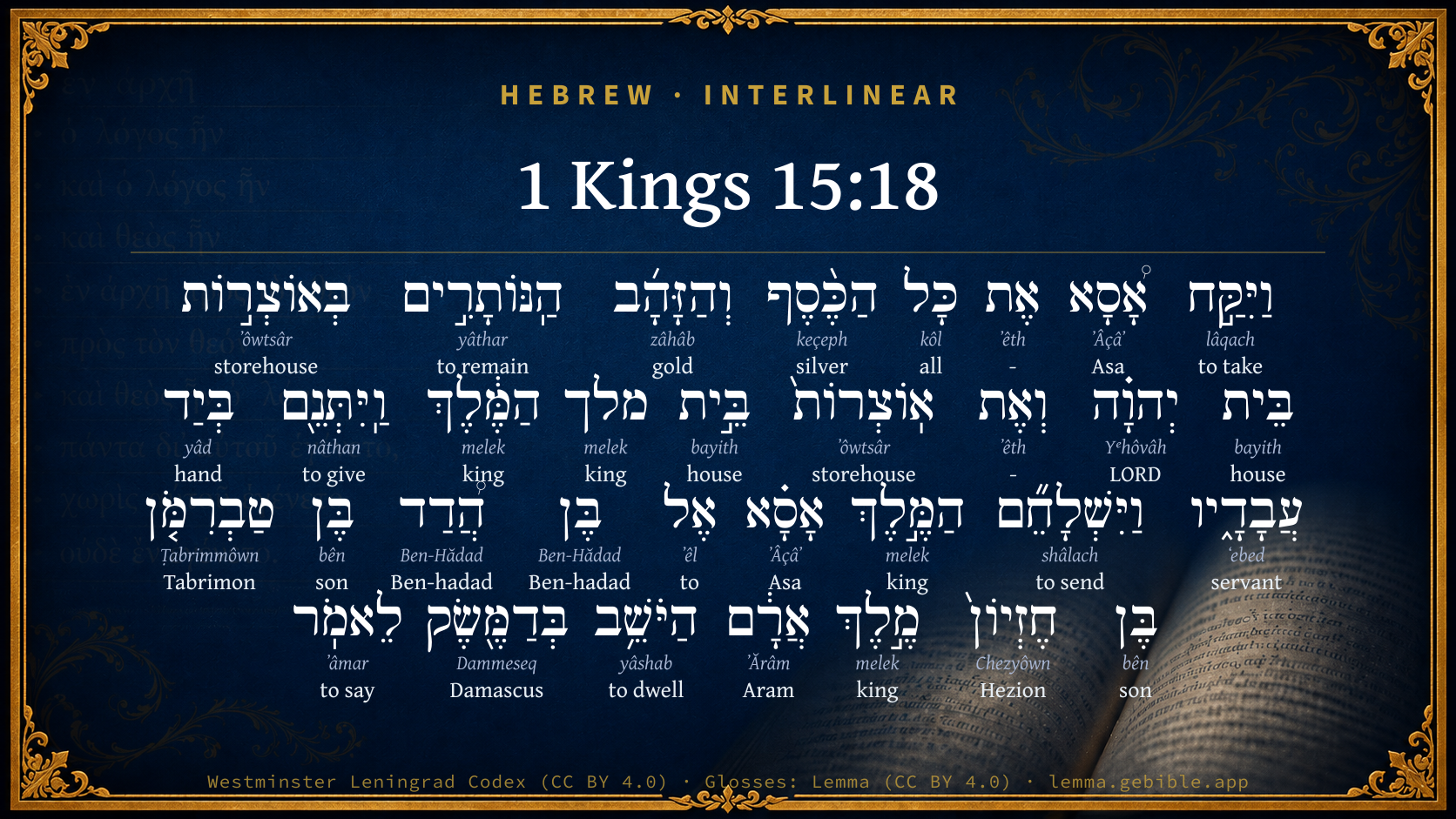
Hebrew (Westminster Leningrad Codex) 1 Kings 15:18 appears in the Hebrew Old Testament. The text above is from the Westminster Leningrad Codex. Each word links to its Strong’s number, a concise gloss, and parsing drawn from the Open Scriptures Hebrew Bible morphology. Click any word for its full Brown-Driver-Briggs (BDB) entry.
Download image
Cite this verse

1 Kings 15:18 (World English Bible). Public Domain. Lemma interlinear Bible study tool, https://lemma.gebible.app/v/1-kings/15/18.

Show BibTeX & RIS
BibTeX
RIS
English Translation
Then Asa took all the silver and the gold that were left in the treasures of the house of Yahweh, and the treasures of the king's house, and delivered them into the hand of his servants; and king Asa sent them to Ben Hadad, the son of Tabrimmon, the son of Hezion, king of Syria, who lived at Damascus, saying,
World English Bible · Public Domain
Highlights
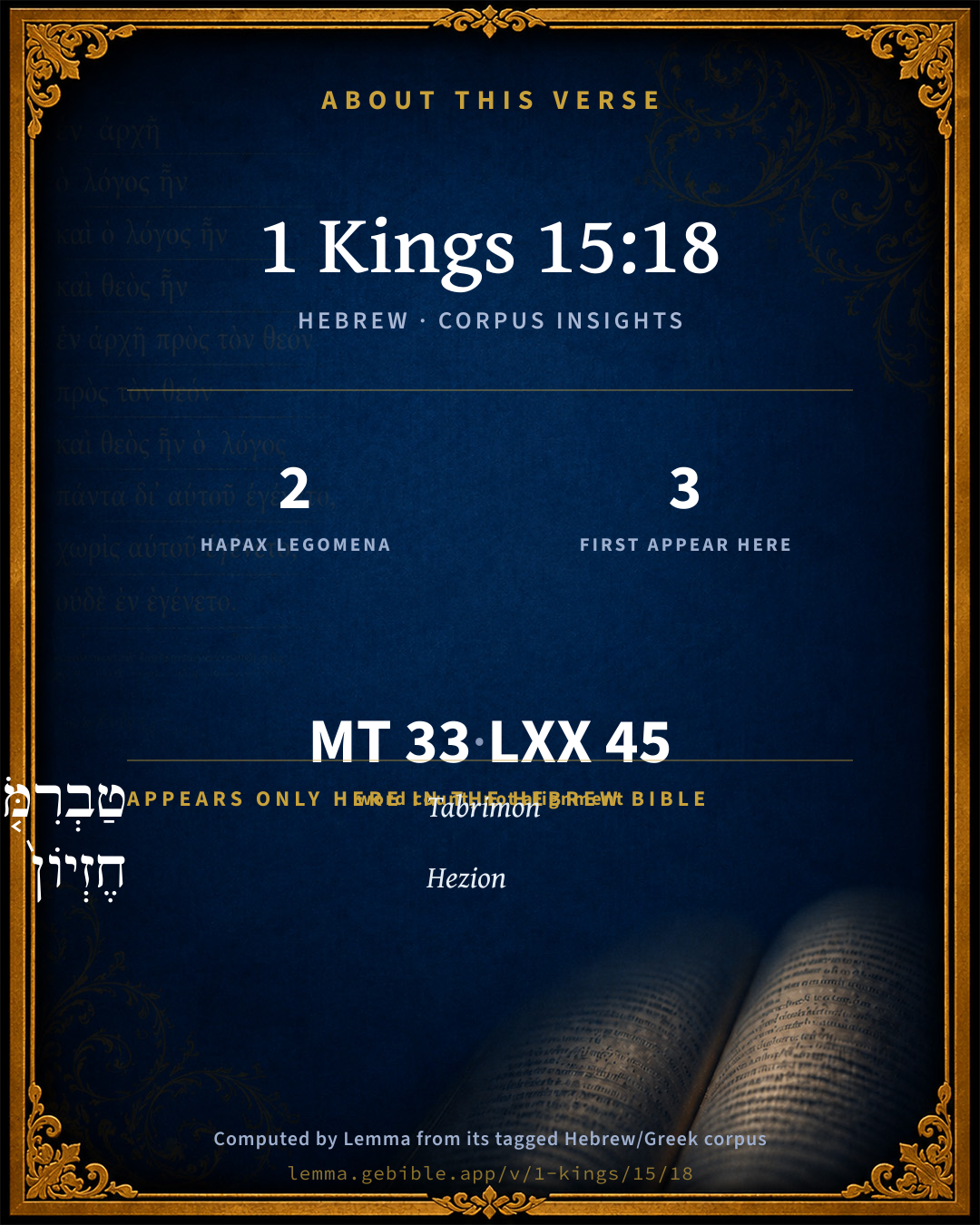
  • 2 hapax legomena — only here in the Hebrew Bible
  • 3 first appearances in the Hebrew Bible
Full analysis ↓
Download a study sheet

One document with this verse’s original text, its word-by-word gloss line, the meaning frame, cross-references with their text, attributed commentary, and full source and license credits — printable, and it pastes into notes with its structure intact.

This verse Autodidact and up

Study sheet (.html) Plain text (.txt)

A passage Seminary Student

Up to 50 verses in one chapter. A passage sheet keeps up to 6 commentary sources and 12 cross-references per verse, in the order this page ranks them, and says so on the sheet whenever that leaves anything out. Ask for a single verse and you get the Autodidact verse sheet above.

Everything on this page stays free to read, with no account — the sheet is a download of what is already on screen, not access to it.

Want to remove ads? Support Godless Engineer
Compare translations 3

The same verse in 3 English versions, stacked beneath the original-language interlinear above. Click any original word for its lexicon entry.

Each is an independent rendering of the whole verse — the interlinear is not word-aligned to these translations.

Highlighted words mark where these versions differ — a whole-verse word diff, not a word-by-word alignment.

  • World English Bible Public Domain
    Then Asa took all the silver and the gold that were left in the treasures of the house of Yahweh, and the treasures of the king's house, and delivered them into the hand of his servants; and king Asa sent them to Ben Hadad, the son of Tabrimmon, the son of Hezion, king of Syria, who lived at Damascus, saying,
  • King James Version Public Domain
    Then Asa took all the silver and the gold that were left in the treasures of the house of the LORD, and the treasures of the king's house, and delivered them into the hand of his servants: and king Asa sent them to Benhadad, the son of Tabrimon, the son of Hezion, king of Syria, that dwelt at Damascus, saying,
  • unfoldingWord Literal Text CC BY-SA 4.0
    And Asa took all of the silver and the gold remaining in the storerooms of the house of Yahweh and the storerooms of the house of the king, and he gave them into the hand of his servants. And King Asa sent them to Ben Hadad, the son of Tabrimmon, the son of Hezion, the king of Aram, the dweller in Damascus, saying,

unfoldingWord Literal Text — © unfoldingWord, licensed CC BY-SA 4.0. Word-aligned USFM3 via Door43 (git.door43.org/unfoldingWord/en_ult).

Versions to compare (up to 4)

3 of 4 selected

Show all 18 translations

Every available English version of this verse, each an independent rendering of the whole verse.

  • World English Bible Public Domain
    Then Asa took all the silver and the gold that were left in the treasures of the house of Yahweh, and the treasures of the king's house, and delivered them into the hand of his servants; and king Asa sent them to Ben Hadad, the son of Tabrimmon, the son of Hezion, king of Syria, who lived at Damascus, saying,
  • Berean Standard Bible Public Domain
    So Asa withdrew all the silver and gold that remained in the treasuries of the house of the LORD and the royal palace. He entrusted it to his servants and sent them with this message to Ben-hadad son of Tabrimmon, the son of Hezion king of Aram, who was ruling in Damascus:
  • Majority Standard Bible Public Domain
    So Asa withdrew all the silver and gold that remained in the treasuries of the house of the LORD and the royal palace. He entrusted it to his servants and sent them with this message to Ben-hadad son of Tabrimmon, the son of Hezion, the king of Aram, who was ruling in Damascus:
  • King James Version Public Domain
    Then Asa took all the silver and the gold that were left in the treasures of the house of the LORD, and the treasures of the king's house, and delivered them into the hand of his servants: and king Asa sent them to Benhadad, the son of Tabrimon, the son of Hezion, king of Syria, that dwelt at Damascus, saying,
  • American Standard Version (1901) Public Domain
    Then Asa took all the silver and the gold that were left in the treasures of the house of Jehovah, and the treasures of the king's house, and delivered them into the hand of his servants; and king Asa sent them to Ben-hadad, the son of Tabrimmon, the son of Hezion, king of Syria, that dwelt at Damascus, saying,
  • Revised Version (1885) Public Domain
    Then Asa took all the silver and the gold that were left in the treasures of the house of the LORD, and the treasures of the king’s house, and delivered them into the hand of his servants: and king Asa sent them to Ben-hadad, the son of Tabrimmon, the son of Hezion, king of Syria, that dwelt at Damascus, saying,
  • Geneva Bible (1599) Public Domain
    Then Asa tooke all the siluer and the gold that was left in the treasures of the house of the Lord, and the treasures of the kings house, and deliuered them into the handes of his seruantes, and King Asa sent them to Ben-hadad the sonne of Tabrimon, the sonne of Hezion king of Aram that dwelt at Damascus, saying,
  • Douay-Rheims (1899) Public Domain
    Then Asa took all the silver and gold that remained in the treasures of the house of the Lord, and in the treasures of the king's house, and delivered it into the hands of his servants: and sent them to Benadad son of Tabremon the son of Hezion, king of Syria, who dwelt in Damascus, saying:
  • Young's Literal Translation Public Domain
    And Asa taketh all the silver and the gold that are left in the treasures of the house of Jehovah, and the treasures of the house of the king, and giveth them into the hand of his servants, and king Asa sendeth them unto Ben-Hadad, son of Tabrimmon, son of Hezion king of Aram, who is dwelling in Damascus, saying,
  • Literal Standard Version CC BY-SA 4.0
    And Asa takes all the silver and the gold that are left in the treasures of the house of YHWH, and the treasures of the house of the king, and gives them into the hand of his servants, and King Asa sends them to Ben-Hadad, son of Tabrimmon, son of Hezion king of Aram, who is dwelling in Damascus, saying,
  • Unlocked Literal Bible CC BY-SA 4.0
    Then Asa took all the silver and gold left in the storerooms in the house of Yahweh, and the storerooms of the king's palace. He put it into the hands of his servants and sent it to Ben Hadad son of Tabrimmon son of Hezion, the king of Aram, who lived in Damascus. He said,
  • unfoldingWord Literal Text CC BY-SA 4.0
    And Asa took all of the silver and the gold remaining in the storerooms of the house of Yahweh and the storerooms of the house of the king, and he gave them into the hand of his servants. And King Asa sent them to Ben Hadad, the son of Tabrimmon, the son of Hezion, the king of Aram, the dweller in Damascus, saying,
  • Darby Bible Public Domain
    And Asa took all the silver and the gold that were left in the treasures of the house of Jehovah, and in the treasures of the king's house, and gave them into the hand of his servants; and king Asa sent them to Ben-Hadad, the son of Tabrimmon, the son of Hezion, king of Syria, who dwelt at Damascus, saying,
  • World Messianic Bible Public Domain
    Then Asa took all the silver and the gold that was left in the treasures of the LORD’s house, and the treasures of the king’s house, and delivered it into the hand of his servants. Then King Asa sent them to Ben Hadad, the son of Tabrimmon, the son of Hezion, king of Syria, who lived at Damascus, saying,
  • Webster's Bible Public Domain
    Then Asa took all the silver and the gold that were left in the treasures of the house of the LORD, and the treasures of the king's house, and delivered them into the hand of his servants: and king Asa sent them to Ben-hadad, the son of Tabrimon, the son of Hezion, king of Syria, that dwelt at Damascus, saying,
  • Free Bible Version CC BY-SA 4.0
    So Asa took all the silver and gold that was left in the treasuries of the Lord's Temple and of the royal palace. He handed it over to his servants and sent them to Ben-hadad, son of Tabrimmon, the son of Hezion, king of Aram, who lived in Damascus, along with this message:
  • Bible in Basic English Public Domain
    Then Asa took all the silver and gold which was still stored in the Lord's house, and in the king's house, and sent them, in the care of his servants, to Ben-hadad, son of Tabrimmon, son of Rezon, king of Aram, at Damascus, saying,
  • JPS Tanakh (1917) Public Domain
    Then Asa took all the silver and the gold that were left in the treasures of the house of the LORD, and the treasures of the king's house, and delivered them into the hand of his servants; and king Asa sent them to Ben-hadad, the son of Tabrimmon, the son of Hezion, king of Aram, that dwelt at Damascus, saying:

Literal Standard Version (2020), Covenant Press — licensed CC BY-SA 4.0. Text via the HelloAO Bible API (eBible.org). Unlocked Literal Bible (unfoldingWord) — licensed CC BY-SA 4.0. Text via the HelloAO Bible API (eBible.org). unfoldingWord Literal Text — © unfoldingWord, licensed CC BY-SA 4.0. Word-aligned USFM3 via Door43 (git.door43.org/unfoldingWord/en_ult). Free Bible Version, Dr. Jonathan Gallagher — licensed CC BY-SA 4.0. Text via the HelloAO Bible API (eBible.org).

Word by word

More ways to search: Search by grammar → Find every occurrence → Compare this word →

Practice this passage: Drill this verse → Learn its vocabulary →

טַבְרִמֹּ֤ן
Ṭabrimmôwn
H2886
“Tabrimon”
Noun, Proper
Part of Speech
Noun
Type
Proper
Full BDB Definition

Origin: from H2895 and H7417

TWOT: None

Tabrimon = "good is Rimmon" - the father of Ben-hadad I, king of Syria
  1. וַיִּקַּ֣ח lâqach H3947 “and · to take” Conjunction + Verb, Qal, Sequential Imperfect, 3rd Person, Masculine, Singular
  2. אָ֠סָא ʼÂçâʼ H609 “Asa” Noun, Proper
  3. אֶת ʼêth H853 “-” Particle, Direct Object
  4. כָּל kôl H3605 “all of” Noun, Common, Masculine, Singular, Construct
  5. הַכֶּ֨סֶף keçeph H3701 “the · silver” Particle, Definite Article + Noun, Common, Masculine, Singular, Absolute
  6. וְהַזָּהָ֜ב zâhâb H2091 “and · the · gold” Conjunction + Particle, Definite Article + Noun, Common, Masculine, Singular, Absolute
  7. הַֽנּוֹתָרִ֣ים yâthar H3498 “the · remaining” Particle, Definite Article + Verb, Niphal, Participle Active, Masculine, Plural, Absolute
  8. בְּאוֹצְר֣וֹת ʼôwtsâr H214 “in/at · storehouses of” Preposition + Noun, Common, Masculine, Plural, Construct
  9. בֵּית bayith H1004 “house of” Noun, Common, Masculine, Singular, Construct
  10. יְהוָ֗ה Yᵉhôvâh H3068 “LORD” Noun, Proper
  11. וְאֶת ʼêth H853 “and · -” Conjunction + Particle, Direct Object
  12. אֽוֹצְרוֹת֙ ʼôwtsâr H214 “storehouses of” Noun, Common, Masculine, Plural, Construct
  13. בֵּ֣ית bayith H1004 “house of” Noun, Common, Masculine, Singular, Construct
  14. מלך melek H4428 “king” Noun, Common, Masculine, Singular, Absolute
  15. הַמֶּ֔לֶךְ melek H4428 “the · king” Particle, Definite Article + Noun, Common, Masculine, Singular, Absolute
  16. וַֽיִּתְּנֵ֖ם nâthan H5414 “and · to give · them” Conjunction + Verb, Qal, Sequential Imperfect, 3rd Person, Masculine, Singular + Suffix, Personal, 3rd Person, Masculine, Plural
  17. בְּיַד yâd H3027 “in/at · hand of” Preposition + Noun, Common, Both, Singular, Construct
  18. עֲבָדָ֑יו ʻebed H5650 “servants · his” Noun, Common, Masculine, Plural, Construct + Suffix, Personal, 3rd Person, Masculine, Singular
  19. וַיִּשְׁלָחֵ֞ם shâlach H7971 “and · to send · them” Conjunction + Verb, Qal, Sequential Imperfect, 3rd Person, Masculine, Singular + Suffix, Personal, 3rd Person, Masculine, Plural
  20. הַמֶּ֣לֶךְ melek H4428 “the · king” Particle, Definite Article + Noun, Common, Masculine, Singular, Absolute
  21. אָסָ֗א ʼÂçâʼ H609 “Asa” Noun, Proper
  22. אֶל ʼêl H413 “to” Preposition
  23. בֶּן Ben-Hădad H1130 “Ben-hadad” Noun, Proper
  24. הֲ֠דַד Ben-Hădad H1130 “Ben-hadad” Noun, Proper
  25. בֶּן bên H1121 “son of” Noun, Common, Masculine, Singular, Construct
  26. בֶּן bên H1121 “son of” Noun, Common, Masculine, Singular, Construct
  27. חֶזְיוֹן֙ Chezyôwn H2383 “Hezion” Noun, Proper
  28. מֶ֣לֶךְ melek H4428 “king of” Noun, Common, Masculine, Singular, Construct
  29. אֲרָ֔ם ʼĂrâm H758 “Aram” Noun, Proper
  30. הַיֹּשֵׁ֥ב yâshab H3427 “the · dwelling” Particle, Definite Article + Verb, Qal, Participle Active, Masculine, Singular, Absolute
  31. בְּדַמֶּ֖שֶׂק Dammeseq H1834 “in/at · Damascus” Preposition + Noun, Proper
  32. לֵאמֹֽר ʼâmar H559 “to say” Preposition + Verb, Qal, Infinitive Construct

About this verse

These counts appear in no published source. They are computed here, from the morphology-tagged text and Lemma’s own curated glosses. What Lemma adds →

33
words
24
distinct lemmas
Historical
section

Notable vocabulary

2 hapax legomena — words that appear only here in the entire Hebrew Bible:

  • טַבְרִמֹּ֤ן Tabrimon H2886
  • חֶזְיוֹן֙ Hezion H2383

First appearance in Scripture

These words make their first canonical appearance in the Hebrew Bible here:

  • בֶּן Ben-hadad H1130
  • טַבְרִמֹּ֤ן Tabrimon H2886
  • חֶזְיוֹן֙ Hezion H2383

Shared distinctive vocabulary

בְּדַמֶּ֖שֶׂק Damascus H1834 occurs in 40 verses of the Hebrew Bible. Also found in:

Grammatical profile

  • 6 verbs
  • 24 nouns
  • 1 preposition
  • 2 particles

Verb forms

  • וַיִּקַּ֣ח Qal · Sequential Imperfect
  • הַֽנּוֹתָרִ֣ים Niphal · Participle Active
  • וַֽיִּתְּנֵ֖ם Qal · Sequential Imperfect
  • וַיִּשְׁלָחֵ֞ם Qal · Sequential Imperfect
  • הַיֹּשֵׁ֥ב Qal · Participle Active
  • לֵאמֹֽר Qal · Infinitive Construct

Repetition

Words recur within this verse — often emphatic in Hebrew:

  • מלך king H4428 ×4
  • אָ֠סָא Asa H609 ×2
  • בְּאוֹצְר֣וֹת storehouse H214 ×2
  • בֵּית house H1004 ×2
  • בֶּן Ben-hadad H1130 ×2
  • בֶּן son H1121 ×2

Hebrew & Septuagint length

In English translation the verse runs 60 words from the Hebrew and 64 from the Septuagint (LXX English) — closely comparable.

A rough comparison of the two English renderings, which tokenize alike — not a word-level alignment.

Word counts can differ between the Hebrew and the Greek without any difference in meaning — e.g. the Hebrew direct-object marker אֵת has no separate Greek word, and Greek often adds the article ὁ.

In the original languages it is 33 Hebrew tokens and 45 Greek tokens — but the two are counted differently (Hebrew bundles its prefixes and suffixes into one token; the Greek is in lemma form), so that isn’t a like-for-like length.

Cross-references

14

Topical passages linked to 1 Kings 15:18 in the Treasury of Scripture Knowledge — connected by theme and wording, ordered by reader-vote popularity; previews shown in the World English Bible.

  • 1 Kings 14:26 and he took away the treasures of the house of Yahweh, and the treasures of the king's house; he even took away all: and he took away all the shields of gold which Solomon had made.
  • 2 Kings 12:18 Jehoash king of Judah took all the holy things that Jehoshaphat and Jehoram and Ahaziah, his fathers, kings of Judah, had dedicated, and his own holy things, and all the gold that was found in the treasures of the house of Yahweh, and of the king's house, and sent it to Hazael king of Syria: and he went away from Jerusalem.
  • 1 Kings 11:23–24 God raised up [another] adversary to him, Rezon the son of Eliada, who had fled from his lord Hadadezer king of Zobah.
  • 1 Kings 15:15 He brought into the house of Yahweh the things that his father had dedicated, and the things that himself had dedicated, silver, and gold, and vessels.
  • Genesis 14:15 He divided himself against them by night, he and his servants, and struck them, and pursued them to Hobah, which is on the left hand of Damascus.
  • Genesis 15:2 Abram said, "Lord Yahweh, what will you give me, seeing I go childless, and he who will inherit my estate is Eliezer of Damascus?"
  • 1 Kings 20:1–5 Ben Hadad the king of Syria gathered all his host together; and there were thirty-two kings with him, and horses and chariots: and he went up and besieged Samaria, and fought against it.
  • 1 Kings 20:33–34 Now the men observed diligently, and hurried to catch whether it were his mind; and they said, Your brother Ben Hadad. Then he said, Go you, bring him. Then Ben Hadad came forth to him; and he caused him to come up into the chariot.
  • 2 Kings 8:7–15 Elisha came to Damascus; and Benhadad the king of Syria was sick; and it was told him, saying, The man of God is come here.
  • 2 Kings 18:15–16 Hezekiah gave [him] all the silver that was found in the house of Yahweh, and in the treasures of the king's house.
  • 2 Chronicles 15:18 He brought into the house of God the things that his father had dedicated, and that he himself had dedicated, silver, and gold, and vessels.
  • 2 Chronicles 16:2–6 Then Asa brought out silver and gold out of the treasures of the house of Yahweh and of the king's house, and sent to Ben Hadad king of Syria, who lived at Damascus, saying,
  • Jeremiah 49:27 I will kindle a fire in the wall of Damascus, and it shall devour the palaces of Ben Hadad.
  • Amos 1:4 But I will send a fire into the house of Hazael, And it will devour the palaces of Ben Hadad.

Cross-references courtesy of OpenBible.info (CC BY 4.0).

Hebrew and Greek witnesses Masoretic Hebrew ↔ Greek Septuagint

The same verse in the two great witnesses to the Old Testament, shown verse-for-verse.

These are two independent witnesses, not word-aligned to each other, and the Septuagint is shown in lemma (dictionary) form.

Hebrew 1 Kings 15:18 Masoretic · Westminster Leningrad Codex

וַיִּקַּ֣ח אָ֠סָא אֶת כָּל הַכֶּ֨סֶף וְהַזָּהָ֜ב הַֽנּוֹתָרִ֣ים בְּאוֹצְר֣וֹת בֵּית יְהוָ֗ה וְאֶת אֽוֹצְרוֹת֙ בֵּ֣ית מלך הַמֶּ֔לֶךְ וַֽיִּתְּנֵ֖ם בְּיַד עֲבָדָ֑יו וַיִּשְׁלָחֵ֞ם הַמֶּ֣לֶךְ אָסָ֗א אֶל בֶּן הֲ֠דַד בֶּן טַבְרִמֹּ֤ן בֶּן חֶזְיוֹן֙ מֶ֣לֶךְ אֲרָ֔ם הַיֹּשֵׁ֥ב בְּדַמֶּ֖שֶׂק לֵאמֹֽר

Then Asa took all the silver and the gold that were left in the treasures of the house of Yahweh, and the treasures of the king's house, and delivered them into the hand of his servants; and king Asa sent them to Ben Hadad, the son of Tabrimmon, the son of Hezion, king of Syria, who lived at Damascus, saying,

World English Bible · Public Domain

Greek LXX 1 Kings 15:18 Septuagint · lemma form

καί λαμβάνω ασα ὁ ἀργύριον καί ὁ χρυσίον ὁ εὑρίσκω ἐν ὁ θησαυρός ὁ οἶκος ὁ βασιλεύς καί δίδωμι αὐτός εἰς χείρ παῖς αὐτός καί ἐκ ἀποστέλλω αὐτός ὁ βασιλεύς ασα πρός υἱός αδερ υἱός ταβερεμμαν υἱός αζιν βασιλεύς συρία ὁ καταοἰκέω ἐν δαμασκός λέγω

And Asa took all the silver and the gold that was found in the treasures of the house of the Lord, and in the treasures of the king's house, and gave them into the hands of his servants; and king Asa sent them out to the son of Ader, the son of Taberema son of Azin king of Syria, who lived in Damascus, saying,

LXX2012 (modern English Septuagint) · Public Domain

On this verse, The Cambridge Bible for Schools and Colleges discusses the Septuagint’s reading. Read the note in Commentary ↓

Hebrew: Westminster Leningrad Codex (CC BY 4.0). Greek: Septuagint (public domain); English from LXX2012 (modern English Septuagint) (Public Domain). How the Septuagint differs from the Hebrew →

Targum (Aramaic paraphrase)

1

The Targum is the ancient Jewish Aramaic paraphrase of the Hebrew Scriptures — an interpretive translation, not the Hebrew text itself. Onkelos (literal) and Pseudo-Jonathan (expansive) render the Torah, and Jonathan the Prophets. Coverage is partial: where no permissively-licensed English translation exists for a verse, only the Aramaic is shown. This is verse-level text, not a word-by-word alignment to the Hebrew.

  1. Targum Jonathan Prophets (Joshua–Malachi)
    וּנְסֵיב אָסָא יַת כָּל כַּסְפָּא וְדַהֲבָא דְאִשְׁתָּאֲרוּ בְּאוֹצְרוֹת בֵּית מַקְדְשָׁא דַייָ וְיַת אוֹצָרֵי בֵּית מַלְכָּא וּמְנִינוּן בִּידָא דְעַבְדוֹהִי וְשַׁדְרִינוּן מַלְכָּא אָסָא לְוַת בַּר הֲדַד בַּר טַבְרִימוֹן בַּר חֶזְיוֹן מַלְכָּא דַאֲרָם דְיָתֵיב בְּדַמֶשֶׂק לְמֵימָר:

    (no public-domain English translation for this verse)

    Targum Jonathan — Aramaic: “Mikraot Gedolot” (public domain). English: “Sefaria Community Translation” (CC0 1.0 (public-domain dedication)); “London "Chaldee Paraphrase," 1871” (public domain). Text via Sefaria.

Commentary

Notes on 1 Kings 15:18 from classic Christian and Jewish commentators (each source and its license shown beneath its notes). The classic Christian expositions comment on the surrounding passage and are grouped to its opening verse, so a note may address several verses; the Jewish commentaries on the Tanakh (Rashi and others) are per-verse, so they appear only where the commentator wrote on this verse.

Lemma curates 59 commentaries, every one of them public domain or Creative Commons licensed, each selected and text-cleaned for this edition rather than reprinted as found. About our sources →

Trapp's Complete Commentary

John Trapp

1Ki 15:18 Then Asa took all the silver and the gold [that were] left in the treasures of the house of the LORD, and the treasures of the king’s house, and delivered them into the hand of his servants: and king Asa sent them to Benhadad, the son of Tabrimon, the son of Hezion, king of Syria, that dwelt at Damascus, saying,

Ver. 18. Then Asa took all the silver.] This was plain sacrilege, since no necessity urged him thereunto.

And the treasures of the king’s house.] Which were much augmented doubtless by the great spoils of the Ethiopians and Lubims, lately beaten by him.

The son of Hezion.] Alias Rezon, of whom see 1Ki 11:23.

John Trapp, A Commentary or Exposition upon All the Books of the Old and New Testament (1647–1656) — public domain. Text from a community e-Sword module.

Albert Barnes' Notes on the Bible

Left - Or, according to another reading, “found.” The wealthy condition of the temple treasury is sufficiently indicated in 1Ki 15:15. Compare 2Ch 15:18.

Asa’s conduct in calling Benhadad to his aid, condemned by the seer Hanani 2Ch 16:7, cannot, of course, be justified; but there was much to excuse it. An alliance, it appears, had existed between Abijam and Tabrimon, Benhadad’s father 1Ki 15:19 - an alliance which may have helped Abijam to gain his great victory over Jeroboam and achieve his subsequent conquests 2Ch 13:17-20. This had been brought to an end by Baasha, who had succeeded in inducing Benhadad to enter into a league with him. It was only natural that Asa should endeavor to break up this league; and, politically speaking, he had a full right to go further, and obtain, if he could, the support of the Syrian troops for himself. The Israelites had set the example of calling in a foreign power, when Jeroboam obtained the aid of Shishak.

To Benhadad - On the probable succession of the Damascene kings, and on the meaning of the name Hadad, see 1Ki 11:14, 1Ki 11:23.

Albert Barnes' Notes on the Bible (1834–1885) — public domain. Text from a community e-Sword/MySword module.

Joseph Benson's Commentary

1Ki 15:18. Asa took all the silver and gold that were left — Which either Shishak had left, or Abijam or Asa or others, of both Israel or Judah, had dedicated; which probably was not inconsiderable, because Asa had got great spoils from Zarah, (2 Chronicles 14.) and he, and his numerous and prosperous people, did at this time express a great zeal for the house and worship of God. Sent them — Wherein he committed three great faults, among many others; 1st, He alienated things consecrated to God, without necessity. 2d, He did this out of distrust of that God whose power and goodness he had lately experienced. 3d, He did this for an ill intent, to hire him to the breach of his league and covenant with Baasha, (1Ki 15:19,) and to take away part of that land which by right, and the special gift of God, belonged to the Israelites.

Joseph Benson's Commentary on the Old and New Testaments (1811–1818) — public domain. Text from a community e-Sword module.

Tyndale Open Study Notes

Tyndale Open Resources

15:18-19 Ben-hadad . . . the king of Aram and his successors were a major factor in Aramean-Israelite relations for many years. Asa’s appeal for Ben-hadad’s help was reinforced with rich gifts taken from the Temple treasury. Despite previous enmity between the Arameans and Israel (11:23-25; 2 Sam 8:3-12; 2 Chr 8:3-4), Ben-hadad and Baasha had established a treaty. Asa understood that the Aramean king’s assistance could be purchased for the right price (1 Kgs 15:20). When God’s prophet Hanani delivered the Lord’s rebuke to Asa for approaching Ben-hadad, Asa reacted uncharacteristically and threw him into prison (2 Chr 16:7-10). Asa apparently forgot God’s previous intervention on his behalf against Zerah’s sizeable army (2 Chr 14:7-8).

Tyndale Open Study Notes — © Tyndale Open Resources, licensed CC BY-SA 4.0. Text via the HelloAO Bible API.

Geneva Bible (1599)

Geneva Bible translators

Or, Syria.

Geneva Bible (1599) marginal notes — public domain. Text via Bolls.life.

Jamieson, Fausset & Brown

Robert Jamieson, A. R. Fausset & David Brown

Then Asa took all the silver and the gold that were left in the . . . house of the Lord--Asa's religious character is now seen to decline. He trusted not in the Lord (Ch2 16:7). In this emergency Asa solicited the powerful aid of the king of Damascene-Syria; and to bribe him to break off his alliance with Baasha, he transmitted to him the treasure lying in the temple and palace. The Syrian mercenaries were gained. Instances are to be found, both in the ancient and modern history of the East, of the violation of treaties equally sudden and unscrupulous, through the presentation of some tempting bribe. Ben-hadad poured an army into the northern provinces of Israel, and having captured some cities in Galilee, on the borders of Syria, compelled Baasha to withdraw from Ramah back within his own territories.

Ben-hadad--(See on Kg1 11:14).

Jamieson, Fausset & Brown — Commentary Critical and Explanatory on the Whole Bible (1871) — public domain (CC PDM 1.0). Text via the HelloAO Bible API.

Adam Clarke's Commentary

Verse 18. Asa took all the silver] Shishak, king of Egypt, had not taken the whole, or there had been some treasures brought in since that time.

Ben-hadad] This was the grandson of Rezon, called here Hezion, who founded the kingdom of Damascus. See 1Kg 11:23-24; and Calmet.

Adam Clarke's Commentary on the Bible (1810–1826) — public domain. Text from a community e-Sword/MySword module.

Ellicott's Commentary for English Readers

(18) Sent them to Ben-hadad.—This shows that Syria, recovering its independence at the fall of Solomon’s empire, was already attaining the formidable power, which so soon threatened to destroy Israel altogether. The Ben-hadad of the text is the grandson of Hezion, who must be the Rezon of 1Ki_11:23. Already, as we gather from the next verse, there had been leagues between Syria and Judah in the preceding reign. Now it is clear that Baasha had attempted to supersede these by a closer league—possibly, like Pekah in later times (2Ki_16:5-6), desiring to strengthen and secure himself against invasion by the subjugation of Judah. Asa naturally resolved to bribe Ben-hadad by presents to prefer the old tie to the new; but he went beyond this, and proposed a combined attack on Israel, for the first time calling in a heathen power against his “brethren, the children of Israel.” It was an expedient which, though it succeeded for its immediate purpose, yet both as a desperate policy and an unfaithfulness to the brotherhood, which, in spite of separation and corruption, still bound the two kingdoms in the covenant of God with Abraham, deserved and received prophetic rebuke. (See 2Ch_16:7-9.) Just so Isaiah, in the days of Ahaz and Hezekiah, denounced the vain trust in confederacies with the neighbouring nations and alliance with Egypt (Isa_30:1-17).

A Bible Commentary for English Readers, edited by Charles John Ellicott (1878–1897) — public domain. Text from a community e-Sword module.

The Cambridge Bible for Schools and Colleges

gen. ed. J. J. S. Perowne

18. Ben-hadad, the son of Tabrimon [R.V. Tabrimmon] the son of Hezion, king of Syria] This is the earliest of the three kings of this name mentioned in the Old Testament. ‘Hezion’ is probably the same person as the ‘Rezon,’ king of Damascus mentioned in 1Ki_11:23, and Ben-hadad 1. was apparently his grandson. We cannot always determine whether the names of these kings are merely significant titles, or true names. ‘Hadad’ was a Syrian god, perhaps the sun-god, and Ben-hadad, ‘son of Hadad’ may mean one devoted to Hadad’s worship. So ‘Tab-rimmon’ signifies ‘good is Rimmon’; Rimmon being another Syrian divinity (see 2Ki_5:18). This is much more likely to be a personal name than Ben-hadad. The war which Ben-hadad now began against Israel appears to have been continued in the days of Ahab. See below 1Ki_20:1. In the LXX. this king is called υἱὸς Ἄδερ.

The Cambridge Bible for Schools and Colleges (gen. ed. J. J. S. Perowne; Cambridge University Press, 1878–1918) — public domain. Text from a community e-Sword module.

John Gill's Exposition

The rest of all the acts of Asa, and all his might, and all that he did, and the cities which he built, are they not written in the book of the chronicles of the kings of Judah?.... Some of which are to be met with in the canonical book of that name, Ch2 14:1, and others in the annals of the kings, out of which the Scripture account was taken:

nevertheless, in the time of his old age he was diseased in his feet; seized with the gout, as the Jews say (a), and which was two years before his death, see Ch2 16:12.

(a) T. Bab. Sanhedrin, fol. 48. 2. So Clemens of Alexandria, Stromat. l. 1. p. 326.

John Gill's Exposition of the Whole Bible (1746–1763) — public domain (CC PDM 1.0). Text via the HelloAO Bible API.

Haydock's Catholic Bible Commentary

House. Sesac had not carried off all the treasures, (Calmet) and the losses had been since in a great measure repaired, ver. 15. (Haydock) --- Asa thought himself justified in employing these treasures in such a pressing necessity, (Calmet) perhaps (Haydock) without reason, as the danger was not so great; and he might have gained the victory without having recourse to an infidel, if he had placed more confidence in God, 2 Paralipomenon xvi. 7, 9. (Menochius) --- He had already discomfited Zara, king of Ethiopia, and had an army of 580,000 men. (Calmet) (2 Paralipomenon xiv. 8.) --- Tabremon, "Good Remmon," idol of Damascus. (Haydock) --- Hezion, the same with Razon, chap. xi. 23. (Menochius)

George Leo Haydock (1774–1849), Haydock's Catholic Family Bible and Commentary, 1859 edition — public domain. Excludes Psalms (Douay-Rheims chapter numbering differs from Protestant) and Deuterocanonical books (Catholic canon only).

Matthew Poole's English Annotations

All the silver and the gold that were left; these poor remainders, which either Shishak had left at that time, 1Ki 14:26, or Abijam, or Asa, or others, both of Israel and Judah, had dedicated; which probably was not inconsiderable, because Asa had got great spoils from Zerah, 2Ch 14, and he and his numerous and prosperous people did at this time express a great zeal for the house and worship of God.

Asa sent them to Ben-hadad; wherein he committed three great faults, amongst many others. First, He alienated things consecrated to God without necessity. Secondly, He did this out of carnal fear and distrust of that God whose power and goodness he had lately experienced. Thirdly, He did this for an ill intent, to hire him to the breach of his league and covenant with Baasha, 1Ki 15:19, and to take away part of that land which by right, and the special gift of God, belonged to the Israelites.

Matthew Poole's English Annotations on the Holy Bible (1683–1685) — public domain. Text from a community e-Sword/MySword module.

Whedon's Commentary on the Bible

Daniel D. Whedon

18. Then Asa took all the silver — Alas! that he who so recently dedicated these spoils to the Lord (1Ki_15:15) should make such use of them as is here described!

Ben-hadad — Three kings of this name reigned in Damascus. The name seems to have been a royal title, like the Egyptian Pharaoh.

Son of Tabrimon — Of whom nothing more is known.

Hezion — He was probably the same as Rezon, the contemporary and adversary of Solomon. 1Ki_11:23.

Daniel D. Whedon (gen. ed.), Commentary on the Old and New Testaments (1874–1909) — public domain. Text from a community e-Sword module.

The Pulpit Commentary

Then Asa took all the silver and the gold that were left LXX to suJreqen, which Rawlinson thinks points to a corruption of our text. He says, "The Jewish treasuries should now have been tolerably full," because

(1) of the long peace, (2Ch_14:1-6) and

(2) the "very much spoil" they had taken from the Ethiopians (ib., ver. 13). Compare ver. 15 above. But the historian has in mind the depletion of the treasury by Shishak. (1Ki_14:26) It is true there was nothing "left" on that occasion, but the treasures since accumulated are referred to under this term. It may be the phrase is not strictly accurate, but the LXX reading looks suspiciously like an emendation in the treasures of the house of the Lord, and the treasures of the king"s house, and delivered them into the hand of his servants: and king Asa sent them cf. 2Ki_16:8. For this act of faithlessness he was reproved by Hanani the: (2Ch_16:7) "O Asa, where was thy piety, while thou robbedst God to corrupt an infidel for the slaughter of the Israelites?" (Hall) to Ben-hadad "the son of the sun". (see note on 1Ki_11:23) Three kings of Damascus at least bore this name, viz., this king, his, (1Ki_20:1) and the son of Hazael, (2Ki 24) the son of Tabrimon the name means, Good is Rimmon, as to which deity, (see note 2Ki_5:18) the son of Hezion by some identified with Rezin, (1Ki_11:23) but on insufficient grounds king of Syria, that dwelt at Damascus "The centre of the Aramaean power west of the Euphrates" (Ewald), saying,

The Pulpit Commentary (1880–1919), ed. H.D.M. Spence-Jones & Joseph S. Exell — public domain. Text from a community e-Sword module.

John Wesley's Explanatory Notes

Were left - What either Shishak had left, or Abijam, or Asa, or others, both of Israel or Judah had dedicated; which probably was not inconsiderable, because Asa had got great spoils from Zerah, 2 Chron. xiv, 9-15, and he and his numerous and prosperous people, did at this time express a great zeal for the house and worship of God. Sent them - Wherein he committed three great faults, amongst many others, first, he alienated things consecrated to God, without necessity. Secondly, he did this out of distrust of that God whose power and goodness he had lately experienced. Thirdly, he did this for an ill intent, to hire him to the breach of his league and covenant with Baasha, ver. 19, and to take away part of that land which by right, and the special gift of God, belonged to the Israelites.

John Wesley, Explanatory Notes Upon the Whole Bible (1754–1765) — public domain. Text via the GEBible commentary corpus.

unfoldingWord translationNotes

Door43 World Missions Community

He put it into the hands of his servants

Putting things in their hands represents giving those things to them. It is implied that they would do with it what he wanted them to do. The full meaning of this statement can be made clear. AT: "He entrusted it to his servants" (See: Metonymy and Assumed Knowledge and Implicit Information)

He said

This means he spoke by means of his servants. Asa told his servants what to say to Ben Hadad and they did. The meaning of this can be made clear. AT: "Asa told his servants to say to Ben Hadad" or "Through his servants, Asa said to Ben Hadad" (See: Metonymy and Assumed Knowledge and Implicit Information)

Let there be a covenant between me and you

A covenant being between two people represents those two people having a covenant with each other. AT: "Let us have a covenant with each other" or "Let us make a peace treaty" (See: Metaphor)

Look, I

"As proof that I want a treaty with you, I"

Break your covenant with Baasha king of Israel

Breaking a covenant represents canceling it and not doing what one has promised to do. AT: "Cancel your covenant with Baasha king of Israel" or "Do not be loyal to Baasha king of Israel as you promised in your covenant with him" (See: Metaphor)

Break your covenant with Baasha king of Israel

Asa wanted Ben Hadad to attack Israel. Ben Hadad could only do that if he broke his covenant with the king of Israel. The meaning of this statement can be made explicit. AT: "Break your covenant with Baasha king of Israel, and attack Israel" (See: Assumed Knowledge and Implicit Information)

translationWords

palace

hand

servant

send

Aram

Damascus

gift

unfoldingWord translationNotes — © Distant Shores Media and the Door43 World Missions Community, licensed CC BY-SA 4.0. Source: git.door43.org/Door43/en_tn.

Lesson kit

Teaching starters — assembled from the data on this page, not authored interpretation. Every prompt links to the verse data it draws on. Edit before teaching.

1 Kings, in the Historical, opens this verse with 33 words (24 distinct Hebrew lemmas). Its most distinctive word is Ṭabrimmôwn (“Tabrimon”). A historical commentator’s framing appears above. Read the whole chapter for the surrounding context.

Discussion questions

  1. How does “Tabrimon” (Ṭabrimmôwn) shape what this verse is saying?
  2. This verse holds 2 words here found nowhere else in the Hebrew Bible. What might the rare words draw attention to?
  3. 3 words here appear for the first time in Scripture. What is being introduced at this debut?
  4. Genesis 14:15 shares the word «Damascus» with this verse. How do the two illuminate each other?
  5. “king” occurs 4× in this one verse. What is the effect of the repetition?
  6. The translations on this page render this verse differently — a whole-verse word diff, not a word-by-word alignment. What might account for the different wordings?
  7. The verb «וַיִּקַּ֣ח» is Qal Sequential Imperfect. How does its form color the action?
  8. Reading how Trapp's Complete Commentary and Albert Barnes' Notes on the Bible read this verse, where do the two commentators agree and where do they part?

Things to notice

  • 2 words in this verse appear nowhere else in the Hebrew Bible.
  • 3 words make their first canonical appearance in Scripture here.
  • This verse counts 33 Hebrew ↔ 45 Greek words.
  • These translations choose different wording for 20 words in this verse.
  • “king” occurs 4× in this single verse.

Reading settings

Reading text

Shown beneath each verse's original-language words.

Old Testament
Old Testament edition

Read the OT as the Masoretic Hebrew (MT) or the Greek Septuagint (LXX).

English shown for the Greek Septuagint (in the Hebrew ↔ Greek comparison).

Comparing translations? Open the Compare panel on any verse page to stack up to four side by side.