
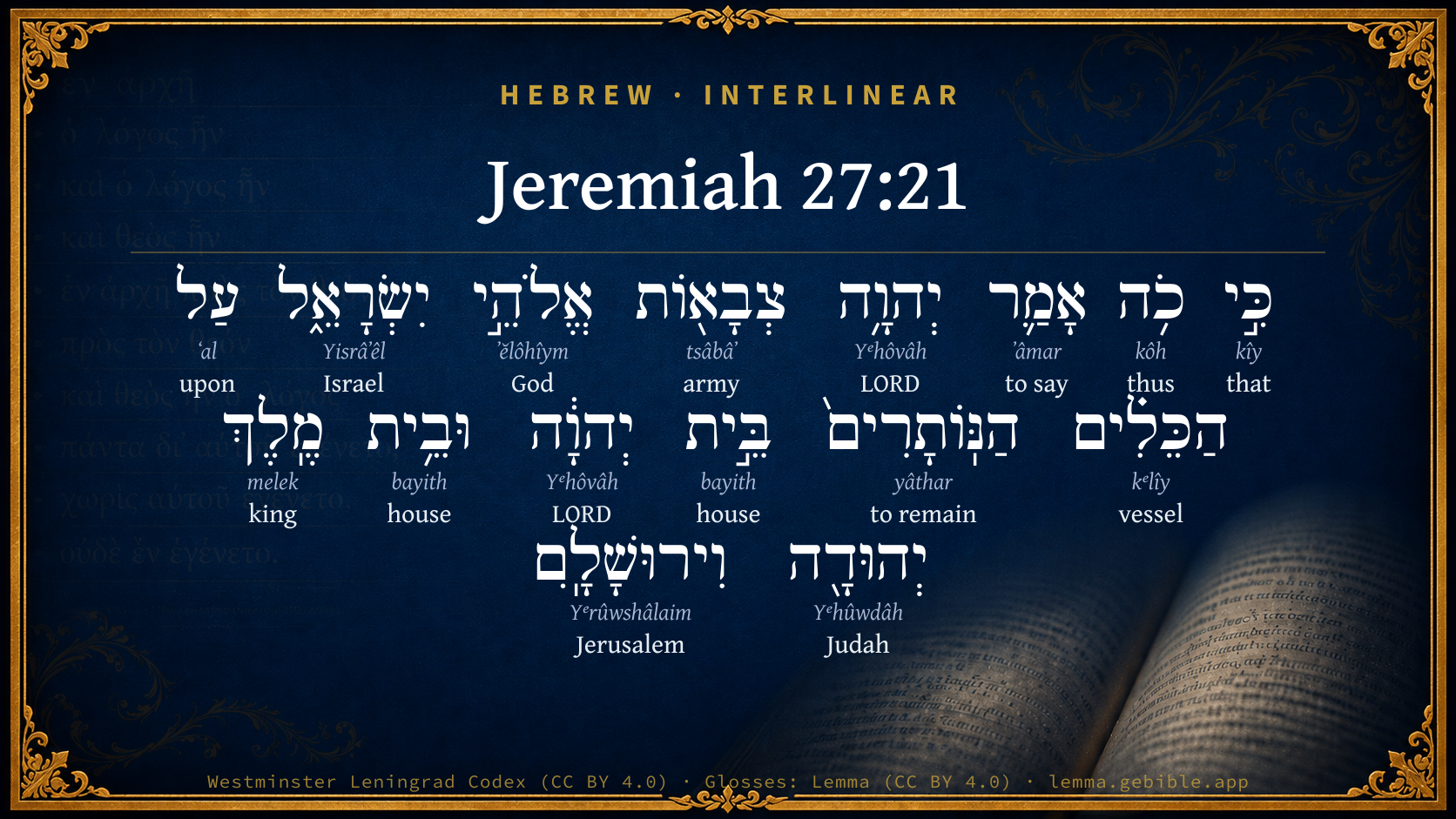
Jeremiah 27:21

Hebrew (Westminster Leningrad Codex) Jeremiah 27:21 appears in the Hebrew Old Testament. The text above is from the Westminster Leningrad Codex. Each word links to its Strong’s number, a concise gloss, and parsing drawn from the Open Scriptures Hebrew Bible morphology. Click any word for its full Brown-Driver-Briggs (BDB) entry.
Download image
Cite this verse

Jeremiah 27:21 (World English Bible). Public Domain. Lemma interlinear Bible study tool, https://lemma.gebible.app/v/jeremiah/27/21.

Show BibTeX & RIS
BibTeX
RIS
English Translation
yes, thus says Yahweh of Hosts, the God of Israel, concerning the vessels that are left in the house of Yahweh, and in the house of the king of Judah, and at Jerusalem:
World English Bible · Public Domain
Download a study sheet

One document with this verse’s original text, its word-by-word gloss line, the meaning frame, cross-references with their text, attributed commentary, and full source and license credits — printable, and it pastes into notes with its structure intact.

This verse Autodidact and up

Study sheet (.html) Plain text (.txt)

A passage Seminary Student

Up to 50 verses in one chapter. A passage sheet keeps up to 6 commentary sources and 12 cross-references per verse, in the order this page ranks them, and says so on the sheet whenever that leaves anything out. Ask for a single verse and you get the Autodidact verse sheet above.

Everything on this page stays free to read, with no account — the sheet is a download of what is already on screen, not access to it.

Want to remove ads? Support Godless Engineer
Compare translations 3

The same verse in 3 English versions, stacked beneath the original-language interlinear above. Click any original word for its lexicon entry.

Each is an independent rendering of the whole verse — the interlinear is not word-aligned to these translations.

Highlighted words mark where these versions differ — a whole-verse word diff, not a word-by-word alignment.

  • World English Bible Public Domain
    yes, thus says Yahweh of Hosts, the God of Israel, concerning the vessels that are left in the house of Yahweh, and in the house of the king of Judah, and at Jerusalem:
  • King James Version Public Domain
    Yea, thus saith the LORD of hosts, the God of Israel, concerning the vessels that remain in the house of the LORD, and in the house of the king of Judah and of Jerusalem;
  • unfoldingWord Literal Text CC BY-SA 4.0
    for thus says Yahweh of Armies, the God of Israel, concerning the vessels remaining the house of Yahweh and the house of the king of Judah and Jerusalem:

unfoldingWord Literal Text — © unfoldingWord, licensed CC BY-SA 4.0. Word-aligned USFM3 via Door43 (git.door43.org/unfoldingWord/en_ult).

Versions to compare (up to 4)

3 of 4 selected

Show all 18 translations

Every available English version of this verse, each an independent rendering of the whole verse.

  • World English Bible Public Domain
    yes, thus says Yahweh of Hosts, the God of Israel, concerning the vessels that are left in the house of Yahweh, and in the house of the king of Judah, and at Jerusalem:
  • Berean Standard Bible Public Domain
    Yes, this is what the LORD of Hosts, the God of Israel, says about the articles that remain in the house of the LORD, in the palace of the king of Judah, and in Jerusalem:
  • Majority Standard Bible Public Domain
    Yes, this is what the LORD of Hosts, the God of Israel, says about the articles that remain in the house of the LORD, in the palace of the king of Judah, and in Jerusalem:
  • King James Version Public Domain
    Yea, thus saith the LORD of hosts, the God of Israel, concerning the vessels that remain in the house of the LORD, and in the house of the king of Judah and of Jerusalem;
  • American Standard Version (1901) Public Domain
    yea, thus saith Jehovah of hosts, the God of Israel, concerning the vessels that are left in the house of Jehovah, and in the house of the king of Judah, and at Jerusalem:
  • Revised Version (1885) Public Domain
    yea, thus saith the LORD of hosts, the God of Israel, concerning the vessels that are left in the house of the LORD, and in the house of the king of Judah, and at Jerusalem:
  • Geneva Bible (1599) Public Domain
    For thus saith the Lord of hostes the God of Israel, concerning the vessels that remaine in the House of the Lord, and in the house of the King of Iudah, and at Ierusalem,
  • Douay-Rheims (1899) Public Domain
    For thus saith the Lord of hosts the God of Israel, to the vessels that are left in the house of the Lord, and in the house of the king of Juda and Jerusalem:
  • Young's Literal Translation Public Domain
    Surely thus said Jehovah of Hosts, God of Israel, concerning the vessels that are left of the house of Jehovah, and of the house of the king of Judah, and `in' Jerusalem:
  • Literal Standard Version CC BY-SA 4.0
    surely thus said YHWH of Hosts, God of Israel, concerning the vessels that are left of the house of YHWH, and of the house of the king of Judah, and [in] Jerusalem:
  • Unlocked Literal Bible CC BY-SA 4.0
    Yahweh of hosts, God of Israel, says this about the objects that remain in the house of Yahweh, the house of the king of Judah, and Jerusalem,
  • unfoldingWord Literal Text CC BY-SA 4.0
    for thus says Yahweh of Armies, the God of Israel, concerning the vessels remaining the house of Yahweh and the house of the king of Judah and Jerusalem:
  • Darby Bible Public Domain
    yea, thus saith Jehovah of hosts, the God of Israel, concerning the vessels that are left in the house of Jehovah, and in the house of the king of Judah, and in Jerusalem:
  • World Messianic Bible Public Domain
    yes, the LORD of Hosts, the God of Israel, says concerning the vessels that are left in the LORD’s house, and in the house of the king of Judah, and at Jerusalem:
  • Webster's Bible Public Domain
    Yes, thus saith the LORD of hosts, the God of Israel, concerning the vessels that remain in the house of the LORD, and in the house of the king of Judah and of Jerusalem;
  • Free Bible Version CC BY-SA 4.0
    Again, this is what the Lord Almighty, the God of Israel, says about the objects left in the Lord's Temple, in the palace of the king of Judah, and in Jerusalem.
  • Bible in Basic English Public Domain
    For this is what the Lord of armies, the God of Israel, has said about the rest of the vessels in the house of the Lord and in the house of the king of Judah and at Jerusalem:
  • JPS Tanakh (1917) Public Domain
    yea, thus saith the LORD of hosts, the God of Israel, concerning the vessels that remain in the house of the LORD, and in the house of the king of Judah, and at Jerusalem:

Literal Standard Version (2020), Covenant Press — licensed CC BY-SA 4.0. Text via the HelloAO Bible API (eBible.org). Unlocked Literal Bible (unfoldingWord) — licensed CC BY-SA 4.0. Text via the HelloAO Bible API (eBible.org). unfoldingWord Literal Text — © unfoldingWord, licensed CC BY-SA 4.0. Word-aligned USFM3 via Door43 (git.door43.org/unfoldingWord/en_ult). Free Bible Version, Dr. Jonathan Gallagher — licensed CC BY-SA 4.0. Text via the HelloAO Bible API (eBible.org).

Word by word

More ways to search: Search by grammar → Find every occurrence → Compare this word →

Practice this passage: Drill this verse → Learn its vocabulary →

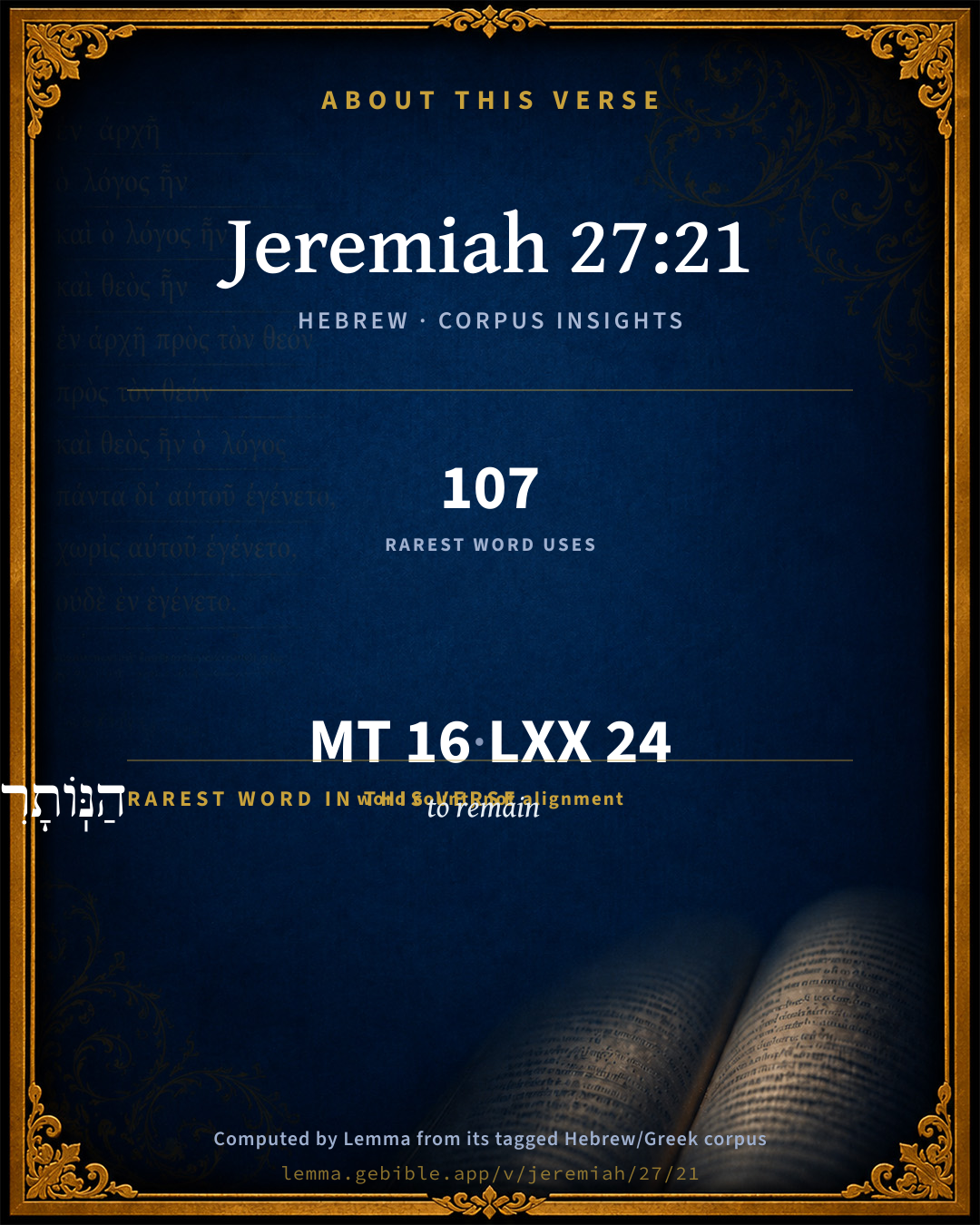
הַנּֽוֹתָרִים֙
yâthar
H3498
“the · remaining”
Particle, Definite Article + Verb, Niphal, Participle Active, Masculine, Plural, Absolute
Part of Speech
Particle + Verb
Stem
Niphal
Form
Participle Active
Gender
Masculine
Number
Plural
State
Absolute
Full BDB Definition

Origin: a primitive root

TWOT: 936

to be left over, remain, remain over, leave - (Qal) remainder (participle) - (Niphal) to be left over, remain over, be left behind - (Hiphil) - to leave over, leave - to save over, preserve alive - to excel, show pre-eminence - to show excess, have more than enough, have an excess
  1. כִּ֣י kîy H3588 “that” Conjunction
  2. כֹ֥ה kôh H3541 “thus” Adverb
  3. אָמַ֛ר ʼâmar H559 “to say” Verb, Qal, Perfect, 3rd Person, Masculine, Singular
  4. יְהוָ֥ה Yᵉhôvâh H3068 “LORD” Noun, Proper
  5. צְבָא֖וֹת tsâbâʼ H6635 “armies” Noun, Common, Both, Plural, Absolute
  6. אֱלֹהֵ֣י ʼĕlôhîym H430 “God(s) of” Noun, Common, Masculine, Plural, Construct
  7. יִשְׂרָאֵ֑ל Yisrâʼêl H3478 “Israel” Noun, Proper
  8. עַל ʻal H5921 “upon” Preposition
  9. הַכֵּלִ֗ים kᵉlîy H3627 “the · vessels” Particle, Definite Article + Noun, Common, Masculine, Plural, Absolute
  10. בֵּ֣ית bayith H1004 “house of” Noun, Common, Masculine, Singular, Construct
  11. יְהוָ֔ה Yᵉhôvâh H3068 “LORD” Noun, Proper
  12. וּבֵ֥ית bayith H1004 “and · house of” Conjunction + Noun, Common, Masculine, Singular, Construct
  13. מֶֽלֶךְ melek H4428 “king of” Noun, Common, Masculine, Singular, Construct
  14. יְהוּדָ֖ה Yᵉhûwdâh H3063 “Judah” Noun, Proper
  15. וִירוּשָׁלִָֽם Yᵉrûwshâlaim H3389 “and · Jerusalem” Conjunction + Noun, Proper

About this verse

These counts appear in no published source. They are computed here, from the morphology-tagged text and Lemma’s own curated glosses. What Lemma adds →

16
words
14
distinct lemmas
Prophets
section

Grammatical profile

  • 2 verbs
  • 11 nouns
  • 1 preposition
  • 1 conjunction
  • 1 adverb

Verb forms

  • אָמַ֛ר Qal · Perfect
  • הַנּֽוֹתָרִים֙ Niphal · Participle Active

Repetition

Words recur within this verse — often emphatic in Hebrew:

  • יְהוָ֥ה LORD H3068 ×2
  • בֵּ֣ית house H1004 ×2

Hebrew & Septuagint length

In the original languages it is 16 Hebrew tokens and 24 Greek tokens — but the two are counted differently (Hebrew bundles its prefixes and suffixes into one token; the Greek is in lemma form), so that isn’t a like-for-like length.

Hebrew and Greek witnesses Masoretic Hebrew ↔ Greek Septuagint

The same verse in the two great witnesses to the Old Testament, shown verse-for-verse.

These are two independent witnesses, not word-aligned to each other, and the Septuagint is shown in lemma (dictionary) form.

Hebrew Jeremiah 27:21 Masoretic · Westminster Leningrad Codex

כִּ֣י כֹ֥ה אָמַ֛ר יְהוָ֥ה צְבָא֖וֹת אֱלֹהֵ֣י יִשְׂרָאֵ֑ל עַל הַכֵּלִ֗ים הַנּֽוֹתָרִים֙ בֵּ֣ית יְהוָ֔ה וּבֵ֥ית מֶֽלֶךְ יְהוּדָ֖ה וִירוּשָׁלִָֽם

yes, thus says Yahweh of Hosts, the God of Israel, concerning the vessels that are left in the house of Yahweh, and in the house of the king of Judah, and at Jerusalem:

World English Bible · Public Domain

Greek LXX Structure differs

In the Septuagint, Jeremiah is about an eighth shorter than the Hebrew and arranges its material differently — the Oracles Against the Nations (Hebrew chapters 46–51) appear in the middle of the Greek book, after 25:13. Because the chapter and verse boundaries do not line up, a verse-for-verse comparison with the Hebrew is not shown.

A verse-for-verse comparison isn’t shown here because the chapters and verses don’t line up. Switch to the LXX edition with the MT / LXX toggle above to read the Greek directly.

Hebrew: Westminster Leningrad Codex (CC BY 4.0). Greek: Septuagint (public domain); English from a public-domain English Septuagint. How the Septuagint differs from the Hebrew →

Targum (Aramaic paraphrase)

1

The Targum is the ancient Jewish Aramaic paraphrase of the Hebrew Scriptures — an interpretive translation, not the Hebrew text itself. Onkelos (literal) and Pseudo-Jonathan (expansive) render the Torah, and Jonathan the Prophets. Coverage is partial: where no permissively-licensed English translation exists for a verse, only the Aramaic is shown. This is verse-level text, not a word-by-word alignment to the Hebrew.

  1. Targum Jonathan Prophets (Joshua–Malachi)
    אֲרֵי כִדְנַן אֲמַר יְיָ צְבָאוֹת אֱלָהָא דְיִשְׂרָאֵל עַל מְנַיָא דְאִשְׁתָּאֲרוּ בֵּית מַקְדָשָׁא דַייָ וּבֵית מְלַךְ שִׁבְטָא דְבֵית יְהוּדָה וּבִירוּשְׁלֵם:

    (no public-domain English translation for this verse)

    Targum Jonathan — Aramaic: “Mikraot Gedolot” (public domain). English: “Sefaria Community Translation” (CC0 1.0 (public-domain dedication)); “London "Chaldee Paraphrase," 1871” (public domain). Text via Sefaria.

Commentary

Notes on Jeremiah 27:21 from classic Christian and Jewish commentators (each source and its license shown beneath its notes). The classic Christian expositions comment on the surrounding passage and are grouped to its opening verse, so a note may address several verses; the Jewish commentaries on the Tanakh (Rashi and others) are per-verse, so they appear only where the commentator wrote on this verse.

Lemma curates 59 commentaries, every one of them public domain or Creative Commons licensed, each selected and text-cleaned for this edition rather than reprinted as found. About our sources →

John Calvin's Commentaries

He repeats again the same words, Yea, thus saith Jehovah, etc.; for so ought the particle כי, ki, to be rendered in this place. And he emphatically expresses what was of itself sufficiently clear, that he might deeply imprint on their minds this declaration of God, and that thus some terror might penetrate into the hearts of those who were so obdurate that it was not easy to effect anything by a simple statement of the truth. Thus, then, saith Jehovah of the vessels which yet remain in the Temple of Jehovah and in, the palace of the king, They shall be carried to Babylon, and there they shall be, etc. Jeremiah intimates that the Jews had no hope, as they were perversely resisting God and refusing to be chastised by his hand. And he says, until the day in which I shall visit them, the vessels; for so the reference may suitably be made; but as it is often the case in Hebrew to put a pronoun when anything remarkable is spoken without any noun, or a subject, as they say, preceding it, I am inclined to refer it to the Jews themselves; for the restoration of the vessels depended on that of the people. He means, then, that the vessels would be held captive until God allowed a free return to the people, which happened through the edict of Cyrus, after he had obtained power in Chaldea and Assyria.

It was the same thing as though the Jews were reminded that the exile which had been predicted would be long, and that they foolishly hoped for what the false prophets had promised as to the vessels; for God had no greater care for the vessels than for his chosen people, as the vessels were acceptable to God for the people’s sake. Here, then, Jeremiah confirms what he has said elsewhere, and that often, that the people would be captives until the day of visitation, that is, till the end of seventy years. When, therefore, says God, I shall visit the Jews themselves, I will then bring back also the vessels; and so it was permitted by the command of Cyrus. We now understand the simple meaning of the words. Another narrative follows, —

John Calvin's Commentaries (1540-1563) — public domain. Text from the Calvin Translation Society English edition (1840s-50s) via the Christian Classics Ethereal Library (ccel.org). Calvin's coverage is partial (roughly two-thirds of the Bible); uncommented books and verses are honest gaps, never fabricated. The 19th-century editor's footnotes and remarks are omitted so the notes are faithfully Calvin's own voice.

John Gill's Exposition

Yea, thus saith the Lord of hosts, the God of Israel,

concerning the vessels that remain in the house of the Lord,.... Which are mentioned in Jer 27:19; together with others:

and in the house of the king of Judah, and of Jerusalem; see Jer 27:18.

John Gill's Exposition of the Whole Bible (1746–1763) — public domain (CC PDM 1.0). Text via the HelloAO Bible API.

Matthew Poole's English Annotations

The prophet enlargeth his prophetical threatening, and makes it extend to all other vessels of price, in the houses of the king, the nobles, or more wealthy citizens.

Matthew Poole's English Annotations on the Holy Bible (1683–1685) — public domain. Text from a community e-Sword/MySword module.

unfoldingWord translationNotes

Door43 World Missions Community

General Information:

Jeremiah continues to speak the words of Yahweh.

Yahweh of hosts ... says this

Jeremiah often uses these words to introduce an important message from Yahweh. See how you translated this in Jeremiah 6:6.

the house of the king of Judah

The word "house" has a range of possible meanings. In this case it refers to the royal palace there the king lived. AT: "the palace of the king of Judah"

They will be brought to Babylon

This can be translated in active form. AT: "People will bring them to Babylon" or "I will bring them to Babylon" (See: Active or Passive)

this is Yahweh's declaration

Yahweh speaks of himself by name to express the certainty of what he is declaring. See how you translated this in Jeremiah 1:8. AT: "this is what Yahweh has declared" or "this is what I, Yahweh, have declared" (See: First, Second, or Third Person)

I will bring them up

The reader should understand that Yahweh will have people carry them up.

translationWords

God

Israel

restore

unfoldingWord translationNotes — © Distant Shores Media and the Door43 World Missions Community, licensed CC BY-SA 4.0. Source: git.door43.org/Door43/en_tn.

Lesson kit

Teaching starters — assembled from the data on this page, not authored interpretation. Every prompt links to the verse data it draws on. Edit before teaching.

Jeremiah, in the Prophets, opens this verse with 16 words (14 distinct Hebrew lemmas). Its most distinctive word is yâthar (“to remain”). A historical commentator’s framing appears above. Read the whole chapter for the surrounding context.

Discussion questions

  1. What does “to remain” (yâthar) contribute to the verse as a whole?
  2. What does the repetition of “LORD” (2× in this one verse) do in this verse?
  3. These translations render this verse differently. What is at stake in choosing one wording over another?
  4. «אָמַ֛ר» is a Qal Perfect verb. How does that grammatical form shape the action described?
  5. Compare how John Calvin's Commentaries and John Gill's Exposition read this verse. Where do they agree or differ?

Things to notice

Reading settings

Reading text

Shown beneath each verse's original-language words.

Old Testament
Old Testament edition

Read the OT as the Masoretic Hebrew (MT) or the Greek Septuagint (LXX).

English shown for the Greek Septuagint (in the Hebrew ↔ Greek comparison).

Comparing translations? Open the Compare panel on any verse page to stack up to four side by side.